Pongal -- Tamil Nadu's Four-Day Harvest Festival That Worships the Sun, the Cow, and the Overflowing Pot
पोंगल -- तमिलनाडु का चार दिवसीय फ़सल उत्सव जो सूर्य, गाय और उफनते बर्तन की पूजा करता है
Pongal coincides with Makar Sankranti (January 14-15) -- the sun's transit into Capricorn and the beginning of Uttarayana. But while Makar Sankranti is a one-day observance elsewhere, Tamil Nadu transforms it into a four-day harvest festival that is the state's most important cultural celebration -- bigger than Diwali, bigger than Navaratri, and deeply tied to Tamil identity, agriculture, and the relationship between humans and the natural world.
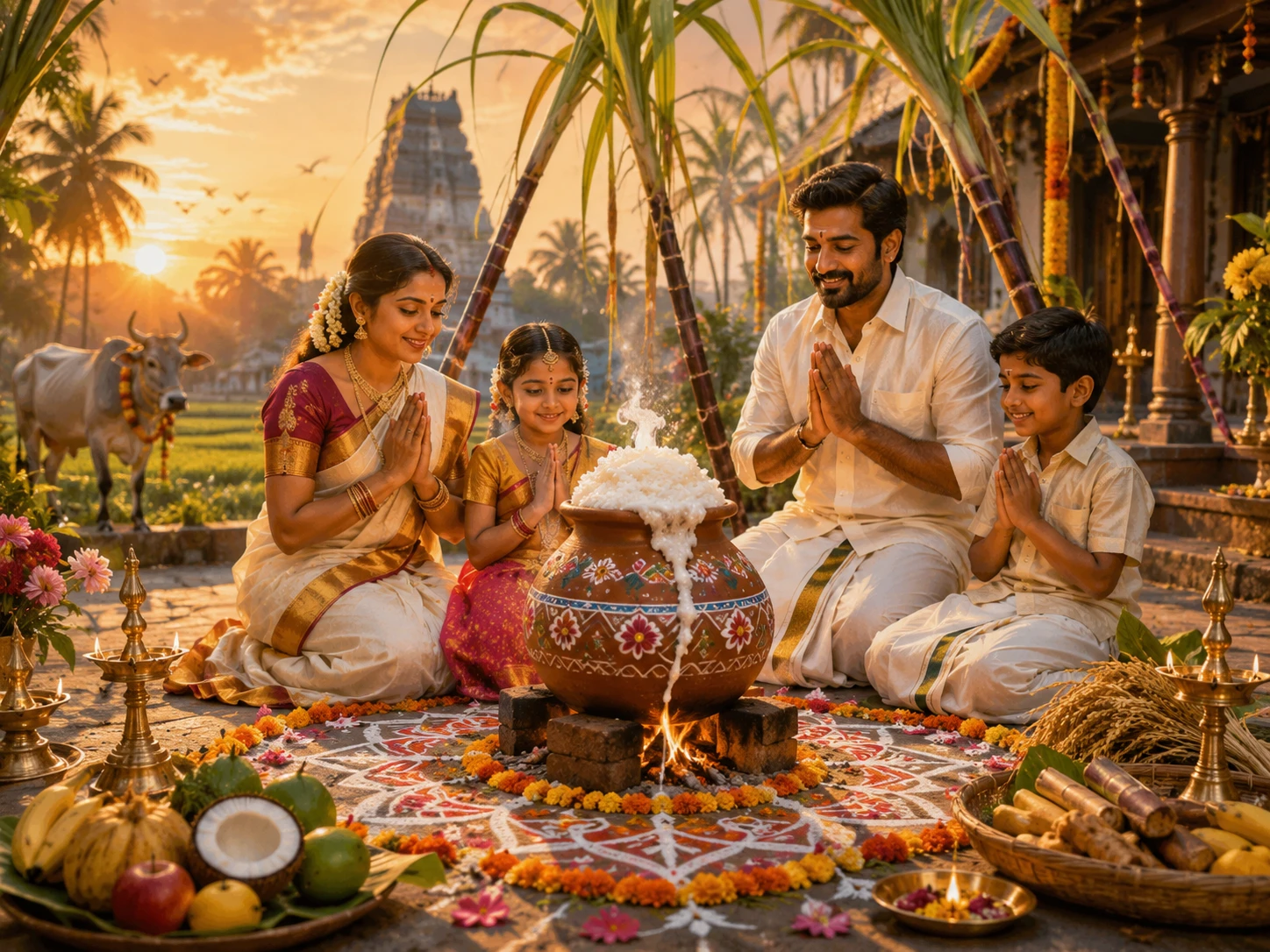
The word 'Pongal' means 'to overflow' or 'to boil over' in Tamil. It refers to the central ritual: cooking newly harvested rice in fresh milk in a clay pot over an open fire until the mixture overflows. The overflow is the festival's defining moment -- it symbolises abundance so great that it cannot be contained. When the pot overflows, the family shouts 'Pongal-o-Pongal!' -- a jubilant declaration that this year's harvest is plentiful, that the sun has been generous, and that life is good.
Day 1 -- Bhogi Pongal: The festival begins with a bonfire at dawn. Families discard old, broken, or unused items -- clothes, furniture, utensils -- into the fire. This is a physical decluttering ritual that mirrors the spiritual principle of letting go of the past to make space for the new. Children dance around the fire beating Bhogi Kotthu (the old items). The bonfire is lit with cow dung cakes and wood, producing fragrant smoke that is believed to purify the household.
Day 2 -- Thai Pongal (Surya Pongal): The main day. Women draw elaborate Kolam (geometric designs made with rice flour) at the entrance. The Pongal pot -- a new clay pot adorned with a turmeric plant tied to its neck -- is placed on a freshly built outdoor fire. Rice, milk, jaggery, cardamom, and ghee are cooked together. When the pot overflows, the family celebrates. The Pongal is offered first to Surya (the Sun God) with prayers of gratitude: 'You gave the rain, the earth gave the grain, and together they gave us life.' The Pongal dish is then shared with family, neighbours, and visitors.
Day 3 -- Mattu Pongal: Cattle are honoured. Cows and bulls are bathed, decorated with paint, flower garlands, and bells. Their horns are painted in bright colours. They are fed Pongal before the family eats. In some regions, Jallikattu (bull-embracing/taming sport) is performed -- a controversial but culturally significant tradition that has been practised for over 2,000 years. Mattu Pongal encodes the civilisational acknowledgement that agriculture is not a solo human achievement. Without the animals who plough the fields and provide milk, there is no harvest.
Day 4 -- Kaanum Pongal: A day of recreation and family bonding. Families visit relatives, go on outings to rivers and parks, and young people socialise. Sisters pray for their brothers' well-being (a parallel to Raksha Bandhan in the South). The word 'Kaanum' means 'to see' -- the day is about seeing and being seen, reconnecting with the wider family and community after the intensive agricultural season.
(Thai Pongal follows Tamil Sangam tradition rather than Sanskrit verse tradition)
Thai Pongal's spiritual authority rests not in a single Sanskrit verse but in the Sangam literature tradition -- the oldest extant Tamil literary corpus (3rd century BCE to 3rd century CE) -- which extensively celebrates agriculture, the sun, and the harvest cycle. The festival predates organised Brahminical religion and represents the Dravidian agricultural thanksgiving tradition at its purest.
— Sangam literature tradition (Tamil agricultural thanksgiving)
Pongal -- Four Days at a Glance
| Day | दिन | Name | Theme | Key Activity | Food |
|---|---|---|---|---|---|
| Day 1 | दिन 1 | Bhogi | Discarding the old | Bonfire of unused items at dawn | Seasonal vegetables |
| Day 2 | दिन 2 | Thai Pongal | Thanking the Sun | Overflowing rice-milk pot, Surya puja | Sakkarai Pongal (sweet rice) |
| Day 3 | दिन 3 | Mattu Pongal | Honouring cattle | Bathing and decorating cows/bulls | Ven Pongal (savoury rice) |
| Day 4 | दिन 4 | Kaanum Pongal | Family and recreation | Visiting relatives, outings, socialising | Varied (picnic foods) |
Pongal is Tamil Nadu's official state festival and a public holiday for all four days. It coincides with Makar Sankranti, Lohri, Bihu, and Uttarayan -- all harvest/sun festivals marking the same astronomical event (sun's entry into Capricorn) across different Indian regions.
Jallikattu, the bull-taming sport performed during Mattu Pongal, is one of the oldest continuously practised sports in the world. Archaeological evidence from the Indus Valley Civilisation (seals depicting bull-leaping, ~2500 BCE) and Sangam literature references (Mullai Pattu) suggest the practice is at least 4,000 years old. After a Supreme Court ban in 2014 (on animal welfare grounds) and massive public protests in 2017 (the Marina Beach protests in Chennai drew millions), the Tamil Nadu government passed a special ordinance exempting Jallikattu from the ban. The sport is now protected under Tamil Nadu's cultural heritage laws and has become a symbol of Tamil cultural identity and resistance to perceived cultural homogenisation.
Cook Pongal and Offer to the Sun
On the next Thai Pongal (or any morning you wish to honour the sun), cook rice with milk, jaggery and cardamom in a pot and let it overflow. Offer the first serving to Surya facing east, then share with family, and chant 'Om Suryaya Namah' twelve times. The simplest thanksgiving: cooking what the earth gave and offering it back to the sky. The Aditya Hridayam, a longer hymn to the sun, is on Eternal Raga with its meaning.
Eternal Raga · शाश्वत राग
Institutional voice — scholarly articles on Sanatan Dharma
Deepen Your Understanding
अपनी समझ और गहरी करें
rituals traditions
Makar Sankranti -- The Only Hindu Festival Tied to the Sun, Not the Moon
Almost every Hindu festival follows the lunar calendar. Makar Sankranti is the exception. It falls on a fixed solar date -- January 14 (or 15) -- when the sun crosses from Sagittarius (Dhanu) into Capricorn (Makara), marking the beginning of Uttarayana, the northern journey of the sun. This astronomical event triggers the most geographically diverse celebration in India: Pongal in Tamil Nadu, Lohri in Punjab, Bihu in Assam, Uttarayan in Gujarat, and Til-Gul in Maharashtra -- all on the same day, all celebrating the same sun, all in completely different ways.
rituals traditions
Chhath Puja -- The Only Hindu Festival Where You Worship the Setting Sun
Most Hindu worship faces east -- toward the rising sun, toward beginnings. Chhath Puja faces west -- toward the setting sun, toward endings, toward the courage to honour what is departing. Standing waist-deep in a river or pond at sunset and again at sunrise, offering Arghya (water oblation) to Surya with bare hands while chanting Vedic hymns -- this is the most physically demanding, most ecologically pure, and most egalitarian festival in the Hindu calendar. No priest. No temple. No idol. Just you, the water, and the sun.
rituals traditions
Vrata -- What a Hindu Vow Really Means (It Is Not Just Fasting)
Your mother kept Karva Chauth without water for sixteen hours. Your grandmother observed Ekadashi every fortnight without fail. Your colleague skips lunch on Tuesdays 'for Hanuman.' The world sees Hindu fasting as dietary restriction. The tradition sees it as something far more radical: Vrata is a voluntary, time-bound act of self-imposed discipline that rewires the relationship between desire and willpower. Fasting is the most visible expression. But the real Vrata happens inside.
rituals traditions
Annadana -- Why Feeding Is the Highest Form of Charity in Hindu Tradition
The Taittiriya Upanishad declares: 'Do not turn away anyone who comes for food.' The Mahabharata ranks Annadana above all other forms of giving. The Sikh Langar feeds 100,000 people daily at the Golden Temple alone. The Akshaya Patra Foundation, inspired by ISKCON, serves mid-day meals to 2 million schoolchildren every day. In a civilisation that equates food with Brahman (Annam Brahma), feeding another person is not charity -- it is worship.
deities avatars
Surya -- The Sun God Who Drives a Seven-Horse Chariot Across the Sky Every Day
He is the most visible god in Hinduism -- you can see him every morning. The Gayatri Mantra, the most sacred verse in the Vedas, is addressed to him. The Konark Sun Temple is shaped like his chariot. And every time you do Surya Namaskar in your yoga class, you are performing a 3,000-year-old sun worship ritual. Surya is the deity hiding in plain sight.
rituals traditions
Naivedya and Prasada -- Why Hindus Feed God Before They Eat
You cook food. You place it before the deity. You wait. The food has not physically changed -- same molecules, same temperature, same taste. And yet the tradition insists that something fundamental has transformed. What went in as Naivedya (offering) comes out as Prasada (grace). This transformation is not chemistry. It is theology -- and it may be the most quietly radical idea in all of Hindu practice.
rituals traditions
Vijayadashami / Dussehra -- The Day India Celebrates Victory (But Whose Victory Depends on Where You Are)
In Delhi, a 100-foot Ravana effigy burns while lakhs cheer. In Kolkata, Durga is immersed in the Hooghly while millions weep. In Mysuru, a golden howdah procession moves through illuminated streets. In Tamil Nadu, tools and books are worshipped. Same day, same Tithi, four completely different festivals -- all called Vijayadashami. This is not inconsistency. It is the genius of a civilisation that encodes a single principle (victory of dharma over adharma) in multiple regional languages of celebration.
Jallikattu, the bull-taming sport performed during Mattu Pongal, is one of the oldest continuously practised sports in the world. Archaeological evidence from the Indus Valley Civilisation (seals depicting bull-leaping, …
More in Rituals & Traditions
Aarti -- Why Hindus Circle Light Before God
13 min read
Abhisheka -- Why Hindus Bathe Their Gods
10 min read
Akshaya Tritiya -- The Day Nothing Given Away Runs Out
12 min readThe same translation error that turned '33 Koti' into '33 crore' in Hinduism also happened in Buddhism. The Chinese translation of Buddhist texts rendered 'Sapta Koti Buddha' (7 Supreme Buddhas) as '7 Crore Buddhas.' The…
Deities AvatarsCommunity Reflections
🕉️
Be the first to share your reflection.