Vijayadashami / Dussehra -- The Day India Celebrates Victory (But Whose Victory Depends on Where You Are)
विजयादशमी / दशहरा -- भारत जिस दिन विजय मनाता है (पर किसकी विजय ये इस पर निर्भर कि तुम कहाँ हो)
Vijayadashami falls on the tenth day (Dashami) of the bright half (Shukla Paksha) of the month of Ashvina (September-October) -- the day after Maha Navami, the climax of Navaratri. The word means 'the victorious tenth' -- Vijaya (victory) + Dashami (tenth). But what victory it celebrates depends entirely on which part of India you are standing in.
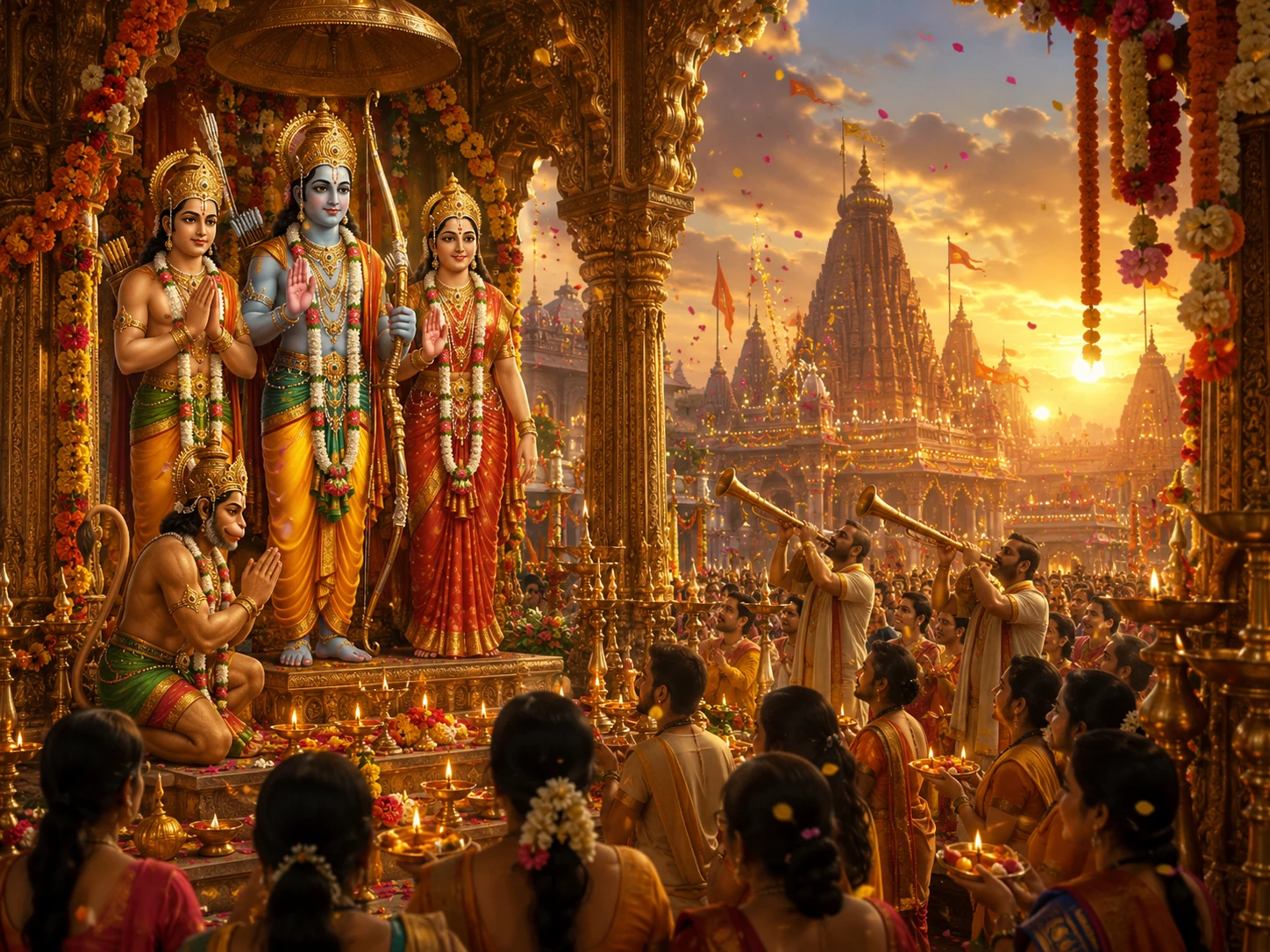
In the Hindi heartland -- Delhi, UP, Bihar, Madhya Pradesh, Rajasthan -- Dussehra is Ravana Dahan. Giant effigies of Ravana, Meghnada, and Kumbhkarna are stuffed with firecrackers and set ablaze in grounds across the country. The burning symbolises Rama's victory over Ravana -- the triumph of dharma over adharma, good over evil, restraint over excess. The ten-day Ramlila performances (dramatisations of the Ramayana) that precede Dussehra are among India's most beloved folk theatre traditions. The Ramlila of Ramnagar (Varanasi), patronised by the Maharaja of Kashi, is a UNESCO Intangible Cultural Heritage and has been performed continuously for over 200 years.
In Bengal, Odisha, Assam, and Jharkhand, Vijayadashami is the culminating day of Durga Puja. This is not about Rama at all. It is about Devi -- the goddess who battled the buffalo demon Mahishasura for nine nights and slew him on the tenth day. Vijayadashami is the day of Durga's Visarjan (immersion) -- the clay idol, crafted and worshipped for five days, is carried in procession to the river and immersed. This moment is simultaneously celebratory and heartbreaking. Bengali families touch Ma Durga's feet, apply sindoor to each other (Sindoor Khela), and weep openly as the idol enters the water. The goddess has gone home to Kailash, and the mortal world feels her absence.
In Karnataka, Vijayadashami is Mysuru Dasara -- one of India's grandest state festivals. The Mysuru Palace is illuminated with nearly 100,000 light bulbs. A golden howdah (ceremonial seat) carrying an idol of Goddess Chamundeshwari is paraded through the city atop a decorated elephant. The tradition dates back to the Vijayanagara Empire (14th century) and has been maintained by the Wodeyar dynasty.
In Tamil Nadu, Andhra Pradesh, and Kerala, the day is Ayudha Puja and Vidyarambham. Tools, instruments, vehicles, and books are worshipped. Factories in Chennai shut down for the day while workers clean and worship their machines. Schools begin new children's education (Vidyarambham) -- toddlers write their first letter in rice grains spread on a plate, guided by a teacher's hand. This is one of the most beautiful rituals in Indian education: the first encounter with knowledge, performed on the day of victory, encoding the message that true victory is the victory of learning.
या देवी सर्वभूतेषु शक्तिरूपेण संस्थिता। नमस्तस्यै नमस्तस्यै नमस्तस्यै नमो नमः॥
yā devī sarvabhūteṣu śakti-rūpeṇa saṁsthitā namastasyai namastasyai namastasyai namo namaḥ
To that Devi who abides in all beings as power (Shakti) -- salutations to Her, salutations to Her, salutations to Her, again and again.
— Devi Mahatmyam (Durga Saptashati) 5.18
One Day, Four Festivals -- Vijayadashami Across India
| Region | क्षेत्र | Festival Name | Victory Celebrated | Key Ritual |
|---|---|---|---|---|
| North India (Delhi, UP, Bihar) | उत्तर भारत | Dussehra / Ravana Dahan | Rama's victory over Ravana | Burning of Ravana effigy after 10-day Ramlila |
| Bengal, Odisha, Assam | बंगाल, ओडिशा, असम | Bijoya Dashami (Durga Puja) | Durga's victory over Mahishasura | Durga Visarjan, Sindoor Khela, weeping farewell |
| Karnataka (Mysuru) | कर्नाटक (मैसूरु) | Mysuru Dasara | Chamundeshwari's victory over Mahishasura | Golden Howdah procession, Jamboo Savari |
| Tamil Nadu, Kerala, AP | तमिलनाडु, केरल, AP | Ayudha Puja / Vidyarambham | Victory of knowledge and skill | Worship of tools, books, machines; children begin learning |
| Gujarat | गुजरात | Dussehra + Garba finale | Devi's nine-night victory | Final Garba night, Fafda-Jalebi tradition |
| Maharashtra | महाराष्ट्र | Dussehra / Apta Puja | Exchange of apta leaves (gold) | Apta leaf exchange symbolising prosperity, Shami Puja |
The Ashoka tree (Apta/Shami) connection: in the Mahabharata, the Pandavas hid their weapons in a Shami tree during their year of disguise. Retrieving them on Vijayadashami symbolised the victory of preparedness. This is why Shami Puja is performed on this day in Maharashtra and Karnataka.
Ramlila -- India's Greatest Living Theatre
The ten-day Ramlila performances that precede Dussehra in North India constitute one of the world's oldest and most widely performed theatrical traditions. From Delhi's iconic Red Fort Ramlila (where the Prime Minister traditionally attends the Ravana Dahan) to village performances in the smallest towns of UP and Bihar, the Ramlila transforms the Ramayana from text into living experience.
The Ramnagar Ramlila near Varanasi, performed continuously since 1830 under the patronage of the Kashi Naresh, is the most celebrated. Unlike stage-bound theatre, the Ramnagar Ramlila is environmental -- it uses the entire town as its stage. Audiences walk with the performers from location to location: Lanka is enacted in one part of town, Ayodhya in another, the forest in an actual wooded area. The performance spans 31 days (not just the standard 10) and follows the Ramcharitmanas text of Tulsidas. UNESCO inscribed it on the Representative List of Intangible Cultural Heritage of Humanity in 2008.
The Delhi Ramlila grounds -- particularly the ones at Red Fort, Dwarka, and Lav Kush -- attract millions of spectators over the ten days. The actors playing Rama, Sita, and Hanuman are treated with near-divine reverence during the performance period. In many traditions, the boy playing Rama is considered temporarily possessed by the deity's spirit and is worshipped by audience members during the performance.
For the GenZ audience that has never attended a Ramlila: imagine an open-air immersive theatre experience lasting ten evenings, with live music, pyrotechnics, audience participation, and a narrative arc that builds to the most spectacular bonfire you have ever seen. It is Burning Man meets Shakespeare meets Bollywood -- except it has been running for centuries, costs nothing to attend, and carries the accumulated devotional energy of a billion people's faith. There is nothing like it anywhere else in the world.
Ayudha Puja and Vidyarambham -- The South Indian Genius
While North India burns Ravana and Bengal immerses Durga, South India does something entirely different on Vijayadashami -- and arguably more philosophically profound. It worships the tools of daily life.
Ayudha Puja (literally 'worship of weapons/instruments') extends the concept of 'weapon' to include every instrument of livelihood and learning. Carpenters worship their saws. Farmers worship their ploughs. Drivers worship their vehicles (decorated with flowers and kumkum, the dashboards of autorickshaws and trucks across Tamil Nadu become miniature mandirs). Musicians worship their instruments. Students worship their textbooks. Software engineers in Bangalore have been known to perform Puja to their laptops -- a practice that would make perfect sense to the tradition, since the laptop is the modern equivalent of the artisan's chisel.
The theological basis is the Devi Mahatmyam's vision of Shakti as present in every instrument of action. The saw that cuts wood, the pen that writes code, the scalpel that heals -- all are expressions of Devi's power channelled through human skill. Worshipping the tool is acknowledging that your competence is not yours alone. It is a partnership between your effort and the divine energy that flows through the instrument.
Vidyarambham (beginning of learning) is the most emotionally charged ritual of the day. Small children, typically three to five years old, are taken to a temple or to a teacher. The child sits on the guru's lap. The guru holds the child's hand and guides it to write the first letter -- usually 'Om' or 'Hari Sri' -- in a plate of rice grains or on the child's tongue with a gold ring. This first encounter with writing is treated as a sacred moment: the child's journey from ignorance to knowledge begins on the day of cosmic victory.
In Kerala, Vidyarambham at the Thunchan Parambu in Tirur (the birthplace of Thunchaththu Ezhuthachan, father of Malayalam literature) draws thousands of children every year. In Tamil Nadu, the Kanchi Kamakshi temple is a popular destination. The tradition encodes a civilisational value: knowledge is the highest form of victory, and the day dharma triumphs over adharma is the perfect day to begin learning.
For the parent in Bangalore wondering when to introduce formal learning to a toddler: Vijayadashami is the traditional answer. And the ritual of writing the first letter in rice is not mere ceremony. It creates a powerful associative memory in the child's mind: my first act of writing happened in a sacred space, guided by a guru, on a day of victory. That association between learning and sanctity, once planted, lasts a lifetime.
The Mysuru Dasara, celebrated continuously since the Vijayanagara Empire (14th century), is Karnataka's official state festival. The Mysuru Palace is illuminated with 97,000+ light bulbs for the ten-day celebration. The Jamboo Savari (golden howdah procession) on Vijayadashami features a 750-kg gold howdah atop a decorated elephant carrying the idol of Goddess Chamundeshwari through a 5-km route. The festival generates an estimated Rs 2,000+ crore economic impact for Mysuru's tourism and hospitality sectors. In 2024, the Karnataka government allocated Rs 50 crore specifically for Dasara celebrations -- making it one of the most heavily state-funded religious festivals in India.
The Philosophical Core -- What Victory Actually Means
Beneath the regional diversity of celebration lies a single philosophical principle that the tradition considers universal: the victory of dharma over adharma is not a one-time historical event. It is a daily, ongoing, internal battle that every human being fights.
The Ravana who burns in Delhi is not just the ten-headed king of Lanka. He is the ten-headed symbol of the ten senses (five Jnana Indriyas + five Karma Indriyas) that, when uncontrolled, lead to destruction. Each of Ravana's heads represents a vice: Kama (lust), Krodha (anger), Moha (delusion), Lobha (greed), Mada (pride), Matsarya (jealousy), Swartha (selfishness), Anyaya (injustice), Amanavta (cruelty), and Ahankara (ego). Burning the effigy is a collective declaration: we choose to burn these within ourselves.
The Durga who defeats Mahishasura in Bengal represents the same principle in Shakta theology. Mahishasura is not merely a buffalo demon -- he is the tamasic force of inertia, ignorance, and brute resistance to change. Durga's nine-night battle represents the sustained effort required to overcome deeply entrenched patterns of darkness. Victory does not come on night one. It requires nine nights of relentless combat -- and even then, the victory on the tenth day is not permanent. Next year, the same battle must be fought again. This is not a flaw in the narrative. It is the deepest truth of the spiritual life: the battle against inner darkness is never permanently won. It must be fought every day, every season, every year.
For the corporate professional dealing with office politics, the JEE aspirant battling self-doubt, the startup founder navigating ethical dilemmas: Vijayadashami is not a holiday from work. It is a reminder that the real work -- the inner battle against the forces that pull you away from your dharma -- never stops. The external celebrations are beautiful. But the internal Vijayadashami, where you confront your own Ravana and choose dharma over convenience, is the one that matters.
The tradition makes this explicit: Vijayadashami is considered the most auspicious day to begin new ventures, new studies, new practices. Not because the day is magically lucky, but because the energy of collective victory -- millions of people simultaneously choosing good over evil -- creates a civilisational momentum that amplifies individual intention. Starting something on Vijayadashami is like launching a boat into a river that is already flowing in your direction.
Begin Something New on Vijayadashami
Vijayadashami is the most auspicious day to begin any new learning. Place your phone, laptop or any instrument of your work before your deity, apply kumkum, and perform a brief Ayudha Puja. Then begin learning a stotram or mantra you have never chanted before, with 108 repetitions on a mala. Eternal Raga's mantra library has hundreds to choose from, each with its meaning. Victory begins with the first step.
Eternal Raga · शाश्वत राग
Institutional voice — scholarly articles on Sanatan Dharma
Deepen Your Understanding
अपनी समझ और गहरी करें
rituals traditions
Navratri -- Nine Nights That Transform India
For nine nights, India becomes a different country. In Gujarat, millions dance garba till dawn. In Bengal, the streets turn into open-air art galleries. In Varanasi, nine temples light up in sequence. In Mysore, the palace blazes with 100,000 bulbs. Navratri is not a single festival -- it is nine nights of goddess worship that unite India's most diverse traditions into one cosmic celebration.
rituals traditions
Durga Puja -- The Ritual System Behind the World's Largest Art Festival
Behind the spectacular pandals and the Instagram-worthy lighting lies a ritual system of extraordinary precision. From the moment the sculptor draws the first line on Mahalaya to the heartbreaking immersion on Dashami, every step of Durga Puja follows a choreography that is part Vedic ritual, part Tantric sadhana, and part Bengali genius. UNESCO recognised it in 2021. Here is what they recognised.
rituals traditions
Diwali -- Five Days of Light
Diwali is not one night of firecrackers. It is a five-day arc from Dhanteras to Bhai Dooj, layering wealth, ancestors, Lakshmi, community, and sibling bonds into a single liturgical sequence. Its origins span Rama's return, Krishna's Narakasura victory, Jain Mahavira's nirvana, and Sikh Bandi Chhor Divas -- making it the most theologically layered festival in the Indian calendar.
deities avatars
Dashavatara -- Why Vishnu Comes Back Ten Times
Fish, tortoise, boar, half-lion, dwarf, axe-warrior, prince, cowherd, enlightened teacher, future horseman. The ten avatars of Vishnu are not random folklore. Read them in sequence and you get something startling -- a narrative that mirrors evolutionary biology, tracks the rise and fall of political systems, and argues that God does not sit above history but enters it, gets dirty, and does the work. The Dashavatara is Hinduism's answer to the question every civilisation asks: why does the world keep breaking, and who fixes it?
rituals traditions
Rama Navami -- The Birth of the Man Who Became God's Gold Standard
On the ninth day of Chaitra Shukla, at the Abhijit Muhurta of high noon, in the Punarvasu Nakshatra, in the city of Ayodhya, in the Treta Yuga -- Vishnu incarnated as Rama. Not as a god performing miracles but as a man navigating impossible moral choices. Rama Navami celebrates not just a divine birth but the arrival of Maryada Purushottam -- the supreme person of propriety -- whose life became the civilisational template for dharmic conduct in a world where every right choice costs something.
rituals traditions
Holi and Holika Dahan -- The Night a Child's Faith Burned an Empire
Before the colours fly, the fire burns. The night before Holi, India lights bonfires to commemorate the moment a five-year-old boy named Prahlad sat in flames and survived because he chanted Vishnu's name -- while the demoness Holika, who was supposed to be fire-proof, burned to ash. The story comes from the Bhagavata Purana, Seventh Canto, and it is one of Hinduism's most powerful narratives about the cost of faith and the fragility of power.
rituals traditions
Muhurta -- Why Hindus Obsess Over the Right Moment
Your grandmother checked the panchang before scheduling your mundan. Your parents consulted an astrologer before fixing your wedding date. Your colleague will not sign a business contract without checking the Choghadiya. The Hindu tradition divides every 24-hour day into 30 Muhurtas of 48 minutes each -- some auspicious, some neutral, some to be avoided -- and this time-quality framework has governed Indian life from Vedic fire rituals to modern real estate transactions.
The Mysuru Dasara, celebrated continuously since the Vijayanagara Empire (14th century), is Karnataka's official state festival. The Mysuru Palace is illuminated with 97,000+ light bulbs for the ten-day celebration. The …
More in Rituals & Traditions
Aarti -- Why Hindus Circle Light Before God
13 min read
Abhisheka -- Why Hindus Bathe Their Gods
10 min read
Akshaya Tritiya -- The Day Nothing Given Away Runs Out
12 min readThe same translation error that turned '33 Koti' into '33 crore' in Hinduism also happened in Buddhism. The Chinese translation of Buddhist texts rendered 'Sapta Koti Buddha' (7 Supreme Buddhas) as '7 Crore Buddhas.' The…
Deities AvatarsCommunity Reflections
🕉️
Be the first to share your reflection.