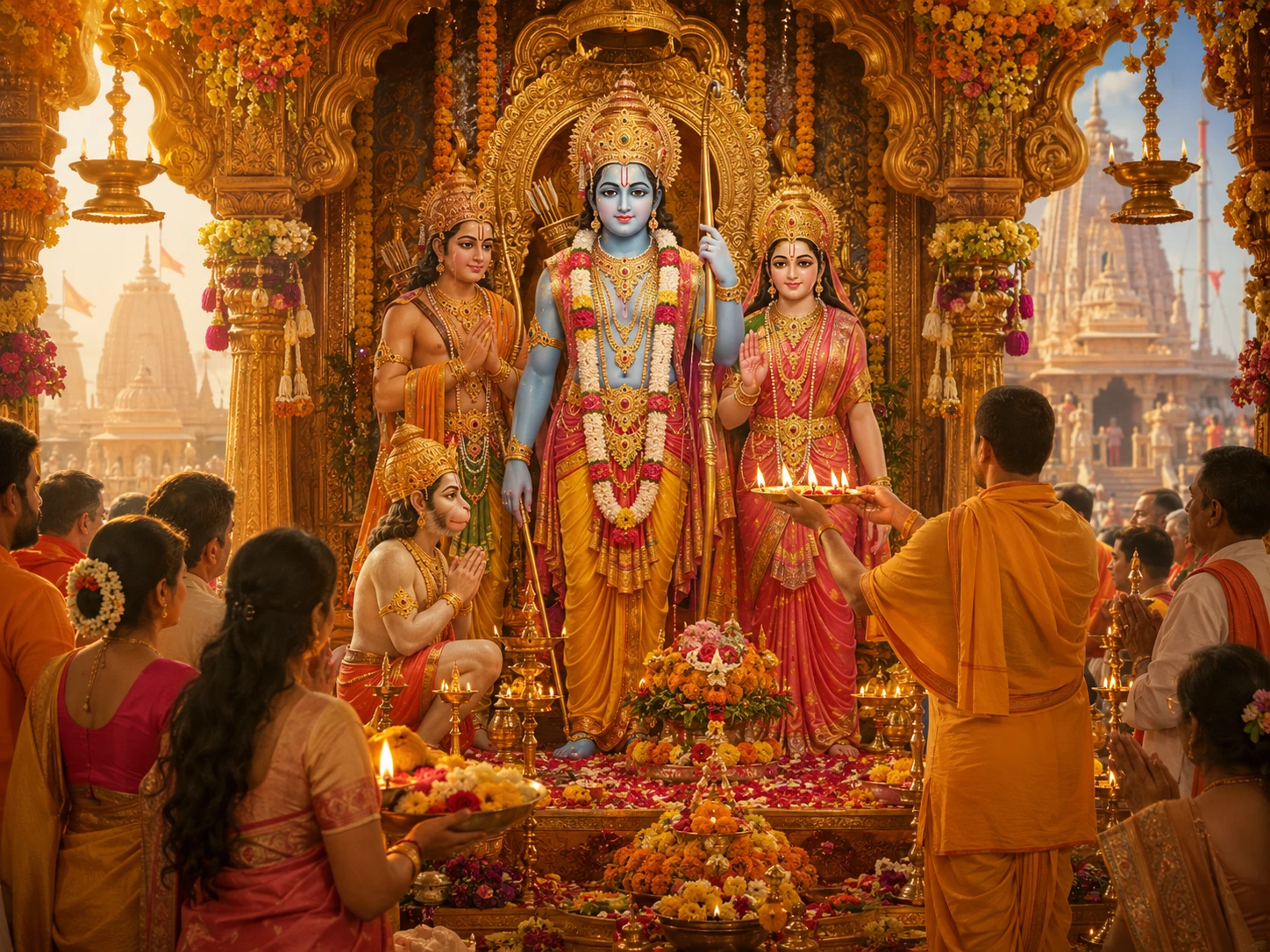
Rama Navami -- The Birth of the Man Who Became God's Gold Standard
राम नवमी -- उस मनुष्य का जन्म जो ईश्वर का स्वर्ण मानक बना
Every year in Chaitra (March-April), India erupts in celebration of the most beloved figure in Hindu civilisation. In Ayodhya, the celebrations last days -- processions with Ram-Sita jhankis (tableaux), Vedic chanting at the Ram Janmabhoomi temple, and the dramatic midday moment when the temple recreates the birth scene at the exact Muhurta of Rama's arrival. In South India, Rama Navami is celebrated with Panaka (a drink of jaggery and pepper) distributed to thousands. In Maharashtra, processions carry the Rama Parivar through the streets. In ISKCON temples worldwide, elaborate Abhisheka of baby Rama murtis takes place at noon.
Rama was born on the ninth Tithi (Navami) of Chaitra Shukla Paksha, at the Abhijit Muhurta (the victorious midday moment), under the Punarvasu Nakshatra, in the Karkataka (Cancer) Lagna. The Valmiki Ramayana's Bala Kanda describes the cosmic alignment at his birth in remarkable astronomical detail -- five planets were exalted in their own signs, and the conditions were so extraordinarily auspicious that the tradition considers this birth-chart the most perfect in all of Hindu astrology.
But Rama Navami is not merely a birthday party for a god. It is the annual remembrance of why Vishnu chose to be born as a human at all. The Ramayana tradition holds that Vishnu incarnated specifically to demonstrate how a human being should live -- not with supernatural powers (though Rama had them) but with dharmic choice under pressure. Rama is called Maryada Purushottam not because he was the most powerful being in the Treta Yuga (he was, technically, being Vishnu incarnate) but because he voluntarily submitted to every constraint of human duty: son, husband, king, brother, friend, enemy -- and in each role, he chose dharma over convenience, even when dharma demanded the most painful sacrifice imaginable.
This is why Rama's story generates more debate than any other figure in Hinduism. Was he right to exile Sita based on public opinion? Was his treatment of Shambuka justified? Was his adherence to his father's word worth fourteen years in the forest? These questions are not bugs in the story. They are features. The Ramayana is designed to be argued over, because dharma itself is not a formula but a living negotiation between competing obligations.
रामो विग्रहवान् धर्मः साधुः सत्यपराक्रमः। राजा सर्वस्य लोकस्य देवानामिव वासवः॥
rāmo vigrahavān dharmaḥ sādhuḥ satya-parākramaḥ rājā sarvasya lokasya devānām iva vāsavaḥ
Rama is dharma embodied in human form -- virtuous, truthful in his valour. He is the king of all the world, as Indra is king of the gods.
— Valmiki Ramayana, Aranya Kanda 37.13 (Maricha describing Rama)
How Rama Navami Is Celebrated -- North, South, East, West
Rama Navami celebrations vary beautifully across India's regions, each reflecting local culture while centred on the same devotion.
In Ayodhya, the celebrations reached an unprecedented scale after the inauguration of the Ram Janmabhoomi Mandir in January 2024. The Prana Pratishtha of the Ram Lalla murti by Prime Minister Modi made Ayodhya the global epicentre of Rama devotion. During Rama Navami, the temple performs a special Surya Tilak -- where a system of mirrors and lenses directs a beam of sunlight onto the forehead of the Ram Lalla murti at the exact moment of Rama's birth Muhurta, creating a natural Tilak of light. This engineering marvel was designed by CBRI Roorkee and IIT Bombay scientists.
In South India, Rama Navami is a major festival. In Bhadrachalam (Telangana), the Sita-Rama Kalyanam (celestial wedding) is performed with state government sponsorship -- the Governor traditionally presents silk garments for the deities. In Karnataka, Panaka and Kosambari (a lentil salad) are distributed. In Tamil Nadu, the day is observed as Rama's birth with visits to Rama temples.
In Maharashtra, Ram Navami processions through cities like Nagpur, Pune, and Mumbai feature elaborate jhankis (tableaux) of scenes from the Ramayana. In Bihar and UP, the day marks the beginning of the Chaitra Navratri celebrations in many communities.
For the NRI family: a home celebration can include reading the Bala Kanda section describing Rama's birth, performing a midday Abhisheka of a baby Rama murti with Panchamrita, and distributing Panaka to neighbours -- a simple, beautiful way to bring the festival into any home, anywhere in the world.
Rama Navami -- Regional Celebrations
| Region | क्षेत्र | Key Celebration | Special Prasada |
|---|---|---|---|
| Ayodhya, UP | अयोध्या, UP | Surya Tilak, Ram Janmabhoomi grand puja | Laddoo, Panjiri |
| Bhadrachalam, Telangana | भद्राचलम, तेलंगाना | Sita-Rama Kalyanam (celestial wedding) | Panakam, Vada Pappu |
| Karnataka | कर्नाटक | Temple pujas, community distribution | Panaka, Kosambari |
| Maharashtra | महाराष्ट्र | Street processions with Rama jhankis | Sundal, fruit prasad |
| Tamil Nadu | तमिलनाडु | Rama temple visits, Kalyana Utsavam | Panagam, Neer Mor |
| Bihar / Mithila | बिहार / मिथिला | Ram-Sita narrative, Chaitra celebrations | Malpua, Thekua |
| ISKCON (Global) | ISKCON (वैश्विक) | Midday Abhisheka of baby Rama | Panchamrita, fruit |
The Ram Janmabhoomi Temple's Surya Tilak mechanism, operational from 2024, uses a combination of mirrors, lenses, and precise astronomical calculation to create a beam of sunlight on Ram Lalla's forehead at the exact birth Muhurta -- ancient devotion engineered by modern science.
The Surya Tilak mechanism at the Ayodhya Ram Mandir is one of the most remarkable fusions of ancient astronomy and modern engineering in any temple worldwide. Designed by scientists from CBRI Roorkee and IIT Bombay, the system uses a series of precisely angled mirrors and lenses to track the sun's position on Rama Navami and direct a beam of sunlight through an aperture in the temple wall onto the forehead of the Ram Lalla murti at exactly 12:00 noon -- the Abhijit Muhurta of Rama's birth. The system accounts for the annual variation in the sun's position (approximately 0.5 degrees) and is calibrated to work accurately for decades. The entire mechanism is hidden within the temple architecture, invisible to devotees -- they see only the miraculous appearance of a golden tilak of light on their Lord's forehead.
Why Vishnu Chose to Be Born as a Man
The theological question at the heart of Rama Navami is: why did the Supreme Being choose the constraints of human birth?
The Valmiki Ramayana's Bala Kanda provides the narrative answer: the Devas approached Vishnu because the demon king Ravana had obtained a boon from Brahma that made him invulnerable to all beings except humans -- whom Ravana considered too weak to threaten him. Vishnu had to incarnate as a human to exploit this loophole. This is a story about the power of underestimation. Ravana's contempt for humanity was his fatal flaw, and Vishnu used that contempt as the doorway for his incarnation.
But the Ramayana tradition offers a deeper answer. Vishnu did not merely need to be born human to kill Ravana. He needed to live a complete human life -- with all its limitations, losses, and moral agonies -- to demonstrate the full range of dharmic conduct. The Rama Avatar is not a god playing dress-up. It is the divine genuinely experiencing what it means to be human: to love and lose, to rule and sacrifice, to fight and forgive, to be wronged and still choose dharma.
This is what makes Rama different from every other Avatar. Krishna is Lila Purushottam -- the supreme person of divine play, who acts with a twinkle in his eye, bending rules, dancing with gopis, and orchestrating cosmic drama with detached amusement. Rama is Maryada Purushottam -- the supreme person of propriety, who follows every rule, bears every burden, and pays the full price of every dharmic choice. Krishna shows you what God looks like when he is enjoying himself. Rama shows you what God looks like when he is suffering -- and still doing the right thing.
For the IIT student who has been told that Rama is 'just a mythological character': the Ramayana is not asking you to believe in flying monkeys and ten-headed demons. It is asking you to consider a model of human conduct where every decision is made not on the basis of personal happiness but on the basis of what is right -- even when what is right destroys your personal happiness. Whether Rama was historical or literary, the ethical framework he embodies is real, demanding, and transformative. That framework is what Rama Navami celebrates.
For the parent in Bangalore trying to explain Rama to a child who has grown up on Marvel movies: Rama is not a superhero. He does not punch his way out of problems. He suffers his way through them. And that is precisely what makes him extraordinary -- not power without consequence, but duty with maximum consequence. Tony Stark sacrifices himself once, dramatically. Rama sacrifices himself quietly, every single day, for fourteen years in the forest and decades on the throne. That sustained, unglamorous, daily sacrifice is harder than any single heroic moment -- and it is the real lesson of Rama's life.
Rama Navami Puja at Home -- A Step-by-Step Guide
Celebrating Rama Navami at home does not require elaborate preparation. Here is a practical guide that any family can follow:
Preparation (morning): Clean the puja space. Place an image or murti of Rama (ideally the Rama Parivar -- Rama, Sita, Lakshmana, and Hanuman). Decorate with flowers and mango leaves. Light a ghee diya.
Morning Puja: Perform a simple Panchopachara Puja to Rama with gandha (sandalwood/kumkum), pushpa (flowers -- yellow and orange preferred), dhupa (incense), dipa (ghee lamp), and naivedya (fruits, Panaka, and sweets). Chant 'Sri Ram Jai Ram Jai Jai Ram' 108 times or recite the Vishnu Sahasranama.
Midday Celebration (Abhijit Muhurta, approximately noon): This is the most auspicious moment -- the time of Rama's birth. If you have a baby Rama murti, perform a small Abhisheka with Panchamrita (milk, curd, honey, ghee, sugar water). Rock the murti in a small cradle (Jhoola) if available -- this recreates the birth scene. Read aloud the Bala Kanda section describing Rama's birth (Valmiki Ramayana, Sarga 18). The entire family can participate.
Panaka Distribution: Prepare Panaka (also called Panakam in South India) -- a traditional drink made by dissolving jaggery in water, adding ground black pepper, cardamom powder, and a squeeze of lemon. This cooling, energising drink is the signature Prasada of Rama Navami and is distributed to neighbours and visitors. The recipe is simple, the taste is memorable, and the act of sharing it embodies the generosity that Rama's life represents.
Evening: Read or narrate a chapter from the Ramayana to the family. The Sundara Kanda (Hanuman's journey to Lanka) is particularly popular for reading on Rama Navami. Conclude with aarti and distribution of Prasada.
For the NRI family: Panaka ingredients (jaggery, pepper, cardamom) are available in any Indian grocery store worldwide. The recipe takes five minutes. Sharing it with non-Indian neighbours is a beautiful way to introduce Rama's story across cultures -- everyone loves a good drink with a good story behind it.
The Ramayana Ecosystem -- Why Rama Navami Is India's Most Personal Festival
Rama Navami is unique among Hindu festivals because it celebrates not a cosmic event (like Diwali's return from exile or Holi's destruction of Holika) but a birth -- the most intimate of human events. And because Rama is the most relatable deity in the Hindu pantheon -- a man who experienced every human emotion -- the celebration takes on a deeply personal quality.
The Ramayana is not one text. It is an ecosystem. Valmiki's Sanskrit original (estimated 5th-4th century BCE) is the Adi Kavya, the 'first poem.' But the Rama story has been retold in virtually every Indian language: Kamban's Tamil Ramavataram (12th century), Tulsidas's Awadhi Ramcharitmanas (16th century), Krittibas Ojha's Bengali Krittivasi Ramayan (15th century), Ezhuthachan's Malayalam Adhyatma Ramayanam (16th century), and dozens more. Each retelling adapts the story to its language, region, and cultural moment while preserving the core narrative arc.
This multiplicity means that Rama Navami is not a monolithic celebration. The Tamil family celebrates Kamban's Rama. The Hindi-speaking family celebrates Tulsidas's Ram. The Bengali family celebrates Krittibas's Rama. The Maharashtrian family celebrates Samarth Ramdas's vision of Rama. Each is the same Rama and yet culturally distinct -- a testament to the tradition's capacity for unity in diversity.
The Ram Katha tradition -- public recitation of the Ramayana by a Kathavachak (storyteller) over nine days during Rama Navami -- is one of India's most enduring performance art forms. Morari Bapu's Ram Kathas draw audiences of hundreds of thousands and are broadcast on television. In smaller towns across UP, Bihar, and Madhya Pradesh, local Kathavachaks perform the Ram Katha in temples, community halls, and even open fields. For nine evenings, the entire town gathers to hear the same story they have heard every year -- and somehow, it is always fresh, because the Ramayana is designed to be experienced, not merely known.
For the young Indian who thinks they 'already know' the Ramayana: attend one evening of a Ram Katha by a skilled Kathavachak. The experience is unlike reading the text. The Kathavachak weaves contemporary references, emotional crescendos, humor, and devotional intensity into the ancient narrative in a way that makes you hear the story as if for the first time. The Ramayana is not a book to be finished. It is a river to be entered. And Rama Navami is the day the tradition invites you to step in.
Chant the Rama Mantra on Rama Navami
On the next Rama Navami, chant 'Sri Ram Jai Ram Jai Jai Ram' 108 times on a mala at midday -- the Abhijit muhurta of Rama's birth. Read the birth sarga of the Bala Kanda aloud to your family, and share panaka (jaggery, pepper and water) with your neighbours. The mantra's page on Eternal Raga gives its meaning, and the Valmiki Ramayana is on the site too.
Tags
Eternal Raga · शाश्वत राग
Institutional voice — scholarly articles on Sanatan Dharma
Deepen Your Understanding
अपनी समझ और गहरी करें
deities avatars
Dashavatara -- Why Vishnu Comes Back Ten Times
Fish, tortoise, boar, half-lion, dwarf, axe-warrior, prince, cowherd, enlightened teacher, future horseman. The ten avatars of Vishnu are not random folklore. Read them in sequence and you get something startling -- a narrative that mirrors evolutionary biology, tracks the rise and fall of political systems, and argues that God does not sit above history but enters it, gets dirty, and does the work. The Dashavatara is Hinduism's answer to the question every civilisation asks: why does the world keep breaking, and who fixes it?
rituals traditions
Vijayadashami / Dussehra -- The Day India Celebrates Victory (But Whose Victory Depends on Where You Are)
In Delhi, a 100-foot Ravana effigy burns while lakhs cheer. In Kolkata, Durga is immersed in the Hooghly while millions weep. In Mysuru, a golden howdah procession moves through illuminated streets. In Tamil Nadu, tools and books are worshipped. Same day, same Tithi, four completely different festivals -- all called Vijayadashami. This is not inconsistency. It is the genius of a civilisation that encodes a single principle (victory of dharma over adharma) in multiple regional languages of celebration.
rituals traditions
Diwali -- Five Days of Light
Diwali is not one night of firecrackers. It is a five-day arc from Dhanteras to Bhai Dooj, layering wealth, ancestors, Lakshmi, community, and sibling bonds into a single liturgical sequence. Its origins span Rama's return, Krishna's Narakasura victory, Jain Mahavira's nirvana, and Sikh Bandi Chhor Divas -- making it the most theologically layered festival in the Indian calendar.
rituals traditions
The 16 Samskaras -- Rites of Passage from Womb to Pyre
Hinduism does not leave life to chance. From the moment a couple decides to conceive to the moment the body returns to the five elements, there are sixteen rituals -- samskaras -- designed to refine the human being at every critical transition. Think of them as firmware updates for the soul, installed at precisely the right moments.
rituals traditions
Muhurta -- Why Hindus Obsess Over the Right Moment
Your grandmother checked the panchang before scheduling your mundan. Your parents consulted an astrologer before fixing your wedding date. Your colleague will not sign a business contract without checking the Choghadiya. The Hindu tradition divides every 24-hour day into 30 Muhurtas of 48 minutes each -- some auspicious, some neutral, some to be avoided -- and this time-quality framework has governed Indian life from Vedic fire rituals to modern real estate transactions.
rituals traditions
Sankalpa -- The Ritual GPS That Locates You in the Cosmos Before Every Puja
Before any Hindu ritual begins, there is a quiet declaration that most people rush through without understanding. It names the current cosmic age, the ruling Manu, the Yuga, the year, the season, the month, the fortnight, the day, the star, the continent, the country, the river, your name, your lineage, and your exact intention. This declaration -- Sankalpa -- is the most sophisticated geo-temporal tagging system in any religious tradition. It tells the universe: I am here, I am this person, and I intend to do this specific act.
rituals traditions
Havan Vidhi -- The Vedic Fire Ritual That Purifies Air, Mind, and Karma
Every major Hindu milestone -- birth, thread ceremony, wedding, housewarming, death -- involves fire. The havan is the oldest continuous ritual technology in Hinduism, dating to the Rig Veda. You pour ghee, herbs, and grains into a consecrated fire while chanting 'Svaha,' and Agni carries your offering to the gods. Modern science confirms: the smoke actually does purify the air. Here is the complete procedure.
The Surya Tilak mechanism at the Ayodhya Ram Mandir is one of the most remarkable fusions of ancient astronomy and modern engineering in any temple worldwide. Designed by scientists from CBRI Roorkee and IIT Bombay, the …
More in Rituals & Traditions
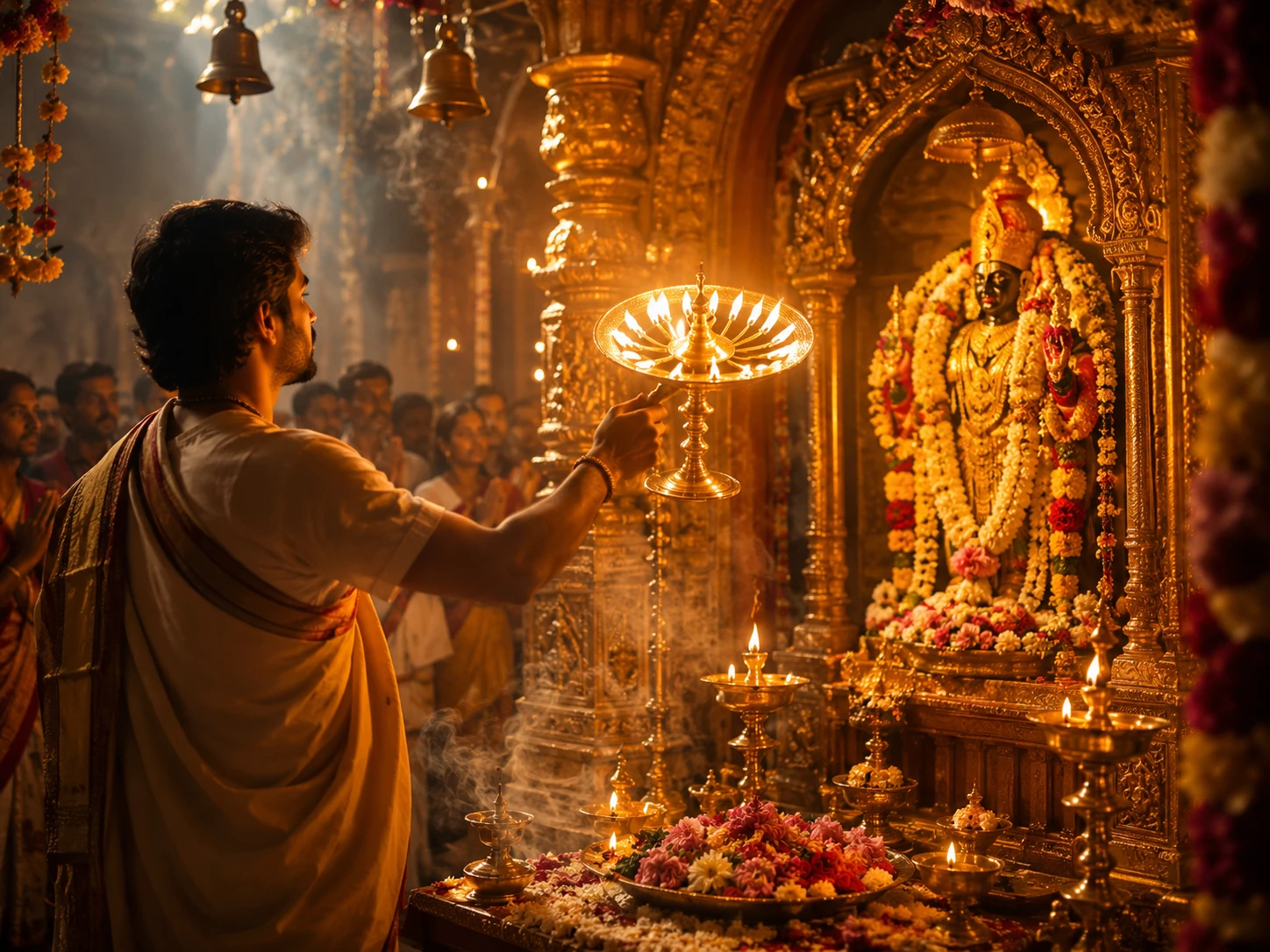
Aarti -- Why Hindus Circle Light Before God
13 min read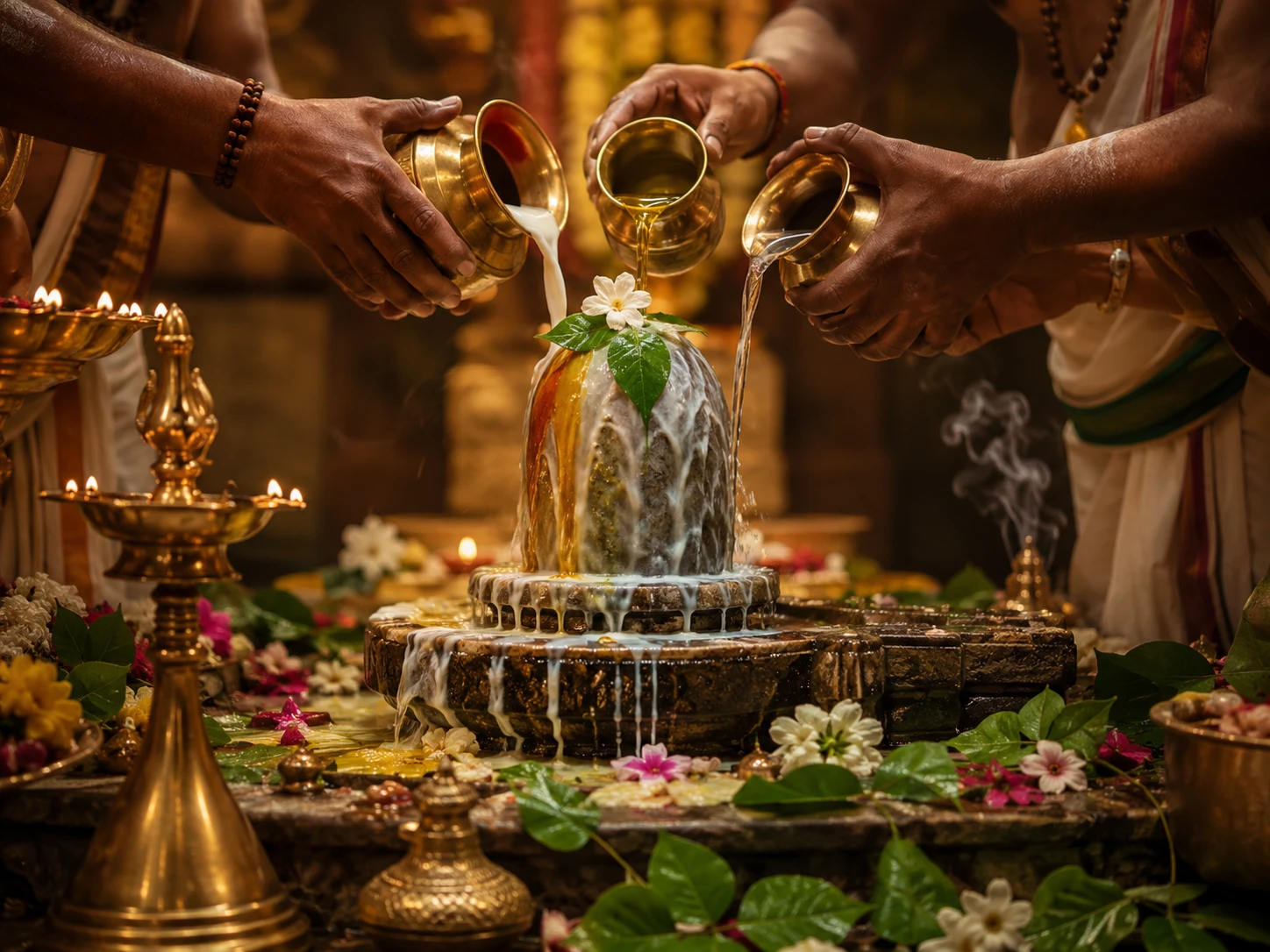
Abhisheka -- Why Hindus Bathe Their Gods
10 min read
Akshaya Tritiya -- The Day Nothing Given Away Runs Out
12 min readThe same translation error that turned '33 Koti' into '33 crore' in Hinduism also happened in Buddhism. The Chinese translation of Buddhist texts rendered 'Sapta Koti Buddha' (7 Supreme Buddhas) as '7 Crore Buddhas.' The…
Deities AvatarsCommunity Reflections
🕉️
Be the first to share your reflection.