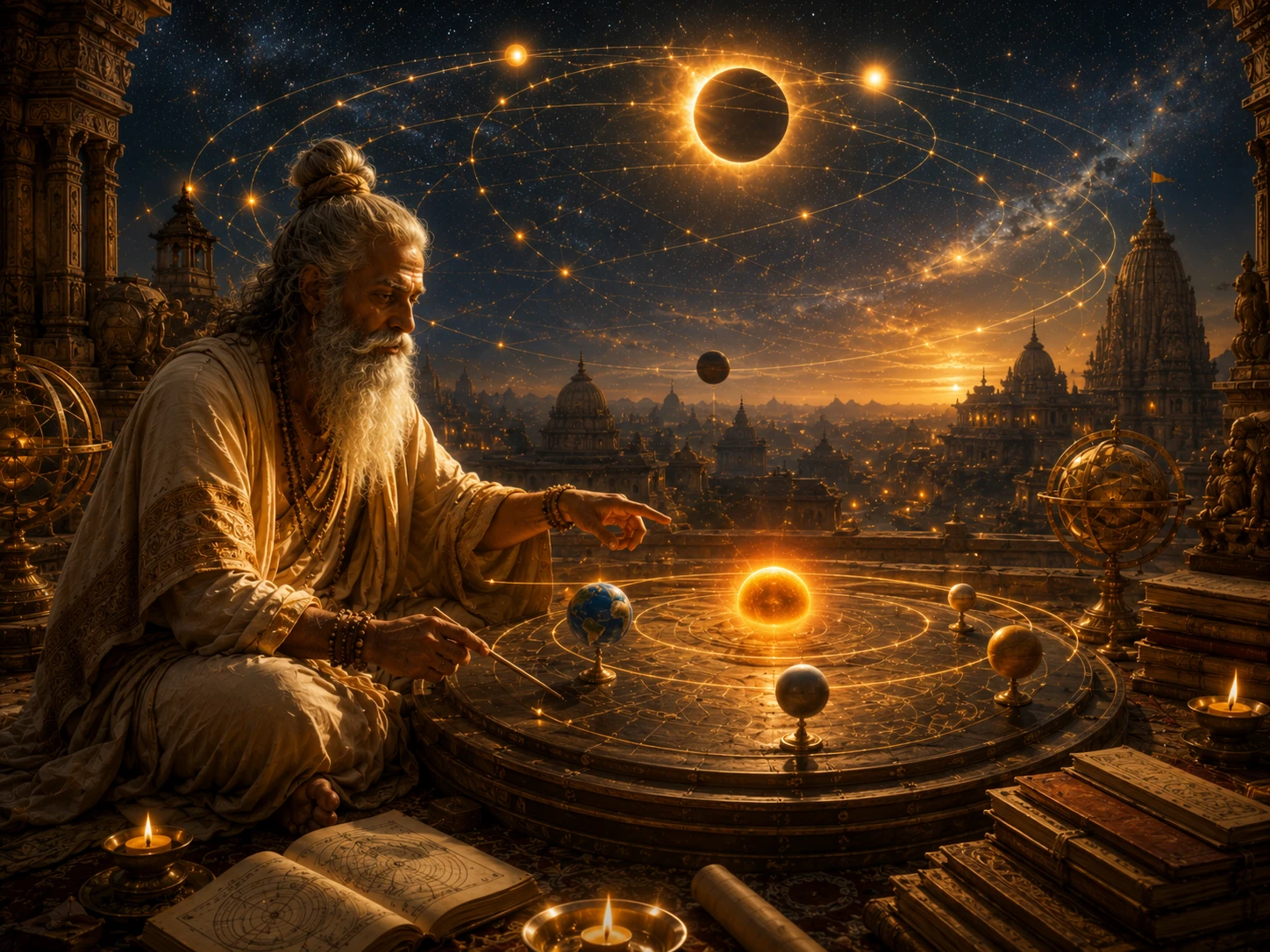
Rahu, Ketu and the Science of Eclipses -- Svarbhanu's Two Stories
राहु, केतु और ग्रहण का विज्ञान -- स्वर्भानु की दो कथाएँ
A total lunar eclipse is unfolding over the Ganga at Varanasi. It is past midnight. The moon, now copper-red, hangs over Assi Ghat. The priests have closed the inner sanctum at Kashi Vishwanath. Down at the water, a few hundred people stand knee-deep, taking the ritual bath that the shastra prescribes at the moment of grahan-moksha. On their phones, many of them have three tabs open: the Panchang app showing sutak timing, a live ISRO video from the Udaipur Solar Observatory, and a WhatsApp group where their grandmother is asking if they have covered the water pot with a tulsi leaf.
This is how India actually experiences an eclipse in 2026. Not myth versus science. Myth and science, held together in the same hour, by the same person, without embarrassment.
The double vision goes back a very long way. In the Rigveda, Rishi Atri describes how the asura Svarbhanu pierced the sun with darkness and how his family of seers recovered the sun. The hymn is dated by most scholars to somewhere between 1500 and 1200 BCE. In the same stream of texts, a few centuries later, the Surya Siddhanta gives precise geometric rules for when and how long an eclipse will last, accurate to within a few minutes even by today's measurement. Purana and siddhanta sit side by side in the library. They do not contradict each other because they are answering different questions: why does this happen to us, and when exactly will it happen. Rahu and Ketu belong to both answers at once. To understand eclipses in the Indian sense is to understand how a civilisation can keep both stories alive for three and a half thousand years without cutting either short.
यत्त्वा सूर्य स्वर्भानुस्तमसाविध्यदासुरः। अक्षेत्रविद्यथा मुग्धो भुवनान्यदीधयुः॥
yat tvā sūrya svarbhānus tamasāvidhyad āsuraḥ akṣetravid yathā mugdho bhuvanāny adīdhayuḥ
O Surya, when Svarbhanu the asura pierced you through with darkness, all the worlds beheld you like a person who has lost his way and knows not where he stands.
— Rigveda 5.40.5 (Atri Sukta)
The story everyone in India grows up with is not from the Rigveda. It is from the Bhagavata Purana, Book 8, and from parallel passages in the Vishnu Purana and the Mahabharata. The setting is the Samudra Manthan -- the churning of the cosmic ocean -- which devas and asuras carried out together using Mount Mandara as the churning rod and Vasuki, the serpent king, as the rope.
Fourteen treasures rose from the ocean. The last was Dhanvantari, divine physician, holding a pot of amrita -- the nectar of immortality. A war broke out immediately. Vishnu, aware that immortal asuras would be a permanent problem, took the form of Mohini, an enchantress of irresistible beauty. The asuras, dazzled, agreed to let her distribute the nectar. She seated the devas in one line and the asuras in another, and began pouring the amrita only to the devas.
One asura, Svarbhanu -- the 'splendour of radiance,' an apprentice of Shukracharya -- was not fooled. He changed his form, slipped between Surya and Chandra in the deva line, and received the nectar. His throat had barely closed around the first drop when Surya and Chandra, whose business was to see, saw him. They called out. Mohini's smile disappeared. Vishnu's Sudarshana Chakra flew and struck. Svarbhanu's head was severed from his body.
But the amrita had already reached his throat. The head could not die. The body could not die. Brahma stepped in: the head, joined to the body of a serpent, became Rahu -- the 'seizer.' The headless body, joined to the tail of a serpent, became Ketu -- 'the banner.' Both were placed among the navagrahas. Both carry, to this day, a grievance against Surya and Chandra for their exposure at the moment of the theft.
The eclipse, the Purana says, is what happens when Rahu finds the sun or the moon and swallows. The swallowing is always temporary. The grievance is permanent. This is one level of the answer.
The other level -- the astronomical one -- runs underneath the same narrative, and has run underneath it since at least the time of the Atharvaveda Parishishta and the earliest Jyotisha texts. Rahu and Ketu are unlike the other seven grahas. Surya has a physical disc. Chandra has a physical disc. So do Mangala, Budha, Brihaspati, Shukra, and Shani. Rahu and Ketu do not. You cannot see them through a telescope. You cannot land a spacecraft on them.
Classical jyotish calls them chhaya grahas -- shadow planets. They are not bodies. They are points. Specifically, they are the two points where the moon's orbit crosses the apparent path of the sun across the sky. Rahu is the ascending node -- the point where the moon crosses the ecliptic moving from south to north. Ketu is the descending node -- the point 180 degrees opposite, where the moon crosses from north to south. When modern Indian astronomy textbooks write 'lunar node,' a traditional panchang-maker would write 'Rahu-pata' or 'Ketu-pata.' The vocabulary is different. The referent is identical.
This is a quietly remarkable move. The shastra keeps the story of Svarbhanu for what it does spiritually and emotionally. Then, without contradiction, the shastra also says: look, an eclipse happens when the sun, the moon, and one of these two nodes are in the same line of sky. Two registers, one phenomenon. For the classical Indian astronomer, this was not a problem to be resolved. It was simply the grain of reality.
Rahu and Ketu -- Mythological and Astronomical Identities
| Aspect | Mythological (Purana) | Astronomical (Siddhanta) |
|---|---|---|
| Origin / उत्पत्ति | Svarbhanu beheaded at Samudra Manthan / समुद्र मन्थन में स्वर्भानु का शीर्षच्छेद | Geometric intersection of moon's orbit with ecliptic / चन्द्र-कक्षा और क्रान्तिवृत्त का प्रतिच्छेद |
| Rahu form / राहु का रूप | Severed head with serpent body / सर्प-देह पर जुड़ा कटा हुआ सिर | Ascending lunar node (north node) / आरोह चन्द्र-पात (उत्तर पात) |
| Ketu form / केतु का रूप | Headless body with serpent tail / सर्प-पूँछ सहित शीर्ष-हीन धड़ | Descending lunar node (south node) / अवरोह चन्द्र-पात (दक्षिण पात) |
| Why eclipse occurs / ग्रहण क्यों होता है | Rahu swallows Surya or Chandra in revenge / प्रतिशोध में राहु सूर्य या चन्द्र को निगलता है | Sun, moon, node align within 18 degrees / सूर्य, चन्द्र और पात 18 डिग्री भीतर एक रेखा में |
| Separation / विभाग | Fixed in navagrahas, permanent grievance / नवग्रह में स्थिर, स्थायी विरोध | Always 180 degrees apart on ecliptic / क्रान्तिवृत्त पर सदा 180 डिग्री पृथक् |
| Motion / गति | Rahu chases with intent / राहु संकल्प के साथ पीछे चलता है | Retrograde, completing zodiac in 18.61 years / वक्री, राशि-चक्र 18.61 वर्षों में पूरा |
| Visibility / दृश्यता | Invisible spectral form / अदृश्य छाया-रूप | Not a body -- only a computed point / कोई पिण्ड नहीं -- केवल गणितीय बिन्दु |
Both columns are found together in the Jyotish tradition. The Surya Siddhanta uses the word 'pata' (node) where the Puranas use 'Rahu' and 'Ketu' -- pointing to the same sky-geometry while preserving the narrative.
छादको भास्करस्येन्दुरधःस्थो घनवद् भवेत्। भूच्छायां प्राङ्मुखश्चन्द्रो विशत्यस्य भवेदसौ॥
chādako bhāskarasyendur adhaḥ-stho ghanavad bhavet bhūcchāyāṃ prāṅmukhaś candro viśaty asya bhaved asau
The moon, positioned below the sun, becomes its eclipser in the manner of a dense body. The moon, moving eastward, enters the earth's shadow -- that becomes [the lunar eclipse].
— Surya Siddhanta 4.9 (Chandragrahana adhikara)
That single verse from the Surya Siddhanta is worth pausing on. In fourteen words of Sanskrit, the text states the physical cause of both a solar eclipse and a lunar eclipse. The sun is eclipsed when the moon passes between it and the earth. The moon is eclipsed when it passes into the earth's shadow. No Svarbhanu. No serpent. Just geometry.
The classical Indian model had three essential facts right. First, the earth is the source of the shadow in a lunar eclipse -- a point the Surya Siddhanta returns to in verse after verse, computing the shadow's diameter in yojanas. Second, the moon is the occulter in a solar eclipse, positioned between the sun and the observer on earth. Third, eclipses happen only near the nodes of the moon's orbit, because only there do the sun, moon, and earth fall into the same plane.
The moon's orbit is tilted about 5.14 degrees from the ecliptic -- the flat disc along which the sun appears to travel against the background of the twelve rashis. Most of the time, at new moon, the moon passes above or below the sun, and there is no eclipse. Most of the time, at full moon, the moon passes above or below the earth's shadow, and there is no eclipse. Only twice a year, when the sun reaches the region of one of the nodes, do a new moon and a full moon there produce a solar and a lunar eclipse about a fortnight apart. This window is what the Surya Siddhanta calls a pakshagrahana yoga, an eclipse season. The rest of the year the pata sits quietly in some other part of the zodiac, and nothing happens.
When your coaching teacher at Narayana in Kota draws the little diagram of sun-earth-moon with a dotted ecliptic plane, she is drawing what the Surya Siddhanta wrote out in words before paper existed in India.
The geometry produces a small family of eclipse types, and Sanskrit has a word for each.
A Surya Grahan can be sampurna -- total -- when the moon's disc completely covers the sun's. During totality, the corona becomes visible, a ghostly halo of plasma that no ordinary observer has any other chance to see. The Surya Siddhanta calls this nimilana, the closing of the eye. Classical Kerala astronomers, observing the 1868 eclipse at Guntur, used the gap in day to measure the solar chromosphere with instruments that were essentially upgraded Dhanu Yantras.
A Surya Grahan can be khandagrasa -- partial -- when the moon covers only a portion of the sun. And it can be valayagraha -- annular, from valaya meaning ring -- when the moon is slightly further from earth in its orbit and so appears smaller than the sun. At annularity, the sun is seen as a brilliant ring around the dark disc of the moon. The June 2020 annular solar eclipse visible from north India and the December 2019 one seen from Tamil Nadu were both valayagraha. The word is two thousand years older than the observation.
A Chandra Grahan has the same three flavours. Sampurna chandra grahan -- total -- happens when the entire moon enters the earth's dark umbra and turns the characteristic copper-red. Khandagrasa chandra grahan -- partial -- occurs when only a slice of the moon crosses the umbra. And upchhaya chandra grahan -- penumbral -- happens when the moon passes only through earth's lighter outer shadow; the moon dims slightly but does not darken. The November 2022 total lunar eclipse visible across most of India was sampurna. The May 2023 event most parts of the country watched was upchhaya, which is why the moon looked almost normal.
Surya Grahan vs Chandra Grahan -- Mechanics at a Glance
| Factor | Surya Grahan | Chandra Grahan |
|---|---|---|
| Moon phase / तिथि | Amavasya (new moon) / अमावस्या | Purnima (full moon) / पूर्णिमा |
| Positional order / क्रम | Sun, Moon, Earth / सूर्य, चन्द्र, पृथ्वी | Sun, Earth, Moon / सूर्य, पृथ्वी, चन्द्र |
| Shadow source / छाया का स्रोत | Moon casts shadow on earth / चन्द्र की छाया पृथ्वी पर | Earth casts shadow on moon / पृथ्वी की छाया चन्द्र पर |
| Viewing duration (total) / पूर्ण अवधि (औसत) | Up to 7 minutes 32 seconds / अधिकतम 7 मिनट 32 सेकंड | Up to 1 hour 47 minutes / अधिकतम 1 घण्टा 47 मिनट |
| Visible from / दृश्य क्षेत्र | Narrow band on earth / पृथ्वी की एक सँकरी पट्टी | Entire night-side hemisphere / समस्त रात्रि-गोलार्ध |
| Eye safety / आँख की सुरक्षा | Never look directly, eclipse glasses required / कभी सीधे न देखें, ग्रहण-चश्मा आवश्यक | Safe for naked eye viewing / खुली आँखों से सुरक्षित |
| Sutak duration (traditional) / सूतक अवधि | 12 hours before first contact / प्रथम स्पर्श से 12 घण्टे पूर्व | 9 hours before first contact / प्रथम स्पर्श से 9 घण्टे पूर्व |
| Frequency / आवृत्ति | Two to five per year globally / विश्व में 2 से 5 प्रति वर्ष | Two to four per year globally / विश्व में 2 से 4 प्रति वर्ष |
All values are verifiable with modern observational data. Classical texts gave duration computations that match the modern values within one to three minutes.
The periodicity that made classical eclipse prediction possible is the regression of the lunar nodes. Rahu and Ketu do not stay fixed against the stars. They move backward along the zodiac, completing a full circuit in 18 years, 7 months, and about 18 days -- 18.61 sidereal years, to be exact. Every nakshatra feels the passage of Rahu roughly once in this cycle. The Surya Siddhanta does not use the word 'regression,' but its tables for the nodes treat them as bodies moving contrary to the other planets, which is precisely what a modern almanac shows.
The Saros cycle, familiar from modern eclipse science, is 18 years and 11 days -- the interval over which a specific eclipse pattern repeats with a small shift in longitude. It is mathematically related to the 18.61-year node cycle, though not identical to it. Babylonian astronomers of the first millennium BCE discovered Saros empirically. Indian astronomers of the same period arrived at equivalent predictive accuracy through the pata framework. Both traditions could forecast eclipses decades in advance. Neither needed a telescope.
Which is why the Panchang your grandmother consults, which takes its calculations from the Drik or Surya Siddhanta computational base, can tell her that the next Chandra Grahan visible from Nashik will begin at 01:36 IST on a specific night three years from now. She trusts the number because Hindu tradition has trusted the number for two thousand years. The trust is empirically earned. When the eclipse arrives, it arrives on schedule.
Around the astronomical core sits a dense shell of ritual. The Dharmashastra treats an eclipse as a period of ashaucha -- a ritual shadow that falls on all domestic activity. It is not a celebration. It is not an entertainment. Temples close their inner sanctums. Food already cooked is not eaten. Pregnant women are advised to stay indoors and avoid sharp objects. Mantra recitation is considered especially potent. So is charity, tirtha-snana, and silent remembrance.
The window for these observances is called sutak. For Surya Grahan, sutak begins twelve hours before first contact. For Chandra Grahan, nine hours before. Fresh food is not cooked during sutak, leftover food is not eaten, and the final bath -- grahan-snan, performed the moment the last contact ends -- is considered the pivot. Across the Gangetic plain, at places like Haridwar, Prayagraj, and Varanasi, tens of thousands of pilgrims gather for precisely this bath. The 2019 partial solar eclipse in late December brought around three lakh people to Haridwar alone.
Many of the older restrictions -- covering water with tulsi leaves to prevent spiritual contamination, avoiding sharp objects, staying indoors -- have explanations in the medical literature of their time. Some are genuinely therapeutic. Some are specific to older dietary and agricultural contexts. Whether a Bengaluru software engineer sitting in her apartment observes sutak rigorously is a personal decision. What matters is that the grammar of the practice is intact. An eclipse in India is still something you mark. You do not just watch it. You inhabit it.
Jyotish treats Rahu and Ketu as a single axis rather than two separate grahas. They are always in opposite rashis, 180 degrees apart. When a horoscope is cast, the position of this axis is considered among the most telling features of the chart. The sign Rahu occupies indicates the area of life where the soul has unresolved, outward-pulling desire. The sign Ketu occupies indicates the area where the soul carries a residue of mastery, detachment, or quiet renunciation from earlier lives.
Rahu is read as material hunger -- ambition, obsession, the force that makes someone pursue what they do not have. Ketu is read as spiritual hunger of the opposite kind -- the pull toward moksha, the instinct to let go, the readiness to leave. A person with Rahu in the seventh house often finds themselves entangled in unusual or fascinating marriages. A person with Ketu in the first house often feels unreachable to others, present but elsewhere. Neither placement is good or bad on its own. Together, the axis points to the specific karmic tension a person has been born to work through in this life.
Panditji in any small-town North Indian community will read the Rahu-Ketu axis before he looks at Mangal or Shani. This is not because the shadow planets are more important than the real ones. It is because they are understood to carry the imprint of the soul's previous trajectory, and so they frame everything else. The Puranic Svarbhanu -- the asura who wanted the amrita without earning it -- and the astronomical node -- the point where the moon's path crosses the sun's apparent one -- are both available as metaphors for this frame. A karmic axis, a desire and a release, written into the sky.
The tradition of studying eclipses has not left India. It has moved into new laboratories. The Udaipur Solar Observatory, built by the Physical Research Laboratory in Ahmedabad, sits on an island in Fateh Sagar Lake and tracks the sun continuously. The Indian Institute of Astrophysics at Kodaikanal has the longest continuous solar photographic record in the world, running back to 1904, and its archival plates contain observations of every major eclipse since the last Great October Eclipse of 1905.
ISRO's Aditya L1, launched on 2 September 2023 and parked at the first Sun-Earth Lagrangian point in January 2024, has changed the equation altogether. From L1, the satellite observes the sun with no interference from the earth's atmosphere and no need to wait for a natural eclipse. Aditya L1 creates an 'artificial eclipse' with its internal coronagraph whenever its scientists want to study the corona. What the 1868 Guntur astronomers had seven minutes to measure, Aditya L1 can measure every hour of every day. Chandrayaan-3, which landed at the lunar south pole on 23 August 2023, has given Indian astronomers direct access to the same moon whose shadow caused every solar eclipse ever observed from the subcontinent.
If you had told a classical Indian astronomer that India would one day build an observatory beyond the earth's own shadow, and another observatory on the moon itself, they would not have been surprised by the ambition. They would have been surprised by the engineering. The astronomical instinct -- to study grahan as the keyhole through which the sun and moon reveal themselves -- was always there. The shadow planets still mark the schedule. Only the instruments have grown up.
Rahu and Ketu always move backward through the zodiac -- the only grahas in the navagraha system that are exclusively retrograde. Their combined motion around the ecliptic takes 18.61 years. This is so close to the 18-year-11-day Saros cycle used by modern eclipse science that the two are sometimes confused. They are related but distinct: the Saros is a calendar of repeating eclipse patterns; the 18.61-year cycle is the period of the moon's orbital nodes. The classical Indian Panchang tracks the latter directly. The agreement between Panchang eclipse predictions and NASA's JPL ephemeris for the coming decade is typically within two minutes.
Check the next Surya Grahan and Chandra Grahan visible from your city
The Eternal Raga Panchang lists every upcoming eclipse, sutak start and end, and the exact moments of sparsha (first contact), madhya (mid-eclipse), and moksha (last contact) for your location. Open it for the current month, and again an hour before the next grahan begins.
Tags
Eternal Raga · शाश्वत राग
Institutional voice — scholarly articles on Sanatan Dharma
Deepen Your Understanding
अपनी समझ और गहरी करें
vedic sciences
Surya Siddhanta -- The Ancient Astronomy Text That Got the Year Right to 1.4 Seconds
Before Copernicus, before Galileo, before the telescope existed -- an Indian text calculated the tropical year as 365.2421756 days. The modern value is 365.2421904. The difference is 1.4 seconds per year. The Surya Siddhanta also described gravity, computed planetary diameters within 1% accuracy, and invented the sine function. It did all this in Sanskrit verse.
vedic sciences
Kaal Ganana -- The Hindu Measure of Time
From a single blink of the eye (Nimesha) to one Day of Brahma (4.32 billion years) -- explore the complete cosmic time hierarchy of Hindu cosmology, anchored in Vishnu Purana 1.3, with its remarkable parallels to modern science.
vedic sciences
The 27 Nakshatras and Their Junction Stars -- Bharat's Lunar Map of the Sky
Long before Greenwich drew a line through London, the Rishis of Bharat had already divided the ecliptic into 27 precise segments of 13 degrees 20 minutes each, anchoring each to a brightest star called the Yogatara. The Surya Siddhanta catalogued their positions with an accuracy that modern astronomy still respects.
vedic sciences
Indian Astronomical Instruments -- From Shanku to Samrat Yantra
Long before the telescope reached India, astronomers here were measuring the sun's declination with a vertical stick, the precession of equinoxes with a brass disc, and time to the second with sundials larger than buildings. Trace the instrument tradition from Aryabhata's wooden sphere to Jai Singh's 27-metre Samrat Yantra still working today.
deities avatars
Navagraha -- The Nine Planetary Deities Who Govern Your Horoscope and Your Life
Before every job interview, before every wedding, before buying a house or starting a business -- millions of Indians check their Navagraha positions. These nine celestial deities -- the Sun, Moon, Mars, Mercury, Jupiter, Venus, Saturn, and the shadow planets Rahu and Ketu -- constitute the most practically influential theological system in Hinduism. Whether you believe in astrology or not, the Navagraha are shaping Indian culture around you.
scriptural exegesis
Samudra Manthan -- When Gods and Demons Ran a Joint Venture and the Universe Almost Died
A cosmic ocean. A mountain for a churning rod. A serpent king for a rope. Gods on one end, demons on the other. And out came 14 treasures -- including wealth, beauty, medicine, immortality, and one poison so lethal it could end creation itself. The Samudra Manthan is not mythology. It is the original playbook for collaboration, crisis management, and how to handle it when your joint venture partner tries to cheat you.
Rahu and Ketu always move backward through the zodiac -- the only grahas in the navagraha system that are exclusively retrograde. Their combined motion around the ecliptic takes 18.61 years. This is so close to the 18-ye…
More in Vedic Sciences
Agnichayana -- The Falcon-Shaped Fire Altar That Survived 3,000 Years
12 min read
Ancient Indian Metallurgy -- The Iron Pillar That Refuses to Rust
13 min readAryabhata -- The Astronomer Who Said the Earth Turns
3 min readThe same translation error that turned '33 Koti' into '33 crore' in Hinduism also happened in Buddhism. The Chinese translation of Buddhist texts rendered 'Sapta Koti Buddha' (7 Supreme Buddhas) as '7 Crore Buddhas.' The…
Deities AvatarsCommunity Reflections
🕉️
Be the first to share your reflection.