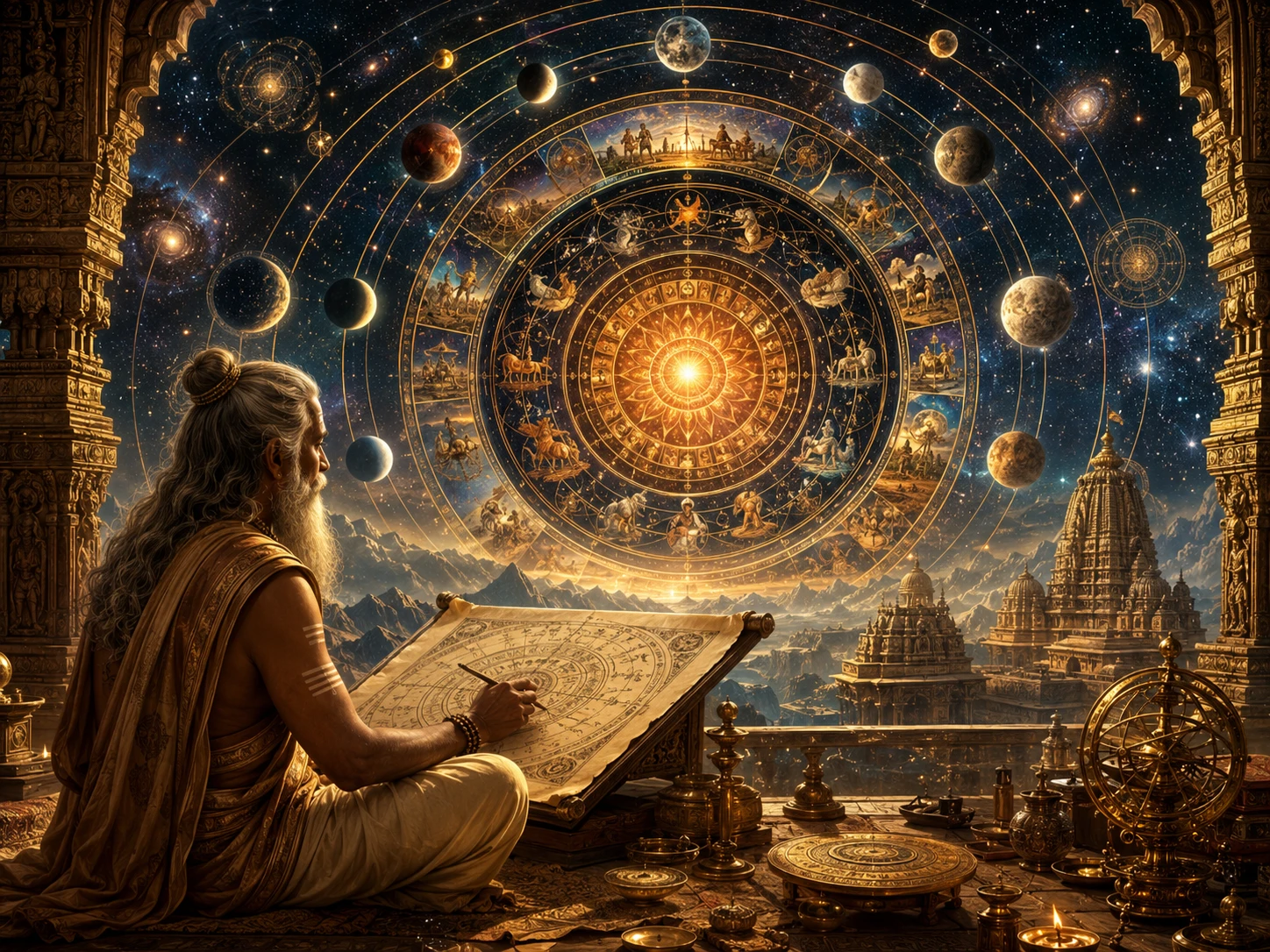
The Four Yugas -- How Long They Last, How People Lived, and Where We Are Now
चार युग -- कितने लम्बे, लोग कैसे जीते थे, और हम अभी कहाँ हैं
Western civilisation imagines time as a line -- a straight arrow from creation to apocalypse, from Genesis to Revelation, from Big Bang to heat death. Hindu civilisation imagines time as a wheel -- an endlessly repeating cycle of creation, sustenance, decline, and dissolution, turning forever like the potter's wheel of Brahma.
The fundamental unit of this cycle is the Maha Yuga (Great Age) -- a complete rotation through four sub-ages called Yugas. The word 'yuga' comes from the root 'yuj' (to yoke, to join) and refers to a period in which a particular quality of consciousness is yoked to human civilisation. The four Yugas are Satya (also called Krita), Treta, Dvapara, and Kali. They are not equal in length. They follow a precise 4:3:2:1 ratio -- the same ratio as the four throws in the ancient Indian dice game from which their names derive.
Krita means the 'perfect throw' (four). Treta means 'three'. Dvapara means 'two'. Kali means 'one' -- the worst throw. The decline is built into the names. The system tells you upfront: things get worse.
The primary sources for Yuga cosmology include the Vishnu Purana (Book 1, Chapter 3), the Bhagavata Purana (Skandha 3, Chapter 11; Skandha 12), the Mahabharata (Shanti Parva), the Manusmriti (Chapter 1), and the Surya Siddhanta. While specific numbers vary slightly between texts, the broad framework is remarkably consistent across millennia of Hindu literature.
The metaphor that ties the system together is the Dharma Vrishabha -- the Bull of Dharma. In Satya Yuga, the bull stands on all four legs: truth, austerity, compassion, and cleanliness. In each successive Yuga, one leg is lost. By Kali Yuga, dharma stands on a single shaking leg -- truth alone -- and even that is under assault. The Bhagavata Purana (Skandha 1, Chapter 17) dramatises this through a scene where King Parikshit encounters a one-legged bull being beaten by a dark figure named Kali -- the personification of the age.
चत्वारि त्रीणि द्वे चैकं कृतत्रेतादिषु क्रमात्। संख्यातानि सहस्राणि द्विगुणानि शतानि च॥
catvāri trīṇi dve caikaṃ kṛtatretādiṣu kramāt | saṃkhyātāni sahasrāṇi dviguṇāni śatāni ca ||
Four, three, two, and one -- in thousands of divine years, doubled by hundreds (as sandhya twilight periods), are the durations of Krita, Treta, and the other Yugas in sequence.
— Vishnu Purana, Book 1, Chapter 3 (Yuga duration formula); also Manusmriti 1.69
The Four Yugas -- Complete Comparison
| Aspect | Satya / Krita Yuga | Treta Yuga | Dvapara Yuga | Kali Yuga |
|---|---|---|---|---|
| Duration (divine years) | 4,800 (= 1,728,000 human years) | 3,600 (= 1,296,000 human years) | 2,400 (= 864,000 human years) | 1,200 (= 432,000 human years) |
| Ratio | 4 parts | 3 parts | 2 parts | 1 part |
| Dharma Bull Legs | 4 (Satya, Tapa, Daya, Shaucha) | 3 (Tapa, Daya, Shaucha lost: Satya weakens) | 2 (Daya, Shaucha lost) | 1 (only Satya remains, barely) |
| Average Human Lifespan | ~100,000 years | ~10,000 years | ~1,000 years | ~100 years (declining to ~20) |
| Average Human Height | ~21 cubits (32 ft) | ~14 cubits (21 ft) | ~7 cubits (10 ft) | ~3.5 cubits (5-6 ft) |
| Dominant Spiritual Path | Dhyana (meditation) | Yajna (fire sacrifice) | Archana (temple worship) | Nama Sankirtana (chanting God's name) |
| Dominant Varna | Brahmins (knowledge rules) | Kshatriyas (warriors rule) | Vaishyas (merchants rule) | Shudras (service class; hierarchy inverts) |
| Key Avatars | Matsya, Kurma, Varaha, Narasimha | Vamana, Parashurama, Rama | Krishna, Balarama | Kalki (yet to come) |
| Moral Climate | Universal truth; no theft, no envy; all beings enlightened | Dharma slightly declines; duty-based society; some conflict | Dharma halved; desire and greed emerge; epics and wars | Adharma dominates; corruption, hypocrisy, materialism |
| Colour Symbol | White (shukla) | Red (rakta) | Yellow (pita) | Black (krishna) |
| Key Scripture Events | Cosmic creation myths; Prahlada-Narasimha | Ramayana; Parashurama campaigns | Mahabharata; Kurukshetra war; Gita spoken | Bhagavatam narrated; Kalki awaited |
| Modern Parallel | Utopian golden age; pre-industrial harmony | Classical civilisation; rule of law emerging | Industrial-colonial era; science vs tradition | Information age; social media; climate crisis; AI |
One Maha Yuga (all four Yugas) = 4,320,000 human years. One thousand Maha Yugas = one Kalpa (one day of Brahma) = 4.32 billion years. This is remarkably close to the scientifically estimated age of Earth (~4.54 billion years).
Where Are We Now? The Kali Yuga Report Card
According to the traditional Hindu calendar, the current Kali Yuga began on 23 January 3102 BCE -- the date associated with Krishna's departure from the earthly plane, shortly after the Mahabharata war. If Kali Yuga lasts 432,000 years, we are currently in approximately Year 5,128 of 432,000. That means we are barely 1.2% into the worst age. The descent has only just begun.
The Bhagavata Purana (Skandha 12, Chapter 2) gives a chillingly specific set of predictions for Kali Yuga. Written roughly 1,500 years ago, some of these read like a news feed from 2026:
Wealth alone will be the criterion of merit. The strong will rule. Truth will have no value. Marriage will be a mere arrangement of convenience. External appearance will determine social standing. Legal skill, not justice, will decide disputes. Scholarship will be measured by speech, not by knowledge. Charity will be performed for show. Rulers will be thieves in disguise. People will migrate to countries where food is plentiful.
It is tempting to read this as doom-and-gloom prophecy. But the Yuga system carries a hidden grace note: Kali Yuga, despite being the most degraded age, is also the easiest age in which to attain liberation. In Satya Yuga, liberation required millennia of meditation. In Treta, decades of yajna. In Dvapara, elaborate temple worship. In Kali, the sages say, all that is needed is sincere chanting of God's name -- Nama Sankirtana.
The Kali Santarana Upanishad (a minor Upanishad from the Krishna Yajurveda) is explicit: in Kali Yuga, the Maha Mantra -- 'Hare Rama Hare Rama, Rama Rama Hare Hare / Hare Krishna Hare Krishna, Krishna Krishna Hare Hare' -- is sufficient for moksha. The bar for liberation drops as the age declines. This is Vishnu's mercy clause built into the operating system of time.
Is the Yuga System Literal or Metaphorical?
Scholars and practitioners disagree. The traditional Puranic view takes the numbers literally -- 432,000 years of Kali Yuga, 4.32 billion years per Kalpa. Sri Yukteswar Giri (Yogananda's guru) proposed a shorter cycle of 24,000 years total, mapping the Yugas to the precession of the equinoxes and arguing that we have already passed the low point of Kali Yuga and are now in ascending Dvapara.
What is not in dispute is the phenomenological observation: civilisations do rise and fall. Moral clarity does oscillate. Periods of enlightenment are followed by periods of decadence, which are followed by collapse, which is followed by renewal. Whether the Yuga numbers are cosmic timekeepers or poetic approximations, the pattern they describe is empirically observable in every civilisation that has existed.
The Yuga system is not a prediction of inevitable doom. It is a map of the terrain. It says: you are currently in difficult country. The path is steep, the visibility is low, and most of your fellow travellers are lost. But precisely because the terrain is difficult, every step counts more. A single act of dharma in Kali Yuga earns merit that would have required centuries of practice in Satya Yuga.
The darkest age is also the most generous. That is the paradox at the heart of Hindu cosmology.
One Kalpa (one day of Brahma) equals 4.32 billion years. The current scientific estimate for the age of the Earth is approximately 4.54 billion years. The Vedic figure, derived purely from cosmological reasoning in texts like the Surya Siddhanta and Vishnu Purana (composed centuries before modern geology existed), is within 5% of the scientific estimate. Whether this is coincidence, convergent reasoning, or something else, it remains one of the most striking numerical correspondences between any ancient cosmological system and modern science.
Chant the Maha Mantra -- Kali Yuga's Medicine
The scriptures say nama sankirtana is the prescribed spiritual practice for the Kali Yuga. Chant the Hare Krishna maha-mantra 108 times on a mala. Its page on Eternal Raga gives the meaning and how to chant it.
Tags
Eternal Raga · शाश्वत राग
Institutional voice — scholarly articles on Sanatan Dharma
Deepen Your Understanding
अपनी समझ और गहरी करें
vedic sciences
Kaal Ganana -- The Hindu Measure of Time
From a single blink of the eye (Nimesha) to one Day of Brahma (4.32 billion years) -- explore the complete cosmic time hierarchy of Hindu cosmology, anchored in Vishnu Purana 1.3, with its remarkable parallels to modern science.
philosophy darshana
Sattva, Rajas, Tamas -- The Three Gunas That Run Your Life
Every mood you have ever felt, every decision you have ever made, every Netflix binge and every 4 AM study session -- Hindu philosophy says it all comes down to three forces. Sattva illuminates, Rajas agitates, Tamas numbs. The Bhagavad Gita's Chapter 14 is essentially a 2,000-year-old personality framework that modern psychology is only now catching up to.
deities avatars
Dashavatara -- Why Vishnu Comes Back Ten Times
Fish, tortoise, boar, half-lion, dwarf, axe-warrior, prince, cowherd, enlightened teacher, future horseman. The ten avatars of Vishnu are not random folklore. Read them in sequence and you get something startling -- a narrative that mirrors evolutionary biology, tracks the rise and fall of political systems, and argues that God does not sit above history but enters it, gets dirty, and does the work. The Dashavatara is Hinduism's answer to the question every civilisation asks: why does the world keep breaking, and who fixes it?
vedic sciences
The 14 Manus -- Cosmic Reset Buttons of Hindu Time
Hindu cosmology does not have one Adam. It has fourteen. Each Manvantara -- a cosmic era of 306.72 million years -- is governed by a different Manu who repopulates the earth, establishes dharma, and oversees a fresh team of gods, sages, and an Indra. We are currently in the 7th Manvantara, ruled by Vaivasvata Manu, son of Surya. Seven Manus have served. Seven are yet to come. And Vishnu takes a new avatar for each.
vedic sciences
Surya Siddhanta -- The Ancient Astronomy Text That Got the Year Right to 1.4 Seconds
Before Copernicus, before Galileo, before the telescope existed -- an Indian text calculated the tropical year as 365.2421756 days. The modern value is 365.2421904. The difference is 1.4 seconds per year. The Surya Siddhanta also described gravity, computed planetary diameters within 1% accuracy, and invented the sine function. It did all this in Sanskrit verse.
philosophy darshana
Karma Explained -- Not Punishment, Not Reward, but the Physics of Action
Karma is not cosmic revenge. It is not 'what goes around comes around.' It is India's most sophisticated theory of causation -- a framework that explains why your choices matter, why consequences are inescapable, and why freedom is still possible. The Gita's karma teaching changed Oppenheimer's life. It might change yours.
One Kalpa (one day of Brahma) equals 4.32 billion years. The current scientific estimate for the age of the Earth is approximately 4.54 billion years. The Vedic figure, derived purely from cosmological reasoning in texts…
More in Vedic Sciences
Agnichayana -- The Falcon-Shaped Fire Altar That Survived 3,000 Years
12 min read
Ancient Indian Metallurgy -- The Iron Pillar That Refuses to Rust
13 min readAryabhata -- The Astronomer Who Said the Earth Turns
3 min readThe same translation error that turned '33 Koti' into '33 crore' in Hinduism also happened in Buddhism. The Chinese translation of Buddhist texts rendered 'Sapta Koti Buddha' (7 Supreme Buddhas) as '7 Crore Buddhas.' The…
Deities AvatarsCommunity Reflections
🕉️
Be the first to share your reflection.