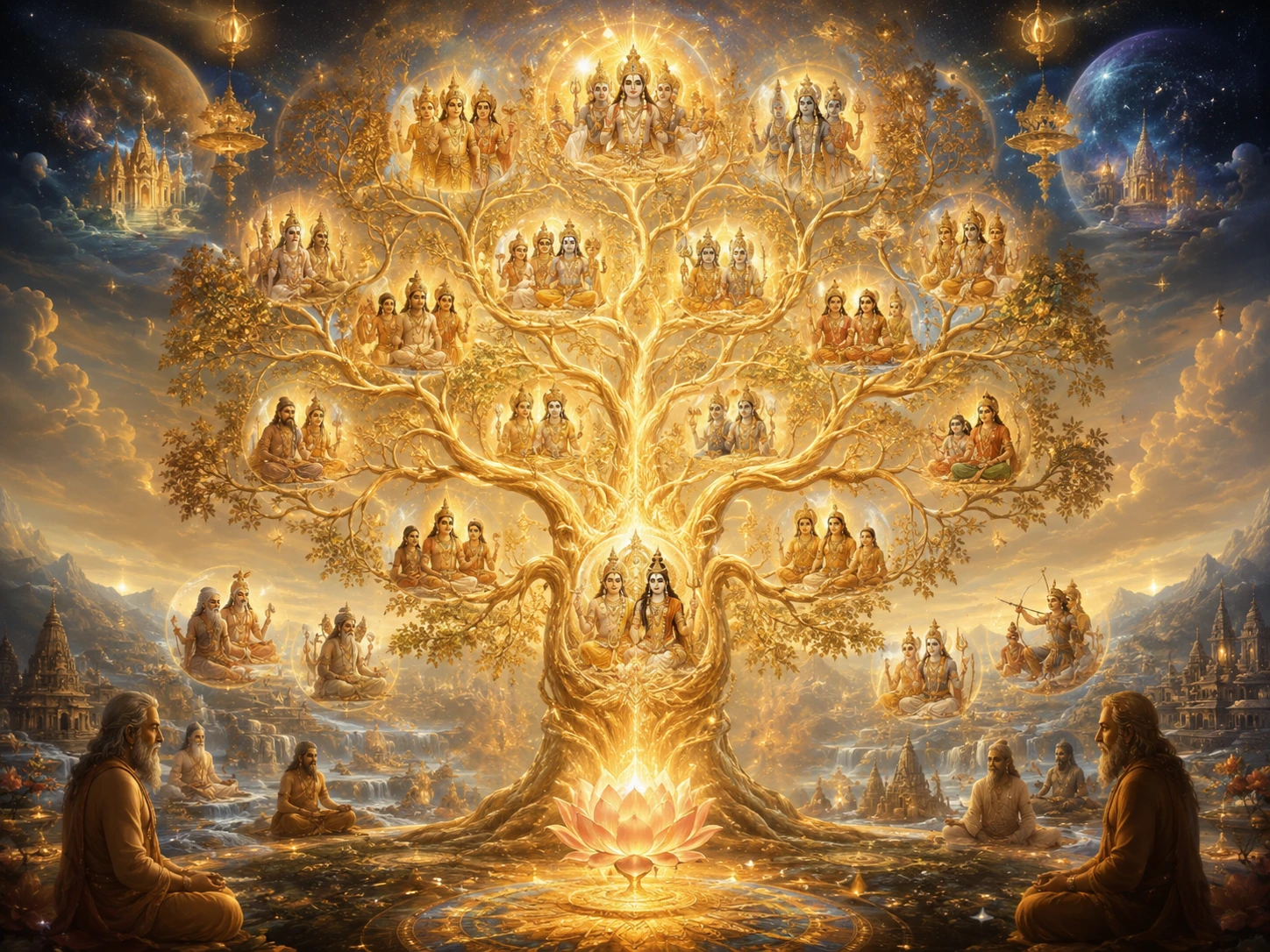
Chandravanshi -- The Lunar Dynasty from Moon to Mahabharata
चन्द्रवंशी -- चन्द्रमा से महाभारत तक चन्द्र राजवंश
Introduction -- The Dynasty Born from a Scandal
The Lunar Dynasty begins with adultery. Soma (the Moon god, born from the eyes of the Prajapati Atri) abducted Tara, the wife of Brihaspati (Jupiter, the guru of the gods). A cosmic war erupted -- Brihaspati's allies (the Devas led by Indra) on one side, Soma's allies (Shukracharya and the Asuras) on the other. Brahma himself intervened and ordered Tara returned. But by then she was pregnant. The child born was Budha (Mercury -- not to be confused with Gautama Buddha). Brihaspati rejected the child. Soma claimed him.
Budha married Ila -- who is simultaneously the daughter of Vaivasvata Manu (Solar Dynasty) and a figure who alternated between male and female form through a divine curse/blessing. Their son was Pururava, the first earthly king of the Chandravansha. Through Pururava's legendary love affair with the apsara Urvashi (the subject of Kalidasa's Vikramorvashiyam), the dynasty grew.
From Pururava the line runs: Ayu > Nahusha > Yayati. And at Yayati, the dynasty splits into the two great branches that define Indian epic literature:
YADU branch (from Yayati's eldest son by Devayani): Leads to the Yadavas, and eventually to Vasudeva, Devaki, and Krishna. This is the branch that produced the 8th avatar of Vishnu.
PURU branch (from Yayati's youngest son by Sharmishtha): Leads to Dushyanta, Shakuntala, Bharata (after whom India is named), Kuru, Shantanu, Bhishma, Dhritarashtra, Pandu -- and ultimately to the Pandavas and Kauravas whose war is the Mahabharata.
The Vishnu Purana (Book 4, Chapters 4-20) and the Mahabharata (Adi Parva) provide the complete genealogy. The cosmic chain: Brahma > Atri > Soma > Budha > Pururava > ... > Yayati > Yadu/Puru > Krishna/Pandavas.
For anyone who grew up watching B.R. Chopra's Mahabharat on Doordarshan, or the more recent Star Plus version, or read Amish Tripathi or Devdutt Pattanaik -- every character in those stories traces back to the Lunar Dynasty. Krishna and the Pandavas are distant cousins. Duryodhana and Arjuna are closer cousins. And the entire Mahabharata war is, at its core, a family property dispute within one branch (Puru) of one dynasty (Chandravansha) that began with the Moon god's affair.
अत्रेः पुत्रः सोमः प्रसूतस्तारां भार्यां बृहस्पतेः। जहार तस्मात्सम्भूतो बुधो यस्येलया सुतः॥
atreh putrah somah prasuutas taaraam bhaaryaam brhaspateh jahaara tasmaat sambhuuto budho yasyelayaa sutah
Soma, born as the son of Atri, abducted Tara, the wife of Brihaspati. From their union was born Budha, who with Ila had a son (Pururava).
— Vishnu Purana, Book 4, Chapter 4 (also Bhagavata Purana 9.14)
The Lunar Dynasty -- Key Figures from Soma to the Mahabharata
| Figure | Branch | Famous For | Key Episode | Source |
|---|---|---|---|---|
| Soma (Chandra) | Origin | Moon god, progenitor | Abducted Tara (Brihaspati's wife); cosmic war; Budha born | Vishnu Purana 4.4 |
| Budha (Mercury) | Origin | Son of Soma and Tara | Planet Mercury; married Ila (Manu's daughter); rejected by Brihaspati | Bhagavata Purana 9.14 |
| Pururava | Main line | First Chandravanshi king | Love affair with Urvashi (Kalidasa's Vikramorvashiyam); introduced fire ritual | Vishnu Purana 4.4 |
| Nahusha | Main line | Became temporary Indra | Replaced Indra briefly; cursed to become a serpent for arrogance toward Agastya | Mahabharata Vana Parva |
| Yayati | FORK POINT | The king who traded youth | Cursed to old age by Shukracharya; Puru gave him his youth; Yadu refused | Vishnu Purana 4.7, Mahabharata Adi Parva |
| Yadu | Yadu branch | Eldest son; founded Yadavas | Refused to give Yayati his youth; cursed that his line would never rule as kings | Vishnu Purana 4.9 |
| Krishna | Yadu > Yadava | 8th Vishnu avatar | Born to Vasudeva-Devaki; raised by Yashoda-Nanda; Mathura, Vrindavan, Dwaraka, Gita | Bhagavata Purana Skanda 10 |
| Puru | Puru branch | Youngest son; inherited the throne | Gave his youth to father Yayati; rewarded with the kingdom despite being youngest | Vishnu Purana 4.8 |
| Dushyanta + Shakuntala | Puru > Bharata | Parents of Bharata | Kalidasa's Abhijnana-Shakuntalam; Dushyanta forgot Shakuntala due to Durvasa's curse | Mahabharata Adi Parva, Shakuntalam |
| Bharata | Puru > Bharata | India named 'Bharat' after him | Chakravartin emperor; performed many Ashwamedha Yajnas; his realm = Bharatavarsha | Vishnu Purana 4.13 |
| Kuru | Puru > Kuru | Founded the Kuru kingdom | Ploughed Kurukshetra with a golden plough; made it sacred | Mahabharata Adi Parva |
| Shantanu | Puru > Kuru | Married Ganga and Satyavati | Ganga drowned 7 sons; 8th = Bhishma. Married Satyavati > Chitrangada, Vichitravirya | Mahabharata Adi Parva |
| Bhishma | Puru > Kuru | The grandsire; vow of celibacy | Renounced throne and marriage for father's happiness; Iccha Mrityu (chose his death) | Mahabharata (entire epic) |
| Dhritarashtra + Pandu | Puru > Kuru | Fathers of Kauravas and Pandavas | Both born via Niyoga from Vyasa; Dhritarashtra blind, Pandu cursed | Mahabharata Adi Parva |
| Pandavas vs Kauravas | Puru > Kuru | The Mahabharata war | 100 Kauravas vs 5 Pandavas; 18-day Kurukshetra war; Gita spoken | Mahabharata (entire epic) |
Sources: Vishnu Purana Book 4 Chapters 4-20, Bhagavata Purana Skanda 9, Mahabharata Adi Parva. The Lunar Dynasty connects to the Solar Dynasty through Ila/Sudyumna (Manu's daughter/son who married Budha). Krishna (Yadu branch) and the Pandavas (Puru branch) are thus distant cousins -- both descended from Yayati, separated by dozens of generations.
... Ayu > Nahusha ...
Dynasty splits into two branches
Yadu branch → Krishna
Puru branch → Pandavas
Tap any name to see their story, key descendants, and Puranic citations.
The Yayati Fork -- Why Krishna and the Pandavas Are Cousins
King Yayati is the hinge of the entire Lunar Dynasty. His story explains why the Mahabharata happened the way it did.
Yayati had two wives: Devayani (daughter of Shukracharya, the guru of the Asuras) and Sharmishtha (daughter of the Asura king Vrishaparvan). When Shukracharya discovered that Yayati had secretly married Sharmishtha in addition to Devayani, he cursed Yayati with premature old age. But Shukracharya allowed a loophole: Yayati could transfer his old age to any son willing to accept it.
Yayati asked each son. Yadu (eldest, from Devayani) refused. So did Turvasu, Druhyu, and Anu. Only Puru (youngest, from Sharmishtha) agreed to give his youth to his father. Yayati enjoyed a thousand years of youth in Puru's body, then returned it and crowned Puru as king -- even though Puru was the youngest. Yadu was cursed: his descendants would never hold the title of Samrat (emperor).
This curse is why Krishna, despite being the supreme deity incarnate, never sat on a throne. He was kingmaker, not king. He installed others -- Yudhishthira in Hastinapura, Ugrasena in Mathura -- but never ruled himself. The Yadava line was barred from emperorship by Yayati's ancient curse. When people ask why Krishna did not simply become king and solve everything, the answer is genealogical: Yadu's refusal, thousands of years earlier, had consequences.
The Puru line, meanwhile, produced the Bharata dynasty (India = Bharatavarsha), the Kuru dynasty (Kurukshetra = Kuru's field), and ultimately the two warring families: the 100 Kauravas (sons of Dhritarashtra) and the 5 Pandavas (sons of Pandu). Their war -- fought on the sacred ground that Kuru himself had ploughed with a golden plough -- is the Mahabharata.
For a law student studying property disputes in Hindu Succession Act cases, or a business family navigating joint-family partition in Marwari or Gujarati tradition, the Yayati story is the ur-template: the youngest son inherits because he showed loyalty, the eldest is disinherited because he showed defiance, and the family splits into branches that meet again in conflict generations later.
The name 'Bharat' -- the official name of India in Hindi and the Indian Constitution -- comes directly from the Lunar Dynasty. King Bharata was the son of Dushyanta and Shakuntala, a descendant of Puru (Yayati's youngest son). He was such a powerful Chakravartin emperor that the entire subcontinent became known as 'Bharatavarsha' -- 'the land of Bharata.' Kalidasa's play Abhijnana-Shakuntalam, considered the greatest work in Sanskrit literature, tells the love story of Bharata's parents. When you say 'Bharat,' you are saying a Chandravanshi king's name.
The Lunar Dynasty connects to the Solar Dynasty through a single person: Ila (also known as Sudyumna), who was Vaivasvata Manu's daughter. Through a divine curse by Shiva, Ila alternated between male and female form each month. In female form (Ila), she married Budha (son of Soma/Moon) and became the mother of Pururava -- the first Chandravanshi king. In male form (Sudyumna), she had other descendants. This means the Solar and Lunar Dynasties share the same grandfather (Vaivasvata Manu) -- they are not separate families but branches of the same cosmic tree, connected through a gender-fluid ancestor. The Mahabharata war between Brihadbala (Solar, Kaurava side) and the Pandavas (Lunar) was literally a family reunion gone wrong.
Find the Lunar Dynasty in the Mahabharata
The Lunar Dynasty's greatest story is the Mahabharata, from the Adi Parva to the Svargarohana Parva. The Mahabharata text is not yet on Eternal Raga; the overview article maps all eighteen parvas so you know where to look in a full translation.
Tags
Eternal Raga · शाश्वत राग
Institutional voice — scholarly articles on Sanatan Dharma
Deepen Your Understanding
अपनी समझ और गहरी करें
scriptural exegesis
Suryavanshi -- The Solar Dynasty from the First King to Rama
Rama was not the first king of Ayodhya. He was the 67th. Before him came Ikshvaku, who sneezed into existence from Manu's nostril. Then Harishchandra, who sold himself into slavery for truth. Then Sagara, whose 60,000 sons were burned to ash. Then Bhagiratha, who brought Ganga from heaven to redeem them. Then Raghu, who conquered the world. Then Dasharatha, who gave his life for a promise. This is the Solar Dynasty -- the longest unbroken royal lineage in any mythology on earth.
deities avatars
Surya's Family -- How One God Fathered Yama, Shani, the Ashwini Kumaras, and All of Humanity
Surya had two wives: Sanjana, who could not bear his radiance, and Chhaya, the shadow she left behind. From Sanjana came Yama (death), Yamuna (the river), Manu (humanity's ancestor), and the Ashwini Kumaras (divine physicians). From Chhaya came Shani (Saturn, karma's enforcer), Tapati (the river), and Savarni Manu (the next cosmic era's ruler). Same father. Two mothers. Ten children. And the entire human race.
scriptural exegesis
Brahma's Children -- The First Generation of Creation
Brahma tried three times to populate the universe. First he created four sons who refused to reproduce and became monks. Then he got so angry that Rudra burst from his forehead. Finally he created ten Prajapatis from his mind -- and through them, every god, demon, human, animal, and plant in existence traces its origin. This is the original org chart of the cosmos.
deities avatars
Kashyapa's Wives -- How One Sage Fathered Gods, Demons, and Everything In Between
Why are gods and demons always at war? Because they are cousins -- half-brothers sharing the same father, the sage Kashyapa. Aditi's sons became the Devas. Diti's sons became the Daityas. Vinata's sons became Garuda and Aruna. Kadru's sons became the serpents. And the family dynamics that produced them explain the entire cosmic conflict of Hindu mythology.
vedic sciences
The 14 Manus -- Cosmic Reset Buttons of Hindu Time
Hindu cosmology does not have one Adam. It has fourteen. Each Manvantara -- a cosmic era of 306.72 million years -- is governed by a different Manu who repopulates the earth, establishes dharma, and oversees a fresh team of gods, sages, and an Indra. We are currently in the 7th Manvantara, ruled by Vaivasvata Manu, son of Surya. Seven Manus have served. Seven are yet to come. And Vishnu takes a new avatar for each.
vedic sciences
Kaal Ganana -- The Hindu Measure of Time
From a single blink of the eye (Nimesha) to one Day of Brahma (4.32 billion years) -- explore the complete cosmic time hierarchy of Hindu cosmology, anchored in Vishnu Purana 1.3, with its remarkable parallels to modern science.
The name 'Bharat' -- the official name of India in Hindi and the Indian Constitution -- comes directly from the Lunar Dynasty. King Bharata was the son of Dushyanta and Shakuntala, a descendant of Puru (Yayati's youngest…
More in Scriptural Exegesis
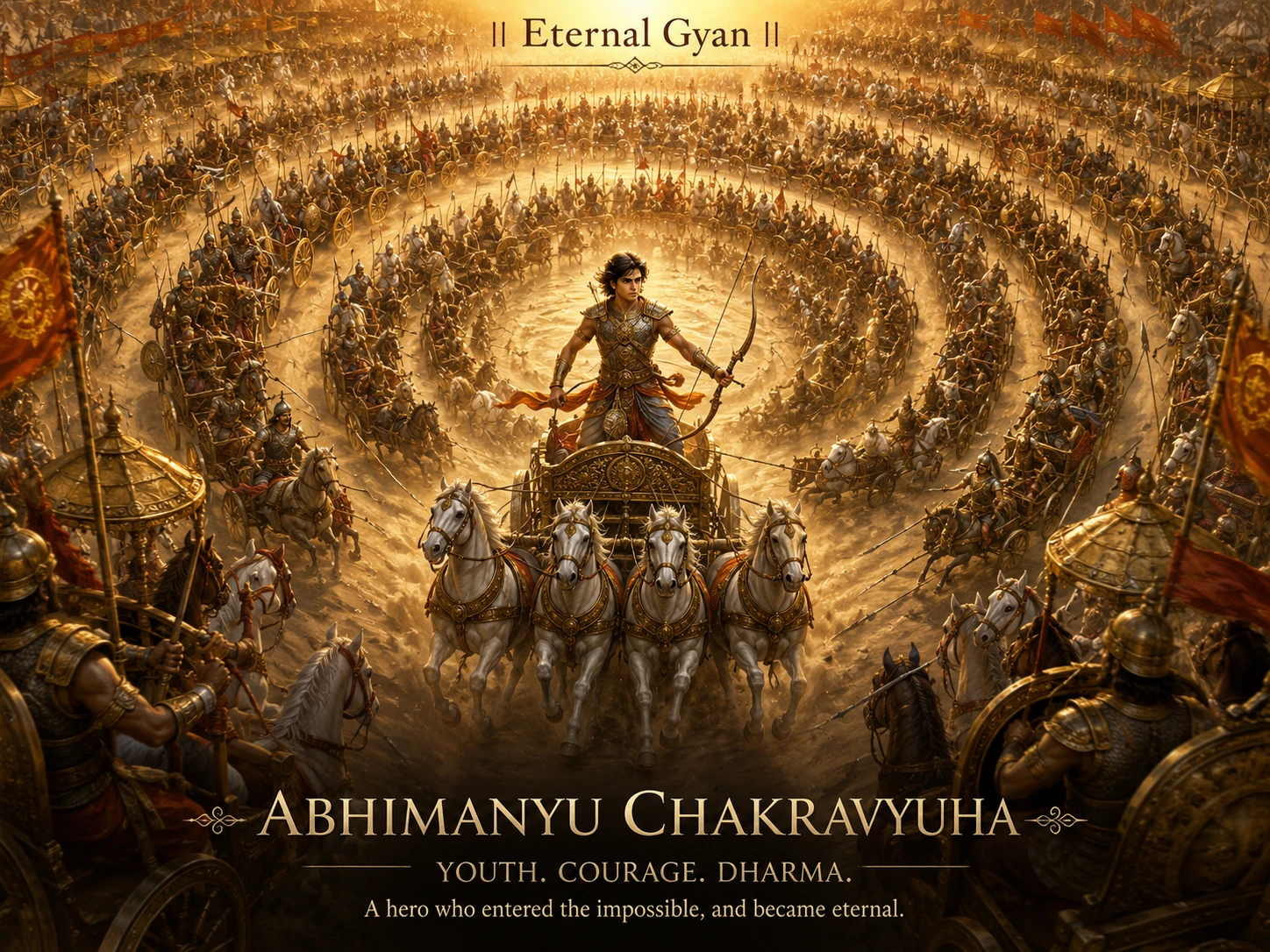
Abhimanyu and the Chakravyuha -- The Boy Who Knew How to Enter but Not How to Leave
14 min read
Adbhuta Ramayana -- The Ramayana Where Sita Becomes Kali
9 min read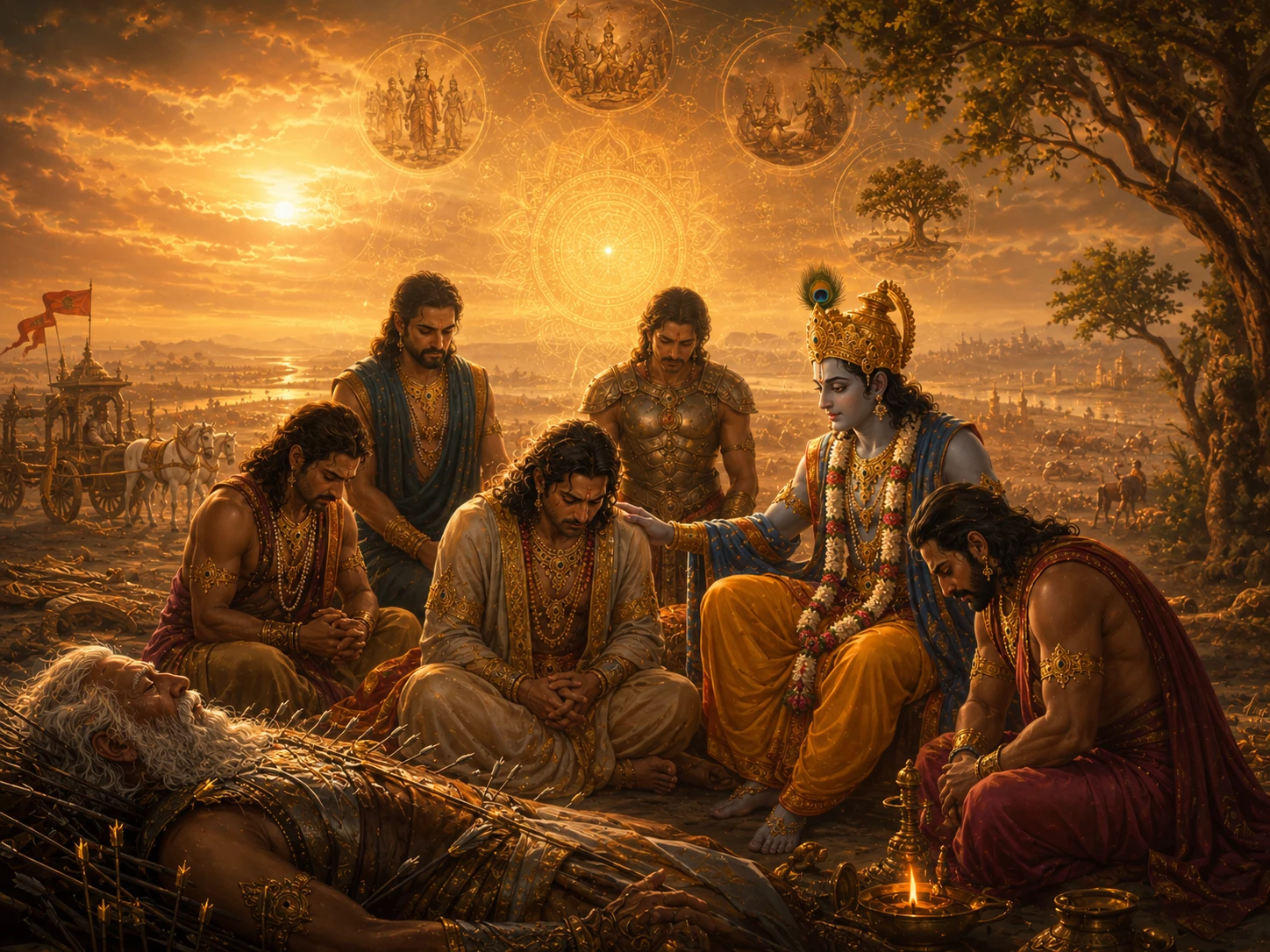
After Kurukshetra -- What Happened Next
14 min readThe same translation error that turned '33 Koti' into '33 crore' in Hinduism also happened in Buddhism. The Chinese translation of Buddhist texts rendered 'Sapta Koti Buddha' (7 Supreme Buddhas) as '7 Crore Buddhas.' The…
Deities AvatarsCommunity Reflections
🕉️
Be the first to share your reflection.