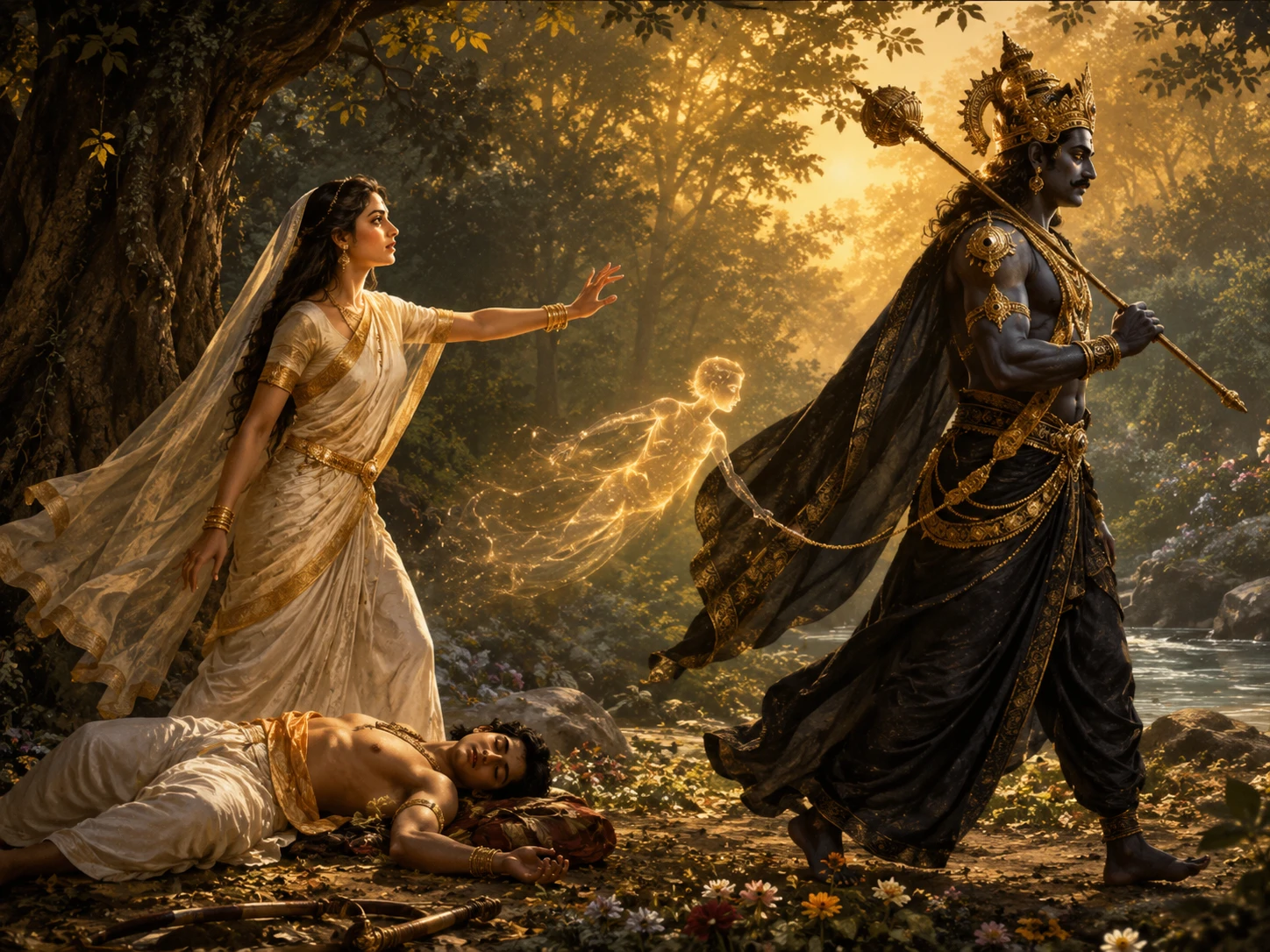
Savitri and Satyavan -- The Woman Who Argued With Death
सावित्री और सत्यवान -- वह स्त्री जिसने मृत्यु से तर्क किया
The Story Inside The Story
The Pandavas have been exiled. Draupadi has been dragged by her hair across the assembly hall in Hastinapura, mocked by men who would not be alive if she had a single male relative left to defend her honour properly. Yudhishthira sits in the Kamyaka forest staring at the ground. He has lost his kingdom to a dice game. He has lost the dignity of his wife to that same game. He believes himself, with some accuracy, to be the worst husband currently breathing in north India.
This is when the sage Markandeya begins the story of Savitri.
The placement is not accidental. The Mahabharata is a cathedral of nested stories, and every nested story is offered for a reason. Markandeya does not tell Yudhishthira an entertaining fable to pass the forest hours. He tells him this specific story because Yudhishthira needs to know something Draupadi has been saying to him without words: a wife is not a passive prize. A wife, when she chooses, can argue with death itself and win. The Pativrata-mahatmya Parva, embedded in the Vana Parva of the Mahabharata, is therefore not a story about a perfect woman quietly serving her husband. It is a story about a woman whose intelligence saves her family, her in-laws' kingdom, her father's lineage, and her husband's body, in that order.
सन्तो हि सत्येन नयन्ति सूर्यं सन्तो भूम्यां तपसा धारयन्ति। सन्तो गतिर्भूतभव्यस्य राजन् सतां मध्ये नावसीदन्ति सन्तः॥
santo hi satyena nayanti sūryam santo bhūmyāṃ tapasā dhārayanti santo gatir bhūta-bhavyasya rājan satāṃ madhye nāvasīdanti santaḥ
By truth alone do the virtuous lead the sun. By austerity the virtuous uphold the earth. The virtuous, O king, are the refuge of all that is past and that is to come. Among the virtuous, the virtuous never sink.
— Mahabharata, Vana Parva, Pativrata-mahatmya Parva (one of Savitri's homilies to Yama)
The Backstory You Were Not Told In School
Most people who carry the Savitri story in their bones learned it as a children's tale -- woman loves husband, husband dies, woman tricks Yama, husband lives. The Mahabharata version is much stranger and much more interesting.
King Ashvapati of the Madra kingdom (the same Madra that produced Madri, mother of the twin Pandavas) was childless for years. He performed a vrata for the goddess Savitri, an aspect of the solar deity, for eighteen years -- ten thousand oblations daily, six-hour meals, full Brahmacharya. The goddess appeared and granted him a daughter. He named the daughter after the goddess.
The girl grew up so radiant that no man would propose to her. The king worried. He sent her, accompanied by ministers, on a journey to find her own husband. The princess returned and announced she had chosen Satyavan, son of the blind exiled king Dyumatsena, who lived in a hermitage. The court sage Narada was visiting at that moment. Narada listened, considered, and informed the court that Satyavan was perfect in every virtue but had exactly one year left to live.
Ashvapati told his daughter to choose someone else. Savitri refused. 'Once a daughter of a kshatriya gives her word, she does not unsay it,' she replied. She married Satyavan. She left the palace, gave away her jewellery, and put on the bark and red cloth of a forest-dwelling wife. For one year she counted the days in her head, the way a Class XII student in Kota counts the days till JEE -- not panic, but precision. On the appointed morning, she undertook the Triratra vow: three days of complete fasting before her husband's death-day. She finished the fast. She accompanied Satyavan into the forest when he went to cut wood. She did not tell him she knew.
This is the part the comic books leave out. Savitri did not pray for a miracle. She prepared for an event. Her vrata was logistical, not magical. She got into position.
The Forest Scene
Satyavan climbs a tree to gather fruits. Then he comes down with a sudden headache, lies with his head in Savitri's lap, and stops breathing. The text is precise: the day, the hour, the moment Narada had named. There is no convenient delay.
A dark figure with red eyes appears. He carries a noose. He is so tall he seems to fold the dusk around himself. Savitri places her husband's head gently on the ground, stands up, and asks him directly: who are you, what are you doing.
It is important to register what is happening here. Yama, the lord of all departed, is in the habit of sending lower officials -- the Yamadūtas -- to fetch ordinary souls. He came for Satyavan in person, as he later admits, because Satyavan was too virtuous to be retrieved by a clerk. This is the only mortal-to-Yama personal interview in the Mahabharata where the mortal is not a king, not a yogi, not a sage. She is a young woman in a red garment standing in a forest, who is simply not going home.
Yama performs his duty. He extracts a soul the size of a thumb from Satyavan's chest, binds it in his noose, and turns south -- the direction of the dead. Then Savitri starts to follow. Yama stops, turns, and tells her to go back. He uses different arguments at different moments: you have done your duty, your husband's body needs the funeral rites, your path is unimpeded only as far as this. She replies each time. The Mahabharata says that Yama was charmed not by her grief, which is unusable in his profession, but by her speech. She did not weep. She gave him philosophy.
This is also where the Mahabharata makes its most quietly radical move on the question of what dharma actually rewards. Yama, in this scene, is the keeper of cosmic law. He is bound by his own office. He cannot be swayed by tears, by beauty, by status, or by lineage. The only currency he transacts in is dharmic truth. When Savitri speaks dharma to him, he is professionally obligated to recognise it. The text is teaching its readers a precise lesson about how to address authority that cannot be coerced. You do not weep at it. You do not flatter it. You meet it on its own ground, in its own language, and you let the truth of what you are saying carry the weight you cannot carry yourself.
The Four Boons -- A Negotiation In Stages
| Boon | वर | Trigger Homily | What Yama Granted | Why It Mattered |
|---|---|---|---|---|
| First | प्रथम | On the company of the virtuous | Dyumatsena's eyesight restored | Satyavan's blind father gets his vision back -- a parent's dignity |
| Second | द्वितीय | On dharma as the basis of friendship (saptapadinam) | Dyumatsena's lost kingdom regained | An entire dispossessed royal family gets its political life back |
| Third | तृतीय | On the conduct of the virtuous | Hundred sons for Ashvapati (her own father) | Her childless father's lineage secured -- a daughter saving her natal house |
| Fourth | चतुर्थ | On compassion as the duty of the strong | Hundred sons for Savitri herself | The trap. To bear sons with Satyavan, Satyavan must live. |
The fourth boon is the masterstroke. Yama, having granted boons that did not include Satyavan's life, is now trapped: a hundred sons for a widow with a virtuous husband legally requires her husband. He gives in. The story makes clear that Savitri did not get her way through tears. She got it through chess.
What Savitri Actually Said
The five homilies Savitri delivered to Yama on the southward path are, line for line, one of the most remarkable passages in the Mahabharata. She does not bargain. She lectures. She tells the lord of death about the duty of the strong towards the weak, the unfailing reward of even a single moment in the company of the virtuous, the principle that walking seven steps with another constitutes friendship under dharma, and the obligation of the wise to be merciful to those who place themselves in their care. Yama, after each homily, simply concedes that her words are correct and offers a boon -- because in the Sanskrit ethical universe, an interlocutor who utters dharma cannot be denied.
The saptapadinam point deserves attention. The line of reasoning is: I have walked seven steps behind you, O Yama, and according to dharma, seven steps walked together create the bond of friendship. Therefore I am now your friend. Friends owe each other certain duties. One of those is conversation. Therefore listen to me. This is the same logic on which the seven-step circumambulation of the marriage fire -- the saptapadi -- is built. The Hindu wedding does not become a wedding at the verbal vow. It becomes a wedding at the seventh step. Savitri is invoking that very metaphysics on Yama: she has performed saptapadi with him. She has, in effect, made him family.
This is what makes Savitri the only person in the Mahabharata who out-thinks Yama. Yudhishthira at one point answers Yama's questions correctly in the Yaksha-prashna; that is intelligence. Savitri reframes the legal status of her relationship with Yama in the middle of the negotiation; that is jurisprudence.
यथा यथा भाषसि धर्मसंहितं मनोऽनुकूलं सुपदार्थमुत्तमम्। तथा तथा मे त्वयि भक्तिरुत्तमा वरं वृणीष्वाप्रतिमं तपस्विनि॥
yathā yathā bhāṣasi dharma-saṃhitaṃ mano-'nukūlaṃ supadārtham uttamam tathā tathā me tvayi bhaktir uttamā varaṃ vṛṇīṣvāpratimaṃ tapasvini
The more you speak words steeped in dharma -- pleasing to the heart, well-ordered, and noble -- the more my regard for you grows. Ask another boon, O ascetic woman, and let it be without limit.
— Mahabharata, Vana Parva, Pativrata-mahatmya Parva (Yama to Savitri after the third homily)
The Vat Savitri vrat observed across Maharashtra, Gujarat, Bihar, Uttar Pradesh, and Madhya Pradesh on Jyeshtha Krishna Amavasya is a direct ritual descendant of this story. Married women tie thread around a banyan (vata) tree, the same tree under which Satyavan supposedly died. In Mumbai's apartment buildings, where there is no banyan in the parking lot, women now tie thread around a banyan branch placed in a steel pot. The Bhavishya Purana and Skanda Purana give the vrat its later ritual codification, but the textual root sits in the Mahabharata. When a Marathi homemaker in Andheri performs Vat Savitri, she is acting out a 5,000-year-old courtroom argument between a young queen and the lord of death.
What The Story Is Not About
Twentieth-century retellings, especially in school textbooks and television serials of the 'Ek Thi Savitri' variety, made the story about a wife's sentimental devotion. That framing is not wrong, but it is incomplete enough to be misleading.
The Mahabharata text gives Savitri zero crying scenes. She fasts deliberately, walks deliberately, argues deliberately. Her devotion is structural, not emotional. She is not in love-spiral grief; she is in dharma-execution mode. Sri Aurobindo, who turned the story into a 24,000-line English epic at his Pondicherry ashram between 1916 and 1950, understood this. His Savitri is a yogic figure, an embodied force of consciousness descending into death itself. He read the story not as a wifely virtue tale but as a model for the redemption of matter through committed will.
Feminist re-readings -- Mahasweta Devi's Bengali reframing, Pradip Bhattacharya's BORI-edition commentaries, the JNU and Delhi University doctoral theses of the 1990s onward -- correctly point out that Savitri's intelligence is what saves Satyavan, not her purity. A merely 'pure' wife who pleaded with Yama and wept would have been escorted home by the Yamadūtas. Savitri argued. The text never lets you forget that.
The story is also not about defeating death. Yama is treated, even in the moments of his withdrawal, as a dharmic figure. He grants the boons because she has spoken truth. He keeps the negotiation civil throughout. There is no humiliation of Yama in the Mahabharata version, no taunting of the lord of death. The story is about a woman who used dharma to outflank dharma's own enforcer -- a trick only available to one who understood dharma better than the enforcer did at that moment.
The Modern Reader's Discomfort
A Bengaluru tech professional reading this story for the first time as an adult often arrives at the same set of questions. Why does the prophesied husband have to die in the first place? Why is the wife the one who has to fast and walk into the forest and stand up to Yama? Why does the saving woman get her name attached to a vrat that only married women perform? The questions are fair.
The Mahabharata's answer, when read carefully, is not what the modern reader expects. Satyavan does not die because he is flawed. He dies because of an inherited karmic ledger -- his father Dyumatsena lost his kingdom and his eyes; the family is paying off accumulated dues. Savitri's intervention does not erase that ledger. It re-routes it. She uses her own punya, accumulated through eighteen years of her father's tapasya plus her own one-year vrata, to overwrite the death entry without erasing the lessons. Dyumatsena gets his sight and kingdom back not because Satyavan's life was returned, but because Savitri argued for those boons separately, on principle.
And the Vat Savitri framing -- only married women, only on a specific day, only with a specific tree -- is a later domestication. The Mahabharata text never says Savitri is to be worshipped only by married women, or that the story is about marital devotion specifically. The text says she is to be remembered. There is a difference between remembering a hero and ritually performing her exact circumstances. The first is universal. The second is what later tradition layered on, partly to anchor an evolving social order around a woman who, on the page, was anything but socially conformist.
Where Savitri Is Today
The story is being read again. A Class XII girl in Patiala, who tops her board exams and is told by relatives to dim her shine so that she remains marriageable, finds the Savitri story differently than her mother did. The mother saw devotion. The daughter sees the girl who travelled to find her own husband, refused to back out of her choice when warned of the consequences, and then negotiated the lord of death into a corner. A litigator at the Bombay High Court appearing in matrimonial disputes uses Savitri as a private mental anchor: not because she idealises wifehood, but because Savitri argued precisely, line by line, with exactly the right ethical citations, in front of an unfriendly bench. A young woman processing her father's terminal cancer at AIIMS Delhi reads the Pativrata-mahatmya Parva not for the husband part but for the part where Savitri does not flinch.
A young man in Hyderabad, working in IT, reading the story for the first time after his wife's miscarriage, finds something else. He finds the husband who walks into the forest to chop wood without knowing his wife has been fasting three days for him. He finds the husband who needs saving and is saved without being asked to perform anything heroic himself. He notices that the story does not require Satyavan to be exceptional. He notices that Satyavan, in fact, is largely passive in his own near-death and resurrection. The husband's role here is to be deeply loved and to come back. That is also a model worth learning from -- the model of the man who allows himself to be saved.
This is the durability of the Pativrata-mahatmya Parva. It does not yield only one reading. It yields different readings to different readers at different moments in their lives. A child hears a love story. An adult hears a courtroom drama. A scholar hears a karmic ledger being re-balanced. A widow hears the only story in classical Hindu literature where a wife brings her husband back. A daughter hears the only story where a daughter, by her own intelligence, secures her father's hundred sons. Each reading is in the text. The Mahabharata simply waits for the reader to be ready.
Sri Aurobindo's epic poem 'Savitri: A Legend and a Symbol' is the longest poem in the English language at nearly 24,000 lines. He worked on it for over thirty years from his Pondicherry ashram, treating each canto as a record of yogic experience. Aurobindo read Savitri as the embodied descent of divine consciousness into the field of death itself, and the entire epic is structured as her journey through successive planes of being. Pondicherry's Sri Aurobindo Ashram and Auroville continue to maintain manuscript editions of the work. The poem is now studied in postgraduate English literature programmes at JNU, Pondicherry University, and the University of Madras as a major twentieth-century epic.
What Yudhishthira Heard
Markandeya finishes the Savitri story. The Mahabharata does not record what Yudhishthira said next. There is no quotable speech of gratitude. There is only the implication, from the way the next chapters proceed, that something moved. He does not immediately reform. The Pandavas continue their exile. Draupadi continues her grievances. The dice game's poison continues to work through the family. But the story is now in the air. And later, in Virata Parva, when Draupadi disguised as Sairandhri faces fresh humiliation at Kichaka's hands and Yudhishthira hesitates again, the reader is supposed to remember that he was told a story in the forest about a woman who walked behind death itself rather than let her husband be erased.
The Mahabharata's deepest device is this layering. Stories are placed where they are needed, even if the listener does not yet recognise that he needs them. Markandeya did not give Yudhishthira a lecture. He gave him a Savitri-shaped mirror. The mirror works on time-delay. By the Kurukshetra War, when Draupadi's twelve-year vow of unbound hair finally finds its release, the mirror has done its work. The husband who was given the Savitri story in his lowest hour did, eventually, become the kind of husband whose wife's vow could be honoured.
This is why the story sits in the Mahabharata exactly where it sits. Not at the start, not at the climax, but in the dust of the forest, when the king has nothing left and is being shown what a queen looks like.
The Mahabharata is, in this way, also the most quietly feminist of the great epics, although it would not have used that word. The Ramayana gives us Sita, whose endurance is the centre of her devotion. The Mahabharata gives us Savitri, whose intelligence is the centre of hers. Both women are honoured. But Savitri's particular gift to the tradition is the demonstration that pativrata dharma, properly understood, is not silence in the face of injustice. It is the willingness to argue, in the right place, with the right words, against the right opponent, on behalf of the people one loves. A woman who walks into the court of death is not a quiet woman. She is a fierce woman who has decided that quietness is no longer the appropriate response.
This is the Savitri the Mahabharata wrote down. The Vat Savitri vrat, beautiful as it is, is one downstream interpretation. The girl in Patiala reading the original text for the first time is reading the source.
Light A Diya On Vat Savitri Amavasya
On the new moon of Jyeshtha (May-June), light a diya in remembrance of Savitri. Keep the home observance simple: light the lamp, place a banyan leaf beside it, and make your own sankalpa for those you love -- whether you are married, unmarried, widowed, or simply a daughter of the tradition. The Rituals and Traditions section of Eternal Gyan has more on vratas like this one.
Tags
Eternal Raga · शाश्वत राग
Institutional voice — scholarly articles on Sanatan Dharma
Deepen Your Understanding
अपनी समझ और गहरी करें
scriptural exegesis
Gajendra Moksha -- The Elephant's Cry That Brought Vishnu Down
An elephant king. A crocodile's jaws. A thousand years of struggle. And then one cry of total surrender that made Vishnu leap off his cosmic seat. The Gajendra Moksha is the Bhagavata's masterclass in what happens when self-effort runs out and grace begins.
scriptural exegesis
Dhruva's Tapasya -- The Five-Year-Old Who Became a Star
Insulted by his stepmother, abandoned by his father, sent into the forest with a twelve-syllable mantra at age five -- Dhruva's tapasya is the Bhagavata's most uncomfortable story about how trauma converts to grace. Six months of meditation in Madhuvan, and Vishnu fixes him at the centre of the sky.
scriptural exegesis
Draupadi in the Sabha -- The Trial That Started the War
A queen was dragged into a court full of kings, warriors, and elders. Not one stood up. She asked a single legal question that nobody could answer. Then she swore an oath that burned a civilization to the ground. Draupadi's Sabha episode is not a story about a helpless woman. It is the most devastating indictment of institutional silence in world literature.
scriptural exegesis
Yaksha Prashna -- Questions at the Lake
Four brothers lie dead beside an enchanted lake. One brother remains. A voice from the water asks 124 questions about dharma, death, happiness, and the self. Yudhishthira's answers in Vana Parva remain the most sophisticated ethical examination in all of Sanskrit literature.
scriptural exegesis
Nala and Damayanti -- Love Across The Gambling Floor
A king who lost his kingdom to dice. A queen who chose him over four gods. A swan that carried letters between Vidarbha and Nishadha. The Nalopakhyana is the Mahabharata's gift to anyone whose life has come apart and who must now find a way to rebuild it.
scriptural exegesis
Markandeya -- The Sage Who Conquered Death
A boy given sixteen years to live, who clung to a Shiva linga when Death came for him; a sage who survived the end of the world and saw a child floating on a banyan leaf. The two great stories of Markandeya, the deathless rishi of the Puranas.
The Vat Savitri vrat observed across Maharashtra, Gujarat, Bihar, Uttar Pradesh, and Madhya Pradesh on Jyeshtha Krishna Amavasya is a direct ritual descendant of this story. Married women tie thread around a banyan (vata…
More in Scriptural Exegesis
Abhimanyu and the Chakravyuha -- The Boy Who Knew How to Enter but Not How to Leave
14 min read
Adbhuta Ramayana -- The Ramayana Where Sita Becomes Kali
9 min read
After Kurukshetra -- What Happened Next
14 min readThe same translation error that turned '33 Koti' into '33 crore' in Hinduism also happened in Buddhism. The Chinese translation of Buddhist texts rendered 'Sapta Koti Buddha' (7 Supreme Buddhas) as '7 Crore Buddhas.' The…
Deities AvatarsCommunity Reflections
🕉️
Be the first to share your reflection.