Dhruva's Tapasya -- The Five-Year-Old Who Became a Star
ध्रुव की तपस्या -- वह पाँच वर्षीय बालक जो तारा बन गया
The Insult That Built a Star
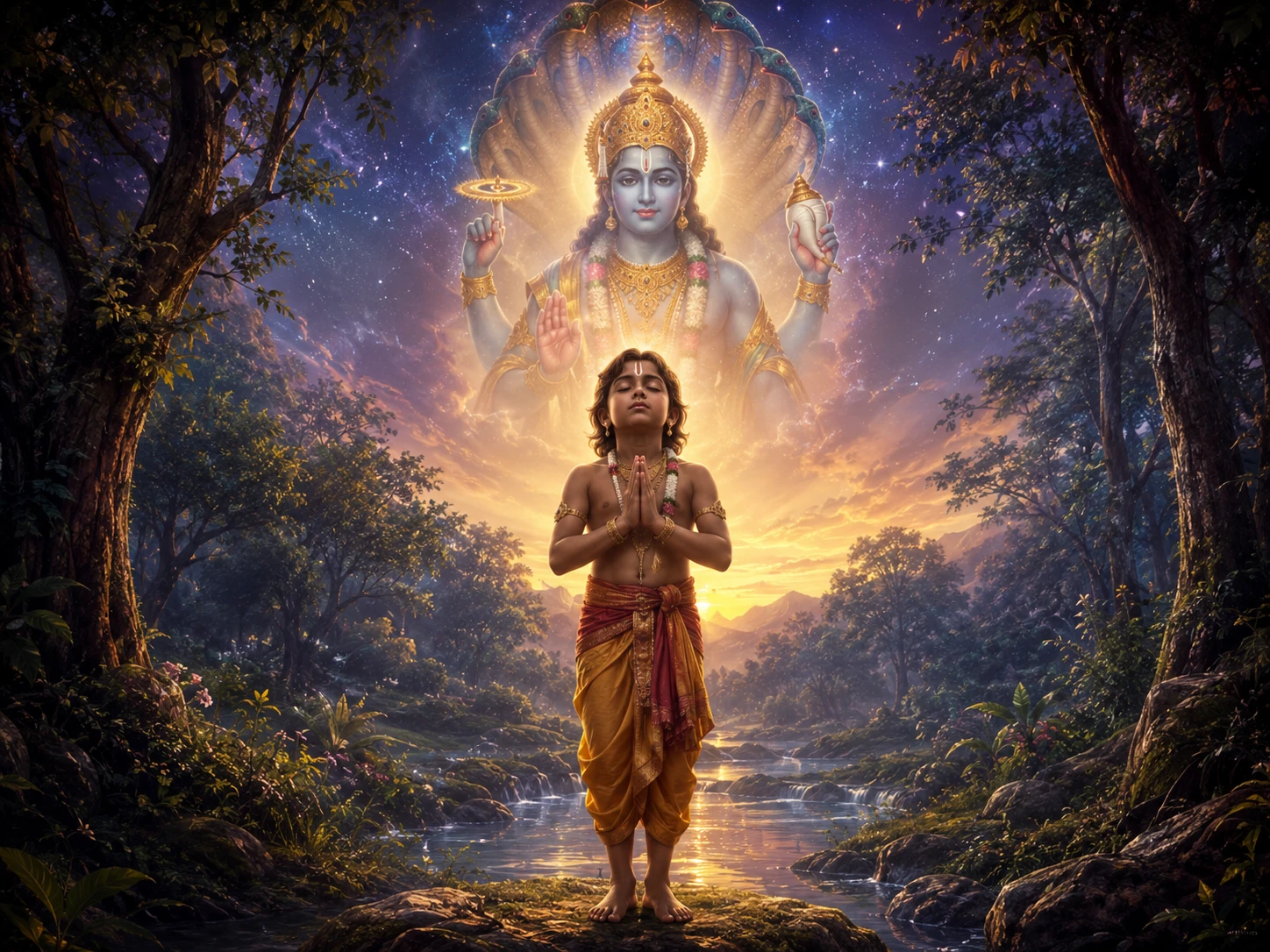
Dhruva was five years old when he was told he could not sit on his father's lap.
The father was King Uttanapada, son of Svayambhuva Manu, grandson of Brahma. The lineage was as direct as a Hindu lineage gets. The father had two wives. Suniti, the senior queen, was the mother of Dhruva. Suruchi, the younger, was the king's preferred wife and the mother of a half-brother named Uttama. On the day the Bhagavata records, the king was holding Uttama on his lap. Dhruva, the senior queen's son, walked over and tried to climb on too.
Suruchi pulled him off.
The Sanskrit of her words is sharp enough that even modern translators leave it almost untouched. You cannot sit on his lap, she said, because you were not born from my womb. If you want this position, perform tapasya so that in another lifetime you may be born to me, and only then will you have this right. Until then, leave this place.
The king said nothing. The Bhagavata is precise about this silence. Uttanapada heard the words. He saw his son's face. He did nothing. The Sanskrit verb the text uses for the king's reaction is bhinna-hridaya -- 'broken-hearted' -- but the man did not act on the broken heart. He let his junior wife define the rules of the household. Modern Indian children growing up in patchwork families, in cities where divorces and second marriages are no longer rare, sometimes recognise this moment instantly. The cruelty of a stepparent is real, but the deeper wound is the silence of the parent who watches it happen and does not intervene. The Bhagavata names that silence directly.
Dhruva ran from the room. He did not run to a friend. He did not run to a teacher. He ran to his mother. And what Suniti told him next is, in many Vaishnava commentaries, the most important sentence in the entire Bhagavata about how a Hindu mother is supposed to respond when her child is humiliated.
योऽन्तःप्रविश्य मम वाचमिमां प्रसुप्तां सञ्जीवयत्यखिलशक्तिधरः स्वधाम्ना। अन्यांश्च हस्तचरणश्रवणत्वगादीन् प्राणान्नमो भगवते पुरुषाय तुभ्यम्॥
yo 'ntaḥ-praviśya mama vācam imāṃ prasuptāṃ sañjīvayaty akhila-śakti-dharaḥ svadhāmnā anyāṃś ca hasta-caraṇa-śravaṇa-tvag-ādīn prāṇān namo bhagavate puruṣāya tubhyam
He who has entered within and, by His own light, has awakened this speech of mine that lay sleeping; who, holding all energies, also animates the other senses -- the hands, feet, ears, skin -- I bow to that Lord, that Person, in You.
— Bhagavata Purana 4.9.6
Suniti's Answer
Suniti did not curse Suruchi. She did not run to demand justice from Uttanapada. She did not consol her son with promises that the situation would change. The Bhagavata describes her as composed, careful, and devastatingly clear.
What your stepmother said is true, she told Dhruva. Power, position, the king's lap -- these things flow from karma, from one's own merit, from one's relationship with the Supreme. Your half-brother sits there because his mother is the favourite. That is a fact of this household. It will not change because we wish it. But there is a higher position than your father's lap. There is the lap of Vishnu Himself. To reach that, all you need is sincere tapasya. Even your stepmother said so, perhaps in mockery, but the path she pointed to is real.
Dhruva listened. He was five. The text is careful to give us his exact age. And then he made a decision that no other character in the Puranas makes at his age. He left.
He did not pack. He did not say goodbye. He walked out of the palace and into the forest, alone, in the direction his mother's words had pointed. The Bhagavata does not say where he was going. He did not know. He only knew that the position higher than his father's lap was somewhere outside the palace gates.
It is at this point in the narrative that Sage Narada appears. Narada was an old friend of Suniti's family, and the moment he heard from his celestial vantage that Dhruva had left, he descended to intercept the boy. Not, the commentaries note carefully, to send him home. To test him.
Narada's Mantra
Narada knelt to the boy's eye level. Tapasya is hard, he said. Tapasya at five is impossible. The forest has tigers. The cold of the night will kill you. Even great sages who have spent decades in such practice rarely receive direct darshan of Vishnu. Go home. Wait until you are older. Suruchi will eventually relent.
Dhruva listened. The text says he listened with full attention, the way a child listens to an elder. And then he gave Narada the answer that has been quoted in every commentary written on this episode for the last fifteen hundred years.
What my stepmother said cut through me like an arrow, he said. The wound is on the inside of my heart. Tapasya in the forest is not harder than carrying that wound back home. The tigers and the cold and the hunger will not be harder than walking past her face every morning. I have decided. Tell me how to do this, or move aside.
Narada was silent. The Sanskrit phrase is suchipravishtah -- as though pierced by a needle. The sage knew, in that moment, that the child standing in front of him was not making a child's promise. The decision was complete. There was no testing left to do.
Narada gave him the mantra. Twelve syllables. The dvadasakshari mantra of Vishnu. The same mantra that opens the Srimad Bhagavatam itself: Om Namo Bhagavate Vasudevaya. Repeat this mantra, Narada said. Go to a forest called Madhuvan, on the banks of the Yamuna, in a region you will later know as Mathura. Sit there. Eat what the forest gives you. Visualise the Lord's form between your eyebrows -- four hands, dark blue, smile of a child, garland of forest flowers, holding conch and discus and lotus and mace. The form is not abstract. The form is specific. Hold it. Repeat the mantra. Stay until He comes.
This is the mantra that has been chanted, with no break, for the five thousand years since. It is the most popular Vaishnava mantra in India today. Krishna devotees from Vrindavan to Bengaluru, from Houston to Sydney, repeat the same twelve syllables that Narada whispered to a five-year-old in a forest path. The lineage is unbroken.
Dhruva's Progressive Austerity in Madhuvan
| Month | Diet | Frequency | Posture / State | मास / आहार |
|---|---|---|---|---|
| First | Wild fruits (kapittha, badara) | Every third day | Standing meditation, mantra repetition | प्रथम / जंगली फल / तीसरे दिन |
| Second | Withered grass and leaves | Every sixth day | Single-pointed visualisation of Vishnu | द्वितीय / सूखी घास और पत्ते / छठे दिन |
| Third | Water only | Every ninth day | Mind held still on the divine form | तृतीय / केवल जल / नवें दिन |
| Fourth | Air only | Every twelfth day | Pranayama, breath as offering | चतुर्थ / केवल वायु / बारहवें दिन |
| Fifth | Nothing -- breath suspended | Continuous | Standing on one leg, motionless | पंचम / न आहार न श्वास / निरन्तर एक पैर पर |
| Sixth | Beyond food and breath | Continuous | Complete absorption -- earth tilts under his foot | षष्ठ / आहार-श्वास से परे / पृथ्वी डगमगाती है |
By the sixth month, the Bhagavata says, the Earth herself was unbalanced by Dhruva's tapasya, and the gods of all worlds had come to plead with Vishnu to grant the boy his wish before the universe lost its centre.
The Darshan in Madhuvan
Vishnu came at the end of the sixth month. Not as a vision, not as a voice, but in person, descending into the same forest clearing where the boy was standing on one leg. Dhruva, who had been holding the Lord's form between his eyebrows for half a year, opened his eyes and could not speak. The Bhagavata is exquisitely tender about this moment. The form he had been visualising was now in front of him -- four hands, the conch, the discus, the dark blue body, the smile -- and his speech failed.
Vishnu, seeing this, did something the Puranas record in only a handful of places. He touched Dhruva's right cheek with the conch shell. The Sanskrit verb is sprista -- 'touched.' One soft contact of metal to skin. And in that touch, all the Vedas opened in Dhruva's mind. The hymn that follows -- twelve verses of dense Vedanta from the mouth of a six-year-old who had been cursed at five for not being his stepmother's son -- is not the boy's composition. The Bhagavata is clear. The hymn was already inside him. The conch's touch only allowed it to surface.
This is the same theological pattern as the Gajendra Moksha. The hymn is older than the speaker. The grace was already deposited. The crisis only made it accessible. Hindus reciting this story to children in Pune apartments and Bengaluru flats do not always pause on this point, but every Vaishnava commentator does. The teaching is consistent across centuries: what you receive from God in the moment of grace is not something He invents on the spot. It is something He restores. You forgot it. The forest brought it back.
Dhruva sang the twelve verses. They are still recited daily in many Vaishnava homes. After the stuti, Vishnu spoke. He told Dhruva that the kingdom waiting for him was no longer just Uttanapada's kingdom. There was a higher seat, a fixed seat, a seat that no king and no curse and no stepmother could move. The North Star. The pole around which all other stars revolve. He would rule his earthly kingdom for thirty-six thousand years. And then he would ascend to that seat, and from there he would shine on every soul that looked up at the night sky and remembered him.
त्वद्दत्तया वयुनयेदमचष्ट विश्वं सुप्तप्रबुद्ध इव नाथ भवत्प्रपन्नः। तस्यापवर्ग्यशरणं तव पादमूलं विस्मर्यते कृतविदा कथमार्तबन्धो॥
tvad-dattayā vayunayedam acaṣṭa viśvaṃ supta-prabuddha iva nātha bhavat-prapannaḥ tasyāpavargya-śaraṇaṃ tava pādamūlaṃ vismaryate kṛta-vidā katham ārta-bandho
By the discernment You have given, I now see this universe as one who has woken from deep sleep, surrendered to You. How can a soul who has known Your refuge -- the foot of liberation, friend of the distressed -- ever forget You?
— Bhagavata Purana 4.9.8
The North Star that we see today, Polaris (Alpha Ursae Minoris), is not the same star that ancient Indian astronomers identified as Dhruva. The Earth's axis wobbles in a 26,000-year cycle called precession, which means the title of 'Pole Star' rotates among different stars. Around 3000 BCE, when the Pyramids were being built, the pole star was Thuban (Alpha Draconis). Polaris took the position around 500 CE. By the year 14000 CE, Vega will be the Pole Star. The Bhagavata's claim that Dhruva sits at the still centre of the wheeling sky aligns more cleanly with the concept of the celestial pole itself, the unmoving point in space, rather than with any one star occupying that position at a given time.
The Return Home
Dhruva returned. The Bhagavata records this with great care because it is the part of the story that ordinary readings often skip. He did not stay in the forest. He did not become a sannyasi. He did not renounce his father, his mother, or even Suruchi. He came home a king. The same king who had been thrown off his father's lap walked back into the palace, and the entire household, including Suruchi, came forward to receive him.
The father, Uttanapada, ran out of the palace gates to meet him. The Sanskrit phrase the Bhagavata uses for this scene is unusually emotional even by Puranic standards: pranetya, abhyetya, alingya, mardhny aghraya -- 'rushed forward, drew near, embraced him, smelled his head.' The smelling of the head is the traditional Indian father's gesture of reclaiming a lost child. Uttanapada, the father who had failed his son once, did not fail him on the day he returned. He smelled his son's head. He cried. The text does not say he asked for forgiveness, but it does not need to. The forehead-smell is itself the asking.
Suruchi too came forward. Dhruva did not ignore her. He did not punish her. He did not make a scene of his ascendancy. The Bhagavata says he saluted her with the same respect he gave his birth mother. The half-brother Uttama, who had once been placed on the lap that Dhruva was denied, embraced him as a brother. The household was not split by Dhruva's tapasya. It was healed.
This is the part of the story that does not fit a Western 'hero defeats antagonist' narrative. There is no defeat. The stepmother is not punished. The father is not shamed. The Bhagavata's claim is that genuine spiritual realisation, the kind earned through the dvadasakshari mantra and six months of single-pointed meditation, does not produce a victor. It produces a son who can return home and bow to the same woman who once threw him out.
Dhruva ruled for thirty-six thousand years. The Bhagavata gives the number with a straight face. Whether literal or symbolic, the point is that his rule was long, his rule was just, and at the end of it he ascended -- not after death, but in his living form -- to the still centre of the sky. From there, the text says, he watches over every soul that looks up.
The Bhagavata adds a detail that traditional commentators dwell on at length. When Dhruva returned to the palace, his stepmother Suruchi -- the woman whose insult had launched the entire arc -- came forward and embraced him. He bowed to her with the same respect he gave to his own mother. The Mahabharata-era ethic of pranama to all elders is not abandoned in the Bhagavata; it is intensified. The boy who has stood face to face with Narayana does not now look down on the woman who pushed him out of the palace. He treats her as another mother, because the four-armed Lord he has just seen is also her Lord. This refusal to convert spiritual attainment into family revenge is what the Vaishnava commentaries flag as the proof that Dhruva's tapasya was real. A vision that hardens you against your own family is a vision misread. A vision that softens you toward the people who hurt you is the vision the Bhagavata is willing to call siddhi.
What the Mantra Actually Says
The twelve syllables Narada gave Dhruva are not a magical spell. The Bhagavata, and the entire Vaishnava tradition that flows from it, is careful to insist on this. Om Namo Bhagavate Vasudevaya is a complete Vedantic theology compressed into the minimum number of syllables Sanskrit grammar will allow.
Om is the primordial sound, the seed-syllable that the Mandukya Upanishad spends its entire treatise unpacking. Namah is salutation, but more specifically, the surrender of the small self -- na-mama, 'not mine.' Bhagavate is the dative form of Bhagavan, the One who possesses the six divine attributes: complete sovereignty, complete strength, complete fame, complete beauty, complete knowledge, complete renunciation. Vasudevaya is the dative form of Vasudeva, which has two simultaneous meanings the tradition holds together: the son of Vasudeva (Krishna), and the One who dwells (vasati) in all beings (deva). The mantra therefore says: I salute, with no claim of self, the Lord who has all six perfections, who is both the historical descended form and the indwelling presence in every being.
A five-year-old who repeated this twelve-syllable mantra for six months was not just chanting. He was, by the design of the mantra, slowly internalising a Vedanta that most adults in any age would struggle to articulate. The repetition was the teaching. By the time Vishnu touched his cheek with the conch, Dhruva did not need to be told what was happening. The mantra had already told him.
This is why the same mantra remains the most common dvadasakshari mantra in Vaishnava initiation today. From ISKCON temples in Mayapur to Madhva matha in Udupi, the mantra Narada gave a child by the side of a forest path five thousand years ago is the same mantra a young software engineer in Hyderabad receives at her diksha ceremony before her Tirupati pilgrimage. The lineage holds. The teaching holds. And what the Bhagavata insists is that the mantra works because of what it says, not because of what it does.
Madhuvan, the forest where Dhruva performed his tapasya, is one of the twelve forests of Vraj that Vaishnavas circumambulate during the Braj Chaurasi Kos Yatra. The site lies about 6 kilometres south of Mathura town, near the modern village of Maholi. A small temple complex marks the spot where, by tradition, the boy stood on one leg for six months. NRI families on the Braj Yatra circuit -- which has surged in popularity since 2017 -- often bring their school-age children specifically to Madhuvan, telling them Dhruva's story at the same age that the boy himself was when he left home.
The Two Lessons That Survive Today
There are two readings of Dhruva's story that compete for attention in modern Indian homes. Both are honest. Both come from the text. They sit in slight tension with each other.
The first reading is the one most parents tell their children. Dhruva was insulted, he refused to accept the insult, he worked harder than anyone expected, and the result was a position higher than any his stepmother could deny him. This is the JEE-aspirant reading, the IAS-aspirant reading, the immigrant-child-in-Toronto reading. It says: when someone tells you that you cannot, set yourself a target so high that the original closure becomes irrelevant. The boy who could not sit on his father's lap became a star. There is power in this reading, and the Bhagavata does not contradict it.
The second reading is the one Vaishnava commentators emphasise more carefully. Dhruva did not perform tapasya to win. He performed tapasya because his mother told him a higher seat existed than the one he had been denied. The original wound was real, but the response was not revenge. It was redirection. By the time Dhruva reached Madhuvan, the question of his stepmother's lap had already been replaced by a different question: where is Vishnu? When he came home, Suruchi was no longer his enemy. She was just another person in a household he had returned to from somewhere else.
The modern parent who tells the first version of the story to her child is teaching ambition. The Vaishnava who recites the second version in a satsang is teaching transformation. The Bhagavata, characteristically, does not insist on one over the other. It puts both in the same six chapters and lets the reader take the version she needs. The IIT aspirant in Kota who reads it before the JEE Advanced needs the first. The middle-aged software engineer at Infosys who reads it after a cancer diagnosis needs the second. Both are inside the same story.
What the Bhagavata insists on, however, is the link between them. Without genuine effort -- without the six months in Madhuvan -- the transformation does not arrive. Without the redirection toward Vishnu, the effort produces only resentment dressed up as success. Dhruva's tapasya works because both halves are present. Ambition without bhakti turns hard. Bhakti without ambition stays unborn.
The second lesson is for the parents in the room. Suniti did not match Suruchi's cruelty with cruelty. She matched it with direction. The Bhagavata gives parents a model that the modern household keeps forgetting -- when a child is humiliated, the answer is not to humiliate the humiliator. The answer is to point the child toward something larger than the wound. Suniti did exactly that, and a star was born.
Chant the Vasudeva Mantra
The twelve-syllable mantra Narada gave Dhruva -- Om Namo Bhagavate Vasudevaya -- has its own page on Eternal Raga with its meaning and how to chant it. Chant it 108 times daily, ideally facing the Pole Star at night. The episode itself is told in the Bhagavata Purana, canto 4, chapter 8, also on the site.
Tags
Eternal Raga · शाश्वत राग
Institutional voice — scholarly articles on Sanatan Dharma
Deepen Your Understanding
अपनी समझ और गहरी करें
scriptural exegesis
Gajendra Moksha -- The Elephant's Cry That Brought Vishnu Down
An elephant king. A crocodile's jaws. A thousand years of struggle. And then one cry of total surrender that made Vishnu leap off his cosmic seat. The Gajendra Moksha is the Bhagavata's masterclass in what happens when self-effort runs out and grace begins.
scriptural exegesis
Prahlada and Narasimha -- Faith That Split a Pillar
A five-year-old boy told the most powerful being in the universe that God exists everywhere -- even in a pillar. His father smashed the pillar to prove him wrong. God stepped out. The Prahlada-Narasimha story is not a children's tale. It is the most radical statement about faith in all of Hindu literature.
deities avatars
Dashavatara -- Why Vishnu Comes Back Ten Times
Fish, tortoise, boar, half-lion, dwarf, axe-warrior, prince, cowherd, enlightened teacher, future horseman. The ten avatars of Vishnu are not random folklore. Read them in sequence and you get something startling -- a narrative that mirrors evolutionary biology, tracks the rise and fall of political systems, and argues that God does not sit above history but enters it, gets dirty, and does the work. The Dashavatara is Hinduism's answer to the question every civilisation asks: why does the world keep breaking, and who fixes it?
vedic sciences
Kaal Ganana -- The Hindu Measure of Time
From a single blink of the eye (Nimesha) to one Day of Brahma (4.32 billion years) -- explore the complete cosmic time hierarchy of Hindu cosmology, anchored in Vishnu Purana 1.3, with its remarkable parallels to modern science.
scriptural exegesis
Vamana and Bali -- The Avatar Who Took Three Steps And A Kingdom
An asura king so generous he was loved across the three worlds. A Vishnu avatar so small he had to look up to ask for charity. A bargain measured in three footsteps. The Vamana-Bali story is the Bhagavata's most layered teaching on what divine grace actually looks like when it appears to take everything from you.
scriptural exegesis
Samudra Manthan -- When Gods and Demons Ran a Joint Venture and the Universe Almost Died
A cosmic ocean. A mountain for a churning rod. A serpent king for a rope. Gods on one end, demons on the other. And out came 14 treasures -- including wealth, beauty, medicine, immortality, and one poison so lethal it could end creation itself. The Samudra Manthan is not mythology. It is the original playbook for collaboration, crisis management, and how to handle it when your joint venture partner tries to cheat you.
The North Star that we see today, Polaris (Alpha Ursae Minoris), is not the same star that ancient Indian astronomers identified as Dhruva. The Earth's axis wobbles in a 26,000-year cycle called precession, which means t…
More in Scriptural Exegesis
Abhimanyu and the Chakravyuha -- The Boy Who Knew How to Enter but Not How to Leave
14 min read
Adbhuta Ramayana -- The Ramayana Where Sita Becomes Kali
9 min read
After Kurukshetra -- What Happened Next
14 min readThe same translation error that turned '33 Koti' into '33 crore' in Hinduism also happened in Buddhism. The Chinese translation of Buddhist texts rendered 'Sapta Koti Buddha' (7 Supreme Buddhas) as '7 Crore Buddhas.' The…
Deities AvatarsCommunity Reflections
🕉️
Be the first to share your reflection.