Vamana and Bali -- The Avatar Who Took Three Steps And A Kingdom
वामन और बलि -- वह अवतार जिसने तीन पग और एक राज्य लिया
The King The Devas Could Not Defeat
Bali Maharaja was an asura. The Bhagavata Purana never tries to soften this. He was the grandson of Prahlada, the great-grandson of Hiranyakashipu, born into the most controversial royal lineage in Hindu cosmology. And yet, by the eighth canto of the Bhagavata, when his story unfolds across nine chapters, Bali is treated by the text with a respect bordering on reverence. He is righteous. He is generous beyond measure. He performs yajnas with full vidhi. He treats brahmins with extraordinary courtesy. He has restored the asura kingdom that his ancestors lost. He has, on the strength of his sheer dharmic discipline, conquered the three worlds.
This is the problem. Indra, the ruler Bali has displaced, is in hiding. The devas have lost their sacrificial portions. The cosmic order, the Bhagavata explains, is not a moral hierarchy. It is a structural one. Each office has its rightful occupant; when an asura, however righteous, sits on the throne meant for the deva, the structure goes off-balance. Bali's righteousness does not solve the problem. It deepens it. The devas approach Vishnu, not because Bali is wicked, but because Bali is in the wrong office.
Vishnu listens. He does not say Bali is bad. He does not say Bali deserves to fall. He says, in effect, that Bali has earned everything he has and yet still must be moved, and the moving must be done in such a way that Bali's dignity is preserved, his lineage honoured, and his devotion rewarded. The Vamana avatar is the form Vishnu takes to do this delicate work. The story that follows is not a story of an asura's defeat. It is the most carefully designed transition of power in the Hindu mythological corpus.
क्रमतो गां पदैकेन द्वितीयेन दिवं विभोः। खं च कायेन महता तार्तीयस्य कुतो गतिः॥
kramato gāṃ padaikena dvitīyena divaṃ vibhoḥ khaṃ ca kāyena mahatā tārtīyasya kuto gatiḥ
With one step He will cover the earth. With the second, the heavens. With His expanded body, the sky itself. Where then will the third step go?
— Bhagavata Purana 8.19.34 (Shukracharya warning Bali about Vamana)
The Sage Who Saw It Coming
Bali, having attained universal sovereignty, undertook a great Ashvamedha yajna -- the horse sacrifice that confirms a king's status as chakravartin. The yajna was conducted on the banks of the Narmada in the Bharukaccha region. Brahmins, sages, and cosmic functionaries attended. Bali stood at the centre, dispensing gifts to whoever asked, with a single rule -- nothing requested at this yajna would be refused.
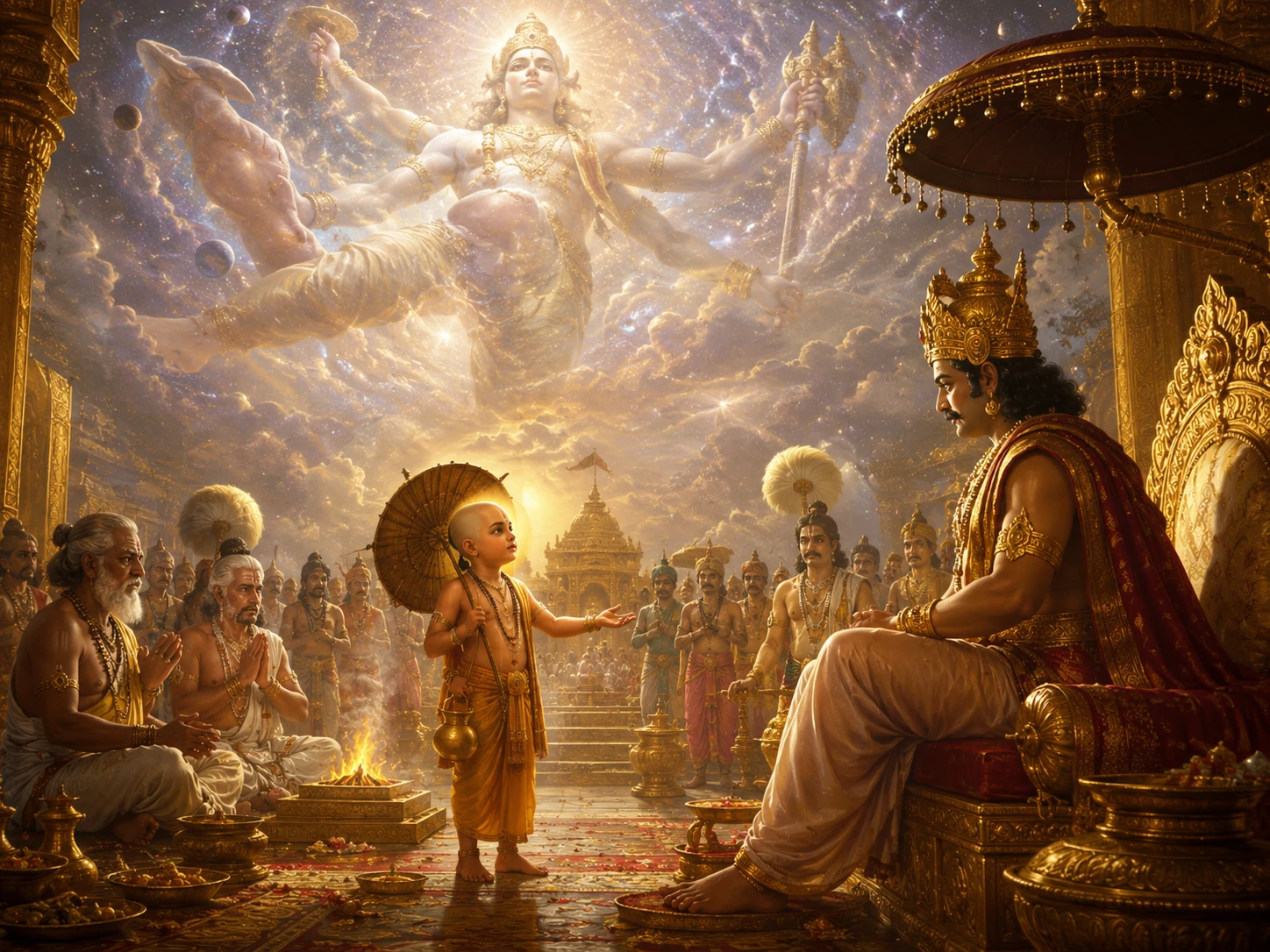
Vamana arrived at the gate. The Bhagavata describes him with great care. He was a small brahmin boy, not yet of full stature, wearing a deer-skin upper garment, carrying a yajnopavita on his shoulder, a danda in one hand, a kamandalu in the other, and a small umbrella over his head. He chanted Vedic mantras as he walked. Bali, the moment he saw him, rose from the throne. The text describes Bali's instinct as immediate -- this was no ordinary brahmacari. The radiance was wrong for that body. The voice was wrong for that age.
Shukracharya, the asura clan's preceptor, arrived at the same instant. Shukracharya could see, with the divine vision granted by his austerities, exactly who this small brahmin was. He drew Bali aside. He delivered the warning that the Bhagavata records as verse 8.19.34 -- this is Vishnu in disguise, this is the moment your kingdom ends, do not promise this brahmacari anything. Send him away with food and water and a polite refusal. The Bhagavata is precise about Bali's response. Bali heard his guru. Bali considered the warning. Bali rejected it. He told Shukracharya that a vow once spoken cannot be unsaid; that he had, before the yajna began, declared that no requestor would be refused; that even if the requestor was Vishnu Himself in dwarf form, the vow stood. Shukracharya, furious, cursed his own disciple to lose his fortune. The Bhagavata records the curse calmly. Bali accepts it. He turns to Vamana.
The Three Steps
Bali asked Vamana what the brahmacari needed. Vamana's reply is one of the most quietly devastating exchanges in the Bhagavata. He did not ask for gold. He did not ask for cattle. He did not ask for villages. He asked for three steps of land. Three. As measured by his own small feet.
Bali laughed. The text records that he laughed gently, with affection. He offered Vamana the wealth of his treasury, the cattle of his stables, an entire kingdom from his vast holdings. The boy refused all of it. He insisted on the three steps. Bali, smiling at what he assumed was a child's modesty, agreed. He performed the sankalpa. He poured the ritual water onto Vamana's outstretched hand. The water touched the skin. The agreement was sealed by Vedic procedure.
In that moment, Vamana grew. The Bhagavata's description of the growth is among the longest sustained passages of cosmic visualisation in the entire Sanskrit corpus. The dwarfish body expanded vertically and horizontally simultaneously. His feet became the foundations of the earth. His thighs became the mountains. His hips became the atmosphere. His chest became the planetary system of the devas. His shoulders became the realms beyond. His head reached the topmost heavens. The water from Bali's offering, falling toward what had been a small hand, now travelled an unimaginable distance to reach the cosmic palm of Trivikrama -- the One Who Has Three Strides.
Vishnu took his first step. The earth, with all its continents, oceans, kingdoms, and mountains, was covered. The text records the cosmic geography in detail. Vishnu took his second step. The atmosphere, the heavens, the realms of devas, the abode of stars -- all of it disappeared under his second foot. The text now arrives at the moment Shukracharya predicted. There is no third place. The three worlds have already been measured by two strides. Vishnu pauses, his cosmic body towering over the assembly, and asks Bali in a voice that fills the universe -- where will the third step go?
What Each Step Took, And What It Returned
| Step | पग | What Was Measured | What Was Lost | What Was Gained |
|---|---|---|---|---|
| First | प्रथम | The earth (Bhuloka) -- continents, oceans, mountains, kingdoms | Bali's terrestrial sovereignty | Bali learns that material wealth has cosmic limit |
| Second | द्वितीय | The heavens (Svarloka) -- realm of devas, planetary systems | Bali's celestial sovereignty | Indra is reinstated; cosmic structural balance restored |
| Third | तृतीय | Bali's own head -- the seat of ego | Bali's pride; the last possession he could have kept | Direct contact with Vishnu's foot, the highest devotional honour |
The third step is the theological pivot of the entire avatar. There was no third place to step because the universe had been exhausted in two strides. Bali, given the option to break his promise and save his head, instead lowered it. The text is precise -- he asked Vishnu to place the third foot on him. The asura who would not break a vow even to save himself received, in that surrender, what no deva had ever received -- Vishnu's foot directly upon his head, eternal protection at the gates of his palace, and the title that no other being in the Bhagavata holds: the most beloved devotee of the avatar who personally pushed him into the netherworld.
Sutala -- The Kingdom Vishnu Gave Back
After the third step pressed Bali down toward Patala, Vishnu did something the Bhagavata records as theologically extraordinary. He did not abandon Bali in the netherworld. He went there. He installed Bali as the ruler of Sutala -- one of the seven subterranean realms, but not a hellish one. Sutala in the Bhagavata's cosmology is described as a kingdom more beautiful than Indra's heavenly Amaravati. Its gardens never wither. Its rivers never dry. Its inhabitants never age. Vishnu announced that he would personally stand guard at the gates of Sutala for as long as Bali ruled there. The dvarapala -- the doorkeeper -- of Sutala is therefore Vishnu Himself.
This is the deepest theological inversion in the entire Vamana story. Bali lost the three worlds. Bali lost his throne. Bali lost his army. Bali lost his title. And in exchange, Bali received an arrangement that no deva, no rishi, no devotee in any other Puranic episode has received. Vishnu became his personal guardian. The Lord whose discus has destroyed armies of asuras stood at the door of one asura's palace, watching over him as he ruled.
The Bhagavata explains this through the principle that the Vaishnava commentaries call the highest grace -- nigraha-anugraha. The grace that comes wrapped in restraint. Vishnu's foot upon Bali's head was not punishment. It was initiation. The pressure was not a curse. It was diksha. Bali received, through the loss of everything he thought he owned, the only thing the Bhagavata considers permanent -- direct, unmediated, eternal contact with the Lord.
Shri Prahlada, Bali's grandfather, arrived at Sutala to be with him. Vindhyavali, Bali's wife, accompanied him. The Bhagavata closes the arc with a description of Sutala that reads almost like a homecoming. The asura who had been pushed down by Vishnu's foot was, by every measurable spiritual standard, more elevated after the fall than he had been before it. The kingdom of Sutala is the Bhagavata's quiet teaching that some descents are ascents in disguise.
भवद्भिर्निर्जिता ह्यद्य भगवान्भगवत्तमः। पदं स्थापय मे मूर्ध्नि शिवायाशिवशान्तये॥
bhavadbhir nirjitā hy adya bhagavān bhagavattamaḥ padaṃ sthāpaya me mūrdhni śivāyāśiva-śāntaye
By You I have today been conquered, O Supreme Lord of Lords. Place Your foot upon my head, for the auspicious removal of all that is inauspicious in me.
— Bhagavata Purana 8.22 (Bali to Vamana, offering his head as the place for the third step)
Onam, celebrated annually across Kerala in August or September, is the largest commemoration of the Vamana-Bali story anywhere in the Hindu world. Kerala's tradition holds that Bali was the just king under whose rule there was no untouchability, no theft, no falsehood, no caste discrimination, and no poverty. After his banishment to Sutala, Vishnu granted him one boon -- that he could return to visit his people once a year. Onam is that visit. The ten-day festival begins with Atham, builds through floral carpets called pookkalam, peaks on Thiruvonam with the elaborate vegetarian feast called sadhya served on banana leaves, includes the Vallamkali snake-boat races on the backwaters near Aranmula and Kuttanad, and is accompanied by Pulikali tiger dances in Thrissur. Onam is celebrated as a state festival in Kerala by all communities -- Hindu, Christian, Muslim -- because it commemorates a king whose rule made everyone equal. Kerala diaspora across the UAE, Qatar, Singapore, and the United States organise Onam celebrations every year that draw thousands. It is, by participation count, possibly the most inclusive Hindu festival in modern India.
The Difficult Part Of The Story
It must be acknowledged that this story is read very differently in Kerala than in many other parts of the Hindu world. Kerala's regional memory of Mahabali is overwhelmingly positive. He is the beloved king. Vamana, in much of Malayali popular imagination, is the deity who took away a beloved king. The Onam song 'Maveli Naadu Vaanidum Kaalam' celebrates Bali's golden age, when there was no falsehood and no inequality. There is a melancholy in Kerala's Onam that is essential to its observance -- the melancholy of a people remembering a ruler who was, in their telling, taken from them.
The Bhagavata Purana's framing is different. The Bhagavata, written from a pan-Indian Vaishnava perspective, treats the Vamana avatar as the central agent and Bali as the recipient of grace. Both readings are present in the same story. Both are dharmic. Both have been held simultaneously by Hindus for centuries without contradiction. The Bhagavata does not deny that Bali was beloved; it agrees and explains the cosmic reason he had to be moved. The Kerala tradition does not deny that Bali received grace; it celebrates his annual return as proof that the grace held.
The more thoughtful theological writing on this -- including the work of late twentieth-century Vaishnava scholars at the Sanskrit College in Tripunithura, Kalady, and the Sree Sankaracharya University -- holds both readings together. Bali was a great king. His displacement was not because he was bad. The displacement, however, was the means by which he received the deepest grace available to any soul. Sutala is not exile. Sutala is initiation. Onam is not mourning. Onam is the annual reminder that the king's grace continues to bless his people through his annual visit.
A Hindu in Mumbai who watches Kerala's Onam celebrations on television without context can misread the festival as a mournful one. The thoughtful reading is that Onam is celebrated, not despite the loss of Bali, but because of how that loss was actually structured. The king is not gone. He is at the gate of Sutala, attended by Vishnu Himself, returning yearly to bless those who once loved him. This is the kind of reading the Bhagavata, and Kerala's tradition together, ask of their thoughtful readers.
What Vamana Asks Of The Modern Reader
The Vamana avatar produces a particular discomfort in modern readers, and the Bhagavata is honest enough to make space for that discomfort. Vamana arrived in disguise. Vamana asked for less than he intended to take. Vamana grew without warning. Bali was, by every contractual standard, deceived. Even Bali's own wife Vindhyavali, in chapter 22, calls this out -- she says, with her face downcast, that the worlds belong to Vishnu in the first place, and that the entire transaction was fraudulent in the sense that the asker was not entitled to ask, the giver was not entitled to give, and the gift was already the asker's own. The Bhagavata records her words. It does not silence her.
This is the level of theological honesty the Bhagavata performs at its best. The text is not pretending Vamana's request was fair. It is acknowledging that the avatar performed a kind of cosmic legal manoeuvre and asking the reader to think about what that manoeuvre actually accomplished. A young lawyer in Bengaluru reading the text for the first time after working on a corporate fraud case finds the parallel uncomfortable. She is, after all, in the business of deciding when manoeuvres of this kind are unethical. The Bhagavata's answer, when read carefully, is not that Vamana's manoeuvre was ethical by the standards of human contract law. The text's answer is that the divine operates in a register that contract law does not capture, and that Bali's response to the manoeuvre -- offering his own head, never breaking his vow, accepting the loss with full equanimity -- is what makes the entire transaction ultimately just.
A software engineer in Hyderabad reading the same chapter notices something different. Bali, knowing he is being asked for everything, does not flinch. The Bhagavata is teaching, through Bali's example, what surrender actually looks like when it is not theatre. Bali does not weep. He does not protest. He does not negotiate. He performs the sankalpa, accepts the consequences, and asks for the third step on his head. The engineer, who has just spent six months negotiating a contract dispute with a former employer over stock options, recognises in Bali's response a kind of dignity that is unavailable to anyone who is still secretly hoping to retain something.
A homemaker in Kochi who has hosted twenty-three Onams in her family courtyard reads the chapter with the comfort of someone who already knows how the story ends. For her, the painful part of the story is not Bali's loss. It is Bali's annual return. Once a year, the king who was taken from her ancestors comes back as a guest, sits at her threshold for a day, eats the sadhya laid on the banana leaf, and leaves before nightfall. The chapter, for her, is not about cosmic balance or contract law. It is about what it means to be visited annually by someone you love and to know, every year, that the visit will end at sunset. The Bhagavata does not speak directly to her experience. But the chapter, properly read, makes room for it.
The Lineage Behind The Surrender
Bali could refuse Shukracharya, accept Vamana, and offer his own head only because of who his grandfather was. Prahlada, Bali's father's father, had spent his childhood reciting Narayana's name while his own father Hiranyakashipu tried in successive ways to kill him. Prahlada survived because Vishnu himself, in the form of Narasimha, emerged from a pillar to defend him. Prahlada then ruled the asura kingdom as a Vaishnava devotee, raised his son Virochana in that tradition, and Virochana raised his son Bali in turn. The Bhagavata is precise about this lineage. Bali was, by birth, an asura. By spiritual descent, he was a Vaishnava three generations deep.
When Vamana stood before him at the yajna, Bali did not see a stranger. He saw, in the depth of his trained vision, the same Lord who had once split a pillar to save his grandfather. The asura who would not break his promise was the great-grandson of the asura who would not stop chanting Narayana's name. The vow Bali kept was not, properly speaking, his own. It was a family inheritance. Three generations of devotion arrived at one moment of surrender.
This is why the Bhagavata, after the Vamana avatar's work is complete, brings Prahlada to Sutala. The grandfather comes to be with the grandson. The text describes their meeting with extraordinary tenderness. Prahlada has waited centuries for this moment. He embraces Bali. He tells him that the loss of three worlds in exchange for the foot of Vishnu on the head is the greatest exchange any being has ever achieved in the cosmic ledger. Prahlada knows. Prahlada was the first one in the lineage to discover this exchange-rate. Bali is the great-grandson who finally cashed it in.
The Bhagavata is teaching, through this multi-generational arc, that no individual's surrender is purely individual. Behind every great act of Vaishnava giving sits a family or a guru or a tradition that taught the giver, often without the giver knowing, what the right answer would be when the moment of asking finally arrived. Bali had been prepared by Prahlada for this conversation since childhood. Prahlada had been prepared by Narasimha. Narasimha was prepared by the Lord's own intervention in the pillar. The chain of grace runs all the way down. The avatar does not arrive in any moment alone. The avatar arrives prepared by every previous act of bhakti the lineage has performed. This is why the Bhagavata is, in the end, a lineage text. Read this way, the Vamana-Bali story is the Hindu tradition's clearest statement that what looks like a single soul's moment of surrender is actually the closing chapter of a family's centuries-long manuscript.
The Vamana mantra 'Om Namo Bhagavate Vamanaya' is recited specifically by Vaishnava families seeking the removal of pride and the blessing of right dharmic action in matters of giving. The Vamana temple at Thrikkakara near Kochi -- the only major Vamana temple in India -- is the focal point of the official Onam festival, with the deity formally welcoming Bali back during the ten-day celebration. The temple is mentioned in early Tamil Sangam literature, suggesting it predates the Bhagavata Purana itself in textual reference. Pilgrims from across the Malayali diaspora -- from Sharjah, Doha, Singapore, Toronto -- visit Thrikkakara during Onam to receive prasad from the only place in the world where Vamana and Bali are formally honoured together as host and returning guest.
Read the Vamana Story in the Bhagavata
The Vamana episode fills the Bhagavata Purana's eighth canto, chapters 18 to 23. It is traditionally read during Onam, on Vamana Jayanti (Bhadrapada Shukla Dwadashi), and at moments of major life transition that call for generosity or the giving up of position. It is on Eternal Raga with Sanskrit and translation.
Tags
Eternal Raga · शाश्वत राग
Institutional voice — scholarly articles on Sanatan Dharma
Deepen Your Understanding
अपनी समझ और गहरी करें
deities avatars
Dashavatara -- Why Vishnu Comes Back Ten Times
Fish, tortoise, boar, half-lion, dwarf, axe-warrior, prince, cowherd, enlightened teacher, future horseman. The ten avatars of Vishnu are not random folklore. Read them in sequence and you get something startling -- a narrative that mirrors evolutionary biology, tracks the rise and fall of political systems, and argues that God does not sit above history but enters it, gets dirty, and does the work. The Dashavatara is Hinduism's answer to the question every civilisation asks: why does the world keep breaking, and who fixes it?
scriptural exegesis
Prahlada and Narasimha -- Faith That Split a Pillar
A five-year-old boy told the most powerful being in the universe that God exists everywhere -- even in a pillar. His father smashed the pillar to prove him wrong. God stepped out. The Prahlada-Narasimha story is not a children's tale. It is the most radical statement about faith in all of Hindu literature.
scriptural exegesis
The Govardhana Episode -- The Day Vrindavan Stopped Worshipping Indra
A seven-year-old boy convinces his village to skip the annual rain-god ceremony and worship the local hill instead. The rain-god retaliates with a flood. The boy lifts the hill on one finger for seven days. Behind the lila sits one of the Bhagavata's sharpest theological arguments -- about who actually deserves your puja.
scriptural exegesis
Gajendra Moksha -- The Elephant's Cry That Brought Vishnu Down
An elephant king. A crocodile's jaws. A thousand years of struggle. And then one cry of total surrender that made Vishnu leap off his cosmic seat. The Gajendra Moksha is the Bhagavata's masterclass in what happens when self-effort runs out and grace begins.
scriptural exegesis
Samudra Manthan -- When Gods and Demons Ran a Joint Venture and the Universe Almost Died
A cosmic ocean. A mountain for a churning rod. A serpent king for a rope. Gods on one end, demons on the other. And out came 14 treasures -- including wealth, beauty, medicine, immortality, and one poison so lethal it could end creation itself. The Samudra Manthan is not mythology. It is the original playbook for collaboration, crisis management, and how to handle it when your joint venture partner tries to cheat you.
deities avatars
Bal Krishna vs Kamsa's Demons -- How a Toddler Defeated an Army
Kamsa sent his deadliest assassins to kill a baby in Vrindavan. A poisoned wet-nurse. A whirlwind. A python the size of a mountain. A crane. A bull. A donkey. A serpent that boiled an entire river. One by one, the infant Krishna dispatched them all -- sometimes with a kick, sometimes with a smile, once by simply becoming too heavy to lift. This is the Bhagavata Purana's most beloved narrative: the child-god who turns assassination attempts into playground games.
Onam, celebrated annually across Kerala in August or September, is the largest commemoration of the Vamana-Bali story anywhere in the Hindu world. Kerala's tradition holds that Bali was the just king under whose rule the…
More in Scriptural Exegesis
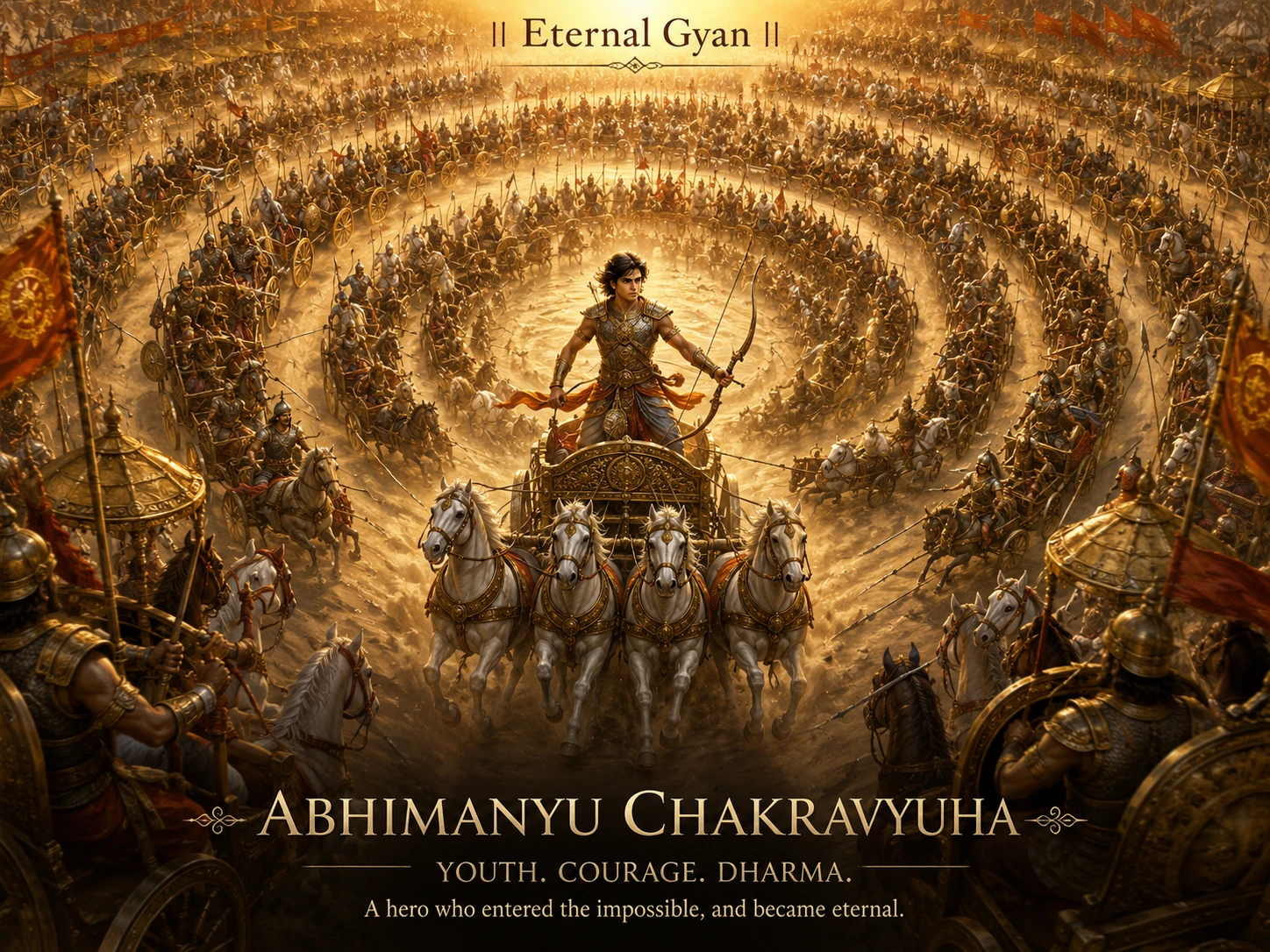
Abhimanyu and the Chakravyuha -- The Boy Who Knew How to Enter but Not How to Leave
14 min read
Adbhuta Ramayana -- The Ramayana Where Sita Becomes Kali
9 min read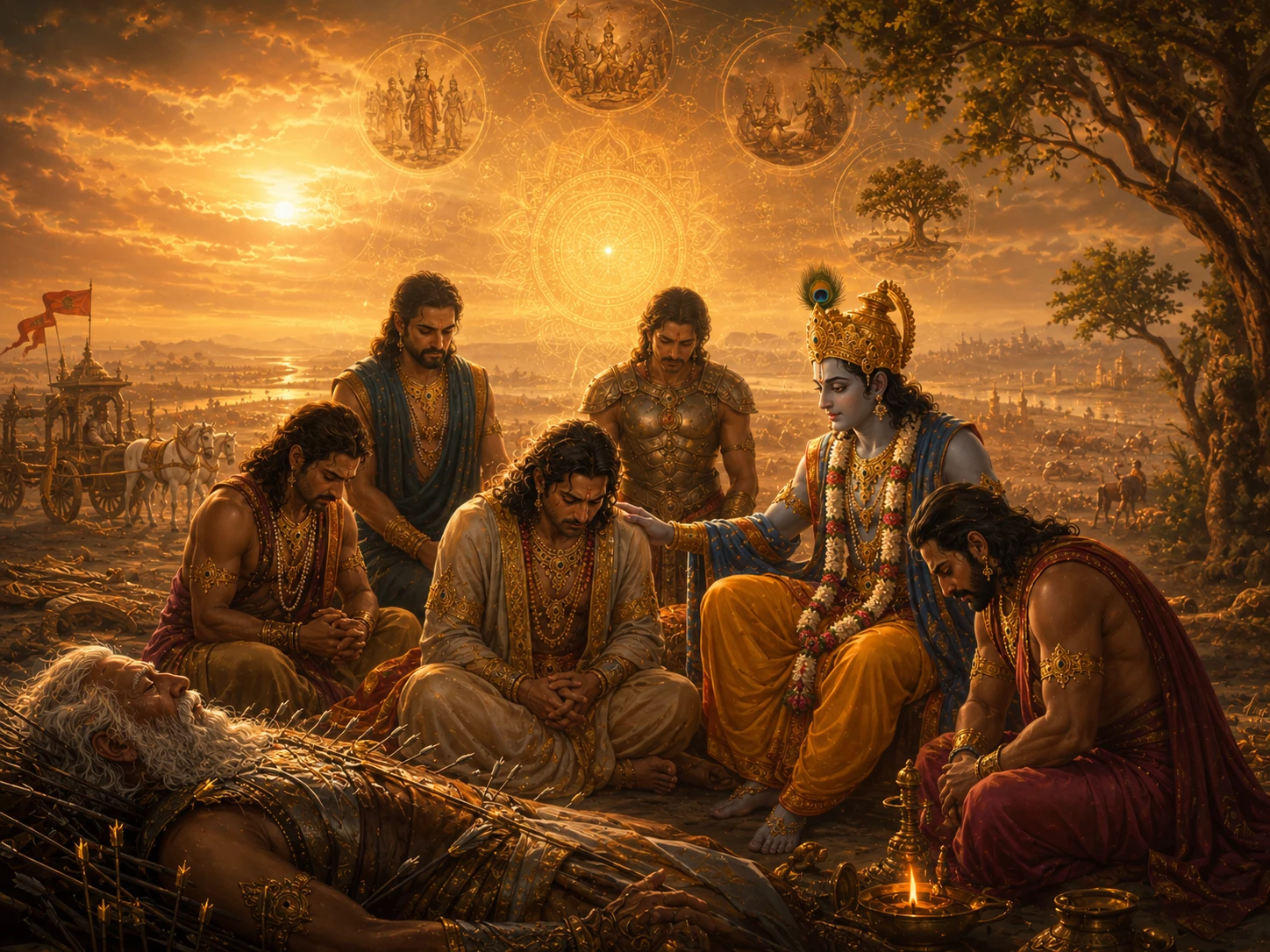
After Kurukshetra -- What Happened Next
14 min readThe same translation error that turned '33 Koti' into '33 crore' in Hinduism also happened in Buddhism. The Chinese translation of Buddhist texts rendered 'Sapta Koti Buddha' (7 Supreme Buddhas) as '7 Crore Buddhas.' The…
Deities AvatarsCommunity Reflections
🕉️
Be the first to share your reflection.