Prahlada and Narasimha -- Faith That Split a Pillar
प्रह्लाद और नरसिंह -- वो भक्ति जिसने खम्भा फाड़ दिया
Hiranyakashipu had done the math. He had performed tapas so severe that Brahma himself appeared and offered a boon. And Hiranyakashipu, unlike every other asura who stupidly asked for immortality and got denied, asked for something cleverer. He asked that death could not come from man or beast, indoors or outdoors, by day or by night, on earth or in sky, by weapon or by hand. He had, essentially, patched every vulnerability in the cosmic code. He was the world's first cybersecurity architect -- and his firewall had no known exploits.
Except one. He forgot that someone might be neither fully man nor fully beast. That twilight is neither day nor night. That a threshold is neither indoors nor outdoors. That a lap is neither earth nor sky. That claws are neither weapon nor hand.
God did not break the rules. God found the zero-day.
The story of Prahlada and Narasimha, primarily sourced from the Bhagavata Purana (Skandha 7, Chapters 1-10) with parallel versions in the Vishnu Purana and Padma Purana, operates simultaneously as children's bedtime story, theological treatise, and political allegory. It is the most widely depicted narrative in South Indian temple sculpture -- Narasimha bursting from the pillar appears on gopurams from Ahobilam to Simhachalam, from Hampi to Melkote.
The political context matters. Hiranyakashipu is not merely a demon. He is a totalitarian ruler who has conquered the three worlds (triloka), displaced the gods, and mandated that all worship be directed exclusively to him. He has abolished religious freedom. No one may chant Vishnu's name. No one may perform Vedic rituals. No one may acknowledge any power higher than the emperor.
Into this regime is born his own son, Prahlada -- a Vishnu devotee from birth. The Bhagavata Purana attributes this to the teachings Prahlada received while still in the womb, when the sage Narada instructed his mother Kayadu during Hiranyakashipu's long absence for tapas. This prenatal spiritual formation is a concept the text takes seriously -- the idea that devotion can be cultivated before conscious memory begins.
Prahlada's bhakti is not rebellion for rebellion's sake. He is not a political dissident. He is a five-year-old boy who genuinely, simply, completely loves God. When his father sends him to the asura gurukul, Prahlada politely absorbs the lessons but when asked what he has learned, recites the nine forms of bhakti instead. He converts his classmates -- not through argument but through the sheer radiance of his devotion.
Hiranyakashipu tries everything. He sends soldiers to kill Prahlada. They cannot -- their weapons shatter. He throws Prahlada off a cliff. The boy floats down unharmed. He has Prahlada trampled by elephants. The elephants refuse. He feeds Prahlada poison. It becomes nectar. He throws Prahlada into a fire on the lap of his sister Holika (who has a boon of fire-immunity). Holika burns. Prahlada walks out. This is the origin story of Holi -- the festival celebrating the burning of Holika and the survival of devotion through fire.
The theological engine here is the concept of divine protection for the devotee who has fully surrendered. Prahlada does not fight back. He does not use counter-magic. He does not even pray for rescue. He simply continues to love Vishnu with a completeness that makes him indestructible. The Bhagavata frames this as the highest form of bhakti -- ahaituki, causeless devotion. Prahlada does not worship Vishnu for protection. He worships because worship is his nature. The protection is a side effect.
This is the UPSC essay answer for 'What is the relationship between faith and courage?' -- Prahlada's courage is not separate from his faith. It is an automatic consequence of it. The IAS officer who refuses a bribe not because she fears CBI but because her moral architecture simply does not include corruption -- that is Prahlada energy.
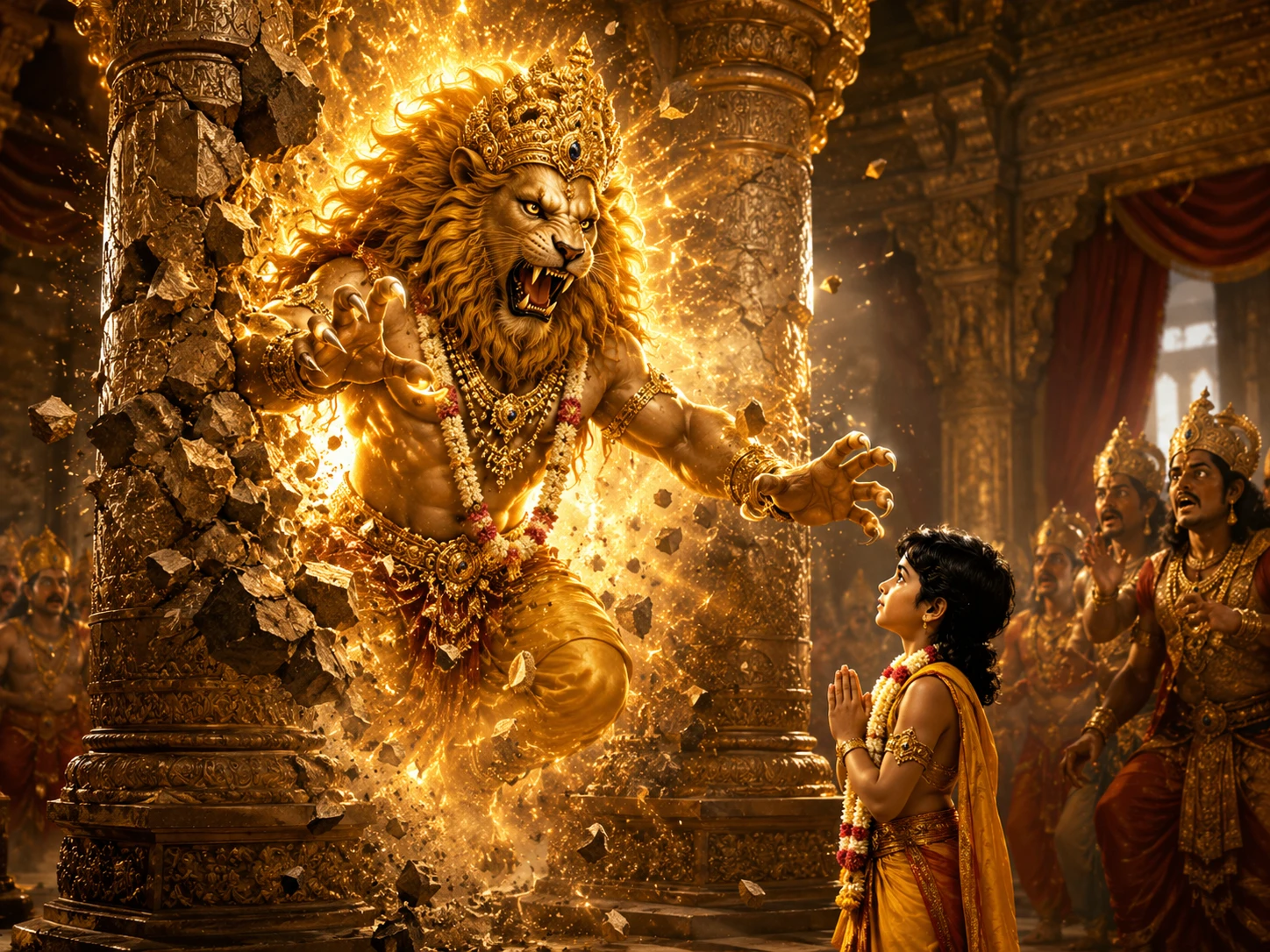
The climax is cinema before cinema existed. Hiranyakashipu, enraged beyond reason, confronts Prahlada directly: 'Where is your Vishnu? Is he in this pillar?' Prahlada says yes. Hiranyakashipu smashes the pillar with his mace.
And Narasimha emerges.
Half-man, half-lion -- satisfying the 'neither man nor beast' condition. At twilight -- neither day nor night. On the threshold of the palace -- neither indoors nor outdoors. He places Hiranyakashipu on his lap -- neither earth nor sky. And he tears the asura apart with his claws -- neither weapon nor hand. Every condition of Brahma's boon is technically honored while being completely obliterated in spirit.
The imagery is deliberately horrifying. Narasimha is described with a mane like a blood-soaked sunset, eyes like molten gold, a roar that shakes the three worlds. He wears Hiranyakashipu's entrails as a garland. Even the gods are terrified. No one can approach him.
Except Prahlada. The five-year-old walks up to the most terrifying form Vishnu has ever taken, and places his small hands on Narasimha's feet. The avatar calms. The rage dissolves. The universe exhales.
This is the second theological breakthrough of the story. God's wrath is not appeased by power, counter-force, or divine intervention. It is appeased by a child's touch. The ferocity that destroyed cosmic tyranny is immediately gentled by innocent devotion. The Bhagavata is making a statement about the hierarchy of divine attributes: omnipotence serves justice, but love governs omnipotence.
प्रह्लादश्चास्मि दैत्यानां कालः कलयतामहम्। मृगाणां च मृगेन्द्रोऽहं वैनतेयश्च पक्षिणाम्॥
prahlādaścāsmi daityānāṃ kālaḥ kalayatāmaham | mṛgāṇāṃ ca mṛgendro'haṃ vainateyaśca pakṣiṇām ||
Among the Daityas I am Prahlada, and among reckoners I am Time. Among beasts I am the lion, and among birds I am Garuda.
— Bhagavad Gita, Chapter 10, Verse 30 (Vibhuti Yoga -- Krishna lists Prahlada among his divine manifestations)
Krishna himself, in the Bhagavad Gita's Vibhuti Yoga chapter, names Prahlada as his primary manifestation among the Daitya race. This is a staggering theological claim -- that the supreme devotee born into a demon family is God's own representation within that lineage. Prahlada does not become divine despite being an asura. He represents divinity because he is an asura who chooses devotion. The Gita is saying that no birth, no family, no circumstances can prevent someone from being an expression of the divine. For a caste-conscious society, this is dynamite.
The Narasimha avatar holds a unique position in the Dashavatara sequence. It is the fourth avatar, following Matsya (fish), Kurma (tortoise), and Varaha (boar) -- the evolutionary progression from aquatic to amphibian to mammalian continues with a hybrid form. Narasimha is the first avatar with a human component, but it is still mixed with animal nature. The full human form comes only with Vamana (fifth avatar). This evolutionary reading -- popularized by commentators who see the Dashavatara as a mythological parallel to biological evolution -- places Narasimha at the transitional point between animal instinct and human reason.
Narasimha temples are among the oldest and most architecturally significant in South India. The Ahobilam complex in Andhra Pradesh contains nine Narasimha shrines spread across the Nallamala Hills, each associated with a different ugra (fierce) or shanta (peaceful) form. The Yoga-Narasimha temple in Melkote, Karnataka, was a center of Ramanuja's Vishishtadvaita teaching. The Narasimha Jharni temple in Bidar, Maharashtra, sits inside a cave system where the deity is carved from a naturally occurring stone formation.
In popular culture, Narasimha represents divine fury in service of justice -- the idea that God can be terrifying when dharma is at stake. The 2007 Telugu film Narasimha Naidu, the numerous Bhojpuri and Tamil films featuring Narasimha imagery, and the consistent use of lion-man iconography in Indian wrestling and martial arts traditions all draw from this well. DRDO's air defense system development center in Hyderabad has a Narasimha photo in its lobby -- the connection between protecting the nation from threats that approach from unexpected angles and Vishnu appearing from an unexpected form is intuitively understood.
Prahlada's story after Narasimha's appearance continues in the Bhagavata. He becomes king of the asuras and rules with dharma. His great-grandson is Bali -- the generous asura-king who gave three worlds to Vamana (Vishnu's fifth avatar). The Prahlada lineage thus produces two of the greatest devotees in the asura race, reinforcing the Bhagavata's message that devotion transcends genetic or social inheritance.
For the young reader scrolling through Instagram at midnight, wondering whether faith matters in a world of algorithms and anxiety -- Prahlada's answer is this: God is not in the temple. God is not in the sky. God is in the pillar your father is about to smash. God is in the exact place your doubt says He cannot be.
The NRI professional in San Francisco who feels disconnected from Hinduism, the medical student in AIIMS Delhi who thinks science and faith are incompatible, the startup founder in Bengaluru who prays before a pitch meeting and then feels embarrassed about it -- Prahlada's story says the same thing to all of them: your devotion is not naive. It is the most sophisticated force in the universe. And when the pillar breaks, you will be the one still standing.
Hiranyakashipu's Boon vs. Narasimha's Solution
| Boon Condition | Intended Protection | Narasimha's Loophole |
|---|---|---|
| Not by man or beast | Immune to all beings | Half-man half-lion (Narasimha) |
| Not indoors or outdoors | Safe in all locations | On the threshold (dehali) of the palace |
| Not by day or by night | Safe at all times | At twilight (sandhya kala) |
| Not on earth or in sky | Safe in all planes | On Narasimha's lap |
| Not by weapon or by hand | Immune to all arms | By claws (nails -- neither weapon nor hand) |
The Narasimha solution does not violate any condition of Brahma's boon. It finds the excluded middle in every binary -- a masterclass in lateral thinking attributed to the divine itself.
The famous Narasimha rock sculpture at Hampi (Karnataka), carved in 1528 CE, stands 6.7 meters tall and is the largest monolithic Narasimha statue in India. Originally it depicted Narasimha seated with his consort Lakshmi on his lap -- but the Lakshmi figure was damaged during the Vijayanagara Empire's fall. The Archaeological Survey of India maintains the site as a UNESCO World Heritage monument. The statue's cross-legged yogic posture (Yoga-Narasimha form) is unusual -- most Narasimha icons show the fierce ugra form. Hampi's calm Narasimha is the deity after Prahlada's touch -- rage dissolved, cosmic order restored.
Experience Narasimha Kavacham on Eternal Raga
The Narasimha Kavacham is one of Hinduism's most powerful protective hymns. Learn it verse by verse on Eternal Raga, with its meaning, then recite it daily.
Tags
Eternal Raga · शाश्वत राग
Institutional voice — scholarly articles on Sanatan Dharma
Deepen Your Understanding
अपनी समझ और गहरी करें
rituals traditions
Diwali -- Five Days of Light
Diwali is not one night of firecrackers. It is a five-day arc from Dhanteras to Bhai Dooj, layering wealth, ancestors, Lakshmi, community, and sibling bonds into a single liturgical sequence. Its origins span Rama's return, Krishna's Narakasura victory, Jain Mahavira's nirvana, and Sikh Bandi Chhor Divas -- making it the most theologically layered festival in the Indian calendar.
deities avatars
Hanuman -- The Perfect Devotee
He could lift mountains, leap oceans, and burn Lanka to the ground -- yet his greatest power was this: he never forgot whose work he was doing. Hanuman is not just a mythological hero. He is the operating system of selfless devotion that India still runs on.
deities avatars
Rama -- Ideal of Dharmic Living
Why does India still name its sons after a prince who chose exile over a throne? Rama's life is not a fairy tale -- it is a manual for dharmic decision-making under impossible pressure. From boardrooms to battlefields, his choices remain the hardest moral benchmark in civilization.
deities avatars
Dashavatara -- Why Vishnu Comes Back Ten Times
Fish, tortoise, boar, half-lion, dwarf, axe-warrior, prince, cowherd, enlightened teacher, future horseman. The ten avatars of Vishnu are not random folklore. Read them in sequence and you get something startling -- a narrative that mirrors evolutionary biology, tracks the rise and fall of political systems, and argues that God does not sit above history but enters it, gets dirty, and does the work. The Dashavatara is Hinduism's answer to the question every civilisation asks: why does the world keep breaking, and who fixes it?
rituals traditions
Holi and Holika Dahan -- The Night a Child's Faith Burned an Empire
Before the colours fly, the fire burns. The night before Holi, India lights bonfires to commemorate the moment a five-year-old boy named Prahlad sat in flames and survived because he chanted Vishnu's name -- while the demoness Holika, who was supposed to be fire-proof, burned to ash. The story comes from the Bhagavata Purana, Seventh Canto, and it is one of Hinduism's most powerful narratives about the cost of faith and the fragility of power.
scriptural exegesis
Bhishma's Terrible Vow
A crown prince gave up the throne, love, marriage, and children -- forever -- so his father could marry a fisherwoman. That single vow made Bhishma immortal in name and set the entire Mahabharata into motion. Was it the noblest sacrifice in literature, or the most catastrophic?
The famous Narasimha rock sculpture at Hampi (Karnataka), carved in 1528 CE, stands 6.7 meters tall and is the largest monolithic Narasimha statue in India. Originally it depicted Narasimha seated with his consort Lakshm…
More in Scriptural Exegesis
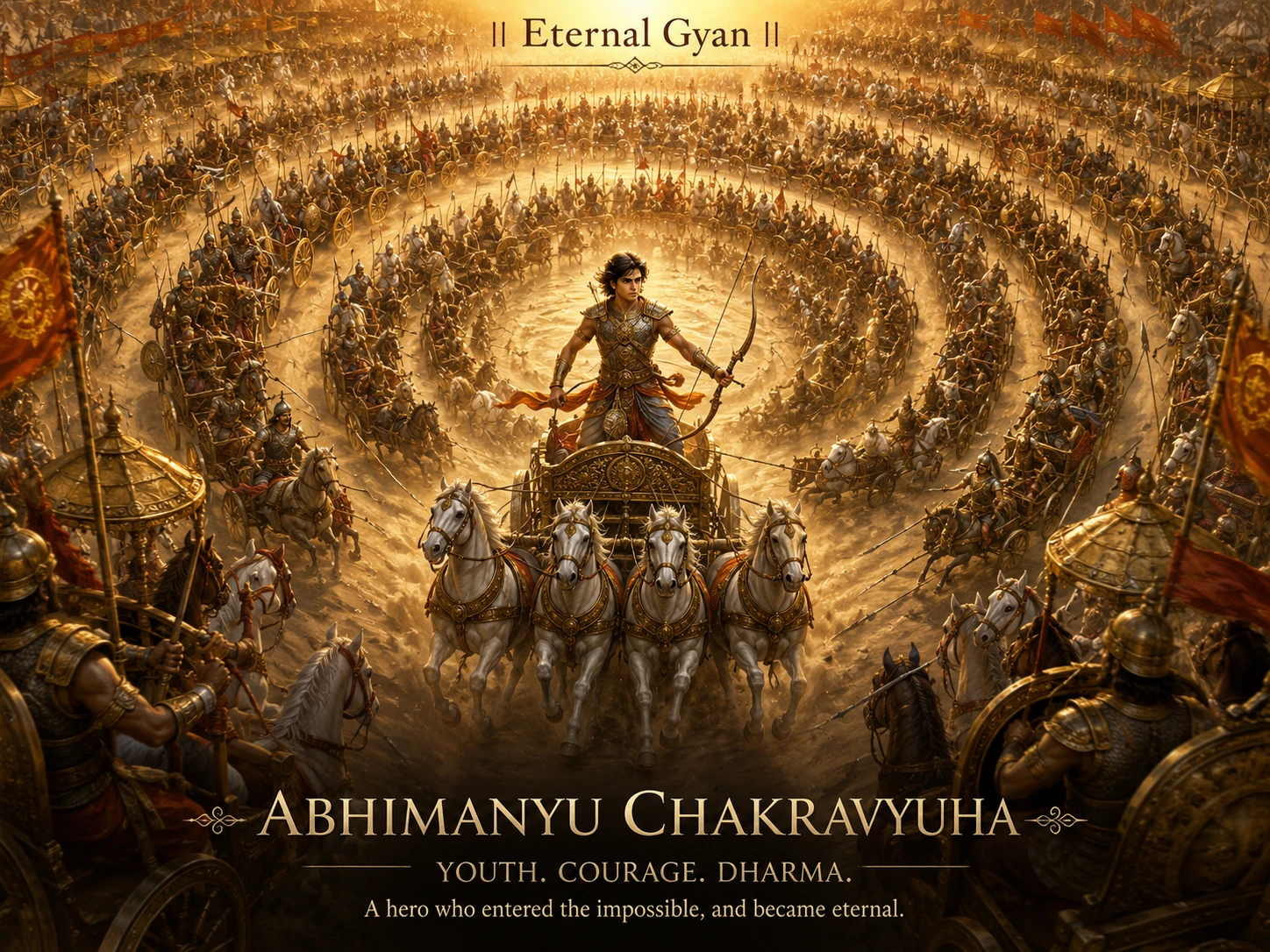
Abhimanyu and the Chakravyuha -- The Boy Who Knew How to Enter but Not How to Leave
14 min read
Adbhuta Ramayana -- The Ramayana Where Sita Becomes Kali
9 min read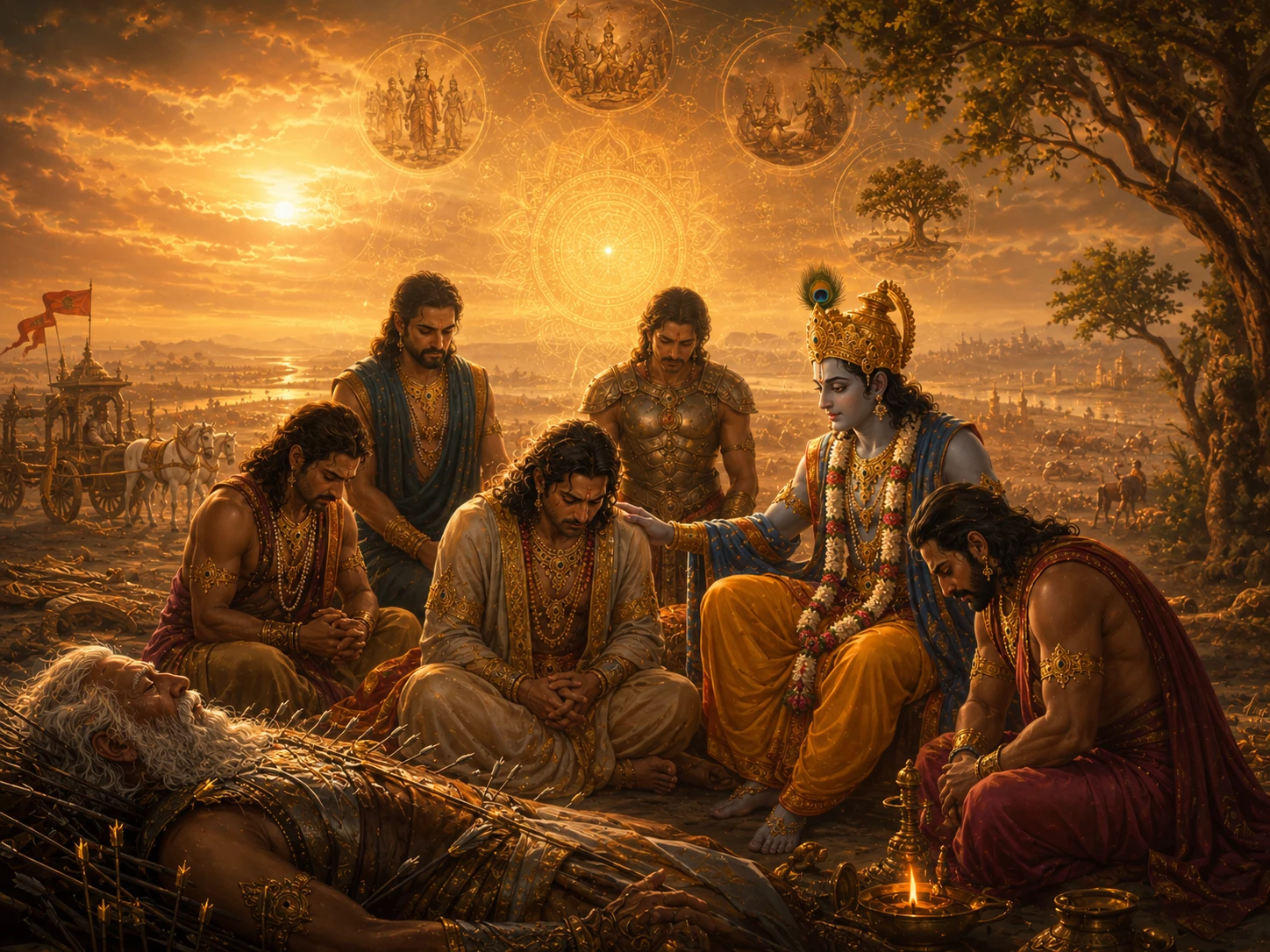
After Kurukshetra -- What Happened Next
14 min readThe same translation error that turned '33 Koti' into '33 crore' in Hinduism also happened in Buddhism. The Chinese translation of Buddhist texts rendered 'Sapta Koti Buddha' (7 Supreme Buddhas) as '7 Crore Buddhas.' The…
Deities AvatarsCommunity Reflections
🕉️
Be the first to share your reflection.