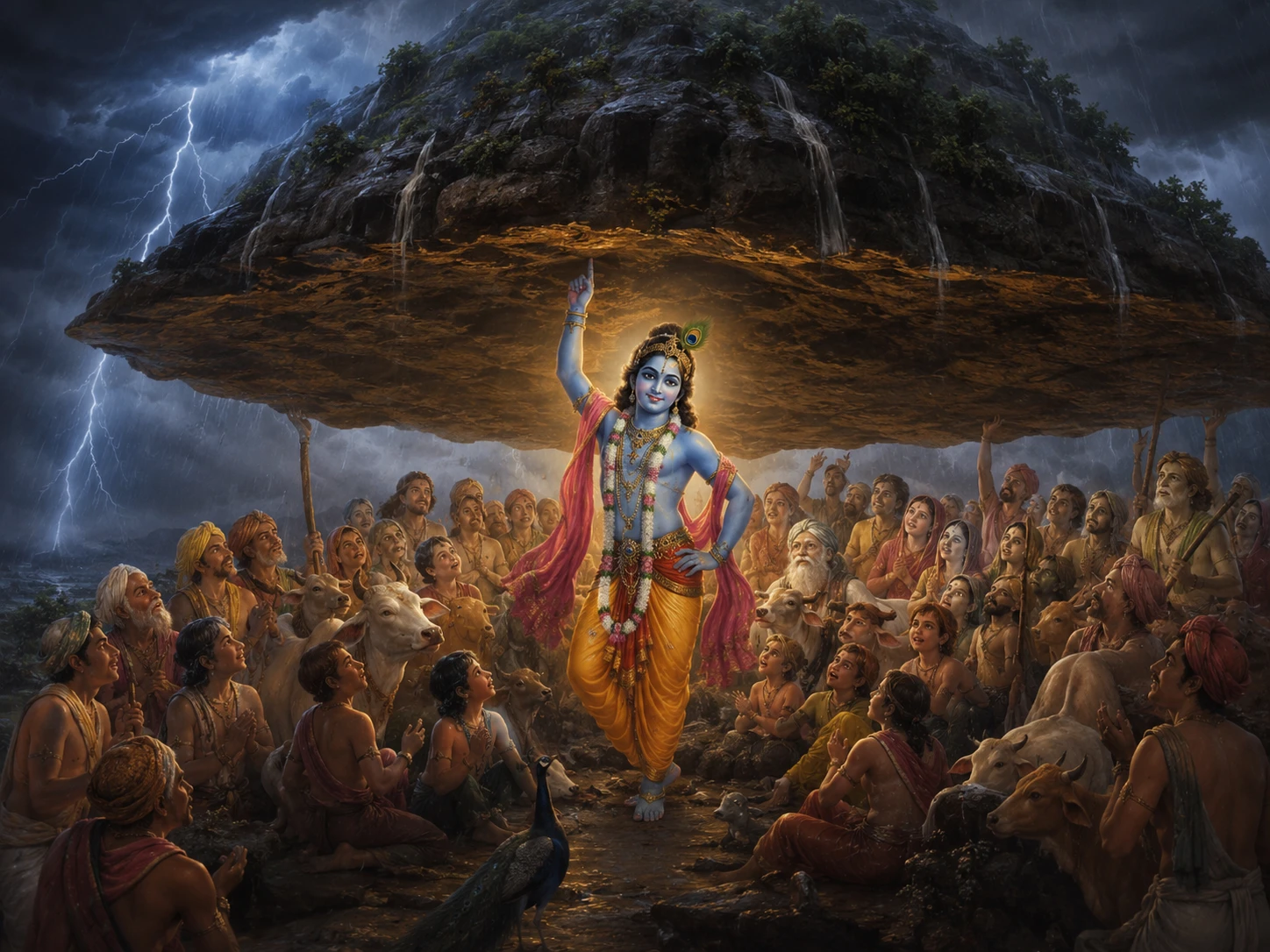
The Govardhana Episode -- The Day Vrindavan Stopped Worshipping Indra
गोवर्धन प्रकरण -- जिस दिन वृन्दावन ने इन्द्र की पूजा बन्द कर दी
A Seven-Year-Old Argues With His Father
Vrindavan, late autumn. The Sharad Purnima moon has come and gone. The kadamba flowers are finished. The cowherds of Vraja are unloading carts of milk, ghee, curd, butter, sweet rice, jaggery, vegetables, and grain into the central courtyard, the same way they have done every year for as long as anyone in the village can remember. The pile is so high it looks like a small hill of food. They are preparing the annual yajna for Indra, the king of devas, the lord of clouds, the deity who decides whether their cows will have grass to eat next year and whether their fields will get water.
A seven-year-old boy walks into the courtyard. He looks at the food, at the priests, at the cooking fires, at the gathering of village elders. He turns to his father, Nanda, and asks one question. The Bhagavata records the question carefully. Why this puja? What exactly does it accomplish? Who told us we have to do it?
Nanda explains, the way fathers everywhere have explained inherited rituals to questioning children. We do it because our fathers did it. We do it because Indra sends rain. We do it because the rain is what makes us prosperous. We do it because, frankly, this is what is done.
The boy listens. Then, in front of the assembled elders of Vraja, he proposes something the village has never proposed before. He says: do not worship Indra this year. Worship the brahmins who teach our children. Worship the cows who give us milk. Worship Govardhana hill, who shelters our cattle, gives us grass and timber, holds the streams from which we drink. Worship what is actually around us. The Bhagavata Purana, in chapters 24 and 25 of its Tenth Canto, gives the boy a long, sharp, almost lawyerly argument. The argument is not really about a puja. It is about where worship actually belongs.
इत्युक्त्वैकेन हस्तेन कृत्वा गोवर्धनाचलम्। दधार लीलया विष्णुश्छत्राकमिव बालकः॥
ity uktvaikena hastena kṛtvā govardhanācalam dadhāra līlayā viṣṇuś chatrākam iva bālakaḥ
Having spoken thus, Vishnu, with one hand, picked up Govardhana hill and held it as easily as a child holds up a mushroom.
— Bhagavata Purana 10.25.19
Why The Bhagavata Calls Indra What It Calls Him
Indra in Vedic literature is the foremost deity. He is invoked in hundreds of Rig Veda hymns. He drinks Soma, slays Vritra, releases the waters, frees the dawns. He is the quintessential celestial king. By the time of the Bhagavata Purana, however, the religious centre of gravity has shifted. The Puranas are bhakti texts. They are written by and for devotees of Vishnu and Shiva. Indra in this later literature is no longer the central deity. He is a karmic functionary -- a position-holder whose position itself is impermanent. Different Manvantaras have different Indras. The current Indra of our Manvantara, the Vaivasvata Manvantara, is one in a sequence.
The Govardhana lila is the Bhagavata's clearest dramatisation of this theological shift. Krishna does not deny that Indra exists. He does not deny that Indra has powers. He simply asks a more pointed question -- is your prosperity actually caused by Indra, or is it caused by your own karma manifesting through the local environment that sustains you? The Bhagavata's answer, through Krishna's mouth, is that worship aimed at intermediary functionaries who imagine themselves to be the source of grace is a misdirection of devotional energy. The actual sources -- the cow that feeds your child, the hill that shades your cattle, the brahmin who teaches your son to read -- are visible, immediate, and unpretending. They are also, in the deepest sense, manifestations of the same divine reality from which Indra also derives his temporary office.
This is why the lila ends not with Indra's defeat but with Indra's correction. After seven days of failed flooding, Indra realises he has misread the situation. He descends from heaven, washes Krishna's feet with the milk of the celestial cow Surabhi, and offers a long, beautiful prayer of apology. The Bhagavata is precise about this -- Indra is not punished. He is taught. The same teaching is, by extension, offered to the reader.
The Seven Days Of Rain
Indra's response, when news reaches Indraloka that a village in Vraja has cancelled his annual yajna, is poorly judged. The Bhagavata describes him as overcome by a particular form of arrogance the Sanskrit calls Aishvarya-mada -- the intoxication of office. He summons the Samvartaka clouds, the same clouds that arrive at the dissolution of cosmic ages. He tells them to drown Vrindavan. Hailstones the size of palm fruits, lightning, wind that uproots trees, rain that does not stop. The villagers run to Krishna. The cattle low in panic. Mothers shield infants. The narrative tension is not subtle.
Krishna does not panic. He walks to Govardhana hill, places his left hand under it, and lifts it. He holds it on his little finger -- the kanishtha, the smallest finger of the left hand. This detail is theologically deliberate. The Bhagavata is not interested in showing strength. It is interested in showing ease. A divine incarnation does not strain. He carries the cosmos the way a child carries a small thing that delights him. The villagers, the cows, the wagons, the household goods, the elders -- all gather underneath. Krishna stands like a column at the centre. For seven days he holds. The text records that he does not lower his arm. He does not switch hands. He does not even appear to notice he is holding anything.
Indra's clouds exhaust their water. The flood has nowhere to land that is not already shielded. The hailstones strike the underside of Govardhana and fall harmlessly to the sides. Eventually the clouds disperse from sheer depletion. The sun returns. Krishna lowers the hill back to its original position, the way a librarian replaces a book on a shelf. The cattle walk back into their pastures. The children run out into the still-wet grass. The Bhagavata notes that no one has died. Not one cow, not one calf, not one infant. The miracle's effectiveness is measured precisely.
What Krishna Replaced With What
| Old Object Of Worship | पुरानी पूज्य वस्तु | What Krishna Substituted | Theological Reason | What This Establishes |
|---|---|---|---|---|
| Indra (sky-god, distant) | इन्द्र (आकाश-देव, दूरस्थ) | Govardhana hill (immediate, visible) | Worship the proximate cause that actually sustains you | Sacred geography matters as much as sacred genealogy |
| Sky and clouds | आकाश और मेघ | Cattle (Surabhi, the cow community) | What you depend on daily deserves daily devotion | Bhakti is anchored in lived material reality, not abstract elevation |
| Vedic priestly elite distant from Vraja | व्रज से दूरस्थ वैदिक पुरोहित-वर्ग | Local brahmins teaching local children | Honour the wisdom-bearer who walks among you | Spiritual authority must be available, not imported |
| Hereditary obligation | वंशागत दायित्व | Reasoned ritual | A rite must answer the question of what it actually does | Tradition is preserved through scrutiny, not through silence |
| Yajna conducted by professionals | विशेषज्ञों द्वारा सम्पन्न यज्ञ | Annakut prepared and offered by villagers themselves | Bhakti is participatory; it is not delegated | Hindu worship can be domestic and democratic |
The Bhagavata is not advocating for atheism toward the devas. It is advocating for a re-localisation of worship -- toward what is here, what is visible, what is immediate. Indra is not erased from the religious imagination. He is repositioned. The lila does not say 'do not worship Indra.' It says 'do not worship Indra by default. Worship what actually deserves it.'
Annakut -- The Mountain Of Food
On the day after Diwali, in temples across India, devotees pile food in a literal mountain in front of the deity. Sweets, savouries, fruits, vegetables, dals, rice preparations, ghee sweets, milk sweets, dry fruits, jaggery -- arranged in concentric tiers, sometimes reaching the height of a person. This is Annakut. The word means 'mountain of food.' The day is also called Govardhan Puja, and it is, line for line, a ritual re-enactment of the Bhagavata's Govardhana lila.
The origin is the moment after the seven days of rain ended. The Vrajavasis, in gratitude, prepared a vast offering of every food they had grown that season. They piled it before Govardhana hill -- treating the hill itself as the deity. Krishna, the Bhagavata records with characteristic theological play, became Govardhana for the duration of the offering. He stood on top of the hill in cosmic form and ate from the assembled food while simultaneously standing among the gopas as their familiar friend. The feast lasted into the night.
Govardhan Puja today is celebrated most elaborately at the Nathdwara temple in Rajasthan, the seven principal temples of the Pushtimarg sampradaya, the Banke Bihari and Radha Ramana temples in Vrindavan, the ISKCON temples worldwide, and in tens of thousands of household and community celebrations across North India during the second day after Diwali. The food piled is shared as prasad with the entire neighbourhood. In Mumbai's Lokhandwala, a Marwari family hosts an annakut for its building society every year. In a London suburb, a Gujarati temple piles 1,008 dishes for the day. In a village in Mathura district, the priests still recreate the entire Govardhana hill from cow dung and decorate it with flowers. The lila is being acted out continuously, in different scales, by communities that have inherited the original Vrindavan moment.
त्वयाभिगुप्ता विचरन्ति निर्भया विनायकानीकपमूर्धसु प्रभो। सदारका नित्यपराभवे जिता ऋद्धिर्न मन्दा निरयाधमस्य ते॥
tvayābhiguptā vicaranti nirbhayā vināyakānīkapa-mūrdhasu prabho sa-dārakā nitya-parābhave jitā ṛddhir na mandā nirayādhamasya te
Protected by You, O Lord, devotees move without fear, even over the heads of leaders of obstacles. Even when defeated, they are not without prosperity. The wealth of one who has You is never diminished, even in apparent fall.
— Bhagavata Purana 10.27 (Indra's prayer of surrender to Krishna after the Govardhana episode)
Govardhana hill in modern Mathura district has shrunk dramatically from its descriptions in the Puranas. The Bhagavata describes it as towering over Vraja. Today the hill is a low ridge, no taller than a small town's water tower in places. Vaishnava tradition explains this as a slow, voluntary diminishing. A sage named Pulastya once asked Govardhana to follow him to Kashi; Govardhana agreed but on the condition that he could not be set down before reaching the destination. When Pulastya put him down briefly, the hill refused to move further. He stayed in Vraja but, according to the tradition, has been gradually sinking into the earth ever since. Today the parikrama of Govardhana, a 23-kilometre walk around the hill, is one of the most popular pilgrim circuits in North India. Devotees from Bengaluru tech parks fly in for it every November. The walk takes about seven hours, mostly barefoot, and ends back at Manasi Ganga, the sacred lake at the foot of the hill.
Reading The Lila In Modern India
The Govardhana episode produces unusual readings in unusual readers. A water-policy researcher in Pune notices that the lila is structurally about local resilience. Vraja's prosperity, the boy points out to his elders, depends on Govardhana's springs, Govardhana's grass, Govardhana's timber. Indra's clouds are useful when they arrive on schedule, but the village's actual ecological base is the hill. The argument anticipates, by 2,000 years, the modern environmental insight that local watersheds and forests are the underlying determinant of community well-being, not distant weather systems alone. The researcher, sitting at a desk in Aundh writing a paper on watershed-based rural planning, finds the parable strangely apt.
A young father in Indore, taking his daughter to Govardhan Puja for the first time, watches her arrange small mounds of food in front of the family's home altar. She insists, at age six, on adding her own school tiffin to the pile. The father remembers the Bhagavata's specific detail -- that Krishna proposed worshipping not only the hill but also the cows and the brahmins. He realises the lila is teaching his daughter, before she has language for it, that gratitude is concrete. You honour what feeds you. The hill, the cow, the teacher. Not abstractions.
A management graduate at IIM Ahmedabad reads the chapter and notices the hierarchy-disruption mechanic. Krishna, in the lila, breaks an inherited ritual loop and proposes a new one based on first principles. He does it as the youngest person in the room. The Bhagavata records that the elders objected, that Nanda himself was uncomfortable, that the priests were professionally offended. Krishna let them speak, listened, and then explained why the inherited ritual no longer served. The graduate writes a note to himself about how to propose process change in a legacy organisation. The note quotes the Bhagavata. He does not, on his first day at his new consulting firm, reveal the source.
A retired headmistress in Lucknow reads the Indra-surrender chapter and notices what a senior figure looks like when he is wrong. Indra does not sulk. He does not hold a grudge. He does not retroactively rationalise. He flies down personally, washes the feet of the seven-year-old who made him look foolish, and offers a long, articulate prayer of apology. The headmistress, who has spent forty years watching adults refuse to apologise to children, reads this as the Bhagavata's quiet model of how authority should fail gracefully.
What The Lila Is Not Saying
It is worth being clear about what the Govardhana episode does not say, because misreadings are common.
The lila does not say that Vedic deities are false. Indra is treated as real throughout. The lila does not say that yajna is wrong. Krishna proposes a different yajna, not the cancellation of yajna. The lila does not say that hereditary religion is bad. The Vrajavasis remain Hindus, follow dharmic life, raise their children in the same broad religious framework. What the lila says is much narrower and much more useful -- that ritual must remain answerable to reason. A puja that cannot answer the question 'why this puja?' is a puja that has lost its connection to the religious life it was meant to express.
This is the Bhagavata's deep teaching, and it is why the text has remained alive for two thousand years across radically different social conditions. The Vrajavasis of the lila are not modernists. They are not breaking with their tradition. They are recovering it. The Govardhana puja they perform is, in fact, more locally rooted, more participatory, more grateful, more concrete than the inherited Indra puja was. It is not less religious. It is more religious.
This is also why the lila ends not with the elimination of Indra but with Indra's incorporation into the wider devotional structure. The Bhagavata is not dismantling the pantheon. It is reordering it -- placing the immediate, the visible, and the local at the centre, with the celestial functionaries arrayed appropriately around them. The reorder is not democratic for its own sake. It is theological. It corresponds, the text argues, to how reality is actually structured. Krishna lifts the hill not to humiliate Indra. He lifts it to demonstrate that the hill itself was never separate from the divine to begin with.
This is the move that makes the Govardhana lila so distinctive within the Krishna corpus. Almost every other Krishna miracle -- the killing of Putana, the subduing of Kaliya, the destruction of Trinavarta -- is a defensive or punitive act against an external threat. The Govardhana lila is something else. It is not directed against an enemy. It is directed against a worldview. The enemy of the lila is the inherited assumption that worship belongs upward, away, elsewhere. Krishna's reply is to take a small village's actual environment, point at it, and say -- this is where the divine has always been. The lifting of the hill is the dramatisation of that statement. It is, in this sense, less a miracle than a teaching with extra weight on it.
The deeper Vaishnava commentaries, particularly Vallabhacharya's Subodhini and Vishvanath Chakravarti's Sarartha-darshini, both written for audiences three to four centuries after the Bhagavata's compilation, develop this point at length. They argue that the Govardhana hill is, in the Pushtimarg view, non-different from Krishna himself. The hill is not a separate object that Krishna lifted. The hill is a form of Krishna lifting another form of Krishna. The lila is therefore the divine demonstrating its own internal multiplicity to the village -- that the hill, the boy, the cattle, and the rain are all expressions of one underlying reality, and that worship, properly performed, is just that reality recognising itself.
Govardhan Puja is celebrated as the first day of the new year in the Vikram Samvat calendar followed across Gujarat, Rajasthan, and large parts of North India. Gujarati Hindus exchange Sal Mubarak greetings on this day. The connection between Krishna's lila and the new-year observance is theologically striking -- the year begins with a public re-affirmation of where worship belongs. In Mumbai's textile market and Surat's diamond bourses, business diaries are opened ceremonially in front of the deity on Govardhan Puja morning. The annakut becomes simultaneously the offering, the prasad, and the symbolic foundation for the year's enterprises. A diamond merchant in Surat who closes his ledger on Diwali night and reopens it the next morning at Govardhan Puja is, whether he reflects on it or not, performing a 2,000-year-old gesture of gratitude to the local hill that fed his ancestors.
Why The Hill Was Lifted On The Left Hand's Smallest Finger
Vaishnava commentators have written for centuries about the precise body posture of Krishna in the Govardhana lila, because the Bhagavata is precise about it. Left hand, smallest finger. Not the right hand. Not the palm. Not even the index finger. The kanishtha of the vama-hasta. The choice is theological.
The right hand in Hindu iconography is the hand of authority, of giving, of the abhaya mudra. The left hand is the hand of receiving, of relation, of intimacy. By lifting Govardhana with the left, Krishna is performing not an exercise of power but an act of relationship. He is not lifting the mountain at it. He is lifting it for them -- the cattle, the children, the elders. The receiving hand is doing the work of giving.
The smallest finger is the finger of casualness. Try lifting any object on your kanishtha. The grip is precarious; the gesture is offhand. By using the kanishtha, the Bhagavata is signalling that this is not effort. The mountain's weight is not a burden. The point of the lila is that it costs the divine nothing to protect what the divine has decided to protect. The strain is not in lifting the hill. The strain is in being human enough to need it lifted. Krishna takes care of the second by demonstrating, casually, that the first is no problem at all.
In Pushtimarg art, in Pichwai paintings, in Madhubani folk renderings, in the bronzes of South India, in the temple sculptures of Khajuraho, the same posture recurs. Left hand, raised slightly. Hill on smallest finger. Right hand free, often holding a flute or in abhaya mudra. This is the iconographic shorthand for the Govardhana-dhari, the Lifter of Govardhana. The shorthand is a teaching in itself. Two thousand years of devotional art has been training Hindu eyes to recognise that the divine does not strain to protect us. The strain is ours. The protection is His.
Celebrate Annakut This Diwali
On the day after Diwali, prepare an annakut at home or with your community -- a literal mountain of food offered to your kuldevta or family deity. As you offer it, tell the children the story of Krishna lifting Govardhan, so the next generation inherits not just the festival but the story behind it. Eternal Raga's Govardhan Puja article explains the day's rituals.
Tags
Eternal Raga · शाश्वत राग
Institutional voice — scholarly articles on Sanatan Dharma
Deepen Your Understanding
अपनी समझ और गहरी करें
deities avatars
Krishna Leela -- Why God Chose to Play
He stole butter, broke pots, lied to his mother's face, danced with married women under the full moon, and lifted an entire mountain on his little finger. The Bhagavata Purana's Tenth Skandha -- the most popular 4,000 verses in all of Hindu literature -- is not a biography. It is a theological argument that the Supreme Being's highest expression is not creation, destruction, or cosmic governance. It is play. Krishna Leela is the radical idea that God's truest nature is joy.
deities avatars
Dashavatara -- Why Vishnu Comes Back Ten Times
Fish, tortoise, boar, half-lion, dwarf, axe-warrior, prince, cowherd, enlightened teacher, future horseman. The ten avatars of Vishnu are not random folklore. Read them in sequence and you get something startling -- a narrative that mirrors evolutionary biology, tracks the rise and fall of political systems, and argues that God does not sit above history but enters it, gets dirty, and does the work. The Dashavatara is Hinduism's answer to the question every civilisation asks: why does the world keep breaking, and who fixes it?
scriptural exegesis
Vamana and Bali -- The Avatar Who Took Three Steps And A Kingdom
An asura king so generous he was loved across the three worlds. A Vishnu avatar so small he had to look up to ask for charity. A bargain measured in three footsteps. The Vamana-Bali story is the Bhagavata's most layered teaching on what divine grace actually looks like when it appears to take everything from you.
scriptural exegesis
Samudra Manthan -- When Gods and Demons Ran a Joint Venture and the Universe Almost Died
A cosmic ocean. A mountain for a churning rod. A serpent king for a rope. Gods on one end, demons on the other. And out came 14 treasures -- including wealth, beauty, medicine, immortality, and one poison so lethal it could end creation itself. The Samudra Manthan is not mythology. It is the original playbook for collaboration, crisis management, and how to handle it when your joint venture partner tries to cheat you.
scriptural exegesis
Gajendra Moksha -- The Elephant's Cry That Brought Vishnu Down
An elephant king. A crocodile's jaws. A thousand years of struggle. And then one cry of total surrender that made Vishnu leap off his cosmic seat. The Gajendra Moksha is the Bhagavata's masterclass in what happens when self-effort runs out and grace begins.
deities avatars
Bal Krishna vs Kamsa's Demons -- How a Toddler Defeated an Army
Kamsa sent his deadliest assassins to kill a baby in Vrindavan. A poisoned wet-nurse. A whirlwind. A python the size of a mountain. A crane. A bull. A donkey. A serpent that boiled an entire river. One by one, the infant Krishna dispatched them all -- sometimes with a kick, sometimes with a smile, once by simply becoming too heavy to lift. This is the Bhagavata Purana's most beloved narrative: the child-god who turns assassination attempts into playground games.
Govardhana hill in modern Mathura district has shrunk dramatically from its descriptions in the Puranas. The Bhagavata describes it as towering over Vraja. Today the hill is a low ridge, no taller than a small town's wat…
More in Scriptural Exegesis
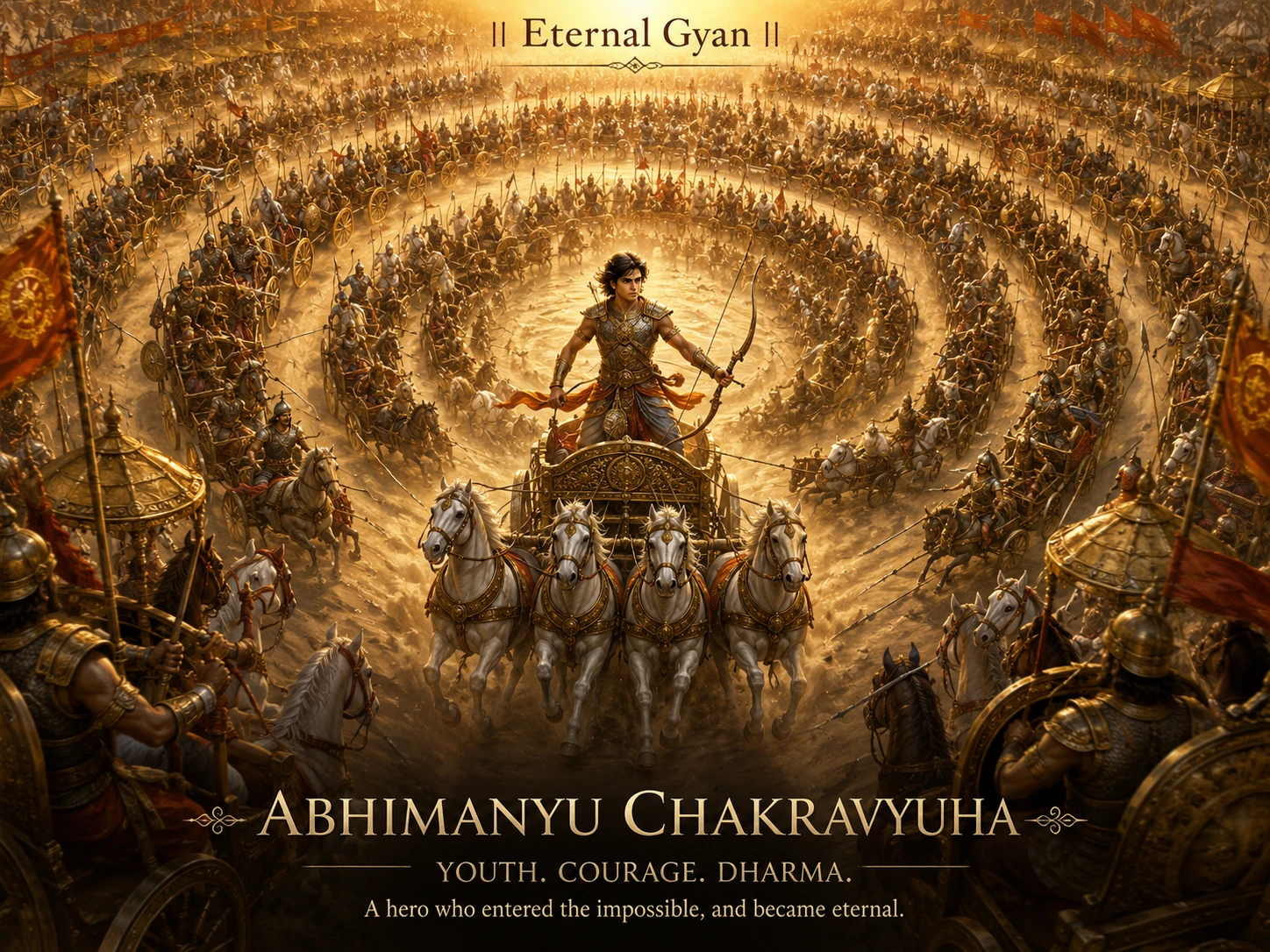
Abhimanyu and the Chakravyuha -- The Boy Who Knew How to Enter but Not How to Leave
14 min read
Adbhuta Ramayana -- The Ramayana Where Sita Becomes Kali
9 min read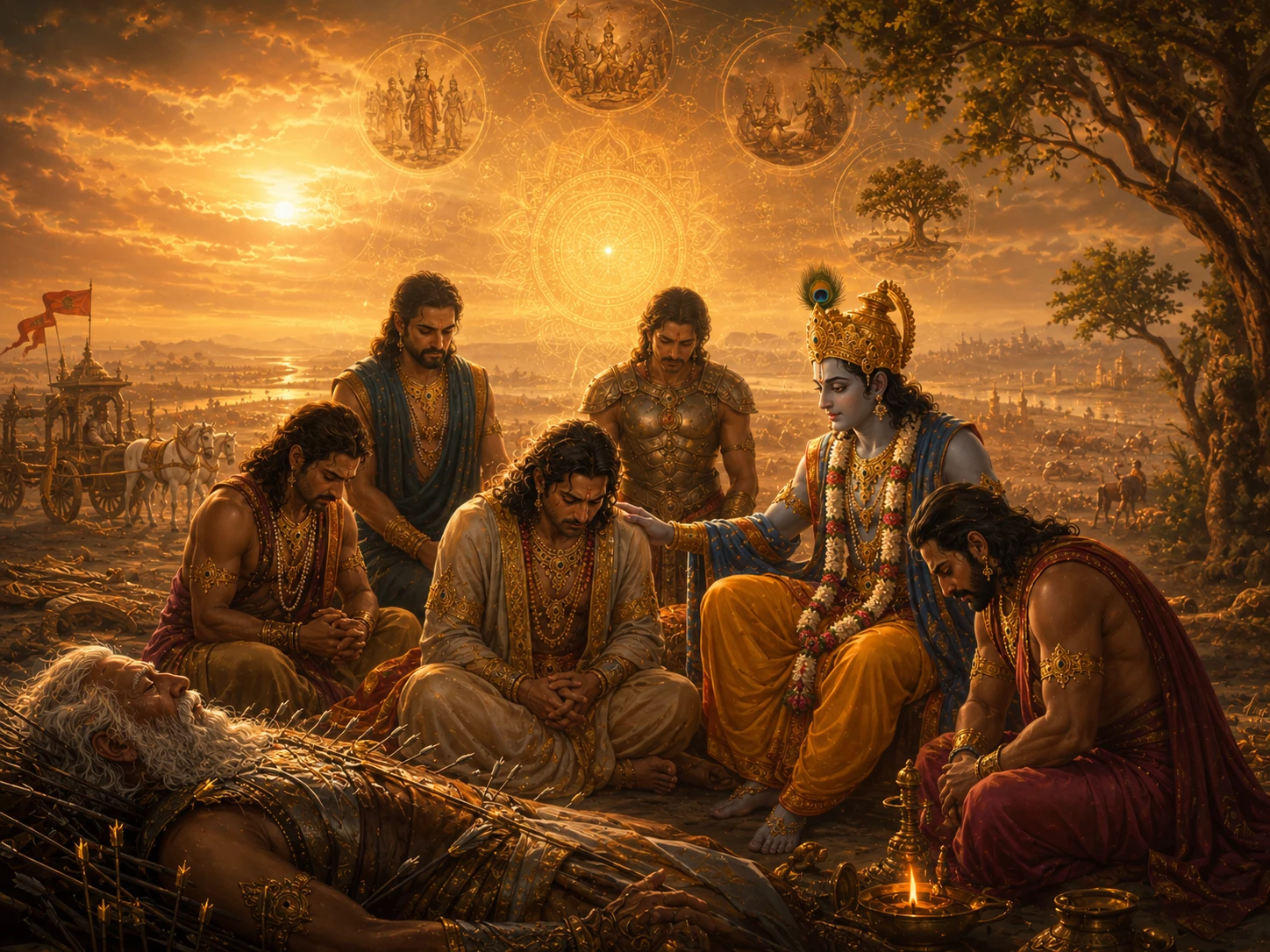
After Kurukshetra -- What Happened Next
14 min readThe same translation error that turned '33 Koti' into '33 crore' in Hinduism also happened in Buddhism. The Chinese translation of Buddhist texts rendered 'Sapta Koti Buddha' (7 Supreme Buddhas) as '7 Crore Buddhas.' The…
Deities AvatarsCommunity Reflections
🕉️
Be the first to share your reflection.