Gajendra Moksha -- The Elephant's Cry That Brought Vishnu Down
गजेन्द्र मोक्ष -- वह पुकार जिसने विष्णु को उतार दिया
The Cry That Broke Heaven Open
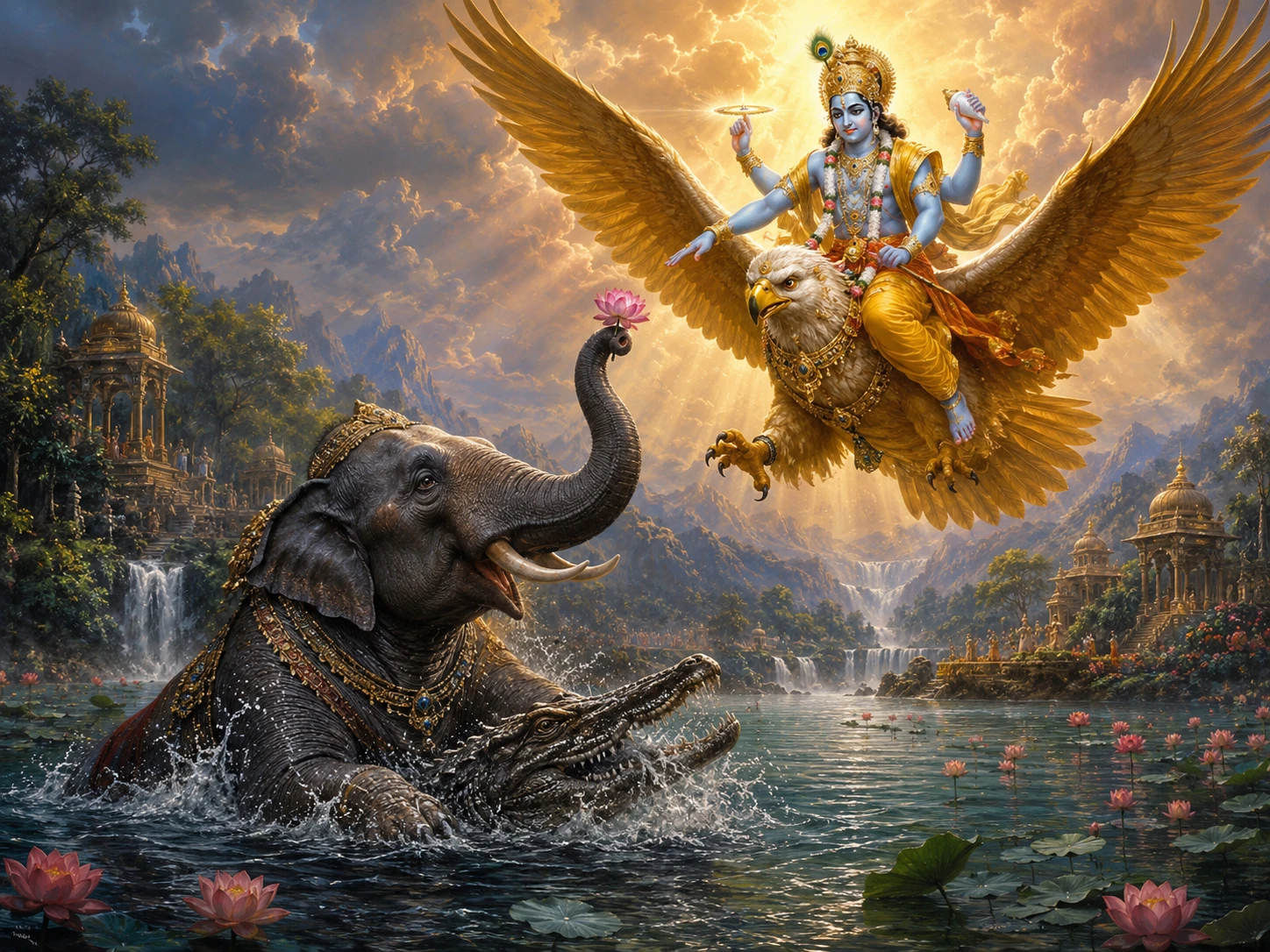
There is a moment in the Bhagavata Purana that has terrified and consoled Hindus for two thousand years in equal measure. An elephant, the strongest land creature in the Indian imagination, is held in a crocodile's jaws at the edge of a lotus lake. He has fought for a thousand years. His herd has abandoned him. His tusks have lost their power. His feet are bleeding. And in that final exhaustion, when no muscle in his enormous body has any strength left to give, he lifts a single lotus from the water with his trunk and cries out a name.
The name reaches Vaikuntha before the sentence finishes.
Vishnu, who had been seated with Lakshmi, does not pause to put on his ornaments. He does not summon Garuda formally. He simply stands, and Garuda is already there. The Lord descends so fast that the sages watching from the heavens later said: he did not travel through space, he arrived through love. The Sudarshana Chakra is unleashed. The crocodile's grip is severed. And Gajendra, the elephant king, is lifted out of the water by Vishnu's own four hands.
This is Gajendra Moksha, the Bhagavata's most ferocious teaching on surrender. It is told in the eighth canto, chapters two through four, in roughly 80 verses of dense Sanskrit. It is recited in ICUs in Bengaluru and AIIMS Delhi when families are told there is nothing more medicine can do. It is whispered into the ears of Vaishnava elders before they take their last breath. And it is, at its core, an instruction manual for the moment every human being eventually faces: when self-effort runs out, what happens next?
श्रीगजेन्द्र उवाच -- ॐ नमो भगवते तस्मै यत एतच्चिदात्मकम्। पुरुषायादिबीजाय परेशायाभिधीमहि॥
śrī-gajendra uvāca -- oṃ namo bhagavate tasmai yata etac cidātmakam puruṣāyādibījāya pareśāyābhidhīmahi
Gajendra said: Om. I bow to that Supreme One because of whom this entire field of consciousness exists. Let me meditate upon Him -- the Primordial Person, the Original Seed, the Lord beyond all lords.
— Bhagavata Purana 8.3.2
The Lake of Trikuta
The story begins not with the elephant but with a mountain. Trikuta -- the Three-Peaked One -- rises somewhere in the Ksheera Sagara, the Ocean of Milk. Eighty thousand miles tall, the Bhagavata says. The number is not literal. It is the kind of scale Vyasa uses to indicate: this is not your geography. This is symbolic terrain.
In a valley of Trikuta, there is a garden called Rtumat, planted by Varuna himself. Inside Rtumat is a lake. The lake is filled with golden lotuses, with kumuda flowers that bloom only at night, with water that the Bhagavata calls amrtanibha -- nectar-like. And on the banks of this lake live elephants. Hundreds of them. Their king is Gajendra.
Gajendra is not described as ordinary. The Bhagavata gives him the diction usually reserved for warriors. His body is a kingdom. His tusks split bamboo groves like a startup founder splits equity in seed rounds. His herd parts before him as Bombay traffic parts for an ambulance. He has wives. He has calves. He has lieutenants. And when the heat of the afternoon comes, he leads the herd into the water to bathe.
This is the moment the crocodile strikes.
The Sanskrit word for this crocodile is graha -- the same word used for a planetary capture, the same word for the seizure that locks a soul into a body. The graha catches Gajendra by the leg. And what follows is one of the longest battles in the Puranas: a thousand years, the text says. The herd watches at first, then panics, then drifts away. The wives weep at the bank. The calves are taken to other elephants. Gajendra fights alone.
When we read this story today, with our IIT Bombay backgrounds and our Reuters feeds, we want to ask: a thousand-year fight? Surely metaphor. And it is. But metaphor for what? For the chronic struggle. For the cancer that comes back after the fifth round of chemo. For the alcoholism that returns in year nine of recovery. For the marriage that has been ending for a decade. The thousand years is not a clock. It is the length of any fight that refuses to resolve. The crocodile is not just a reptile. It is whatever has caught your leg.
Two Curses, One Lake
The Bhagavata then does something extraordinary. It pulls back from the fight to tell us who these two combatants actually are.
The elephant was once a king. His name was Indradyumna, ruler of the Pandyas. He was a great devotee of Vishnu, an ardent worshipper, the kind of king who built temples and conducted yagnas. One day Sage Agastya arrived at his court. Indradyumna was deep in meditation, vrata-observed, with a vow of silence. He did not rise to greet the sage. He did not speak. The protocol of hospitality was, by the letter of the law, broken.
Agastya, who never softens, cursed him. You who are absorbed in your own meditation while a guest stands at the gate -- be born as an elephant. Hard skin. No language. The strength of an animal and the memory of a king.
The crocodile's previous life was equally strange. He was a Gandharva named Huhu, a celestial musician of the Suras. One day he was bathing in a lake with his consorts when Sage Devala came to perform his austerities. Huhu, in playful mischief, dragged the sage's leg underwater. Devala surfaced, furious. Be born as the very thing you played at being -- a leg-grabber in the water. Become a crocodile.
Notice the symmetry. One was punished for not rising. The other was punished for pulling someone down. One sin was inertia. The other was malice. And both ended up in the same lake, locked into each other for a thousand years, neither remembering who he had been.
This is the part of the story that matters most for how Hindus read karma. It is not retributive. It is corrective. The exact form of the punishment was the exact form of the original sin made visible. Indradyumna had been silent when he should have stood -- he became an elephant, voiceless and embodied. Huhu had grabbed -- he became a grabber. The Bhagavata is showing us that karma does not punish. It teaches.
Indradyumna and Huhu -- A Symmetry of Karma
| Aspect | Indradyumna (becomes Gajendra) | Huhu (becomes the Crocodile) | पूर्व-जीवन (इन्द्रद्युम्न / हूहू) |
|---|---|---|---|
| Original status | King of the Pandya country | Gandharva, celestial musician | पाण्ड्य नरेश / गन्धर्व |
| Sin committed | Did not rise to greet Sage Agastya during silent vow | Pulled Sage Devala's leg in the water as mischief | अगस्त्य का अनादर / देवल का पाद-कर्षण |
| Curse-giver | Sage Agastya | Sage Devala | अगस्त्य ऋषि / देवल ऋषि |
| Form taken | Elephant -- powerful body, no human voice | Crocodile -- the leg-grabber of waters | हाथी / मगर |
| Karmic mirror | He sat when he should have risen, so he became a beast that cannot speak its name | He grabbed in play, so he becomes the one who cannot let go | जड़ता का प्रतिबिम्ब / पकड़ का प्रतिबिम्ब |
| Liberation moment | Surrender to Vishnu after a thousand-year struggle | Killed by Sudarshana Chakra, returns to original Gandharva form | शरणागति से मुक्ति / सुदर्शन से मुक्ति |
| Final destination | Vaikuntha, given the form of Vishnu's parshada (attendant) | Restored Gandharva status, returns to celestial realm | वैकुण्ठ -- विष्णु पार्षद / गन्धर्व लोक |
The Bhagavata teaches that the same blow of grace liberated both. Vishnu's chakra was not punishment for the crocodile. It was release.
The Hymn That Reached Vaikuntha
After a thousand years of fighting, Gajendra's body finally fails. His feet are pulled deeper into the water. His tusks have lost their cut. The strength of his herd is gone. The strength of his lineage is gone. And in that silence -- when the Bhagavata says all his self-effort is exhausted -- something else surfaces.
A memory.
In his previous life, as Indradyumna, he had memorised a hymn to Vishnu. He had chanted it daily for years before the curse fell. The body of the elephant did not remember the words. But the soul did. The Sanskrit phrase the Bhagavata uses is breathtaking: prag-janmany anushikshitam -- 'that which had been studied in the previous birth.' The hymn rose from beneath the body, beneath the species change, beneath the thousand years of fighting. It rose because it was rehearsed in another life entirely.
This is one of the most consequential teachings the Bhagavata offers about devotional practice. The japa you do in this life, even if you forget every word of it, even if your body changes form, even if a thousand years pass, is not lost. It surfaces when the body has nothing else left to give. The man on a Mumbai local train who chants Hanuman Chalisa during his commute is not just passing time. He is depositing a hymn into a vault that will open at the moment of his greatest helplessness.
Gajendra's stuti is twenty-eight verses long. It is not a beginner's prayer. It speaks of the unmanifest source, the witness consciousness, the Lord who is beyond name and form yet bears all forms, the One who is at once the beginning, the middle, and the end. It is dense Vedanta in the mouth of an elephant. And every time it is recited today, in any temple from Tirupati to Pashupatinath, it carries the same theological argument: when nothing of your strength is left, your meditation alone reaches Him.
The last verse is the one that is said to have moved Vishnu personally. We have placed it below.
नायं वेद स्वमात्मानं यच्छक्त्याहंधिया हतम्। तं दुरत्ययमाहात्म्यं भगवन्तमितोऽस्म्यहम्॥
nāyaṃ veda svam ātmānaṃ yac-chaktyāhaṃ-dhiyā hatam taṃ duratyaya-māhātmyaṃ bhagavantam ito 'smy aham
This soul does not even know its own self, struck blind by the I-ness produced by His own power. To that Lord, whose greatness cannot be crossed by any means, I now go for refuge.
— Bhagavata Purana 8.3.29
The Gajendra Moksha Stotra is the prescribed deathbed prayer in many Vaishnava families across South India. In Sri Vaishnava and Madhva traditions, it is read aloud at the bedside of a dying elder because of a belief drawn directly from the text: that whoever hears this hymn at the moment of death is guaranteed liberation. Hospitals in Bengaluru, Chennai, and Tirupati that serve large Vaishnava populations now keep printed copies in the chaplain's drawer alongside the standard medical paperwork.
Why Vishnu Came Personally
The most theologically loaded moment in the Gajendra Moksha is not the rescue itself. It is the question the Bhagavata raises: why did Vishnu come personally, instead of sending an emissary?
The Vaishnava commentaries are unanimous. Vishnu came because the cry was not for survival. It was for surrender. Gajendra did not pray for his leg to be released. He did not pray for the crocodile to be killed. He did not even pray for his own life. He prayed only to know God before he died. That single absence -- the absence of any selfish ask -- is what triggered the descent.
The Sanskrit term for this is ananyasharanagati -- surrender to no one but Him, surrender that does not turn around to ask for anything. The South Indian Vaishnava tradition makes this the keystone of all bhakti. You may pray for a job, a partner, a clean MRI scan -- but at the highest level of devotional surrender, there is only the cry to know Him. Everything else is added.
This is why the elephant's prayer is read by Vaishnava elders to people in palliative care. Not because the elephant lived -- he did, in a sense -- but because his concern at the moment of dying was not life. It was the Lord. And the Bhagavata's claim is that the moment that priority shifts from self-preservation to surrender, Vishnu does not delay. He does not check the file. He does not weigh karma. He simply arrives, fast enough that the sages later say he came not through space but through love.
Ramanujacharya, writing in the eleventh century from Srirangam, framed this in his Sharanagati Gadya as the doctrine of prapatti -- the formal taking of refuge that has six limbs, of which the absence of all other support is the central one. A prapanna, one who has surrendered, no longer keeps a backup plan in the heart. He does not say: 'I will surrender to Narayana, and also keep my savings, my caste backing, my political contact.' The Gajendra story is the textbook example because the elephant has nothing left -- no herd, no strength, no leverage. The Sri Vaishnava acharyas teach this verse-by-verse to seminary students at Sriperumbudur and Melukote, and the students often weep, because the elephant has done in distress what they are still trying to do in study.
What the Lotus Means
There is a final detail that almost every popular retelling of Gajendra Moksha gets wrong. Most narrations show the elephant lifting his trunk in surrender, with the cry alone reaching Vishnu. The Bhagavata is more specific. Gajendra plucks a single lotus from the lake and offers it.
A lotus. From the very lake that is killing him.
The lake is the world. The crocodile is bondage. The elephant is the soul, vast in its sense of self-importance. And the lotus is the one thing in that world that is untouched by the water it grows in. It rises through mud, through algae, through the same currents that hide the crocodile, and it stays clean. The lotus is dharma in the middle of disaster. It is the offering you can still make from inside your worst circumstance.
This is the practical instruction the Bhagavata wants the reader to carry away. Even when caught -- by a job loss, a divorce, a diagnosis, a betrayal -- there is one offering you can still pluck from the same lake that is drowning you. A prayer. A single act of devotion. A name. The water around you does not have to recede before you can offer it. The lotus grows in the same water.
Vishnu, the commentaries say, did not come for the cry alone. He came because the cry was accompanied by the offering. Even at the end of strength, Gajendra had something to give. And that, the Bhagavata insists, is what surrender actually looks like. Not the absence of action. The single right action when no other action is possible.
This is why the Gajendra-stuti is among the few hymns prescribed for chanting at the moment of death in Vaishnava manuals. Not because death is the only time it works -- but because death is the moment when, like the elephant, you cannot move, cannot fight, cannot negotiate. What you have left is a voice and a memory. The texts say the elephant gave both, and so can you. The Bhagavata's promise is not poetry. It is procedure. It is what to do when nothing else is left to do.
The Two-Body Problem
There is a question that careful readers eventually raise about Gajendra Moksha. If the elephant was Indradyumna in a previous birth, who exactly was crying out? The body that prayed was an elephant's body. The mind that remembered the hymn was the king's. The soul that reached Vishnu was the same soul that had sat on the Pandya throne and offered yagnas. Three different layers, all simultaneously present in the same being.
The Bhagavata is interested in exactly this layering. It uses the term jiva to describe the witness that survives the body change. The elephant's tusks broke. The king's crown was long gone. But the jiva, the conscious witness, was unbroken across both births. The hymn surfaced because the jiva had carried it through the curse, through the new species, through the thousand years of fighting. Nothing about the elephant's brain remembered Sanskrit. The hymn came from beneath the brain.
This is the doctrine that makes Hindu reincarnation theology genuinely different from a simple recycling of selves. It is not that Indradyumna 'became' Gajendra. It is that the unbroken jiva took a different costume. The costume could not speak the king's language. The wearer of the costume could. When self-effort exhausted the costume, the wearer became audible.
For a young Indian today, raised on watch-tap-scroll cycles and a ten-second attention economy, this teaching has a strange relevance. The Bhagavata is not asking you to believe in a literal next life. It is asking you to recognise that beneath every life-event, beneath every crisis, beneath the costume of personality and circumstance, there is a witness that does not change. The witness is the one who can pray. The witness is the one who can offer the lotus. The crocodile holds the leg of the costume. It cannot reach the witness. And when the costume realises this, even briefly, even at the worst moment, that is what Vishnu hears.
The Pandya kingdom that Indradyumna ruled in his previous life is the same dynasty later mentioned in Sangam-era Tamil literature, ruling from Madurai. The Sthala Purana of the Tirukkurungudi temple in Tamil Nadu identifies that temple's lake as the original site of Gajendra Moksha. Whether or not the geography is literal, the link between the Bhagavata episode and South Indian Vaishnava temple tradition is unbroken: Tirumala, Srirangam, and Tirukkurungudi all carry the iconography of Vishnu rescuing Gajendra in their utsava murti processions.
The Modern Reader's Question
An IIT Madras student reading the Gajendra Moksha for the first time will eventually arrive at a hard question. The story is beautiful. The theology is intricate. But what is the operating manual? When a layoff arrives at a Bengaluru startup that has just had its Series B disappear, what does Gajendra Moksha actually instruct? When a Tier-2 medical college student in Indore receives a diagnosis that was supposed to belong to people thirty years older, what does the elephant's prayer say to her? When an NRI son in New Jersey gets the 3 a.m. call that his father has had a stroke in Hyderabad and is unlikely to survive the flight home, what is the operating instruction in this hymn?
The Bhagavata's answer comes in three movements.
First, fight. Gajendra fought for a thousand years before he prayed. The text does not romanticise premature surrender. The elephant tried every muscle in his enormous body. He used his herd's strength, then his own, then the last reserves of will. The Hindu tradition does not respect the man who reaches for grace before he has reached for effort. Karma yoga comes before bhakti.
Second, recognise the limit. There comes a point in any chronic struggle when the muscles, the calls, the strategies, the LinkedIn messages, the second opinions, the tenth round of therapy, no longer move the situation. That point is real. The Bhagavata's word for it is bala-kshaya -- the exhaustion of strength. Recognising it is not weakness. It is honest accounting.
Third, offer the lotus. Surrender is not a collapse. It is an active offering of the one thing you can still pluck from your circumstance. A prayer at the temple at 6 a.m. before the day's calls. The Hanuman Chalisa during the Mumbai local commute. The Vishnu Sahasranama at the bedside of an aging parent. These are not magical interventions. They are deposits in a vault that the Bhagavata insists will open at the moment of greatest helplessness, just as Gajendra's hymn from his previous birth surfaced when no other strength was left.
The story does not promise that the crocodile will release its grip in this lifetime. It promises something stranger: that the One who removes the crocodile arrives the moment the offering is made.
Recite the Gajendra Moksha Stotra
The Gajendra Stuti from the Bhagavata Purana is on Eternal Raga with Devanagari, IAST, and meaning in English and Hindi. It is traditionally recited on Ekadashi and at moments of personal crisis.
Tags
Eternal Raga · शाश्वत राग
Institutional voice — scholarly articles on Sanatan Dharma
Deepen Your Understanding
अपनी समझ और गहरी करें
deities avatars
Dashavatara -- Why Vishnu Comes Back Ten Times
Fish, tortoise, boar, half-lion, dwarf, axe-warrior, prince, cowherd, enlightened teacher, future horseman. The ten avatars of Vishnu are not random folklore. Read them in sequence and you get something startling -- a narrative that mirrors evolutionary biology, tracks the rise and fall of political systems, and argues that God does not sit above history but enters it, gets dirty, and does the work. The Dashavatara is Hinduism's answer to the question every civilisation asks: why does the world keep breaking, and who fixes it?
scriptural exegesis
Prahlada and Narasimha -- Faith That Split a Pillar
A five-year-old boy told the most powerful being in the universe that God exists everywhere -- even in a pillar. His father smashed the pillar to prove him wrong. God stepped out. The Prahlada-Narasimha story is not a children's tale. It is the most radical statement about faith in all of Hindu literature.
scriptural exegesis
Samudra Manthan -- When Gods and Demons Ran a Joint Venture and the Universe Almost Died
A cosmic ocean. A mountain for a churning rod. A serpent king for a rope. Gods on one end, demons on the other. And out came 14 treasures -- including wealth, beauty, medicine, immortality, and one poison so lethal it could end creation itself. The Samudra Manthan is not mythology. It is the original playbook for collaboration, crisis management, and how to handle it when your joint venture partner tries to cheat you.
scriptural exegesis
Dhruva's Tapasya -- The Five-Year-Old Who Became a Star
Insulted by his stepmother, abandoned by his father, sent into the forest with a twelve-syllable mantra at age five -- Dhruva's tapasya is the Bhagavata's most uncomfortable story about how trauma converts to grace. Six months of meditation in Madhuvan, and Vishnu fixes him at the centre of the sky.
scriptural exegesis
Vamana and Bali -- The Avatar Who Took Three Steps And A Kingdom
An asura king so generous he was loved across the three worlds. A Vishnu avatar so small he had to look up to ask for charity. A bargain measured in three footsteps. The Vamana-Bali story is the Bhagavata's most layered teaching on what divine grace actually looks like when it appears to take everything from you.
scriptural exegesis
Why Sundara Kanda is the Most Revered
It is the only book of the Ramayana named after a quality, not a place. It is the only one where Rama is absent from the action. And it is the most recited, most parayana'd, most trusted text in living Hindu practice. Why does Sundara Kanda hold this unmatched position?
The Gajendra Moksha Stotra is the prescribed deathbed prayer in many Vaishnava families across South India. In Sri Vaishnava and Madhva traditions, it is read aloud at the bedside of a dying elder because of a belief dra…
More in Scriptural Exegesis
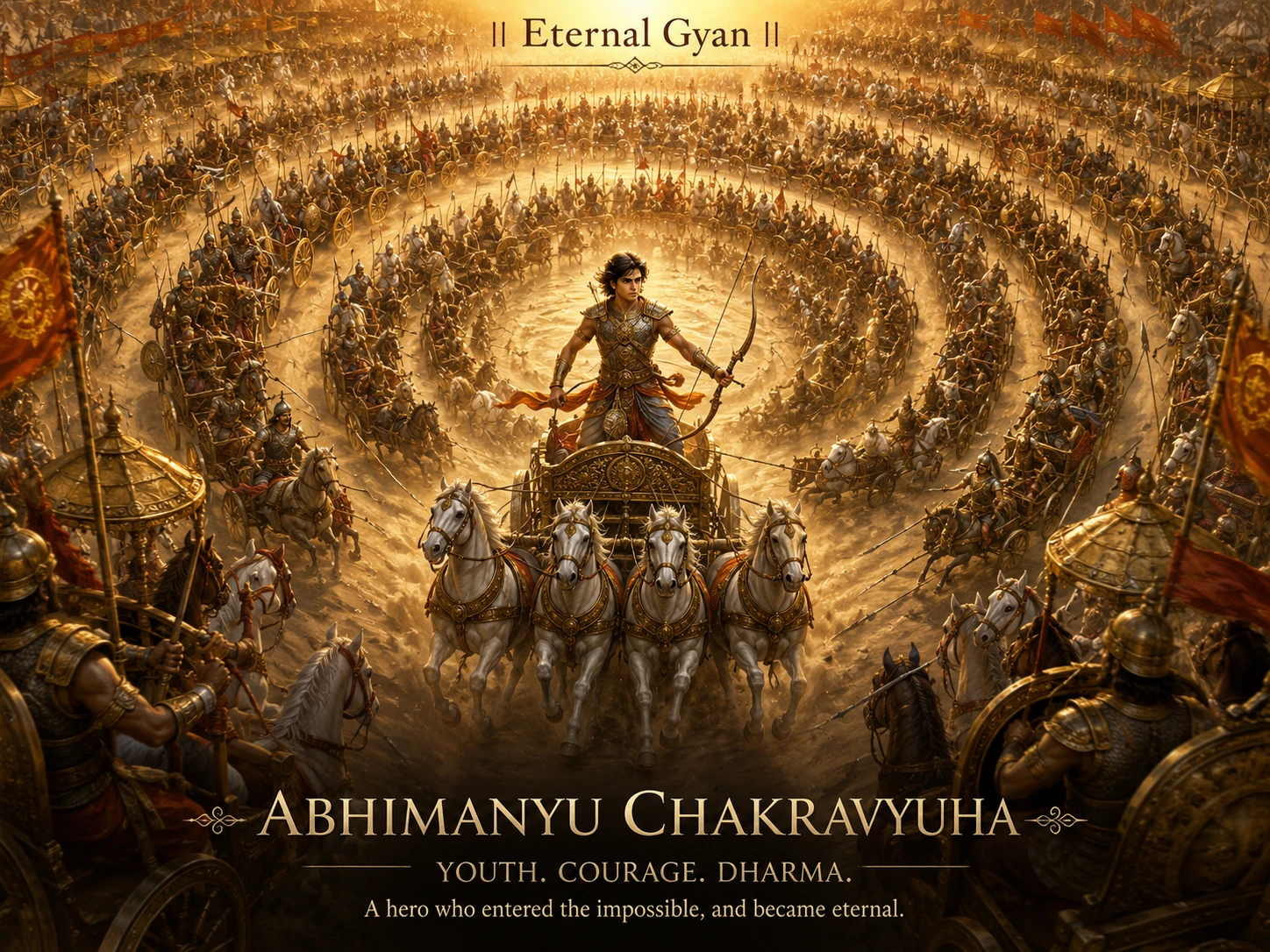
Abhimanyu and the Chakravyuha -- The Boy Who Knew How to Enter but Not How to Leave
14 min read
Adbhuta Ramayana -- The Ramayana Where Sita Becomes Kali
9 min read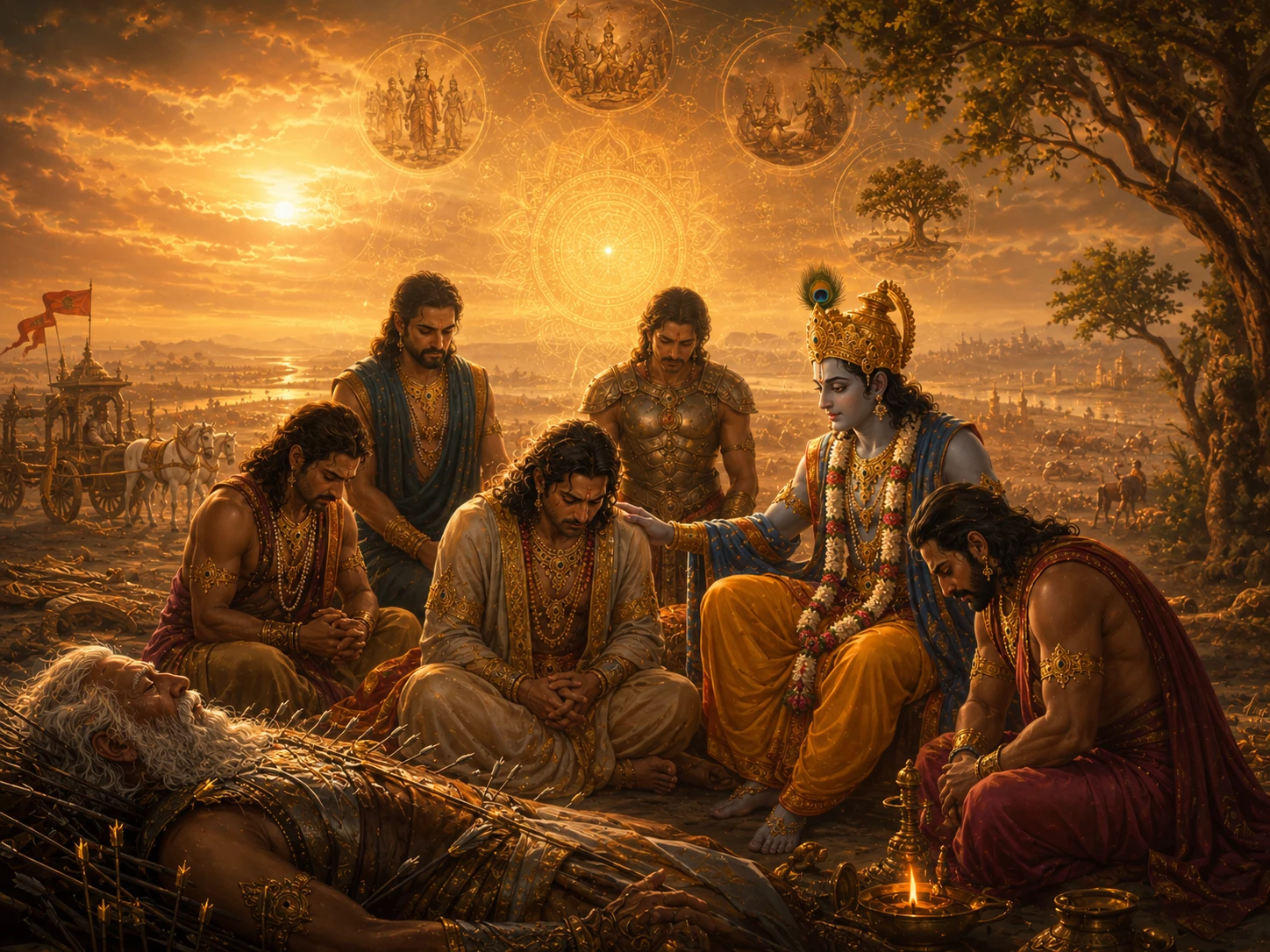
After Kurukshetra -- What Happened Next
14 min readThe same translation error that turned '33 Koti' into '33 crore' in Hinduism also happened in Buddhism. The Chinese translation of Buddhist texts rendered 'Sapta Koti Buddha' (7 Supreme Buddhas) as '7 Crore Buddhas.' The…
Deities AvatarsCommunity Reflections
🕉️
Be the first to share your reflection.