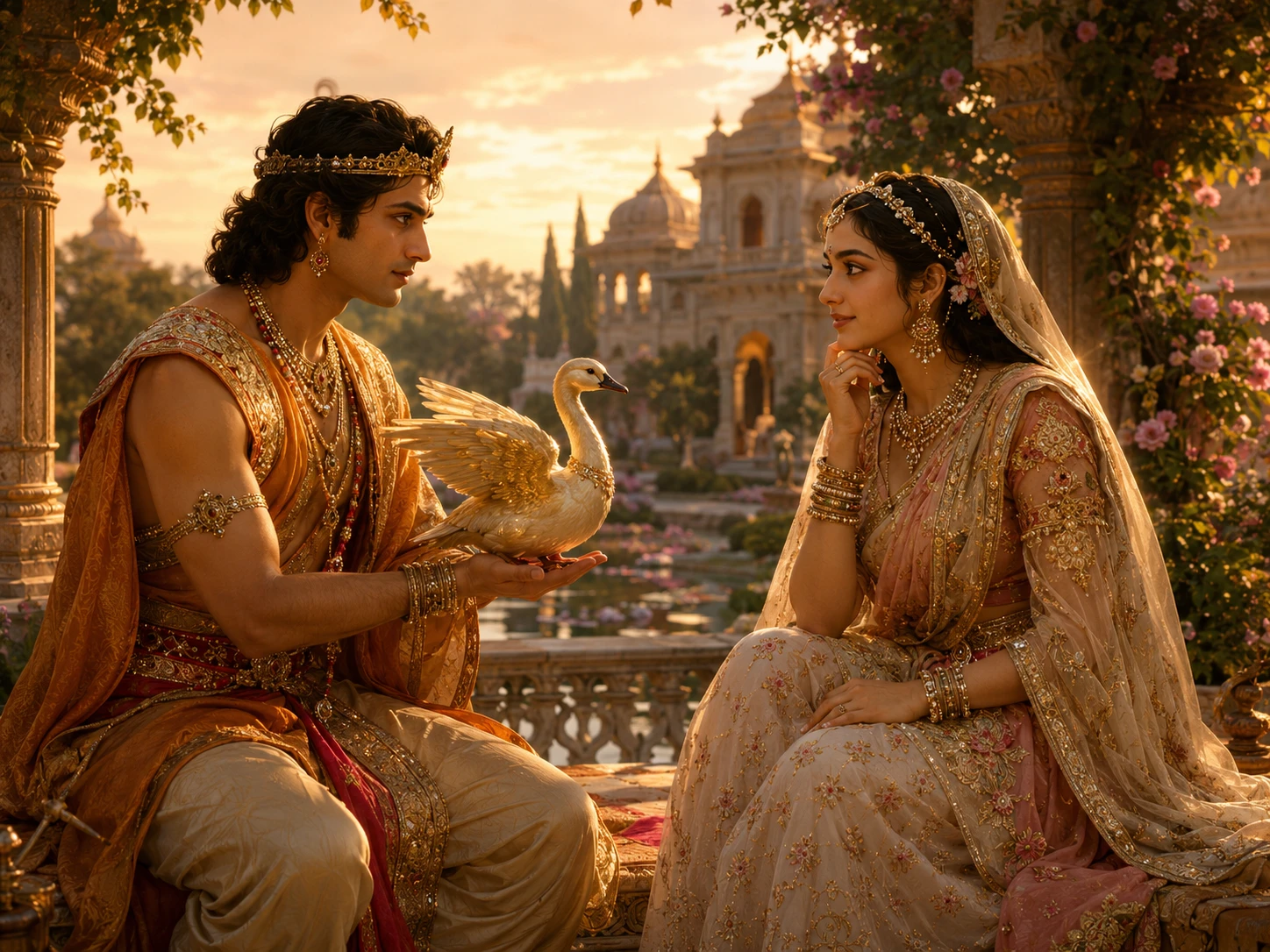
Nala and Damayanti -- Love Across The Gambling Floor
नल और दमयन्ती -- द्यूत-कक्ष के पार का प्रेम
Why This Story Is Where It Is
Yudhishthira has just lost everything to a dice game. His kingdom, his brothers' freedom, his wife's dignity. He sits in the Kamyaka forest and cannot stop thinking about that one cursed evening at Hastinapura. The sage Brihadashva walks into the Pandava encampment. Yudhishthira asks him a sharp, almost rhetorical question: is there any king in history who has been as miserable as I am right now?
Brihadashva does not answer with comfort. He answers with a story. He tells Yudhishthira about a king named Nala -- a king who, like Yudhishthira, lost his kingdom to dice; whose wife, like Draupadi, was loyal beyond reasonable expectation; who wandered the forest in disguise for years before being restored. The Nalopakhyana, embedded in the Vana Parva of the Mahabharata across roughly twenty-six chapters (52-79 in Ganguli, 50-78 in BORI Critical Edition), is one of the longest sub-stories in the epic. It is not there for entertainment. It is medicine for a specific patient at a specific moment.
This framing matters. The Nalopakhyana is not, primarily, a romance. It is a recovery manual. A king reads it because a king has lost something. A reader picks it up because a reader has, somewhere in their life, lost something. The romance is the sweet edge of the lesson. The lesson is that fortune turns, dharma holds, and the way back is always longer than the way down.
आसीद्राजा नलो नाम वीरसेनसुतो बली। उपपन्नो गुणैरिष्टै रूपवानश्वकोविदः॥
āsīd rājā naḷo nāma vīrasena-suto balī upapanno guṇair iṣṭai rūpavān aśva-kovidaḥ
There was a king named Nala, the mighty son of Virasena, endowed with all desired virtues, of beautiful form, and a master of horses.
— Mahabharata, Vana Parva, Nalopakhyana Parva 53.1 (Ganguli)
The Cast Of The Story
Nala was king of the Nishadha kingdom, son of Virasena. He was beautiful, just, charitable, a master of horses (the ashvakovida noted in the opening verse becomes structurally important later), and possessed a single weakness, which is the weakness of every Yudhishthira-class virtuous man in the Mahabharata: he loved dice and trusted that virtue alone would protect him from the consequences.
Damayanti was princess of Vidarbha, daughter of King Bhima (not the Pandava Bhima). The Mahabharata describes her in language usually reserved for goddesses, then adds a detail that is almost modern: she had absorbed Nala's qualities through reputation alone, before ever seeing him. She had built him in her mind from descriptions and decided, before any meeting, that he was the man she would choose. This is, in twenty-first-century terms, the original case of falling in love through someone's profile.
The agent of communication was a hamsa, a golden swan, that flew between the two kingdoms. Nala caught the swan in his garden once. The swan promised that if released, it would fly to Vidarbha and tell Damayanti about Nala. It kept the promise. It described Nala to Damayanti and Damayanti to Nala until both were certain they wanted no other partner. The swan as messenger is a Sanskrit literary trope -- it later appears in Kalidasa's 'Meghaduta' (where a cloud carries the message), in Banabhatta's 'Kadambari' (where a parrot does), and in countless dohas of the Bhakti poets. The Nalopakhyana is the foundation text for the whole genre.
The Swayamvara And The Four Gods
King Bhima of Vidarbha, perhaps sensing his daughter's silence about every suitor on offer, announced a swayamvara. Word reached the upper worlds. Indra, Agni, Varuna, and Yama -- the four lokapalas, guardians of the four directions -- decided to attend. They had decided that Damayanti was too valuable for any human king. While travelling toward Vidarbha, they encountered Nala on the road and asked him a favour. The favour was that Nala go ahead to Damayanti's chamber and tell her, on behalf of the four gods, that she should choose one of them.
Nala objected. He was himself there to win her hand. The gods invoked his promise. Nala had already, in the heat of polite reply, said yes to the favour. He went. The text is precise about his discomfort.
Damayanti listened. Then she said something the Mahabharata records carefully. She told Nala: come to the swayamvara with the four gods. There, in front of all the lokapalas, I will choose you. No blame will fall on you. I will take the burden of the choice publicly and visibly. Nala returned and reported. The four gods, on the day of the swayamvara, used divine power to take Nala's exact form. Damayanti walked into the hall and saw five identical Nalas. The crisis was simple: she had said she would choose Nala. There were five.
How Damayanti Identified The Real Nala -- The Five Tells
| Tell | पहचान | Why It Worked | Devata Limitation Exposed | Modern Echo |
|---|---|---|---|---|
| Eyelids that blinked | पलकें झपकीं | Devas do not blink. Mortals do. | Bodily perfection -- gods cannot mimic ordinary breath rhythm | Recognising someone in a video call by their natural pause-points |
| Feet touching the ground | चरण ज़मीन पर थे | Devas float a finger's breadth above earth | The trace of physical weight | How a friend walks differently from a stranger doing an impression |
| A garland that wilted | माला मुरझाई | Flowers near a deva remain unfaded | Mortal proximity affects organic matter | The smell of someone's actual clothes versus a perfume sample |
| Shadow on the floor | धरती पर छाया | Devas cast no shadow | Sunlight obeys the difference between embodied and luminous beings | A photo where you can tell who is real from who is rendered |
| Sweat at the brow | ललाट पर स्वेद | Devas do not perspire | Mortal physiology under the strain of being chosen | Nervous palms before an interview no candidate can fake |
Damayanti did not pray to the gods to reveal Nala. She used observation. The Mahabharata makes a quiet philosophical point here -- the divine and the mortal differ in body, not in beauty. The text is celebrating embodied, perspiring, breathing humanity by giving it the win.
Why Kali Came
When Damayanti placed her garland on Nala, the four gods accepted defeat with grace and gave him boons. But on their way back, they met Kali. This Kali is not the goddess. The Sanskrit word 'Kali' here refers to a male personification of the demon of the dice age -- the same root word that names our current Kali Yuga. Kali had also wanted to attend the swayamvara, had arrived late, and was now furious that Damayanti had chosen a mortal over the gods.
The gods told him to leave it alone. Damayanti had married a man worthy of her. Kali refused. He swore that he would enter Nala's body, wait for an opening, and bring him down. He found his opening twelve years later, when Nala once urinated without first washing his feet -- a small ritual lapse that, in the dharmic universe, leaves the body briefly unprotected. Kali entered. From that day, Nala began to be drawn back to dice.
His brother Pushkara appeared with a dice game. Pushkara had Kali's invisible help. Nala played. Nala lost. Each round the stakes grew. Damayanti pleaded. Nala did not stop. Within days, Nala had lost his kingdom, his wealth, his royal robes, everything except the single garment on his body. He left the palace with Damayanti walking beside him in similar rags, into the same forest in which Yudhishthira will one day walk hearing this story.
The parallel is precise. The Mahabharata is asking Yudhishthira, through Brihadashva, to look at himself in this mirror. The diagnosis is not 'you are unlucky.' The diagnosis is 'something entered you when you were unprotected, and you let it play through you. Now you must wait while it plays out.' The Sanskrit word for this is karma -- not retribution, but the working-through of a force already set in motion.
न मेऽस्ति किञ्चिद्धनमप्रमेय्यं यदद्य देयं तव विप्रमुख्य। जानामि चात्मानमलंकृतां च तथाप्ययं भारत सत्यवादी॥
na me 'sti kiṃcid dhanam aprameyaṃ yad adya deyaṃ tava vipra-mukhya jānāmi cātmānam alaṃkṛtāṃ ca tathāpy ayaṃ bhārata satya-vādī
I have nothing of unmeasured wealth left to give you today, O foremost of brahmins. I know my own self; even adorned, even in this state, my husband is a speaker of truth.
— Mahabharata, Vana Parva, Nalopakhyana Parva (Damayanti speaking after her exile)
The forest separation between Nala and Damayanti, where Nala leaves a sleeping Damayanti and walks away believing it is for her own good, is one of the most controversial scenes in the Mahabharata. Nala, in self-loathing for what his gambling has cost her, decides she will be safer alone. He is wrong. The text uses this scene to make a sharp ethical point -- a man's well-meant unilateral decision about a woman's safety can be exactly the wrong call. Damayanti spends years wandering the forest after this, surviving by intelligence and being mistaken for everything from a goddess to a fugitive thief. The Mahabharata never absolves Nala for the abandonment. When they finally reunite, Damayanti's first words are not gratitude. They are a question -- a careful, level question about what dharma permits a man to do to a sleeping wife.
The Karkotaka Transformation
Nala, walking through the burning forest after the separation, hears a voice calling for help. A serpent named Karkotaka is trapped in a forest fire. Nala saves the serpent by carrying him out. Karkotaka, in gratitude, then bites Nala. Not as betrayal -- as gift. The serpent's venom transforms Nala's appearance into that of a hideous, dwarfish charioteer. The transformation is the disguise Nala will need to live unrecognised while Kali still occupies him. The venom also slowly poisons Kali, weakening the demon over time.
In this disguised form, taking the name Bahuka, Nala goes to the kingdom of Ayodhya and enters the service of King Rituparna -- a man whose particular skill is the science of dice. Rituparna can count the leaves of a tree at a glance. He has mastered the very thing that destroyed Nala. Nala becomes his charioteer because Nala, the master of horses, possesses the only skill Rituparna lacks: ashvavidya, the science of horses. The two men strike a private agreement. Each will teach the other his discipline.
This is the Mahabharata's deepest move in the recovery arc. Nala does not get back what he lost by undoing the loss. He gets it back by becoming someone who has now mastered the art that broke him. He learns dice. Properly. From a master. By the time the venom finishes its work and Kali leaves Nala's body, Nala is no longer the man who could be tricked at a board.
This is a structural teaching the Mahabharata returns to repeatedly. The Pandavas, exiled because of dice, will spend their thirteen years acquiring exactly the skills they were missing on the night of the dice game. Arjuna will go to Indraloka and master divine weapons. Bhima will hone his strength against Hidimba and Bakasura. Yudhishthira will gather the discourses on dharma that will steady him at Kurukshetra. The Pandava exile is, in miniature, a Nala-yatra. Each brother is being remade by the very forest into which their loss threw them. The text wants the reader to notice the parallel. Nala learning dice from Rituparna is the model. The Pandavas in the Kamyaka and Dvaita forests are running the same recovery loop on a larger scale.
The deeper philosophical point is karma's relationship to learning. The Mahabharata does not promise that the same misfortune will not return. It promises that if you have been remade by the misfortune, you will meet its return as a different person. That is the only guarantee. It is a smaller promise than the modern self-help market would prefer, and a larger promise than nihilism allows. The Mahabharata sits exactly between the two.
The Second Swayamvara That Was A Trap For The Trickster
Damayanti, returned to her father's court at Vidarbha, sends out brahmins as messengers across the kingdoms with a strange ballad. The ballad describes a woman abandoned in the forest by her husband and asks if anyone has seen him. One of the brahmins, in Ayodhya, hears a misshapen charioteer named Bahuka muttering an answer to the ballad in a voice that contains, beneath the deformity, the careful idiom of a king. The brahmin reports back. Damayanti is now reasonably certain Nala is alive in Ayodhya, in disguise, in Rituparna's service.
She arranges a second swayamvara. She announces it to be held the next morning at sunrise, an impossibly short notice for any king to attend. Only one chariot in the world could cover the distance from Ayodhya to Vidarbha overnight -- the chariot of the kingdom that had Nala-class horsemanship at the reins. Rituparna, hearing of the swayamvara, summons his charioteer Bahuka and asks if it can be done. Bahuka harnesses the horses and drives. The horses fly. Rituparna, watching the speed, realises that no ordinary charioteer drives like this. Halfway through the night, in the open country, Rituparna offers to teach Bahuka the science of dice in exchange for the secret of his horsemanship. They exchange disciplines on a moving chariot. The exchange is what finally drives Kali out of Nala's body. Kali, weakened by venom and now exposed by Nala's mastery of dice, departs.
They arrive in Vidarbha. Damayanti, hidden, watches the chariot approach. She listens to the cooking sounds from the kitchen Bahuka uses; she watches the way the cook moves; she sends in tests. By morning she is sure. She has no swayamvara at all. The 'swayamvara' was the bait. Nala recognises that it was a bait. He confronts her in private. The reunion is not a soft Bollywood scene. It is, the text records, a careful negotiation between two damaged people about whether they can still be married after everything that has happened to them apart.
What This Story Says To A Modern Reader
The Nalopakhyana speaks differently to different modern readers, the way only a great story can. A young entrepreneur in Koramangala whose first startup has just shut down reads it and sees the kingdom-loss arc -- the way a dharmic person can collapse from a single weakness left unguarded, and the way the road back goes through learning the very thing that brought you down. He reads it on the night his wife sits across the table calculating which assets are still in her name, and what they will eat next month. He does not skip Damayanti's response. He learns from it.
A Mumbai woman watching her husband's quiet descent into Dream11 and IPL betting reads the story differently. She reads Damayanti's silence first, then her words. She notices the moment Damayanti pleads with Nala to stop. She notices that Nala does not stop. She notices that the Mahabharata records Damayanti's pleading without granting it the power to redirect him. The text is honest about a hard fact -- a wife cannot save a husband from his own gambling. She can survive what comes next. She cannot prevent it.
A student of Sanskrit at BHU reads the story and notices the architecture. Brihadashva tells Yudhishthira this story. Inside the story, Damayanti tells Nala she will choose him. Inside that, the swan tells Damayanti about Nala. Inside that, Karkotaka transforms Nala. Each layer is a frame. The Mahabharata teaches its readers, by example, how to read itself -- inside-out and outside-in, with patience for nested stories that pay off only at the right moment.
A father in Pune teaching his daughter the story finds the part he was not expecting. His daughter is twelve. She listens to the swayamvara scene and asks why all the gods had to disguise themselves as Nala. Why couldn't they just have entered the swayamvara as themselves? The father stops. The daughter has noticed something the commentary tradition has wrestled with for centuries. The gods knew they were beautiful. They knew they were powerful. But they suspected, correctly, that against a young woman who knew her own mind, beauty and power were not enough. So they cheated. The fact that they cheated is itself the deepest praise of Damayanti in the text.
Sir Edwin Arnold's 1883 English translation of the Nalopakhyana, published in his volume 'Indian Idylls', was one of the first Mahabharata-derived works to receive sustained literary attention in the West. Arnold treated the Nala-Damayanti story as a classical romance equal to anything in Greek or Latin literature, and his translation found its way into school anthologies across the British Empire. In post-Independence India, the story re-entered the public imagination through a series of films -- the 1957 Hindi film 'Nal Damayanti', and Tamil and Telugu adaptations across the 1950s and 1960s. Today the Nalopakhyana is a set text in the Sanskrit MA programmes at JNU, BHU, Sampurnanand Sanskrit Vishwavidyalaya in Varanasi, and Rashtriya Sanskrit Sansthan in Tirupati.
Why Brihadashva Picked This Story
When Brihadashva finishes the Nalopakhyana, he gives Yudhishthira one final piece of medicine. He teaches him the dice-mastery secret of Rituparna -- the very science Nala learned on the moving chariot. The Mahabharata is precise about this transmission. Yudhishthira receives, by direct teaching from Brihadashva, the science of dice. The text does not say Yudhishthira will use it, or that he will become a dice-master. The text says only that the science was transmitted. The implication is left open.
A generation of readers has wondered why this transmission is in the text. The answer the text suggests is more careful than the question: a man who has been broken by something must, at minimum, understand it. He need not become its practitioner. He must not remain its victim. Brihadashva is not turning Yudhishthira into a gambler. He is closing the wound. He is making sure that the next time Yudhishthira sits at any board where the stakes are real, he will not be the one who does not know the rules.
This closing gift is what makes the Nalopakhyana more than a romance and more than a recovery story. It is the Mahabharata's quiet philosophy of what to do after a defeat. First, hear the story of someone who recovered. Second, weep if you must, but only briefly. Third, learn the technique that broke you. Fourth, keep walking. The kingdom does come back. Damayanti does come back. The kingdom and the wife both come back differently than they were before, and the man who receives them is also different. That is the price and the reward of the Nala-yatra. The Mahabharata, by placing this story exactly where it places it, is offering the same yatra to anyone reading.
The young entrepreneur in Koramangala closes the book at this point and notices something he did not notice on the first read. The story has not promised him his startup back. It has not promised him the same wife who was sitting across the table doing the math. It has only promised that if he becomes a different man, what comes next will meet him as he is now, not as he was. That is enough. That is what the Mahabharata always actually offers, and never promises more than.
Recite the Nala-Damayanti Shloka
The Mahabharata's Nalopakhyana gives a verse traditionally recited to ward off the troubles of Kali: 'Karkotakasya nagasya Damayantya Nalasya cha, Rituparnasya rajarsheh kirtanam Kali-nashanam.' Recite it through difficult periods, for the recovery of what was lost and the return of those separated. It is not yet on Eternal Raga; the mantra library has other hymns for hard times.
Tags
Eternal Raga · शाश्वत राग
Institutional voice — scholarly articles on Sanatan Dharma
Deepen Your Understanding
अपनी समझ और गहरी करें
scriptural exegesis
Savitri and Satyavan -- The Woman Who Argued With Death
She knew the day her husband would die. She walked into the forest beside him anyway. And when Yama came with his noose, she argued -- not pleaded -- her way to four boons that turned death itself into the doorway home.
scriptural exegesis
Yaksha Prashna -- Questions at the Lake
Four brothers lie dead beside an enchanted lake. One brother remains. A voice from the water asks 124 questions about dharma, death, happiness, and the self. Yudhishthira's answers in Vana Parva remain the most sophisticated ethical examination in all of Sanskrit literature.
scriptural exegesis
Draupadi in the Sabha -- The Trial That Started the War
A queen was dragged into a court full of kings, warriors, and elders. Not one stood up. She asked a single legal question that nobody could answer. Then she swore an oath that burned a civilization to the ground. Draupadi's Sabha episode is not a story about a helpless woman. It is the most devastating indictment of institutional silence in world literature.
scriptural exegesis
Gajendra Moksha -- The Elephant's Cry That Brought Vishnu Down
An elephant king. A crocodile's jaws. A thousand years of struggle. And then one cry of total surrender that made Vishnu leap off his cosmic seat. The Gajendra Moksha is the Bhagavata's masterclass in what happens when self-effort runs out and grace begins.
scriptural exegesis
Dhruva's Tapasya -- The Five-Year-Old Who Became a Star
Insulted by his stepmother, abandoned by his father, sent into the forest with a twelve-syllable mantra at age five -- Dhruva's tapasya is the Bhagavata's most uncomfortable story about how trauma converts to grace. Six months of meditation in Madhuvan, and Vishnu fixes him at the centre of the sky.
scriptural exegesis
Yudhishthira -- The King Who Inherited a Wasteland
He was the eldest. The dharmaputra. The man whose chariot rode four inches above the ground because he had never lied. He lost a kingdom at dice and won it back through a war that killed almost everyone he loved. The Mahabharata gives us the strangest gift in the eldest Pandava -- a man whose dharma was so exact that even his dog could enter heaven, and whose grief at the cost of that exactness made him refuse heaven if his enemies were there.
The forest separation between Nala and Damayanti, where Nala leaves a sleeping Damayanti and walks away believing it is for her own good, is one of the most controversial scenes in the Mahabharata. Nala, in self-loathing…
More in Scriptural Exegesis
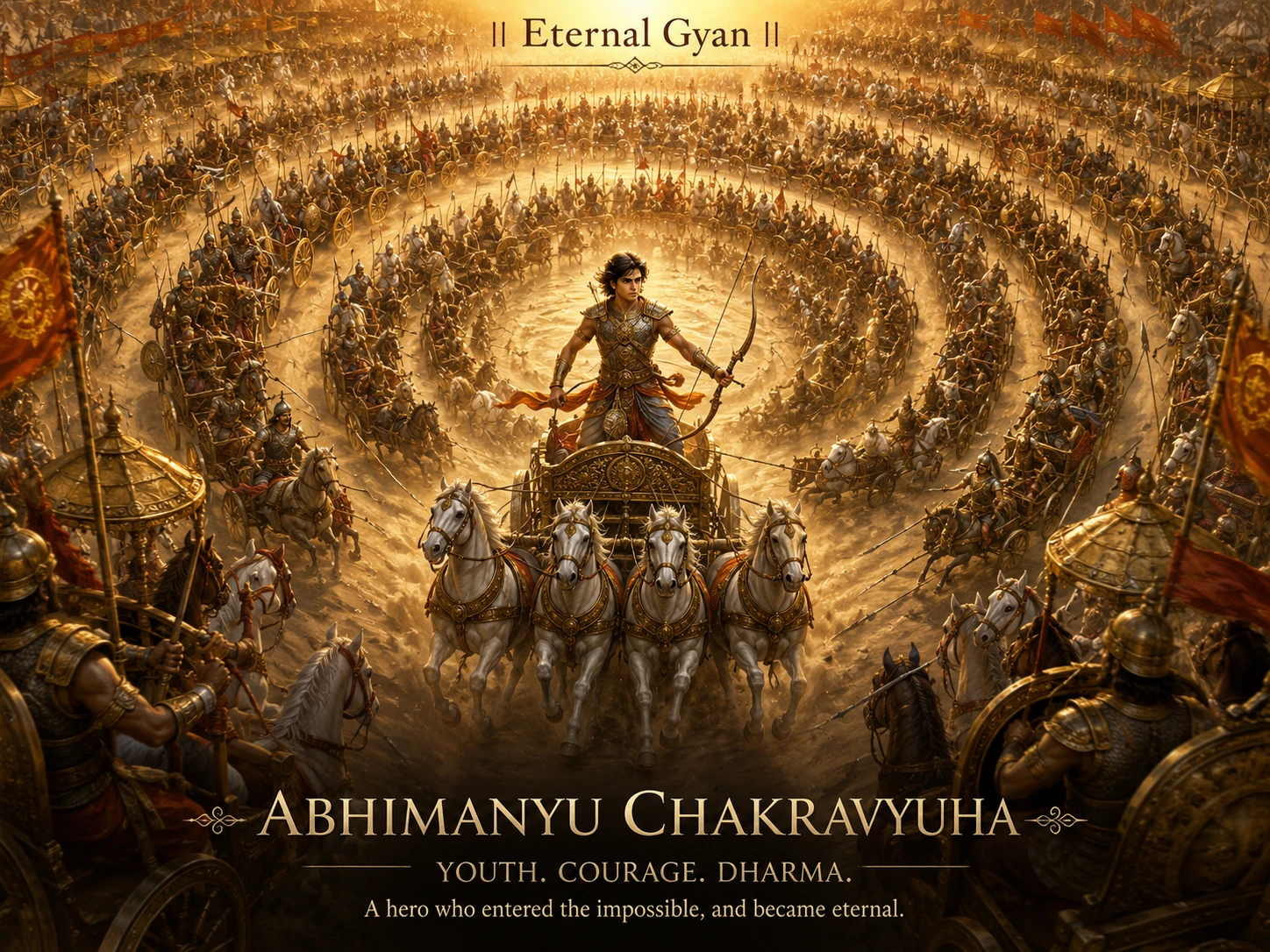
Abhimanyu and the Chakravyuha -- The Boy Who Knew How to Enter but Not How to Leave
14 min read
Adbhuta Ramayana -- The Ramayana Where Sita Becomes Kali
9 min read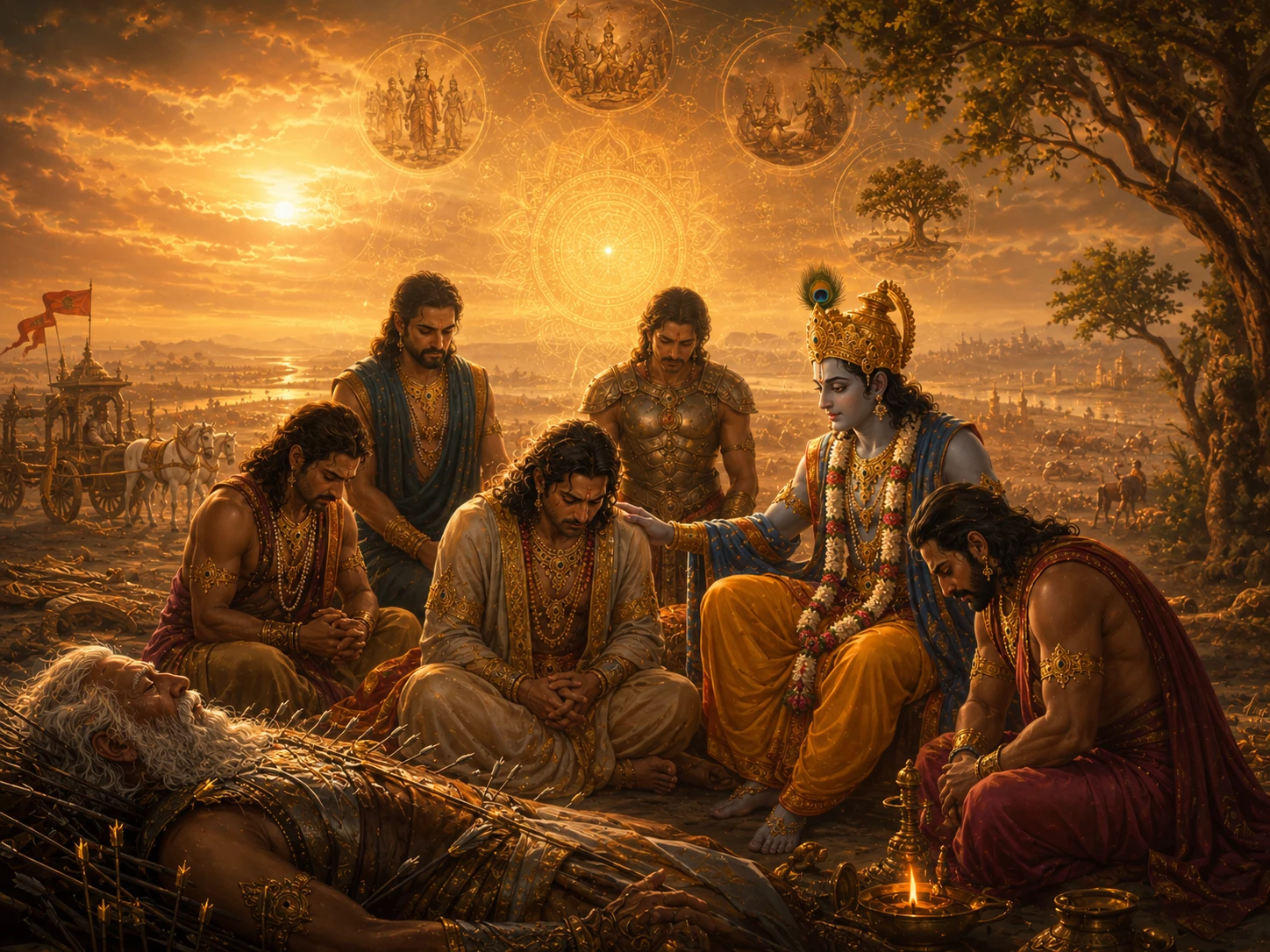
After Kurukshetra -- What Happened Next
14 min readThe same translation error that turned '33 Koti' into '33 crore' in Hinduism also happened in Buddhism. The Chinese translation of Buddhist texts rendered 'Sapta Koti Buddha' (7 Supreme Buddhas) as '7 Crore Buddhas.' The…
Deities AvatarsCommunity Reflections
🕉️
Be the first to share your reflection.