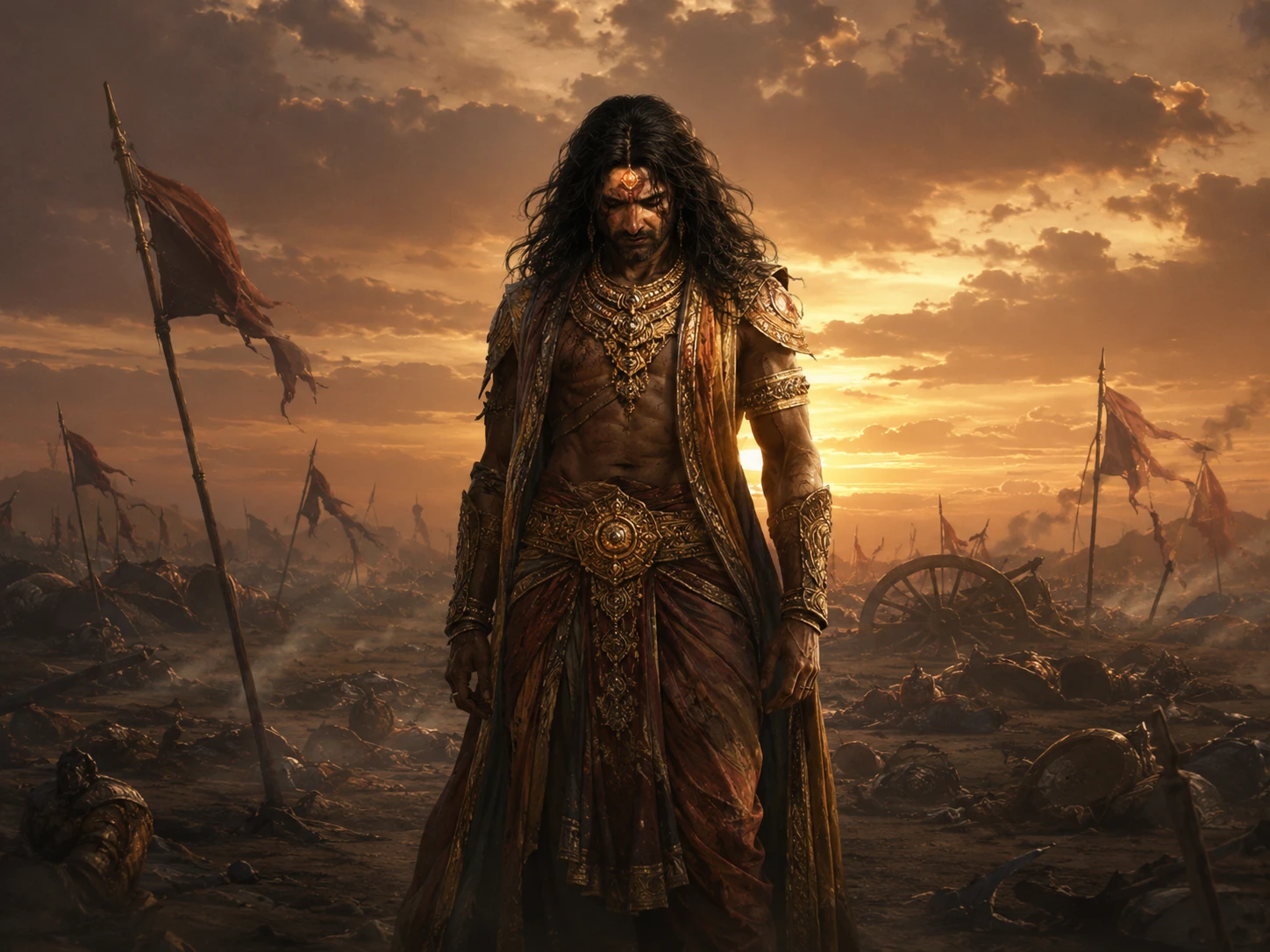
Ashwatthama and the Brahmashirsha -- The Night the War Refused to End
अश्वत्थामा और ब्रह्मशिर्ष -- वह रात जब युद्ध समाप्त होने से मना कर गया
Ashwatthama is the Mahabharata's most disturbing character -- not because he is the most evil, but because he is the most recognisable. He is a man of genuine talent who was shaped by childhood deprivation, corrupted by loyalty to the wrong cause, and finally destroyed by grief that he could not process. His story does not end at Kurukshetra. It extends into eternity. He is one of the seven Chiranjeevis -- the immortals of Hindu tradition -- cursed to walk the earth for 3,000 years (or, in Puranic expansions, until the end of the Kali Yuga) in pain, solitude, and decay. Ashwatthama is not a villain you can safely hate. He is a cautionary tale you have to reckon with.
His story unfolds primarily in the Sauptika Parva (Book 10 -- 'The Book of the Sleeping Warriors') and the Aishika Parva (Book of the Weapon). The Sauptika Parva has 18 chapters in the Critical Edition. It is one of the shortest parvas but arguably the darkest in the entire Mahabharata. It takes place in a single night -- the night after Day 18, after Duryodhana has been struck down by Bhima and lies dying by a lake. The war is officially over. The Pandavas have won. And then, in that victory, something worse than the war begins.
Ashwatthama's background is essential. He is the son of Dronacharya and Kripi. Born with a divine jewel (mani) embedded in his forehead -- a gift from Shiva that made him impervious to hunger, thirst, disease, and weapons. But his childhood was marked by humiliation. The Adi Parva records that young Ashwatthama once cried because other children were drinking milk while his Brahmin family could not afford it -- they gave him water mixed with rice powder and told him it was milk. This primal wound of poverty and humiliation in a boy with divine potential is the seed of everything that follows.
The trigger for the massacre is the death of Drona on Day 15. The Pandavas, unable to defeat Drona in combat, use a stratagem devised by Krishna. Bhima kills an elephant named Ashwatthama and cries out: 'Ashwatthama is dead!' Drona, desperate, turns to Yudhishthira -- the one man who never lies -- and asks: 'Is my son dead?' Yudhishthira speaks a half-truth: 'Ashwatthama is dead' -- and then adds, sotto voce, 'the elephant, not the man' -- words deliberately drowned out by the blowing of conch shells. Drona, shattered by grief, drops his weapons. Dhrishtadyumna, the Pandava commander, beheads the unarmed Brahmin warrior.
This is the original sin that sets the Sauptika Parva in motion. Ashwatthama's father was killed through deceit while disarmed. In Ashwatthama's mind -- and this is where the Mahabharata resists simple morality -- the Pandavas have no moral authority left. They killed Bhishma by hiding behind Shikhandin. They killed Drona through a lie. They will kill Karna when his chariot wheel is stuck. They will kill Duryodhana by striking below the belt. Every Pandava victory involves some violation of the warrior code. Ashwatthama sees himself not as a murderer but as a man returning the violence that was done to his side -- using the enemy's own methods.
After Duryodhana's fall on Day 18, only three Kaurava warriors survive: Ashwatthama, Kripacharya, and Kritavarma. They find Duryodhana dying by a lake. Ashwatthama promises him: 'I will avenge you tonight.' Duryodhana, with his last act of authority, appoints Ashwatthama as the final commander of the Kaurava forces. It is a meaningless title -- there is no army left to command. But it gives Ashwatthama the legitimacy (in his own mind) to act.
The night massacre is described with deliberate horror. Ashwatthama enters the Pandava camp under cover of darkness. At the gate, he encounters a terrifying figure -- the text describes it as an enormous being with flaming eyes, a body that fills the horizon. In some readings, this is Shiva himself, testing Ashwatthama's resolve. Ashwatthama performs a sacrifice, offering himself to Rudra (Shiva as the Destroyer), and receives supernatural strength. The guardian entity permits him to pass.
Inside the camp, everyone is asleep. The war is over. Guards are lax. Ashwatthama's first target is Dhrishtadyumna -- the man who beheaded his father Drona. He kills Dhrishtadyumna by stomping and strangling him, denying him a warrior's death by weapons. Then he finds the tent of the Upapandavas -- the five sons of Draupadi, one from each Pandava husband. He mistakes them for the Pandavas themselves (or, in some readings, kills them knowingly). All five are slaughtered in their sleep. He kills Shikhandin, Uttamaujas, Yudhamanyu, and thousands of Panchala soldiers.
Kritavarma and Kripa guard the exits. Anyone who wakes and tries to flee is cut down. The massacre is total. By dawn, the Pandava camp is a graveyard. The only survivors are the five Pandava brothers themselves (who were sleeping elsewhere -- Krishna had mysteriously led them away from the camp that night), Krishna, Satyaki, and Yuyutsu. Every other ally of the Pandavas is dead.
The detail that the Pandavas were absent from the camp is crucial. Krishna knew. He led the brothers away before the massacre. He did not warn the camp. He did not prevent the killing. The Mahabharata does not explain Krishna's choice -- it simply records that he ensured the Pandavas survived while allowing everyone else to die. This is Krishna at his most inscrutable, and it has generated centuries of theological debate.
The final confrontation occurs the next morning. Draupadi, learning that all five of her sons have been murdered in their sleep, demands justice. Bhima pursues Ashwatthama to a forest hermitage. Cornered, Ashwatthama launches the Brahmashirsha Astra -- one of the most devastating weapons in the Mahabharata's divine arsenal. It manifests with four heads of Brahma, radiates fire in all directions, and threatens to destroy the entire world. Arjuna counters with his own Brahmashirsha Astra. The two weapons race toward each other, and the sages Narada and Vyasa appear, commanding both warriors to withdraw.
Arjuna, who possesses full knowledge of the weapon, successfully retracts his missile. Ashwatthama cannot. His father Drona had taught him how to launch the Brahmashirsha but deliberately withheld the knowledge of recalling it -- mirroring the Abhimanyu pattern of incomplete knowledge with catastrophic consequences. Unable to withdraw the weapon, Ashwatthama redirects it -- into the womb of Uttara, Abhimanyu's widow, who carries the last heir of the Pandava dynasty.
Krishna intervenes. He protects the child in the womb with his own divine power and declares: the child will be born dead, but I will revive him. He will be named Parikshit, and he will rule for sixty years. Then Krishna pronounces the curse. Ashwatthama is to wander the earth for 3,000 years -- solitary, shunned by all, with wounds that ooze blood and pus and never heal, afflicted by every disease, unable to die and unable to find peace. The divine jewel is ripped from his forehead, leaving an open wound that will bleed forever. He is stripped of everything -- power, identity, community, dignity -- and left with only consciousness and suffering.
त्रीणि वर्षसहस्राणि पृथिव्यामटसे त्वम्। सर्वभूतेषु गूढात्मा विचरिष्यसि दुर्मते॥
trīṇi varṣa-sahasrāṇi pṛthivyām aṭase tvam | sarva-bhūteṣu gūḍhātmā vicariṣyasi durmate ||
For three thousand years you shall wander this earth. Hidden from all beings, with a concealed soul, you shall roam, O wicked-minded one.
— Mahabharata, Sauptika Parva, Section 16 (Krishna's curse to Ashwatthama)
Ashwatthama -- The Trajectory from Potential to Ruin
| Phase | Event | What It Reveals | Parva |
|---|---|---|---|
| Childhood | Cries because other children drink milk while he gets rice-water | Primal wound of deprivation in a boy with divine potential; poverty breeds resentment | Adi Parva |
| Training | Drona teaches him Brahmashirsha but withholds recall knowledge | Pattern of incomplete knowledge -- mirrors Abhimanyu; Drona did not trust his own son fully | Drona Parva |
| War Years | Fights loyally for Kauravas; becomes one of the greatest warriors | Genuine martial excellence; loyalty to Duryodhana is personal, not ideological | Drona Parva |
| Father's Death | Drona killed through Yudhishthira's half-truth; beheaded while disarmed | Ashwatthama's worldview shatters; he sees Pandavas as hypocrites | Drona Parva, Day 15 |
| Night Massacre | Kills the Upapandavas, Dhrishtadyumna, Shikhandin, thousands of sleeping soldiers | Grief becomes atrocity; the owl-and-crow metaphor -- nature endorses predation on the sleeping | Sauptika Parva |
| Brahmashirsha | Launches weapon at Uttara's womb -- the last Pandava heir | Cannot recall it due to incomplete knowledge; targets the most vulnerable to end a lineage | Sauptika / Aishika Parva |
| Curse | 3,000 years wandering with oozing wounds, disease, solitude; mani ripped out | Immortality as punishment, not reward; consciousness without community is hell | Sauptika Parva, Section 16 |
| Legacy | Listed as one of the seven Chiranjeevis; temple legend at Asirgarh Fort | Indian culture does not erase him -- it preserves him as an eternal warning | Puranic tradition |
The Mahabharata does not present Ashwatthama as a one-dimensional villain. It tracks the entire arc from deprivation to corruption to atrocity to punishment. The text invites you to understand the mechanism even as it condemns the act.
The Ashwatthama story raises questions that the Mahabharata deliberately leaves unanswered. Is an immortal curse worse than death? The Mahabharata's answer seems to be yes -- emphatically. Death in battle earns svarga (heaven). Even Duryodhana, the primary antagonist, dies and goes to heaven. But Ashwatthama is denied death. He is condemned to exist without purpose, without companionship, without healing. His immortality is not divine favour. It is the universe's way of saying: what you did is so far beyond the pale that even Yama, the god of death, will not accept you.
For modern India, the Ashwatthama archetype is everywhere. The brilliant IIT graduate who could not handle rejection and turned toxic. The Kota student driven to the edge by parental pressure and systemic failure. The corporate leader who was genuinely talented but whose unprocessed childhood wounds made them destructive in positions of power. Ashwatthama is not a monster. He is a broken system's most dangerous product -- a person of real ability who was never given the emotional or ethical framework to handle the world he was thrown into.
The legend that Ashwatthama still wanders persists in rural India and military folklore. The Asirgarh Fort in Madhya Pradesh has a tradition that a wounded man with a bleeding forehead visits the local Shiva temple at dawn, offers a single flower, and disappears before anyone can speak to him. Whether this is mythology, folklore, or something stranger, the cultural point is clear: India has not forgotten Ashwatthama. Three thousand years of wandering, and the story is still being told. That is the real curse -- not the suffering, but the memory.
Ashwatthama's story has become one of the most viral topics in Indian internet culture. The 'Is Ashwatthama still alive?' question generates millions of searches annually on Google India. The Asirgarh Fort (near Burhanpur, Madhya Pradesh) -- where local legend claims he visits a Shiva temple at dawn -- has become a dark tourism destination. The Chiranjeevi mantra that names all seven immortals (Ashwatthama, Bali, Vyasa, Hanuman, Vibhishana, Kripa, Parashurama) is recited for longevity and freedom from disease. The Pallava dynasty of South India traced their genealogy to Ashwatthama through a union with a Naga princess -- making him the legendary ancestor of the rulers who built Mahabalipuram and Kanchipuram. Bollywood's interest in Ashwatthama has surged, with multiple film projects announced featuring the character as a contemporary immortal wandering modern India.
Find the Sauptika Parva in the Mahabharata
The Sauptika Parva, the tenth of the Mahabharata's eighteen books, holds the night massacre and the Brahmashirsha confrontation. The Mahabharata text is not yet on Eternal Raga; the Mahabharata overview article maps all eighteen parvas so you know where to look in a full translation.
Tags
Eternal Raga · शाश्वत राग
Institutional voice — scholarly articles on Sanatan Dharma
Deepen Your Understanding
अपनी समझ और गहरी करें
scriptural exegesis
7 Chiranjeevis -- The Immortals of Hindu Tradition
Seven beings who will not die until the end of this cosmic age. One is cursed to wander in agony. One rules the underworld. One compiled every scripture you have ever read. One is the most worshipped deity in India. The Chiranjeevis are not a mythology trivia list -- they are a map of how immortality works in Hindu thought, and why it is not always a blessing.
scriptural exegesis
Abhimanyu and the Chakravyuha -- The Boy Who Knew How to Enter but Not How to Leave
On the 13th day of Kurukshetra, a sixteen-year-old boy broke into the deadliest military formation in the ancient world -- alone, because the adults who promised to follow him were blocked at the gate. He fought Drona, Karna, Ashwatthama, Kripa, Duryodhana, and Shalya simultaneously. He killed Duryodhana's son Lakshmana. He made Karna flee. He held an entire army at bay for hours. And then they killed him -- not in fair combat, but by surrounding him, destroying his chariot, breaking his weapons, and attacking from all sides at once. Abhimanyu's death is not a tragedy of weakness. It is a tragedy of incomplete knowledge sent to do a complete job.
scriptural exegesis
Karna's Tragedy -- The Sun's Forgotten Son
Born with divine armor, abandoned at birth, raised by a charioteer, humiliated for his caste, cursed by his teacher, and killed while defenseless -- Karna's story is not the Mahabharata's subplot. It is the Mahabharata's conscience. Every system that failed him is a system that still fails people today.
scriptural exegesis
Bhishma's Terrible Vow
A crown prince gave up the throne, love, marriage, and children -- forever -- so his father could marry a fisherwoman. That single vow made Bhishma immortal in name and set the entire Mahabharata into motion. Was it the noblest sacrifice in literature, or the most catastrophic?
scriptural exegesis
100 Kauravas -- The Forgotten Brothers of the Mahabharata
Everyone knows Duryodhana and Dushasana. But what about Vikarna, who stood up for Draupadi when no one else did? Or Yuyutsu, who defected to the Pandavas because his conscience demanded it? The Mahabharata names all 100 sons of Dhritarashtra -- warriors, strategists, and dissenters -- most of whom are killed across 18 days. Their story is not just a casualty list. It is the most devastating portrait of fratricidal war ever composed.
scriptural exegesis
Parikshit to Janamejaya -- The Pandava Dynasty After the War and Why the Mahabharata Was Told
The child who survived a divine weapon in the womb became the king who united a shattered kingdom. His son, consumed by vengeance for his father's death by snakebite, launched a sacrifice to burn every serpent in the world -- and it was at that sacrifice that a sage named Vaishampayana narrated the entire Mahabharata for the first time. Without Parikshit's miraculous survival, there is no Pandava dynasty. Without Janamejaya's rage, there is no Mahabharata as we know it. These two generations are the reason the story exists.
scriptural exegesis
The Dice Game -- The Darkest Hour of the Mahabharata
A king who cannot say no to a challenge. An uncle whose dice are loaded with the bones of the dead. A court full of elders who watch injustice and say nothing. And a woman who asks one question that nobody in the room can answer: 'Did my husband lose himself first, or me?' The dice game in the Sabha Parva is not a plot device. It is the moral black hole at the centre of the Mahabharata. Everything before it is prologue. Everything after it is consequence. And the central horror is not what happens -- it is who lets it happen.
Ashwatthama's story has become one of the most viral topics in Indian internet culture. The 'Is Ashwatthama still alive?' question generates millions of searches annually on Google India. The Asirgarh Fort (near Burhanpu…
More in Scriptural Exegesis
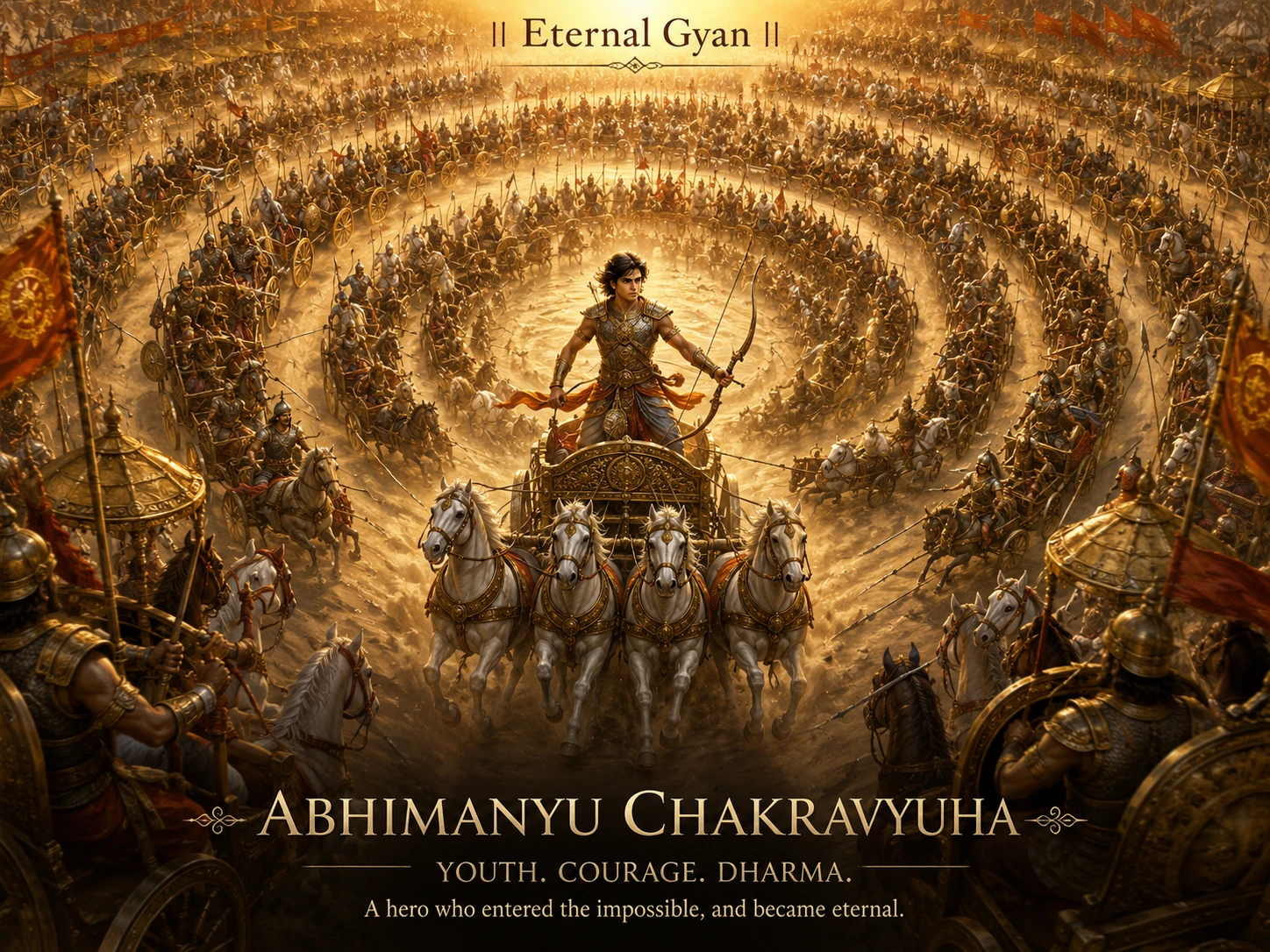
Abhimanyu and the Chakravyuha -- The Boy Who Knew How to Enter but Not How to Leave
14 min read
Adbhuta Ramayana -- The Ramayana Where Sita Becomes Kali
9 min read
After Kurukshetra -- What Happened Next
14 min readThe same translation error that turned '33 Koti' into '33 crore' in Hinduism also happened in Buddhism. The Chinese translation of Buddhist texts rendered 'Sapta Koti Buddha' (7 Supreme Buddhas) as '7 Crore Buddhas.' The…
Deities AvatarsCommunity Reflections
🕉️
Be the first to share your reflection.