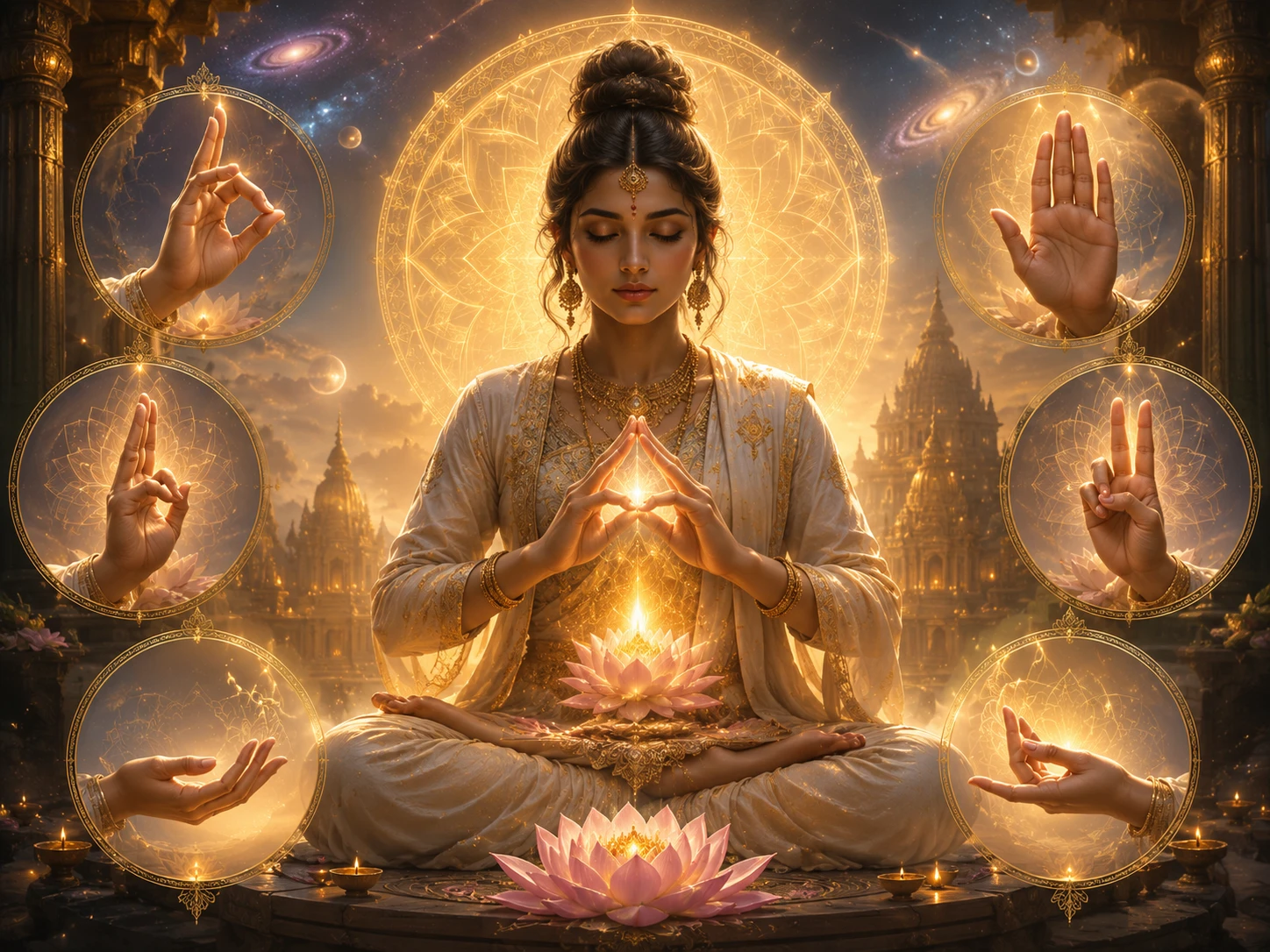
Mudras in Ritual and Yoga -- The Silent Language of the Hands
मुद्रा -- अनुष्ठान और योग में हाथों की मौन भाषा
You perform mudras every single day without knowing it.
When you press your palms together to greet an elder -- that is Anjali Mudra. When you point your finger at the screen to show someone a message -- that is a gesture so loaded with energy that the Tantric tradition forbids the index finger from touching the Japa mala because it is the finger of Ahamkara (ego). When you clasp your hands behind your head in frustration after a dropped catch in a cricket match -- that is an unconscious mudra that opens the chest and releases tension from the Anahata (heart) chakra.
Mudras are everywhere. They are in every temple sculpture from Khajuraho to Mahabalipuram -- the deity's hand position tells you which aspect of the divine is being invoked. They are in every Bharatanatyam performance -- the dancer's 28 root hand gestures (Asamyuta Hastas) create a vocabulary of nearly 900 combined meanings without a single spoken word. They are in every yoga class -- Gyan Mudra during meditation, Anjali Mudra at Namaste, Dhyana Mudra in seated practice.
The word Mudra comes from Sanskrit, meaning 'seal,' 'mark,' or 'gesture.' A mudra seals energy within a specific circuit in the body. When you touch the tip of your index finger to your thumb in Gyan Mudra, you are not merely making a shape with your hand. You are closing an electrical circuit between two nadis (energy channels) that connects the Vayu (air) element of the index finger with the Agni (fire) element of the thumb, creating a specific energetic state that enhances concentration and calms the mind.
This is not mystical speculation. The five fingers of the hand correspond to the five Mahabhutas (great elements) in Ayurvedic and Tantric tradition: the thumb represents Agni (fire), the index finger Vayu (air), the middle finger Akasha (ether/space), the ring finger Prithvi (earth), and the little finger Jala (water). Every mudra is a specific combination of these elements -- a recipe for a particular energetic state, composed with the precision of an Ayurvedic formulation.
The Hatha Yoga Pradipika lists 10 mudras. The Gheranda Samhita lists 25. The Natya Shastra lists 24 Asamyuta (single-hand) and 13 Samyuta (double-hand) gestures for dance. The Tantric texts describe hundreds more for specific deity worship. Combined, the mudra tradition represents arguably the most elaborate system of non-verbal communication and energy manipulation ever developed by any civilisation.
नासनं सिद्धसदृशं न कुम्भकः केवलोपमः। न खेचरीसमा मुद्रा न नादसदृशो लयः॥
nāsanaṃ siddha-sadṛśaṃ na kumbhakaḥ kevalopamḥ | na khecarī-samā mudrā na nāda-sadṛśo layaḥ ||
There is no asana equal to Siddhasana, no kumbhaka equal to Kevala, no mudra equal to Khechari, and no laya (absorption) equal to Nada.
— Hatha Yoga Pradipika 4.45 (Svatmarama)
Five Categories of Mudra -- From Hands to the Whole Body
Traditional yoga classifies mudras into five major categories, each affecting a different layer of being.
Hasta Mudras (Hand Mudras) are the most common and accessible. These include Gyan Mudra (thumb + index finger for knowledge), Chin Mudra (same gesture but palm facing down for grounding), Dhyana Mudra (meditation gesture with both hands in lap), Anjali Mudra (palms pressed together at heart), and Prana Mudra (thumb + ring finger + little finger for life force). These can be practised by anyone, anywhere -- during meditation, during commute, even at a desk during work. They require no flexibility, no special clothing, no teacher.
Mana Mudras (Head Mudras) engage the sensory organs -- eyes, ears, nose, tongue, and lips. Shanmukhi Mudra (closing all six sensory gates with the fingers) used in Nada Yoga is a Mana Mudra. Khechari Mudra -- where the tongue is rolled back to touch the soft palate (and in advanced practice, inserted into the nasal cavity behind the palate) -- is the supreme Mana Mudra according to the Hatha Yoga Pradipika. The text declares there is no mudra equal to Khechari.
Kaya Mudras (Postural Mudras) involve the entire body. Viparita Karani (inverted action), Yoga Mudra (seated forward fold with hands clasped behind), and Maha Mudra (great seal -- a combination of chin lock, root lock, and specific leg position) fall in this category.
Bandha Mudras (Lock Mudras) involve internal energy locks. Mula Bandha (root lock), Uddiyana Bandha (abdominal lock), and Jalandhara Bandha (chin lock) redirect prana flow within the body. These are crucial in advanced pranayama and are the bridge between physical yoga and subtle energy work.
Adhara Mudras (Perineal Mudras) work on the base of the torso, redirecting the downward-moving Apana Vayu upward. Ashwini Mudra (contraction of the anal sphincter) and Vajroli Mudra are in this category.
The five categories demonstrate that mudra is not limited to hand gestures. It is a complete system of body-energy management that includes everything from a simple finger touch to the most advanced internal practices of Hatha Yoga. When a yoga teacher in a Pune studio says 'take Gyan Mudra,' they are accessing the tip of an iceberg that extends into the deepest waters of Tantric practice.
The Five Elements and Your Fingers -- The Ayurvedic Logic of Mudras
The elemental theory of mudras provides a systematic logic that transforms random hand gestures into precise therapeutic tools.
Thumb = Agni (Fire): The master element. The thumb can touch all other fingers, making it the modulator. Fire governs transformation, digestion, and will.
Index Finger = Vayu (Air): Governs movement, nerve function, and thought. Excess Vayu causes anxiety, restlessness, and scattered thinking. Gyan Mudra (thumb touching index finger) balances fire and air -- calming anxiety while sharpening intellect.
Middle Finger = Akasha (Space/Ether): Governs expansion, openness, and the sense of hearing. Shunya Mudra (middle finger pressed to thumb base) reduces the space element -- traditionally used for ear problems and hearing issues.
Ring Finger = Prithvi (Earth): Governs stability, strength, and body mass. Prithvi Mudra (ring finger touching thumb) increases the earth element -- used for weight gain, tissue repair, and building confidence.
Little Finger = Jala (Water): Governs fluidity, taste, and the reproductive system. Varun Mudra (little finger touching thumb) balances the water element -- used for dehydration, skin dryness, and joint lubrication.
The beauty of this system is its combinatorial logic. Want to increase fire and reduce water? Touch the little finger base with the thumb (Agni-Vardhak Mudra). Want to balance all five elements? Place all four fingers against the thumb (Panchatatva Mudra). Each combination creates a unique circuit with a specific therapeutic effect.
A dermatologist in Delhi or a physiotherapist in Chandigarh might find this framework clinically interesting. While peer-reviewed studies on mudra therapy are limited, preliminary research from institutions including AIIMS and NIMHANS has explored the effects of specific hand positions on autonomic nervous system parameters like heart rate variability and galvanic skin response -- finding measurable effects consistent with the tradition's claims.
The five-finger-five-element model also maps elegantly onto the Pancha Kosha (five sheaths) model of Vedantic philosophy: Annamaya Kosha (food/physical -- earth), Pranamaya Kosha (energy -- water), Manomaya Kosha (mental -- fire), Vijnanamaya Kosha (wisdom -- air), and Anandamaya Kosha (bliss -- space). Mudras, in this framework, are not merely adjusting physical elements but tuning the entire multi-layered architecture of the human being.
Essential Mudras -- A Practitioner's Quick Reference
| Mudra | Sanskrit Meaning | Hand Position | Primary Effect | When to Use |
|---|---|---|---|---|
| Gyan Mudra | Gesture of Knowledge | Thumb tip touches index finger tip; other fingers extended | Enhances concentration, memory, and mental clarity; calms Vayu | Meditation, study, before exams or presentations |
| Anjali Mudra | Offering Gesture | Palms pressed together at heart centre | Balances left-right brain hemispheres; evokes respect and gratitude | Greeting (Namaste), beginning and end of yoga or puja |
| Dhyana Mudra | Meditation Gesture | Right hand rests in left palm, thumbs touching, forming triangle | Deepens meditation; activates Ida and Pingala nadis | Seated meditation, especially in morning Brahma Muhurta |
| Prana Mudra | Life Force Seal | Thumb touches ring + little finger tips; index and middle extended | Activates dormant energy, strengthens immunity, reduces fatigue | When feeling drained; during pranayama |
| Chin Mudra | Consciousness Gesture | Same as Gyan but palms face downward on knees | Grounds energy; connects individual to earth element | Grounding meditation, when feeling unmoored or anxious |
| Prithvi Mudra | Earth Gesture | Thumb touches ring finger tip; others extended | Increases earth element, builds strength and confidence | Weight gain, tissue repair, building self-assurance |
| Khechari Mudra | Space-Moving Seal | Tongue rolled back to touch soft palate | Supreme mudra per HYP; activates Amrit (nectar); stills mind | Advanced yogic practice under guru guidance only |
Hasta mudras can be practised by anyone for 15-45 minutes daily. Khechari and advanced mudras require guru guidance. Start with Gyan Mudra during your next meditation session for immediate benefit.
Mudras in Temple Iconography -- Reading the Deity's Hands
Walk into any Hindu temple and the deities will speak to you through their hands -- if you know how to read them.
Vishnu's four hands hold the Shankha (conch), Chakra (discus), Gada (mace), and Padma (lotus), but the position of these objects and the hand gestures vary across icons. In one form, the lower right hand shows Abhaya Mudra (palm forward, fingers up) -- the gesture of fearlessness, saying 'Do not fear, I protect you.' In another, the lower left hand shows Varada Mudra (palm forward, fingers pointing down) -- the gesture of boon-giving, saying 'Ask, and I shall grant.' The combination of Abhaya and Varada -- one hand giving protection, the other giving blessings -- is the most common configuration across Hindu deity iconography.
Shiva Nataraja at Chidambaram is a masterclass in mudra reading. His upper right hand holds the Damaru (drum) in a gesture of creation -- the drum's sound is the Nada from which the universe emerges. His upper left holds Agni (fire) in a gesture of destruction. His lower right displays Abhaya Mudra -- do not fear even as creation and destruction dance around you. His lower left points in Gajahasta Mudra (elephant trunk gesture) toward his raised left foot -- the foot of liberation, which grants Moksha to the devotee who surrenders.
The Dhyana Shlokas (meditation verses) that accompany every deity's worship are essentially verbal descriptions of these mudras and iconographic attributes. When a priest recites the Dhyana Shloka before beginning puja, he is mentally constructing the deity's form -- including the precise hand positions -- in his mind's eye. This mental construction is itself a form of Nyasa: placing the deity's murti in the mind before placing offerings before the physical murti.
For the architecture student studying temple sculpture at Hampi or Konark, for the art history student at JNU or MSU Baroda, for the competitive exam aspirant preparing Indian Art and Culture -- understanding mudras is not optional. It is the Rosetta Stone of Indian iconography. Without it, a four-armed Vishnu is just a statue. With it, every hand position narrates a cosmic function.
Mudras and Modern Neuroscience -- What Your Fingertips Tell Your Brain
The human hand occupies a disproportionately large area of the brain's sensory and motor cortex -- the so-called cortical homunculus. The fingers alone account for more cortical territory than the entire torso. This means that fine motor actions of the fingers -- including the precise positions of mudras -- generate outsized effects on brain activation patterns.
Neuroscience has documented that specific finger positions activate specific regions of the brain. When you touch the thumb to the index finger (Gyan Mudra), you are activating circuits in the prefrontal cortex associated with attention and executive function. When you press the thumb to the ring finger (Prithvi Mudra), different circuits in the parietal cortex associated with body awareness and spatial orientation light up.
This is not esoteric speculation. The mechanism is straightforward: the somatosensory cortex maps every body part to a specific brain region. When you create sustained, intentional pressure between two fingers, you create sustained activation of the corresponding brain regions. Over the 15-45 minutes of a typical mudra meditation session, this sustained activation produces measurable changes in brain wave patterns -- particularly an increase in alpha waves (associated with calm alertness) and theta waves (associated with deep meditation and creative insight).
Researchers at the National Institute of Mental Health and Neurosciences (NIMHANS) in Bengaluru have studied the effects of Gyan Mudra on attention span in medical students, finding statistically significant improvements in sustained attention tasks after eight weeks of daily practice. The effect size was comparable to established mindfulness interventions -- suggesting that the ancient tradition's claims about mudra's cognitive benefits are not merely placebo.
For the IIT or NIT student interested in brain-computer interfaces, this opens a fascinating question: could mudra positions serve as input signals for neural interfaces? The precision and consistency of traditional mudra hand shapes make them excellent candidates for gesture-based computing -- an area where several Indian startups are already working, connecting ancient hand vocabulary to cutting-edge technology.
Mudras in Indian Dance -- The Vocabulary of the Body
No discussion of mudras is complete without acknowledging their supreme expression in Indian classical dance.
The Natya Shastra, Bharata Muni's encyclopaedic treatise on performing arts (dated roughly 200 BCE to 200 CE), codifies 24 Asamyuta Hastas (single-hand gestures) and 13 Samyuta Hastas (double-hand gestures). These are the root vocabulary. Combined with arm positions, body angles, facial expressions (nava rasa), and foot patterns, they create a communication system capable of narrating the Ramayana, expressing the longing of the Gopis for Krishna, or depicting the fury of Durga in battle -- all without a single spoken word.
In Bharatanatyam, Kathak, Odissi, Kuchipudi, and Kathakali, the mudra is the atom of narrative. Pataka (flag) -- all fingers extended, thumb bent -- can mean a cloud, a river, a forest, or a plate, depending on how it is used. Mayura (peacock) -- ring finger touching thumb, others extended -- becomes a peacock dancing, a braid being tied, or a bell being rung. The audience reads these gestures the way a reader reads letters on a page -- with instant comprehension born of cultural literacy.
This is relevant to mudra's spiritual function because the underlying principle is identical: a specific hand position creates a specific energy. In dance, that energy is narrative. In yoga, it is pranic. In ritual, it is devotional. But the mechanism -- the precision of finger placement creating a 'seal' that redirects flow -- is the same across all three domains.
The NRI parent in Houston or London who enrols their daughter in Bharatanatyam class is, whether they realise it or not, giving her access to one of the world's oldest and most sophisticated systems of embodied knowledge. The mudras she learns in Alarippu (the opening piece of a Bharatanatyam recital) are the same gestures used in Tantric puja, in yogic meditation, and in the iconography of the temple sculptures she will see on her next trip to Tamil Nadu.
Mudras You Can Practice Today -- From Metro to Meeting Room
The beauty of hasta mudras is their absolute portability. Unlike asanas that need space, or pranayama that needs quiet, or meditation that needs time -- mudras need only your hands. And you have those with you at all times.
Here are five situations where mudra practice can transform your daily experience:
Before an exam or interview: Sit with Gyan Mudra for five minutes. The thumb-index connection activates prefrontal cortex circuits associated with calm focus. IIT-JEE, NEET, UPSC, campus placement -- any high-stakes performance benefits from this pre-game ritual.
During a stressful commute: On the Delhi Metro or Mumbai local, rest your hands on your thighs in Prana Mudra (thumb + ring + little finger). This combination activates dormant energy reserves and reduces fatigue. Twenty minutes in Prana Mudra during a Rajiv Chowk to Huda City Centre commute is twenty minutes of subtle recharging.
At your desk during afternoon slump: Surya Mudra (thumb pressing the ring finger toward the palm) increases the fire element, boosting metabolism and alertness. Better than a third cup of chai from the office pantry.
Before sleep: Dhyana Mudra (both hands in lap, right over left, thumbs touching) for ten minutes of pre-sleep meditation calms the nervous system and improves sleep quality. The triangle formed by the thumbs represents the integration of opposites -- the perfect posture for releasing the day's tensions.
During puja at home: Anjali Mudra at the beginning and end of your prayer. When you hold Anjali at the heart centre, the pressing of palms creates a circuit that connects the left and right hemispheres of the brain through the corpus callosum. This is why Namaste feels calming -- it is neurologically synchronising your brain hemispheres.
No Sanskrit knowledge required. No initiation required. No flexibility required. Just intention and consistency. As with all Hindu practice, the key is not what you do but the awareness with which you do it. A Gyan Mudra held with distracted attention is just a hand shape. A Gyan Mudra held with focused intention is a doorway.
The specific hand gestures used by Indian classical dancers to narrate mythology are so precisely codified that an AI system developed by researchers at IIT Bombay was trained to recognise and classify Bharatanatyam mudras with over 95% accuracy. The system used computer vision to identify the 28 root Asamyuta Hastas from video footage -- demonstrating that the geometric precision of these ancient gestures is machine-readable. Meanwhile, physiotherapists at Christian Medical College, Vellore, have explored Hasta Mudras as a complementary therapy for patients with peripheral neuropathy, finding that the fine motor control required for sustained mudra practice improved nerve conduction velocity in the fingers -- the ancient practice literally rewiring the modern body's neural pathways.
Begin with Gyan Mudra -- The Simplest Gateway to Mudra Practice
During your next japa or meditation, sit with your hands resting on your knees, palms up, the tip of each thumb gently touching the tip of each index finger, the other fingers relaxed and extended. Hold it for the whole of your 108-count japa. Notice how the mind settles faster and distractions fall away -- the gyan mudra is doing its work. The mantra meditation library on Eternal Raga has mantras to choose from.
Eternal Raga · शाश्वत राग
Institutional voice — scholarly articles on Sanatan Dharma
Deepen Your Understanding
अपनी समझ और गहरी करें
tantra mantra yantra
Nyasa -- Installing Mantra in the Body
Before any mantra japa begins, the tantric practitioner performs Nyasa -- the systematic touching of body parts while chanting specific syllables, literally installing the deity's presence in their own flesh. This is not metaphor. It is the ancient world's most sophisticated body-mind integration technology -- and the direct ancestor of modern Yoga Nidra.
tantra mantra yantra
Tantra, Mantra and Yantra -- The Three Pillars of Spiritual Practice
Tantra is the loom, Mantra is the thread, Yantra is the pattern. Together they form the complete technology of spiritual transformation that India gifted to the world -- and they are far more profound than popular culture imagines.
tantra mantra yantra
Japa -- Vachika, Upamshu, Manasika and the Art of Sacred Repetition
Krishna declares in the Gita: 'Among sacrifices, I am Japa.' Not the fire ritual, not the horse sacrifice, not the Soma offering -- but the silent repetition of a sacred name. Three levels of chanting, one mala of 108 beads, and a practice you can do on the Delhi Metro without anyone knowing.
tantra mantra yantra
Nada Yoga -- The Yoga of Sacred Sound
The Hatha Yoga Pradipika declares that of all paths to samadhi, meditation on Nada -- the inner sound -- is supreme. In a world drowning in noise-cancelling earbuds and Spotify playlists, the oldest yoga of sound asks you to listen to the one frequency that needs no device.
tantra mantra yantra
The Seven Chakras -- Energy Centres That Map Your Inner Universe
You have seven power stations running along your spine. Each governs a specific domain of human experience -- from survival instinct to sexual energy to willpower to love to expression to intuition to cosmic consciousness. The chakra system is not mystical poetry. It is the most detailed map of human psychology ever embedded in a spiritual framework -- and modern neuroscience is only now catching up to what Tantric yogis described 1,500 years ago.
tantra mantra yantra
The Science of Mantra -- How Sacred Sound Rewires Consciousness
A mantra is not a prayer. It is not a wish. It is a precision instrument of consciousness -- a vibrational key engineered in Sanskrit thousands of years ago to unlock specific states of mind. Modern neuroscience is only now catching up.
tantra mantra yantra
Yantra Meditation Guide -- How to Meditate with Sacred Geometry
A yantra is not a decoration. It is an optical mantra -- a geometric diagram engineered to restructure visual perception and, through it, consciousness itself. This guide teaches you how to meditate with yantras, from beginner trataka to advanced Sri Yantra navigation.
The specific hand gestures used by Indian classical dancers to narrate mythology are so precisely codified that an AI system developed by researchers at IIT Bombay was trained to recognise and classify Bharatanatyam mudr…
More in Tantra, Mantra & Yantra
Agama vs Tantra vs Veda -- Three Streams of Hindu Practice
14 min read
Agni Dhyana -- What Meditation on Fire Is Actually Grounded In
8 min read
Ashta Siddhi -- The Eight Yogic Powers and How Hanuman Embodies Them
13 min readThe same translation error that turned '33 Koti' into '33 crore' in Hinduism also happened in Buddhism. The Chinese translation of Buddhist texts rendered 'Sapta Koti Buddha' (7 Supreme Buddhas) as '7 Crore Buddhas.' The…
Deities AvatarsCommunity Reflections
🕉️
Be the first to share your reflection.