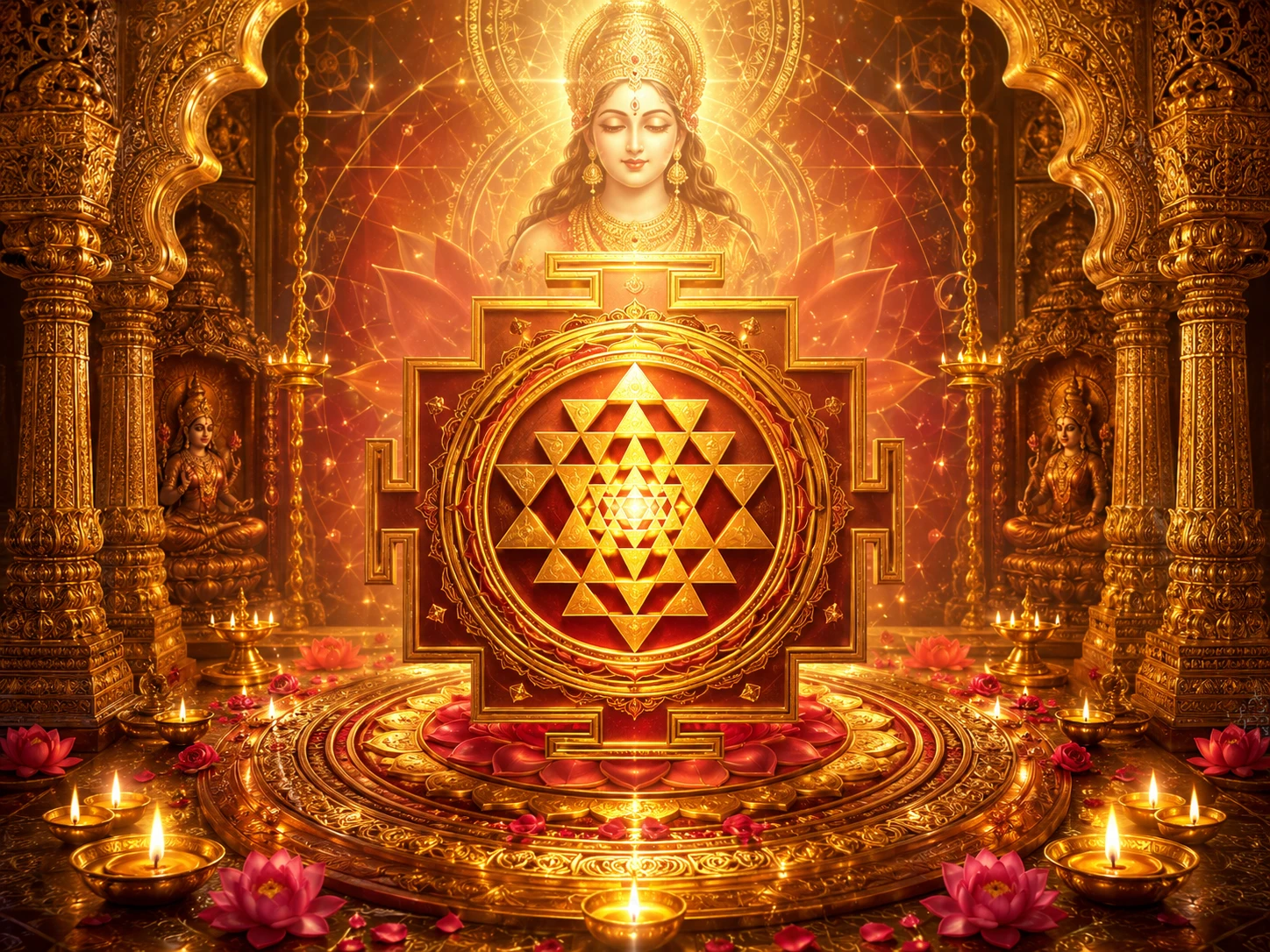
Sri Vidya -- The Philosophy of the Goddess as Ultimate Reality
श्री विद्या -- देवी ही परम सत्य है, इस दर्शन की कथा
On a Tuesday afternoon in Banjara Hills, Hyderabad, an architect named Vikram Reddy is staring at his AutoCAD screen and refusing to admit defeat. He has been hired to design a small private temple for a textile family, and the family wants a Sri Yantra inlaid in the floor. Two months ago he had said yes within thirty seconds. Now he has been working for three weeks, and his triangles still will not close.
The Sri Yantra is built from nine interlocking triangles around a central point, four pointing up and five pointing down. From these nine, forty-three smaller triangles must emerge with their corners meeting cleanly at every node. Modern CAD packages, even high-end ones with precise vector logic, struggle here. Engineers from IIT Madras and IISc Bengaluru have written papers on this. The geometry is so tight that a millimetre of slack at one vertex throws the entire figure out of symmetry. There is, in working architectural practice, a quiet rule of thumb. If you can draw the Sri Yantra cleanly, you understand the figure. If you cannot, you do not.
Vikram, who knows none of this on his first attempt, eventually drives to a small mutt in the Old City and asks the priest where to buy a Sri Yantra master template. The priest does not sell him one. The priest asks him whether he has been initiated. Vikram says no. The priest says, gently, that he can help with the geometry, but the philosophy behind the geometry is what builds the temple. Without the philosophy, what gets inlaid in the floor is a decoration. With it, what gets inlaid is a map. That conversation, more than the AutoCAD problem, is what brings most thoughtful Indians to the doorstep of Sri Vidya.
Sri Vidya is, in one sentence, the philosophy that the goddess is not a form of the absolute -- she is the absolute. Most Indians, even practising Hindus, carry a softer assumption. They imagine Devi as one of three faces, alongside Vishnu and Shiva, ordered politely in a cosmic hierarchy. The Shakta traditions reject this hierarchy. Of all the Shakta lines, Sri Vidya is the most philosophically uncompromising. It does not just say Devi is supreme. It argues, with full Vedantic apparatus, why she has to be.
The argument has three layers, and each layer attaches to a different kind of practice. The outermost layer is the Sri Yantra itself, the geometric form of the goddess, drawn or carved or inlaid wherever a serious devotee can keep it. The middle layer is the mantra, called the Panchadashi (fifteen syllables) at one stage of practice and the Shodashi (sixteen syllables) at the next. The innermost layer is the philosophy of Shiva-Shakti as two faces of one reality, in which Shakti is the dynamic side and Shiva is the still side, and neither has any meaning without the other.
What makes Sri Vidya unusual within Shakta thought is that it does not stay tantric in feeling. It is rigorously argued, line by line, in the manner of Advaita Vedanta. It cites Upanishadic verses. It accepts the Vedantic conclusion that Brahman is non-dual, then asks the question that Sri Vidya treats as obvious and Vedanta usually leaves implicit -- if Brahman is non-dual, what is the principle that makes Brahman appear as a world? The answer Sri Vidya gives is Shakti. Not as a separate principle. As Brahman's own dynamic face. This is why Sri Vidya is sometimes called the meeting point of Vedanta and Tantra, and why Adi Shankara, the great consolidator of Advaita, is also remembered as a passionate devotee of the goddess.
शिवः शक्त्या युक्तो यदि भवति शक्तः प्रभवितुं न चेदेवं देवो न खलु कुशलः स्पन्दितुमपि। अतस्त्वामाराध्यां हरिहरविरिञ्च्यादिभिरपि प्रणन्तुं स्तोतुं वा कथमकृतपुण्यः प्रभवति॥
śivaḥ śaktyā yukto yadi bhavati śaktaḥ prabhavituṃ na ced evaṃ devo na khalu kuśalaḥ spanditum api atas tvām ārādhyāṃ harihara-viriñcyādibhir api praṇantuṃ stotuṃ vā katham akṛta-puṇyaḥ prabhavati
Only when joined with Shakti can Shiva exercise the power to act. Otherwise the god is not even able to stir. How then can one without accumulated merit hope to bow to you, who are revered by Hari, Hara and Brahma alike, or even to praise you?
— Saundarya Lahari, Verse 1
The verse contains a Sanskrit pun the tradition treats as a settled doctrinal point. The word for an inert corpse is shava. The word for the supreme deity is Shiva. The only difference is the short vowel 'i' between sh and v. That 'i', the tradition says, is the bija sound for Shakti. Take it out and Shiva collapses into shava -- the same letters, but no movement, no breath, no consciousness on display. Add it back and the corpse becomes the lord. The doctrine is encoded in the orthography itself. The texts that develop this most systematically belong to the wider Shakta canon, including the Tripura Upanishad, the Bhavanopanishad, and the great commentarial tradition that grew around the Saundarya Lahari.
In modern terms, the closest analogy is something most Indian working professionals already understand intuitively. A founder with a brilliant strategy but no operations team has nothing. An operations team with no strategic clarity is busywork. Strategy and execution are not in tension. They are two phases of one act, and severing them produces either paralysis or thrash. Sri Vidya extends this insight to cosmology. The universe is not produced by Shiva alone, who would be paralysed. It is not produced by Shakti acting against Shiva. It is produced by Shiva-Shakti as one inseparable principle that the mind, for the limited purpose of analysis, can describe as two faces.
This is why Sri Vidya iconography always shows Lalita Tripura Sundari, the form of the goddess at the centre of this tradition, seated on a throne whose four legs are the four classical gods -- Brahma, Vishnu, Rudra and Ishvara -- and whose seat is Sadashiva. The image is not making a hierarchical claim about gods. It is making a structural claim about consciousness. Without Shakti to animate them, even the highest gods are furniture.
Within Sri Vidya itself there are three classical lineages, each tracing its starting authority to a different rishi. They are usually called Kadi-mata, Hadi-mata and Kahadi-mata, named after the first letter of the Panchadashi mantra each one uses. Kadi-mata begins the mantra with the syllable 'ka' and traces its authority to Manmatha, the lord of love. Hadi-mata begins with 'ha' and traces its authority to Lopamudra, the wife of the rishi Agastya, who is among the very few women acharyas in Indian philosophical history. Kahadi-mata begins with both 'ka' and 'ha' in different positions and is associated with Durvasa, who is also remembered for his composition of the Lalita Stava Ratna.
For an outsider, this fork can look like sectarian noise. It is the opposite. It is the tradition's quiet acknowledgement that the same goddess is approached differently by different temperaments, and that no single ritual sequence captures her completely. Kadi practice tends to emphasise loving devotion in the manner of a flowering. Hadi practice tends to emphasise the silent, contemplative discipline. Kahadi practice synthesises elements of both, with a stronger ritual-yantric apparatus. A serious South Indian Sri Vidya household will know which mata it follows because the daily puja procedure is shaped accordingly.
This pluralism is genuinely Indian. It is not a marketing-friendly modern syncretism. It is the natural shape of a 1500-year-old living tradition that always assumed multiple competent paths to the same understanding. When a tax accountant in Coimbatore today tells her newly initiated daughter-in-law that the family follows Hadi-mata and so the puja begins with 'haim' rather than 'kaim', she is not transmitting trivia. She is anchoring her granddaughter's eventual practice into a chain of teachers that goes back, by the tradition's own count, to Lopamudra herself.
The practical experience of sitting with a teacher in any of these matas has a recognisable texture, and the texture is what most casual outsiders never encounter. The teacher does not begin with metaphysics. He or she will typically ask what the student is reading, what time she sleeps, how steady her work week is, and whether she has any current panchakarma or medical issue. The full mantra may not arrive for months. What arrives first is a small set of preliminary syllables, with instructions to repeat them at fixed times of day and observe what happens. Months in, after the student has shown up regularly without dropping the discipline, the longer mantra is given. The structure is calibrated to weed out the curious and identify the committed. Almost every working Indian who has been through it describes the experience as more like preparing for a long professional examination than like joining a religious group.
The Three Classical Lineages of Sri Vidya
| Aspect | Kadi-mata | Hadi-mata | Kahadi-mata |
|---|---|---|---|
| First syllable of Panchadashi | ka | ha | ka and ha placed differently |
| Originating authority | Manmatha (Kamadeva) | Lopamudra (wife of Agastya) | Durvasa rishi |
| Devotional emphasis | Loving devotion, the goddess as the principle of beauty | Contemplative discipline, the goddess as inner silence | Ritual-yantric synthesis of the two |
| Geographic stronghold today | Sringeri tradition, much of the Karnataka and Tamil Nadu mainstream | Kashmir Shaiva-influenced regions, Andhra and Bengal pockets | Specialised tantric lineages, often priest-family transmission |
| Reference text most cited | Saundarya Lahari, attributed to Adi Shankara | Tripura Mahimnah Stotra and Lalita Trishati | Lalita Stava Ratna and Devi Mahatmya |
| Best modern analogy | Bhakti as a flowering, the heart leading | Jnana refined into worship, the mind leading | Engineered worship, the form leading |
These are not competing schools so much as temperamental specialisations within one philosophy. A serious Sri Vidya teacher will know all three even if she only initiates in one.
Sri Vidya's place within wider Hindu thought is impossible to understand without Adi Shankara. The orthodox account, accepted across the four Shankara mathas, is that the philosopher who consolidated Advaita Vedanta in the 8th century also composed the Saundarya Lahari, the most beloved hymn to the goddess in the Sri Vidya canon. Whether every verse is from his hand is debated by textual scholars. What is not debated within the living tradition is that Shankara is responsible for installing the Sri Chakra in the major mathas, including Sringeri, Kanchi, and Kamakshi temple at Kanchipuram, where it remains the centre of daily ritual.
This matters for a reason that takes a moment to unpack. Advaita Vedanta is, at its philosophical core, a tradition that says ultimate reality is featureless, attributeless, beyond any image. A casual reading would conclude that Vedanta and goddess worship sit awkwardly together, the first rejecting all forms, the second devoted to a particular form. Shankara's response, embodied in the Saundarya Lahari and in his ritual installations, is that the apparent contradiction is dissolved once Shakti is understood not as a separate goddess but as Brahman's own self-expression. Worshipping Lalita is then not worship of a deity beneath Brahman. It is worship of Brahman seen through her dynamic face. The Sri Yantra carved at Sringeri is the geometric statement of exactly this claim.
The practical consequence today is that Sri Vidya is not a fringe tradition. It is woven into the daily life of two of the most authoritative Vedantic institutions in India. The Kanchi mutt, until the videha mukti of Maha Periyava on January 8, 1994, served as one of Sri Vidya's most public guardians, and his successors continue that role. Sringeri Sharada Peetham keeps Sri Chakra puja at the centre of its temple complex. A Sanskrit student in 2026 sitting for the Acharya entrance examination at either institution will be expected to know not just the Brahma Sutras and Upanishads but also the Saundarya Lahari and the structural logic of the Sri Yantra. The goddess is not a soft adjacent specialty. She is part of the core curriculum.
श्रीमाता श्रीमहाराज्ञी श्रीमत्सिंहासनेश्वरी। चिदग्निकुण्डसम्भूता देवकार्यसमुद्यता॥
śrīmātā śrīmahārājñī śrīmat-siṃhāsaneśvarī cidagni-kuṇḍa-sambhūtā devakārya-samudyatā
She is the venerable Mother, the great Empress, the sovereign of the auspicious lion-throne. She is born from the fire-pit of pure consciousness, ever ready to act for the work of the gods.
— Lalita Sahasranama, Names 1 to 4 (opening verse)
The Sri Yantra is not a stylised drawing -- it is a precise mathematical figure. Its nine interlocking triangles must produce exactly forty-three smaller triangles with all corners meeting at clean nodes. Engineers at IIT Madras and IISc Bengaluru have published papers showing that even modern CAD software struggles to render it without subtle errors. The traditional method, taught only after initiation, uses a small set of geometric ratios and a sequence of compass-and-straightedge constructions that produces the figure exactly. Generations of temple priests in Kanchipuram and Sringeri have been able to inlay it cleanly in stone without any modern tools.
Sri Vidya's most distinctive philosophical move is the identification of the practitioner's own body with the Sri Chakra. This is not metaphor, in the soft modern sense. It is a strict structural claim. The same nine triangles that form the geometric figure are mapped, in the texts, onto specific energy centres along the central channel of the body. The central bindu corresponds to the crown. The four upward-pointing triangles correspond to the masculine, still aspect of consciousness. The five downward-pointing triangles correspond to the feminine, dynamic aspect. The whole figure is what the practitioner is, when seen with sufficient inner clarity.
The tradition also names four pithas, or seats of the goddess, said to be located at four points of the Indian subcontinent. These are usually identified as Kamarupa in the east, Jalandhara in the north, Purnagiri, and Oddiyana. The exact geographical identification of Purnagiri and Oddiyana is contested in scholarship, with several plausible candidates in each case. What is not contested in the practice is that these four pithas are simultaneously inner points within the body of the practitioner herself. Pilgrimage to the outer pithas is read as pilgrimage to the inner pithas, and the outer journey is regarded as a useful but optional support to the inner one. A young Bengali professional travelling to Kamakhya in Guwahati for Ambubachi Mela is not on a sentimental tourist trip. She is, in this framework, walking out into the geography of her own awareness.
This structural identification of the body with the yantra is what gives Sri Vidya its peculiar density. It is a metaphysics, a ritual system, a meditative practice, and a map of the human body all at once, woven so tightly that any one strand pulled out collapses the others. This is why teachers within the tradition refuse to teach the technique without the philosophy. A practitioner who builds her practice on the technique alone is doing something, but she is not doing Sri Vidya.
The most surprising fact about Sri Vidya in 2026 is how alive it remains. It is not a museum tradition. The transmission is hand to hand, often within families, sometimes outside them, but always through living teachers who themselves received the practice from a living teacher. Three brief portraits make this concrete.
The first is a postgraduate student at IIIT Hyderabad who, while sorting through her late grandmother's belongings in an apartment near KBR Park, finds a small notebook. The notebook turns out to be a daily Sri Vidya puja log, kept for forty-seven years. It records the goddess's name forms used each day, the offerings made, and short personal annotations in Telugu. The student, raised entirely in convent school English, takes the notebook to a local teacher and begins her own slow approach to the tradition. Three years later she is a half-initiated practitioner working in machine learning by day and writing her grandmother's notebook into Devanagari by night. The transmission has moved one more generation forward without permission from any of the obvious institutional channels.
The second is a Friday-night Sri Vidya group in Cupertino, California, where roughly a dozen Indian-origin engineers meet at one host's home, recite the Lalita Sahasranama, share a vegetarian dinner, and study one or two verses of the Saundarya Lahari for the rest of the evening. They are connected by Zoom every alternate week to a teacher near Madurai. The teacher is in his late seventies and has only six full-time students. The Cupertino group is one of his outer circles, and the Zoom call is itself, in his framing, a form of digital pilgrimage.
The third is a tax officer in Chennai who, after the loss of her husband in 2023, was advised by an elderly relative to begin a structured Sri Vidya practice. She found a teacher through a small mutt off T. Nagar, accepted the discipline, and three years later runs a small group at her home for working women in similar circumstances. None of these three locations -- Hyderabad, Cupertino, Chennai -- looks like a traditional spiritual centre. All three are, in the actual living transmission of Sri Vidya, exactly where the tradition currently is.
A natural modern question is whether the requirement of initiation, called diksha, is still necessary. Why not, the question runs, just download the Saundarya Lahari, learn the Panchadashi mantra from a YouTube channel, and sit. Three replies inside the tradition take this question seriously rather than dismissing it.
The first reply is pedagogical. Sri Vidya is not a single mantra. It is a coordinated system of mantra, yantra, philosophy, and ritual sequence in which the four parts only make sense together. A student who picks up the mantra alone often picks it up with the wrong rhythm, the wrong intentions, and no recourse when something inside her practice goes wrong. The diksha, in this reading, is less a permission slip than a competent introduction. It is closer to learning Carnatic vocals from a guru than to receiving a key.
The second reply is structural. The mantras of Sri Vidya are short, but they are not generic. They have specific seed sounds whose use is calibrated to the practitioner's own constitution. A teacher who knows the student adjusts the sequence and the visualisations slightly to match. Without that calibration, the practice tends to either not work or produce instabilities that the practitioner has no framework to handle.
The third reply is the most interesting and the least often stated. Sri Vidya is, in the tradition's own self-understanding, a relationship. A practitioner does not approach the goddess in the abstract. She approaches a specific lineage, with specific teachers and specific predecessors, all of whom have been received by the goddess through their own practice. Joining that lineage through a teacher is the act of saying, in the tradition's grammar, that the relationship is now reciprocal. There is, after that, somebody on the other side of the practice who has been listening for a long time. Whether one accepts that grammar is a personal question. What the tradition asks is that the question be taken at face value rather than worked around. Most thoughtful practitioners eventually find that the question of initiation only resolves itself once one is ready to be in the relationship at all.
Recite the Lalita Sahasranama
The thousand names of Lalita Tripura Sundari are the most accessible entry into the Sri Vidya devotional rhythm. The recitation does not require initiation and is traditionally offered on Fridays.
Tags
Eternal Raga · शाश्वत राग
Institutional voice — scholarly articles on Sanatan Dharma
Deepen Your Understanding
अपनी समझ और गहरी करें
sacred symbols
Sri Chakra -- The Sacred Geometry That Takes a Lifetime to Draw Perfectly
Nine interlocking triangles. Four pointing upward (Shiva). Five pointing downward (Shakti). Their intersection creates 43 smaller triangles that map the entire journey of consciousness from the material to the divine. The Sri Yantra is the most complex sacred geometric figure in any world tradition -- and mathematicians still argue about whether it can be drawn with perfect precision.
philosophy darshana
Shakta Philosophy -- Devi as Ultimate Reality
What if God is not He but She? Not an abstract principle but a living, breathing, dancing power? Shakta philosophy does not merely add a feminine dimension to Hindu theology. It inverts the entire structure: Shakti is the primary reality, and consciousness without her is inert. Shiva without Shakti is shava -- a corpse. This is not metaphor. This is metaphysics.
philosophy darshana
Advaita Vedanta Explained -- Shankara's Radical Philosophy of Non-Duality
You are not your job title. You are not your Instagram bio. According to Adi Shankaracharya, you are not even your body or mind -- you are Brahman itself, the infinite consciousness wearing a temporary costume. Advaita Vedanta is the most radical philosophical claim in Indian history: that the entire universe is one undivided reality, and separation is the grandest illusion.
tantra mantra yantra
Tantra, Mantra and Yantra -- The Three Pillars of Spiritual Practice
Tantra is the loom, Mantra is the thread, Yantra is the pattern. Together they form the complete technology of spiritual transformation that India gifted to the world -- and they are far more profound than popular culture imagines.
philosophy darshana
Rta, Dharma, Karma -- The Three Threads of Cosmic Order
Long before any tradition coined the word 'ethics,' Vedic thought had three distinct words for what holds existence together. Rta is the order itself. Dharma is your part within it. Karma is the receipt every action issues. This is how they fit, and why mixing them up is the most expensive error in Indian thought.
deities avatars
Ardhanarishvara -- The Half-Male, Half-Female Form of Shiva
Split exactly down the centre. Right half: matted hair, serpent, drum, trident, ash-smeared skin. Left half: silk, flowers, kohl-lined eye, curved breast, jewelled anklet. One body. Two genders. Zero contradiction. Ardhanarishvara is the most radical statement on gender in any world mythology -- 5,000 years before the modern conversation began. This is not inclusion as a concession. This is divine completeness as a first principle.
The Sri Yantra is not a stylised drawing -- it is a precise mathematical figure. Its nine interlocking triangles must produce exactly forty-three smaller triangles with all corners meeting at clean nodes. Engineers at II…
More in Philosophy & Darshana
The 14 Lokas -- Hindu Cosmology as a Map of Consciousness
14 min read
Achintya Bhedabheda -- Chaitanya's Theology of Inconceivable Difference-and-Unity
13 min read
Adhyasa -- Superimposition and the Foundational Error of the Self
13 min readThe same translation error that turned '33 Koti' into '33 crore' in Hinduism also happened in Buddhism. The Chinese translation of Buddhist texts rendered 'Sapta Koti Buddha' (7 Supreme Buddhas) as '7 Crore Buddhas.' The…
Deities AvatarsCommunity Reflections
🕉️
Be the first to share your reflection.