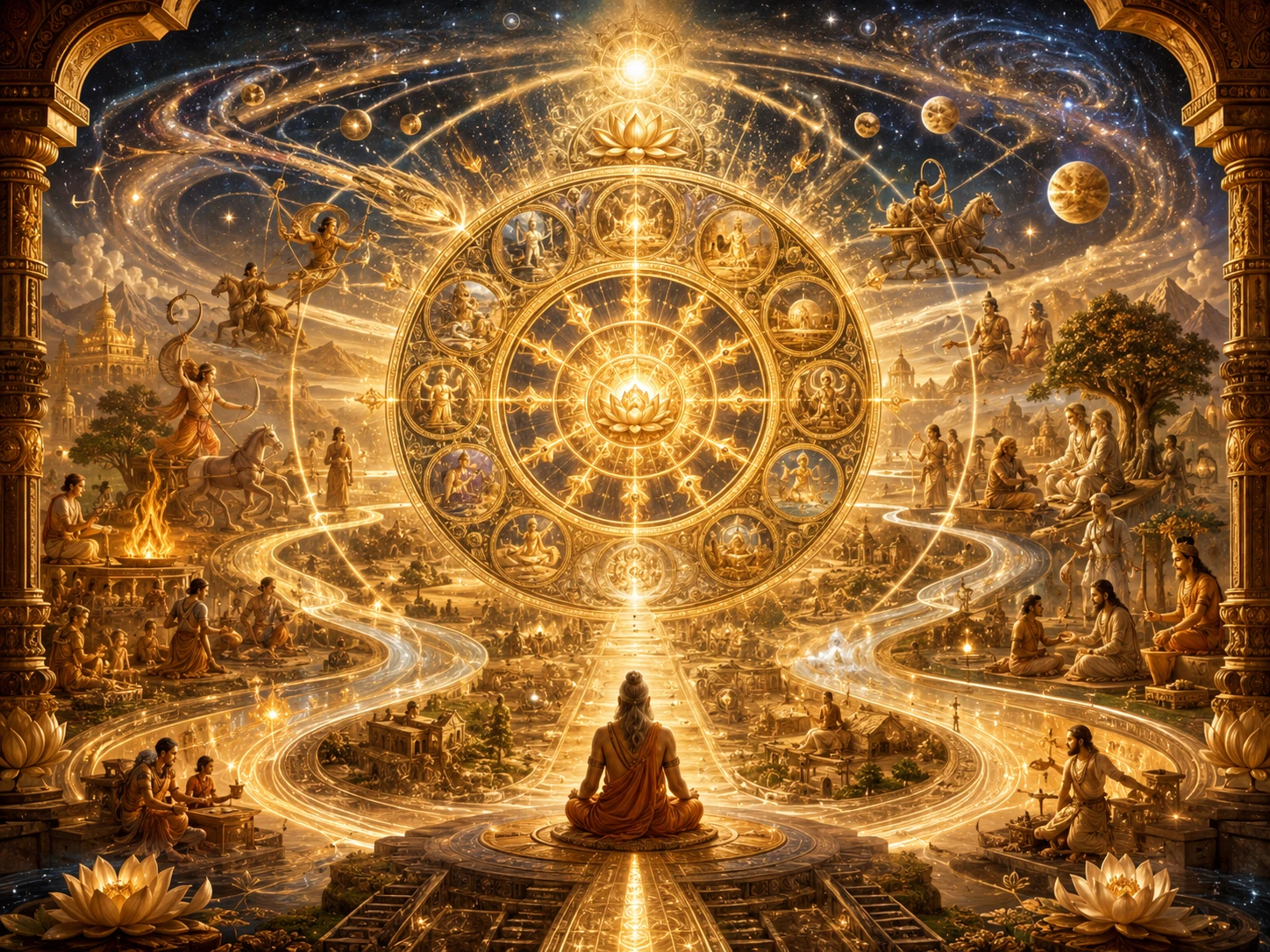
Rta, Dharma, Karma -- The Three Threads of Cosmic Order
ऋत, धर्म, कर्म -- ब्रह्माण्डीय व्यवस्था के तीन सूत्र
Aarav Kapoor has eleven minutes to decide. He is 28, a quant at a Bandra hedge fund, and his trading screen shows a momentary mispricing in a small-cap stock. The ticker is barely moving. The arbitrage is clean, technically legal, and would clear three months of his EMI in one afternoon. He also knows the seller on the other side: a retail investor from a Tier-3 town who has been getting his entry timing badly wrong for years.
Aarav clicks. The trade goes through. He makes his money. He sleeps badly that night, and the next, and the next. He cannot find the word for what is wrong, because his English-medium education trained him in 'ethics' but never in the three older Indian words that would have given him a precise diagnosis.
Those three words are Rta, Dharma, and Karma. They are not synonyms. Rta is the cosmic order itself -- the way reality is structured so that fire burns upward and rivers flow seaward and consequences follow actions. Dharma is the particular role you play within that order, given who you are, where you are, and whom you owe. Karma is the receipt every action issues, the accounting line that records what you did and who carries the result.
Aarav broke none of SEBI's rules. But something was wrong, and he could feel it before he could name it. The Vedic seers had names for it. They remain some of the most precise vocabulary any tradition has developed for the moral architecture that holds human life together.
Start with Rta, the senior of the three. The word appears in the Rigveda nearly three hundred times, and almost never as something you do. It is not a commandment, not a code, not a rule. It is what is the case. The sun rises in the east, not because someone wrote it down somewhere, but because that is how the cosmos is structured. Monsoons return. The first cry comes from a newborn. A fire offering rises upward and a libation flows downward. All of this is Rta -- the unforced grain of reality.
The Vedic seers were not philosophers in the Greek sense. They did not argue Rta into existence; they observed it. A hymn to Varuna, the guardian of Rta, marvels that the rivers do not exhaust the sea no matter how endlessly they flow into it. That is not a pious metaphor. It is an empirical observation about cosmic balance, and the seer's response is reverence: the world hangs together because Rta holds. When Rta holds, the world is. When it breaks, anrta -- the chaos, the uncoupling -- begins to leak in.
What separates Rta from a generic 'natural law' is its moral charge. Rta is not value-neutral. The text speaks of those who walk with Rta and those who slip into anrta, and the slippage carries consequence. The hymns to Varuna are full of trembling self-examination on this point. The seer is afraid not of breaking a rule but of having drifted from the underlying order, even unintentionally. Modern legal language has nothing quite like this register. The closest parallel might be a careful scientist's anxiety about whether her data actually reflects reality, magnified into a cosmological key.
There is also a striking democratic quality to Rta in the early Veda. It is not the property of the priest, the ruler, or the wealthy. The same Rta governs the king's coronation and the householder's morning fire. The same Rta guarantees that the seasons will return and that a promise made to a stranger will hold. To live within Rta is, in this view, the basic price of being a civilised human, and breaking that compact corrodes both you and the world.
Linguists who study Indo-European roots have noticed something striking. The Sanskrit Rta shares its ancestor with the Latin 'ratus' (settled, fixed), the Old English 'riht' (right), and even the Greek 'arthron' (joint, articulation). The same root that gave us Rta gave the West words like 'right,' 'rite,' 'rectitude,' 'ritual,' even 'art.' The intuition is shared across the Indo-European family: the universe has joints, and the joints fit. Civilisation is the practice of fitting yourself to those joints, not muscling them open.
ऋतं च सत्यं चाभीद्धात्तपसोऽध्यजायत। ततो रात्र्यजायत ततः समुद्रो अर्णवः॥
ṛtaṃ ca satyaṃ cābhīddhāt tapaso 'dhyajāyata tato rātryajāyata tataḥ samudro arṇavaḥ
From the kindled fire of Tapas were born Rta and Satya. From them came Night, and then the surging cosmic ocean.
— Rigveda 10.190.1
Rta is breathtaking, but it is not yet practical. A young Pune chartered accountant does not wake up wondering how to align with cosmic order. She wakes up wondering whether to file her uncle's GST return as he asked, even though the numbers feel off. For that question, Vedic thought offers the second word: Dharma.
Dharma is what happens when Rta lands on a particular human life. It is the contextual translation. The same cosmic order that requires the sun to rise also requires that a daughter handle her father's care, a doctor not abandon a patient mid-surgery, a lawyer not coach a witness, and a software engineer not ship code she knows is broken. None of these duties is universal. They are conditional on who you are. A surgeon's dharma is not a journalist's dharma is not a soldier's dharma. This is why Indian thought speaks of sva-dharma -- your dharma, conditioned on your station -- and apad-dharma, the modified dharma that applies in emergencies.
Yudhishthira's most famous moment in the Mahabharata is exactly such a translation problem. He is asked to confirm a half-truth on the battlefield -- that Drona's son Ashwatthama is dead, when in fact only an elephant by that name has died. He says it. The skies darken. His chariot, which had floated above the ground, touches earth. The text does not call him a liar. It calls him a man who chose between two dharmas and learned that even right answers carry cost. Dharma is rarely a clean menu. It is a calibration.
Even now, the precision of this calibration shows up wherever Indians live with multiple loyalties at once. A tax consultant in Surat pulls late nights to file legitimate returns for a long-time client whose business is failing -- because his sva-dharma to that client outweighs the easier revenue from new corporate work. A young IIT-Kharagpur alumna in Boston flies home twice a year not because of guilt but because her dharma to her aging parents has not been delegated to a bank statement. A senior journalist sits on a story for three days to verify it, knowing the scoop will go to a competitor, because the dharma of journalism is to the reader before it is to the byline. None of this is captured by the English word 'duty,' which has gone hollow over the centuries. The word 'dharma' still carries the weight.
Now to the third word -- the one most mangled in modern usage. Karma is not cosmic revenge. It is not a points system. It is not what happens to you when you cut someone off in Bengaluru traffic. Karma is the simple, brutal observation that every action you take has consequences, and those consequences attach to you whether the law sees them or not.
The Sanskrit root 'kr' means 'to do.' Karma is, literally, 'a thing done.' When the Bhagavad Gita's most famous verse says 'karmany evadhikaras te' -- you have a right only to your action, never to its fruits -- it is not preaching detachment. It is naming a structural fact. You can choose what you do. You cannot choose what your action does next, because once an act is in the world, it belongs to the world.
This is why karma is so much more layered than 'as you sow, so shall you reap,' which makes it sound transactional. The full doctrine is closer to compound interest in finance. Every action you commit accrues a kind of moral capital -- positive if it aligns with Rta and Dharma, negative if it doesn't. The accruals roll forward across days, years, and -- the tradition adds -- lifetimes. Most of what happens to you is not a punishment for one specific act; it is the cumulative balance of how you have been moving through the world. The cricketer who blames the umpire after a single bad call has missed the point. The umpire is one event; the average over a career is the karmic bank statement.
Indian thought, with characteristic patience, divides karma into three buckets. Sanchita karma is the entire accumulated stock from all previous actions -- the karmic equivalent of a long bank statement going back further than you can read. Prarabdha karma is the slice of that accumulated stock that has begun ripening in this present life -- the trades that have already settled and are landing in your account this quarter. Agami karma is what you are creating, fresh, with every action this Tuesday morning. The seriousness of this taxonomy is that it tells you exactly how much agency you have at any given moment. You cannot undo sanchita. You cannot accelerate prarabdha. But agami is entirely yours, every single morning, for as long as you are breathing. That last point is what the Bhagavad Gita is fundamentally about.
कर्मण्येवाधिकारस्ते मा फलेषु कदाचन। मा कर्मफलहेतुर्भूर्मा ते सङ्गोऽस्त्वकर्मणि॥
karmaṇyevādhikāraste mā phaleṣu kadācana mā karmaphalaheturbhūr mā te saṅgo'stvakarmaṇi
Your right is to action alone, never to its fruits. Do not be motivated by the fruits of action, nor be attached to inaction.
— Bhagavad Gita 2.47
Rta, Dharma, Karma -- Three Words, Three Scales
| Aspect | Rta | Dharma | Karma |
|---|---|---|---|
| Era of dominance | Vedic Samhita period | Smriti and Itihasa period | Upanishadic and Gita formulation |
| Scale | Cosmic | Personal and social | Individual action |
| What it is | The order of reality itself | Your role within that order | The accounting of every action |
| Primary source | Rigveda Samhita | Manusmriti, Mahabharata | Upanishads, Bhagavad Gita |
| Mechanism | Self-existing structure | Calibration to context | Cause and consequence |
| Common misuse today | Forgotten almost entirely in popular usage | Reduced to 'religion' or rigid duty | Reduced to 'instant cosmic revenge' |
| Cricket analogy | The laws that allow a ball to swing | The role each player has on the field | The runs and wickets accumulated over the match |
These three are not stages or rivals. They are the same moral universe seen at three magnifications -- cosmos, life, action.
Once you have all three words, the architecture becomes clear. Imagine the laws of thermodynamics. They are not negotiable. Heat moves from hot to cold; energy is conserved; entropy increases. Now imagine the user manual for a power plant. It tells you, given those laws, what an operator should do, what a maintenance engineer should do, what a load-balancing manager should do. None of those instructions argues with thermodynamics; they translate it into operational instruction. And the plant's logbook -- recording every action taken, every shift handover, every fault rectified -- is the running ledger of consequence.
Rta is the laws of thermodynamics. Dharma is the user manual. Karma is the logbook.
This is why a Hindu argument about ethics is rarely an argument about whether something is right or wrong in some bodiless way. It is an argument about which scale you are on. Did this action align with cosmic order? That is an Rta question. Was it appropriate for this person, in this position, at this moment? That is a Dharma question. Has the consequence already begun, and how far will it travel? That is a Karma question. Most modern Indian confusion -- the kind Aarav felt at his trading desk -- comes from collapsing all three questions into one and asking only the easiest version: was this legal? Indian thought is patient enough to keep all three open.
The English words 'right,' 'rite,' 'rectitude,' 'ritual,' and even 'art' all share their deep Indo-European root with the Sanskrit Rta. The same intuition -- that the universe has joints, and that civilised life means fitting yourself to those joints -- runs from the Rigveda to Latin to Old English. Meanwhile, 'karma' entered the Oxford English Dictionary in 1827 and is now one of the most-used Sanskrit-origin words in global English. Yet its current Instagram-caption usage ('she got her karma') would be philosophically unrecognisable to the rishis -- who saw karma as a long, compound, often invisible accounting, not a viral revenge fantasy.
Three misreadings dominate the way urban Indians today use these words, and each one costs precision.
The first: Karma has been demoted to a punchline. When a friend cuts you off and then gets stuck at the next signal, that is not karma -- that is bad luck and cosmic comic timing. Karma is the slow, often invisible accounting of what your actions do over years. It is unflattering precisely because it is honest about how much of your present life is the harvest of choices you no longer remember making.
The second: Dharma has been collapsed into 'religion.' This is a colonial-era simplification that the educated Indian elite has now internalised. When the Constitution speaks of dharma, it does not mean Hinduism. When the Mahabharata speaks of Yudhishthira's dharma, it does not mean his religion. Dharma is your particular role in the moral order, conditioned on who you are. Saying 'my dharma is Hinduism' is a category error -- like saying 'my profession is human.'
The third: Rta has been forgotten almost entirely. This is the saddest erasure. Without Rta, dharma becomes ungrounded -- merely a list of rules with no cosmological backing -- and karma becomes superstitious -- merely a magical force with no structural reason to operate. The whole architecture loses its joinery. What you are left with is what most contemporary discussion of 'Hindu values' reduces to: a vague mix of duty-talk and revenge-talk, neither of which the Vedic seers would recognise.
What does it look like to live all three at once? Imagine three Indians on the same Tuesday morning.
Priya is a public-sector hospital surgeon in Pune. She has a private practice that pays five times more, but the hospital is short-staffed. She stays. Her sva-dharma -- the calibrated duty of her station -- says one thing; her bank balance says another. Choosing the hospital is a small alignment with Rta (the order in which a society needs hospitals to function), enacted as Dharma (her specific role within it), and the karmic ledger ticks one line in her favour. None of this makes her wealthy. All of it makes her trustworthy.
Rohan is a UPSC aspirant in Old Rajinder Nagar. He is on his third attempt. His father wants him to quit and join a private firm. His mother wants him to keep going. He himself is no longer sure. The threefold framework gives him a clean diagnosis. Is staying in the attempt aligned with Rta -- the larger structure of how a country needs honest civil servants? Yes. Is it aligned with his Dharma -- his actual aptitude, the duty he owes his family, the realistic horizon of his time? Less clear. What is the karmic accumulation either way? Slow, invisible, but real. The decision belongs to him. The framework only forces him to ask the right questions in the right order.
Anita is an NRI software engineer in Singapore, planning to refuse her parents' inheritance arrangement -- her brother is to inherit the house, she is to inherit cash. She is right that the arrangement is unequal. But before she escalates, the threefold lens offers her something else: what is the Rta of family inheritance in this generation? What is her sva-dharma to her parents, who are not the ones who wrote the unequal rule? What is the long karmic cost of winning this argument while losing the relationship? She may still refuse the arrangement. She will refuse it better.
Karthik runs a small architecture firm in Bandra and has been offered a contract to design a luxury residential tower. The site requires displacing a chawl of 200 families. The municipal clearance is in order. The CSR offset is on paper. The fee covers four years of his firm's payroll. He could take the contract. The threefold lens does not tell him to refuse it -- ethics is not a vending machine. It tells him that whatever he chooses will operate at three scales at once. Refusing aligns with one reading of Rta and risks his sva-dharma to his ten employees, none of whom signed up for moral grandstanding. Accepting reverses the calculation. There is no ethically clean answer. There is only the discipline of seeing all three scales clearly before he signs, and the willingness to live with the karmic line item that follows. This is what Indian ethics actually feels like from the inside. Not a code that delivers verdicts, but a vocabulary that prevents you from cheaply lying to yourself.
There is one more thing worth saying. The three words are not three doctrines. They are one doctrine seen at three different magnifications. Pull back to the cosmic level and what you see is Rta -- the order itself. Zoom in to the human level and you see Dharma -- the calibration of that order to person and circumstance. Zoom in further to the level of a single act, on a single Wednesday, by a single person, and you see Karma -- the accounting of one ripple in the larger water.
This is why classical Indian thought never had to choose between the cosmic and the personal, the abstract and the practical. The same moral universe holds at every scale. A grandmother lighting a diya at dusk in a Lucknow lane is performing a Dharma (a householder's duty), generating Karma (an act of unselfconscious devotion), and aligning herself with Rta (the order in which darkness yields to light each day, in each life, in the cosmos itself). She does not need three lectures to do this. She has been doing it her whole life. The lectures are for those of us who left home to learn 'ethics' in English, and now have to walk back through three older words to find what was already on our doorstep.
The seers gave us the words. They did not give us the answers. The framework does not tell Aarav whether to take the trade, or Karthik whether to sign the contract, or Anita whether to refuse the inheritance. It tells them which questions to ask and in what order. That is what philosophical vocabulary actually does. It does not save you from hard decisions. It saves you from having to make them in a vocabulary too thin to hold what is actually at stake.
Begin with the Bhagavad Gita's Karma Yoga
Read the Gita's third chapter, where Krishna unfolds the doctrine of action. Read it slowly, on Eternal Raga with Sanskrit and meaning; the whole architecture of rta, dharma and karma quietly assembles itself as you go.
Eternal Raga · शाश्वत राग
Institutional voice — scholarly articles on Sanatan Dharma
Deepen Your Understanding
अपनी समझ और गहरी करें
scriptural exegesis
Gita Chapter 3 -- Karma Yoga: Why Sitting Still Is Not an Option
After hearing Chapter 2, Arjuna asks the most logical follow-up question in the history of philosophy: 'If knowledge is superior to action, why are you pushing me to fight?' Krishna's answer in Chapter 3 builds the complete architecture of Karma Yoga -- why action is inescapable, how selfless action purifies, why leaders must act even when they have nothing to gain, and how desire is the real enemy on every battlefield.
philosophy darshana
Dharma, Artha, Kama, Moksha -- The Four Goals That Make a Complete Life
Hinduism does not ask you to choose between God and money. Between spirituality and pleasure. Between duty and desire. Its four Purusharthas -- Dharma, Artha, Kama, Moksha -- are the most holistic life-framework any civilisation has designed. The catch? Each must be pursued in the right order, at the right time, under the right constraints.
philosophy darshana
Yoga Vasishtha -- The Text That Says the World Is Mind
A 30,000-verse dialogue between sage Vasishtha and a despairing teenage Rama. The teaching is short and shocking: the world you experience is the texture of your own awareness, not a thing standing apart from you. Why this 1500-year-old Kashmiri text reads in 2026 like a careful answer to the simulation hypothesis.
philosophy darshana
Jiva, Ishvara, Jagat -- The Three Categories Every Vedanta School Must Answer For
Three Sanskrit words decide what kind of Vedantin you are. Jiva is the individual self. Ishvara is the personal Lord. Jagat is the world. How any school relates these three to Brahman determines whether it is Advaita, Vishishtadvaita, Dvaita, Shuddhadvaita, or Achintya-Bhedabheda. This is the map.
philosophy darshana
The Six Darshanas -- India's Original Intellectual Operating Systems
Long before Greek philosophy had its first argument, India had six complete philosophical systems -- each with its own logic, metaphysics, epistemology, and liberation path. Nyaya built formal logic. Vaisheshika invented atomic theory. Samkhya mapped consciousness. Yoga engineered the mind. Mimamsa decoded ritual. Vedanta asked the final question. Together, they are the most comprehensive intellectual framework any civilisation has produced.
rituals traditions
Panchamaha Yajnas -- The 5 Daily Duties Every Householder Owes
You owe five debts the moment you wake up: to knowledge, to the divine, to your ancestors, to all living beings, and to fellow humans. The Panchamaha Yajnas are not grand fire rituals -- they are five daily micro-acts that the tradition considers the minimum operating system of a responsible life. Skip them and you are, according to Manu, living as a thief.
The English words 'right,' 'rite,' 'rectitude,' 'ritual,' and even 'art' all share their deep Indo-European root with the Sanskrit Rta. The same intuition -- that the universe has joints, and that civilised life means fi…
More in Philosophy & Darshana
The 14 Lokas -- Hindu Cosmology as a Map of Consciousness
14 min read
Achintya Bhedabheda -- Chaitanya's Theology of Inconceivable Difference-and-Unity
13 min read
Adhyasa -- Superimposition and the Foundational Error of the Self
13 min readThe same translation error that turned '33 Koti' into '33 crore' in Hinduism also happened in Buddhism. The Chinese translation of Buddhist texts rendered 'Sapta Koti Buddha' (7 Supreme Buddhas) as '7 Crore Buddhas.' The…
Deities AvatarsCommunity Reflections
🕉️
Be the first to share your reflection.