Yoga Vasishtha -- The Text That Says the World Is Mind
योग वासिष्ठ -- वह ग्रन्थ जो कहता है, जगत् मन ही है
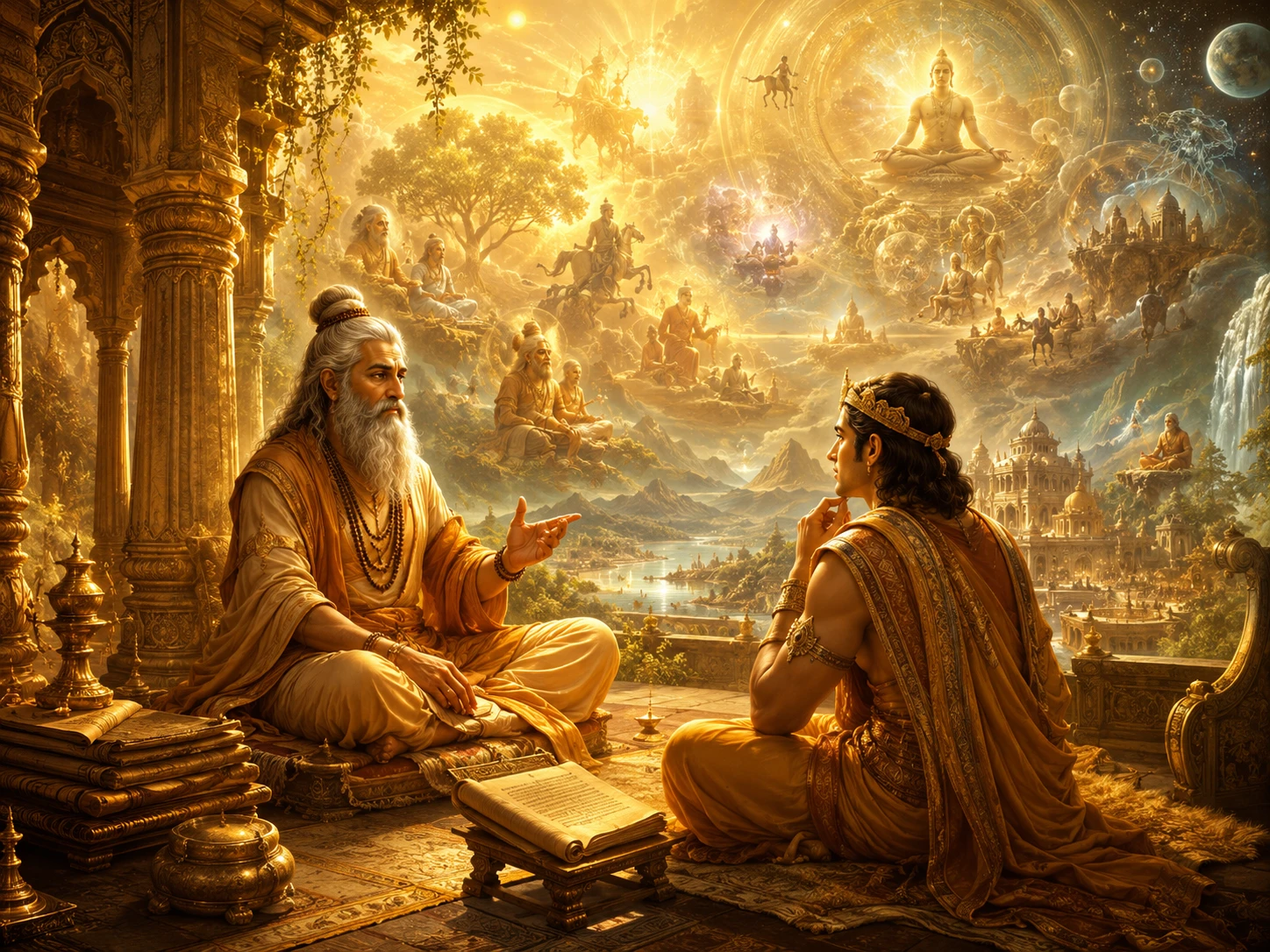
Imagine an eighteen-year-old prince who has just returned from a long pilgrimage and is sitting, refusing food, in a corner of a Treta-Yug palace in Ayodhya. He has been a fine archer, the favourite son of his father Dasharatha, the brilliant elder brother of three. Until recently he was, by every external measure, the success story of his generation. Now, after seeing what he saw on his travels -- old age, sickness, death, the inner emptiness of every reward he had been chasing -- he cannot speak. He says, in the few words he can manage to his teachers, that he sees no point in anything. Not the kingdom. Not the wedding being arranged. Not the next campaign. Nothing. He has, in 21st-century language, what would be called a major depressive episode tangled with an existential crisis.
This is the opening situation of the Yoga Vasishtha, one of the longest texts in the Hindu philosophical canon and arguably the most direct in addressing the precise emotional state most thoughtful young Indians eventually arrive at. The royal court is unable to help. The family priest is unable to help. The famous yogis brought from outside are unable to help. Eventually King Dasharatha sends for the family's senior teacher, the sage Vasishtha. What follows is a sustained dialogue, said to last several days in the courtyard, in which Vasishtha walks Rama out of his despair not by comforting him but by going further into it than Rama had been willing to go himself. The text records that conversation.
The Yoga Vasishtha is, in raw scale, the second-largest single text in the Hindu canon. It runs to roughly 30,000 verses across six books, called Prakaranas. The traditional attribution is to Valmiki, author of the Ramayana, on the grounds that this dialogue takes place within the larger life of Rama. Modern scholarship, including the careful work of Walter Slaje and Jurgen Hanneder, traces the surviving recension to Kashmir between roughly the 10th and 14th centuries, growing out of an earlier text called the Mokshopaya. Whatever the dating debate, the text in our hands is one of the most ambitious philosophical compositions in any Indian language.
The six books move in a deliberate arc, mirroring Rama's own movement out of despair. The first, Vairagya Prakarana, is the diagnosis. It contains Rama's questions and the description of his suffering. The second, Mumukshu Vyavahara, is the teaching on what kind of person can actually receive liberation, and what disqualifies one. The third, Utpatti Prakarana, is the most metaphysically dense. It is here that Vasishtha argues, with patience and repetition, that the world has no independent existence. The fourth, Sthiti Prakarana, examines the persistence of the world even after that argument is granted. The fifth, Upashanti Prakarana, is the longest and the most narrative-rich, full of stories Vasishtha tells Rama to make the abstract claim concrete. The sixth, Nirvana Prakarana, is the final consolidation, often divided into two halves in surviving manuscripts.
What makes the structure unusual is that Vasishtha does not lecture. He tells stories. The stories are nested several layers deep, with characters who themselves tell stories whose characters then tell more stories. The deepest narratives are designed to break, gently and on purpose, the listener's confidence in the difference between waking and dreaming. By the time Rama emerges, days later, he is no longer the same young man who sat down. He has not been talked out of his despair. He has been walked through it.
आत्मैवेदं जगत्सर्वमात्मैव कलनाक्रमः। हेमाङ्गदतयेवायमात्मोदेति मनस्तया॥
ātmaivedaṃ jagatsarvam ātmaiva kalanākramaḥ hemāṅgadatayevāyam ātmodeti manastayā
This entire universe is the Self alone, and the Self alone is the unfolding of imagination. Just as gold appears as a bracelet, so the Self rises into the appearance of mind.
— Yoga Vasishtha, Utpatti Prakarana 3.100.32
The central teaching of the Yoga Vasishtha is summarised in a Sanskrit phrase the tradition uses as shorthand: drishti-srishti vada. Drishti is seeing. Srishti is creation. Vada is doctrine. Putting the three together produces an English approximation that hardly does justice to the original: the doctrine that seeing is creation. The world, in this account, is not first created and then perceived. It is the perceiving itself, in its full texture, that constitutes whatever world is then said to exist. To use a working analogy that any film student in FTII Pune would recognise, the screen does not exist independently of the projection. It is what the projection is happening on, but you only know about the screen because of the film, and the film exists only because of the screen. Take either away and the experience collapses.
This is a sharper claim than what most Indians associate with Advaita Vedanta. Mainstream Advaita, as systematised by Adi Shankara, says that the empirical world is dependent on Brahman and is, in the final analysis, mithya -- neither absolutely real nor absolutely unreal. The Yoga Vasishtha, while operating within the broad Advaitic family, takes a more rigorous step. It says the world is, structurally, the texture of awareness itself. There is no independent stuff out there waiting to be noticed. There is only awareness presenting itself, in this rhythm or that, with a coherence we mistake for solidity.
The text is candid that this claim is hard to sit with. It does not expect Rama to accept it on first hearing. It expects him to argue, and Rama does. Where Vasishtha differs from a debater is that he does not try to win the argument. He simply keeps offering Rama narratives that, taken seriously, make the contrary position untenable. By the third or fourth iteration of a story in which a king dreams an entire lifetime in one afternoon's nap, the listener has stopped looking for the trick. The trick was the assumption itself.
A second working analogy, drawn from neuroscience rather than cinema, makes the structural claim more legible to a contemporary reader. Researchers studying perception at NIMHANS Bengaluru and at AIIMS Delhi have, over the last two decades, established that what reaches the visual cortex is not a faithful image from the eyes but a heavily reconstructed inference. The brain is constantly predicting what it expects to see and updating only the parts that fail the prediction. The world you experience as 'out there' is, technically, a model the brain is running in tight feedback with sensory input, refreshed many times a second. The Yoga Vasishtha is not making a neuroscience claim. But the structural shape of its teaching -- that what we call the world is a coherent appearance generated within awareness, not a thing transmitted to it -- is recognisable to anyone who has read Andy Clark or Anil Seth on predictive processing. The text would say, with some amusement, that the rishis arrived at the structural claim by introspection rather than fMRI, and that the introspective route was always available without grant funding.
The narrative method of the Yoga Vasishtha is what makes it readable rather than crushing. Some of the stories deserve their own essays, but four are central enough that any introduction to the text mentions them. The first is the story of Queen Lila, a wife who, after the death of her husband, prays to be granted the experience of his next life. The goddess grants the prayer. Lila enters a state in which she watches her husband live an entire other life as a different king in a different kingdom, marries another queen, fights other wars, and eventually dies again. When she returns to her own awareness, she has the disorienting recognition that her own current life and the borrowed dream-life were structurally the same kind of thing. The story is a meditation on grief, on time, and on the false confidence we have in calling one experience real and another a dream.
The second is the story of Queen Chudala, perhaps the most beloved character in the text. Chudala is a queen who attains liberation through her own practice, while her husband Sikhidhwaja, a king of considerable power, does not. After patient attempts to teach him in her own form fail, she takes the form of a young male sage, befriends him, and over years guides him to the same realisation. The story is unusual in Indian devotional literature for two reasons. The teacher is a woman, and the teacher is more advanced than the king-husband. Both facts are stated without any apology or fanfare in the text. The student-teacher relationship is treated as the foundational one; gender is just a body the teacher chose for the encounter.
The third is the story of Bhushunda, a crow who has lived through many cosmic dissolutions. He is among the rare characters in Hindu literature who has watched multiple Kalpas come and go. Vasishtha visits him on a mountain peak and asks how he has survived. Bhushunda answers that he has survived by remaining inwardly still, and lets Vasishtha understand that the survival of cosmic ages and the survival of one human life are, in awareness, the same problem. The fourth, the story of Karkati the rakshasi, takes the same logic into a different register, showing that even what looks like demonic appetite can be rebuilt, given the right interior recognition, into something steady. These four stories are why the text is read aloud, on long evenings, in households across South India even now. They are not just illustrations. They are the path itself, told slowly enough that the mind has time to surrender.
The Six Prakaranas of the Yoga Vasishtha
| Prakarana | Name (Devanagari) | What it covers | Where Rama is in the arc |
|---|---|---|---|
| 1. Vairagya | वैराग्य प्रकरण | Diagnosis. Rama's questions. The shape of his despair laid bare in his own words. | Cannot speak. Refusing food. The crisis itself. |
| 2. Mumukshu Vyavahara | मुमुक्षु व्यवहार प्रकरण | Who can be liberated. The qualifications and the disqualifications. Practical pre-conditions. | Beginning to listen. Asking what is even possible. |
| 3. Utpatti | उत्पत्ति प्रकरण | Origin. Where the world comes from, with the central teaching that it does not come from anywhere outside awareness. | Engaging the metaphysical claim. Strong argument. |
| 4. Sthiti | स्थिति प्रकरण | Persistence. Why the world continues to behave as if real even after the argument lands. | Argument has landed. Lived experience still has questions. |
| 5. Upashanti | उपशान्ति प्रकरण | Quieting. The longest book, full of nested stories that progressively dissolve the listener's resistance. | Resistance dissolving. Stillness emerging. |
| 6. Nirvana | निर्वाण प्रकरण | Final consolidation. Often divided into two halves in surviving manuscripts. Brings the entire path together. | Different person from the one who sat down at the start. |
The six-Prakarana arc is sometimes compared to a contemporary therapeutic protocol: diagnosis, motivation assessment, structural reframe, examination of stickiness, narrative integration, and stable resolution.
It is hard to read the Yoga Vasishtha in 2026 without thinking about the simulation hypothesis. The version put forward by the Oxford philosopher Nick Bostrom in 2003 argues that, given certain assumptions about the future of computation, we are statistically more likely to be living in a simulation than in a base reality. The claim has caught the imagination of computer scientists, of CEOs in Bangalore and Silicon Valley alike, and of any teenager who has spent enough hours inside a well-designed video game. The Yoga Vasishtha was not anticipating this. It was solving its own problem. But the structural overlap is striking enough that it deserves to be named honestly.
Where they overlap: both frameworks treat the apparent solidity of the world with suspicion. Both regard the texture of conscious experience as more fundamental than the assumed stuff producing it. Both notice that the laws of the apparent world are remarkably consistent, and treat the consistency itself as something that needs explanation rather than as a brute fact. Both, when followed through, refuse to take the word 'real' as if it meant something settled.
Where they differ -- and the difference matters -- is in what they do with the recognition. The simulation hypothesis is, in its strong forms, a thesis about computation that leaves the reader essentially where she started, only with a new and slightly haunting layer of doubt. The Yoga Vasishtha is not interested in computation. It is interested in liberation. Its claim is that recognising the dream-nature of the world is not the end of the inquiry but the beginning of the practice. Once you no longer take experience as a thing standing apart from you, the grip of fear and craving begins to loosen. That loosening is what the text means by moksha. The two frameworks share a description; they do not share a destination. The Yoga Vasishtha would say, with characteristic patience, that this is precisely why the text continues to matter.
मनो जीवः स्फुरत्युच्चैर्मानसं नगरं जगत्। भविष्यद्वर्तमानं च भूतं च परिवर्तयन्॥
mano jīvaḥ sphuratyuccair mānasaṃ nagaraṃ jagat bhaviṣyad-vartamānaṃ ca bhūtaṃ ca parivartayan
The mind, becoming the living principle, brilliantly displays the world as a city of its own imagining, turning it about as future, present, and past.
— Yoga Vasishtha, Sthiti Prakarana 4.54.27
The Yoga Vasishtha was a quiet companion of two unexpected modern figures. The American physicist J. Robert Oppenheimer is said to have read it alongside the Bhagavad Gita and to have absorbed its language of dream and dissolution. The English novelist Aldous Huxley quoted from it in The Perennial Philosophy. Closer home, the late B. K. S. Iyengar of Pune kept a Sanskrit copy on his shelf for decades, and described it as the only philosophical text he could read for hours without the mind asking for entertainment. Each of these readers came to the text on a different question. Each took something different away. The text seems to allow that.
What does Yoga Vasishtha actually do for someone reading it in 2026? Three working answers, each grounded in a real kind of reader.
The first is the burned-out professional. Consider a 28-year-old product manager in Gurgaon who has been promoted twice in three years, has the salary her parents always wanted her to have, and yet finds herself unable to get out of bed on a Tuesday. She does not need a self-help book. She has read the self-help books. What the Yoga Vasishtha offers her is an honest acknowledgement that her exhaustion is not because she has failed at the game. The exhaustion is because the game itself, on closer examination, is much thinner than it presented itself as. The text does not say 'go back to the game and play harder.' It does not say 'leave the game and become a sadhvi.' It says, observe what is actually solid and what is not, and let that observation reorder your engagement on its own time.
The second is the philosophy-curious student. A second-year undergraduate at Ashoka University reading Wittgenstein and Nagarjuna in parallel will find in the Yoga Vasishtha a third interlocutor who agrees with both on the limits of conventional reference and adds a constructive answer they decline to give. The text is not skeptical for its own sake. It treats the recognition of the world's dream-nature as setup, not punchline.
The third is the bereaved. Anyone who has lost a parent or a spouse and has spent the months afterwards walking around with the strange, jet-lagged feeling that the world has continued without authority -- the people moving on the road, the news anchor on TV, the WhatsApp groups still active -- that feeling, the text says, is closer to the truth than the busy normalcy that came before it. Bereavement opens a window into how the world actually is. The text does not promise to close that window. It promises to make the view through it bearable, and eventually, peaceful.
A practical question deserves a practical answer. The Yoga Vasishtha is enormous, and the reader who picks up the four-volume Vihari-Lala Mitra Sanskrit-and-English edition without preparation usually puts it down within a week. The tradition itself recognised the problem. Around the medieval period, an abridgement called the Laghu Yoga Vasishtha was prepared, attributed to Abhinanda of Kashmir. It runs to roughly 6,000 verses rather than 30,000, preserves the major stories and arguments, and is the door most Indians actually walk through.
The most accessible modern English rendering is Swami Venkatesananda's Vasishtha's Yoga, published originally in 1976 by the State University of New York Press, then in shorter compilations such as The Concise Yoga Vasishtha. Venkatesananda was a disciple of Swami Sivananda of Rishikesh and translated the text with a working spiritual practice in mind, not just an academic apparatus. For Hindi readers, Gita Press Gorakhpur publishes a two-volume translation that is the standard household edition across northern India.
The practical advice from teachers within the tradition is to read it slowly, in small portions, ideally aloud, and to accept that one full read-through is not the goal. The text is meant to be returned to. A stanza that puzzled a 28-year-old will be transparent at 38. A story that felt repetitive at 38 will produce tears at 48. Several South Indian Brahmin families still observe the tradition of reading aloud one chapter every full moon evening, taking decades to complete the whole text. There is no rush. The text was never trying to be finished. It was trying to be lived alongside.
The closing observation is one the text earns. The Yoga Vasishtha was composed in Kashmir at a moment when Hindu philosophical thought was unusually fertile. The Trika Shaivism of Abhinavagupta was developing nearby. Buddhist Madhyamaka was still alive in conversation. The valley produced an extraordinary density of philosophical work in roughly two centuries, much of which was scattered or lost when the political situation changed in later medieval times. The Yoga Vasishtha is one of the survivors. The text we have is a window into a vanished intellectual world that, briefly, took the question of consciousness more seriously than perhaps any other community in history.
The relevance for an Indian reader today is more than philosophical. It is also a small act of inheritance. The text was preserved across centuries by householders in Karnataka, Tamil Nadu, Andhra Pradesh, Maharashtra and the diaspora wherever Hindu families settled, often in handwritten copies passed down a generation at a time. The young engineer in Bengaluru who picks up Venkatesananda's translation in 2026 is the latest member of a chain of readers who decided this conversation was worth keeping alive. She does not have to read it all. She does not have to agree with all of it. She only has to sit, for an hour or two on a Saturday afternoon, with a sage who patiently walked an eighteen-year-old prince out of his despair, and let some of that patience reach her own. The text was always meant to be read this way. One generation at a time, one questioning reader at a time, one quiet evening at a time.
Read the Yoga Vasishtha, One Section at a Time
Begin with one prakarana at a time, in a good translation, and return to the same passage on a second evening before moving on. The Yoga Vasishtha is not yet on Eternal Raga; the Scriptures library holds the Gitas and Upanishads it draws on.
Tags
Eternal Raga · शाश्वत राग
Institutional voice — scholarly articles on Sanatan Dharma
Deepen Your Understanding
अपनी समझ और गहरी करें
philosophy darshana
Advaita Vedanta Explained -- Shankara's Radical Philosophy of Non-Duality
You are not your job title. You are not your Instagram bio. According to Adi Shankaracharya, you are not even your body or mind -- you are Brahman itself, the infinite consciousness wearing a temporary costume. Advaita Vedanta is the most radical philosophical claim in Indian history: that the entire universe is one undivided reality, and separation is the grandest illusion.
philosophy darshana
Rta, Dharma, Karma -- The Three Threads of Cosmic Order
Long before any tradition coined the word 'ethics,' Vedic thought had three distinct words for what holds existence together. Rta is the order itself. Dharma is your part within it. Karma is the receipt every action issues. This is how they fit, and why mixing them up is the most expensive error in Indian thought.
philosophy darshana
Sri Vidya -- The Philosophy of the Goddess as Ultimate Reality
Sri Vidya is the most rigorously argued of all goddess traditions. It does not say the Devi is one form of the divine. It says she is the divine, and Shiva is her stillness. This is the philosophy that produced the Sri Yantra, Lalita Sahasranama, and Saundarya Lahari -- and why it still asks for an initiated teacher in 2026.
philosophy darshana
Jiva, Ishvara, Jagat -- The Three Categories Every Vedanta School Must Answer For
Three Sanskrit words decide what kind of Vedantin you are. Jiva is the individual self. Ishvara is the personal Lord. Jagat is the world. How any school relates these three to Brahman determines whether it is Advaita, Vishishtadvaita, Dvaita, Shuddhadvaita, or Achintya-Bhedabheda. This is the map.
philosophy darshana
Dvaita vs Advaita -- The Greatest Debate in Hindu Philosophy
Are you and God the same being, temporarily confused? Or are you and God eternally different, connected by love but never identical? This question split Hindu philosophy into rival schools, produced centuries of razor-sharp debate, and still determines whether you pray saying 'I am Brahman' or 'I am Brahman's servant'. The answer depends on which genius you believe -- Shankaracharya or Madhvacharya.
scriptural exegesis
The Ramayana -- An Overview of Valmiki's Epic
A hunter's arrow, a grieving bird and a curse that came out as poetry: how the Ramayana began, what happens in its seven books, and how one epic became hundreds of Ramayanas across India and Asia.
The Yoga Vasishtha was a quiet companion of two unexpected modern figures. The American physicist J. Robert Oppenheimer is said to have read it alongside the Bhagavad Gita and to have absorbed its language of dream and d…
More in Philosophy & Darshana
The 14 Lokas -- Hindu Cosmology as a Map of Consciousness
14 min read
Achintya Bhedabheda -- Chaitanya's Theology of Inconceivable Difference-and-Unity
13 min read
Adhyasa -- Superimposition and the Foundational Error of the Self
13 min readThe same translation error that turned '33 Koti' into '33 crore' in Hinduism also happened in Buddhism. The Chinese translation of Buddhist texts rendered 'Sapta Koti Buddha' (7 Supreme Buddhas) as '7 Crore Buddhas.' The…
Deities AvatarsCommunity Reflections
🕉️
Be the first to share your reflection.