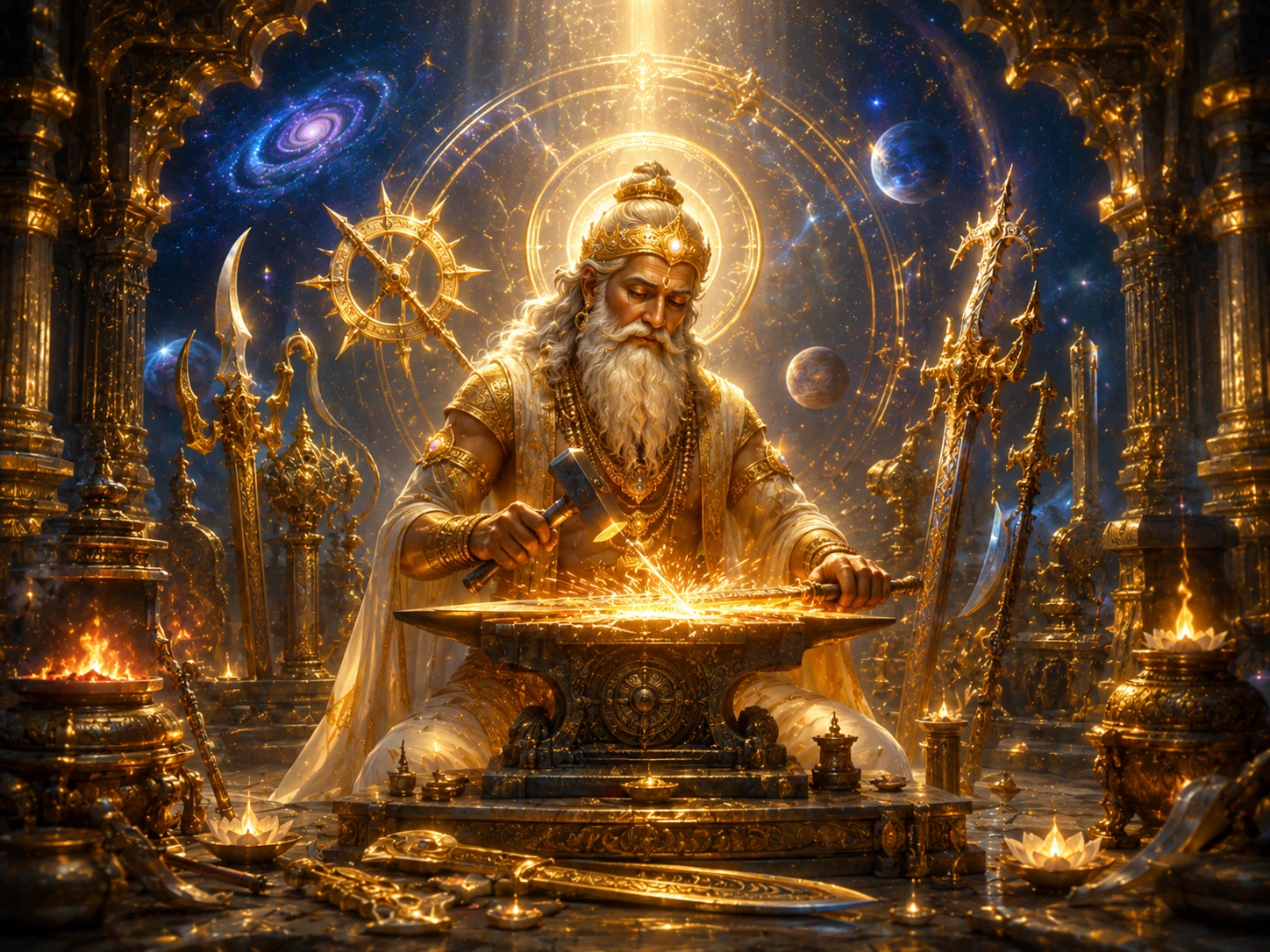
The Cosmic Forge -- Vishwakarma, Divine Engineer
ब्रह्माण्डीय भट्ठी -- विश्वकर्मा, दिव्य अभियन्ता
In the Greek tradition, the divine craftsman is Hephaestus -- a lame god, mocked by the Olympians, tolerated for his usefulness. In the Norse tradition, it is the dwarves -- industrious but grotesque, hidden underground. In Hindu tradition, the divine engineer is Vishwakarma -- and he is neither mocked, nor hidden, nor minor. He is Prajapati, a creator-god, the architect of the universe itself.
This difference tells you something fundamental about how Indian civilisation regards craft, engineering, and making. In the Hindu cosmos, the builder is not subordinate to the warrior or the priest. He is their peer. Everything the gods use -- their weapons, their cities, their chariots, their ornaments -- was designed and built by one being: Vishwakarma, whose name literally means 'all-creating.'
From the Sudarshana Chakra spinning on Vishnu's finger to the golden city of Lanka rising from the sea, from the Pushpaka Vimana that flew Rama home to the Vajra thunderbolt in Indra's hand -- every signature artefact of Hindu mythology bears a single maker's mark. Vishwakarma is the invisible infrastructure behind the entire divine arsenal.
विश्वकर्मा विमनाः सुमनाः सुसमद्धाः। वाचस्पतिर्विश्वकर्मा न आ मृळात्॥
vishvakarmaa vimanaah sumanaah susamaddhaah | vaachaspatir vishvakarmaa na aa mriLaat ||
Vishwakarma, the all-creator, of exalted mind, well-endowed with powers -- may Vishwakarma, the lord of speech and creation, be gracious to us.
— Rigveda, Mandala 10, Sukta 81
Vishwakarma's Greatest Creations
| Creation | Commissioned By | Key Feature | Current Significance |
|---|---|---|---|
| Lanka | Kubera (later seized by Ravana) | Golden city on an island, with multi-tiered fortifications | Sri Lanka's cultural identity; Ravana temples in Lanka |
| Dwarka | Krishna | City built on reclaimed sea; described as having six sectors and a grid layout | Submerged ruins off Gujarat coast studied by ASI; Dwarkadhish Temple |
| Indraprastha | Pandavas (via Maya Danava) | Illusory architecture -- water appeared as land, land as water | Purana Qila, Delhi -- claimed archaeological layers; Delhi's mythological origin |
| Pushpaka Vimana | Kubera | Mind-controlled aerial vehicle; auto-expanding cabin | Central to Ramayana's narrative structure; ISRO cultural connections |
| Sudarshana Chakra | Vishnu | 108-edged disc from compressed solar matter | Worshipped as independent deity in South Indian temples |
| Vajra | Indra | Thunderbolt made from sage Dadhichi's bones | Symbol of strength in Hindu and Buddhist traditions |
| Trishula | Shiva | Three-pronged weapon from solar dust | Most recognized symbol of Shaivism worldwide |
| Agneyastra components | Various deities | Multiple fire-weapons and divine armaments | Foundation of the entire divine arsenal system |
Vishwakarma is uniquely cross-factional: he builds for Devas, Asuras, and mortals alike. He built Lanka for Kubera (a god), which was used by Ravana (an asura), and Indraprastha for the Pandavas (mortals). His craft serves everyone.
Vishwakarma's most dramatic creation story involves the city of Indraprastha. When the Pandavas receive their share of the Kuru kingdom -- the Khandavaprastha region, a barren forest -- they need to build a capital from nothing. Krishna calls upon Maya Danava, the architect of the Asuras, who in turn invokes Vishwakarma's principles to design the city.
The result is Indraprastha -- a city so beautiful, so architecturally confusing, that it becomes a plot device in the Mahabharata. When Duryodhana visits, he mistakes a crystal floor for water and lifts his garments to avoid getting wet. When he walks towards what appears to be solid ground, he falls into a pool. Draupadi laughs -- or, in some versions, her attendants do. That humiliation becomes one of the precipitating causes of the Great War.
This is architecture as narrative engine. The building itself drives the plot. And the architect who designed it -- working through Maya Danava -- is Vishwakarma. The divine engineer, in this instance, is not a background figure. He is the author of a building that started a war.
Vishwakarma Puja is celebrated annually on the last day of the Bengali month of Bhadra (typically September 17 in the Gregorian calendar). It is one of India's most widely observed industrial festivals -- a day when factories, workshops, printing presses, IT offices, and manufacturing units across India stop production to worship their tools and machines.
In the steel mills of Jamshedpur, lathes and furnaces are decorated with marigold garlands. At the Hindustan Aeronautics Limited facility in Bengaluru, aircraft components receive tilak. In the IT parks of Hyderabad and Pune, some teams perform puja on their laptops and servers -- a practice that draws both devotion and social media jokes in equal measure. At construction sites across Bihar, Jharkhand, and West Bengal, cranes and bulldozers are washed, decorated, and offered prasad.
This is not performative religiosity. For millions of Indian workers, the tool is not separate from the person using it. The relationship between craftsman and instrument is intimate, and Vishwakarma Puja acknowledges that intimacy. When a welder in Ludhiana garlands his welding torch, he is performing the same act as a Vedic priest offering worship to the sacrificial fire -- recognising the sacred in the functional.
ISRO celebrates Vishwakarma Puja at its facilities. DRDO laboratories observe it. The Indian Railways workshops in Jamalpur (one of the oldest railway workshops in Asia, established 1862) have held Vishwakarma Puja every year since the British era. The tradition predates modern industry but has absorbed it completely.
The submerged ruins off the coast of Dwarka in Gujarat have been studied by the Archaeological Survey of India (ASI) and the National Institute of Oceanography (NIO) since the 1960s. Underwater excavations have revealed stone structures, pottery, and anchors dating to approximately 1500 BCE, with some researchers arguing for older dates. While the connection to Krishna's Dwarka remains debated, the existence of a significant ancient port settlement is established. If Vishwakarma built the mythological Dwarka, someone built the real one -- and it now lies under the Arabian Sea, exactly as the Mahabharata describes.
For India's engineering community, Vishwakarma is not a historical curiosity -- he is a living patron. The Vishwakarma Skill University in Haryana (established 2016) is specifically designed to train skilled workers and craftsmen. IIT Kharagpur, IIT Bombay, and multiple NITs host Vishwakarma Puja celebrations that bring together engineering students and cultural practice.
The philosophical point is important. In a world where Silicon Valley celebrates 'disruption' and 'move fast and break things,' the Vishwakarma tradition offers a counterpoint: build carefully, build beautifully, and build so well that what you make outlasts the gods who use it. Lanka still stands in cultural memory. Dwarka still stands under the sea. The Sudarshana Chakra still spins. The engineer's work endures after the warrior's battles are forgotten.
For every young engineer in India -- whether designing bridges at L&T, coding at Infosys, or building rockets at ISRO -- Vishwakarma is the mythological ancestor. The tradition says: your work is not merely professional. It is sacred.
Offer Gratitude to Your Tools
Vishwakarma Puja teaches us to honour the instruments of our work. Take five quiet minutes to clean and thank the tools that make your work possible -- a pen, a laptop, a machine -- the way artisans do on Vishwakarma Puja. The Meditate section has practices to settle the mind first.
Tags
Eternal Raga · शाश्वत राग
Institutional voice — scholarly articles on Sanatan Dharma
Deepen Your Understanding
अपनी समझ और गहरी करें
divine arsenal
Sudarshana Chakra -- The Disc of Divine Will
Vishnu's spinning disc is not merely a weapon -- it is cosmic justice made manifest. With 108 serrated edges, it never misses, never falters, and returns to the hand that released it. From Shishupala's hundredth sin to the Sudarshana Homa still performed in South Indian temples, this is the story of divine precision.
divine arsenal
Vimanas -- Flying Machines of Hindu Texts
Long before the Wright brothers, Hindu texts described flying vehicles that were mind-controlled, self-navigating, and capable of interplanetary travel. From the Pushpaka Vimana's auto-expanding cabin to Jatayu's aerial battle with Ravana -- the first dogfight in literature -- Vimanas occupy a fascinating intersection of mythology, imagination, and the enduring question of ancient technological knowledge.
divine arsenal
The Celestial Chariots -- Pushpaka Vimana, Arjuna's Ratha, and the Flying Machines of Hindu Mythology
Ravana's Pushpaka Vimana could fly across oceans and read its owner's mind. Arjuna's chariot bore Hanuman on its flag and was driven by God himself. These were not fairy tale carriages -- they may be literary encodings of technologies that ancient India actually possessed.
divine arsenal
Astra vs Shastra -- The Two Classes of Weapons in Hindu Warfare
One is hurled with mantras and divine invocation. The other is wielded by hand and muscle. Understanding the fundamental difference between Astra and Shastra unlocks the entire weapons philosophy of ancient India.
divine arsenal
The Celestial Bows -- Pinaka, Gandiva, Sharanga, Vijaya and the Sacred Art of Dhanurvidya
Five bows shaped the fate of two great epics. Forged by Vishwakarma and Brahma, wielded by Shiva, Rama, Arjuna, Vishnu, and Karna -- these were not mere weapons but extensions of cosmic will. Know their origins, their powers, and the warriors who earned them.
divine arsenal
The Sacred Swords -- Chandrahasa, Nandaka, Asi, and the Wootz Steel Legacy
Ravana's Chandrahasa laughed like the crescent moon as it cut. Vishnu's Nandaka separated truth from illusion with a single stroke. And the first sword ever created -- Asi -- was forged by Brahma himself as a living being of fire. These blades shaped mythology, and the steel that made them shaped world history.
The submerged ruins off the coast of Dwarka in Gujarat have been studied by the Archaeological Survey of India (ASI) and the National Institute of Oceanography (NIO) since the 1960s. Underwater excavations have revealed …
More in Divine Arsenal
Akshauhini -- The Epic Army Structure Where Every Digit Sums to 18
14 min read
Ancient Indian Martial Arts -- Kalaripayattu to Malla-Yuddha
14 min read
Astra Invocation and Withdrawal -- The Ritual of Weapons
16 min readThe same translation error that turned '33 Koti' into '33 crore' in Hinduism also happened in Buddhism. The Chinese translation of Buddhist texts rendered 'Sapta Koti Buddha' (7 Supreme Buddhas) as '7 Crore Buddhas.' The…
Deities AvatarsCommunity Reflections
🕉️
Be the first to share your reflection.