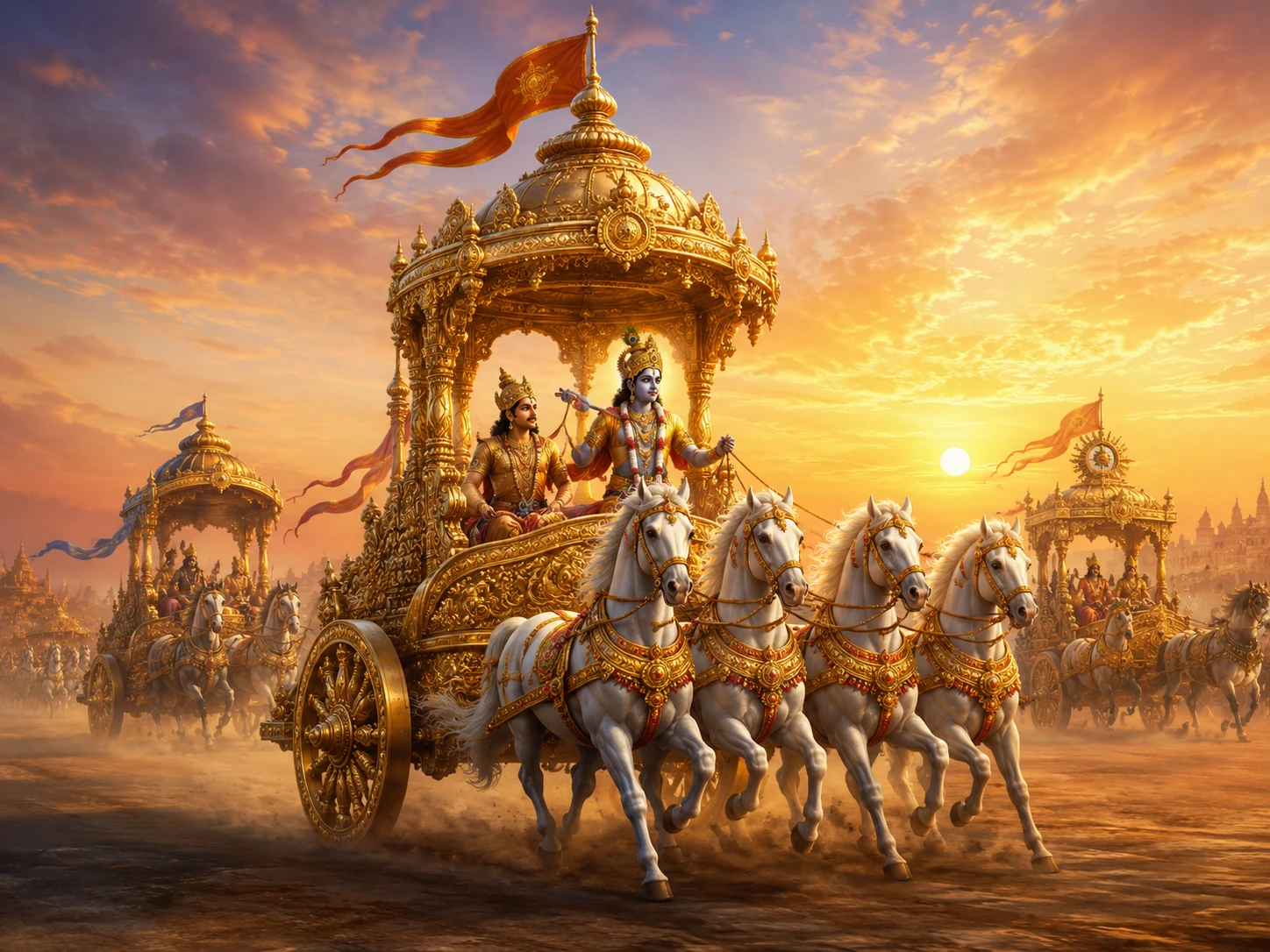
The Celestial Chariots -- Pushpaka Vimana, Arjuna's Ratha, and the Flying Machines of Hindu Mythology
दिव्य रथ -- पुष्पक विमान, अर्जुन का रथ, और हिन्दू पौराणिक कथाओं के उड़ने वाले यान
When we imagine ancient warfare, we picture horses pulling wooden carts across dusty plains. But the chariots of Hindu mythology are something else entirely. The Pushpaka Vimana could fly at the speed of thought, expand to accommodate any number of passengers, and navigate autonomously to wherever its master wished to go. Arjuna's battle chariot, gifted by Agni and driven by Krishna, was so fortified with divine protections that when those protections were finally removed after the war, it spontaneously combusted -- the accumulated damage from eighteen days of cosmic weapons had only been held at bay by divine energy.
These descriptions are too specific to be dismissed as poetic fancy. They describe capabilities -- autonomous navigation, mind-controlled flight, expandable capacity, energy shielding -- that read less like fantasy and more like engineering specifications written in mythological language.
This does not mean the ancient Indians had jet engines. But it strongly suggests that the civilisation that produced the world's first urban planning (Mohenjo-daro), the world's first steel (wootz), and the world's first systematic grammar (Panini's Ashtadhyayi) may well have possessed advanced technologies that were later lost, and whose memory survived only in the language of epic poetry.
The Celestial Chariots and Vimanas
| Chariot/Vimana | रथ/विमान | Created By | Owner(s) | Capabilities | Key Moment |
|---|---|---|---|---|---|
| Pushpaka Vimana | पुष्पक विमान | Vishwakarma (for Brahma) | Brahma to Kubera to Ravana (stolen) to Rama (recovered) | Flew at speed of thought. Expanded to fit any number. Mind-controlled navigation. Self-illuminating. Could fly in any direction including vertically. | Ravana used it to abduct Sita. Rama used it to return to Ayodhya after Lanka war. The entire journey from Lanka to Ayodhya is narrated as aerial sightseeing -- the first recorded 'flight description' in world literature. |
| Arjuna's Ratha | अर्जुन का रथ | Agni (god of fire) with divine fortification | Arjuna (charioteer: Krishna) | White horses (Saindharva breed). Kapidhwaj -- Hanuman seated on flag (divine protection). Impervious to all weapons while Krishna drove it. Speed matched any divine vehicle. | After Krishna left the mortal world and removed his divine protection, Arjuna's chariot spontaneously burst into flames -- revealing that it had been destroyed hundreds of times during the war but held together solely by Krishna's will. |
| Karna's Ratha | कर्ण का रथ | Standard but massive war chariot | Karna (charioteer: Shalya) | Large, imposing, befitting Karna's stature. No divine protection beyond Karna's own skill. | The chariot wheel sinking into the earth on Day 17 -- whether by curse (Brahmana's curse on Karna) or battlefield mud -- decided the war's outcome. The mightiest warrior fell because his vehicle failed him. |
| Surya's Chariot | सूर्य रथ | Vishwakarma | Surya (the Sun God) | Pulled by seven horses (representing seven colours of light / seven days). One wheel (representing the year). Charioteer: Aruna (god of dawn). | Travels across the sky daily from east to west. Konark Sun Temple in Odisha is built as a stone replica of this chariot -- 24 wheels (hours), 7 horses, and engineering precision that still baffles architects. |
| Ravana's Aerial Fleet | रावण का वायु बेड़ा | Lanka's advanced smiths (Mayasura's design) | Ravana and Lanka's army | Multiple Vimanas described in Lanka. Ravana possessed not just Pushpaka but other flying craft. Lanka itself is described as a city of gold with aerial docking. | Jatayu attacked Ravana's Vimana mid-flight during Sita's abduction -- the first recorded aerial battle in world literature. |
| Indra's Chariot | इन्द्र का रथ | Vishwakarma | Indra (sent for Arjuna) | Arrived from Amaravati (heaven) to take Arjuna for divine weapons training. Described as self-luminous, with no horses visible, moving through clouds. | Matali (Indra's charioteer) flew Arjuna to heaven -- described as ascending through layers of atmosphere, each with different characteristics. Resembles atmospheric layers described in modern science. |
Vishwakarma appears as the creator of virtually every divine vehicle and weapon. He is the patron deity of Indian engineers -- and ISRO's vehicle assembly building is informally called 'Vishwakarma Bhavan' by some scientists.
मनो यथा ध्यायति यत्र यत्र गन्तुमिच्छति। तत् तत् समीपं प्राप्नोति पुष्पकं तत् विचित्रकम्॥
mano yathaa dhyaayati yatra yatra gantum icchati tat tat samiipam praapnoti pushpakam tat vicitrakam
Wherever the mind thinks and desires to go, to that very place the wondrous Pushpaka reaches -- it travels as swiftly as thought itself.
— Valmiki Ramayana, Sundara Kanda 8.16
Not Mere Mythology -- The Technology Question
The responsible approach to this question is neither blind faith nor dismissive skepticism. The texts describe technologies with remarkable specificity. The Vaimanika Shastra (a text whose dating is debated -- some scholars place it in the early 20th century as a channelled work, others argue it draws on much older oral traditions) describes aircraft with mercury vortex engines, materials science for airframe construction, and navigation systems. While the text's antiquity is disputed, the concepts it describes are not entirely fanciful.
What is not disputed is that ancient India possessed genuinely advanced technologies in specific domains. Wootz steel (Ukku), produced in crucibles in present-day Karnataka and Tamil Nadu from at least the 3rd century BCE, was the finest steel in the ancient world -- the famed Damascus swords were made from imported Indian wootz. The zinc distillation process at Zawar in Rajasthan predated European discovery by over a millennium. The Antikythera mechanism's Indian parallels in astronomical computation suggest sophisticated mechanical engineering knowledge.
The question is not whether ancient India had 'flying machines' in the modern sense. The question is whether a civilisation capable of producing wootz steel, Panini's grammar (which anticipates formal logic by 2,500 years), and the mathematical zero might also have produced transport technologies that were advanced for their era -- and whether the mythological descriptions are cultural memory of those achievements, encoded in narrative form for preservation across millennia.
The Konark Sun Temple in Odisha -- a 13th-century stone chariot with 24 wheels that function as sundials accurate to the minute -- proves that Indian engineers could build functional precision instruments on a monumental scale. If they could encode time measurement into a stone chariot, what might their actual chariots have been capable of?
When Arjuna's chariot was finally released from Krishna's divine protection after the war, it burst into flames and was reduced to ashes -- revealing that it had absorbed the energy of hundreds of celestial weapons over 18 days. It was essentially a divine force field on wheels. Modern tank armour engineers call this 'reactive armour' -- a technology the mythology described thousands of years ago.
Visit Konark -- The Stone Chariot Temple
The Konark Sun Temple is Surya's chariot rendered in stone, with twenty-four carved wheels and seven horses. Read about it on its Eternal Raga temple page.
Tags
Eternal Raga · शाश्वत राग
Institutional voice — scholarly articles on Sanatan Dharma
Deepen Your Understanding
अपनी समझ और गहरी करें
divine arsenal
Astra vs Shastra -- The Two Classes of Weapons in Hindu Warfare
One is hurled with mantras and divine invocation. The other is wielded by hand and muscle. Understanding the fundamental difference between Astra and Shastra unlocks the entire weapons philosophy of ancient India.
divine arsenal
The Celestial Bows -- Pinaka, Gandiva, Sharanga, Vijaya and the Sacred Art of Dhanurvidya
Five bows shaped the fate of two great epics. Forged by Vishwakarma and Brahma, wielded by Shiva, Rama, Arjuna, Vishnu, and Karna -- these were not mere weapons but extensions of cosmic will. Know their origins, their powers, and the warriors who earned them.
divine arsenal
The Arrows That Changed Destiny -- Famous Banas of Hindu Mythology
In Hindu mythology, a single arrow could end a war, kill an immortal, or alter the fate of an entire civilisation. From the Brahmastra arrow that killed Ravana to the Anjalikastra that felled Karna -- every arrow carried a story within its flight.
deities avatars
Dashavatara -- Why Vishnu Comes Back Ten Times
Fish, tortoise, boar, half-lion, dwarf, axe-warrior, prince, cowherd, enlightened teacher, future horseman. The ten avatars of Vishnu are not random folklore. Read them in sequence and you get something startling -- a narrative that mirrors evolutionary biology, tracks the rise and fall of political systems, and argues that God does not sit above history but enters it, gets dirty, and does the work. The Dashavatara is Hinduism's answer to the question every civilisation asks: why does the world keep breaking, and who fixes it?
vedic sciences
Ancient Indian Metallurgy -- The Iron Pillar That Refuses to Rust
A 7-metre iron pillar has stood in open Delhi air for 1,600 years without rusting. Wootz steel from Tamil Nadu became the legendary Damascus blade. From Vedic kṛṣṇāyas to Vagbhata's bell-metal recipe -- the textual and material evidence of how Bharat worked metal.
deities avatars
Surya -- The Sun God Who Drives a Seven-Horse Chariot Across the Sky Every Day
He is the most visible god in Hinduism -- you can see him every morning. The Gayatri Mantra, the most sacred verse in the Vedas, is addressed to him. The Konark Sun Temple is shaped like his chariot. And every time you do Surya Namaskar in your yoga class, you are performing a 3,000-year-old sun worship ritual. Surya is the deity hiding in plain sight.
When Arjuna's chariot was finally released from Krishna's divine protection after the war, it burst into flames and was reduced to ashes -- revealing that it had absorbed the energy of hundreds of celestial weapons over …
More in Divine Arsenal
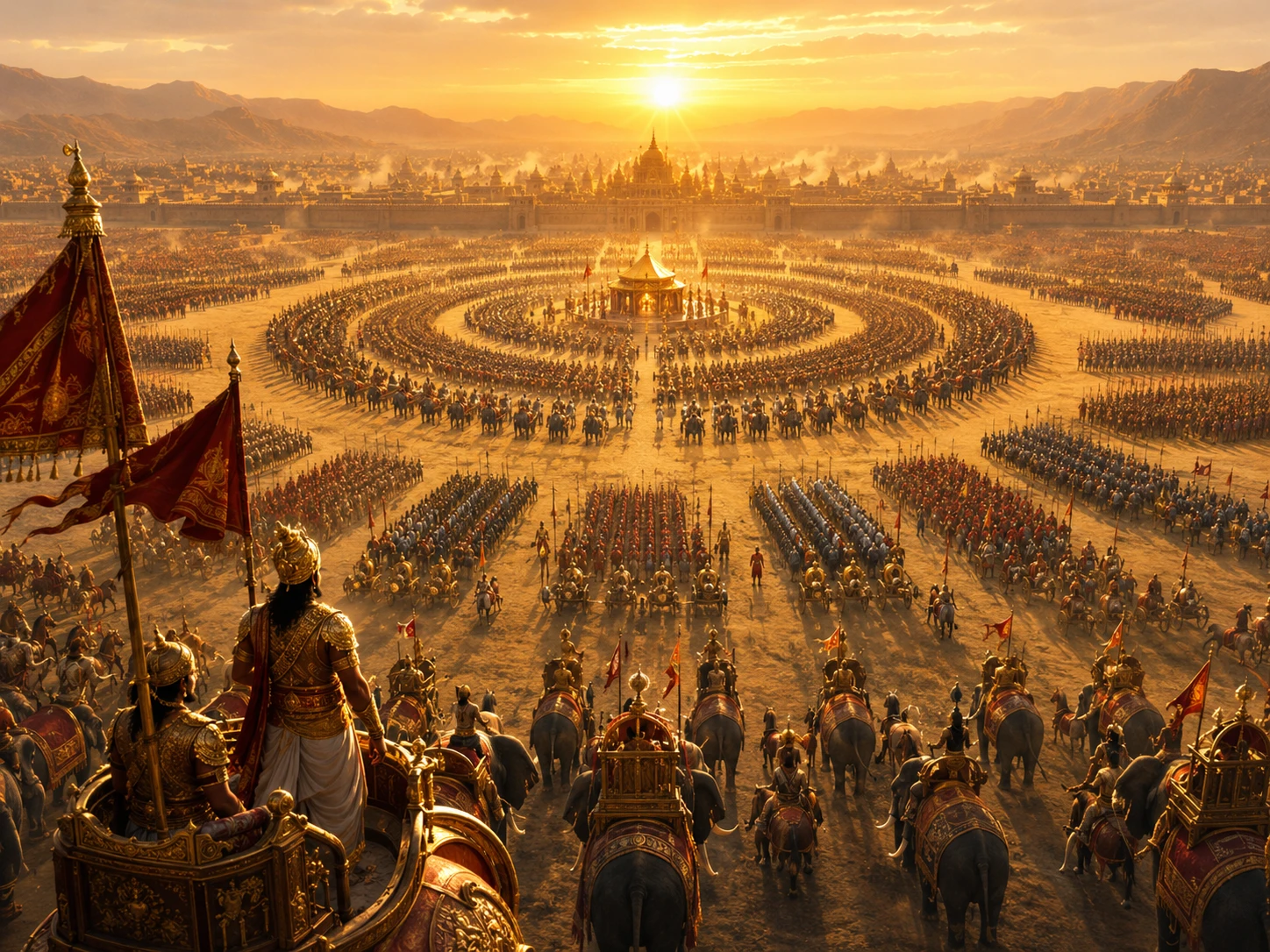
Akshauhini -- The Epic Army Structure Where Every Digit Sums to 18
14 min read
Ancient Indian Martial Arts -- Kalaripayattu to Malla-Yuddha
14 min read
Astra Invocation and Withdrawal -- The Ritual of Weapons
16 min readThe same translation error that turned '33 Koti' into '33 crore' in Hinduism also happened in Buddhism. The Chinese translation of Buddhist texts rendered 'Sapta Koti Buddha' (7 Supreme Buddhas) as '7 Crore Buddhas.' The…
Deities AvatarsCommunity Reflections
🕉️
Be the first to share your reflection.