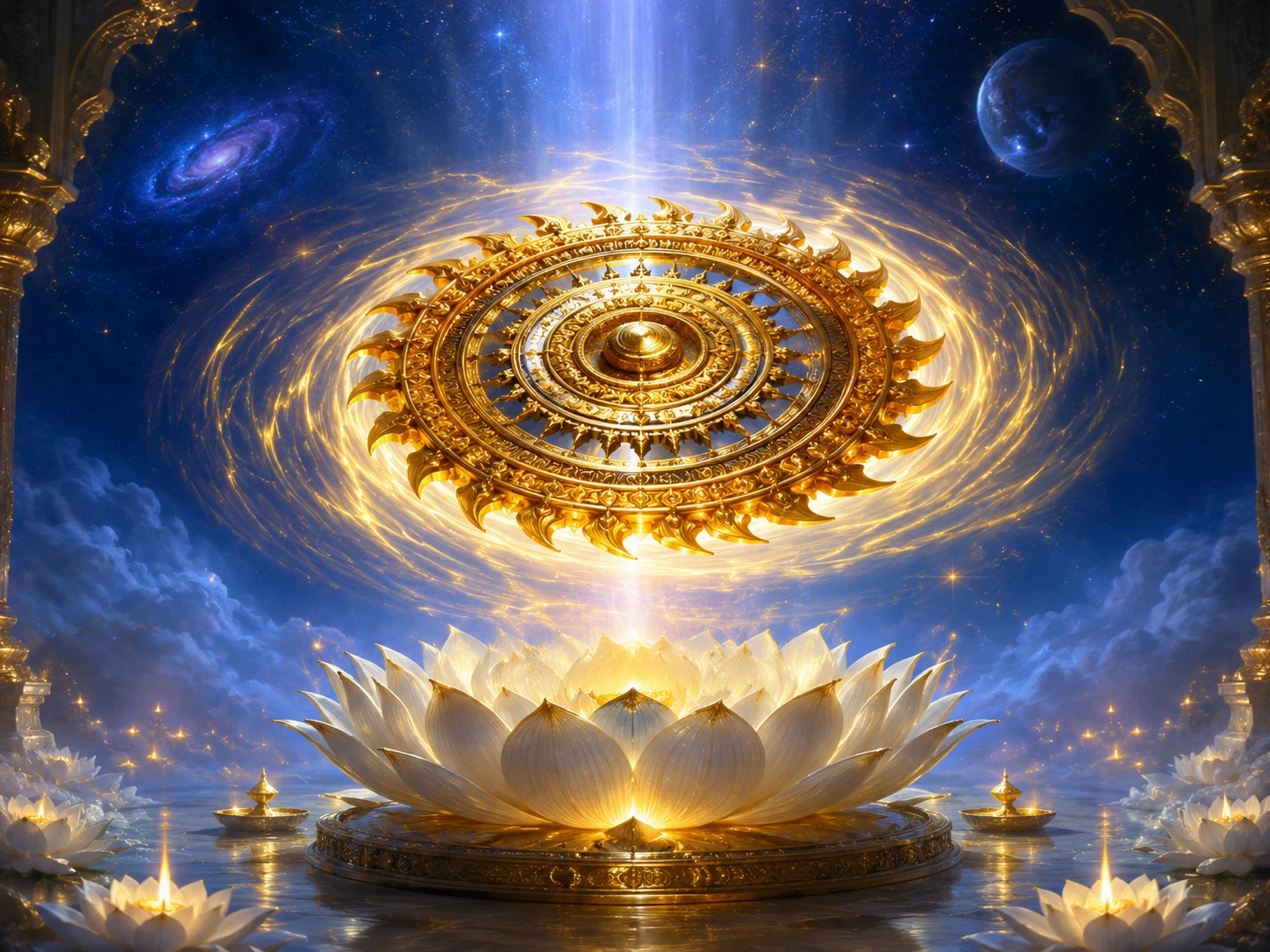
Sudarshana Chakra -- The Disc of Divine Will
सुदर्शन चक्र -- दिव्य संकल्प की चक्रधारा
There is a weapon in Hindu cosmology that does not need an archer's aim, a warrior's arm, or even a battlefield to fulfil its purpose. It spins. It waits. And when the moment arrives -- when dharma itself demands a correction -- it moves with a precision that no mortal forge could ever produce. This is the Sudarshana Chakra, Vishnu's primary weapon, and arguably the most iconic armament in all of Indian mythology.
The name itself is a revelation. 'Su' means auspicious, 'darshana' means vision -- the Sudarshana is literally 'that which grants auspicious sight.' It is not a tool of destruction first; it is a tool of discernment. It sees what is right, and then it acts. In a tradition that prizes the distinction between reaction and response, between rage and righteousness, this etymology matters enormously.
सहस्रादित्यसङ्काशं विश्वकर्मविनिर्मितम्। चक्रं सुदर्शनं नाम तेजोराशिमनुत्तमम्॥
sahasraadityasankaasham vishvakarmavinirnmitam | cakram sudarshanam naama tejoraashimanuttamam ||
Radiant as a thousand suns, fashioned by Vishwakarma himself -- the disc named Sudarshana, an unsurpassed mass of brilliance.
— Vishnu Purana, Amsha 1
The origin stories of the Sudarshana Chakra vary across the Puranas, and each variation adds a layer of meaning. In the Vishnu Purana, the disc is fashioned by Vishwakarma -- the divine architect -- from the dust of the Sun's radiance, shaved off by Samjna (Surya's wife) who could no longer bear his brilliance. The leftover solar matter became three weapons: Shiva's Trishula, Kartikeya's Vel, and Vishnu's Sudarshana. In this telling, the Chakra is literally made of compressed sunlight.
The Linga Purana offers a different genealogy. Here, Shiva himself gives the Chakra to Vishnu after being pleased by his intense tapasya near the Chakra Tirtha on the banks of the Narmada. This is significant -- it makes the Chakra a gift of Mahadeva to Narayana, binding the two great streams of Hindu worship.
A third tradition, found in the Padma Purana, describes Vishnu performing 1,000 years of penance, offering 1,000 lotuses daily to Shiva. When one lotus went missing, Vishnu offered his own eye to complete the count. Moved by this devotion, Shiva bestowed the Sudarshana.
The Sudarshana Chakra is described as having 108 serrated edges (dhaaraa), divided into two concentric rings of 54 each. The number 108 appears across Hindu, Buddhist, and Jain traditions -- the same number as beads on a Japa mala. When the Chakra spins, each edge produces a distinct frequency, making it -- in mythological terms -- a weapon that literally hums with cosmic resonance.
What makes the Sudarshana unique among divine weapons is its dual classification. In the taxonomy of Hindu weaponry, an Astra is a projectile weapon invoked by mantras and released at a target, while a Shastra is a hand-held weapon that requires physical skill. The Sudarshana defies this neat division. It sits on Vishnu's index finger, spinning perpetually -- a Shastra. But when released, it flies to its target guided by divine will and returns to the wielder -- an Astra. It occupies both categories simultaneously, much like Vishnu himself occupies both the transcendent and the immanent.
The Chakra is also personified. In South Indian temple traditions, particularly in Sri Vaishnavism, Sudarshana is worshipped as Sudarshana Azhwar -- a sentient deity in his own right. Temples like the Sudarshana Perumal temple in Thirumozhiisai near Chennai and the famous Srirangam temple in Tiruchirappalli house dedicated shrines. The deity is depicted with sixteen arms, each holding a distinct weapon, fire blazing from every limb. This is not metaphor. In the Sri Vaishnava theological system, Sudarshana is Vishnu's direct operative power -- his kriya-shakti made manifest.
Notable Uses of the Sudarshana Chakra Across Hindu Texts
| Event | Text | Target | Significance |
|---|---|---|---|
| Shishupala Vadha | Mahabharata, Sabha Parva | Shishupala | Forgave 100 insults; struck at the 101st -- the mathematics of divine patience |
| Mandara Parvat Rescue | Vishnu Purana | Mount Mandara | Steadied the churning mountain during Samudra Manthan when it began to sink |
| Jalandhara Vadha | Padma Purana | Demon Jalandhara | Vishnu used it to trace a line that broke the chastity illusion protecting Jalandhara |
| Sati Devi's Body | Devi Bhagavata | Sati's corpse | Vishnu dismembered Sati's body (carried by grieving Shiva) to create the 51 Shakti Peethas |
| Surya's Brilliance | Vishnu Purana | Surya (the Sun) | Vishwakarma shaved Surya's radiance; residue formed the Chakra |
| Krishna vs Narakasura | Bhagavata Purana | Narakasura | Krishna used it in Pragjyotishpura (modern Assam) -- later celebrated as Diwali in some traditions |
The Sudarshana appears in more incidents than any other single divine weapon. Its versatility -- from combat to cosmic maintenance -- reflects Vishnu's role as the sustainer.
The story that best captures the Sudarshana's philosophical weight is the killing of Shishupala at the Rajasuya Yajna. Shishupala, king of Chedi and a cousin of Krishna, had been promised by Krishna's aunt Shrutashrava that her son would be forgiven a hundred offences. At Yudhishthira's grand sacrifice, Shishupala began publicly insulting Krishna -- questioning his divinity, his morality, his right to be honoured. The court watched in uncomfortable silence. Bhishma counselled patience. Krishna sat still, counting.
At the 100th insult, nothing happened. The court perhaps assumed the matter was resolved through restraint. Then came the 101st -- and the Sudarshana Chakra flew from Krishna's finger, crossed the length of the sabha, and severed Shishupala's head. From his body rose a brilliant light that merged into Krishna.
This is not a story about a weapon. This is a story about thresholds. Every person who has worked in a high-pressure environment -- a surgeon making the call, an engineer at ISRO counting down the final sequence, a parent deciding when patience must end and correction must begin -- knows this arithmetic. The Sudarshana does not act in anger. It acts at the mathematically precise moment when forbearance has been fully exhausted and further tolerance would constitute complicity.
चक्रं प्रदक्षिणं कृत्वा गगनं ज्वालामालिनम्। शतापराधान् क्षम्यापि शतमेकोत्तरं हनत्॥
cakram pradakshinam kritvaa gaganam jvaalaamaalinam | shataapaaraadhan kshamyaapi shatamekottaram hanat ||
The disc, wreathed in flames, circled the sky and, having forgiven a hundred transgressions, struck upon the hundred-and-first.
— Mahabharata, Sabha Parva, Adhyaya 45
The Sudarshana Chakra remains a living force in contemporary Hindu worship, not a museum exhibit from the epics. The Sudarshana Homa is one of the most powerful fire rituals in the Sri Vaishnava tradition, performed at major temples across Tamil Nadu, Karnataka, and Andhra Pradesh. At Tirumala (Tirupati), the Sudarshana Homa is conducted during Brahmotsavam as a protective ritual for the entire region. In Srirangam, it is performed to ward off epidemics, natural disasters, and mass affliction.
The ritual involves chanting the Sudarshana Mantra -- 'Om Sahasrara Hum Phat' -- while offering specific aahutis into the sacred fire. The yantra used in the homa is the Sudarshana Yantra, a geometric diagram with interlocking triangles representing the 108 edges of the Chakra. Goldsmiths in Kumbakonam and Kanchipuram still craft Sudarshana Yantras on copper plates, following specifications that trace back centuries.
This is not fringe practice. When the COVID-19 pandemic swept through India in 2020-21, multiple temples in Tamil Nadu conducted special Sudarshana Homas for community protection. At Ahobila Mutt centres across the country, the ritual is performed monthly. For devotees, the Chakra is not an ancient curiosity -- it is an active protective presence.
The chakram -- a circular throwing weapon -- was a real weapon used by Sikh Nihang warriors and Rajput soldiers. The Nihang Singh tradition of wearing steel chakrams on their turbans echoes the Sudarshana's presence on Vishnu's finger. Maharaja Ranjit Singh's army reportedly used chakrams in battle against Afghan forces. The weapon is featured in the Akali Nihang martial tradition, which is still practised at the annual Hola Mohalla festival in Anandpur Sahib, Punjab.
In the iconographic language of South Indian temples -- especially the Pallava, Chola, and Vijayanagara periods -- the Sudarshana appears as a standard element of Vishnu's four-armed form, held in the upper right hand. But there is a deeper detail that most visitors miss. In temples like Srivilliputtur, Kanchipuram Varadaraja Perumal, and Melkote (Karnataka), the Sudarshana is given a separate shrine (sannadhi) next to Vishnu's main sanctum. At Melkote, the Sudarshana processional deity (utsava murti) participates independently in temple festivals.
This architectural choice tells a theological story: the weapon has graduated from instrument to entity, from power to personality. Compare this with how we treat technology today. An ISRO satellite starts as an instrument; after years of reliable service, it acquires a name, a reputation, a public affection (think Mangalyaan). The Sudarshana's journey from tool to deity follows a similar, if far more ancient, logic.
Sudarshana vs Other Famous Divine Discs and Circular Weapons
| Weapon | Wielder | Tradition | Key Distinction |
|---|---|---|---|
| Sudarshana Chakra | Vishnu / Krishna | Hindu | Self-returning, sentient, worshipped as independent deity |
| Vajra | Indra | Hindu / Buddhist | Thunderbolt -- linear strike, not circular; made from Dadhichi's bones |
| Kunta Chakra | Yudhishthira | Mahabharata | Smaller combat disc; mortal weapon, not divine origin |
| Chakram | Nihang Sikhs | Historical India | Real steel throwing ring; physical weapon inspired by mythological precedent |
| Xena's Chakram | Xena (fictional) | Western pop culture | Circular throwing weapon in 1990s TV; shows cross-cultural resonance of the disc archetype |
The Sudarshana's uniqueness lies in its sentience and dual classification (Astra + Shastra). No other circular weapon in world mythology has been elevated to independent deity status.
For the young Indian navigating a world of competitive exams, career pressure, and social media noise, the Sudarshana offers a surprisingly practical philosophy: precision over force. The Chakra does not carpet-bomb. It does not create collateral damage. It identifies one target, travels the exact distance required, and returns. For a JEE aspirant in Kota deciding which topics to focus on, for a UPSC candidate in Old Rajinder Nagar choosing which optional to master, for a startup founder in Koramangala deciding which feature to ship first -- the lesson is the same. The most powerful force is not the one that does the most. It is the one that does exactly enough.
The Shishupala story adds another layer: patience has a number. Forbearance is not infinite tolerance -- it is calibrated grace. Krishna did not act at insult one, or fifty, or ninety-nine. He acted at 101 -- the exact point where mercy had been fully spent. In an age of instant reactions and Twitter pile-ons, this is a lesson worth meditating on.
Invoke the Sudarshana Mantra
The Sudarshana mantra is traditionally chanted for protection and to clear negative influences; learn it from a teacher before regular japa. The Sudarshana Stotram, praising Vishnu's discus, is on Eternal Raga with its meaning.
Tags
Eternal Raga · शाश्वत राग
Institutional voice — scholarly articles on Sanatan Dharma
Deepen Your Understanding
अपनी समझ और गहरी करें
divine arsenal
Astra vs Shastra -- The Two Classes of Weapons in Hindu Warfare
One is hurled with mantras and divine invocation. The other is wielded by hand and muscle. Understanding the fundamental difference between Astra and Shastra unlocks the entire weapons philosophy of ancient India.
divine arsenal
The Celestial Bows -- Pinaka, Gandiva, Sharanga, Vijaya and the Sacred Art of Dhanurvidya
Five bows shaped the fate of two great epics. Forged by Vishwakarma and Brahma, wielded by Shiva, Rama, Arjuna, Vishnu, and Karna -- these were not mere weapons but extensions of cosmic will. Know their origins, their powers, and the warriors who earned them.
divine arsenal
The Cosmic Forge -- Vishwakarma, Divine Engineer
Every divine weapon. Every celestial city. Every flying chariot. They all have the same maker. Vishwakarma -- the architect of the gods -- built Lanka for Kubera, Dwarka for Krishna, Indraprastha for the Pandavas, and forged every weapon in the divine arsenal. He is the patron deity of Indian engineers, craftsmen, and factory workers, worshipped annually on Vishwakarma Puja with the tools of modern industry laid at his feet.
divine arsenal
Pashupatastra -- The Supreme Weapon Never Used
The most fearsome weapon in the Mahabharata was never deployed on the battlefield. Shiva granted it to Arjuna after a wrestling match in the forests of Indrakila, yet Arjuna carried it through all eighteen days of Kurukshetra without ever invoking it. The Pashupatastra's true power lay not in its destruction, but in its restraint -- a philosophy that modern nuclear doctrine would independently discover thousands of years later.
divine arsenal
10 Weapons That Changed the War
Across the Ramayana and Mahabharata, certain weapons did not merely kill -- they altered the course of history. From Rama shattering Shiva's bow to win Sita, to the Shakti that saved the Pandavas by killing the one person it should not have, these ten weapon-moments are the pivot points on which two epics turn.
divine arsenal
The Divine Shields and Armour -- Karna's Kavach-Kundal, Agastya's Gift, and the Spiritual Meaning of Protection
Karna was born wearing armour that made him invincible -- and gave it away to the one man who wanted him dead. Rama received divine armour from a sage moments before facing Ravana. In Hindu tradition, the greatest protection is not what you wear on your body but what you carry in your soul.
The Sudarshana Chakra is described as having 108 serrated edges (dhaaraa), divided into two concentric rings of 54 each. The number 108 appears across Hindu, Buddhist, and Jain traditions -- the same number as beads on a…
More in Divine Arsenal
Akshauhini -- The Epic Army Structure Where Every Digit Sums to 18
14 min read
Ancient Indian Martial Arts -- Kalaripayattu to Malla-Yuddha
14 min read
Astra Invocation and Withdrawal -- The Ritual of Weapons
16 min readThe same translation error that turned '33 Koti' into '33 crore' in Hinduism also happened in Buddhism. The Chinese translation of Buddhist texts rendered 'Sapta Koti Buddha' (7 Supreme Buddhas) as '7 Crore Buddhas.' The…
Deities AvatarsCommunity Reflections
🕉️
Be the first to share your reflection.