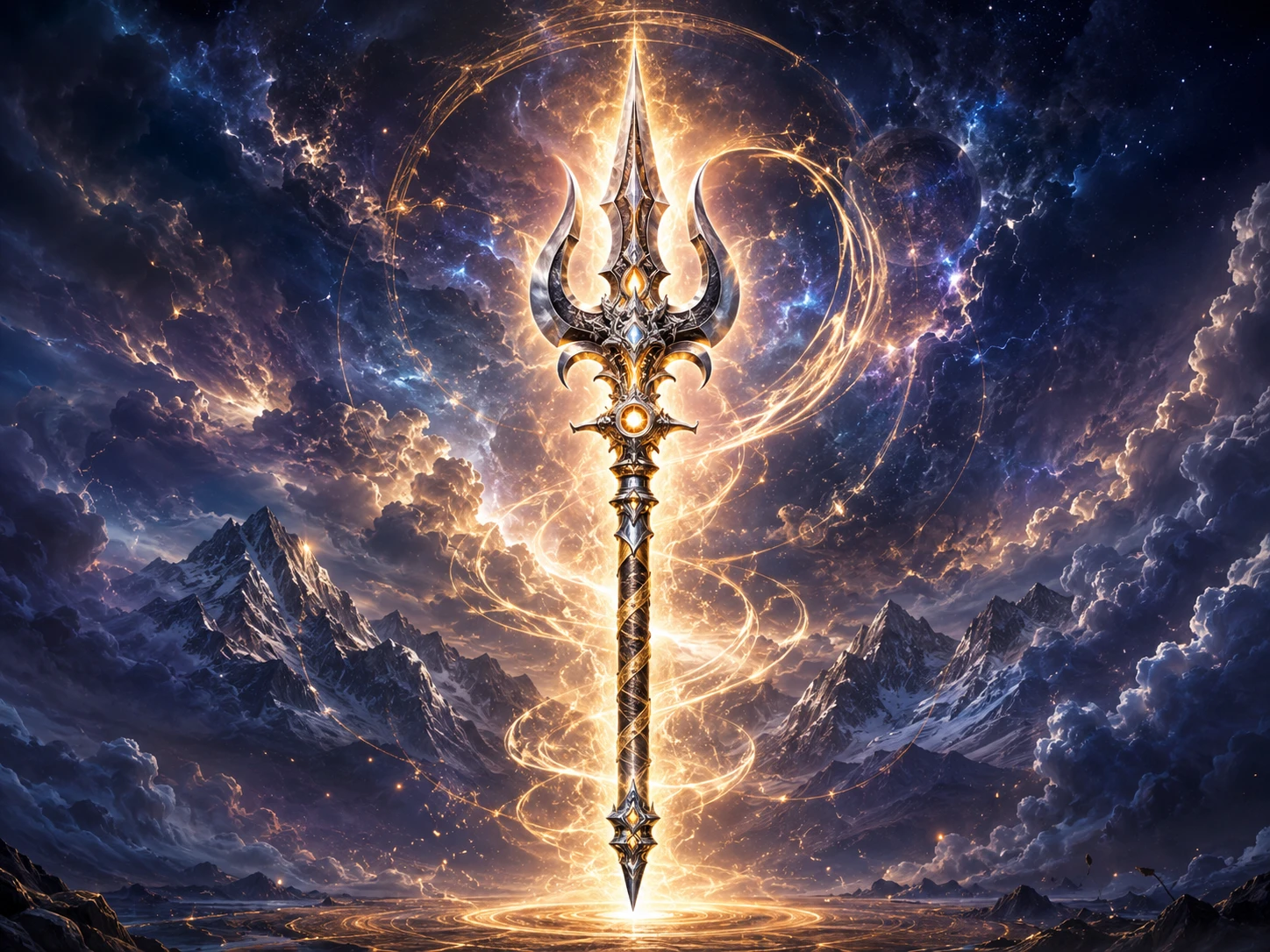
Pashupatastra -- The Supreme Weapon Never Used
पाशुपतास्त्र -- वह परम अस्त्र जो कभी चलाया नहीं गया
In the hierarchy of divine weapons that populate the Mahabharata's vast armoury, one stands above all others -- not because it was used most spectacularly, but because it was never used at all. The Pashupatastra, Shiva's personal weapon, is described as capable of destroying the entire creation -- not just an army, not just a kingdom, but the fabric of existence itself. It can be released by the mind, the eyes, words, or a bow. It cannot be countered by any other weapon. And the one mortal who possessed it during the Great War chose, across eighteen days of escalating carnage, to keep it sheathed.
That restraint is not a footnote to the Mahabharata. It is, perhaps, the story's most sophisticated moral argument.
पशूनां पतिरीशानो महादेवो महेश्वरः। पाशुपतं महास्त्रं तु सर्वास्त्रविनिवर्तनम्॥
pashuunaam patiriishaano mahaadevo maheshvarah | paashupatam mahaaastram tu sarvaastravinirvartanam ||
Ishana, the lord of all beings, Mahadeva, Maheshwara -- his great weapon the Pashupata is the annihilator of all other weapons.
— Mahabharata, Vana Parva, Adhyaya 41
The story of how Arjuna obtained the Pashupatastra is one of the Mahabharata's great set-pieces, immortalized separately in the 5th-century Sanskrit mahakavya 'Kiratarjuniya' by the poet Bharavi. The episode takes place during the Pandavas' thirteen-year exile. On Vyasa's counsel, Arjuna journeys alone into the Himalayas to perform tapasya and obtain divine weapons for the inevitable war.
In the forests of Indrakila -- a peak often identified with the ranges near modern-day Kedarnath or the Kumaon hills of Uttarakhand -- Arjuna encounters a wild boar charging at him. He shoots an arrow at it. Simultaneously, another arrow strikes the same boar from a different direction. Arjuna turns to find a Kirata -- a tribal hunter -- accompanied by his wife, claiming the kill.
A quarrel erupts. Arjuna, the greatest archer of his age, challenges the hunter. What follows is one of the most remarkable escalation sequences in world literature. They fight with arrows -- the Kirata matches him. Arjuna draws his Gandiva bow -- the Kirata shatters it. They fight with swords -- equal. With maces -- equal. Finally, they wrestle, bare-handed. And the Kirata pins Arjuna to the ground.
Arjuna, battered and humbled, fashions a small Shiva linga from the earth and offers worship. When he places his flower garland on the linga, he sees it appear on the Kirata's neck. The tribal hunter was Shiva all along. The goddess beside him was Parvati.
Bharavi's 'Kiratarjuniya' (5th century CE) is considered one of the six greatest mahakavyas in Sanskrit literature. Its 18th canto is famous for featuring the most complex wordplay in all of Sanskrit poetry, including an entire verse -- 'na nonanunno nunnono naanaa naanaaananaa nunna' -- that uses only one consonant (na). IIT Madras researchers have studied its computational linguistics as an example of early constraint-based pattern generation, centuries before Western poets attempted similar feats.
Shiva, pleased by Arjuna's courage and devotion, reveals his true form and grants the Pashupatastra. The conditions of the grant are severe. Arjuna is instructed:
First, it must never be used against a lesser opponent. Deploying this weapon against an ordinary warrior would be like detonating a thermonuclear device to settle a street brawl. The response would be grotesquely disproportionate, and the karmic consequences would be equally catastrophic.
Second, it must never be used in anger. The weapon responds to the invoker's emotional state. If released in rage, it would consume everything -- the target, the wielder, and the world.
Third, its invocation requires a specific state of spiritual readiness -- a meditative composure that cannot coexist with hatred or vengeance.
These are not casual rules of engagement. They are, in essence, the earliest articulation of a just-war doctrine that the modern world would labour for centuries to formulate. Proportionality. Emotional discipline. Last resort. The Pashupatastra comes with its own Geneva Convention.
Pashupatastra vs Other Supreme Weapons of the Mahabharata
| Weapon | Deity Source | Wielder(s) | Used in War? | Destructive Scope |
|---|---|---|---|---|
| Pashupatastra | Shiva | Arjuna | Never used | Capable of annihilating all creation |
| Brahmastra | Brahma | Drona, Arjuna, Ashwatthama, Karna | Used multiple times | Can destroy an entire army; irrevocable once launched |
| Brahmashira | Brahma | Arjuna, Ashwatthama | Invoked once by Ashwatthama (redirected) | Four times the power of Brahmastra; burns a region for 12 years |
| Narayanastra | Vishnu | Drona, Ashwatthama | Used once by Ashwatthama (Day 16) | Intensifies against resistance; only countered by complete surrender |
| Brahma Danda | Brahma | Drona | Never used | Capable of absorbing any Astra; purely defensive supreme weapon |
| Vaishnavastra | Vishnu | Krishna (withheld) | Never used | Krishna's personal ultimate; held in reserve like the Pashupatastra |
The Mahabharata establishes a clear hierarchy: weapons that were never used are ranked higher than those that were. Restraint is the measure of supremacy, not destruction.
The eighteen days of Kurukshetra tested Arjuna's restraint to its breaking point -- not once, but repeatedly.
On Day 13, his sixteen-year-old son Abhimanyu was trapped in the Chakravyuha and killed by six warriors simultaneously, in violation of every rule of combat. The father's grief was volcanic. Still, no Pashupatastra.
On Day 14, fighting continued into the night -- an unprecedented breach of war convention -- as Arjuna fulfilled his vow to kill Jayadratha before sunset. He used Pashupati's name, but not the weapon. The distinction is critical.
On Day 15, Drona, his own guru, was killed through a deception orchestrated by his own side. On Day 17, Karna fell. On Day 18, Duryodhana was struck below the waist by Bhima in a mace fight -- another violation. At every escalation, the weapon that could have ended everything sat dormant in Arjuna's spiritual armoury.
Why? Because the Pashupatastra's conditions prohibited it. No single opponent on the field -- not even Karna at his mightiest, not even Bhishma on his arrow-bed -- warranted its deployment. The war, however brutal, remained a war among mortals. The Pashupatastra was designed for a threat that transcended the mortal plane. Arjuna understood the difference between devastating power and appropriate response.
India's nuclear weapons doctrine explicitly states a 'No First Use' policy, pledging to use nuclear arms only in retaliation. Dr. APJ Abdul Kalam, who led India's missile programme, was a known admirer of ancient Indian texts. India's missile series is named after Vedic weapons -- Agni (fire), Prithvi (earth), Akash (sky), Nag (serpent), Trishul (trident). The philosophical parallel between Arjuna's restraint with the Pashupatastra and India's nuclear posture -- possessing ultimate capability but choosing strategic restraint -- is not merely poetic. It is a living strategic tradition.
There is a profound irony in the Pashupatastra story that modern Indian strategic thinkers appreciate. The weapon was most useful precisely because it was never used. Its existence in Arjuna's arsenal changed the calculus of every opponent who knew about it. Drona, who was aware of Arjuna's divine weapons, calibrated his war strategy accordingly. Karna, who possessed his own divine arsenal including Shakti (a one-use weapon from Indra), had to factor in the possibility that Arjuna could escalate beyond anything he could counter.
This is textbook deterrence theory. In the Cold War, strategists coined terms like 'Mutual Assured Destruction' and 'second-strike capability.' The Mahabharata had articulated the same logic millennia earlier, wrapped in narrative rather than policy papers. The weapon you hold but never fire is not wasted. It is working hardest in the moment you choose not to use it.
At the National Defence Academy in Khadakwasla, Pune, and at the Defence Services Staff College in Wellington, Tamil Nadu, Mahabharata strategy is studied alongside Clausewitz and Sun Tzu. The Pashupatastra scenario -- possessing a weapon of absolute power and choosing restraint -- is not a quaint mythological curiosity to these officers. It is a case study.
न शक्यं तत् परैर्जेतुं नापि देवासुरैर्मिथः। पाशुपतं महच्छस्त्रं त्रैलोक्यविजयावहम्॥
na shakyam tat parairjetum naapi devaasurairhmithah | paashupatam mahacchhastram trailokyavijayaavaham ||
It cannot be overcome by enemies, nor even by the combined forces of gods and demons. The great weapon Pashupata brings victory across all three worlds.
— Mahabharata, Vana Parva, Adhyaya 41
The Kirata episode carries another teaching that is especially resonant for young India. Arjuna did not receive the Pashupatastra through birth, lineage, or entitlement. He earned it through three specific acts: he left the comfort of his brothers' company to walk alone into the wilderness (courage to isolate), he fought an unknown opponent with escalating intensity without backing down (perseverance under pressure), and when defeated, he did not sulk or plot revenge but immediately turned to worship (humility after failure).
For a student preparing for NEET in Hyderabad, for an IAS probationer in Mussoorie, for a young coder at a Bengaluru startup pulling all-nighters before a product launch -- the pattern is recognizable. The most powerful tool you will ever possess comes not from privilege but from the willingness to walk into the forest alone, to fight beyond your known limits, and to bow when the universe reveals you are not yet enough. And then -- crucially -- it comes with a responsibility to use it wisely.
The Pashupatastra is the ultimate argument for restraint over display, for competence held in reserve over competence constantly deployed. In a world addicted to visible achievement, it asks a subversive question: what if your greatest power is the one you never show?
Meditate on the Kirata Episode
Reflect on Arjuna's journey from combat to surrender to grace. Set a timer for fifteen minutes and sit with the question: what power do I hold in reserve, and why? The Meditate section has practices to settle the mind first.
Eternal Raga · शाश्वत राग
Institutional voice — scholarly articles on Sanatan Dharma
Deepen Your Understanding
अपनी समझ और गहरी करें
divine arsenal
Astra vs Shastra -- The Two Classes of Weapons in Hindu Warfare
One is hurled with mantras and divine invocation. The other is wielded by hand and muscle. Understanding the fundamental difference between Astra and Shastra unlocks the entire weapons philosophy of ancient India.
divine arsenal
Sudarshana Chakra -- The Disc of Divine Will
Vishnu's spinning disc is not merely a weapon -- it is cosmic justice made manifest. With 108 serrated edges, it never misses, never falters, and returns to the hand that released it. From Shishupala's hundredth sin to the Sudarshana Homa still performed in South Indian temples, this is the story of divine precision.
divine arsenal
10 Weapons That Changed the War
Across the Ramayana and Mahabharata, certain weapons did not merely kill -- they altered the course of history. From Rama shattering Shiva's bow to win Sita, to the Shakti that saved the Pandavas by killing the one person it should not have, these ten weapon-moments are the pivot points on which two epics turn.
divine arsenal
The Celestial Bows -- Pinaka, Gandiva, Sharanga, Vijaya and the Sacred Art of Dhanurvidya
Five bows shaped the fate of two great epics. Forged by Vishwakarma and Brahma, wielded by Shiva, Rama, Arjuna, Vishnu, and Karna -- these were not mere weapons but extensions of cosmic will. Know their origins, their powers, and the warriors who earned them.
divine arsenal
The Arrows That Changed Destiny -- Famous Banas of Hindu Mythology
In Hindu mythology, a single arrow could end a war, kill an immortal, or alter the fate of an entire civilisation. From the Brahmastra arrow that killed Ravana to the Anjalikastra that felled Karna -- every arrow carried a story within its flight.
divine arsenal
The Cosmic Forge -- Vishwakarma, Divine Engineer
Every divine weapon. Every celestial city. Every flying chariot. They all have the same maker. Vishwakarma -- the architect of the gods -- built Lanka for Kubera, Dwarka for Krishna, Indraprastha for the Pandavas, and forged every weapon in the divine arsenal. He is the patron deity of Indian engineers, craftsmen, and factory workers, worshipped annually on Vishwakarma Puja with the tools of modern industry laid at his feet.
divine arsenal
The Divine Shields and Armour -- Karna's Kavach-Kundal, Agastya's Gift, and the Spiritual Meaning of Protection
Karna was born wearing armour that made him invincible -- and gave it away to the one man who wanted him dead. Rama received divine armour from a sage moments before facing Ravana. In Hindu tradition, the greatest protection is not what you wear on your body but what you carry in your soul.
Bharavi's 'Kiratarjuniya' (5th century CE) is considered one of the six greatest mahakavyas in Sanskrit literature. Its 18th canto is famous for featuring the most complex wordplay in all of Sanskrit poetry, including an…
More in Divine Arsenal
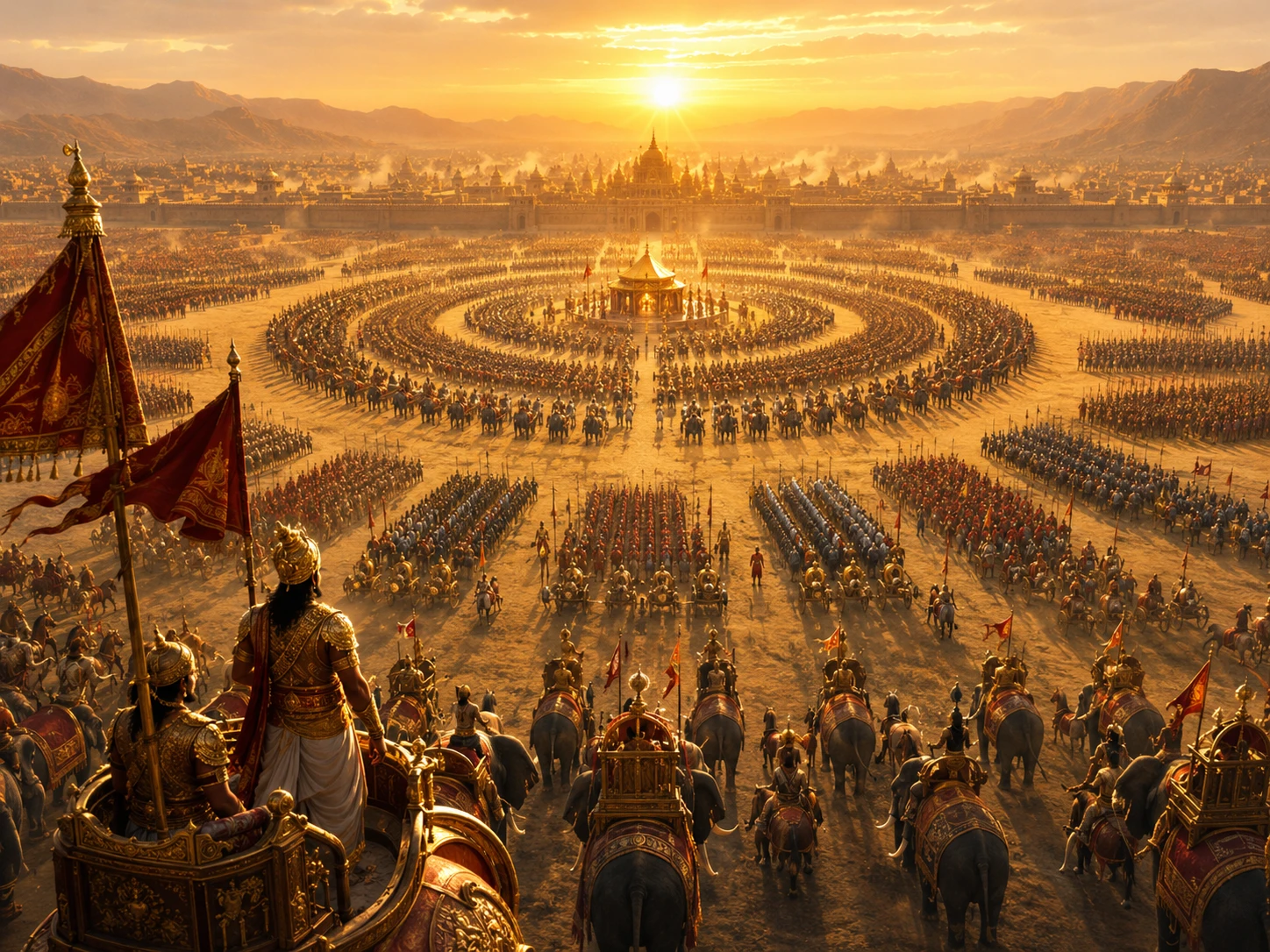
Akshauhini -- The Epic Army Structure Where Every Digit Sums to 18
14 min read
Ancient Indian Martial Arts -- Kalaripayattu to Malla-Yuddha
14 min read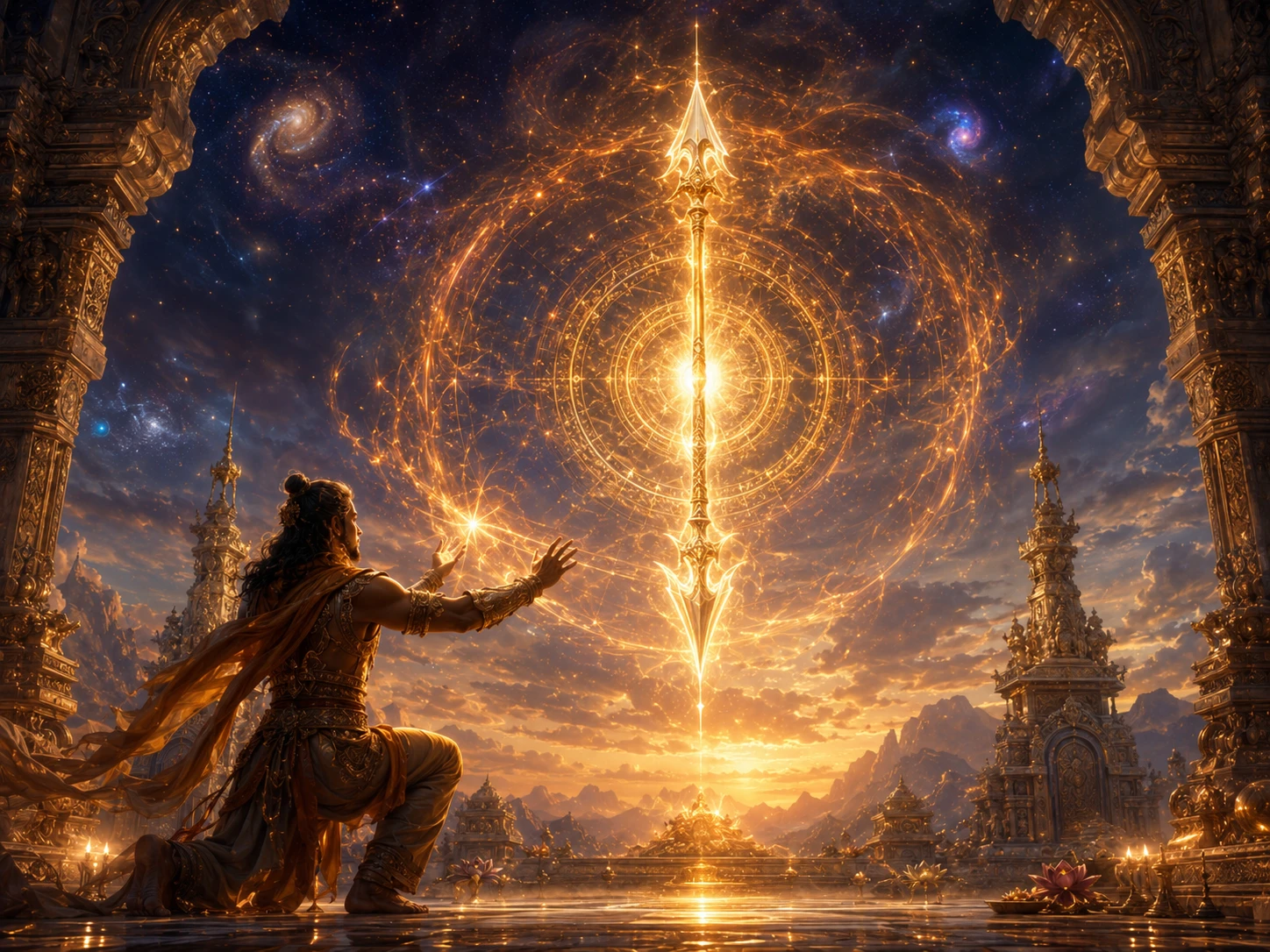
Astra Invocation and Withdrawal -- The Ritual of Weapons
16 min readThe same translation error that turned '33 Koti' into '33 crore' in Hinduism also happened in Buddhism. The Chinese translation of Buddhist texts rendered 'Sapta Koti Buddha' (7 Supreme Buddhas) as '7 Crore Buddhas.' The…
Deities AvatarsCommunity Reflections
🕉️
Be the first to share your reflection.