Venkateswara -- The Lord of Seven Hills and the World's Most Visited God
वेंकटेश्वर -- सप्तगिरि स्वामी और विश्व के सबसे दर्शनीय भगवान
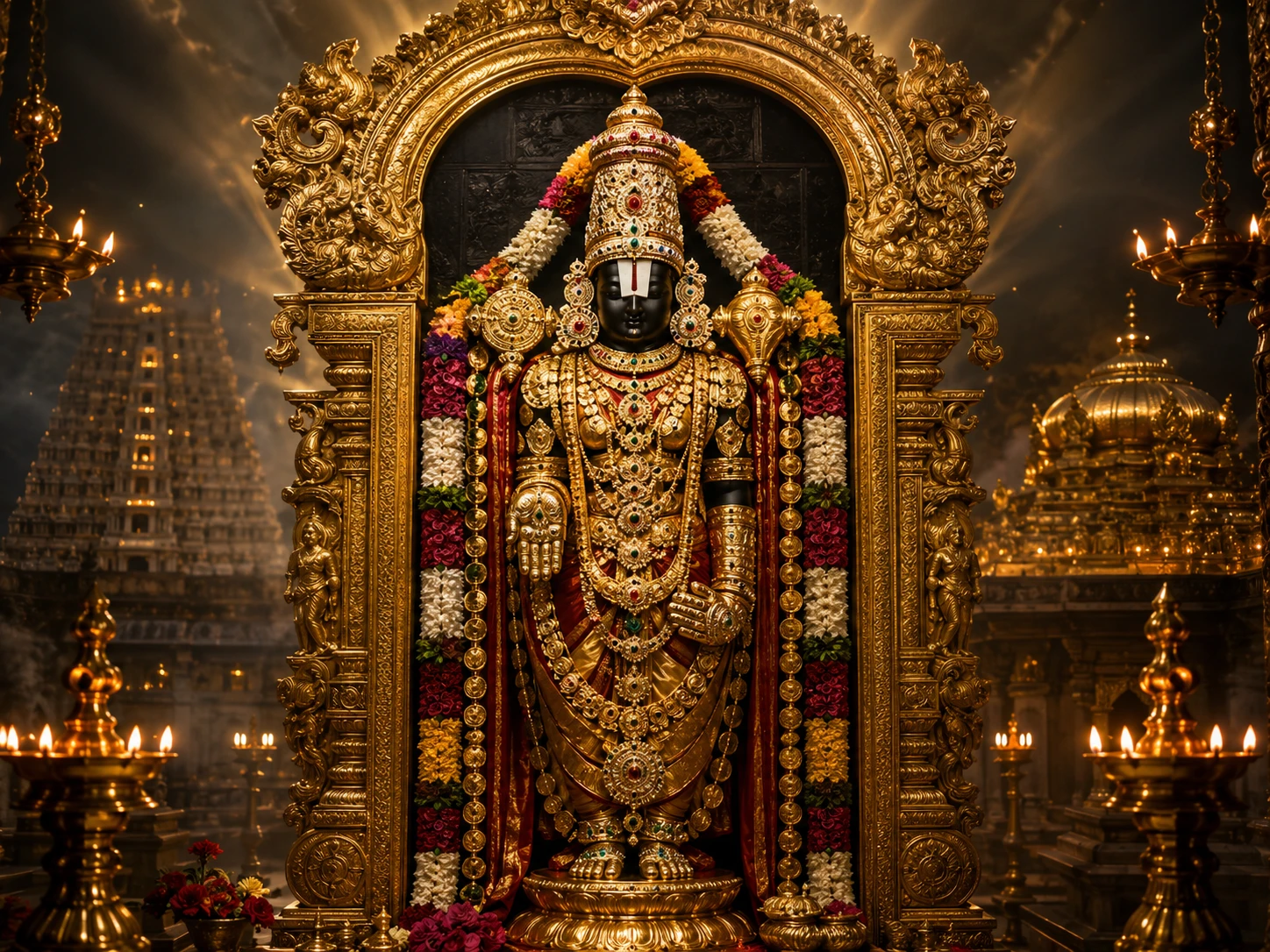
There is a hill in southern Andhra Pradesh where God stands. Not sits, not reclines, not dances -- stands. Upright, arms at his sides, eyes covered with camphor-soaked cloth and then with artificial eyes called Netra Darshana, wearing a diamond-studded crown that weighs over 16 kg, his chest adorned with the Kaustubha gem and the mark of Lakshmi. He has been standing there for, depending on which tradition you follow, somewhere between 1,200 and 5,000 years. And every single day, between 50,000 and 100,000 human beings climb 3,500 steps to see him for approximately 5 to 10 seconds.
This is Venkateswara -- also called Balaji, Srinivasa, Govinda, and Perumal -- the Lord of the Seven Hills of Tirumala. His temple, managed by the Tirumala Tirupati Devasthanams (TTD), is by every measurable metric the most visited and wealthiest religious institution on Earth. The numbers are staggering: an estimated 30-40 million pilgrims visit annually (more than Mecca, more than the Vatican, more than any other religious site). The TTD's annual revenue from donations exceeds Rs 3,000-4,000 crore ($400-500 million). The hundi (donation box) alone collects an estimated Rs 3-5 crore per day. The temple's gold reserves are among the largest of any non-governmental institution in India. The Laddu Prasadam operation produces approximately 300,000 laddus per day -- one of the largest single-product food operations in Asia.
And yet, most non-South-Indian Hindus cannot explain why. What is it about Venkateswara -- a relatively specific regional form of Vishnu, not one of the ten canonical avatars, not the subject of any Bollywood blockbuster -- that draws more daily visitors than any other deity in any religion?
The answer lies in a mythology of debt, a theology of grace, and an institutional model that is, quite simply, the most successful religious enterprise in human history.
कमलाकुचचूचुककुङ्कुमतो नियताऽरुणिताऽतुलनीलतनो। कमलायतलोचन लोकपते विजयी भव वेङ्कटशैलपते॥
kamalākucacūcukakuṅkumato niyatā'ruṇitā'tulanīlatano | kamalāyatalocana lokapate vijayī bhava veṅkaṭaśailapate ||
O Lord of Venkata Hill, whose incomparable dark-blue body is perpetually reddened by the kumkum from the bosom of Kamala (Lakshmi), whose eyes are wide and lotus-like, O Lord of the Worlds -- may you be ever victorious!
— Sri Venkatesha Suprabhatam, Verse (from the Suprabhatam section) -- attributed to Prativadi Bhayankaram Annangaracharya (15th century CE)
The mythology of Venkateswara centres on one of the most unusual concepts in Hindu theology: God is in debt.
According to the Venkatachala Mahatmya and the Sthala Purana of Tirumala, Vishnu incarnated as Srinivasa on the Seven Hills. When he wished to marry Padmavati (a local princess, incarnation of Lakshmi), he needed wealth for the wedding. He borrowed an enormous sum from Kubera, the god of wealth. The loan was so vast that its interest alone would take Kaliyuga (the current cosmic age) to repay. Every donation to the Tirumala temple is understood, in this tradition, as a contribution toward repaying Venkateswara's debt to Kubera. The deity is not merely receiving gifts; he is paying off a cosmic loan -- and every rupee a devotee places in the hundi is helping God clear his credit.
This is brilliant theology disguised as charming mythology. It accomplishes several things at once. First, it makes donation theologically necessary rather than merely virtuous -- you are not just giving to God; you are helping God fulfil his obligation. Second, it creates a relationship of mutual dependence: God needs the devotee's money as much as the devotee needs God's grace. This is not a transactional relationship; it is an intimate one. Third, it explains the temple's extraordinary wealth without triggering the guilt that sometimes accompanies religious riches -- the wealth is not hoarded; it is owed.
The tonsure (head-shaving) tradition at Tirumala is another dimension of this theology of debt and offering. An estimated 20,000-30,000 devotees shave their heads at the Kalyana Katta (tonsure hall) daily, making it the largest tonsure operation in the world. The hair is collected, processed, and sold at international auctions -- generating approximately Rs 200-300 crore annually for the TTD. The hair is primarily purchased by wig manufacturers in the United States, Europe, and East Asia. Your colleague's luxury human-hair wig may well have originated on the Seven Hills of Tirumala.
The theological logic of the tonsure is the logic of surrender: hair is considered one of the most valued aspects of personal appearance (particularly for women, for whom the offering is considered an especially significant sacrifice). By offering it to the deity, the devotee symbolically surrenders their vanity, their attachment to physical beauty, and their ego. The IIT graduate who shaves her head before a placement interview at Tirumala is making a statement: my career is not mine to control; it belongs to Govinda.
The darshan (viewing) experience at Tirumala is engineered for maximum spiritual impact in minimum time. Pilgrims wait in queue for 2-12 hours (depending on the ticket type -- free darshan, Rs 300 special entry, or the Supadham VIP entry). The queue system, managed by TTD with military precision, processes thousands of people per hour through a series of corridors that gradually narrow until, suddenly, the devotee is face-to-face with the deity. The actual viewing lasts approximately 5-10 seconds before TTD employees gently but firmly move the devotee forward. Those 5-10 seconds, after hours of waiting, after climbing 3,500 steps, after travelling from Hyderabad or Chennai or Mumbai or New Jersey -- are described by devotees as among the most intense experiences of their lives.
The Venkatesha Suprabhatam -- the morning wake-up hymn sung to Venkateswara at 3:00 AM every morning before the temple opens -- is one of the most frequently recited devotional compositions in South India. Composed by Prativadi Bhayankaram Annangaracharya (15th century), it is broadcast on loudspeakers, played on radio stations, and chanted in homes across Tamil Nadu, Andhra Pradesh, Telangana, and Karnataka. For many South Indian families, waking up to the Suprabhatam is as culturally embedded as waking up to an alarm clock.
Tirumala by the Numbers -- The World's Most Visited Temple
| Metric | Data | Context |
|---|---|---|
| Daily Visitors | 50,000-100,000 | More than the Vatican on most days |
| Annual Visitors | 30-40 million | More than Mecca (2-3 million for Hajj) |
| Annual Revenue (Donations) | Rs 3,000-4,000 crore ($400-500M) | Exceeds the GDP of several small nations |
| Daily Hundi Collection | Rs 3-5 crore ($350,000-600,000) | One of the largest daily cash collections on Earth |
| Daily Laddu Production | ~300,000 laddus | One of Asia's largest single-product food operations |
| Daily Tonsures | 20,000-30,000 | Largest tonsure operation in the world |
| Annual Hair Revenue | Rs 200-300 crore ($25-35M) | Sold at international auctions to wig manufacturers |
| Temple Staff | ~16,000 employees | Larger than many Indian companies |
| Gold Reserves | Estimated 7,000-9,000+ kg | Among the largest non-governmental gold reserves in India |
| Queue Wait Time | 2-12 hours (free darshan) | 5-10 seconds of actual deity viewing |
The TTD operates its own bus fleet, hotels, hospitals, educational institutions, and cow shelters. It runs one of the largest free meal (anna prasadam) operations in the world, feeding approximately 100,000 pilgrims daily. It is, by any corporate metric, one of the most efficiently managed institutions in India.
The theological significance of Venkateswara extends well beyond the temple's impressive economics. In Sri Vaishnava theology, Venkateswara represents Vishnu's supreme act of accessibility -- God choosing to stand on a hilltop, visible and reachable to anyone willing to climb.
The Alvar saints -- the twelve Tamil poet-saints of the 7th-10th century CE who are considered the founders of Sri Vaishnavism -- sang extensively about Tirumala. Tirumangai Alvar, Kulasekhara Alvar, and others composed pasurams (devotional verses) about the Lord of the Seven Hills that are still recited in the temple's daily rituals. The Naalayira Divya Prabandham (the 4,000 hymns of the Alvars) includes multiple sections dedicated to Venkateswara, establishing his theological importance in the Tamil Vaishnava canon alongside Srirangam's Ranganatha and Kanchipuram's Varadaraja.
Ramanujacharya (1017-1137 CE), the founder of Vishishtadvaita Vedanta and the most important philosopher of Sri Vaishnavism, had a significant connection to Tirumala. He reorganised the temple's administration, established the ritual procedures that are still followed today, and is credited with resolving a theological dispute about whether the deity was Shaiva or Vaishnava (he established that the deity is Vishnu in his Venkateswara form). The Jeeyar tradition -- a lineage of Sri Vaishnava monastic leaders -- continues to this day, with the current Jeeyar maintaining spiritual authority over the temple's religious practices.
The political economy of Tirumala is a subject that deserves its own article but cannot be ignored here. The TTD is governed by an executive officer appointed by the Andhra Pradesh state government, making it effectively a government-administered religious institution -- a status that generates continuous controversy. The temple's annual budget (approximately Rs 3,500 crore) is larger than the budgets of many Indian districts. The TTD's investments include fixed deposits, gold, and real estate. It funds hundreds of schools, colleges, hospitals, and charitable programmes across India. When Andhra Pradesh was bifurcated in 2014 to create Telangana, the question of which state would control the TTD was among the most politically sensitive issues in the reorganisation.
For the software engineer in Hyderabad who drives four hours to Tirumala on a Friday night, stands in queue until dawn, sees the deity for seven seconds, and drives back feeling that everything in his life will be okay. For the grandmother from Guntur who has visited 47 times and plans to make it 50 before she dies. For the NRI family from Texas who schedules their India trip around Tirumala darshan and ships six boxes of Tirumala Laddus back to Houston in their checked luggage. Venkateswara is not a philosophical abstraction. He is, for approximately 40 million people every year, the most real thing in the universe -- a god who stands on a hill, who owes money to another god, whose eyes you cannot see directly, and who will give you everything if you are willing to climb.
The cultural impact of Venkateswara on South Indian life -- and increasingly on pan-Indian and global Hindu life -- is difficult to overstate.
The phrase 'Govinda Govinda' -- the call that pilgrims chant as they climb the 3,500 steps to Tirumala -- has become a cultural shorthand for struggle, perseverance, and the promise of divine reward at the end of effort. When an Andhra Pradesh farmer starts his new crop season, he says 'Govinda Govinda.' When a Telugu family moves into a new house, the first visit is to Tirumala. When a software engineer in Hyderabad gets a US visa, the first call after the embassy is to schedule a Tirumala trip for thanksgiving. The deity has become the default address for gratitude, petition, and life transition across all of South India.
The Tirupati Balaji brand -- if one may use such a commercial term for a divine institution -- is the most recognised Hindu religious brand in the world. The TTD's Laddu has a GI tag. The Suprabhatam is on every devotional playlist. The image of Venkateswara -- dark-faced, diamond-crowned, with the distinctive Urdhva Pundra (vertical Vaishnavite tilak) -- is recognisable to virtually every Indian. ISKCON temples worldwide install Radha-Krishna or Jagannath as their primary deities, but TTD's influence has ensured that Venkateswara murtis are now found in Hindu temples from Singapore to London to San Jose.
The temple's influence on Andhra Pradesh and Telangana politics is enormous. Chief Ministers routinely visit for darshan during crises. The appointment of the TTD Executive Officer is a politically sensitive decision that signals the ruling party's relationship with the Hindu establishment. During elections, promises related to Tirumala -- free bus services for pilgrims, expansion of queue facilities, increased anna prasadam distribution -- are standard campaign pledges.
The economic ripple effect extends well beyond the temple itself. The town of Tirupati (at the foot of the hills) is a significant economic centre driven almost entirely by religious tourism: hotels, restaurants, flower shops, prasadam packaging units, travel agencies, and auto-rickshaw services all exist because of the temple. An estimated 300,000-500,000 people in the Tirupati-Tirumala region derive their livelihoods directly or indirectly from the temple economy.
For the UPSC aspirant studying at the British Council Library in Hyderabad who takes a break every two months to visit Tirumala, not as superstition but as a rhythm of renewal. For the NRI physician in New Jersey who flies to India once a year specifically for darshan and considers it the most important medical consultation of his year -- the one where he checks the health of his soul. For the 73-year-old Brahmin priest who has performed the Suprabhatam seva every morning at 3 AM for forty years and considers it not a job but a relationship. Venkateswara is not a tourist destination. He is a gravitational field -- a point in space-time around which millions of lives orbit, year after year, generation after generation, with no sign of the orbit decaying.
The institutional model of the TTD deserves examination because it is, quite simply, the most successful religious management system ever devised.
The TTD employs approximately 16,000 people -- more than many mid-size Indian companies. It operates a fleet of buses that transport pilgrims from Tirupati town to Tirumala. It runs the SVBC (Sri Venkateswara Bhakti Channel), a 24/7 devotional television channel. It manages guest houses and cottages on the hills with a total capacity of over 25,000 pilgrims per night. It runs multiple hospitals, engineering colleges, degree colleges, and schools. It operates cow shelters (goshalas) that maintain over 5,000 cattle. It funds charitable initiatives across India, from feeding programmes to wedding assistance for economically weaker families.
The queue management system at Tirumala is studied as a case study in operations management at business schools. On peak days, the temple processes up to 100,000 visitors through a single inner sanctum that measures approximately 5x5 metres. The queue is a serpentine system spanning multiple floors of a dedicated building (Vaikuntam Queue Complex), with compartments, time slots, electronic displays, and TTD staff managing flow. Devotees are sorted by ticket type: free darshan (Sarva Darshan), paid special entry (Rs 300), and VIP Supadham darshan. The entire system operates with remarkable efficiency -- though 'efficiency' may seem a strange word to apply to an experience that involves a 6-hour wait for a 7-second glimpse of God.
The Tirumala Laddu is the most famous prasadam in Hinduism and a protected intellectual property. The recipe, which the TTD guards carefully, involves a specific ratio of Bengal gram flour (besan), sugar, cashew nuts, cardamom, raisins, and ghee prepared from cow's milk. The laddus are prepared in massive kadais (cooking vessels) by dedicated teams of cooks who work in shifts around the clock. Each laddu is individually stamped with a TTD seal. The quality control is rigorous -- any laddu that fails to meet weight, texture, or taste standards is rejected. The entire operation has been certified by food safety agencies and is regularly audited.
The hair auction is another institutional innovation. The hair offered by tonsured devotees is collected, cleaned, sorted by length and quality, and auctioned to international buyers. The primary market is the global human-hair wig industry, with buyers from Italy, China, the United States, and Southeast Asia bidding for Tirumala hair, which is considered among the highest quality in the world because Indian devotees generally do not chemically treat their hair. The annual hair auction generates Rs 200-300 crore, making it one of the TTD's most significant revenue streams after direct donations.
The TTD's model has been studied by religious institutions worldwide. The Vatican, Mecca's Hajj administration, and Buddhist temple management systems in Thailand and Japan have all looked at the TTD as a benchmark for managing large-scale religious pilgrimage. No other religious institution manages the combination of daily visitor volume, annual revenue, food production, queue management, and charitable outreach that the TTD achieves -- and it does so year after year, decade after decade, with a deity who has been standing in the same spot for over a millennium.
For the management consultant who is asked 'What is the best-run institution in India?' -- the answer is not Infosys, not TCS, not the Indian Railway. The answer, by virtually every operational metric, is the Tirumala Tirupati Devasthanams. It is the only institution in India that has operated continuously for over 1,000 years, serves over 100,000 customers daily, generates over $400 million in annual revenue, and maintains a customer satisfaction rate that no corporation on Earth can match. Because when the customer leaves, they are not satisfied. They are blessed.
The Tirumala Laddu -- officially called 'Srivari Laddu' -- received a Geographical Indication (GI) tag in 2009, making it a legally protected product like Champagne or Darjeeling tea. Each laddu weighs approximately 175 grams and is made with Bengal gram flour, sugar, cardamom, cashews, and ghee. The daily production of 300,000 laddus requires approximately 10,000 kg of ghee, 6,000 kg of sugar, and 4,000 kg of gram flour. The TTD's laddu kitchen operates 24 hours a day and employs hundreds of cooks. Meanwhile, the Venkateswara deity is bathed (abhishekam) with specific substances on specific days: milk on Monday, curd on Tuesday, sandalwood paste on Wednesday, and so on. The most spectacular abhishekam occurs during Brahmotsavam (the nine-day annual festival in September-October), when the deity is adorned with different alankara (decorative costume) each day -- from the Shankha-Chakra-Nama Alankaram to the Mohini Alankaram -- drawing over a million additional visitors. And the TTD's annual report is a public document: for anyone who wants to see how a divine institution manages its budget, it is available for download -- making Venkateswara possibly the only god in any religion whose financial statements are published annually.
Recite the Venkatesha Suprabhatam
Wake with the dawn hymn sung to Lord Venkateswara at Tirumala every morning before daybreak -- one of the most beloved devotional compositions of South India. It is on Eternal Raga with its meaning.
Tags
Eternal Raga · शाश्वत राग
Institutional voice — scholarly articles on Sanatan Dharma
Deepen Your Understanding
अपनी समझ और गहरी करें
deities avatars
Lakshmi -- Beyond Wealth, the Goddess Who Refuses to Stay
India lights 300 million diyas on Diwali night for a goddess whose central teaching is that wealth is not meant to be hoarded. Lakshmi is the most worshipped and most misunderstood deity in Hinduism -- she represents not money but the flow of abundance, and the moment you try to trap her, she leaves.
deities avatars
Trimurti -- Brahma, Vishnu, Shiva and the Three-Act Play of the Cosmos
The universe has three jobs: it must be created, maintained, and destroyed. Hinduism assigns each job to a god -- Brahma the creator, Vishnu the preserver, Shiva the destroyer -- and then does something no other religion has dared: it worships the destroyer as enthusiastically as the creator. That is the Trimurti, and it is Hinduism's most revolutionary idea about how reality works.
deities avatars
Jagannath -- Lord of the Universe, the Deity Without Hands and the World's Oldest Chariot Festival
He has no fingers, no feet, no sculpted facial features -- just enormous circular eyes on a flat wooden face. He is the most 'unfinished' deity in Hinduism, and he is worshipped by more people than almost any other form of Vishnu. The Jagannath temple in Puri is one of the four Char Dham, his Rath Yatra is the origin of the English word 'juggernaut,' and his theology breaks every rule of Hindu worship including caste -- at Jagannath's table, everyone eats together.
deities avatars
Narayana -- Cosmic Vishnu Beyond Avatara
Before Krishna lifted Govardhan and Rama crossed the ocean, there was Narayana lying on the serpent Ananta in the milk ocean. The avatars come and go. Narayana remains. This is the theological Vishnu at the base of every Vaishnava tradition, from Ramanuja's Sri Vaishnavism to the Badrinath pilgrimage to the Ashtakshari mantra every devotee chants.
deities avatars
Dashavatara -- Why Vishnu Comes Back Ten Times
Fish, tortoise, boar, half-lion, dwarf, axe-warrior, prince, cowherd, enlightened teacher, future horseman. The ten avatars of Vishnu are not random folklore. Read them in sequence and you get something startling -- a narrative that mirrors evolutionary biology, tracks the rise and fall of political systems, and argues that God does not sit above history but enters it, gets dirty, and does the work. The Dashavatara is Hinduism's answer to the question every civilisation asks: why does the world keep breaking, and who fixes it?
The Tirumala Laddu -- officially called 'Srivari Laddu' -- received a Geographical Indication (GI) tag in 2009, making it a legally protected product like Champagne or Darjeeling tea. Each laddu weighs approximately 175 …
More in Deities & Avatars
33 Koti Devata -- Why Hinduism Has 33 Types of Gods, Not 33 Crore
13 min read
Agni -- The Fire God
19 min read
Annapurna -- Goddess of Food
19 min readThe same translation error that turned '33 Koti' into '33 crore' in Hinduism also happened in Buddhism. The Chinese translation of Buddhist texts rendered 'Sapta Koti Buddha' (7 Supreme Buddhas) as '7 Crore Buddhas.' The…
Deities AvatarsCommunity Reflections
🕉️
Be the first to share your reflection.