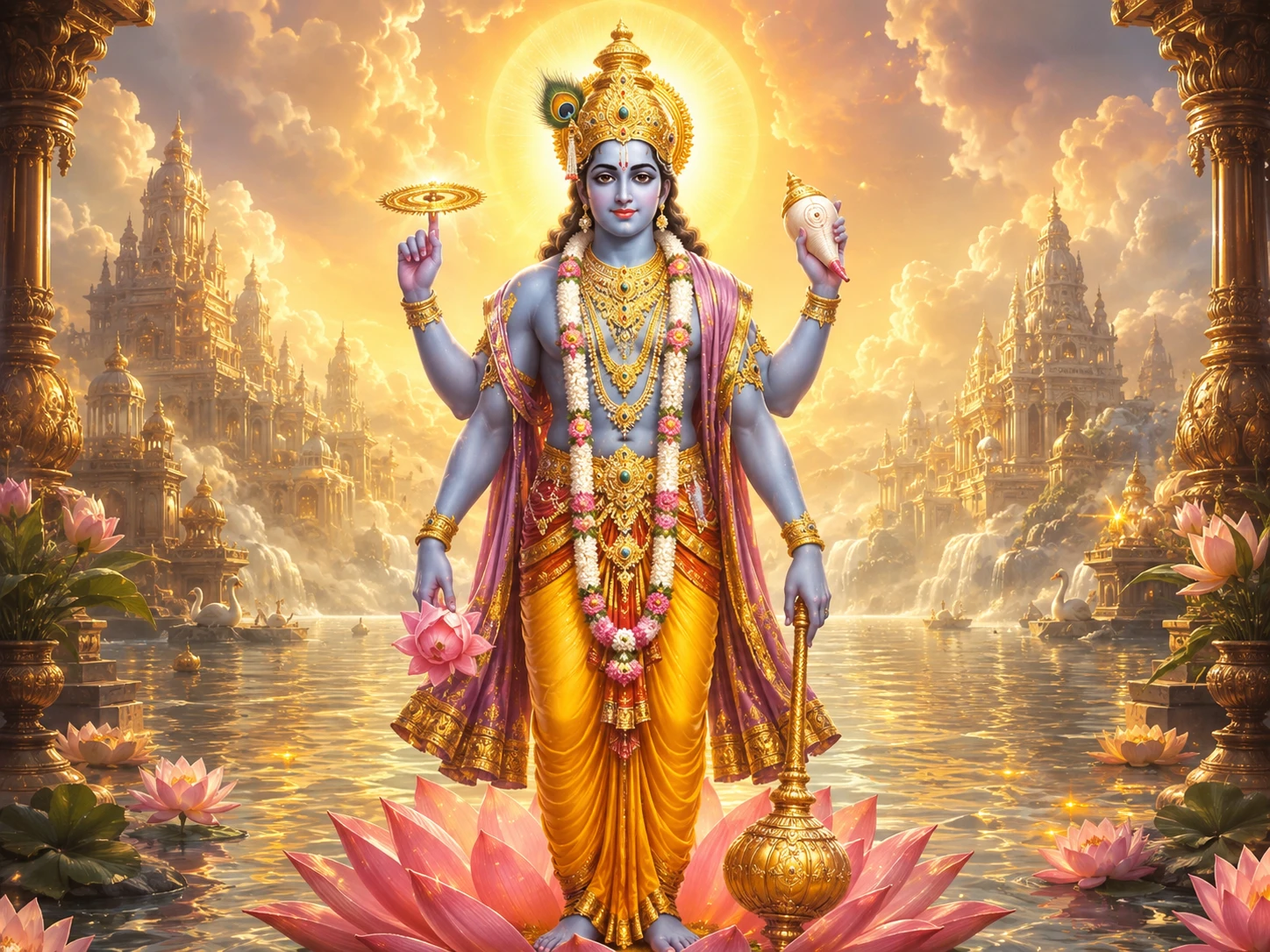
Narayana -- Cosmic Vishnu Beyond Avatara
नारायण -- अवतारों से परे ब्रह्माण्डीय विष्णु
On Srirangam island in Tamil Nadu, where the Kaveri and the Kollidam rivers divide around a strip of land about three kilometers long, stands the Ranganathaswamy Temple -- the largest functioning Hindu temple complex in the world by enclosed area, covering 156 acres within seven concentric walls. In the inner sanctum of this vast city-within-a-town lies a single black stone image roughly six meters long. The deity is reclining on his right side, his head resting on his right hand, his body stretched along the coils of a five-headed serpent. His eyes are half-closed. This is Ranganatha, a specific form of Narayana, and he has been lying in this posture on this island for at least two thousand years. Every devotee who enters Srirangam understands at a glance what the iconography is showing: Vishnu in his original cosmic form, before any avatar, before Krishna or Rama or Varaha, lying on the serpent Ananta on the cosmic milk ocean. This is not a god who acted in history. This is the god of whom history is a single long unfolding.
The name Narayana itself carries deep theological meaning. The Manu Smriti gives an etymology (1.10): apo nara iti prokta apo vai narasunavah, tah ayanam purvam tasya tena narayanah smritah. 'The waters are called nara, because they are the progeny of Nara; since the waters were his first ayana (resting place), he is therefore remembered as Narayana.' A second reading from the Mahabharata's Shanti Parva takes nara to mean 'the human' or 'the soul' -- Narayana is then 'the one whose ayana (abode) is within all souls.' Both etymologies appear side by side in classical Vaishnava commentary and are treated as complementary. The first is cosmological: Narayana is the one who rests on the primordial waters out of which the universe emerges. The second is psychological: Narayana is the one who rests within every sentient being as the antaryamin, the inner witness. The Bhagavad Gita opens chapter ten with Krishna's statement that he is the self seated in the heart of every being. That statement is a direct gloss on the second etymology of Narayana.
सहस्रशीर्षं देवं विश्वाक्षं विश्वशम्भुवम् । विश्वं नारायणं देवमक्षरं परमं पदम् ॥१॥
sahasraśīrṣaṃ devaṃ viśvākṣaṃ viśvaśambhuvam | viśvaṃ nārāyaṇaṃ devam akṣaraṃ paramaṃ padam ||1||
The deity of a thousand heads, whose eyes are everywhere, who is the source of well-being for all; the cosmic Narayana, the imperishable, the highest goal.
— Narayana Suktam, Mahanarayana Upanishad (Taittiriya Aranyaka 10.13), Verse 1
The relationship between Narayana and Vishnu is one of the most important theological questions in Hindu thought. In popular usage they are often treated as synonymous: both refer to the same deity. But in the high Vaishnava traditions, specifically in the Pancharatra Agama and the Sri Vaishnava theology developed by Ramanuja, a finer distinction is drawn. Narayana is the supreme reality as such, the para-brahman, and Vishnu is his first manifestation in the universe. Narayana without Vishnu is the absolute in stillness; Vishnu without Narayana is impossible because he has no ground. The Puranas describe the relationship with a specific image: at the start of each cosmic cycle, Narayana lies in yoga-nidra (cosmic yogic sleep) on the serpent Shesha in Kshira Sagara. From his navel a lotus arises, bearing Brahma, who then begins the work of creation. During the cycle, Vishnu is the preserver active within the world. At its end, everything dissolves back into Narayana. The cycle repeats. Vishnu operates. Narayana abides.
The shayana murti -- the reclining form -- is the iconographic signature of Narayana. Beyond Srirangam, major shayana shrines exist at Thiruvananthapuram's Padmanabhaswamy Temple in Kerala, at Thiruvattar, Thirunanguru, and several other Divya Desam sites in South India; at Ananta Vasudeva in Bhubaneswar, Odisha; at Vaikuntha Perumal in Kanchipuram; and in temple panels across almost every medieval Chola, Pallava, and Hoysala shrine. The image shows Narayana lying on the thousand-hooded serpent Ananta-Shesha, whose coils float on the milk ocean. Lakshmi, the consort, is usually shown seated near his feet, massaging them. Brahma emerges from the lotus at Narayana's navel. The demons Madhu and Kaitabha sometimes appear rising from Narayana's ears, preparing to attack Brahma, forming the narrative moment of the Madhusudana episode. The whole image is a compressed cosmology. It says: consciousness rests. Time coils. Matter floats. Creation begins from within the creator, not outside him. This is what the shayana murti shows, and the entire Vaishnava tradition of meditation on it has developed over fifteen centuries.
The Five Manifestations of Narayana (Pancharatra Theology)
| Form | Meaning | Context |
|---|---|---|
| Para / पर | The supreme transcendent form in Vaikuntha. / वैकुंठ में परम लोकातीत रूप। | Narayana in his highest abode, beyond time. / काल से परे नारायण का उच्चतम धाम। |
| Vyuha / व्यूह | The four-fold emanation for creation. / सृष्टि के लिए चतुर्गुण प्रवाह। | Vasudeva, Sankarshana, Pradyumna, Aniruddha. / वासुदेव, संकर्षण, प्रद्युम्न, अनिरुद्ध। |
| Vibhava / विभव | Descent into the world as avatara. / अवतार रूप में संसार में अवतरण। | Matsya, Kurma, Varaha, and the rest. / मत्स्य, कूर्म, वराह, और शेष। |
| Antaryamin / अंतर्यामी | The inner witness within every soul. / हर आत्मा के भीतर का अंतःसाक्षी। | The deity as the indweller of all beings. / सभी प्राणियों के भीतर निवास करते देवता। |
| Archa / अर्चा | The ritual image in the temple. / मंदिर की अनुष्ठानिक मूर्ति। | Narayana accepting worship in physical form. / भौतिक रूप में भक्ति स्वीकार करते नारायण। |
This fivefold scheme is foundational to the Pancharatra Agama and was systematized in Ramanuja's Sri Bhashya. It provides a theological bridge between abstract absolute and devotional temple worship.
The Alvars, twelve poet-saints of Tamil Nadu between roughly the sixth and the ninth centuries of the Common Era, transformed Narayana-worship into a popular devotional movement that reshaped South Indian religion. Their four thousand verses, known collectively as the Nalayira Divya Prabandham, are often called the Tamil Veda. The Alvars include Nammalvar, the pre-eminent poet whose Tiruvaymoli of 1102 verses is treated by Sri Vaishnavas as equivalent in authority to the Chhandogya Upanishad; Andal, the only woman Alvar, whose Tiruppavai is recited by millions of Tamil women in the month of Margazhi each winter; Thirumangai Alvar, a former brigand turned devotee; and Periyalvar, the father of Andal. The Alvars established the list of 108 Divya Desams, the sacred sites associated with Narayana worship across India, including Sri Rangam, Tirupati, Badrinath, Mathura, Dvaraka, and Naimisharanya. Ramanuja in the eleventh century formalized the theology that these poets had sung. Without the Alvars, there would be no Sri Vaishnavism. Without Sri Vaishnavism, Narayana-worship in South India would be a different and much smaller phenomenon.
At Badrinath in Uttarakhand, at an altitude of 3,133 meters on the bank of the Alaknanda river, stands the Badrinarayan Temple. The site is open for darshan only six months a year, from the end of April to the beginning of November, because heavy snow makes the approach impossible through winter. On the closing day, called Vijaya Dashami or later, the main priest performs a ceremony in which the temple is sealed for six months. During those six months, Hindu tradition holds that Narada, the celestial sage, personally conducts the puja inside the sealed sanctum. When the doors reopen in spring, a ghee lamp is found still burning and fresh flowers lie at the deity's feet. The tradition is sustained by the local Rawal priest's testimony every year and is a matter of faith; its empirical details are not independently verified. What is verified is that the temple itself sits at the exact location where, according to the Mahabharata, Nara and Narayana, the twin rishis, performed tapas for thousands of years. In Hindu cosmology, Narayana and Nara are the twin forms of the deity -- Narayana as God, Nara as the human soul in perfect union with God.
Ramanuja (1017-1137 CE), the acharya of Sri Vaishnavism, built the most comprehensive theological system addressed to Narayana. His Vishishtadvaita, 'qualified non-dualism,' holds that the individual soul and the material world are real but are modes (prakara) of the one supreme reality, Narayana. This position sits between Shankara's Advaita, which holds that only Brahman is ultimately real, and Madhva's Dvaita, which holds that the soul and God are eternally distinct. Ramanuja's Sri Bhashya, his commentary on the Brahma Sutras, argues the Vishishtadvaita position verse by verse. His Gita Bhashya rereads the Bhagavad Gita as a manual for surrender to Narayana. His Sharanagati Gadya is a short Sanskrit poem in which he formally takes refuge at the feet of Narayana and Lakshmi at Srirangam on behalf of all beings. This act of prapatti -- total surrender -- is the central practice of Sri Vaishnavism to this day. A Sri Vaishnava devotee in Chennai who recites the Sharanagati Gadya in 2026 is joining a ritual chain that has operated continuously for nine centuries. The Ramanuja-Narayana bond is not dispersed. It is concentrated in a single temple, a single lineage, a single text.
Madhva (1238-1317 CE), born in coastal Karnataka and founder of the Dvaita or Tattvavada school, developed a different theology of Narayana. For Madhva, Narayana (whom he often addresses as Hari or Vishnu) is the supreme personal god, eternally distinct from every individual soul and from matter. The soul is not identical to Narayana, not a mode of him, but permanently separate and dependent on him. Liberation (moksha) is not merger into Narayana but eternal devotional relationship with him in Vaikuntha. Madhva's theology is strikingly personal: the devotee and the deity remain forever two, and the highest spiritual state is not the collapse of difference but its perfection. The Madhva sampradaya established major mathas at Udupi in coastal Karnataka, where the Krishna temple draws thousands of pilgrims every day. The Dvaita tradition has produced distinguished scholars -- Jayatirtha, Vyasatirtha, Raghavendra Swami -- and remains active in Karnataka, coastal Andhra, and Maharashtra. For a Kannada Madhva family in 2026, Narayana is not a distant abstraction. He is a specific presence whom they address daily by name and whom they never confuse with themselves.
The Ashtakshari mantra -- om namo narayanaya, 'om, salutation to Narayana' -- is the eight-syllable mantra at the centre of Sri Vaishnava practice, but it is also widely chanted across all Vaishnava traditions and by non-sectarian Hindus. It is the one mantra that Sri Vaishnava acharyas traditionally give at initiation, and its eight syllables are read theologically as containing the essence of the Vedanta. The Narada Bhakti Sutras and the Ahirbudhnya Samhita both describe methods of ashtakshari japa. A typical Sri Vaishnava devotee will recite the mantra 108 times in the morning on a tulsi mala and again 108 times in the evening. A less formal practice is simply to say om namo narayanaya three times before beginning any important action -- a long drive, an examination, a surgery, a business negotiation. The name of Narayana is understood to enter the situation before the situation begins, and to remain after it ends. The mantra is not geographic and not sectarian. A Telugu Reddy family in Hyderabad, a Tamil Iyengar family in Chennai, a Marathi Deshastha family in Pune, a Gujarati Vaishnav family in Ahmedabad, and a Hindi-speaking Jain family in Delhi can all chant it without any theological adjustment.
The Narayana theology has a specific environmental dimension that has become important in contemporary Hindu discourse. The deity lies on the serpent Shesha, whose name means 'remainder' -- what is left over when all else has dissolved. Shesha himself rests on the milk ocean, Kshira Sagara, which is understood in older cosmology not as literal milk but as the primordial field of all possibility before form emerges. In the image, Narayana does not stand apart from nature. He is embedded in it. The ocean, the serpent, the lotus from his navel, the earth receiving the lotus -- these form one continuous reality, and the deity is the consciousness within it rather than a sovereign above it. Several contemporary Hindu environmental movements, including the Vrindavan-based Green Krishna initiative and the Swami Vivekananda Ashrama's water conservation work in coastal Karnataka, draw on this reading. Narayana as antaryamin of every being implies that protecting biodiversity is a form of Narayana-seva. The claim is not that environmentalism is scriptural, but that the Narayana tradition offers a theological grounding for it that does not require importing concepts from outside. The shayana murti has always been telling the reader that the deity lies in the water, not above it.
For someone beginning a Narayana practice without a Sri Vaishnava guru, the entry point is the Ashtakshari. Sit at any time of the day. Take three slow breaths. Begin the mantra: om namo narayanaya. Repeat it 108 times on a tulsi mala or on the counter beads. Sit in silence for two minutes afterward. Do this once a day for forty days. At the end of forty days, observe what has changed. The tradition holds that the first effect of Ashtakshari japa is the gradual settling of mental agitation; the second is the deepening capacity to remain steady when difficult circumstances arise; the third, reached after years rather than weeks, is the direct experience of Narayana as the antaryamin within one's own heart. The first two effects are verifiable. The third is a matter of faith and practice. No acharya claims that the third comes quickly or automatically. What every acharya agrees on is that the mantra itself is sufficient -- it does not need to be supplemented by visualization, breath counting, or any other technique. The Sri Vaishnava position is unambiguous: begin the mantra, and the mantra will teach you everything else.
The Padmanabhaswamy Temple in Thiruvananthapuram, Kerala, is the shayana shrine that became globally famous for a reason outside theology: in 2011, a Supreme Court-appointed committee opened sealed vaults in the temple and documented treasures estimated at more than one lakh crore rupees, making it by some measures the richest religious institution in the world. The vault openings revealed gold ornaments, precious stones, crowns, and ritual objects accumulated over centuries from the rulers of the former princely state of Travancore, which held a specific relationship with Narayana. The Travancore maharajas, since 1750, have formally ruled the kingdom as padmanabha dasa, servants of Padmanabhaswamy, with the deity considered the actual sovereign. The current scion of the family, Moolam Thirunal Rama Varma, continues to hold the hereditary title. This specific form of political-religious integration is distinctive. In most Indian kingdoms, the deity was a patron of the king. In Travancore, the deity was the king, and the human ruler his minister. The arrangement survived the end of princely India in 1947 and remains a matter of contentious legal dispute about temple governance to the present. The Kerala state government, the royal family, and the temple trust continue to negotiate the relationship.
The Salagram stone, found only in the bed of the Kali Gandaki river in Nepal, is worshipped across India as a natural murti of Narayana that requires no consecration. The stone is a black ammonite fossil with a spiral opening, and Vaishnava tradition identifies the spiral as the chakra of Vishnu inscribed in stone by nature itself. A traditional orthodox Vaishnava household in Tamil Nadu, Andhra, Karnataka, or Maharashtra will keep a single salagram in the daily puja shelf, and that salagram is the family's primary deity. No temple visit is required. The salagram receives three offerings per day: morning bath, midday food, evening arati. Unlike most Hindu murtis, the salagram is not made. It is found. A Kathmandu-based trader who supplies salagrams to families across the Indian subcontinent follows ancient protocols about how the stone is collected, packaged, and dispatched. The salagram tradition predates temple Vaishnavism by several centuries and has survived all the sectarian reorganizations that followed. It remains perhaps the purest form of Narayana worship available to the ordinary householder, requiring no priest, no initiation, no temple, and no elaborate infrastructure.
The Gaudiya Vaishnava tradition founded by Chaitanya Mahaprabhu in sixteenth-century Bengal takes a different approach to Narayana. Chaitanya and his followers held that Krishna, specifically the Krishna of Vrindavan playing with the gopis, is the original supreme person, and that Narayana of Vaikuntha is Krishna in his majestic aishvarya aspect. The relationship is inverted: Vaikuntha-Narayana is the formal expression of Vrindavan-Krishna. This theological move is presented in Rupa Goswami's Bhakti Rasamrita Sindhu and Jiva Goswami's Bhagavat Sandarbha, the foundational texts of Gaudiya theology. For a Gaudiya practitioner, the Ashtakshari mantra is still chanted, but the primary mantra is the sixteen-word maha-mantra: Hare Krishna Hare Krishna Krishna Krishna Hare Hare, Hare Rama Hare Rama Rama Rama Hare Hare. The Gaudiya tradition spread first across Bengal and Odisha, then through the ISKCON movement founded by Srila Prabhupada in 1966, to become the most visible Vaishnava school in the English-speaking world. A Hare Krishna chanter at Alchemy in Khan Market, Delhi, or at the Akshay Patra kitchen in Bengaluru, is working within a specific theological understanding that repositions Narayana while keeping him central. The repositioning is not a rejection. It is a rereading.
The four feet of Lord Padmanabha are sometimes called the four feet of dharma in classical commentary. Each of Narayana's feet is said to uphold one of the four pillars on which the moral order of the universe rests: truth, tapas, compassion, and purity. When any of these four declines, dharma weakens, and Narayana withdraws a foot. The Bhagavata Purana describes Kali Yuga as the age in which three of the four feet have been folded up, leaving dharma to stand on one foot alone -- the foot of truth, which holds even now. This allegorical reading is found in the first canto of the Bhagavata and is referenced across Vaishnava commentary. It is offered not as a literal zoology of the deity's anatomy but as a conceptual framework for understanding historical cycles. In the classical scheme, Satya Yuga has dharma standing on all four feet, Treta Yuga on three, Dvapara Yuga on two, and Kali Yuga on one. Contemporary Vaishnava teachers use this framework to discuss moral decline in public life, corporate behaviour, family structure, and environmental stewardship. The four-feet-of-dharma reading is probably the most accessible theological map Hindu thought offers for diagnosing a social condition without falling into either nostalgia or despair.
Narayana as a theological concept has outlived every political regime that has ruled India. The Sri Rangam temple has been sacked, rebuilt, occupied by the Delhi Sultanate in 1323, recaptured by Vijayanagara forces around 1371, contested again, and yet the deity has been in continuous worship for at least two thousand years. The 108 Divya Desams have survived drought, famine, colonial taxation, post-Independence temple disputes, and the recent tensions around the Archaka Reform Act in Tamil Nadu. Every regime passes. The shayana murti remains. This quality of endurance is itself part of what Narayana means in the tradition. The deity who lies on the serpent is not a king to be deposed. He is the stable ground on which every kingdom rises and falls. A Bengaluru technology founder who loses her startup in a difficult Series B round may find the Ashtakshari more useful in that moment than a dozen motivational videos, because the mantra points to the only thing that does not change when circumstances do. Whether this is taken as literal theology or as a pragmatic psychological observation, the claim is the same: something in the Narayana image, something in his name, refuses to be washed away by the rise and fall of worldly events. The tradition calls this akshara -- the imperishable.
Chant Om Namo Narayanaya
Chant the Ashtakshari, Om Namo Narayanaya, 108 times on a mala, once in the morning and once in the evening. It is the core mantra of the Vaishnava traditions. Its page on Eternal Raga gives the meaning and how to chant it.
Tags
Eternal Raga · शाश्वत राग
Institutional voice — scholarly articles on Sanatan Dharma
Deepen Your Understanding
अपनी समझ और गहरी करें
deities avatars
Dashavatara -- Why Vishnu Comes Back Ten Times
Fish, tortoise, boar, half-lion, dwarf, axe-warrior, prince, cowherd, enlightened teacher, future horseman. The ten avatars of Vishnu are not random folklore. Read them in sequence and you get something startling -- a narrative that mirrors evolutionary biology, tracks the rise and fall of political systems, and argues that God does not sit above history but enters it, gets dirty, and does the work. The Dashavatara is Hinduism's answer to the question every civilisation asks: why does the world keep breaking, and who fixes it?
scriptural exegesis
Krishna's 16,108 Queens -- The Story Behind the Number
The number sounds absurd until you understand what it means. Krishna did not 'collect' 16,108 wives. He rescued 16,100 women from a demon's prison, and when no one in society would accept them back -- because they were 'tainted' -- he married every single one to restore their honour. Add 8 named queens (the Ashtabharya) married through love, valour, or diplomacy, and you get the most misunderstood number in Hindu mythology. This is not a harem story. It is the largest social rehabilitation programme in ancient literature.
scriptural exegesis
Samudra Manthan -- When Gods and Demons Ran a Joint Venture and the Universe Almost Died
A cosmic ocean. A mountain for a churning rod. A serpent king for a rope. Gods on one end, demons on the other. And out came 14 treasures -- including wealth, beauty, medicine, immortality, and one poison so lethal it could end creation itself. The Samudra Manthan is not mythology. It is the original playbook for collaboration, crisis management, and how to handle it when your joint venture partner tries to cheat you.
deities avatars
Rukmini and Krishna -- The Princess Who Wrote First
Promised by her brother to another king, the princess of Vidarbha sent Krishna a letter of seven verses asking him to carry her away. The story of Rukmini, chief queen of Dwarka, revered as Lakshmi herself -- and why her letter is one of the great love poems of the Bhagavata.
rituals traditions
Tirtha Yatra -- Why Hindus Travel to Get Closer to God
The word 'Tirtha' does not mean 'holy place.' It means 'crossing point' -- a ford where the river of worldly existence can be crossed to reach the far shore of liberation. Hindu pilgrimage is not tourism with a spiritual label. It is the deliberate journey to locations where the boundary between the material and the divine is believed to be thinnest -- where the crossing is easiest. From Kashi to Kailash, from Char Dham to Kumbh Mela, the tradition maps a sacred geography onto the physical landscape of the subcontinent, turning the act of travel itself into a spiritual practice.
deities avatars
Matsya Avatar -- The Fish Who Saved the World from the Flood
A tiny fish asks a king for protection, outgrows every vessel he puts it in, and turns out to be Vishnu, come to carry the seeds of a new world through the flood. The first of the ten avatars, from its earliest telling in the Shatapatha Brahmana to the Bhagavata Purana.
At Badrinath in Uttarakhand, at an altitude of 3,133 meters on the bank of the Alaknanda river, stands the Badrinarayan Temple. The site is open for darshan only six months a year, from the end of April to the beginning …
More in Deities & Avatars
33 Koti Devata -- Why Hinduism Has 33 Types of Gods, Not 33 Crore
13 min read
Agni -- The Fire God
19 min read
Annapurna -- Goddess of Food
19 min readThe same translation error that turned '33 Koti' into '33 crore' in Hinduism also happened in Buddhism. The Chinese translation of Buddhist texts rendered 'Sapta Koti Buddha' (7 Supreme Buddhas) as '7 Crore Buddhas.' The…
Deities AvatarsCommunity Reflections
🕉️
Be the first to share your reflection.
Related across Eternal Raga