Jagannath -- Lord of the Universe, the Deity Without Hands and the World's Oldest Chariot Festival
जगन्नाथ -- जगत के स्वामी, बिना हाथों के देवता और विश्व का सबसे प्राचीन रथ उत्सव
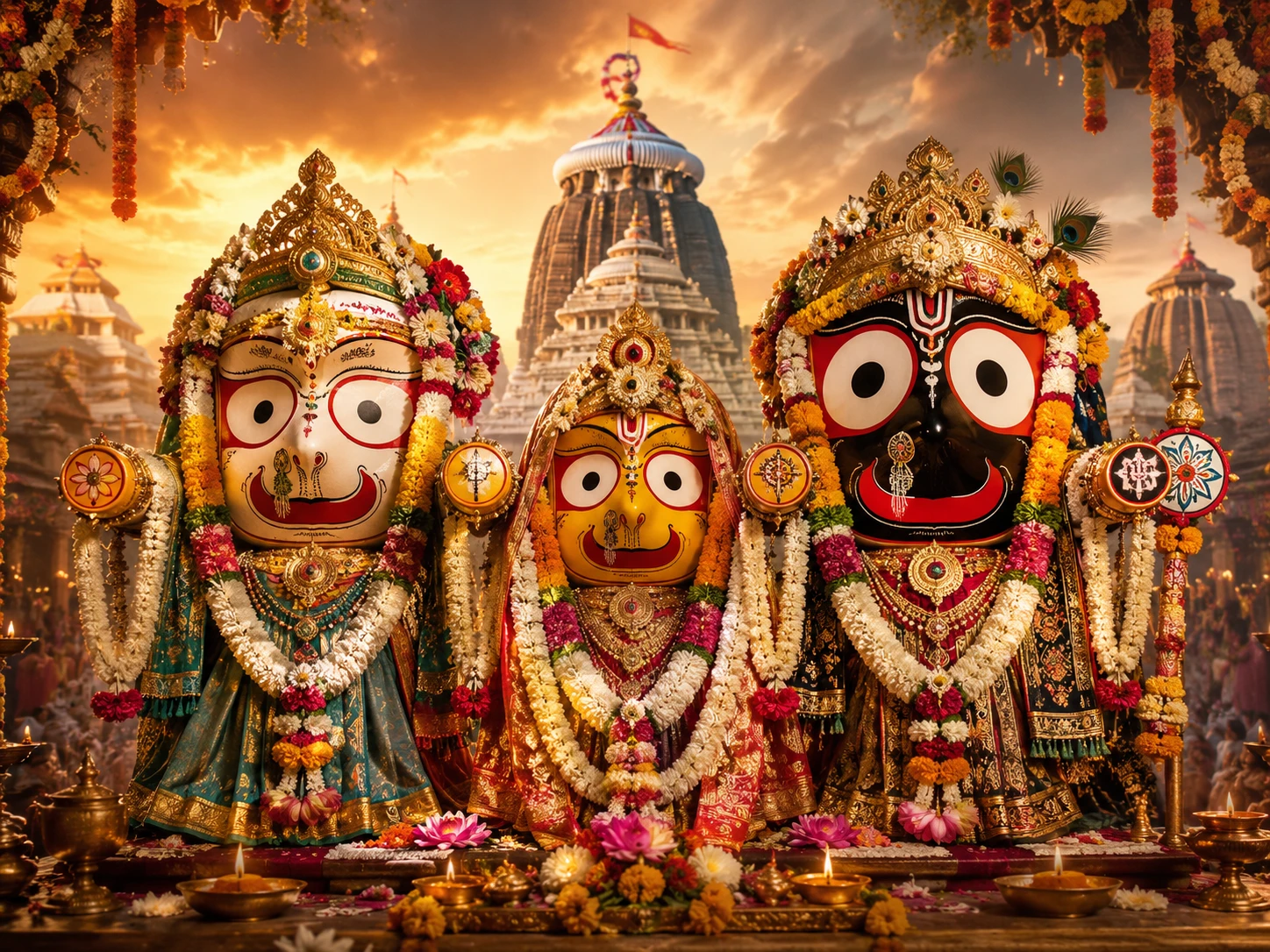
The first thing that strikes you about Lord Jagannath is that he looks nothing like any other Hindu deity. No elegant proportions. No detailed iconography. No graceful posture. He is a flat-faced wooden figure with enormous circular eyes, a wide mouth, no ears, no neck, stubby arm-stumps with no hands, and no legs. He looks, to the uninitiated, unfinished -- like a sculpture abandoned midway.
And that is exactly the point.
According to the Skanda Purana and the temple's Sthala Purana, when King Indradyumna of Avanti wished to install a deity of Vishnu in Puri, the divine architect Vishwakarma agreed to carve the image -- on one condition: no one must open the door of his workshop until he was done. Weeks passed. The queen, unable to bear the silence, opened the door. Vishwakarma vanished, leaving the images incomplete. The 'unfinished' Jagannath -- along with his brother Balabhadra and sister Subhadra -- were installed as they were. Brahma himself descended to consecrate the deities and paint their enormous eyes.
This origin story is a theological masterclass. It says: the divine is not complete. Or rather -- the divine is complete precisely because it is not polished, not refined, not perfected by human hands. Jagannath's rough, elemental form makes a claim that no perfectly sculpted murti can: the divine is beyond form. The elaborate iconography of other deities -- the four arms, the specific mudras, the detailed ornaments -- are aids to human visualization. Jagannath dispenses with all of them. He offers you two eyes and says: this is enough. Look at me and I will look at you. That is the entire relationship.
For the IIT student who feels 'incomplete' because she didn't crack the top 100 rank. For the startup founder whose MVP is rough and unpolished but works. For the person who feels they are not good enough, finished enough, perfect enough to be loved. Jagannath says: I am the Lord of the Universe, and I have no hands. Your incompleteness is not a flaw. It is the very condition of your divinity.
The Jagannath Temple in Puri -- one of the four Char Dham (sacred pilgrimage sites) of India alongside Badrinath, Dwaraka, and Rameshwaram -- is among the oldest and most important temples in Hinduism. The current structure dates to the 12th century CE, built by the Eastern Ganga dynasty king Anantavarman Chodaganga (though the site's sacred history extends much further back). The temple's main spire (deul) rises 65 metres, and the Nilachakra (the blue discus atop the spire) is visible from a distance of 20 km, making it a landmark for sailors approaching the Odisha coast for centuries.
महाम्भोधेस्तीरे कनकरुचिरे नीलशिखरे वसन्प्रासादान्तः सहजबलभद्रेण बलिना। सुभद्रामध्यस्थः सकलसुरसेवावसरदो जगन्नाथः स्वामी नयनपथगामी भवतु मे॥
mahāmbhodhestīre kanakarucire nīlaśikhare vasanprāsādāntaḥ sahajabalabhadreṇa balinā | subhadrāmadhyasthaḥ sakalasurasevāvasarado jagannāthaḥ svāmī nayanapathagāmī bhavatu me ||
On the shore of the great ocean, where the sands glitter like gold, atop the blue hill of Nilachala, residing within a palace with his brother Balabhadra the mighty -- with Subhadra at his side -- he who gives all the gods the opportunity to serve him: may that Lord Jagannath, my Master, be the object of my vision.
— Jagannathashtakam, Verse 3 -- Adi Shankaracharya
The Rath Yatra of Puri -- the annual chariot procession where Jagannath, Balabhadra, and Subhadra are carried on three massive wooden chariots from the main temple to the Gundicha Temple (approximately 3 km) -- is the world's oldest and largest chariot festival. It takes place annually on the second day of the bright half of Ashadha (June-July) and draws an estimated 1-2 million people to the Grand Road (Bada Danda) of Puri.
The chariots are colossal. Jagannath's chariot, called Nandighosa, has 16 wheels and stands approximately 14 metres tall. Balabhadra's chariot, Taladhwaja, has 14 wheels. Subhadra's chariot, Darpadalana, has 12 wheels. All three are built from scratch every year from specific types of wood (neem, sal, and other designated species) by hereditary carpenter families (Biswakarma seva). The construction begins on Akshaya Tritiya (April-May) and must be completed before the Rath Yatra date. The entire process -- from tree selection to wheel construction to painting -- follows rituals codified centuries ago.
The English word 'juggernaut' -- meaning an unstoppable, overwhelming force -- derives from 'Jagannath' via British colonial-era accounts of the Rath Yatra. European travellers in the 17th and 18th centuries reported (often inaccurately) that devotees threw themselves under the wheels of the massive chariot. While scholarly consensus holds that such accounts were exaggerated and influenced by colonial biases, the etymology remains: 'juggernaut' entered the English language because the Jagannath Rath Yatra was the most visually overwhelming religious spectacle that British observers had ever witnessed.
The Nabakalebara ('New Body') ceremony is one of the most extraordinary rituals in Hinduism. Approximately every 12-19 years, when there are two months of Ashadha in the Hindu calendar (an intercalary month), the wooden deities of Jagannath, Balabhadra, Subhadra, and Sudarshana are replaced with new ones. The old murtis are ceremonially buried in a secret location within the temple compound called Koili Vaikuntha ('the cemetery of heaven'). The new ones are carved from specially selected neem trees (daru brahma) identified through an elaborate search involving specific signs: the tree must have four main branches, must be near a cremation ground, an ant-hill, and a water body, and must be marked with specific natural insignia.
During Nabakalebara, a secret ritual called Brahma Parivartana transfers the 'Brahma' (a mysterious sacred substance, traditionally believed to be kept in a small casket inside the deity's body cavity) from the old murti to the new. No one except the designated priests has ever seen this substance. Some devotees believe it is a fragment of Krishna's bone from the Mahabharata-era cremation. Others believe it is a self-manifested shaligrama. The secrecy is absolute -- the transfer happens in complete darkness, with the priests blindfolded and their hands wrapped in cloth. The last Nabakalebara was held in 2015, drawing an estimated 10-12 million visitors to Puri over the festival period.
Jagannath's most radical theological contribution is his relationship with caste -- or rather, his annihilation of it.
The Mahaprasad (great offering) of Jagannath Temple is unique in all of Hinduism: food offered to Jagannath and then distributed to devotees is considered so sacred that caste distinctions are irrelevant in its consumption. At the Ananda Bazaar (the prasad marketplace inside the temple compound), a Brahmin, a Dalit, a Kshatriya, and a Shudra can sit side by side and eat from the same plate. This is not a modern reform. This has been the practice for centuries -- predating B.R. Ambedkar, predating the Constitution, predating every social reform movement in Indian history.
The Mahaprasad -- which includes rice, dal, vegetables, and the famous dry sweet khaja -- is cooked in earthen pots stacked in a pyramidal structure over wood fire. The kitchen (Rosa Ghara) is said to be the largest kitchen in the world, with 752 earthen hearths and the capacity to cook food for 100,000 people daily. The cooking is done exclusively by a hereditary class of cooks called Supakara or Mahasuara.
Chaitanya Mahaprabhu's arrival in Puri in the early 16th century transformed Jagannath worship from a regional Odia tradition into a pan-Indian devotional movement. Chaitanya, overcome with ecstasy upon seeing Jagannath's face, fainted at the Lion Gate (Simhadwara) and had to be carried inside by his companions. He spent the last eighteen years of his life in Puri, performing sankirtana (congregational chanting) on the streets, participating in the Rath Yatra, and experiencing states of devotional rapture that his followers documented in the Chaitanya Charitamrita. His influence permanently linked Jagannath worship with the Gaudiya Vaishnava tradition and made Puri a pan-Indian pilgrimage destination.
The Gita Govinda connection is equally important. Jayadeva's 12th-century Sanskrit poem is sung daily as part of the seva (worship service) at the Jagannath Temple -- it has been part of the temple ritual for over 800 years. The evening aarti at the temple includes verses from the Gita Govinda, making it one of the oldest continuously performed musical-literary compositions in human history.
For the ISRO scientist who visits Puri after a successful satellite launch and eats Mahaprasad sitting next to a rickshaw-puller -- and neither of them thinks this is unusual. For the Odia grandmother who has never left Puri in her life but knows every verse of the Jagannathashtakam by heart. For the NRI software engineer from San Jose who schedules his India trips around the Rath Yatra and weeps openly when the Nandighosa chariot begins to move. Jagannath is not a museum exhibit. He is a living presence -- incomplete, enormous-eyed, handless, armless, and more loved than any perfectly sculpted deity in any temple in the world.
Jagannath's Unique Features -- What Makes Him Different from Every Other Deity
| Feature | Jagannath | Other Deities |
|---|---|---|
| Physical Form | Unfinished -- no hands, no feet, no ears, round eyes on flat wood | Detailed anthropomorphic sculpted stone or metal murtis |
| Material | Wood (neem) -- replaced periodically (Nabakalebara) | Stone, bronze, panchaloha -- permanent |
| Triad | Worshipped with siblings (Balabhadra, Subhadra) not consort | Usually with consort (Lakshmi, Parvati, etc.) |
| Caste in Worship | Mahaprasad abolishes caste -- everyone eats together | Most temples historically maintained caste protocols |
| Chariot Festival | Rath Yatra -- deity leaves temple and goes to the people | Deities typically stay in garbhagriha; devotees come to them |
| Body Replacement | Murtis replaced every 12-19 years in Nabakalebara | Murtis are permanent; replacement is extremely rare |
| Sacred Substance | Brahma Parivartana -- secret transfer in complete darkness | No equivalent secret ritual in other traditions |
| Food Operation | Largest temple kitchen in world -- 100,000+ daily meals | Large operations exist but none at this scale |
| Literary Connection | Gita Govinda sung daily for 800+ years as part of seva | Stotrams recited but rarely a single literary work integrated this deeply |
Jagannath breaks almost every convention of Hindu temple worship -- and in doing so, reveals something profound: the divine is not constrained by the rules humans create to worship it.
The Jagannath Temple's role in the Bhakti movement and its influence on Indian social reform cannot be overstated.
When Ramananda (14th-15th century), the great Vaishnava saint who opened his teachings to all castes, declared that devotion transcends social hierarchy, he was articulating a principle that the Jagannath tradition had practised for centuries through its Mahaprasad system. When Chaitanya Mahaprabhu embraced Haridasa Thakur -- a Muslim-born devotee -- and took him to worship Jagannath, the theological statement was clear: the Lord of the Universe recognises no boundaries of birth.
The temple's seva (service) system is an elaborate hereditary structure involving 36 categories of servitors (called 'Niyogas') who perform specific ritual functions. The Daita community handles the deities during the most intimate rituals, including Nabakalebara. The Pati Mahapatra servitors perform the sacred bathing ceremony (Snana Yatra). The Supakara cooks prepare the Mahaprasad. This system, while hereditary and therefore not free from caste dynamics, operates as a self-contained service economy where each community has an irreplaceable role -- and where the deity is the employer, not any human authority.
The 'Mahaprasad as equaliser' principle extends beyond the temple. When Jagannath's Mahaprasad is distributed, the recipient's caste is not asked. A Brahmin eating Mahaprasad next to a Dalit does not consider himself polluted -- because the food has been 'eaten' by Jagannath first, and God's leftovers carry no caste. This theological innovation -- food offered to God becomes God's leftovers (ucchishta), and God's ucchishta purifies rather than pollutes -- is a radical social technology disguised as a dining practice.
Modern Puri faces the tensions between tradition and development that every sacred Indian city navigates. The Shree Jagannath Heritage Corridor project (launched 2021) aims to transform the temple surroundings with improved pilgrim amenities, security, and crowd management. Critics argue it has displaced traditional communities; supporters say it will make the pilgrimage experience safer for the millions who visit. The theological question underneath the debate is classic Jagannath: does the Lord of the Universe need a renovated neighbourhood, or does the neighbourhood need the Lord?
For the Odia diaspora engineer in Seattle who watches the Rath Yatra live-stream on YouTube and cries when the Nandighosa begins to move. For the college student from Bhubaneswar who has grown up visiting the temple every week and cannot imagine a life without Jagannath's enormous eyes watching over her. For the anthropologist studying how a 12th-century temple operates as a modern welfare institution, producing 100,000 daily meals, managing thousands of employees, and maintaining rituals that have not changed in 800 years. Jagannath is the proof that incompleteness can be the most complete thing in the world -- that a god without hands can hold more than a god with a thousand arms.
The global spread of Jagannath worship through ISKCON (the International Society for Krishna Consciousness, founded by A.C. Bhaktivedanta Swami Prabhupada in 1966) has made the Rath Yatra a worldwide event. ISKCON conducts Rath Yatra processions in over 50 countries, from London's Trafalgar Square to New York's Fifth Avenue to Moscow's Gorky Park. These processions follow the same basic format as the Puri original: massive decorated chariots pulled by devotees through city streets, accompanied by kirtan (congregational chanting) and free prasadam distribution.
The ISKCON Rath Yatras have introduced millions of non-Indians to the concept of Jagannath -- and, through the deity, to the broader Vaishnava tradition. The distribution of vegetarian prasadam at these events (ISKCON distributes an estimated 1.2 billion free meals globally per year through its Food for Life programme, originally inspired by Prabhupada's instruction that 'no one within ten miles of an ISKCON temple should go hungry') is the world's largest religiously motivated food distribution programme. The theological lineage is clear: Jagannath's Mahaprasad, which abolishes caste distinctions at its table in Puri, has been scaled to abolish hunger distinctions at ISKCON tables worldwide.
The Supreme Court of India's involvement with Jagannath Temple governance reflects the temple's national importance. Multiple Supreme Court orders have addressed the temple's administration, the rights of hereditary servitors, and the management of the Rath Yatra. In 2020, during the COVID-19 pandemic, the Supreme Court initially ordered that the Rath Yatra could not be held (the first cancellation in the festival's known history), then partially reversed the order to allow a restricted Yatra without public participation -- a decision that made international headlines and demonstrated that even in a pandemic, Jagannath moves.
The Jagannath Temple's flag (Patita Pavana -- 'Redeemer of the Fallen') atop the Nilachakra is changed daily by a hereditary climber who scales the 65-metre spire without any safety equipment -- one of the most daring daily rituals in any religion. The temple kitchen uses an ingenious stacking system where earthen pots are placed one atop another over the fire, and remarkably, the topmost pot cooks first -- a phenomenon that temple cooks attribute to divine intervention and that no food scientist has satisfactorily explained. The temple's shadow never falls on the ground at any time of day due to its architectural design -- though this claim, while widely believed, has been contested by engineers. The Singhadwara (Lion Gate) of the temple is oriented so that the sound of the sea (audible everywhere else in Puri) is mysteriously inaudible once you step inside -- a phenomenon attributed to Subhadra's wish for quiet. And the word 'juggernaut,' which entered English as a synonym for unstoppable force, has come full circle: in 2024, a Puri-based tech startup named itself 'Juggernaut' and uses the Nilachakra as its logo.
Chant the Jagannathashtakam
Recite Shankaracharya's eight-verse hymn to Lord Jagannath, each verse ending with the prayer 'Jagannathah Svami Nayana Patha Gami Bhavatu Me' -- may the Lord of the Universe be the object of my vision. It is on Eternal Raga with its meaning.
Tags
Eternal Raga · शाश्वत राग
Institutional voice — scholarly articles on Sanatan Dharma
Deepen Your Understanding
अपनी समझ और गहरी करें
deities avatars
Venkateswara -- The Lord of Seven Hills and the World's Most Visited God
Every day, 50,000 to 100,000 pilgrims climb the Seven Hills of Tirumala to see a deity whose face is so sacred that artificial eyes are placed over his real ones so devotees do not look directly into them. The Tirumala Tirupati Devasthanams receives more annual donations than the GDP of several small countries. Venkateswara is not just a god. He is an institution.
deities avatars
Trimurti -- Brahma, Vishnu, Shiva and the Three-Act Play of the Cosmos
The universe has three jobs: it must be created, maintained, and destroyed. Hinduism assigns each job to a god -- Brahma the creator, Vishnu the preserver, Shiva the destroyer -- and then does something no other religion has dared: it worships the destroyer as enthusiastically as the creator. That is the Trimurti, and it is Hinduism's most revolutionary idea about how reality works.
deities avatars
Radha -- Krishna's Eternal Beloved and the Supreme Devotee Who Became Greater Than God
She is not mentioned by name in the Bhagavata Purana. She has no temple at the centre of Vrindavan. She did not marry Krishna. And yet -- in the devotional traditions of North India, in the poetry of Jayadeva, in the philosophy of Chaitanya, and in the hearts of millions who chant 'Radhe Radhe' -- she is considered superior to Krishna himself. That is the paradox and the power of Radha.
scriptural exegesis
Krishna's 16,108 Queens -- The Story Behind the Number
The number sounds absurd until you understand what it means. Krishna did not 'collect' 16,108 wives. He rescued 16,100 women from a demon's prison, and when no one in society would accept them back -- because they were 'tainted' -- he married every single one to restore their honour. Add 8 named queens (the Ashtabharya) married through love, valour, or diplomacy, and you get the most misunderstood number in Hindu mythology. This is not a harem story. It is the largest social rehabilitation programme in ancient literature.
scriptural exegesis
Gita Govinda -- Jayadeva's Song of Radha and Krishna
Written in the twelfth century and still sung every night before Jagannath in Puri, Jayadeva's Gita Govinda turned the love of Radha and Krishna into music. What the poem is, how it is built, and why it changed Indian devotion, dance and music.
rituals traditions
Rath Yatra -- The Day Jagannath Comes Out to Meet Everyone
Once a year, the deities of Puri leave their temple on three towering chariots built new for the occasion, pulled through the streets by hundreds of thousands of people. How the Rath Yatra works, what happens in the weeks around it, and why a king sweeps the road before the gods.
deities avatars
Narayana -- Cosmic Vishnu Beyond Avatara
Before Krishna lifted Govardhan and Rama crossed the ocean, there was Narayana lying on the serpent Ananta in the milk ocean. The avatars come and go. Narayana remains. This is the theological Vishnu at the base of every Vaishnava tradition, from Ramanuja's Sri Vaishnavism to the Badrinath pilgrimage to the Ashtakshari mantra every devotee chants.
The Jagannath Temple's flag (Patita Pavana -- 'Redeemer of the Fallen') atop the Nilachakra is changed daily by a hereditary climber who scales the 65-metre spire without any safety equipment -- one of the most daring da…
More in Deities & Avatars
33 Koti Devata -- Why Hinduism Has 33 Types of Gods, Not 33 Crore
13 min read
Agni -- The Fire God
19 min read
Annapurna -- Goddess of Food
19 min readThe same translation error that turned '33 Koti' into '33 crore' in Hinduism also happened in Buddhism. The Chinese translation of Buddhist texts rendered 'Sapta Koti Buddha' (7 Supreme Buddhas) as '7 Crore Buddhas.' The…
Deities AvatarsCommunity Reflections
🕉️
Be the first to share your reflection.