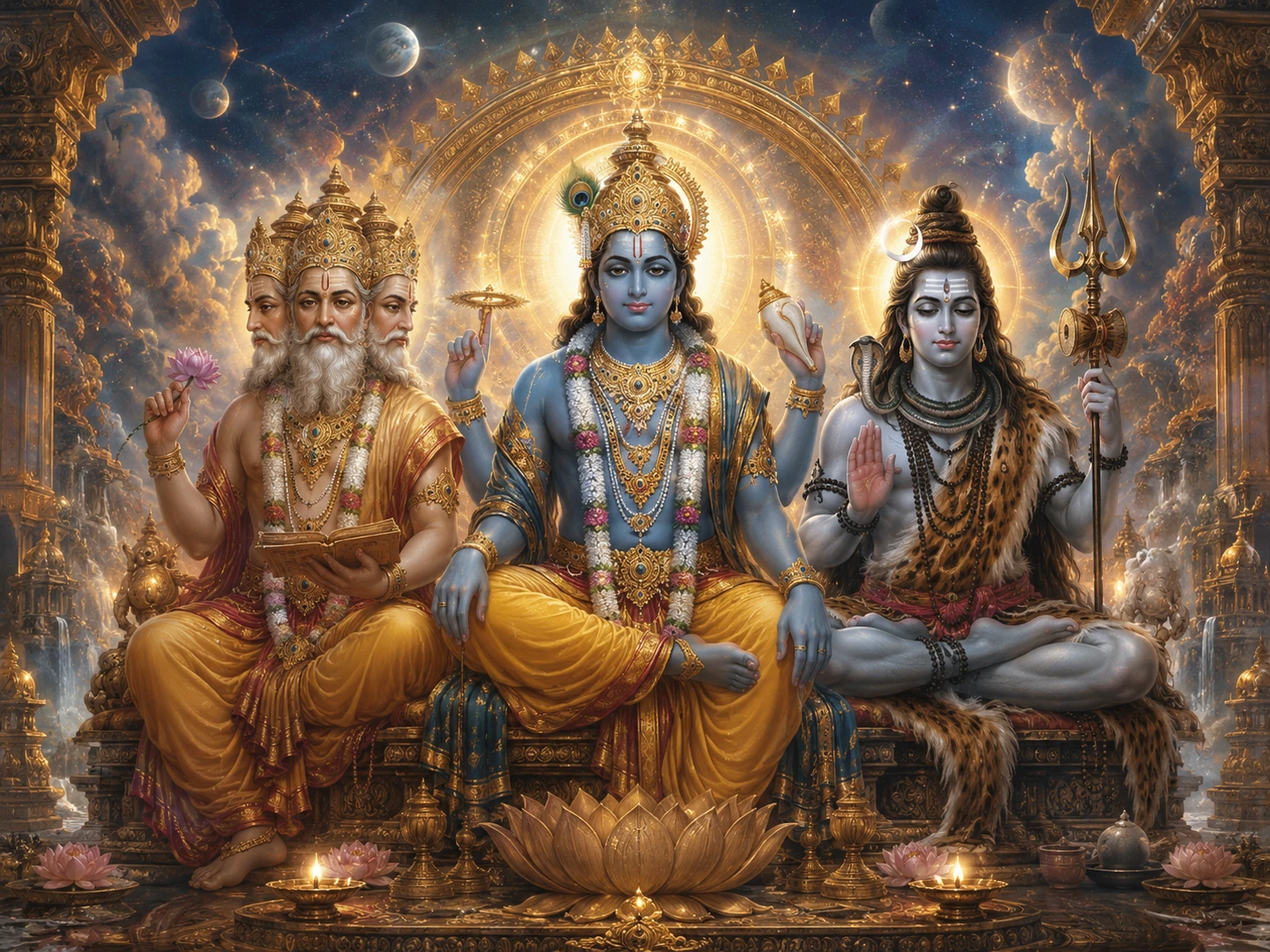
Trimurti -- Brahma, Vishnu, Shiva and the Three-Act Play of the Cosmos
त्रिमूर्ति -- ब्रह्मा, विष्णु, शिव और ब्रह्माण्ड का तीन-अंकीय नाटक
The most elegant idea in Hindu theology can be stated in a single sentence: the universe is not a line; it is a circle.
In the Abrahamic traditions -- Judaism, Christianity, Islam -- the universe has a beginning (creation by God), a middle (human history), and an end (apocalypse, judgment, eternity). Time is linear. It starts, it progresses, it concludes. The universe is a story with a first page and a last page.
In Hindu cosmology, the universe has no first page and no last page. It has cycles. Creation (srishti) leads to preservation (sthiti), which leads to dissolution (pralaya), which leads to creation again. This is not a metaphor. It is the structural principle of the cosmos, encoded in the Trimurti -- the three forms of the Supreme: Brahma the Creator, Vishnu the Preserver, Shiva the Destroyer.
The Trimurti (Sanskrit: tri = three, murti = form) is not a committee of three gods who divided responsibilities like departments in a corporation. It is one reality experiencing itself through three functions. The Maitrayaniya Upanishad (5.2) -- one of the earliest texts to describe this trinity -- states that the one Brahman becomes three: Brahma through tamas (creative potential), Vishnu through sattva (sustaining harmony), and Shiva through rajas (transformative energy). Three gunas, three gods, one reality.
The genius of this framework becomes apparent when you compare it to every other cosmological model humans have invented. The Big Bang theory says the universe began 13.8 billion years ago -- but what came before? Science has no answer. The Hindu model says: another universe. And before that? Another. The cycles are beginningless and endless (anadi and ananta). There is no first creation because there was always a previous dissolution. There is no final dissolution because there will always be a next creation.
Modern physics, incidentally, is beginning to flirt with cyclical models -- the 'Big Bounce' hypothesis, the Penrose Conformal Cyclic Cosmology model -- but Hindu theology has been operating on this assumption for at least 2,500 years. This is not to claim that the Vedic rishis anticipated quantum cosmology (that would violate our editorial honesty standards), but to note that the intuition of cyclical time is not a primitive fantasy. It is a sophisticated cosmological framework that happens to align with some of the most advanced thinking in modern theoretical physics.
For the JEE student who sees the same exam pattern repeat year after year. For the startup founder who watches companies rise and fall in Koramangala in five-year cycles. For anyone who has noticed that economic booms are always followed by busts, that empires always rise and fall, that relationships cycle through closeness and distance. The Trimurti is not abstract theology. It is an observation about the pattern of everything.
सृष्टिस्थितिविनाशानां शक्तिभूते सनातने। गुणाश्रये गुणमये नमस्ते पुरुषोत्तम॥
sṛṣṭisthitivināśānāṃ śaktibhūte sanātane | guṇāśraye guṇamaye namaste puruṣottama ||
Salutations to you, O Purushottama (Supreme Being), who is the eternal power behind creation, preservation, and destruction; who is the abode of the gunas and yet pervaded by the gunas.
— Vishnu Purana, 1.2.66 (approximate)
The three members of the Trimurti are not equal in the popular imagination, and the story of why is one of the most fascinating narratives in Hindu theological history.
Brahma, the Creator, has almost no temples. In all of India, the Pushkar Temple in Rajasthan is virtually the only major temple dedicated to Brahma. This is extraordinary -- the god who created the universe has fewer temples than minor regional deities. Multiple Puranic stories explain this: in the Shiva Purana, Brahma lied about seeing the top of the Shiva Linga during the Lingodbhava contest and was cursed by Shiva to have no worship on earth. In the Padma Purana, Brahma was cursed by Saraswati (his own consort) for creating Shatarupa and becoming attracted to her. In the Skanda Purana, Brahma's fifth head was cut off by Bhairava (Shiva's fierce form) as punishment for his arrogance.
But the real reason for Brahma's marginalisation may be philosophical rather than mythological. Creation is a one-time act -- once the universe is created, the creator's job is done. Preservation and destruction, by contrast, are ongoing. Vishnu preserves every moment of every day. Shiva destroys and transforms continuously. Brahma creates once and then... waits for the next cycle. In a tradition that values ongoing spiritual practice (sadhana) over one-time achievements, the god who did his job and retired is less compelling than the gods who are always working.
Vishnu, the Preserver, is the most widely worshipped member of the Trimurti, with a following that spans the entire subcontinent and beyond. His ten avatars (Dashavatara) -- from Matsya (fish) to Kalki (the future avatar) -- provide the narrative framework for Hindu history. His temples (Tirumala, Srirangam, Badrinath, Dwaraka) are among the most visited in the world. The Vaishnava traditions (Sri Vaishnavism, Gaudiya Vaishnavism, Pushti Marga, ISKCON) constitute the largest sectarian grouping in Hinduism.
Shiva, the Destroyer, occupies a unique theological position. He is worshipped more as an ascetic, a yogi, a paradox -- the god who is simultaneously householder (married to Parvati, father of Ganesha and Kartikeya) and renunciant (the naked ash-smeared ascetic of the cremation grounds). Shaiva traditions (Kashmir Shaivism, Shaiva Siddhanta, Lingayatism, Nath Sampradaya) constitute the second-largest sectarian grouping. Shiva's temples (Varanasi, Kedarnath, Somnath, Rameshwaram, Chidambaram) are some of the oldest and most architecturally significant in India.
The Elephanta Caves Maheshmurti -- a massive three-headed sculpture of Shiva located on an island in Mumbai harbour, dating to approximately the 5th-6th century CE -- is perhaps the most famous artistic representation of the Trimurti concept (though it is debated whether it represents the Trimurti of Brahma-Vishnu-Shiva or three aspects of Shiva: Creator, Preserver, Destroyer). The sculpture is over 6 metres tall, carved from living basalt rock, and its serene, powerful faces have been described by art historians as one of the masterpieces of Indian sculpture. Every Mumbai local knows the Elephanta ferry -- the one-hour boat ride from the Gateway of India to the caves is one of the most popular day trips in the city -- but most visitors do not realise they are looking at a philosophical argument about the nature of the cosmos carved in stone 1,500 years ago.
The Trimurti -- Three Gods, Three Functions, Three Gunas
| Aspect | Brahma | Vishnu | Shiva |
|---|---|---|---|
| Cosmic Function | Srishti (Creation) | Sthiti (Preservation) | Pralaya (Dissolution) |
| Guna | Rajas (activity, passion) | Sattva (harmony, goodness) | Tamas (transformation, inertia) |
| Consort (Tridevi) | Saraswati (Knowledge) | Lakshmi (Prosperity) | Parvati / Shakti (Power) |
| Vahana | Hamsa (Swan) | Garuda (Eagle) | Nandi (Bull) |
| Sacred Text | Vedas (he speaks them into existence) | Bhagavata Purana, Vishnu Purana | Shiva Purana, Shaiva Agamas |
| Primary Abode | Satyaloka | Vaikuntha / Kshira Sagara | Kailash |
| Iconic Image | Four-headed, holding Vedas and kamandalu | Reclining on Shesha, or standing with four arms | Nataraja, Lingam, Dakshinamurti, Ardhanarishvara |
| Number of Major Temples | Virtually one (Pushkar) | Thousands (Tirumala alone gets 50,000 daily) | Thousands (12 Jyotirlingas, plus thousands more) |
| Modern Analogy | The startup founder who builds v1 and exits | The COO who keeps the company running year after year | The investor who shuts down failing ventures to fund new ones |
| Om Correspondence | A (Akara -- creation) | U (Ukara -- preservation) | M (Makara -- dissolution) |
The correspondence of Om's three phonemes (A-U-M) to the Trimurti is one of the most elegant mappings in Hindu theology. Every time you chant Om, you are invoking the entire cycle of creation, preservation, and dissolution in a single syllable.
The Trimurti concept has a fascinating architectural legacy. The Elephanta Maheshmurti (5th-6th century CE) in Mumbai harbour is the most famous, but the Trimurti is also depicted in the Badami Cave Temples (6th century, Karnataka), the Ellora Caves (8th century, Maharashtra), and most spectacularly in the unfinished Trimurti at the Thanumalayan Temple in Suchindram, Tamil Nadu, where a single lingam has Brahma, Vishnu, and Shiva carved on its three faces.
The theological tensions within the Trimurti concept are real and should not be glossed over. Vaishnavas consider Vishnu to be the Supreme Being from whom Brahma and Shiva emerge; in this view, the Trimurti is not a partnership of equals but a hierarchy with Vishnu at the top. Shaivas make the same claim for Shiva -- the Shaiva Agamas describe Shiva performing all five cosmic functions (creation, preservation, destruction, concealment, and grace) alone, making Brahma and Vishnu subordinate manifestations. Shaktas go further, arguing that Shakti (the Goddess) is the Supreme Reality and that the Trimurti are her instruments. The Smartha tradition, following Shankaracharya, treats all members of the Trimurti (plus Shakti, Surya, and Kartikeya) as equal manifestations of the one nirguna Brahman, and advocates panchayatana puja (worship of five deities).
These sectarian differences are not merely academic. They have produced distinct temple architectures, festival calendars, dietary practices, initiation rituals, and philosophical literatures. A Sri Vaishnava from Srirangam and a Shaiva Siddhanta practitioner from Thanjavur may both be Tamil Brahmins, but their worship systems, theological commitments, and even dietary taboos differ significantly. The Trimurti, meant to unify, has in practice also divided -- which is itself a very Trimurti thing to do (creation of unity, preservation of difference, destruction of simplistic categories).
For the India that simultaneously worships Vishnu at Tirumala, Shiva at Varanasi, and the Goddess at Kamakhya -- without seeing any contradiction. For the family that has a Shiva linga in the puja room next to a Vishnu idol next to a Durga photograph. For the grandmother who chants Vishnu Sahasranama in the morning and Shiva Panchakshara in the evening and sees no inconsistency. The Trimurti is not a doctrine to be believed. It is a practice to be lived -- the recognition that creation, preservation, and transformation are all sacred, all necessary, and all happening simultaneously, at every scale, from the cosmic to the personal, at every moment of every day.
The Trimurti is not merely a Hindu concept -- it is a universal pattern that appears in every domain of human experience, and recognising it transforms how you see the world.
In economics: every market has creators (entrepreneurs who build new products), preservers (operators who maintain existing businesses), and destroyers (disruptors who render old models obsolete). The startup ecosystem in Bangalore's Koramangala is a perfect Trimurti: founders create (Brahma), operations teams maintain (Vishnu), and pivots or shutdowns destroy the old to make way for the new (Shiva). The venture capitalist who funds a company's Series A (creation), monitors its growth (preservation), and shuts it down when it fails (destruction) is performing all three Trimurti functions.
In biology: cells are continuously created (mitosis), maintained (homeostasis), and destroyed (apoptosis -- programmed cell death). Without apoptosis -- without Shiva's function at the cellular level -- cancer occurs, because cells that should die refuse to. The body's health depends on all three functions operating in balance. A biology student at AIIMS who understands this is studying the Trimurti in its most literal form.
In ecology: forests grow (creation), sustain ecosystems for centuries (preservation), and burn in periodic wildfires (destruction) that clear old growth and release nutrients for new forest. The controlled burn programmes of the Indian Forest Service are, ecologically, performing Shiva's function -- destroying in order to renew. The environmentalist who opposes all destruction does not understand ecology; and, the Trimurti would add, does not understand the cosmos.
In personal life: relationships are created, maintained, and sometimes dissolved. Careers begin, sustain, and end. Ideas are born, developed, and superseded. Grief is the experience of Shiva's function applied to something you love. Growth is the experience of Brahma's function applied to your own potential. Stability is the experience of Vishnu's function applied to your daily discipline.
The Trimurti is not asking you to worship three gods. It is asking you to recognise three functions -- and to respect all three equally. The person who only creates and never maintains produces chaos. The person who only maintains and never creates produces stagnation. The person who only destroys and never rebuilds produces nihilism. The balanced life -- the dharmic life -- engages all three.
The Trimurti's most underappreciated member -- Shiva the Destroyer -- deserves a defence, because the Western translation of 'destroyer' profoundly misrepresents what Shiva actually does.
Shiva does not destroy in the sense that a bomb destroys a building. He dissolves in the sense that sleep dissolves waking consciousness, that death dissolves the body, that the end of a kalpa dissolves the universe into its constituent elements so that a new kalpa can begin. The Sanskrit word is samhara or pralaya, not vinasha (permanent annihilation). Pralaya is dissolution -- a return to potential, not a descent into nothingness. When Shiva performs the Tandava at the end of a cosmic cycle, he is not murdering the universe. He is composting it. The old universe becomes the raw material for the new one.
This distinction has practical implications. The CEO who fires underperforming employees is performing pralaya, not vinasha -- she is dissolving one organisational structure to create space for a better one. The surgeon who removes a tumour is performing samhara on cancerous tissue to preserve healthy tissue -- Shiva's function in service of Vishnu's. The student who drops out of a degree programme that is wrong for her to start a new career is performing personal pralaya -- dissolving an old identity to create space for a new one.
In Indian psychology (as codified in texts like the Yoga Sutras and the Bhagavad Gita), the most difficult and most liberating act is letting go -- vairagya, detachment. Shiva is the god of vairagya. He sits on cremation grounds because the cremation ground is where all attachments are burned away. He smears himself with ash because ash is what remains after everything impermanent has been consumed by fire. He is naked because he has nothing left to lose. He is the endpoint of the spiritual journey: the being who has dissolved every false identity and rests in pure consciousness.
The JEE aspirant who lets go of a wrong answer and moves to the next question. The grieving parent who accepts that their child is gone and begins to rebuild. The entrepreneur who shuts down a failed startup, mourns it, and starts again. They are all performing Shiva's function. And the Trimurti says: this is not failure. This is sacred. This is how the universe renews itself.
The syllable Om (AUM) is explicitly mapped to the Trimurti in the Mandukya Upanishad: A corresponds to the waking state and Brahma (creation), U to the dream state and Vishnu (preservation), M to deep sleep and Shiva (dissolution), and the silence after Om corresponds to Turiya -- the fourth state of pure consciousness beyond the Trimurti entirely. The Elephanta Caves Maheshmurti was designated a UNESCO World Heritage Site in 1987, and the 20-minute ferry ride from the Gateway of India is one of Mumbai's most popular tourist experiences -- though most visitors photograph the sculpture without realising they are capturing a 1,500-year-old theological argument about the nature of reality. Meanwhile, the Pushkar Brahma Temple -- virtually the only dedicated Brahma temple in India -- hosts an annual fair (Pushkar Mela) that attracts 200,000 visitors, making it one of the largest camel fairs in the world. Brahma may have lost his worship, but his temple gained a camel fair -- which, in some cosmic accounting, might be a fair trade.
The iconography of the Trimurti across Indian sculpture provides a visual history of how the concept evolved.
The earliest known Trimurti sculpture is at the Elephanta Caves (5th-6th century CE) near Mumbai -- the massive Maheshmurti, showing three faces of Shiva representing Creator, Preserver, and Destroyer. But the most explicit Trimurti sculptures -- showing Brahma, Vishnu, and Shiva as three distinct figures merged into one -- appear from the Gupta period onward. The Badami Cave 3 (578 CE, Karnataka) contains a stunning Vishnu panel alongside Brahma and Shiva imagery. The Ellora Caves (6th-10th century, Maharashtra) feature all three deities across its Hindu, Buddhist, and Jain sections -- making Ellora itself a kind of architectural Trimurti.
The Dattatreya tradition offers the most literal visual interpretation: Dattatreya is depicted with three heads (Brahma, Vishnu, Shiva) on one body, accompanied by four dogs (representing the four Vedas) and a cow (representing the earth/dharma). The Dattatreya Peethas at Girnar (Gujarat), Gangapur (Karnataka), and Audumbar (Maharashtra) are major pilgrimage sites where the Trimurti is worshipped in this unified form.
The Om symbol itself is a Trimurti diagram. The three curves of the Devanagari Om (ॐ) correspond to the three states of consciousness (waking, dreaming, deep sleep), the three gunas (sattva, rajas, tamas), and the three gods (Brahma, Vishnu, Shiva). The dot (bindu) above represents Turiya -- the fourth state, the transcendent consciousness beyond the Trimurti. The crescent (chandra-bindu) represents Maya -- the veil of illusion that separates the three states from the fourth. Every time a Hindu chants Om -- before a mantra, before a meal, before an exam, at the beginning of a new venture -- they are invoking the complete Trimurti cycle in a single syllable.
The concept of the Tridevi (the three goddesses) parallels the Trimurti: Saraswati (consort of Brahma, goddess of knowledge), Lakshmi (consort of Vishnu, goddess of prosperity), and Parvati/Shakti (consort of Shiva, goddess of power). The Tridevi represents the dynamic, active aspect (Shakti) of each cosmic function -- if the Trimurti is the static potential, the Tridevi is the kinetic reality. Brahma creates, but Saraswati gives creation meaning through knowledge. Vishnu preserves, but Lakshmi gives preservation purpose through prosperity. Shiva destroys, but Parvati gives destruction direction through power.
This is not a patriarchal framework where the goddesses are mere consorts. It is the Shakta insight that the masculine divine is inert without the feminine -- Shiva without Shakti is shava. The Trimurti needs the Tridevi to function. The gods without the goddesses are ideas without energy, potential without actualization, blueprints without builders.
For the student preparing for UPSC who is asked 'What is the Trimurti?' in a General Knowledge paper -- the answer is not three gods. The answer is one reality expressed through three functions, experienced through three gunas, symbolized in one syllable (Om), activated by three goddesses, and enacted in every cycle of creation, existence, and transformation -- from the birth and death of universes to the rise and fall of civilisations to the rhythm of your own breath: inhale (creation), hold (preservation), exhale (dissolution). The Trimurti is not in a temple. The Trimurti is in every breath you take.
Chant Om -- The Sound of the Trimurti
Om holds creation (A), preservation (U) and dissolution (M) in a single breath. Chant it slowly, A-U-M, then rest in the silence after -- the fourth state the Mandukya Upanishad calls turiya. The Three Parts of Om dharana on Eternal Raga sets out this practice, and the Mandukya Upanishad is on the site too.
Tags
Eternal Raga · शाश्वत राग
Institutional voice — scholarly articles on Sanatan Dharma
Deepen Your Understanding
अपनी समझ और गहरी करें
deities avatars
Nataraja -- The Cosmic Dancer
One foot crushes a dwarf. The other is raised in liberation. A ring of fire frames the dance. A drum beats creation into existence. An open palm says 'do not fear.' This is Nataraja -- Shiva as the Lord of Dance -- and it is the single most replicated Indian bronze in the history of art. The physicists at CERN chose it to stand outside the world's largest particle accelerator. The Chola bronzesmiths of Tamil Nadu perfected it a thousand years ago. And every time a subatomic particle appears and disappears, the cosmic dance continues.
deities avatars
Dakshinamurti -- The Silent Teacher Who Taught the Universe Through Silence
Under a banyan tree sits a young guru, surrounded by old disciples. He says nothing. They understand everything. This is Dakshinamurti -- Shiva as the original teacher -- and his image is the most profound statement on education in any civilisation: the highest knowledge cannot be spoken. It can only be transmitted through presence.
deities avatars
Venkateswara -- The Lord of Seven Hills and the World's Most Visited God
Every day, 50,000 to 100,000 pilgrims climb the Seven Hills of Tirumala to see a deity whose face is so sacred that artificial eyes are placed over his real ones so devotees do not look directly into them. The Tirumala Tirupati Devasthanams receives more annual donations than the GDP of several small countries. Venkateswara is not just a god. He is an institution.
deities avatars
Brahma -- The Creator Who Has Few Temples
Brahma is the creator of the universe in the Hindu Trimurti, yet almost no temple in India is dedicated to him. He carries the four Vedas in his four mouths, married Saraswati, and measures cosmic time in units longer than the age of the observable universe. Why then is he so rarely worshipped?
deities avatars
Nine Forms of Shiva -- The Many Faces of Mahadeva
He is the silent teacher under a banyan tree and the screaming destroyer on a battlefield. He is half-woman and half-man. He drank the poison that would have ended the universe and his throat turned blue. Nine scripturally-attested forms of Shiva -- from Nataraja to Rudra -- and why each one exists.
deities avatars
Dashavatara -- Why Vishnu Comes Back Ten Times
Fish, tortoise, boar, half-lion, dwarf, axe-warrior, prince, cowherd, enlightened teacher, future horseman. The ten avatars of Vishnu are not random folklore. Read them in sequence and you get something startling -- a narrative that mirrors evolutionary biology, tracks the rise and fall of political systems, and argues that God does not sit above history but enters it, gets dirty, and does the work. The Dashavatara is Hinduism's answer to the question every civilisation asks: why does the world keep breaking, and who fixes it?
scriptural exegesis
Mandukya Upanishad -- 12 Verses That Map the Entire Landscape of Consciousness
Twelve verses. The shortest Upanishad. And yet Gaudapada built the entire edifice of Advaita philosophy on it, and Rama told Hanuman in the Muktika Upanishad that this one text alone is sufficient for liberation. The Mandukya Upanishad maps consciousness into four states -- waking, dreaming, deep sleep, and Turiya (the Fourth) -- and then shows that the syllable AUM contains all four. It is not a meditation manual. It is a complete theory of reality compressed into 12 sentences.
The syllable Om (AUM) is explicitly mapped to the Trimurti in the Mandukya Upanishad: A corresponds to the waking state and Brahma (creation), U to the dream state and Vishnu (preservation), M to deep sleep and Shiva (di…
More in Deities & Avatars
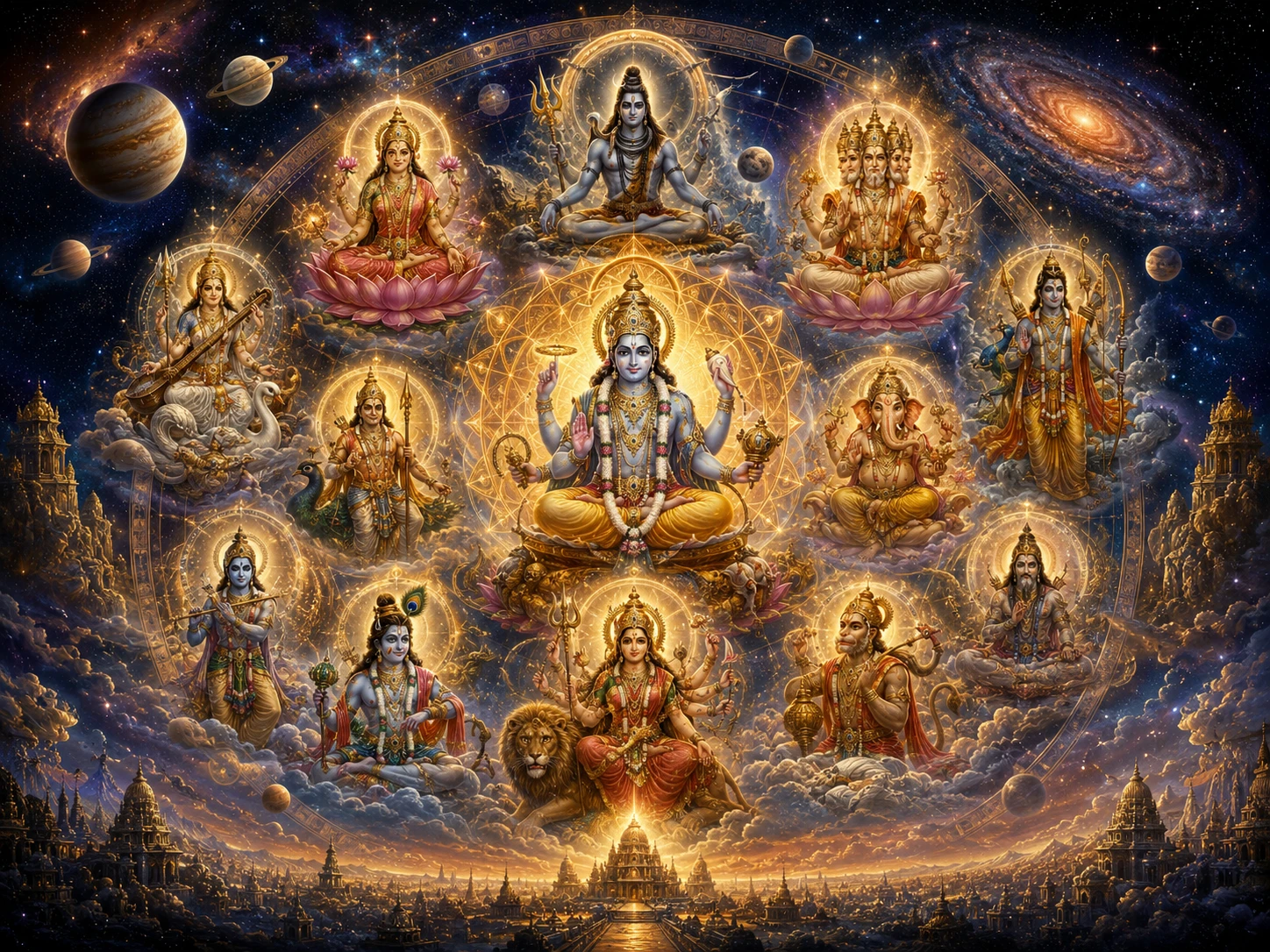
33 Koti Devata -- Why Hinduism Has 33 Types of Gods, Not 33 Crore
13 min read
Agni -- The Fire God
19 min read
Annapurna -- Goddess of Food
19 min readThe same translation error that turned '33 Koti' into '33 crore' in Hinduism also happened in Buddhism. The Chinese translation of Buddhist texts rendered 'Sapta Koti Buddha' (7 Supreme Buddhas) as '7 Crore Buddhas.' The…
Deities AvatarsCommunity Reflections
🕉️
Be the first to share your reflection.