Dakshinamurti -- The Silent Teacher Who Taught the Universe Through Silence
दक्षिणामूर्ति -- मौन गुरु जिन्होंने मौन से ब्रह्माण्ड को पढ़ाया
Consider the most counter-intuitive image in all of Hindu iconography. A teacher who does not speak. Students who learn without hearing a word. A guru who is younger than his disciples. Knowledge transmitted not through lecture, debate, or textbook, but through silence.
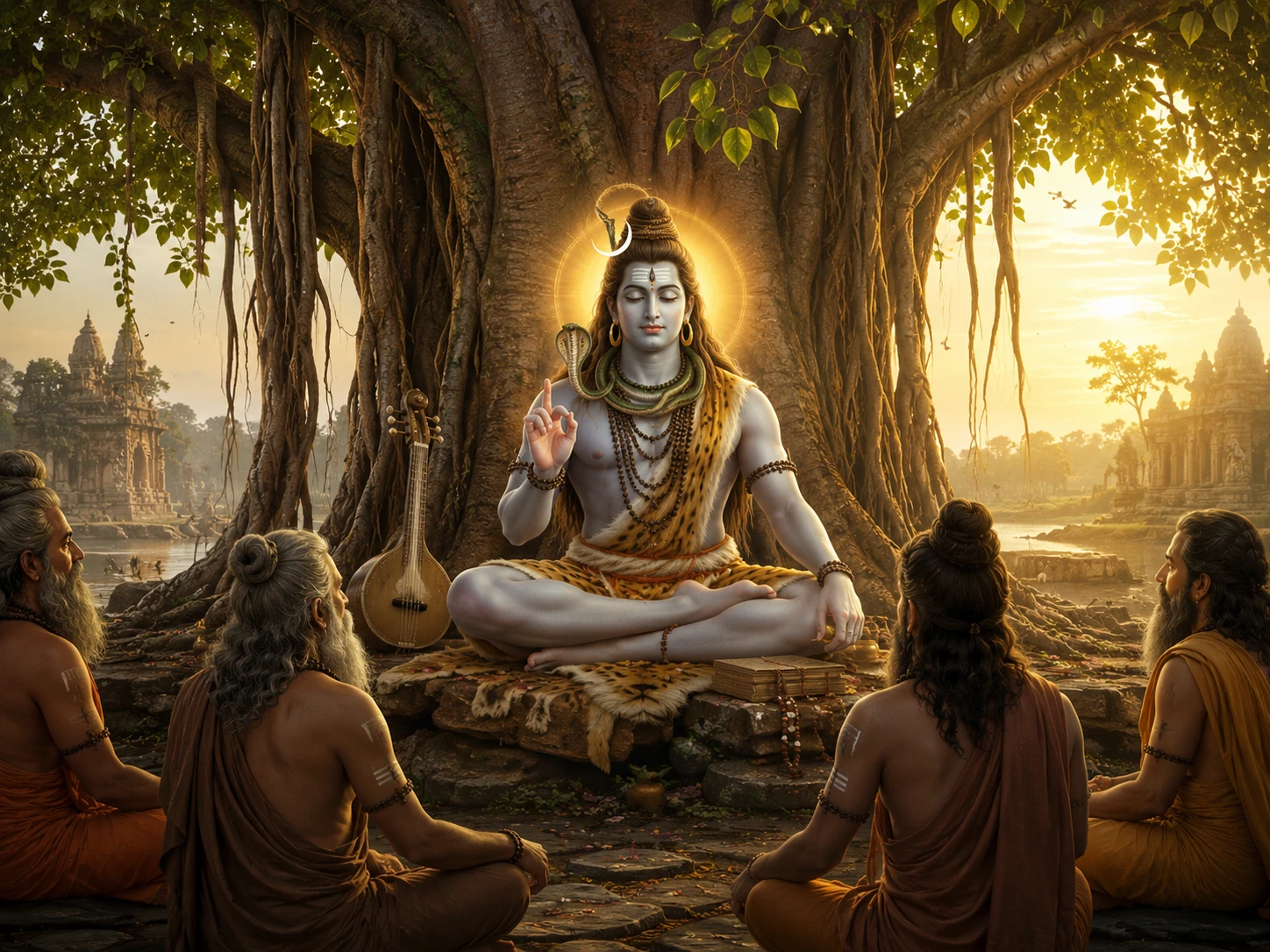
This is Dakshinamurti -- literally 'the one who faces south' (dakshina = south, murti = form) -- Shiva in his aspect as the Adi Guru, the first teacher of the universe. He sits under a banyan tree (vata vriksha), youthful and serene, his right hand raised in Chin Mudra (the gesture of supreme knowledge, where the thumb and index finger touch, forming a circle), surrounded by four aged rishis -- Sanaka, Sanandana, Sanatana, and Sanatkumara, the mind-born sons of Brahma -- who are among the oldest beings in the cosmos. The guru is young. The students are ancient. The teaching is silence. And the result is complete understanding.
Chitram vatatarormule vriddhah shishyah gururyuva -- 'What a wonder! At the base of the banyan tree, the disciples are old and the guru is young.' This verse, from the Dakshinamurti Stotram, captures the paradox in a single line. In every other educational setting on Earth -- from the gurukulas of ancient India to the IITs of modern India, from the madrasas of the medieval world to the universities of the West -- the teacher is older than the student. Experience comes with age. Wisdom accumulates over lifetimes. But Dakshinamurti inverts this. The youngest being in the picture possesses the deepest knowledge. And he teaches without opening his mouth.
For the PhD student who reads a thousand papers but understands less than when she started. For the UPSC topper who scored 98% but cannot explain what dharma means. For the IIT professor who publishes forty papers a year but has never experienced the flash of insight that transforms understanding. Dakshinamurti is the correction: information is not knowledge. Knowledge is not wisdom. And wisdom cannot be transmitted through words.
Every Teacher's Day (September 5) in India implicitly invokes Dakshinamurti -- the original guru. Every Guru Purnima celebration, when students honour their teachers, echoes the four Kumaras sitting at the feet of the silent Shiva. The Indian educational tradition's deepest conviction -- that the guru-shishya relationship is sacred, that true learning happens in the presence of a realised teacher, not merely through textbooks -- comes directly from this image.
चित्रं वटतरोर्मूले वृद्धाः शिष्याः गुरुर्युवा। गुरोस्तु मौनं व्याख्यानं शिष्यास्तुच्छिन्नसंशयाः॥
citraṃ vaṭatarormūle vṛddhāḥ śiṣyāḥ gururyuvā | gurostu maunaṃ vyākhyānaṃ śiṣyāstucchinnasaṃśayāḥ ||
What a wonder! At the root of the banyan tree, the disciples are old and the guru is young. The guru's teaching is silence, and yet the disciples' doubts are completely resolved.
— Dakshinamurti Stotram, Dhyana Shloka 3 -- Adi Shankaracharya
The Dakshinamurti Stotram, composed by Adi Shankaracharya (8th century CE), is not merely a devotional hymn. It is a compressed course in Advaita Vedanta -- the philosophy of non-duality that is considered the pinnacle of Hindu metaphysics. In ten verses plus dhyana shlokas, Shankaracharya expounds the entire Vedantic teaching: that the universe you perceive is a projection of consciousness (like a city seen in a mirror), that the apparent multiplicity of the world is an illusion (like the apparent multiplicity of space seen through different pots), that the waking state is no more 'real' than the dream state, and that the true Self (Atman) is identical with the ultimate reality (Brahman).
The first verse of the stotram proper is one of the most famous in all of Sanskrit philosophy:
Vishvam darpana drishyamana nagari tulyam nijantargatam -- 'The universe is like a city seen in a mirror -- appearing to be outside but actually existing within oneself.'
This single line contains the entire Advaita teaching. The world you experience -- the office, the traffic, the Instagram feed, the exam hall, the hospital waiting room -- is real as an experience, but its ultimate nature is a reflection within consciousness, not an independent external reality. The mirror metaphor is precise: a mirror-city is not nothing (you can see it, navigate it, respond to it), but it is not independently real (it exists only because the mirror exists). Similarly, the world is not nothing, but it exists only because consciousness exists.
Shankaracharya chose Dakshinamurti as the deity for this teaching because the image itself embodies the philosophy. Dakshinamurti does not argue for Advaita; he IS Advaita. He does not explain non-duality; he demonstrates it through silence. In duality, there is a speaker and a listener, a teacher and a student, a subject and an object. In non-duality, there is only awareness -- and awareness is silent. Dakshinamurti's silence is not the absence of teaching; it is the highest form of teaching -- the transmission of truth that precedes and transcends language.
The Chin Mudra that Dakshinamurti holds is itself a philosophical statement. The index finger represents the individual self (jiva). The thumb represents the universal Self (Brahman). When they touch, forming a circle, it represents the realisation that jiva and Brahman are one -- the mahavakya 'Tat Tvam Asi' (Thou Art That) expressed in a hand gesture. The three remaining fingers, slightly curved away, represent the three gunas (sattva, rajas, tamas) or the three states (waking, dreaming, deep sleep) that must be transcended to achieve this realisation.
The mythology of Dakshinamurti, as found in the Shiva Purana and various Shaiva Agamas, provides the narrative context for this silent teaching.
Brahma's four mind-born sons -- Sanaka, Sanandana, Sanatana, and Sanatkumara (collectively called the Kumaras) -- were created to populate the universe. But they had no interest in creation. They were born renunciants -- ascetics from birth who refused to participate in the worldly cycle of creation, preservation, and destruction. They wanted only one thing: to know Brahman, the ultimate reality.
They wandered the cosmos seeking a teacher. They approached Brahma, their father -- but Brahma, the Creator, is concerned with creation, not liberation. They approached Vishnu -- but Vishnu's domain is sustenance, the maintenance of cosmic order, not the transcendence of it. Finally, they came to Mount Kailash, to Shiva -- the god of destruction, the ascetic, the yogi, the one who has already transcended the world.
Shiva appeared to them as Dakshinamurti -- a youthful figure (because the Atman is ageless), seated under a banyan tree (because the banyan tree, with its aerial roots growing downward from branches, symbolises the inverted tree of samsara described in the Bhagavad Gita 15.1 and the Katha Upanishad). He faced south -- an unusual orientation for a Hindu deity, since south is traditionally associated with death (Yama, the god of death, rules the south). Dakshinamurti faces south because he faces death itself, because he teaches the knowledge that conquers death -- not physical immortality but liberation from the cycle of birth and death (moksha).
He sat. He raised his hand in Chin Mudra. He said nothing. And the four Kumaras, the oldest beings in creation, who had spent lifetimes seeking this knowledge, understood. Their doubts dissolved. The teaching was complete.
The pedagogical implications are profound. The Indian educational tradition has always held that certain kinds of knowledge require a teacher's physical presence -- not because the teacher will say something that cannot be found in a book, but because the teacher's state of being transmits something that words cannot carry. This is why the guru-shishya tradition insists on living with the guru, serving the guru, sitting in the guru's presence. The learning that matters most happens not in the lecture but in the silence between lectures. The JEE coaching centre in Kota can teach you physics through 12 hours of daily lectures. But the Dakshinamurti model says: the teacher who changes your life is not the one who explains the most. It is the one whose presence makes the explanation unnecessary.
This is not mystical hand-waving. It has a neurological analogue: mirror neurons, discovered in the 1990s, fire both when an animal performs an action and when it observes the same action performed by another. Learning through observation and presence -- through being in the same room as someone who embodies what you are trying to learn -- is not a spiritual fantasy. It is a biological mechanism. Dakshinamurti's silent teaching, it turns out, has a scientific basis.
Dakshinamurti vs Other Forms of Shiva -- The Many Faces of the Teacher-God
| Shiva Form | Domain | Method | Teaching | Associated With |
|---|---|---|---|---|
| Dakshinamurti | Knowledge (Jnana) | Silence, Chin Mudra | Atman is Brahman -- non-duality | Advaita Vedanta, Guru Purnima, Shankaracharya |
| Nataraja | Cosmic Dance (Nritya) | Ananda Tandava -- rhythmic creation and destruction | The universe is a dance of energy | Chidambaram, physics, CERN |
| Bhairava | Fierce Justice (Ugra) | Punishment of ego, time (Kala) | Confront your deepest fears | Varanasi, Tantric traditions |
| Ardhanarishvara | Gender Unity | Half-male, half-female body | Consciousness and energy are one | Shakta-Shaiva synthesis |
| Pashupati | Lord of Animals | Compassion for all beings | All life is sacred, interconnected | Pashupatinath (Nepal), ecology |
| Rudra | Storm, Destruction | Fierce hymns (Rudram) | Destruction is necessary for renewal | Vedic ritual, Chamakam |
| Sadashiva | Eternal Transcendence | Five faces (Pancha Brahma) | Five cosmic functions | Agamic theology, temple architecture |
| Mahayogi | Supreme Asceticism | Meditation on Kailash | Renunciation is the highest wealth | Sadhus, Naga tradition, Kumbh Mela |
Shiva's forms are not costumes; they are aspects of a single cosmic principle experienced from different angles. Dakshinamurti is Shiva when the universe needs knowledge. Nataraja is Shiva when it needs rhythm. Bhairava is Shiva when it needs confrontation. Each form is complete; together, they describe a god who encompasses everything from the silence of meditation to the thunder of destruction.
The banyan tree (vata vriksha) under which Dakshinamurti sits is itself a theological text.
The banyan is unique among trees: its branches send down aerial roots that become new trunks, so that a single tree can spread across acres, creating the appearance of a forest that is actually one organism. The Great Banyan Tree in the Acharya Jagadish Chandra Bose Indian Botanic Garden in Howrah, Kolkata, has a canopy spanning over 14,500 square metres -- it looks like a forest of 3,600 trees, but it is one tree.
This is the perfect metaphor for Brahman: one reality that appears as many. The countless trunks are the individual selves (jivas), the branches are the paths of karma, the leaves are the Vedas (as the Gita says in 15.1: urdhva-mulam adhaḥ-śākham aśvatthaṃ prāhur avyayam, 'They speak of an imperishable banyan tree with roots above and branches below, whose leaves are the Vedas'). The Katha Upanishad (2.3.1) also uses the inverted tree metaphor. Dakshinamurti sitting under this tree is not a random scenic choice -- he is sitting at the base of the cosmic tree that IS the universe, teaching that all its apparent multiplicity flows from a single root.
The banyan also has a practical significance in Indian village life. It is the original community centre -- the tree under which the panchayat meets, where the village teacher holds class, where travellers rest in the shade. Before schools had buildings, before panchayats had halls, there was the banyan. Dakshinamurti's classroom is not a marble university or a polished seminar room. It is a tree. The message: the highest knowledge does not require infrastructure. It requires only a teacher and a student and the willingness to sit.
The banyan tree tradition continues in contemporary India in ways both sacred and secular. The IIM Ahmedabad campus was designed by Louis Kahn around open courtyards and shaded walkways that echo the banyan's canopy -- education happening in the spaces between buildings, not just within them. Start-up incubators call themselves 'Banyan' or 'Bodhi Tree.' The Indian Railways plants banyan trees at railway stations as part of the 'Green Railway' initiative. And in every village in India, from Tamil Nadu to Haryana, there is a tree -- usually a banyan or a peepal -- under which the old men sit and argue about politics, cricket, and the meaning of life. They are all, without knowing it, in Dakshinamurti's classroom.
The name 'Dakshinamurti' itself has a beautiful double meaning. Dakshinamurti can mean 'south-facing form' (dakshina = south). But dakshina also means 'skilful,' 'capable,' 'favourable,' or 'generous' (the same root from which guru-dakshina, the offering to the teacher, is derived). And a-murti means 'formless.' So Dakshinamurti can also be read as 'the skilful formless one' -- God who is formless but takes form out of compassion to teach. He does not need a body. He does not need a voice. But he assumes both -- the youthful body, the mudra, the seat under the tree -- because his students need something to see, something to sit before, something to orient their attention toward. The form is a concession to the student's limitation, not a reflection of the teacher's nature.
This is profoundly relevant for the digital age. In a world of YouTube lectures, online courses, Coursera certificates, and AI tutors, Dakshinamurti's teaching raises a question that no technology can answer: can the highest knowledge be transmitted through a screen? The tradition says no -- that some things can only be received in person, in silence, in the presence of one who has realised what they teach. Whether this is literally true or whether it reflects a pre-modern bias is debatable. But the experience of sitting before a great teacher -- a Ramana Maharshi, a Nisargadatta Maharaj, a Swami Chinmayananda, even a brilliant IIT professor who makes you see physics differently -- suggests that Dakshinamurti might be pointing to something real. There is a quality of transmission that happens in presence which no bandwidth can carry.
Dakshinamurti's iconographic presence in Indian temples follows a specific architectural rule that most devotees pass by without noticing: he is almost always found on the south-facing wall of a Shiva temple's outer enclosure.
In the Agamic temple architecture of South India (codified in texts like the Kamikagama, Karanagama, and Suprabhedagama), the four sides of a Shiva temple are assigned to specific forms of Shiva. The west face (behind the main deity, facing the worshipper as they approach) houses Lingodbhava -- the emergence of the linga. The north face houses Brahma. The east is the main entrance with Nandi facing the garbhagriha. And the south face -- the direction of death and knowledge -- houses Dakshinamurti.
This placement means that in temples like Brihadeshwara (Thanjavur), Gangaikondacholapuram, Arunachaleshwar (Tiruvannamalai), and Kapaleeshwarar (Mylapore, Chennai), you can find Dakshinamurti by simply walking to the southern wall. He is usually depicted seated under a banyan tree, one leg folded (virasana), foot resting on the prostrate figure of Apasmara Purusha (the demon of ignorance -- the same figure Nataraja dances upon), right hand in Chin Mudra, left hand holding a text or fire.
The figure of Apasmara (also called Muyalaka) beneath Dakshinamurti's foot is theologically significant. Apasmara literally means 'forgetfulness' -- the forgetting of one's true nature, the amnesia of the soul that thinks it is a body, a mind, a social role, a LinkedIn profile, when in reality it is infinite consciousness. Dakshinamurti keeps his foot on Apasmara not to destroy ignorance (ignorance cannot be destroyed; it can only be dispelled by knowledge, as darkness is dispelled by light) but to keep it suppressed. The moment the foot is lifted, ignorance returns. This is why the image is permanent, carved in stone, fixed to the temple wall -- because the suppression of ignorance must be maintained continuously.
The connection between Dakshinamurti and the Indian mathematical and scientific tradition is often underappreciated. The four Kumaras represent the four Vedas. The knowledge Dakshinamurti transmits is not only Brahmavidya (knowledge of Brahman) but also all forms of knowledge: music (he sometimes holds a veena), astronomy, grammar, logic, and the sciences. In the South Indian tradition, Dakshinamurti is considered the originator of the yoga, music, and dance traditions -- making him the patron deity not only of Vedantic scholars but of Bharatanatyam dancers, Carnatic musicians, and yoga practitioners.
For the computer scientist at IISc who just proved a theorem and felt, for one moment, that the proof was not her creation but a discovery of something that was always there. For the musician who, in the middle of a Raga Todi alap, lost awareness of herself and became the raga. For the meditator who, after twenty years of practice, suddenly understood what the silence between thoughts actually is. Dakshinamurti is smiling. He always knew. He just couldn't tell you.
The Dakshinamurti Stotram by Shankaracharya generated a 1,200-page commentary (Manasollasa) by his direct disciple Sureshvaracharya -- making it possibly the highest word-per-verse commentary ratio in all of Sanskrit literature (1,200 pages for 10 verses). The Sringeri Math, the southern seat of the Shankaracharya tradition, has Dakshinamurti as its presiding deity. Albert Einstein reportedly had a statue of Dakshinamurti on his desk (though this claim, frequently repeated, is difficult to verify -- what is verifiable is that Schrodinger and other quantum physicists were deeply influenced by Vedantic thought, and Dakshinamurti's mirror-metaphor has been cited in multiple physics-philosophy crossover papers). In IIT Madras, the logo features a yantra-like geometric design -- but the campus also has a significant Dakshinamurti shrine, and many students visit it before exams -- an unintended but perfect alignment between the deity of knowledge and the institution of engineering. The irony: they go to pray for exam success to a deity whose entire teaching is that words and examinations cannot capture the deepest knowledge.
Guru Purnima -- the full moon of Ashadha (July), dedicated to the guru -- is India's annual homage to Dakshinamurti.
The festival honours Vyasa (the compiler of the Vedas, hence also called Vyasa Purnima) but its deeper meaning connects to the Dakshinamurti archetype: the recognition that knowledge does not generate itself; it requires a teacher, and the teacher is to be honoured as the divine made visible. The Guru Stotram chanted on this day -- Gurur Brahma Gurur Vishnu Gurur Devo Maheshwarah, Guru Sakshat Parabrahma Tasmai Shri Gurave Namah ('The guru is Brahma, the guru is Vishnu, the guru is Shiva; the guru is verily the Supreme Brahman; salutations to that guru') -- is a direct invocation of the Dakshinamurti principle: the teacher is not separate from God.
In modern India, Guru Purnima has been adopted far beyond its traditional religious context. Yoga teachers, martial arts instructors, dance gurus, music ustaads, and even corporate mentors receive gifts and reverence on this day. IIT and IIM alumni groups organise Guru Purnima events to honour favourite professors. Start-up incubators celebrate mentors. The principle has migrated from the ashram to the office, from the temple to the tech park, because the underlying insight is universal: everyone who has achieved anything has been shaped by someone who taught them, and that debt deserves acknowledgment.
The Dakshinamurti archetype also appears in one of the most celebrated moments in modern Indian science. When C.V. Raman received the Nobel Prize in Physics in 1930, he is reported to have said that his true guru was not a person but his mother's reverence for knowledge -- the household culture that treated learning as sacred. Srinivasa Ramanujan, the self-taught mathematical genius, described his theorems as visions received from the goddess Namagiri -- making his mathematics, in effect, a transmission from a divine guru, not unlike Dakshinamurti's silent teaching to the Kumaras. And when APJ Abdul Kalam was asked what his greatest achievement was, he did not cite the missile programme or the presidency; he said it was being a teacher. Kalam, who spent his final years lecturing at IIMs and IITs, was -- whether he knew it or not -- following the Dakshinamurti model: the highest achievement is not what you accomplish but what you transmit.
The four Kumaras are still sitting under the banyan tree. Dakshinamurti is still in Chin Mudra. The silence is still teaching. And somewhere in India -- in a physics lab, a music room, a yoga studio, a grandmother's kitchen, a startup garage -- someone is learning something that cannot be put into words, from someone whose presence makes words unnecessary. That is Dakshinamurti's classroom. It has no walls. It has no syllabus. And it will never close.
Meditate with the Dakshinamurti Stotram
Shankaracharya's ten-verse Dakshinamurti Stotram is a meditation on reality, consciousness and the Self, taught in silence. Read one verse, then sit in silence with it for a few minutes before moving to the next. It is on Eternal Raga with its meaning.
Eternal Raga · शाश्वत राग
Institutional voice — scholarly articles on Sanatan Dharma
Deepen Your Understanding
अपनी समझ और गहरी करें
deities avatars
Nataraja -- The Cosmic Dancer
One foot crushes a dwarf. The other is raised in liberation. A ring of fire frames the dance. A drum beats creation into existence. An open palm says 'do not fear.' This is Nataraja -- Shiva as the Lord of Dance -- and it is the single most replicated Indian bronze in the history of art. The physicists at CERN chose it to stand outside the world's largest particle accelerator. The Chola bronzesmiths of Tamil Nadu perfected it a thousand years ago. And every time a subatomic particle appears and disappears, the cosmic dance continues.
deities avatars
Bhairava -- Shiva's Fierce Form and the Guardian of Kashi
He carries a skull in one hand and a noose in another. His vahana is a dog -- the animal every other deity avoids. He wanders cremation grounds at midnight, ash-smeared and wild-eyed. He is also the Kotwal (police chief) of the oldest continuously inhabited city on earth -- Varanasi. This is Bhairava: the form Shiva took after cutting off Brahma's fifth head, the deity who turned his own sin into a pilgrimage, and the guardian that must be worshipped before you leave Kashi, or the city will not let you go.
deities avatars
Parvati -- Shakti, Wife, Mother, and the Woman Who Moved a Mountain God
She is the daughter of the Himalayas who performed tapas so intense that even Shiva -- the god who burned Kamadeva to ash for daring to disturb his meditation -- was compelled to open his eyes. Parvati is Hinduism's most complete feminine archetype: lover, mother, warrior, philosopher, and the literal other half of god.
deities avatars
Nine Forms of Shiva -- The Many Faces of Mahadeva
He is the silent teacher under a banyan tree and the screaming destroyer on a battlefield. He is half-woman and half-man. He drank the poison that would have ended the universe and his throat turned blue. Nine scripturally-attested forms of Shiva -- from Nataraja to Rudra -- and why each one exists.
philosophy darshana
Maya -- The Cosmic Illusion That Runs the Universe
You walk down a dark path and see a snake. Your heart pounds, your body freezes. Then someone brings a lamp. It was a rope. The snake was never there. Hindu philosophy says the entire universe works exactly like this -- and the lamp is called knowledge. Welcome to Maya, the most counterintuitive and most liberating idea in Indian thought.
scriptural exegesis
Isha Upanishad -- The Complete Guide to 18 Verses That Changed Indian Philosophy
Eighteen verses. That is all. The Isha Upanishad is the shortest of the principal Upanishads -- the final chapter of the Shukla Yajurveda -- and yet it tackles more ground in fewer words than most philosophical treatises manage in hundreds of pages. Enjoy the world through renunciation. Act for a hundred years without attachment. See your Self in all beings. These are not greeting-card platitudes. They are precision-engineered instructions for living in the world without being destroyed by it. Gandhi called it the essence of Hinduism. Shankara built his Advaita commentary around it. And its opening verse remains the most quoted line in all Upanishadic literature.
scriptural exegesis
Brihadaranyaka Upanishad -- Yajnavalkya, Maitreyi, and the Question That Defines All Love
A husband prepares to leave home forever. He calls his wife and offers to divide his property between her and his other wife. Maitreyi stops him with one question: 'If this whole earth filled with wealth were mine, would I be immortal through it?' Yajnavalkya answers: 'No. Your life would be like that of the wealthy -- comfortable but mortal. There is no hope of immortality through wealth.' And Maitreyi says: 'Then what shall I do with that by which I do not become immortal? Tell me instead, sir, what you know.' What follows is one of the most profound philosophical dialogues in human history -- the teaching that everything you love, you love for the sake of the Self.
The Dakshinamurti Stotram by Shankaracharya generated a 1,200-page commentary (Manasollasa) by his direct disciple Sureshvaracharya -- making it possibly the highest word-per-verse commentary ratio in all of Sanskrit lit…
More in Deities & Avatars
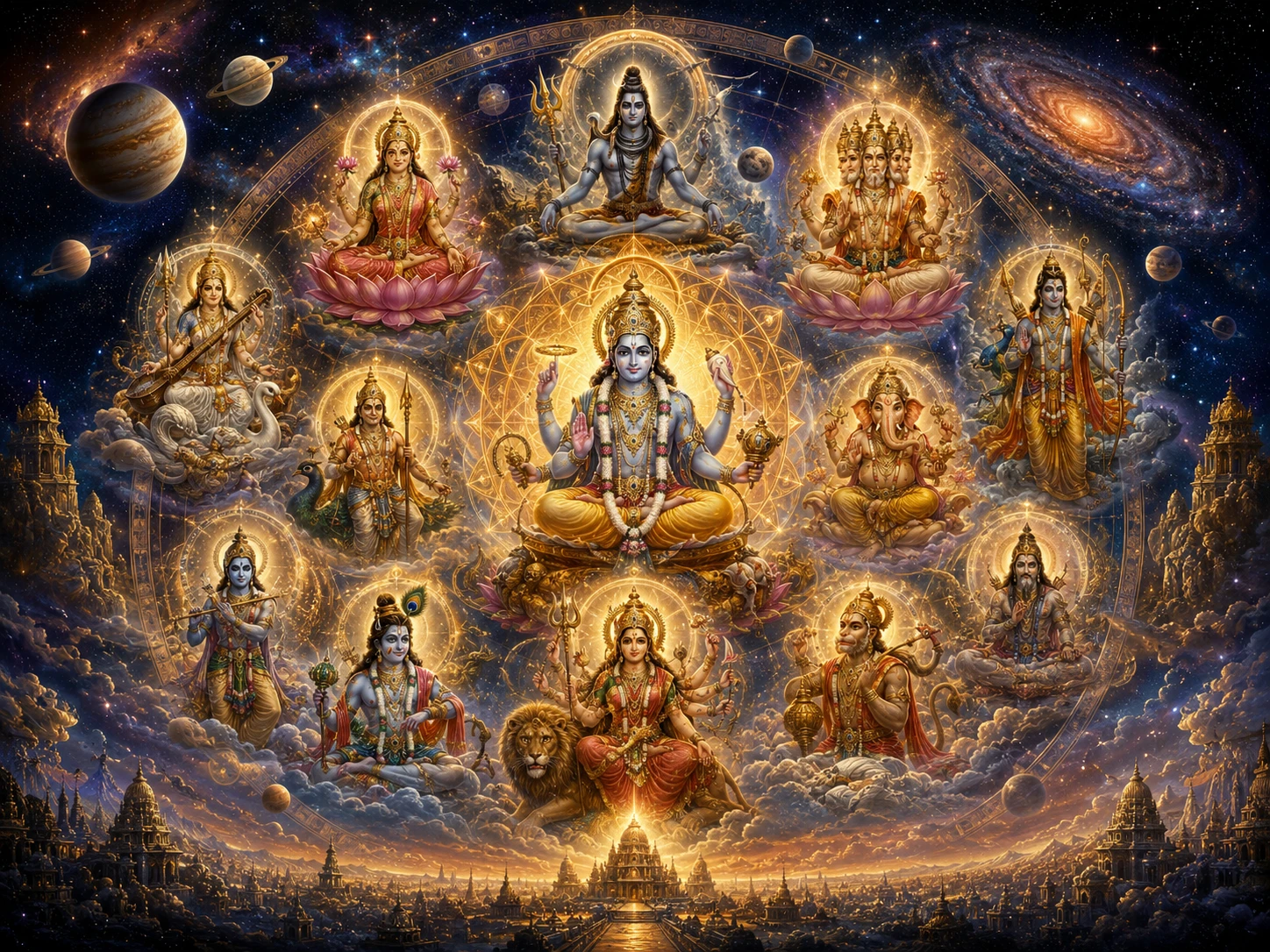
33 Koti Devata -- Why Hinduism Has 33 Types of Gods, Not 33 Crore
13 min read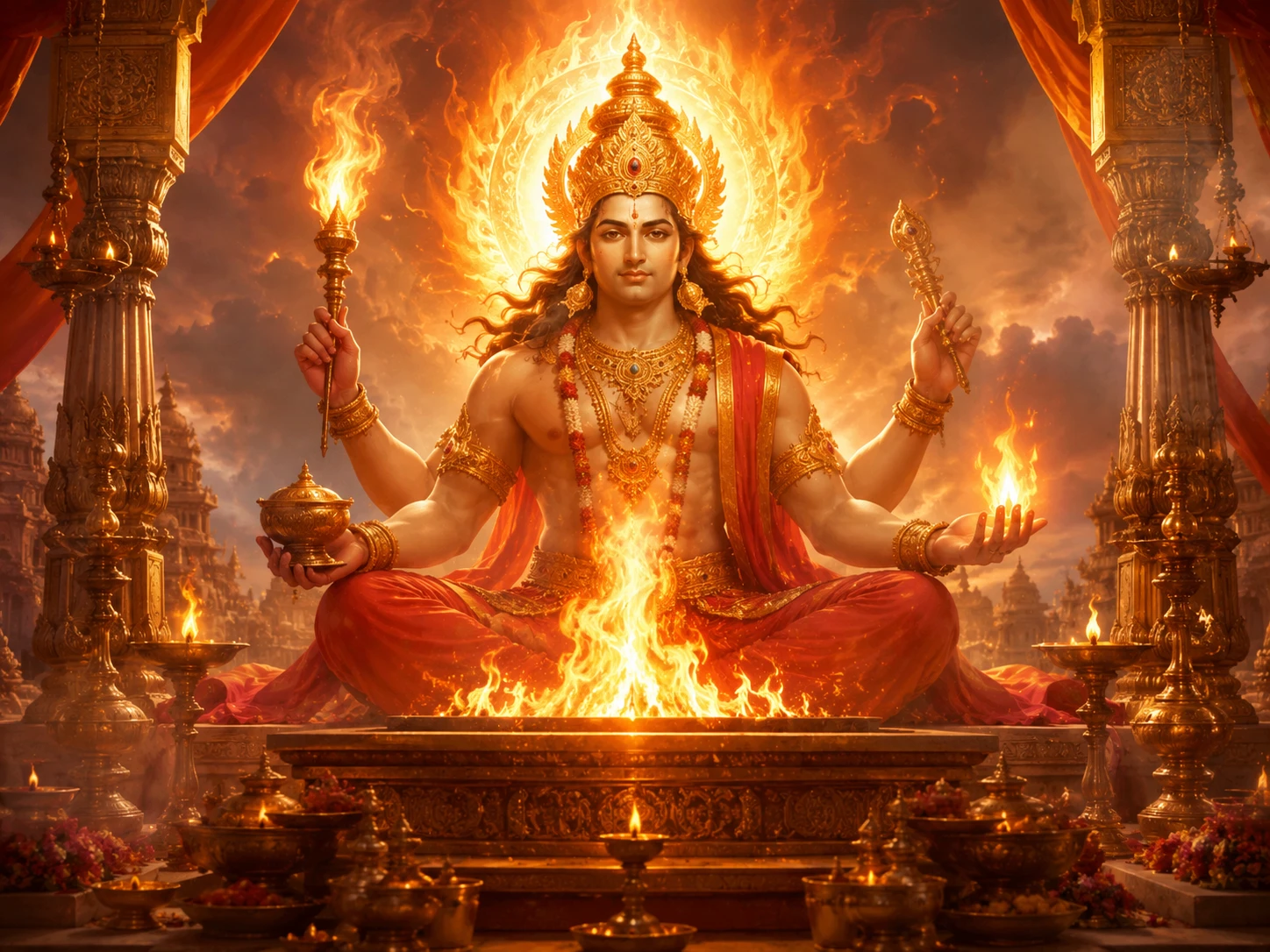
Agni -- The Fire God
19 min read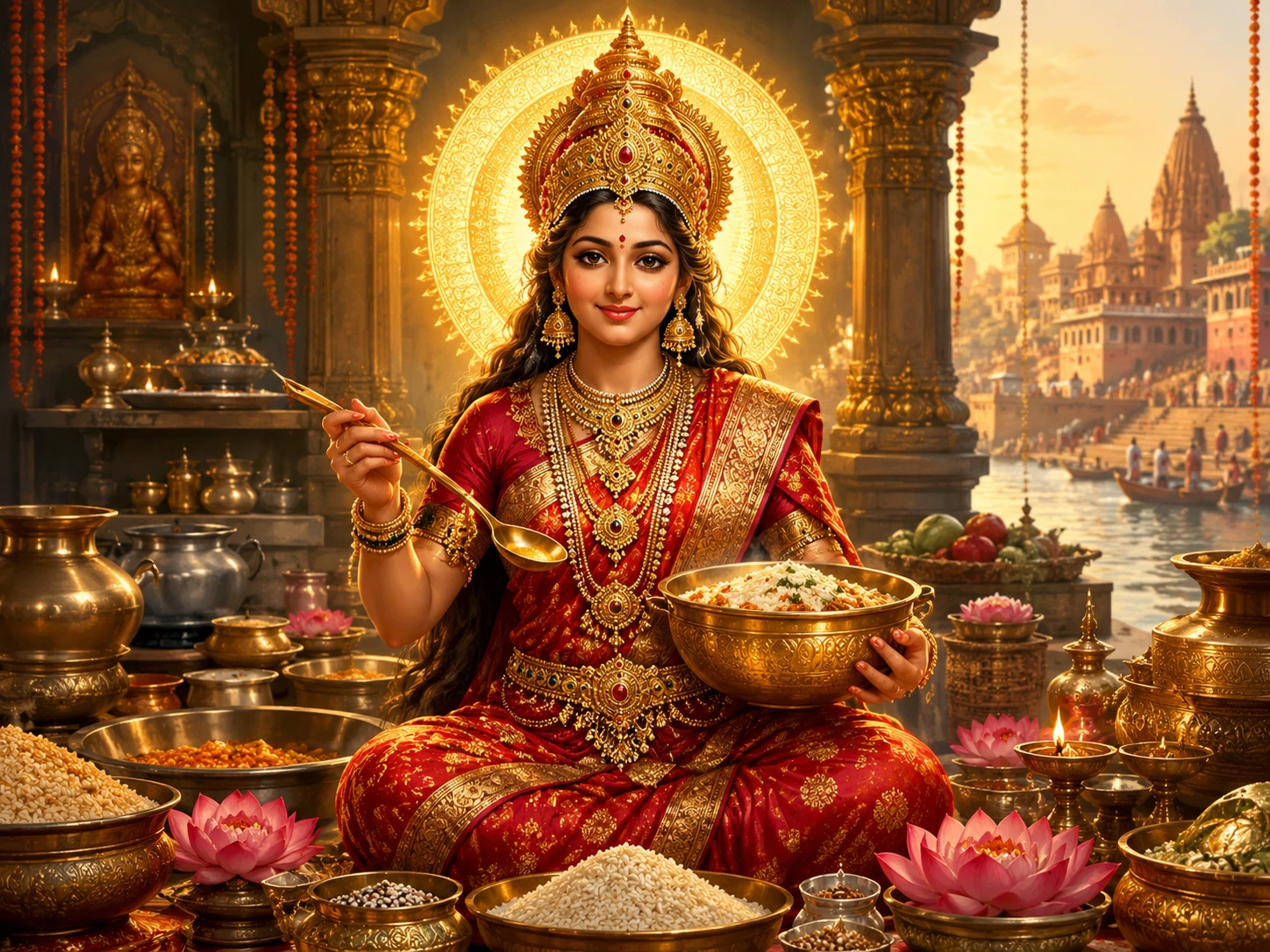
Annapurna -- Goddess of Food
19 min readThe same translation error that turned '33 Koti' into '33 crore' in Hinduism also happened in Buddhism. The Chinese translation of Buddhist texts rendered 'Sapta Koti Buddha' (7 Supreme Buddhas) as '7 Crore Buddhas.' The…
Deities AvatarsCommunity Reflections
🕉️
Be the first to share your reflection.