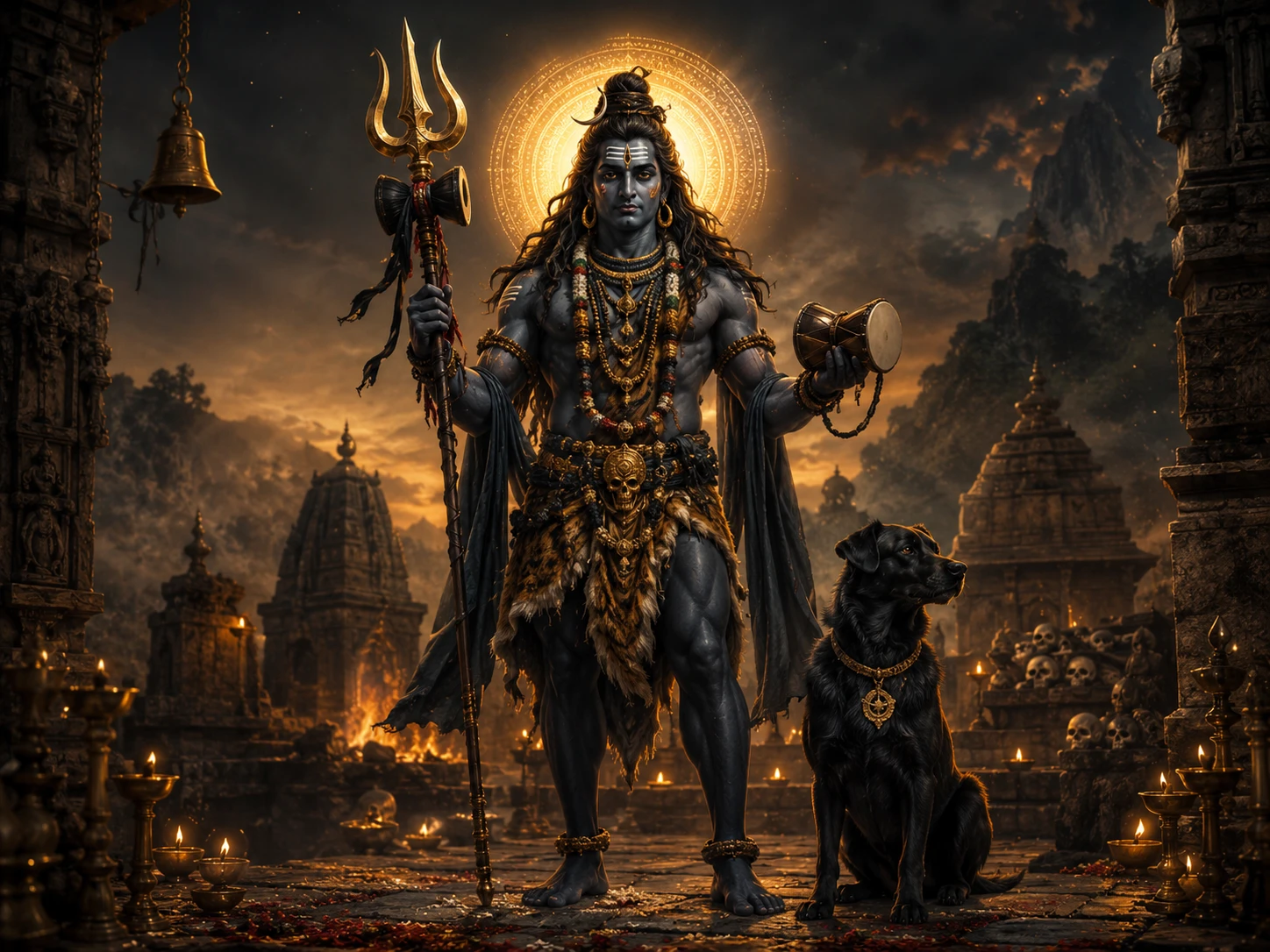
Bhairava -- Shiva's Fierce Form and the Guardian of Kashi
भैरव -- शिव का उग्र रूप और काशी के प्रहरी
The name 'Bhairava' comes from the root 'bhiru' -- fear. But the meaning is inverted. Bhairava does not mean 'the fearful one.' It means 'the one who destroys fear' or 'the one from whom fear itself flees.' The Shiva Purana derives the name from three syllables: 'Bha' from Bharana (sustenance), 'Ra' from Ravana (withdrawal/dissolution), and 'Va' from Vamana (emission/creation). Bhairava, by his name alone, contains the full cycle of the cosmos.
Every Hindu tradition has its fierce deity. Vishnu has Narasimha. Devi has Kali. Shiva's fierce form is Bhairava -- and he is arguably the most complex of the three. Because Bhairava is not simply fierce. He is fierce AND penitent. He committed the one act the Vedic universe considers the gravest sin -- Brahmahatya, the killing of a Brahmana (here, the cutting of Brahma's fifth head) -- and then transformed that sin into a journey of atonement that created one of Hinduism's most sacred pilgrimage practices.
This is the form of Shiva that does not comfort you. This is the form that confronts you. If Dakshinamurti is the teacher under the banyan tree (silence, patience, wisdom), Bhairava is the teacher in the cremation ground (urgency, mortality, no hiding). He strips away pretence. His iconography -- skull, cremation ash, dogs, midnight, intoxicants -- is designed to dismantle every social boundary between 'pure' and 'impure.' In Bhairava's presence, the categories collapse. There is only consciousness. Naked, undecorated, ash-smeared consciousness.
The Origin: Why Shiva Cut Brahma's Fifth Head
The Shiva Purana, Linga Purana, and Skanda Purana all narrate the origin story. Brahma originally had five heads. With his fifth head (which faced upward), he began to claim equality with -- or even superiority over -- Shiva. Some versions say he uttered disrespectful words. Others say he lusted after his own creation, Sandhya (the twilight goddess). The fifth head represented unchecked ego: the Brahmana's intellectual arrogance weaponised, the creator-god who forgets he too was created.
Shiva, to destroy this cosmic arrogance, manifested as Bhairava and cut off Brahma's fifth head with his left thumbnail (or, in some versions, with a trident). The severed head stuck to Bhairava's palm -- becoming the Kapala (skull-cup) that is his signature iconographic attribute.
But the act had consequences. Cutting a Brahmana's head is Brahmahatya -- the most severe sin in Vedic dharma. Even Shiva was not exempt. The skull fused to his hand and would not fall off. Bhairava wandered the three worlds as a Kapalika (skull-bearer), begging for alms in the skull-cup. This wandering penance is called 'Bhikshatana' -- Shiva as the divine beggar, reduced to the lowest social status, walking from place to place seeking the one location where the skull would finally fall and the sin be absolved.
That place was Kashi -- Varanasi. The moment Bhairava entered the sacred precincts of Kashi, the skull dropped from his hand. The sin was destroyed. The site where the skull fell is called Kapalamochana Tirtha (the pilgrimage ford of skull-release), and it is still visited by pilgrims today.
The teaching is extraordinary: even the Supreme Lord, when He acts within the framework of Dharma, accepts the consequences of His actions. Shiva did not use His omnipotence to avoid the penalty. He walked the full path of atonement. For any UPSC aspirant studying the principle of 'Rule of Law' -- the idea that no one is above the law -- this story from the Shiva Purana is the mythological foundation: even Mahadeva paid for Brahmahatya.
देवराजसेव्यमानपावनाङ्घ्रिपङ्कजं व्यालयज्ञसूत्रमिन्दुशेखरं कृपाकरम्। नारदादियोगिवृन्दवन्दितं दिगम्बरं काशिकापुराधिनाथकालभैरवं भजे॥
devaraajasevyamaanapaavanaa~Nghri pa~Nkajam vyaalayaj~nasuutram indushekharam kR^ipaakaraam | naaradaadiyogivR^indavanditam digambaram kaashikaapuraadhiNaatha kaalabhairavam bhaje ||
I worship Kala Bhairava, the lord of the city of Kashi, whose lotus feet are served by Indra the king of gods, who wears the serpent as sacred thread and the crescent moon as crown, who is the embodiment of compassion, who is revered by Narada and hosts of yogis, who is sky-clad (digambara).
— Kala Bhairava Ashtakam, Verse 1 (composed by Adi Shankaracharya)
The Ashta Bhairava -- Eight Fierce Forms
| Bhairava | Attribute | Direction | Shakti (Consort) | Function |
|---|---|---|---|---|
| Asitanga Bhairava | Dark-limbed | East | Brahmani | Protector. Guards the Eastern quarter. Removes obstacles born of ignorance. |
| Ruru Bhairava | Dog-form / Ferocious | South-East | Maheshwari | Destroyer of evil tendencies. Invoked to eliminate mental impurities. |
| Chanda Bhairava | Fierce / Violent | South | Kaumari | Punisher of the wicked. Enforcer of cosmic justice. |
| Krodha Bhairava | Wrathful | South-West | Vaishnavi | Destroys anger in the devotee by absorbing it. Paradox: the wrathful one who removes wrath. |
| Unmatta Bhairava | Intoxicated / Ecstatic | West | Varahi | Dissolution of ego through divine madness. The sacred fool. Associated with Tantric left-hand paths. |
| Kapala Bhairava | Skull-bearer | North-West | Indrani / Aindri | Bearer of the Brahmahatya skull. Teaches that sin carried consciously becomes tapas. |
| Bhishana Bhairava | Terror-inducing | North | Chamunda | Destroys fear by embodying it completely. Face your terror and it dissolves. |
| Samhara Bhairava | Annihilator | North-East | Chandika | Total dissolution. Death of the ego-self. The final Bhairava before liberation. |
The Ashta Bhairava form a complete mandala -- eight forms guarding eight directions, each paired with a Shakti, each addressing a specific spiritual obstacle. Together they create a protective ring around the devotee. This is why Bhairava worship is foundational in Tantric traditions: the eight Bhairavas cover every angle of spiritual danger. In Kashmir Shaivism, Bhairava is not merely a form of Shiva -- He IS the supreme reality (Parabrahman) in its most direct, unmediated expression.
Kala Bhairava: The Kotwal of Kashi
In Varanasi, Bhairava is not a minor deity in the corner of a temple. He is the Kotwal -- the city's guardian, its metaphysical police chief. The Kala Bhairava Temple, located on Vishwanath Gali (the lane leading to the Kashi Vishwanath Temple), is one of the most visited shrines in the city. Tradition holds that anyone who dies in Kashi attains Moksha, and Kala Bhairava is the one who administers this -- he whispers the Taraka Mantra (the liberating mantra) into the ear of the dying.
Pilgrims visiting Varanasi are traditionally advised to visit Kala Bhairava before leaving the city. The belief: if you depart without Bhairava's permission, Kashi will not let you go -- some obstacle, delay, or circumstance will keep you there. This is not superstition to the millions who practise it. It is protocol. You entered the sacred space. You must take leave from its guardian.
One of the most striking features of Kala Bhairava worship is the offering of liquor (Madira). In most Hindu temples, alcohol is strictly prohibited. At the Kala Bhairava temple, it is the primary offering. Devotees pour liquor directly onto the murti, and temple mythology holds that the deity drinks it. This is not an aberration. It is a Tantric principle: Bhairava transcends the pure/impure binary. What is poison to ordinary worship is nectar to the one who has conquered all categories. This is the same principle as Shiva drinking the Halahala poison -- what would destroy others is absorbed and transformed by the one whose consciousness is beyond classification.
The dog is Bhairava's vahana and constant companion. In orthodox Brahmanical tradition, dogs are considered impure. Bhairava rides one. He is the deity of those who live outside the mainstream -- ascetics, Aghoris, Nath Yogis, Kapalikas, wanderers, and anyone who has ever felt that the neat categories of respectable society do not contain them. For the loner in the back row of a Kota coaching class, for the queer student who does not fit the family's template, for the startup founder who dropped out and is working from a rented room -- Bhairava is the divine assertion that the margins are also sacred ground.
Adi Shankaracharya -- the same philosopher who established the four Mathas, systematised Advaita Vedanta, and is generally associated with the most intellectually refined strand of Hindu thought -- composed the Kala Bhairava Ashtakam, an eight-verse hymn of fierce devotion to the guardian of Kashi. This is the same Shankaracharya who also composed the serene Nirvana Shatakam ('Chidananda Rupah, Shivoham Shivoham'). The range is the point. The man who wrote the calmest philosophical statement in Sanskrit also wrote an ecstatic hymn to the most terrifying form of Shiva. In Hindu intellectual tradition, refinement and fierceness are not in tension. They are both expressions of a consciousness that refuses to exclude any mode of being.
In Kashmir Shaivism -- one of the most philosophically sophisticated schools of Hindu thought, developed by Abhinavagupta (10th-11th century CE) -- Bhairava is not a 'form' of Shiva. He IS the supreme reality. The foundational text of the tradition, the Bhairava Tantra (also called Vijnanabhairava Tantra), presents 112 meditation techniques (dharanas) that Bhairava teaches to his Shakti. The text opens with Shakti asking: 'What is your true nature, O Bhairava?' The 112 techniques that follow are the answer -- each one a doorway to experiencing supreme consciousness directly. This text has influenced not only Hindu meditation but also modern mindfulness and awareness-based practices globally. Several of the techniques (awareness of breath, awareness of the space between thoughts, awareness of the moment between waking and sleeping) have been independently 'discovered' by Western psychology and neuroscience in the 20th century.
Chant the Kala Bhairava Ashtakam
Eight verses by Shankaracharya. The guardian of Kashi. The protector of those who have nowhere else to go. Chant it on Saturday evenings -- Bhairava's sacred time -- and feel the fear dissolve.
Tags
Eternal Raga · शाश्वत राग
Institutional voice — scholarly articles on Sanatan Dharma
Deepen Your Understanding
अपनी समझ और गहरी करें
deities avatars
Who is Shiva?
He is the ash-smeared ascetic who is also the ideal husband. The destroyer of the universe who is called 'The Auspicious One.' The god of death who drank poison to save all life. He sits in meditation on a Himalayan peak, and simultaneously dances the cosmos into existence and annihilation. No deity in Hinduism contains more contradictions -- and no deity resolves them more completely. This is not a mythology explainer. This is an attempt to stand at the foot of the mountain and look up.
deities avatars
Nine Forms of Shiva -- The Many Faces of Mahadeva
He is the silent teacher under a banyan tree and the screaming destroyer on a battlefield. He is half-woman and half-man. He drank the poison that would have ended the universe and his throat turned blue. Nine scripturally-attested forms of Shiva -- from Nataraja to Rudra -- and why each one exists.
deities avatars
Nataraja -- The Cosmic Dancer
One foot crushes a dwarf. The other is raised in liberation. A ring of fire frames the dance. A drum beats creation into existence. An open palm says 'do not fear.' This is Nataraja -- Shiva as the Lord of Dance -- and it is the single most replicated Indian bronze in the history of art. The physicists at CERN chose it to stand outside the world's largest particle accelerator. The Chola bronzesmiths of Tamil Nadu perfected it a thousand years ago. And every time a subatomic particle appears and disappears, the cosmic dance continues.
deities avatars
Kali -- The Fierce Mother Who Devours Time Itself
Black-skinned, wild-haired, wearing a garland of fifty severed heads and a skirt of severed arms, standing on Shiva's chest with her tongue extended in shock -- Kali is the most misunderstood deity in Hinduism and the most theologically radical. She is not a demon. She is not 'dark energy.' She is Time in feminine form, the cosmic mother who destroys everything so that everything can be reborn. Ramakrishna called her 'Ma.' Millions still do.
philosophy darshana
Kashmir Shaivism -- The Philosophy of Divine Recognition
What if liberation is not about gaining something new but recognising what you already are? Kashmir Shaivism says you are already Shiva -- infinite, free, blissful consciousness. You have simply forgotten. The entire universe is Shiva's dance of self-concealment and self-recognition. Your job is to remember.
tantra mantra yantra
Tantra, Mantra and Yantra -- The Three Pillars of Spiritual Practice
Tantra is the loom, Mantra is the thread, Yantra is the pattern. Together they form the complete technology of spiritual transformation that India gifted to the world -- and they are far more profound than popular culture imagines.
tantra mantra yantra
Dasha Mahavidya -- Ten Wisdom Goddesses Who Map the Entire Universe
One holds her own severed head. Another is an ugly old widow. A third paralyses enemies by seizing their tongues. The Dasha Mahavidya are not comfortable goddesses. They are the ten dimensions of reality that most religions are too afraid to acknowledge -- from transcendent beauty to terrifying destruction, from cosmic abundance to abject poverty. Together, they form the most complete map of feminine divinity ever conceived.
Adi Shankaracharya -- the same philosopher who established the four Mathas, systematised Advaita Vedanta, and is generally associated with the most intellectually refined strand of Hindu thought -- composed the Kala Bhai…
More in Deities & Avatars
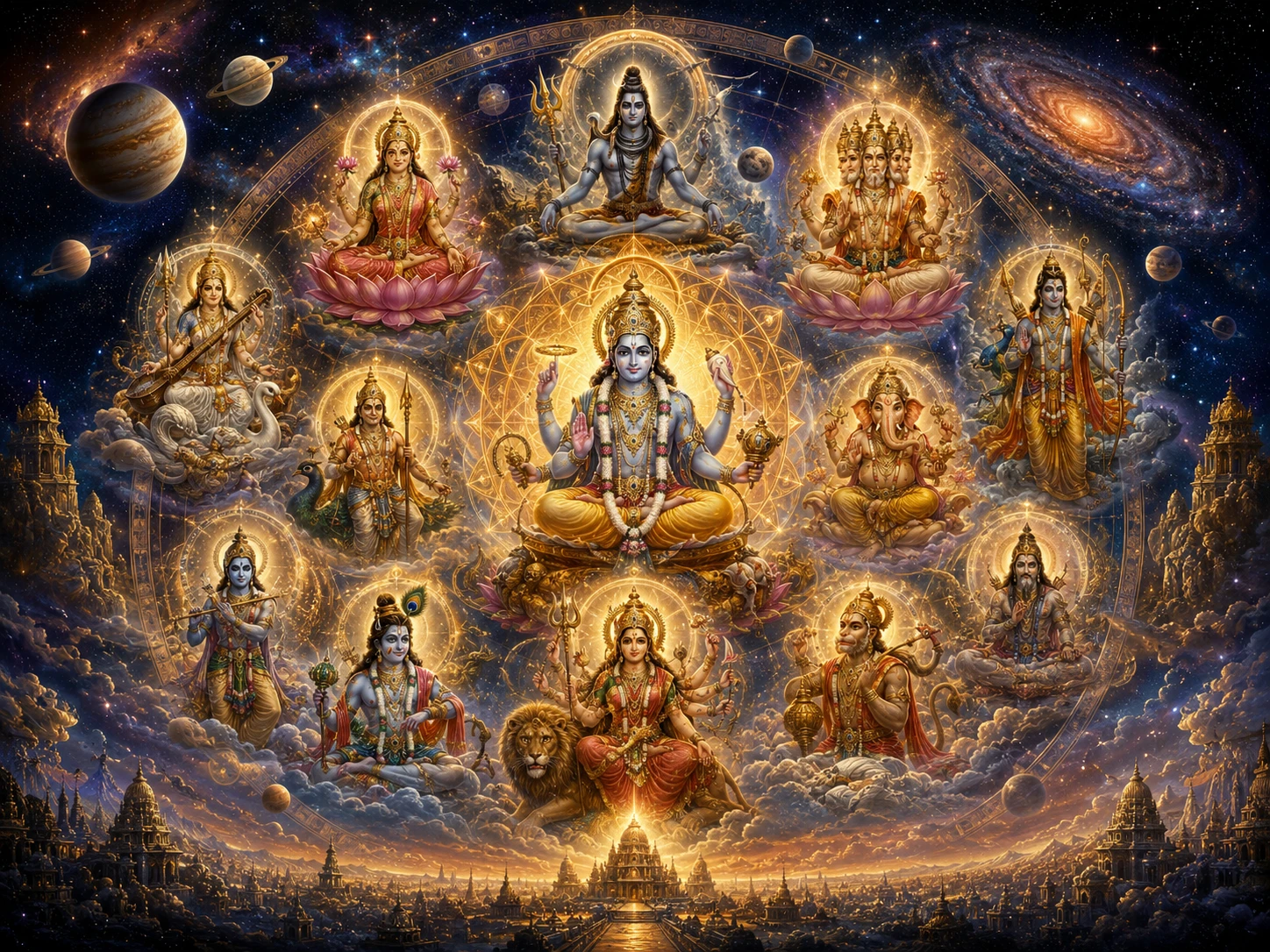
33 Koti Devata -- Why Hinduism Has 33 Types of Gods, Not 33 Crore
13 min read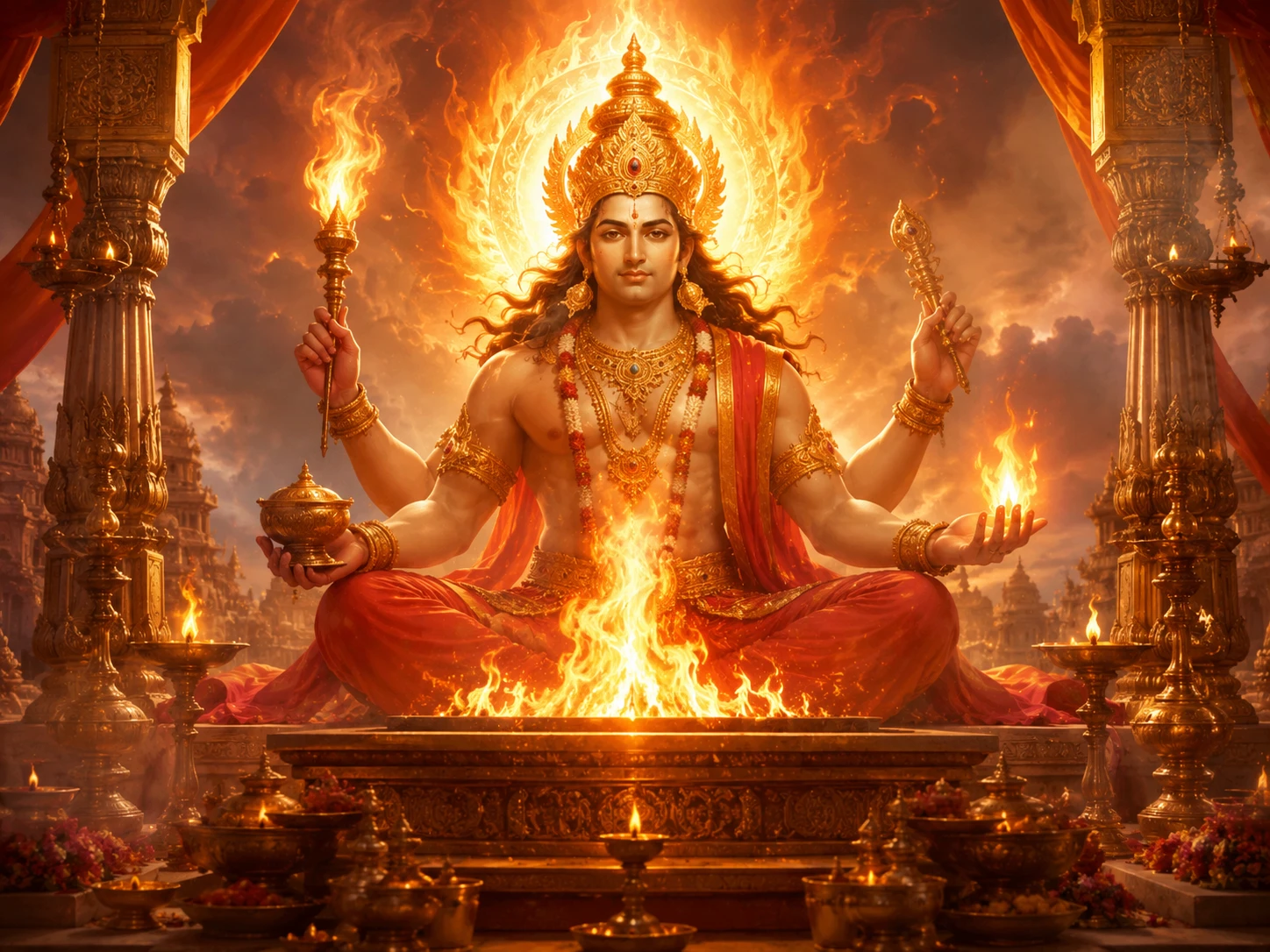
Agni -- The Fire God
19 min read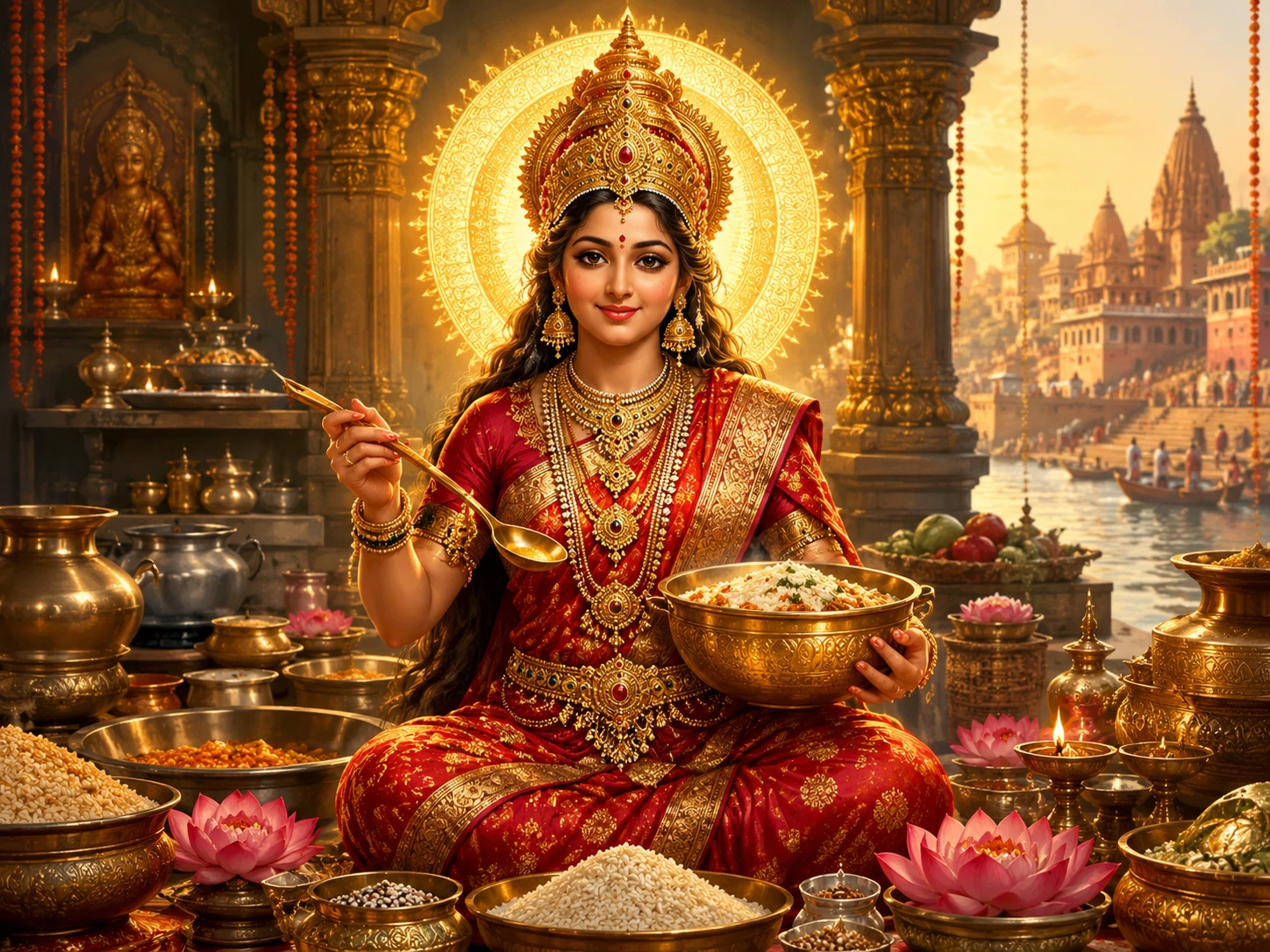
Annapurna -- Goddess of Food
19 min readThe same translation error that turned '33 Koti' into '33 crore' in Hinduism also happened in Buddhism. The Chinese translation of Buddhist texts rendered 'Sapta Koti Buddha' (7 Supreme Buddhas) as '7 Crore Buddhas.' The…
Deities AvatarsCommunity Reflections
🕉️
Be the first to share your reflection.