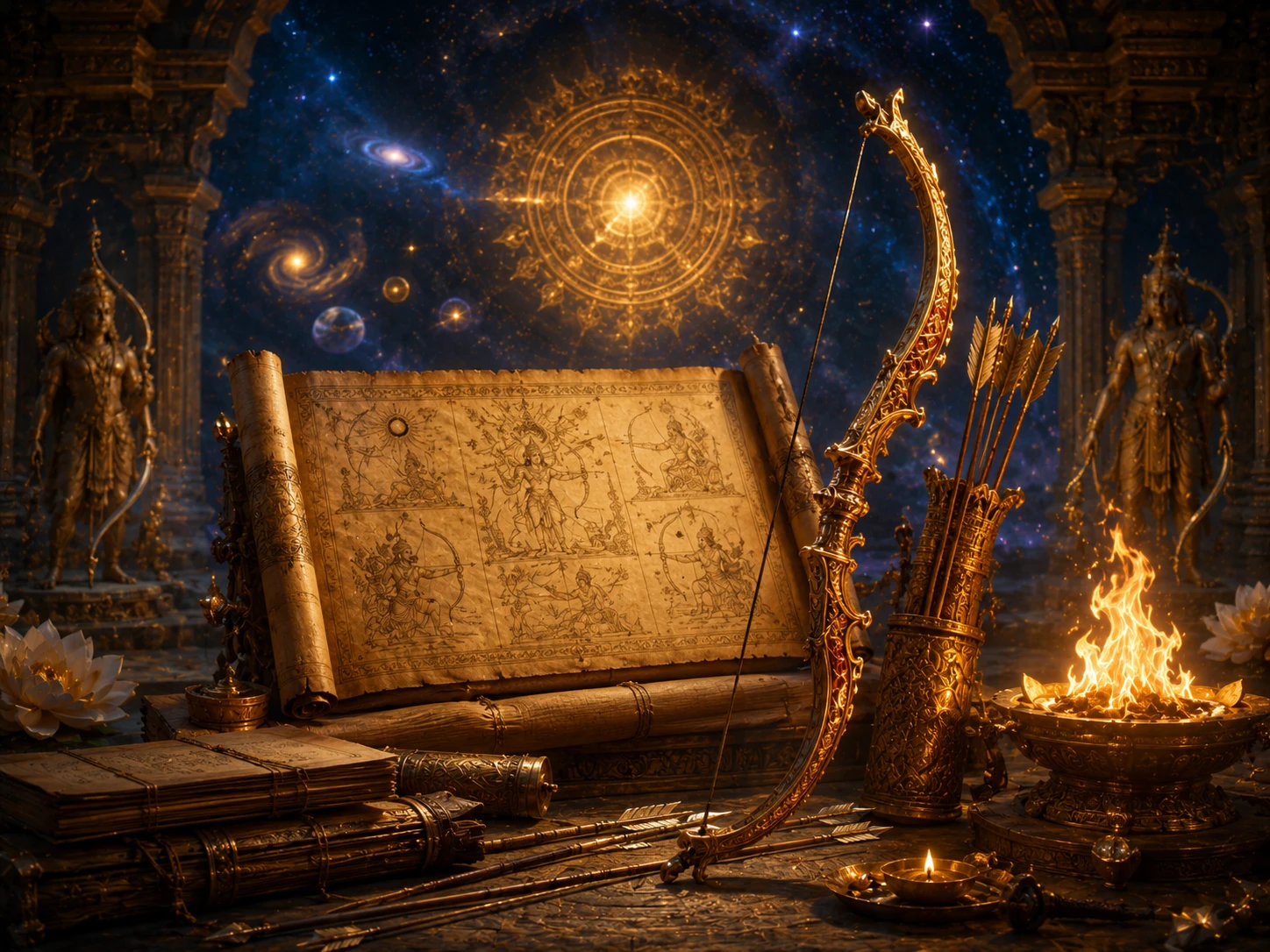
Dhanurveda in the Agni Purana -- India's Ancient Science of Warfare
अग्नि पुराण में धनुर्वेद -- भारत का प्राचीन युद्ध विज्ञान
Every cadet who enters the National Defence Academy in Khadakwasla, Pune, inherits a martial tradition that stretches back not centuries but millennia. The discipline of arms, the science of formations, the ethics of combat, the physical conditioning of the warrior body -- all of these were codified in a Sanskrit text called the Dhanurveda long before any European military manual existed.
Dhanurveda -- literally 'the knowledge (Veda) of the bow (Dhanus)' -- is classified in the Hindu knowledge system as an Upaveda (applied science) attached to the Yajur Veda. It sits alongside Ayurveda (medicine), Gandharvaveda (music and performing arts), and Sthapatyaveda (architecture) as one of the four practical extensions of Vedic knowledge. While the Vedas deal with cosmic truth and ritual, the Upavedas deal with worldly application. Dhanurveda is the application of Vedic principles to the art and science of warfare.
The word 'Dhanus' means bow, but the scope of Dhanurveda extends far beyond archery. Over time, the term came to encompass the entire spectrum of martial knowledge: armed and unarmed combat, weapon fabrication, military strategy, army organisation, siege warfare, naval operations, and the spiritual preparation of the warrior. It is the Indian equivalent of combining West Point's curriculum, a DRDO weapons manual, and a yoga teacher training into a single discipline.
The oldest surviving textual treatment of Dhanurveda is found in the Agni Purana (Chapters 248-252), dated between the 8th and 11th centuries CE. This text is understood to be an edited compilation of much older manuals -- the oral tradition places the original Dhanurveda in the Vedic period itself (1700-1100 BCE), attributed variously to the sages Bhrigu, Vishvamitra, or Bharadvaja. While the original texts are lost, their influence survives in the epics. When Drona teaches the Pandavas and Kauravas at his ashram, when Parashurama instructs Karna in weapons, when Arjuna obtains divine astras from Indra and Shiva -- they are all operating within the Dhanurvedic tradition.
For the UPSC aspirant studying Ancient Indian History, the NDA cadet studying military heritage, or the Kalaripayattu practitioner in Kerala tracing the roots of their art -- the Dhanurveda is the foundational text of Indian martial civilisation.
धनुर्वेदं प्रवक्ष्यामि चतुष्पादं द्विजोत्तम। रथाश्वगजपादातयोधाश्रितमुच्यते॥
dhanurvedaṃ pravakṣyāmi catuṣpādaṃ dvijottama | rathāśva-gaja-pādāta-yodhāśritam ucyate ||
O best of Brahmins, I shall describe the Dhanurveda in four sections. It rests upon warriors of chariots, horses, elephants, and infantry.
— Agni Purana, Chapter 249 (opening verse)
Five Warrior Divisions and Five Weapon Classes
The Agni Purana's Dhanurveda section organises military training into five warrior divisions (Yodha Vibhaga), each specialised for a different mode of combat.
Rathika (Chariot Warriors): The elite of the Vedic battlefield. Chariot warfare required the combined skills of a driver (Sarathi) and a fighter -- the driver manoeuvred the vehicle while the warrior fired arrows, hurled javelins, or engaged in close combat. Arjuna-Krishna and Karna-Shalya are the epic archetypes. The rathika trained in archery from a moving platform, tactical coordination with the charioteer, and the physics of firing at targets while in motion -- essentially an ancient drive-by combat system.
Gajika (Elephant Warriors): The heavy armour division. Elephant-mounted warriors served as mobile fortresses -- the tanks of the ancient battlefield. Training included mahout skills, platform combat, and the art of directing an elephant in formation without being thrown.
Ashvarohi (Cavalry): Fast-strike mounted warriors. Horse-borne combat required mastery of lance, sword, and bow while controlling a galloping horse with the knees. The Maratha light cavalry that terrorised the Mughal empire was a direct descendant of this tradition.
Padati (Infantry): The backbone of any army. Infantry training covered swordsmanship, spear fighting, shield work, and hand-to-hand combat. The Agni Purana describes nine combat stances (Asanas) for infantry fighters -- body positions optimised for attack, defence, and counterattack.
Mushtika (Wrestlers/Unarmed Combatants): The Malla-Yuddha specialists. This division trained in wrestling, boxing (Musti-Yuddha), grappling, and unarmed self-defence. Bhima and Duryodhana's final battle on Day 18 of Kurukshetra was a Mushtika contest.
Paralleling the five warrior types, the Agni Purana classifies all weapons into five categories: Yantra-Mukta (machine-projected -- arrows, missiles from catapults), Hasta-Mukta (hand-thrown -- javelins, spears, chakras), Mukta-Sandharita (thrown but retained -- the noose or pasha, weighted ropes), Hasta-Dharita (permanently held -- swords, maces, daggers), and Bahu-Yuddha (the hands themselves -- boxing, wrestling, pressure point strikes).
This five-by-five matrix -- five warrior types trained in five weapon classes -- creates a comprehensive military curriculum that accounts for every combat scenario from long-range archery to close-quarters grappling. The NDA cadet studying combined-arms doctrine today is essentially following the same principle: different combat situations demand different warrior specialisations and different weapons systems, and the mark of a complete military force is mastery across all five domains.
The Five Weapon Classes of Dhanurveda
| Weapon Class | Sanskrit Term | Mechanism | Examples | Modern Equivalent |
|---|---|---|---|---|
| Machine-projected | Yantra-Mukta | Launched by mechanical device (bow, catapult) | Arrows, Astras, catapult stones, fire missiles | Artillery, missiles, firearms |
| Hand-thrown | Hasta-Mukta | Thrown by hand and released | Javelin (Shakti), spear, Sudarshana-type discus | Grenades, thrown weapons |
| Thrown but retained | Mukta-Sandharita | Thrown and pulled back or retained via rope | Noose (Pasha), weighted chain, rope-dart | Tethered weapons, recovery systems |
| Permanently held | Hasta-Dharita | Stays in hand throughout combat | Sword (Khadga), mace (Gada), axe (Parashu), dagger | Bayonet, combat knife, baton |
| Bare hands | Bahu-Yuddha | The body itself as weapon | Wrestling (Malla-Yuddha), boxing (Musti-Yuddha), grappling | Hand-to-hand combat, martial arts |
The five-class system accounts for every range of combat: from beyond visual range (Yantra-Mukta) to skin-to-skin contact (Bahu-Yuddha). This range-based classification anticipates modern military doctrine's distinction between strategic, operational, tactical, and close-quarters combat.
Dhanurveda's Living Legacy -- From Kalaripayattu to the Indian Armed Forces
Dhanurveda is not a dead text. Its principles survive in living martial traditions across India.
Kalaripayattu, the martial art of Kerala often called the oldest fighting system in the world, traces its lineage directly to the Dhanurvedic tradition. The Kalari (training hall) reproduces the Dhanurvedic curriculum: students progress through unarmed combat (Bahu-Yuddha equivalent), stick fighting, dagger and shield work, spear combat, and sword fighting -- covering four of the five weapon classes. The marma-point strikes taught in advanced Kalaripayattu correspond to the vital-point combat described in Dhanurvedic texts and elaborated in Ayurvedic surgical manuals.
Gatka, the Sikh martial art of Punjab, preserves the sword-and-shield combat of the Hasta-Dharita class. Silambam from Tamil Nadu preserves staff fighting. Malla-Yuddha survives in traditional wrestling akhadas across Uttar Pradesh, Maharashtra, and Karnataka. Thang-Ta from Manipur preserves sword-and-spear traditions. Each of these is a regional branch of the Dhanurvedic tree.
The Indian Armed Forces carry Dhanurvedic DNA in ways both symbolic and structural. The Rajputana Rifles, the Maratha Light Infantry, and the Gorkha Rifles all trace their martial ethos to pre-colonial warrior traditions rooted in Dhanurvedic principles. The Commando Wing at CIJWS (Counter Insurgency and Jungle Warfare School) in Vairengte, Mizoram, teaches hand-to-hand combat techniques that share structural similarities with Kalaripayattu. DRDO's missile programme names its weapons after Vedic and epic astras -- Agni, Prithvi, Akash, Nag, Trishul, Brahmos -- a direct acknowledgement that modern Indian defence sees itself as heir to the Dhanurvedic tradition.
For the defence aspirant preparing for NDA, CDS, or CAPF exams: Dhanurveda appears in questions about ancient Indian military organisation, Vedic knowledge systems, and the Upaveda classification. Understanding that India had a formalised military science millennia before Clausewitz or Napoleon transforms how you approach Indian history -- not as a civilisation that was conquered because it lacked military knowledge, but as one whose military knowledge was among the most sophisticated in the ancient world.
The Nine Combat Stances -- Dhanurveda's Body Science
Beyond weapons and warrior types, the Agni Purana devotes significant attention to the warrior's body itself -- how it should be positioned, how weight should be distributed, and how the relationship between stance and strike determines combat effectiveness.
Nine combat stances (Yuddha Asanas) are prescribed: Vaishnava (standing with weight on the front foot, named after Vishnu's protective forward posture), Samapada (equal weight on both feet -- the neutral ready position), Vistrita (wide stance with feet apart for stability), Pratyalidha (aggressive forward lunge with the left foot forward), Alidha (the reverse lunge with right foot forward), Mandala (circular stance for defence against multiple attackers), and three others that vary by textual tradition.
These stances encode biomechanical principles that modern sports science would recognise immediately. Pratyalidha, for example, mirrors the stance a modern boxer takes when throwing a cross -- weight transferred forward to maximise power delivery through the kinetic chain from foot to fist (or arrow). Samapada mirrors the balanced ready position in martial arts worldwide. Mandala mirrors the circular defensive footwork taught in Kalaripayattu, Wing Chun, and Capoeira.
The text also describes the archer's grip, the angle of draw, the point of release, and the follow-through -- technical details that would not be out of place in an Olympic archery coaching manual. The emphasis on breathing during the draw (a controlled exhale at the moment of release) anticipates the modern understanding that respiratory control reduces hand tremor and improves accuracy.
For the sports science student at LNIPE Gwalior or the physiology student preparing for competitive exams: the Dhanurveda's biomechanical observations are empirical. They were derived from centuries of battlefield testing, not laboratory measurement. But the convergence with modern kinesiological principles is remarkable -- suggesting that careful observation of human movement produces similar insights regardless of the era or the methodology.
Spiritual Preparation of the Warrior -- Dhanurveda's Inner Dimension
What distinguishes the Dhanurveda from all other ancient martial manuals -- including Sun Tzu's Art of War, Vegetius's De Re Militari, or Miyamoto Musashi's Book of Five Rings -- is its insistence that physical combat training is inseparable from spiritual practice.
The Agni Purana explicitly states that Brahmins and Kshatriyas can teach Dhanurveda -- placing the priestly and warrior classes as co-custodians of martial knowledge. This is not a caste restriction but a knowledge framework: the Brahmin brings the mantra dimension (the spiritual technology of weapon activation through Astra invocation), while the Kshatriya brings the physical dimension (combat technique, formation strategy, battlefield command). The complete warrior requires both.
The epics illustrate this principle repeatedly. Dronacharya is a Brahmin who teaches weapons to Kshatriya princes -- he masters both the mantra and the martial. Parashurama, a Brahmin by birth, is simultaneously a supreme warrior. Arjuna, a Kshatriya, spends years in tapas to receive divine weapons from Indra and Shiva. The boundary between priest and warrior dissolves at the highest levels of Dhanurvedic practice because ultimate combat effectiveness requires spiritual mastery -- the ability to invoke and control forces that transcend the physical plane.
This integrated approach -- body, mind, and spirit trained as a single system -- is what makes Dhanurveda unique. A warrior who trains only his body can fight. A warrior who trains body and mind can strategise. A warrior who trains body, mind, and spirit can invoke divine weapons, see through the chaos of battle with transcendent clarity, and -- most importantly -- maintain dharmic conduct even when every instinct screams for unrestricted violence. Arjuna on the chariot, guided by Krishna, is the archetype: a warrior whose physical skill is matched by spiritual wisdom, making him not just effective but ethical.
For the Indian Armed Forces officer who begins each day with the regimental prayer, for the NDA cadet who participates in temple parades alongside drill, for the Kalaripayattu student who begins every session with a prayer to Parashurama and Ganesha -- the Dhanurvedic integration of martial and spiritual training is not an ancient curiosity. It is a living inheritance.
The Agni Purana's Military Curriculum -- Chapters 248 to 251
The Dhanurveda section of the Agni Purana occupies four consecutive chapters (248-251), and reading them in sequence reveals a structured military curriculum that moves from theory to practice with surprising pedagogical sophistication.
Chapter 248 begins with taxonomy -- the classification of weapons into five categories (Yantra-mukta, Pani-mukta, Mukta-sandharita, Amukta, and Bahuyuddha) and the classification of warriors into four divisions based on their primary weapon specialisation. This is the foundation course: before you learn to fight, you learn the conceptual architecture of warfare. An NDA first-year cadet studying Military History and Fundamentals of Warfare would recognise this as doctrine before drills.
Chapter 249 moves to the bow -- the supreme weapon of the Dhanurvedic tradition and the weapon from which the entire science takes its name (Dhanus = bow). It covers bow types (the Karmuka, Kodanda, and others differentiated by construction material -- bamboo, horn, and composite), string materials (sinew, plant fibre, silk), arrow types categorised by head shape (leaf-blade, crescent, pronged, and blunt for different tactical purposes), and the physics of the draw-release-flight cycle. The level of technical detail anticipates the modern engineering approach to projectile dynamics: the Agni Purana distinguishes between arrows designed for penetrating armour, arrows designed for cutting (severing chariot reins or horse harnesses), and arrows designed for incendiary effect.
Chapter 250 covers the training of war horses and elephants -- the armoured divisions of the ancient battlefield. Horse breeds are classified by region (Kamboja horses from Central Asia were the most prized, followed by Sindhi breeds and Arabian imports). Elephant battle tactics (the Gaja-yuddha) cover formations, signalling systems, and the specific vulnerabilities of war elephants (the trunk joint, the area behind the ear, and the feet). The Mahabharata's battle descriptions become significantly more comprehensible once you have read this chapter -- the specific tactical problems of managing elephant charges and cavalry flanking manoeuvres are Agni Purana content applied to narrative.
Chapter 251 addresses the chariot -- the apex weapon platform of the Vedic battlefield. Chariot construction specifications (axle length, wheel diameter, platform height, canopy dimensions) are detailed enough that a modern engineer could produce a working prototype. Chariot warfare tactics include the circling manoeuvre (Pradakshina-yuddha), the frontal charge (Abhimukha), and the tactical withdrawal (Apasarpana) -- each with specific situations where it is appropriate and counterproductive.
The four-chapter sequence mirrors modern military academy pedagogy: strategic concepts first, then individual weapons training, then combined arms (horses, elephants, chariots together), then formation-level operations. The NDA's own three-year curriculum follows an analogous progression: first year (foundations), second year (specialisation), third year (combined operations). The structural parallel suggests that the problem of training warriors has a natural pedagogical solution that military educators have independently discovered across millennia.
What the Agni Purana adds that no modern curriculum does is the fifth dimension: mantra. Interwoven through all four chapters are references to the spiritual preparation required for combat -- the specific mantras to be chanted before stringing a bow, before mounting a horse, before entering a chariot for battle. The modern combat briefing covers intelligence, weather, terrain, and enemy disposition. The Dhanurvedic briefing added one more variable: cosmic alignment. And for the young officer at the Officers Training Academy in Chennai who privately seeks temple blessings before a posting to a difficult sector, the Dhanurvedic fifth dimension is not ancient history. It is personal practice.
The Agni Purana's Dhanurveda section describes nine combat stances (Asanas) for warriors -- body positions optimised for attack, defence, and counterattack. These include Vaishnava (standing with weight on the front foot), Samapada (equal weight distribution), and Pratyalidha (lunging stance). Modern Kalaripayattu practitioners in Kerala still use stances that are structurally identical to these Agni Purana descriptions. The continuity spans at least 1,200 years of documented practice -- and possibly much longer through oral transmission. Meanwhile, the Indian Army's Commando training manual at the CIJWS (Counter Insurgency and Jungle Warfare School) in Mizoram includes close-quarters combat techniques that instructors privately acknowledge share roots with traditional Indian martial arts, though the official curriculum frames them as modern CQB (Close Quarters Battle) doctrine.
Explore the Warrior Tradition -- Begin with Warrior Meditation
The Dhanurvedic tradition begins with mental discipline before physical training. Sit for ten minutes daily with a single point of focus, in the spirit of Arjuna's ekagrata -- the mental foundation of every great warrior in the epics. Pair it with 108 repetitions of Om Gam Ganapataye Namah on a mala before any major challenge. The dharanas in the Meditate section give simple objects to begin with.
Tags
Eternal Raga · शाश्वत राग
Institutional voice — scholarly articles on Sanatan Dharma
Deepen Your Understanding
अपनी समझ और गहरी करें
divine arsenal
Astra vs Shastra -- The Two Classes of Weapons in Hindu Warfare
One is hurled with mantras and divine invocation. The other is wielded by hand and muscle. Understanding the fundamental difference between Astra and Shastra unlocks the entire weapons philosophy of ancient India.
divine arsenal
10 Weapons That Changed the War
Across the Ramayana and Mahabharata, certain weapons did not merely kill -- they altered the course of history. From Rama shattering Shiva's bow to win Sita, to the Shakti that saved the Pandavas by killing the one person it should not have, these ten weapon-moments are the pivot points on which two epics turn.
divine arsenal
Rules of War -- Dharmayuddha and the Geneva Conventions
Three thousand years before the Geneva Conventions, Indian warriors debated whether you could strike a man who had dropped his weapon. The Mahabharata's rules of engagement cover night fighting bans, non-combatant immunity, treatment of prisoners, proportional force, and the use of weapons of mass destruction -- and then shows what happens when every single rule is broken.
divine arsenal
Ancient Indian Martial Arts -- Kalaripayattu to Malla-Yuddha
India may have invented the concept of systematic combat training. Kalaripayattu is arguably the oldest martial art on earth. Malla-Yuddha produced wrestlers who fought Alexander's soldiers. Gatka armed the Sikh Khalsa. Silambam inspired Filipino Eskrima. From Parashurama's legendary training grounds in Kerala to Akharas still operating in Varanasi -- Indian martial arts are the unacknowledged root of half the world's fighting systems.
divine arsenal
The Celestial Bows -- Pinaka, Gandiva, Sharanga, Vijaya and the Sacred Art of Dhanurvidya
Five bows shaped the fate of two great epics. Forged by Vishwakarma and Brahma, wielded by Shiva, Rama, Arjuna, Vishnu, and Karna -- these were not mere weapons but extensions of cosmic will. Know their origins, their powers, and the warriors who earned them.
divine arsenal
Vyuha Formations -- The Strategic Chess of Kurukshetra
Eighteen formations deployed across eighteen days. Every morning, the commander-in-chief chose a shape -- eagle, lotus, crescent, thunderbolt, tortoise, crocodile -- and nearly four million soldiers rearranged themselves accordingly. Each vyuha had a counter-vyuha. Each counter had a counter-counter. The Mahabharata's battle tactics are the world's oldest documented game theory -- played with real armies on a real field.
divine arsenal
Akshauhini -- The Epic Army Structure Where Every Digit Sums to 18
1 chariot. 1 elephant. 3 horses. 5 foot soldiers. That is the Patti -- the smallest tactical unit of the Mahabharata's military system. Multiply it through nine hierarchical levels and you get the Akshauhini: 218,700 warriors. Multiply that by 18 and you get the Kurukshetra War: nearly four million soldiers arranged in the most precisely documented military hierarchy in all of ancient literature.
The Agni Purana's Dhanurveda section describes nine combat stances (Asanas) for warriors -- body positions optimised for attack, defence, and counterattack. These include Vaishnava (standing with weight on the front foot…
More in Divine Arsenal
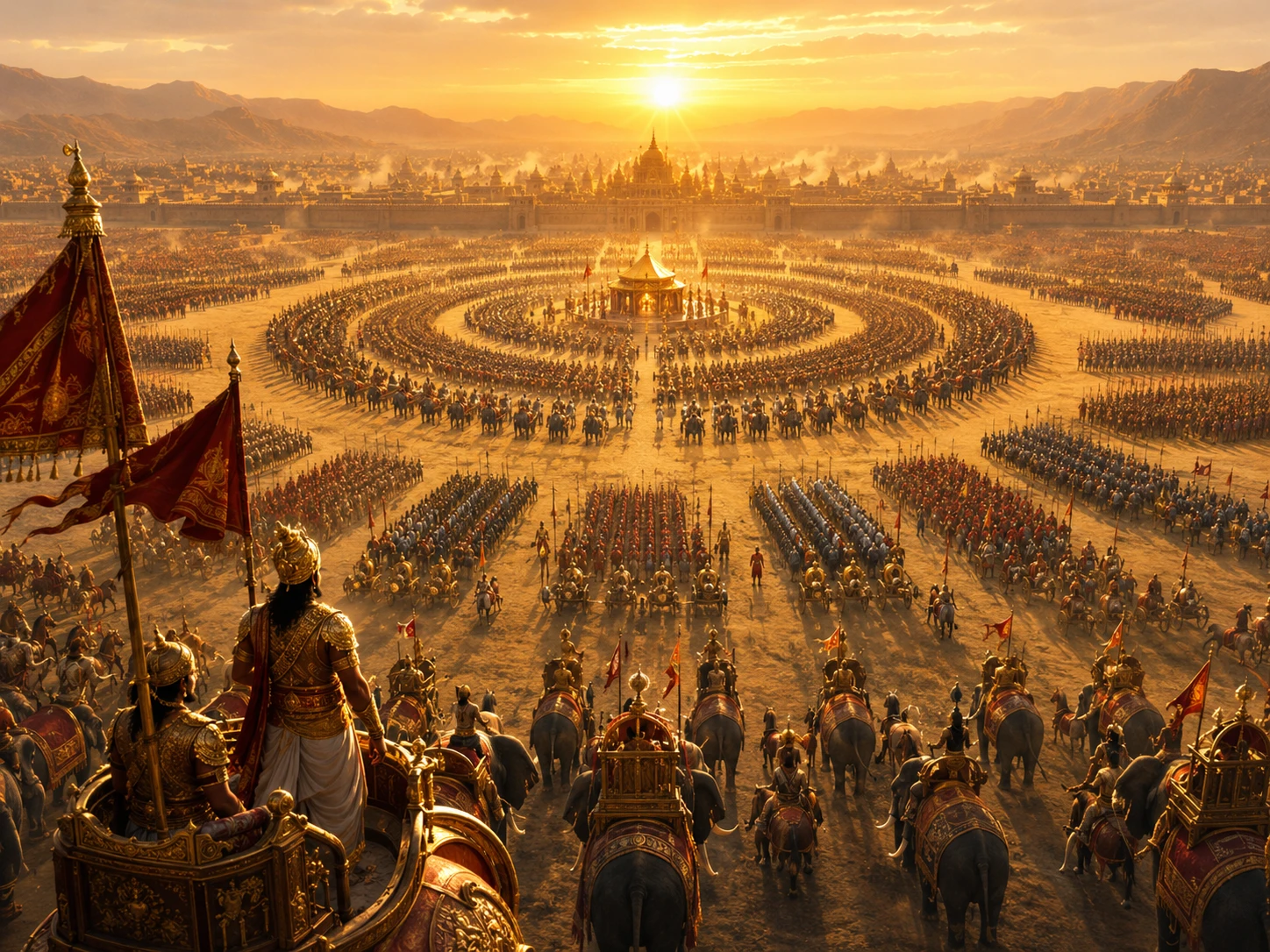
Akshauhini -- The Epic Army Structure Where Every Digit Sums to 18
14 min read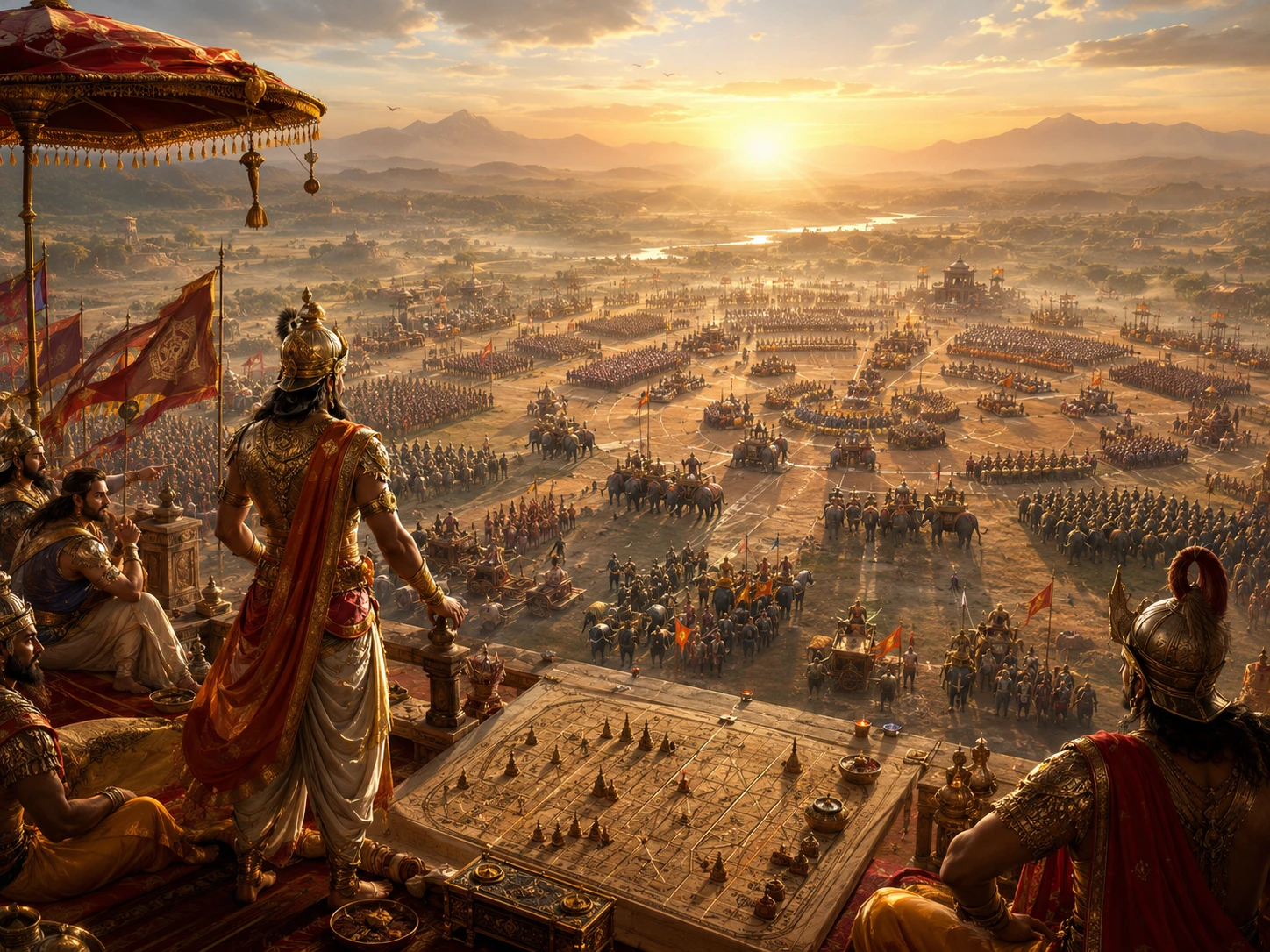
Ancient Indian Martial Arts -- Kalaripayattu to Malla-Yuddha
14 min read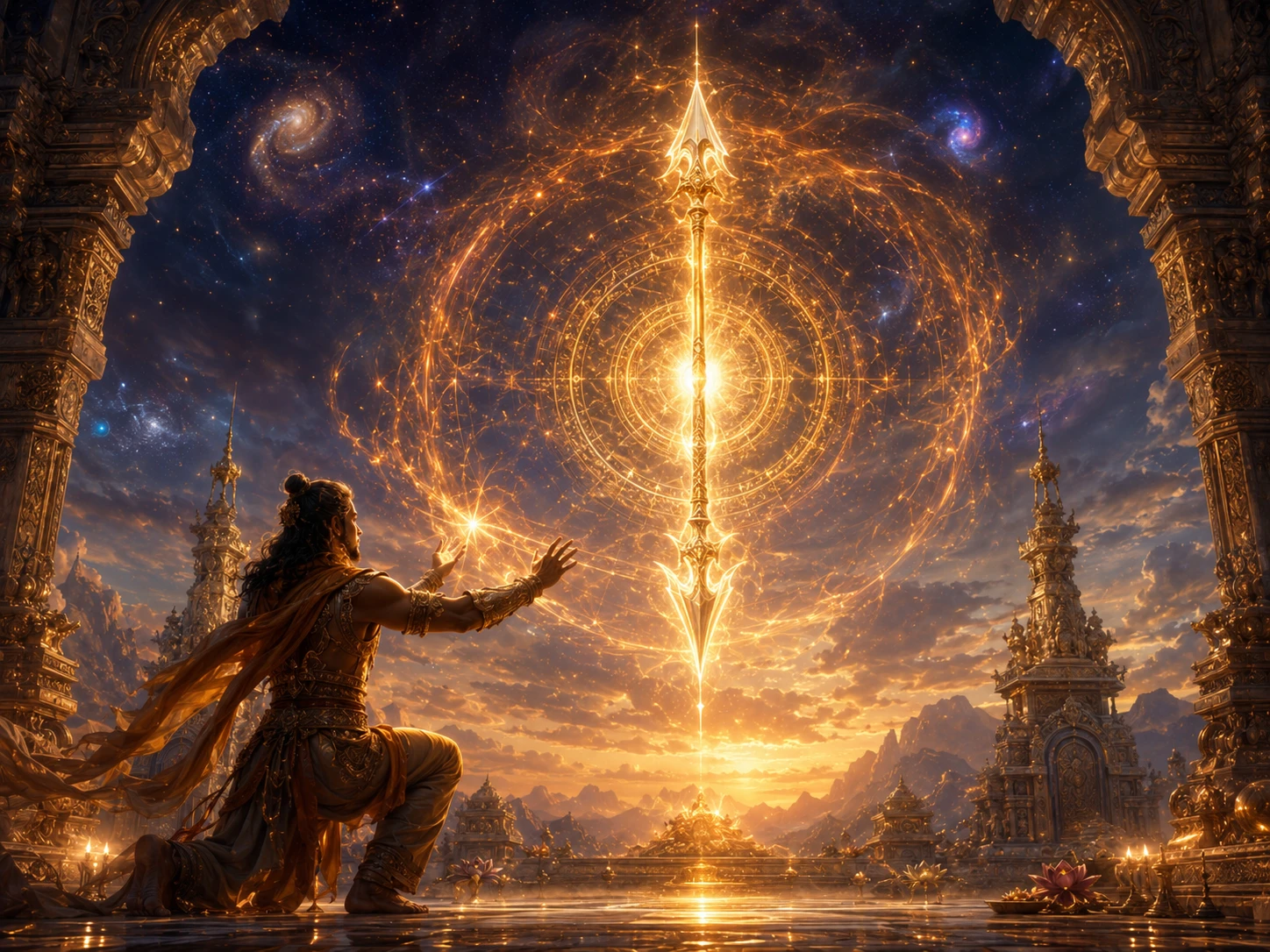
Astra Invocation and Withdrawal -- The Ritual of Weapons
16 min readThe same translation error that turned '33 Koti' into '33 crore' in Hinduism also happened in Buddhism. The Chinese translation of Buddhist texts rendered 'Sapta Koti Buddha' (7 Supreme Buddhas) as '7 Crore Buddhas.' The…
Deities AvatarsCommunity Reflections
🕉️
Be the first to share your reflection.