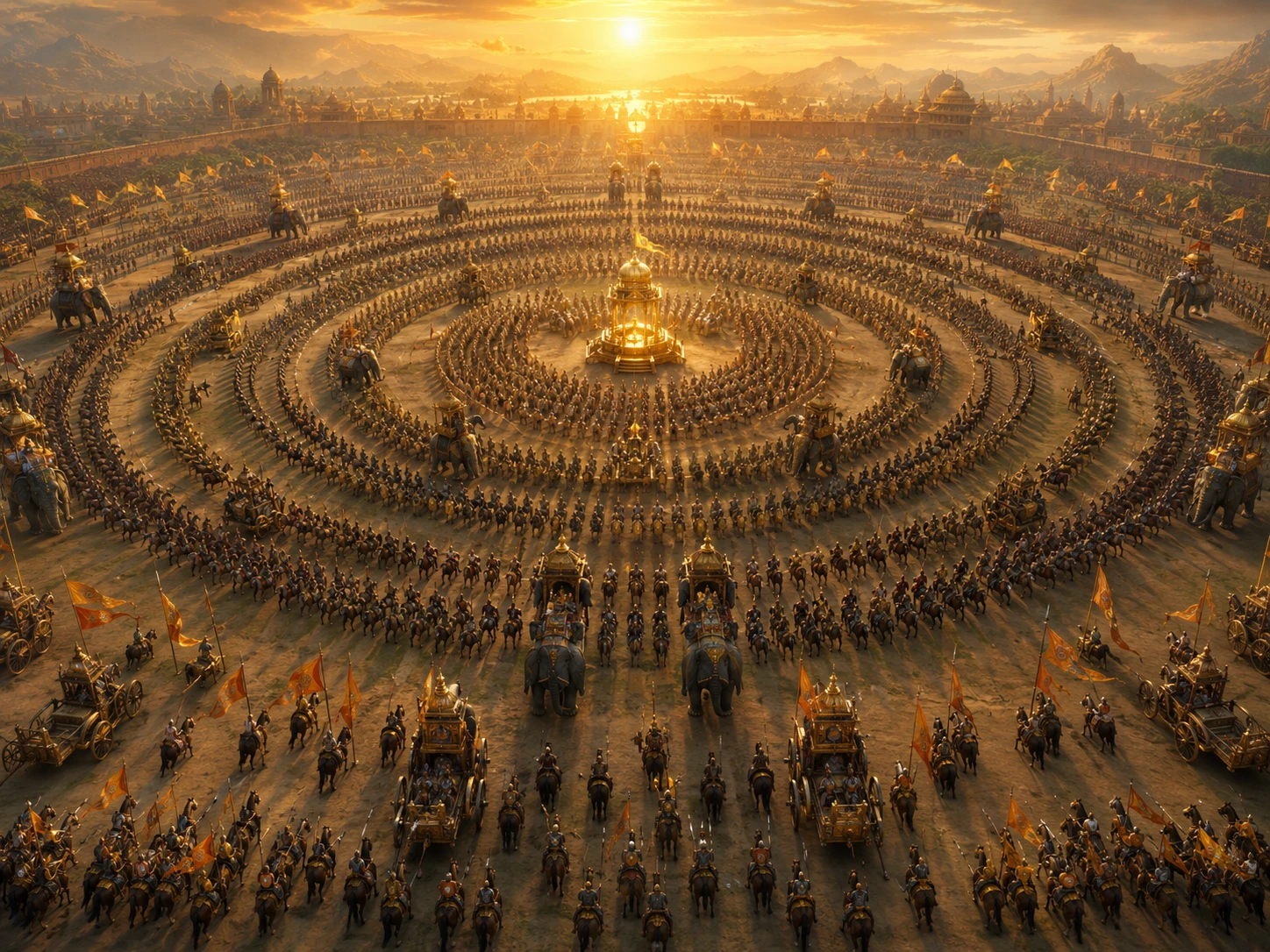
Vyuha Formations -- The Strategic Chess of Kurukshetra
व्यूह रचना -- कुरुक्षेत्र की रणनीतिक शतरंज
The word Vyuha (Sanskrit: व्यूह) means 'to arrange troops in a battle array.' Its root is व्यः -- 'cover' or 'veil' -- and this etymology is revealing. A vyuha was not just an arrangement. It was a disguise. The formation concealed the army's true strength, hid its vulnerabilities, and presented a shape designed to deceive the opponent about the commander's intent.
The Kurukshetra War lasted eighteen days. On each morning, both the Kaurava and Pandava commanders chose a vyuha and deployed their entire army -- spanning millions of soldiers, thousands of chariots, elephants, and cavalry -- into that shape before battle commenced. The formation was not static. As warriors fell, as flanks crumbled, as the day's momentum shifted, the vyuha adapted. Drums, conch shells, trumpets, and flag signals communicated restructuring commands across the vast battlefield. A vyuha was a living organism, not a frozen diagram.
The Mahabharata names at least eighteen distinct vyuhas deployed across the war. Some were offensive, designed to pierce the enemy centre. Some were defensive, designed to protect a specific commander. Some were asymmetric, designed to create local numerical superiority on one flank while sacrificing the other. And every formation had a known counter-formation -- which is why the war was not just a clash of arms but a daily chess match between two of India's greatest military minds: Bhishma and Drona on one side, and Dhrishtadyumna (advised by Krishna and Arjuna) on the other.
For the NDA cadet studying Military Strategy or the UPSC aspirant writing the Essay paper on 'Ancient India's Contribution to Strategic Thought,' the vyuha system is the definitive evidence that India possessed a formalised military science millennia before Clausewitz or Napoleon. The formations are not mythological decoration. They are tactical doctrine -- documented with the specificity of a modern field manual.
व्यूहं दृष्ट्वा तु पाण्डवानामाचार्यः शिष्यप्रियः। सेनापतिं तदा वाक्यमभ्यभाषत दुर्मुखम्॥
vyūhaṃ dṛṣṭvā tu pāṇḍavānām ācāryaḥ śiṣyapriyaḥ | senāpatiṃ tadā vākyam abhyabhāṣata durmukham ||
Seeing the Pandava army arrayed in formation, the teacher (Drona), beloved of his students, then spoke these words to the commander (Duryodhana).
— Bhagavad Gita 1.2 (opening context of the Kurukshetra battle formations)
The 18-Day Vyuha Deployment -- Formation vs Counter-Formation
| Day | Kaurava Vyuha | Pandava Counter | Key Event | Commander |
|---|---|---|---|---|
| Day 1 | Sarvatomukhi (All-facing) | Vajra (Thunderbolt) | War begins; Bhishma leads Kaurava attack | Bhishma |
| Day 2 | Garuda (Eagle) | Krauncharuna (Heron) | Arjuna devastates Kaurava flanks; Bhima rampages | Bhishma |
| Day 3 | Garuda (Eagle) | Ardha-Chandra (Crescent) | Bhishma wounded but fights on; fierce chariot duels | Bhishma |
| Day 6 | Krauncha (Heron) | Makara (Crocodile) | Bhima penetrates deep into Kaurava formation | Bhishma |
| Day 7 | Mandala (Circle) | Vajra (Thunderbolt) | Defensive vs offensive; deadlock | Bhishma |
| Day 8 | Kurma (Tortoise) | Trishula (Trident) | Bhishma shifts to Oormi (Ocean); Arjuna counters with Sringataka (Horned) | Bhishma |
| Day 9 | Sarvatobhadra (Safe all sides) | Unspecified | Massive Kaurava defence; Bhishma's last offensive day | Bhishma |
| Day 11 | Shakata (Cart) | Krauncharuna (Heron) | Drona takes command; war intensifies | Drona |
| Day 12 | Garuda (Eagle) | Mandala (Circle) | Arjuna's Samsaptaka challenge begins | Drona |
| Day 13 | Chakravyuha (Wheel/Disc) | Unknown (breached by Abhimanyu) | Abhimanyu enters alone; killed inside -- war's turning point | Drona |
| Day 14 | Chakrashakata (Wheel-Cart triple layer) | Custom (Dhrishtadyumna) | Arjuna's oath to kill Jayadratha before sunset; night battle begins | Drona |
| Day 16 | Makara (Crocodile) | Ardha-Chandra (Crescent) | Karna takes command; kills Pandava warriors | Karna |
| Day 18 | Unspecified (disarray) | Unspecified | Shalya killed; Duryodhana flees to lake; war ends | Shalya |
Not all 18 days have named formations in the Critical Edition. The table reflects the most well-attested deployments from Ganguli's translation and BORI CE. Formations on days 4, 5, 10, 15, and 17 are either unspecified or described only in general terms.
The Big Five Vyuhas -- Shape, Strategy, and Counter
While the Mahabharata mentions at least eighteen formations, five stand out for their frequency of use, their tactical complexity, and their relevance to modern strategic thinking.
Chakravyuha (Wheel/Disc Formation): The most famous and feared formation in the entire epic. Concentric circles of warriors rotating in opposite directions, creating a labyrinth that draws the enemy inward but makes escape nearly impossible. Only four warriors on the Pandava side knew how to penetrate it: Krishna, Arjuna, Pradyumna, and Abhimanyu. On Day 13, Drona deployed the Chakravyuha knowing Arjuna was diverted by the Samsaptakas. Abhimanyu entered alone -- he knew how to break in but not how to exit, because Arjuna had taught Subhadra the entry technique while Abhimanyu was still in the womb, but Subhadra fell asleep before Arjuna could explain the exit. Jayadratha sealed the gate behind Abhimanyu, preventing the other Pandavas from following. The sixteen-year-old fought six Maharathis simultaneously, killed tens of thousands, and was eventually killed through coordinated violation of Dharma Yuddha rules. His death is the emotional centre of the entire war.
Garuda Vyuha (Eagle Formation): An aggressive formation shaped like the divine eagle Garuda, with the commander at the beak, the two greatest warriors as the eyes, and the main army forming the body and wings. Bhishma deployed this on Day 2 to counter the Pandava Krauncha formation. The natural predator-prey logic holds: eagles eat herons, so Garuda counters Krauncha.
Mandala Vyuha (Circular Defence): A purely defensive formation -- a circle with the commander-in-chief at the centre, surrounded by concentric rings of warriors of decreasing rank. Extremely difficult to penetrate because the attacker faces resistance from all directions. Bhishma used this on Day 7. The Pandavas countered with the Vajra Vyuha -- a concentrated strike formation designed to punch through the circular defence at a single point.
Vajra Vyuha (Thunderbolt Formation): Named after Indra's weapon. Shaped like a concentrated spearhead -- narrow at the front (where the strongest warriors are placed) and broadening behind. It is the counter to circular formations because its concentrated force can breach a single point of the circle's perimeter. Arjuna deployed this on Day 1 with Bhima at the tip.
Ardha-Chandra Vyuha (Crescent Formation): A curved formation resembling a half-moon, with the flanks extending forward to envelop the enemy. The crescent creates a killing zone: the enemy advances into the concavity and finds itself attacked from three sides simultaneously. This is structurally identical to the double envelopment tactic used by Hannibal at Cannae (216 BCE) and by Khalid ibn al-Walid at the Battle of Walaja (633 CE) -- two of the most celebrated tactical victories in Western and Islamic military history. The Mahabharata's Ardha-Chandra predates both.
Two additional formations deserve mention for their tactical ingenuity. The Makara Vyuha (Crocodile Formation) -- deployed by the Pandavas on Day 6 and by Karna on Day 16 -- resembled a crocodile with wide-open jaws. The formation's strength was its ability to absorb the enemy into its 'mouth' and then close the jaws around them, creating a pocket of encirclement. This is functionally identical to the Soviet Deep Battle doctrine's concept of 'Kesselschlacht' (cauldron battle) -- luring the enemy forward and then cutting off their retreat with mobile flanking forces.
The Suchimukha Vyuha (Needle Formation) -- a narrow, elongated column designed to pierce through the enemy centre like a needle through fabric. This was the kamikaze formation: high casualties at the tip, but devastating penetration if the tip held. The modern military equivalent is the 'flying wedge' -- used by American football teams, police riot squads, and armoured columns. The formation sacrifices breadth for depth, width for penetration, safety for impact. It is the formation of desperation and of genius -- and the Mahabharata records both.
The Counter-Vyuha Logic -- Why Every Formation Had a Weakness
The Mahabharata's most sophisticated military insight is that no vyuha is perfect. Every formation optimises for one dimension (offence, defence, envelopment, penetration) at the cost of another. This is the principle of strategic trade-offs -- a concept that modern business strategy textbooks (Porter's competitive strategy, for instance) present as cutting-edge thinking, but which the Mahabharata embedded in its narrative structure three millennia earlier.
The Garuda Vyuha concentrates power at the beak (front) but leaves the tail (rear) vulnerable. The counter is the Krauncha (Heron) -- which has a sharp beak that targets the Garuda's body while the wide wings absorb the frontal assault.
The Mandala (Circle) is defensively impregnable but offensively passive -- the army cannot advance while maintaining circular integrity. The counter is the Vajra (Thunderbolt) -- a concentrated lance that sacrifices width for depth, piercing the circle at a single point.
The Chakravyuha is the supreme trap but requires six or more Maharathis to maintain the rotating layers -- which means the commander-in-chief must commit his best warriors to formation maintenance rather than individual combat. If even one layer breaks, the entire structure collapses. Abhimanyu proved this: a single warrior of sufficient skill can penetrate and disrupt the formation from within, even if he cannot escape.
The Shakata (Cart) formation is stable and difficult to outflank, but its rigid rectangular shape cannot adapt quickly to lateral threats. The counter is any flanking formation -- Krauncha, Ardha-Chandra, or even a simple two-pronged attack on both sides of the 'cart.'
This counter-vyuha logic mirrors modern game theory: every strategy has a best response, and the optimal play depends on predicting your opponent's choice before it is revealed. The daily morning ritual of choosing and deploying a vyuha was exactly this -- a zero-sum game where both commanders simultaneously chose their formation, and the day's outcome depended on whose choice countered the other's more effectively.
For the IIM student studying competitive strategy or the chess player at a state tournament: the vyuha system is the earliest documented example of simultaneous-move strategy in which both players must commit resources before seeing the opponent's commitment. Game theory formalised this in the 20th century. The Mahabharata practised it in the Bronze Age.
Modern Parallels -- From Blitzkrieg to IPL Field Placement
The vyuha system anticipates several modern military and strategic concepts with uncanny precision.
The Vajra Vyuha -- a concentrated armoured thrust at a single point of the enemy line -- is structurally identical to the German Blitzkrieg doctrine of World War II. The Schwerpunkt (focal point of attack) concept, considered revolutionary in 1940, is the Vajra principle applied with mechanised forces instead of chariot-mounted warriors.
The Chakravyuha's concentric rotating layers anticipate the modern concept of defence in depth -- multiple lines of resistance that absorb and slow the attacker, forcing them deeper into a kill zone. NATO's Cold War defensive doctrine along the Fulda Gap in Germany employed exactly this principle: successive defensive lines that traded space for time.
The daily formation-counter-formation cycle mirrors modern electronic warfare, where one side deploys a radar system and the other deploys countermeasures, leading to an escalating cycle of detection and evasion. The DRDO's work on electronic countermeasures operates on the same logic: every capability generates a counter-capability, and superiority is temporary.
Even cricket -- India's true national sport -- uses vyuha logic. When a captain sets the field, he is deploying a formation. An attacking field (slips, gully, short leg) is a Garuda Vyuha -- aggressive, concentrated where the 'kill' is most likely. A defensive field (deep square leg, long-on, third man) is a Mandala Vyuha -- spread in a circle to contain rather than attack. And when a captain changes the field mid-over based on the batsman's response, he is doing exactly what Bhishma and Drona did every morning: reading the opponent's formation and adjusting his own in real time.
Virat Kohli setting an aggressive field to Rassie van der Dussen is Arjuna deploying the Vajra. Rohit Sharma spreading the field to contain Steve Smith is Bhishma choosing the Mandala. The vocabulary is different. The strategic logic is identical.
The Indian Premier League auction itself follows vyuha logic. When a franchise assembles a playing XI, it is choosing a formation: the right balance of batsmen, bowlers, all-rounders, and wicketkeepers mirrors the Patti's balance of chariots, elephants, cavalry, and infantry. A team stacked with batsmen but light on bowling is a Garuda without a tail -- all beak, no stability. A team packed with bowlers is a Mandala -- defensively strong but unable to chase targets. The captain who balances his XI the way a commander balanced an Akshauhini -- right ratio of offensive and defensive capability at every level -- wins tournaments. MS Dhoni's CSK dynasty was built on this principle: not the most talented XI, but the most balanced formation.
Command, Control, and Communication -- How Millions Moved in Sync
The most underappreciated aspect of the vyuha system is not the formations themselves but the communication infrastructure that made them possible.
Consider the logistics: an Akshauhini of 218,700 warriors needs to restructure itself from one formation to another within the hour between dawn and the commencement of battle. That means hundreds of sub-units -- each commanded by a Maharathi or Atirathi -- need to receive, interpret, and execute formation orders simultaneously across a battlefield spanning several square kilometres. Without radios, without satellites, without even written orders (most warriors were illiterate), how was this achieved?
The Mahabharata describes a sophisticated system of auditory and visual signals. Conch shells (Shankha) were primary command instruments -- each major warrior had a distinct conch with a recognisable sound. The Bhagavad Gita's opening chapter (1.12-19) lists them: Bhishma blew the Simhanada (Lion's Roar), Krishna blew Panchajanya, Arjuna blew Devadatta, Bhima blew Paundra, Yudhishthira blew Anantavijaya, Nakula blew Sughosha, Sahadeva blew Manipushpaka. Each conch produced a distinct pitch and timbre -- a sonic identification system that allowed warriors across the battlefield to know which commander was issuing orders.
Beyond conch signals, the text describes drums (Dundubhi, Mridanga, Bheri) for tempo commands (advance, hold, retreat, reform), flags (Dhvaja) for visual identification of unit positions (Arjuna's Hanuman flag, Bhishma's palm-tree flag, Drona's golden altar flag, Karna's elephant-rope flag), and horn signals (Turya, Gomukha) for emergency restructuring commands. The combination of these systems -- sonic (conch + drums), visual (flags), and supplementary (horns) -- created a redundant multi-channel communication system. If the drums were drowned out by battle noise, the flags were still visible. If dust obscured the flags, the conch shells still carried over the din.
This is functionally identical to modern military communication doctrine, which mandates redundant communication channels (radio, visual signals, runners) to ensure command connectivity survives battlefield disruption. The Indian Army's Signals Corps, headquartered at Jabalpur, operates on the same principle: multiple overlapping communication systems ensure that no single point of failure can sever the chain of command.
The human element was equally critical. The Mahabharata describes the role of the Suta (charioteer) as not merely a driver but a battlefield communications officer. The Suta observed the field from the elevated chariot platform, interpreted signals from the commander, relayed orders to nearby units, and advised the warrior on tactical adjustments. Krishna's role as Arjuna's Suta is not servile -- it is the most important tactical position in the combined-arms team. The charioteer sees what the warrior, focused on combat, cannot. Krishna the charioteer is Krishna the strategist: the one who reads the battlefield in real time and adjusts the formation from within.
For the product manager at a Bengaluru startup managing distributed teams across time zones, or the cricket captain coordinating field changes through gestures rather than verbal communication: the vyuha's command infrastructure is the oldest documented solution to the problem of coordinating large, distributed teams in high-stakes, real-time environments where direct verbal communication is impossible.
The ancient game of Chaturanga -- the direct ancestor of modern chess -- was invented in India during the Gupta period (4th-6th century CE) and is widely believed to have been inspired by the Mahabharata's four-division army structure (chariots, elephants, cavalry, infantry). The four types of chess pieces (rook/chariot, bishop/elephant, knight/horse, pawn/infantry) map directly onto the four divisions of the akshauhini. The word 'Chaturanga' literally means 'four-limbed' -- referring to the four army divisions. Modern chess, played by over 600 million people worldwide, is the Mahabharata's vyuha system compressed onto a 64-square board. Every time Viswanathan Anand or D. Gukesh deploys a Sicilian Defence, they are executing a formation-counter-formation strategy that Bhishma and Drona would recognise instantly.
Master Your Inner Formation -- Align Before You Attack
The vyuha tradition teaches that alignment precedes action. Before deploying an army, you align the formation. Before deploying your day, align your mind. Each morning, take five minutes of breathwork to 'set the field', then state one clear sankalpa for the day's main objective. This is your personal vyuha -- a daily formation that organises your energy before the day's battle begins. The Meditate section has the pranayama practices to start with.
Tags
Eternal Raga · शाश्वत राग
Institutional voice — scholarly articles on Sanatan Dharma
Deepen Your Understanding
अपनी समझ और गहरी करें
divine arsenal
Akshauhini -- The Epic Army Structure Where Every Digit Sums to 18
1 chariot. 1 elephant. 3 horses. 5 foot soldiers. That is the Patti -- the smallest tactical unit of the Mahabharata's military system. Multiply it through nine hierarchical levels and you get the Akshauhini: 218,700 warriors. Multiply that by 18 and you get the Kurukshetra War: nearly four million soldiers arranged in the most precisely documented military hierarchy in all of ancient literature.
scriptural exegesis
Abhimanyu and the Chakravyuha -- The Boy Who Knew How to Enter but Not How to Leave
On the 13th day of Kurukshetra, a sixteen-year-old boy broke into the deadliest military formation in the ancient world -- alone, because the adults who promised to follow him were blocked at the gate. He fought Drona, Karna, Ashwatthama, Kripa, Duryodhana, and Shalya simultaneously. He killed Duryodhana's son Lakshmana. He made Karna flee. He held an entire army at bay for hours. And then they killed him -- not in fair combat, but by surrounding him, destroying his chariot, breaking his weapons, and attacking from all sides at once. Abhimanyu's death is not a tragedy of weakness. It is a tragedy of incomplete knowledge sent to do a complete job.
divine arsenal
Rules of War -- Dharmayuddha and the Geneva Conventions
Three thousand years before the Geneva Conventions, Indian warriors debated whether you could strike a man who had dropped his weapon. The Mahabharata's rules of engagement cover night fighting bans, non-combatant immunity, treatment of prisoners, proportional force, and the use of weapons of mass destruction -- and then shows what happens when every single rule is broken.
divine arsenal
Dhanurveda in the Agni Purana -- India's Ancient Science of Warfare
Long before Sun Tzu wrote The Art of War, India had the Dhanurveda -- a complete military science classified as an Upaveda of the Yajur Veda. Preserved in four chapters of the Agni Purana, it covers five warrior types, five weapon classes, nine combat stances, and a training philosophy that would make any NDA commandant nod in recognition.
divine arsenal
Astra vs Shastra -- The Two Classes of Weapons in Hindu Warfare
One is hurled with mantras and divine invocation. The other is wielded by hand and muscle. Understanding the fundamental difference between Astra and Shastra unlocks the entire weapons philosophy of ancient India.
divine arsenal
10 Weapons That Changed the War
Across the Ramayana and Mahabharata, certain weapons did not merely kill -- they altered the course of history. From Rama shattering Shiva's bow to win Sita, to the Shakti that saved the Pandavas by killing the one person it should not have, these ten weapon-moments are the pivot points on which two epics turn.
divine arsenal
The Celestial Chariots -- Pushpaka Vimana, Arjuna's Ratha, and the Flying Machines of Hindu Mythology
Ravana's Pushpaka Vimana could fly across oceans and read its owner's mind. Arjuna's chariot bore Hanuman on its flag and was driven by God himself. These were not fairy tale carriages -- they may be literary encodings of technologies that ancient India actually possessed.
The ancient game of Chaturanga -- the direct ancestor of modern chess -- was invented in India during the Gupta period (4th-6th century CE) and is widely believed to have been inspired by the Mahabharata's four-division …
More in Divine Arsenal
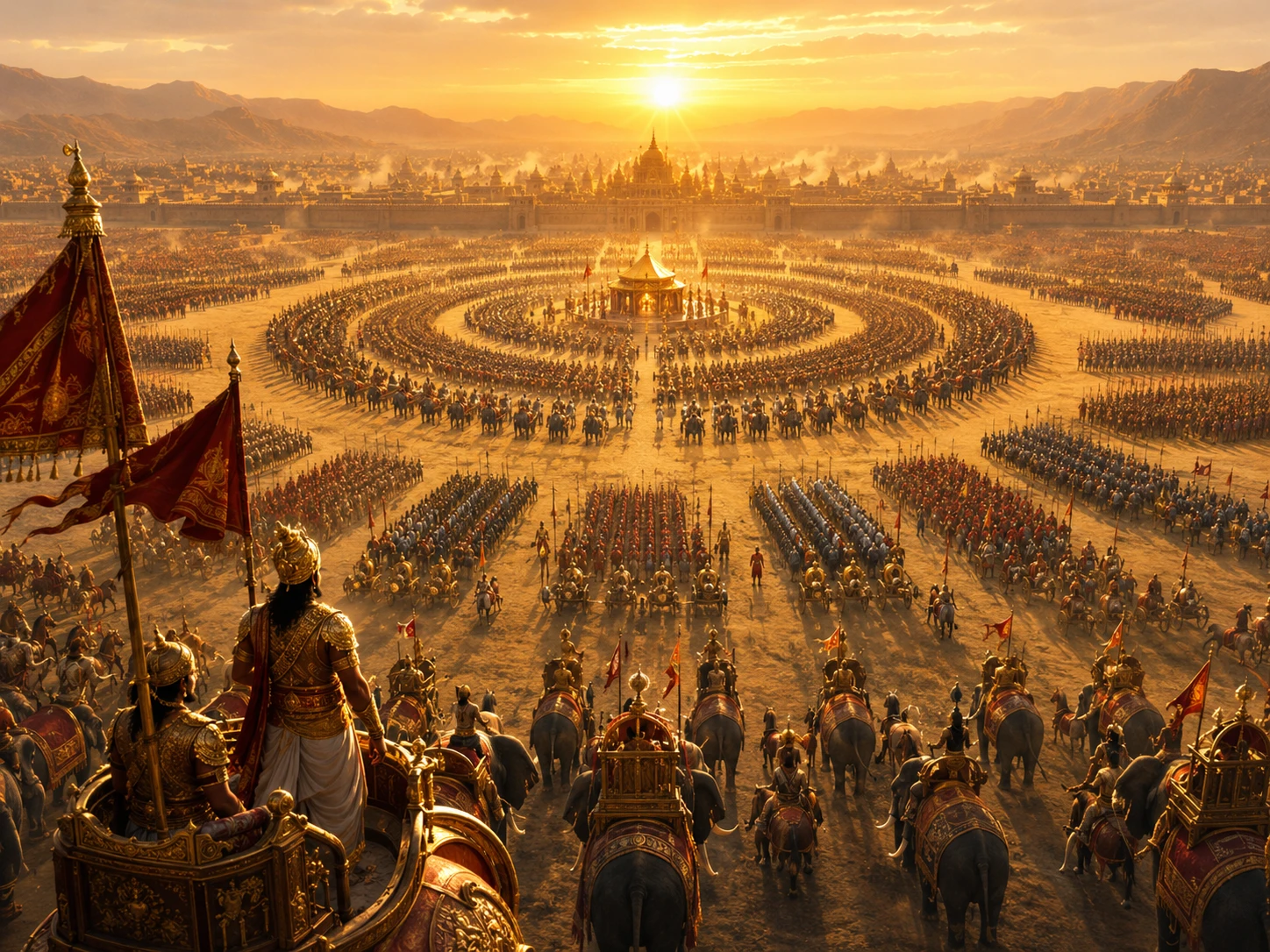
Akshauhini -- The Epic Army Structure Where Every Digit Sums to 18
14 min read
Ancient Indian Martial Arts -- Kalaripayattu to Malla-Yuddha
14 min read
Astra Invocation and Withdrawal -- The Ritual of Weapons
16 min readThe same translation error that turned '33 Koti' into '33 crore' in Hinduism also happened in Buddhism. The Chinese translation of Buddhist texts rendered 'Sapta Koti Buddha' (7 Supreme Buddhas) as '7 Crore Buddhas.' The…
Deities AvatarsCommunity Reflections
🕉️
Be the first to share your reflection.