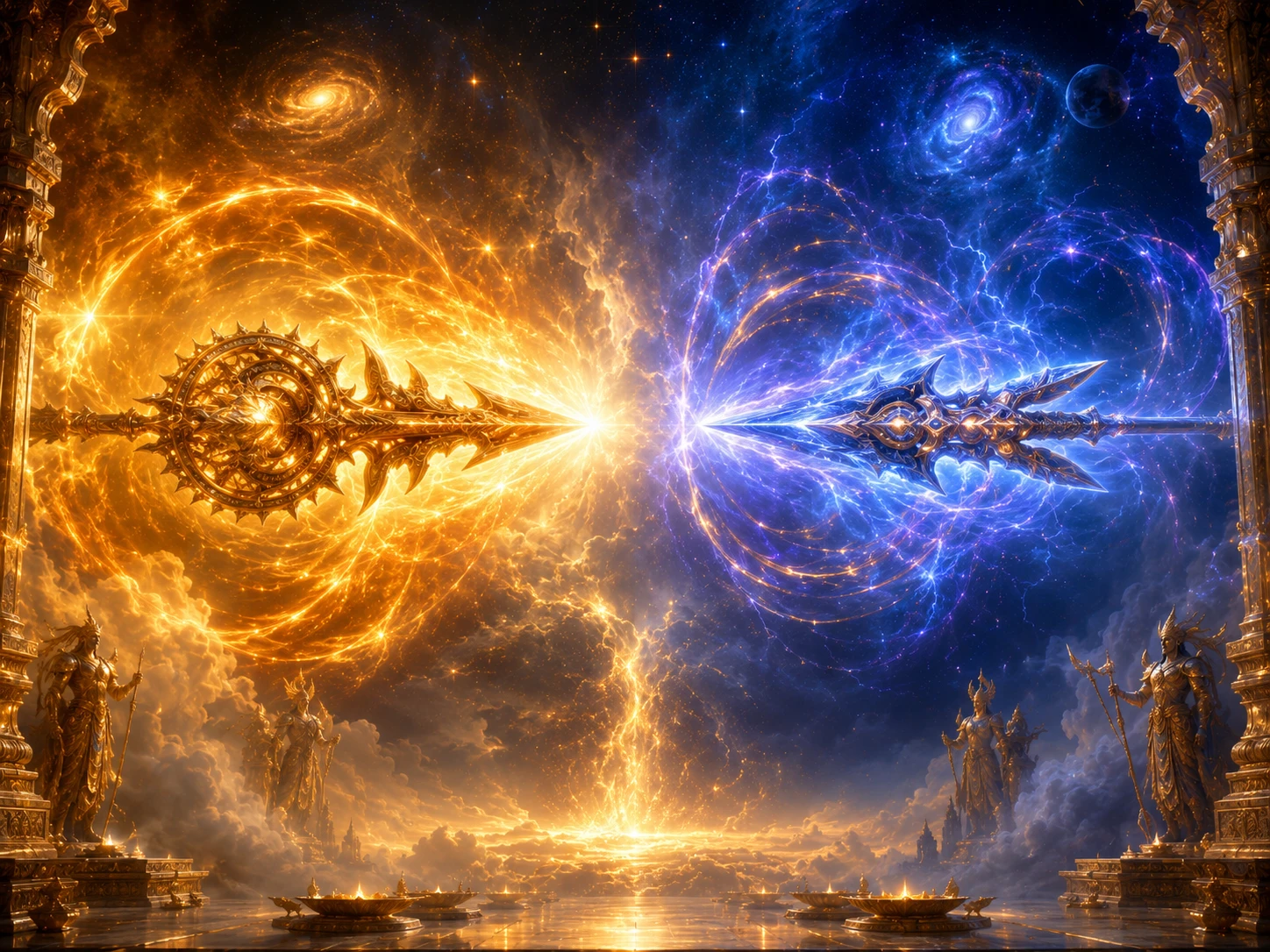
Brahmastra vs Brahmashirsha -- The Escalation Ladder of Brahma's Weapons
ब्रह्मास्त्र बनाम ब्रह्मशिरास्त्र -- ब्रह्मा के शस्त्रों की विनाश सीढ़ी
The god of creation built the weapons of ultimate destruction. This paradox -- that Brahma, whose cosmic function is to bring things into being, also designed the instruments capable of ending all being -- is the Mahabharata's most profound meditation on the nature of power.
Brahma created not one but three escalation tiers of celestial weapons, each exponentially more destructive than the last:
Brahmastra -- the base tier. A single-target weapon of absolute precision. It never misses. When deployed, the sky fills with fire, rivers evaporate, the earth trembles, and the target is annihilated. It is invoked through a specific mantra to Brahma and can be delivered through any carrier -- an arrow, a blade of grass, even a thought. In modern terms: a precision-guided nuclear weapon.
Brahmashirsha Astra (Brahma's Head Weapon) -- the second tier. It manifests with the four heads of Brahma at its tip and is four times more destructive than the Brahmastra. Where the Brahmastra destroys the target, the Brahmashirsha destroys the target and everything around it. The area struck becomes barren for 12 years -- no rain falls, no grass grows, the soil turns toxic. In modern terms: a thermonuclear weapon with area-denial effects, comparable to a hydrogen bomb.
Brahmanda Astra (Brahma's Cosmic Weapon) -- the third and ultimate tier. It manifests with all five heads of Brahma (including the fifth head that Shiva severed). It possesses the power to destroy the entire Brahmanda -- the cosmic egg, the solar system, all fourteen Lokas of Hindu cosmology. Nothing can counter it. Nothing can survive it. In modern terms: a weapon that makes nuclear arsenals look like firecrackers. It is the ultimate deterrent -- a weapon so powerful that its mere existence prevents escalation.
This three-tier structure anticipates the modern nuclear weapons hierarchy with uncanny precision: tactical nuclear weapons (limited yield, specific targets) correspond to Brahmastra; strategic thermonuclear weapons (city-destroying, area-denying) correspond to Brahmashirsha; and the hypothetical 'Doomsday Device' (planet-killing) corresponds to Brahmanda Astra. The Mahabharata imagined the complete escalation ladder three millennia before the Cold War arms race.
ब्रह्मास्त्रं तु समादाय धनुषि प्रतिसन्धय। अर्जुनः क्रोधताम्राक्षः सम्भ्रान्तः प्रत्यपद्यत॥
brahmāstraṃ tu samādāya dhanuṣi pratisandhaya | arjunaḥ krodha-tāmrākṣaḥ sambhrāntaḥ pratyapadyata ||
Taking up the Brahmastra and placing it on his bow, Arjuna, his eyes red with anger, stood ready to counter the threat.
— Mahabharata, Sauptika Parva (Ashwatthama-Arjuna confrontation)
The Ashwatthama-Arjuna Crisis -- When Two Brahmastras Collide
The defining episode of the Brahmastra tradition occurs in the Sauptika Parva and Ashvamedhika Parva of the Mahabharata -- one of the most dramatic weapons crises in all of world literature.
After the Kurukshetra war ends with the Pandavas' victory, Ashwatthama -- son of Drona, the last surviving Kaurava-allied warrior of significance -- commits the war's most heinous act: he enters the Pandava camp at night and slaughters the sleeping Upapandavas (the five sons of the Pandavas by Draupadi) and Dhrishtadyumna. When confronted by the Pandavas, Ashwatthama, cornered and desperate, invokes the Brahmashirsha Astra -- the four-headed weapon of ultimate destruction -- directing it at the Pandava army and, specifically, at the unborn child in Uttara's womb (Abhimanyu's son, the last heir of the Pandava line).
Arjuna counters by invoking his own Brahmastra. Two celestial weapons of near-absolute power are now racing toward each other across the battlefield. If they collide, the texts are explicit: the impact will destroy the world. Vyasa and Narada physically appear on the battlefield and stand between the two weapons, commanding both warriors to withdraw.
Arjuna withdraws his Brahmastra. This is the moment that defines him as a complete warrior -- not the Kurukshetra victories, not the killing of Karna, not even the Bhagavad Gita dialogue. The ability to pull back a weapon of mass destruction in flight, through mantra and will, when every emotion screams for retaliation -- this is the apex of Dhanurvedic mastery.
Ashwatthama cannot withdraw. He confesses to Vyasa that he knows only the invocation, not the recall. Drona, his own father, either withheld the withdrawal mantra or judged his son unready for it. Unable to recall the Brahmashirsha, Ashwatthama redirects it -- away from the army but toward Uttara's womb, attempting to destroy the Pandava lineage at its source.
Krishna intervenes. He enters the womb and protects the unborn child, who is later born as Parikshit -- the future king whose lineage will sustain the Kuru dynasty. Ashwatthama receives Krishna's devastating curse: 3,000 years of wandering, alone, diseased, and forgotten, his forehead-gem ripped away.
The moral is crystalline: the power to launch without the power to recall is not mastery. It is irresponsibility. The tradition does not celebrate Ashwatthama's ability to invoke the Brahmashirsha. It condemns his inability to control what he unleashed. This is India's oldest documented argument for what modern strategic theory calls 'negative control' -- the principle that the ability to prevent the use of a weapon is as important as the ability to use it.
Brahma's Three-Tier Weapons Programme
| Weapon | Manifestation | Destructive Power | Known Wielders | Modern Parallel |
|---|---|---|---|---|
| Brahmastra | Single blazing missile; sky fills with fire | Annihilates single target with absolute precision; never misses | Parashurama, Rama, Drona, Karna, Arjuna, Ashwatthama, Bhishma | Precision nuclear weapon (tactical nuke) |
| Brahmashirsha Astra | Four heads of Brahma at tip | 4x Brahmastra; area barren for 12 years; no rain; toxic soil | Arjuna, Ashwatthama, Drona (limited circle) | Thermonuclear / hydrogen bomb with area-denial |
| Brahmanda Astra | Five heads of Brahma (including severed fifth) | Can destroy entire Brahmanda (solar system / 14 Lokas) | Drona possessed knowledge; never used in the epic | Hypothetical Doomsday Device; total extinction weapon |
The escalation is exponential, not linear. Brahmashirsha is 4x Brahmastra. Brahmanda is described as capable of destroying the universe itself. The tradition records that Drona possessed Brahmanda Astra knowledge but was asked by the gods not to use it against the Pandavas -- the ultimate case of restraint under provocation.
The Brahma Danda -- Defence Against the Ultimate Offence
There is one more weapon in Brahma's arsenal that completes the system: the Brahma Danda (Brahma's Rod). Unlike the three offensive weapons, the Brahma Danda is purely defensive -- a rod that absorbs any incoming Astra, including the Brahmastra itself.
The most famous deployment: when Vishvamitra, in a fit of rage, fired the Brahmastra at Vasishtha, Vasishtha simply held up the Brahma Danda. The Brahmastra -- the weapon that never misses, that destroys everything in its path -- was absorbed like water into sand. The most powerful offensive weapon in the cosmos met the one thing that could stop it: a defensive instrument created by the same god.
This is strategically profound. Brahma created both the ultimate sword and the ultimate shield. The system is complete: escalation (Brahmastra to Brahmashirsha to Brahmanda) and counter-escalation (Brahma Danda absorbs all three). The message is that the creator who builds weapons of destruction also provides the means of defence -- but the defensive weapon is given only to ascetics (Vasishtha was a Rishi, not a Kshatriya). Those who renounce aggression receive the shield. Those who seek power receive the sword -- and the moral responsibility that comes with it.
For the student of international relations: this is the ancient equivalent of Mutually Assured Destruction (MAD) theory. The existence of the Brahma Danda means that no offensive Brahma weapon can guarantee victory, because a defender armed with the Danda can neutralise even the Brahmanda Astra. This creates strategic stability: the rational actor will not fire if they know the target can absorb the strike. The Cold War's nuclear stability rested on the same logic -- and the Mahabharata articulated it first.
The Night That Changed Everything -- Sauptika Parva
To understand why the Brahmashirsha was fired, you need to understand the night that made a Brahmin's son into a war criminal.
The Kurukshetra War is over. Eighteen days of carnage. The Pandavas have won. Duryodhana lies dying, his thighs shattered by Bhima's mace in a fight that violated every rule of Dharma Yuddha. Three Kaurava warriors survive: Ashwatthama (son of Drona), Kripacharya (uncle of Ashwatthama), and Kritavarma. They find Duryodhana in the forest, bleeding, broken, but burning with rage. His last command as king: Ashwatthama is appointed supreme commander of the Kaurava army. An army of three men.
That night, Ashwatthama sits beneath a banyan tree and watches an owl attack a colony of sleeping crows -- methodically, silently, without mercy. The sleeping birds never know what hit them. The metaphor ignites something in Ashwatthama's grief-maddened mind. If honour is already dead -- his father was killed through deception (the false announcement 'Ashwatthama is dead' referred to an elephant, not the man) -- then why should he fight by the rules?
What follows is the darkest chapter in the Mahabharata. Ashwatthama enters the sleeping Pandava camp at midnight. He kills Dhrishtadyumna -- the man who beheaded his father Drona -- by stamping on his throat while Dhrishtadyumna begs for a warrior's death by the sword. He kills all five sons of Draupadi (the Upapandavas) in their sleep. He kills Shikhandi, the warrior who had stood before Bhishma. He sets fire to the camp. By dawn, the Pandava camp is a cremation ground. The five Pandava brothers survive only because they had slept elsewhere that night, on Krishna's advice.
This is not war. This is the annihilation of a bloodline conducted under cover of darkness, in violation of every Kshatriya code. And it is not the end -- because when the Pandavas pursue Ashwatthama in fury, the son of Drona reaches for the most terrible weapon in his arsenal.
For anyone who has studied the ethics of warfare -- from the Geneva Conventions to the IHL modules taught at NDA Khadakwasla and the Indian Military Academy Dehradun -- the Sauptika Parva is required reading. It asks: what happens when a combatant, consumed by grief and rage, decides that the rules no longer apply? The Mahabharata's answer is: Brahmashirsha happens. Weapons of mass destruction are not deployed by strategists. They are deployed by men who have lost everything and no longer care about the consequences.
The Unborn Child -- When a Brahmashirsha Targeted a Womb
The confrontation between Ashwatthama and Arjuna in the aftermath of the night massacre is the Mahabharata's single most important weapons-ethics case study.
Arjuna pursues Ashwatthama to Vyasa's ashram. Both warriors invoke the Brahmashirsha simultaneously. Two weapons of cosmic destruction -- each capable of making the struck area barren for twelve years -- fly toward each other. The impact of their collision would annihilate the world.
Vyasa and Narada physically step between the two trajectories and order both warriors to withdraw. This is the moment of truth. Arjuna, who received his Astra training from both Drona and the gods, possesses the knowledge of Pratyahara (withdrawal). He pulls back the Brahmashirsha. The weapon returns to his quiver, neutralised. Ashwatthama cannot. He received the invocation mantra from his father Drona but never learned (or never mastered) the withdrawal technique. The weapon is out and cannot be recalled.
What does a man do when he has fired an irrecoverable weapon and has been ordered to stand down? Ashwatthama, in an act of spite that the Mahabharata treats as the single lowest point of the entire war, redirects the Brahmashirsha into the womb of Uttara -- Abhimanyu's widow, Arjuna's daughter-in-law -- who carries the last surviving heir of the Pandava bloodline. The Brahmashirsha strikes the unborn Parikshit.
Krishna intervenes. He enters Uttara's womb -- the Bhagavatam states he shielded the embryo with his own Sudarshana energy -- and revives the child. Parikshit is born, grows to become a great king, and it is to Parikshit that Shuka narrates the entire Srimad Bhagavatam. The entire Bhagavata Purana -- the most beloved scripture in the Vaishnava tradition -- exists because Krishna saved an unborn child from a Brahmashirsha.
Ashwatthama's punishment is civilisational. Krishna curses him to wander the earth for three thousand years, alone, covered in sores oozing blood and pus, rejected by all human society, unable to die. He is forced to surrender the Mani (jewel) from his forehead -- the one thing that made him immune to disease, hunger, and fatigue. The curse is not death. It is permanent exile from civilisation while remaining alive to feel every moment of it.
The lesson is unmistakable. The warrior who fires an irrecoverable weapon of mass destruction at a non-combatant -- and not just any non-combatant, an unborn child -- receives the harshest punishment the epic can imagine. Not execution. Perpetual suffering. For the UPSC aspirant writing the Ethics paper in Mains, the Ashwatthama case is the perfect framework for discussing proportionality in warfare, targeting of civilians, and the moral costs of weapons that cannot be controlled once deployed.
And for the IIT student building drone warfare systems or AI-guided weapons at a defence startup in Pune or Bengaluru: the question the Mahabharata poses is not 'Can you build it?' The question is: 'Can you recall it once it is fired? And if you cannot -- should you fire it at all?'
Modern Nuclear Doctrine -- The Mahabharata Wrote It First
The parallels between the Brahma weapons hierarchy and modern nuclear strategy are too precise to be coincidental in structure, even if accidental in origin.
The Non-Proliferation Treaty (NPT) of 1968 attempted to limit nuclear weapons to five recognised states -- much as the Mahabharata limits Brahmastra knowledge to a select circle of warriors (Bhishma, Drona, Parashurama's lineage, and their direct students). Proliferation anxiety -- the fear that Astras will spread to unworthy wielders -- runs through the epic. Drona teaches Ashwatthama the invocation but not the withdrawal specifically because he fears his son's temperament. Parashurama curses Karna to forget the Brahmastra invocation at the moment he needs it most -- because Karna obtained the knowledge through deception (claiming to be a Brahmin). The epic's position is clear: the problem is not the weapon. The problem is the wielder's character.
The concept of Second Strike Capability -- the ability to absorb a nuclear first strike and still retaliate -- maps directly onto the Brahma Danda. Vasishtha did not need to launch a pre-emptive attack. He could simply absorb whatever Vishwamitra threw at him and remain standing. This made him invulnerable to first-strike logic: there was no advantage in attacking first because the Brahma Danda would neutralise the strike.
No First Use (NFU) -- India's declared nuclear doctrine since 1998 -- has its clearest ancient precedent in the Brahmanda Astra. Drona possessed it but was asked by the gods never to use it. Its value was entirely in possession, not deployment. India's nuclear deterrence operates on the same principle: the weapons exist to prevent war, not to fight it. DRDO's missile naming (Agni, Prithvi, Akash, Trishul, Nag) is not mere cultural branding -- it is an acknowledgement that India's modern defence thinking is rooted in the same strategic soil that produced the Mahabharata's weapons philosophy.
The Comprehensive Nuclear-Test-Ban Treaty (CTBT) finds its echo in the Mahabharata's prohibition against testing apex weapons. Brahmanda Astra was never tested in the epic -- you cannot test a weapon that destroys the universe. Similarly, the Pashupatastra given to Arjuna by Shiva came with the explicit instruction never to use it against human combatants. The possession of the ultimate weapon carried the ultimate restriction: you must never use it. Strategic restraint is not modern. It is Vedic.
The Mahabharata's description of Brahmastra effects -- blinding light, immense heat, rivers evaporating, the area becoming barren and toxic for years, birth defects in subsequent generations -- bears an uncanny resemblance to the documented effects of nuclear weapons. Robert Oppenheimer, the father of the atomic bomb, famously quoted the Bhagavad Gita ('Now I am become Death, the destroyer of worlds') after the Trinity test. Less well known is that several Manhattan Project scientists, including Oppenheimer himself, were familiar with Sanskrit texts and had read descriptions of celestial weapons in the Mahabharata. Whether the resemblance is coincidence, metaphorical convergence, or evidence of ancient knowledge remains debated -- but the textual parallels are striking enough that multiple peer-reviewed papers in the history of science have examined them.
Contemplate Power and Restraint -- The Arjuna Meditation
Arjuna's ability to withdraw the Brahmastra came from years of mental discipline. Practise trataka daily -- gazing at a candle flame without blinking, building the ekagrata (one-pointed focus) that underpins all Dhanurvedic mastery. The Steady Gaze dharana on Eternal Raga teaches it. The goal is not to acquire weapons but to develop the character that knows when not to use them.
Tags
Eternal Raga · शाश्वत राग
Institutional voice — scholarly articles on Sanatan Dharma
Deepen Your Understanding
अपनी समझ और गहरी करें
divine arsenal
Astra Invocation and Withdrawal -- The Ritual of Weapons
A divine Astra was not merely fired. It was invoked -- summoned through a specific mantra, charged with the deity's power, released with precise intention, and -- if the warrior was skilled enough -- withdrawn before impact. The protocol for activating and deactivating a celestial weapon was as ritualised as a nuclear launch sequence. And the inability to withdraw was the difference between a warrior and a war criminal.
divine arsenal
Pashupatastra -- The Supreme Weapon Never Used
The most fearsome weapon in the Mahabharata was never deployed on the battlefield. Shiva granted it to Arjuna after a wrestling match in the forests of Indrakila, yet Arjuna carried it through all eighteen days of Kurukshetra without ever invoking it. The Pashupatastra's true power lay not in its destruction, but in its restraint -- a philosophy that modern nuclear doctrine would independently discover thousands of years later.
divine arsenal
Narayanastra -- The Weapon That Could Only Be Defeated by Surrender
After Drona's death, his son Ashvatthama released the personal weapon of Narayana on the Pandava army. It grew stronger the harder it was fought, and Krishna's answer was the strangest order of the war: lay down your arms. The story of the Narayanastra.
divine arsenal
10 Weapons That Changed the War
Across the Ramayana and Mahabharata, certain weapons did not merely kill -- they altered the course of history. From Rama shattering Shiva's bow to win Sita, to the Shakti that saved the Pandavas by killing the one person it should not have, these ten weapon-moments are the pivot points on which two epics turn.
divine arsenal
Rules of War -- Dharmayuddha and the Geneva Conventions
Three thousand years before the Geneva Conventions, Indian warriors debated whether you could strike a man who had dropped his weapon. The Mahabharata's rules of engagement cover night fighting bans, non-combatant immunity, treatment of prisoners, proportional force, and the use of weapons of mass destruction -- and then shows what happens when every single rule is broken.
scriptural exegesis
Ashwatthama and the Brahmashirsha -- The Night the War Refused to End
The war ended on Day 18 when Bhima shattered Duryodhana's thighs. The victory celebrations should have begun. Instead, that night, three Kaurava survivors -- Ashwatthama, Kripa, and Kritavarma -- entered the sleeping Pandava camp and slaughtered everyone inside. The five sons of Draupadi. Dhrishtadyumna. Shikhandin. Thousands of soldiers who believed the war was over. Then Ashwatthama launched the Brahmashirsha Astra at the unborn child in Uttara's womb -- Arjuna's grandson, the last heir of the Pandava line. Krishna saved the child and cursed Ashwatthama to wander the earth for 3,000 years in agony. He is still walking.
divine arsenal
Dhanurveda in the Agni Purana -- India's Ancient Science of Warfare
Long before Sun Tzu wrote The Art of War, India had the Dhanurveda -- a complete military science classified as an Upaveda of the Yajur Veda. Preserved in four chapters of the Agni Purana, it covers five warrior types, five weapon classes, nine combat stances, and a training philosophy that would make any NDA commandant nod in recognition.
The Mahabharata's description of Brahmastra effects -- blinding light, immense heat, rivers evaporating, the area becoming barren and toxic for years, birth defects in subsequent generations -- bears an uncanny resemblan…
More in Divine Arsenal
Akshauhini -- The Epic Army Structure Where Every Digit Sums to 18
14 min read
Ancient Indian Martial Arts -- Kalaripayattu to Malla-Yuddha
14 min read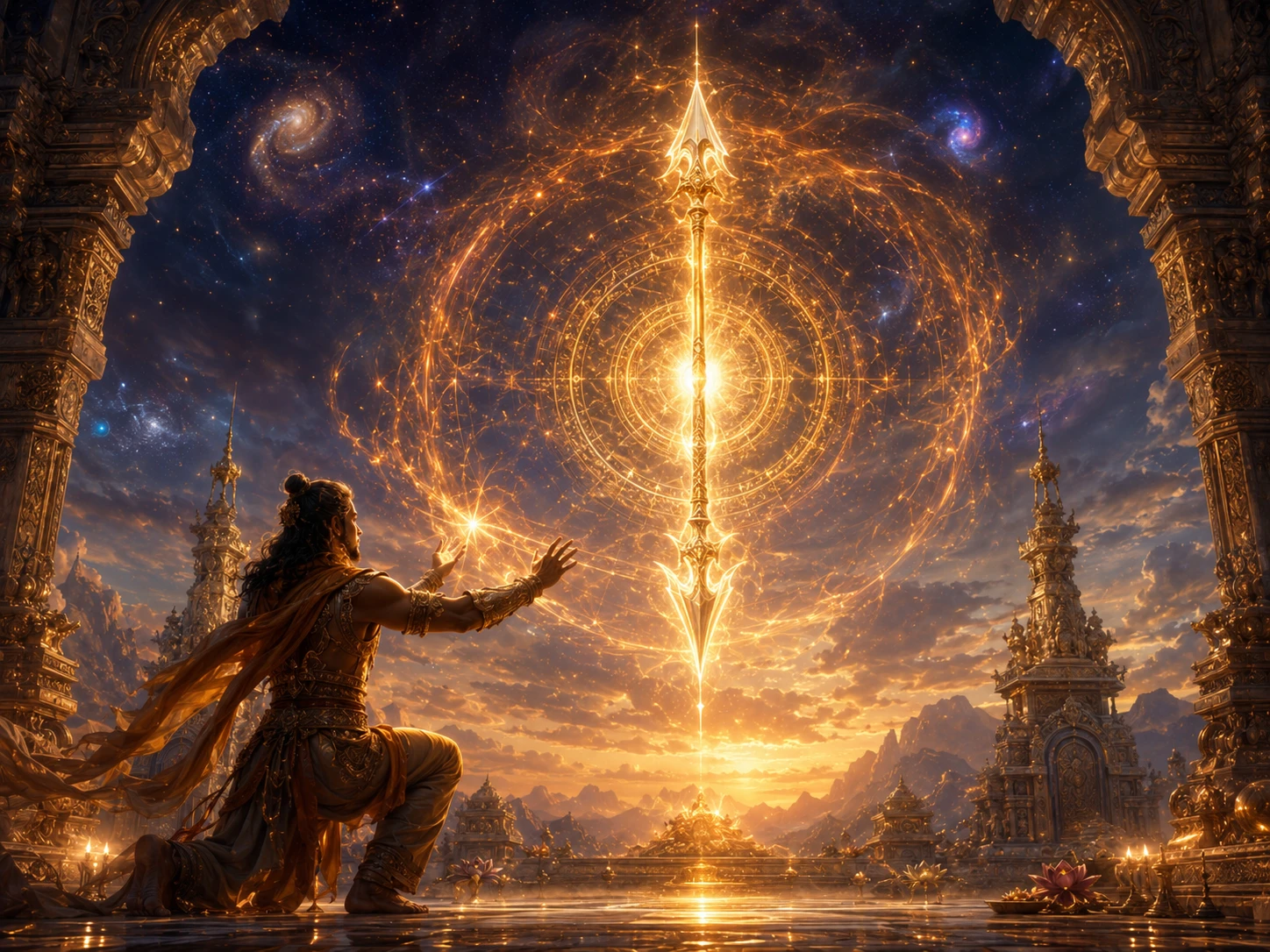
Astra Invocation and Withdrawal -- The Ritual of Weapons
16 min readThe same translation error that turned '33 Koti' into '33 crore' in Hinduism also happened in Buddhism. The Chinese translation of Buddhist texts rendered 'Sapta Koti Buddha' (7 Supreme Buddhas) as '7 Crore Buddhas.' The…
Deities AvatarsCommunity Reflections
🕉️
Be the first to share your reflection.