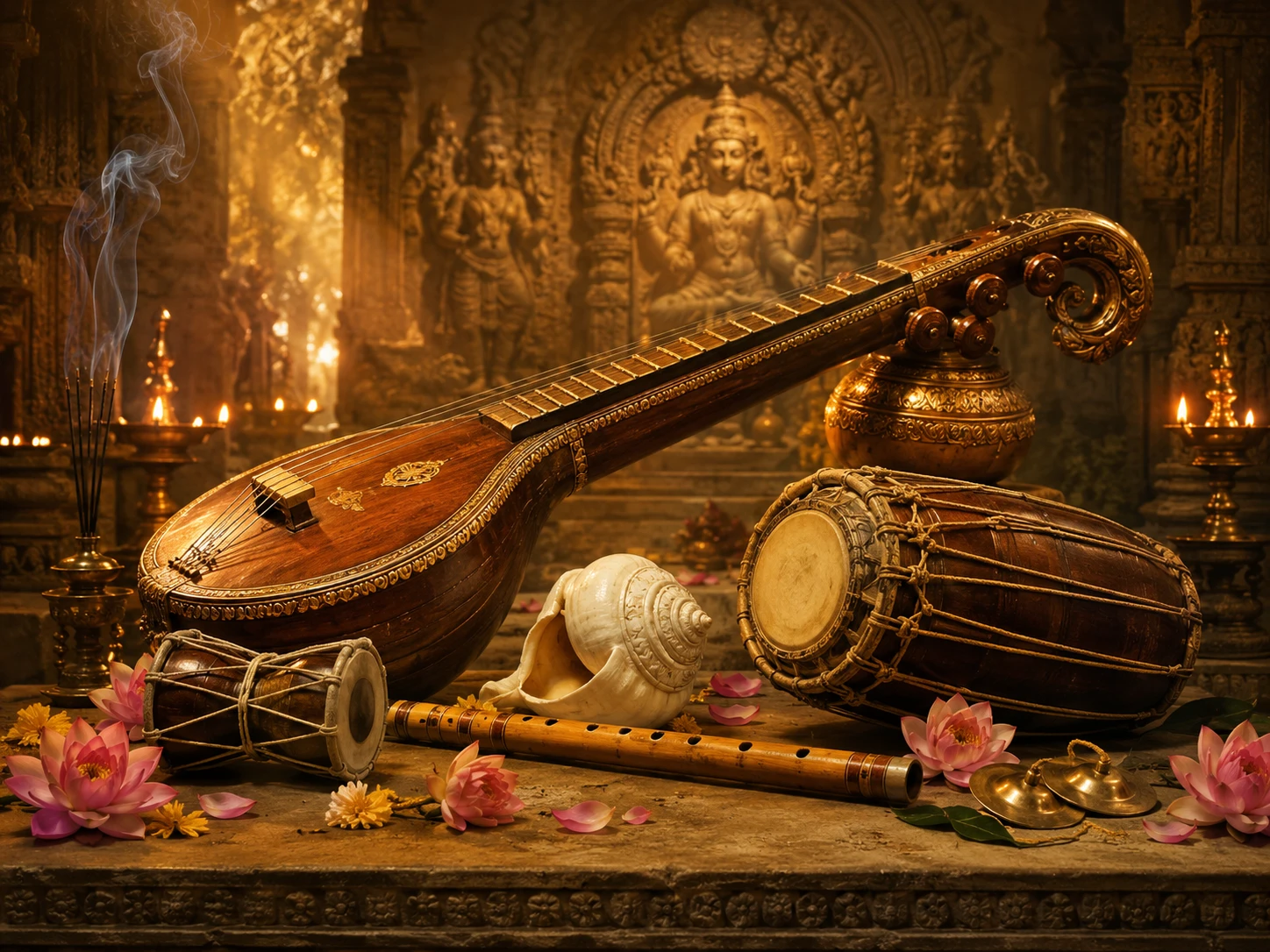
Divine Musical Instruments -- Veena, Damaru, Murali
दिव्य वाद्य -- वीणा, डमरू, मुरली
In Hindu cosmology, the universe does not begin with light. It begins with sound. The primordial vibration -- Nada Brahma, the sound that is God -- precedes creation, sustains existence, and dissolves the cosmos at the end of each cycle. 'Om' is not merely a sacred syllable; it is the acoustic signature of reality itself.
It should surprise no one, then, that the three instruments most closely associated with Hindu deities are not weapons or sceptres but musical instruments. Saraswati holds a Veena, not a sword. Shiva dances with a Damaru, not a battle-axe. Krishna enchants with a Murali, not a conch of command. In a tradition where sound precedes matter, the musician outranks the warrior.
These three instruments are not merely divine accessories. Each serves a specific cosmic function. The Veena organises knowledge. The Damaru generates the phonetic structure of language. The Murali awakens the emotional core that makes knowledge and language worth having. Together, they form a trinity of sound that mirrors the trinity of the gods who hold them.
अइउण् । ऋलृक् । एओङ् । ऐऔच् । हयवरट् । लणमङणनम् । झभञ् । घढधष् । जबगडदश् । खफछठथचटतव् । कपय् । शषसर् । हल् ।
a i u N | Ri lRi k | e o G | ai au c | ha ya va ra T | la Na ma Ga Na na m | jha bha NY | gha Dha dha Sh | ja ba ga Da da sh | kha pha Cha Tha tha ca Ta ta v | ka pa y | sha Sha sa r | ha l |
The 14 Maheshwara Sutras -- the complete phonetic inventory of Sanskrit, said to have emerged from 14 beats of Shiva's Damaru at the end of his cosmic dance (Tandava). These sounds form the foundation of Panini's Ashtadhyayi, the world's first formal grammar.
— Maheshwara Sutras (Shiva Sutras), as cited in Panini's Ashtadhyayi
Shiva's Damaru is the most intellectually revolutionary instrument in all of mythology. A small, hourglass-shaped drum, held in Nataraja's upper right hand, it is the instrument that -- according to tradition -- created language itself.
The story is precise. At the conclusion of his cosmic dance (Tandava), Shiva struck his Damaru fourteen times. From these fourteen beats emerged fourteen groups of sounds -- the Maheshwara Sutras -- which contain every phoneme in the Sanskrit language. The sage Panini, witnessing this revelation, used these fourteen sutras as the foundation of his Ashtadhyayi, the world's first complete formal grammar, composed around the 4th century BCE.
This is not casual mythology. The Maheshwara Sutras are a real, functional phonetic classification system. They group Sanskrit sounds by place and manner of articulation with a precision that modern linguists at institutions like JNU's Centre for Linguistics and CIIL Mysuru study as a landmark in the history of language science. Noam Chomsky has acknowledged Panini as a precursor to generative grammar. The entire system traces its origin to a drum.
The implications are staggering. In Hindu tradition, the scientific study of language is not a secular, human achievement that happened despite religion. It is a divine gift that happened through religion. Grammar is sacred. Phonetics is worship. The Damaru is the proof.
Saraswati's Veena represents a different dimension of sound -- not the raw phonetic material of language, but the organised, aesthetic expression of knowledge. In Hindu iconography, Saraswati is seated on a white lotus, dressed in white, holding a Veena in her two primary hands and a book (Pustaka) and crystal rosary (Sphatika mala) in the other two. The message is clear: knowledge (book), spiritual discipline (rosary), and artistic expression (Veena) are inseparable facets of learning.
The specific Veena depicted is debated -- some traditions show a Rudra Veena (the tube zither associated with Dhrupad), others a Saraswati Veena (the carved South Indian instrument). Regardless, the Veena's presence in her hands has made it the most symbolically important instrument in Indian music. At the Brihadeeswarar Temple in Thanjavur, the Chola-era carvings depict musicians playing Veenas nearly identical to those used in Carnatic concerts today. The unbroken tradition stretches over a millennium.
For every student sitting in their first Carnatic music class in Mylapore, Chennai, or picking up a sitar for the first time at Bhatkhande University in Lucknow, the teacher begins with a Saraswati Vandana -- an invocation of the goddess. The instrument in the student's hands is not secular technology. It is, in the tradition's own framing, an extension of the divine.
The Three Divine Instruments and Their Cosmic Functions
| Instrument | Deity | Cosmic Function | What It Creates | Living Tradition |
|---|---|---|---|---|
| Damaru | Shiva (Nataraja) | Phonetic creation -- raw material of language | 14 Maheshwara Sutras = Sanskrit phoneme system | Panini's grammar; computational linguistics research at IIT Madras; Nataraja statue at CERN |
| Veena | Saraswati | Aesthetic organisation -- structured expression of knowledge | Raga and Tala systems; the grammar of melody and rhythm | Carnatic and Hindustani traditions; Saraswati Puja (Vasant Panchami); school invocations |
| Murali (Bansuri) | Krishna | Emotional awakening -- desire, devotion, longing (viraha) | Bhakti movement; Madhurya Rasa (the emotion of divine romance) | Braj folk music; Hariprasad Chaurasia tradition; temple aarti across India |
Together: Damaru creates language, Veena gives it structure, Murali gives it feeling. The full spectrum of human expression -- from grammar to music to poetry -- is covered by three divine instruments.
And then there is the Murali -- the bamboo flute. If the Damaru is intellect and the Veena is aesthetics, the Murali is pure emotion. Krishna's flute does not create language or organise knowledge. It does something far more dangerous: it makes you feel.
The Bhagavata Purana describes the effect of Krishna's flute-playing in Vrindavan with a specificity that would impress any poet. When Krishna plays, the rivers stop flowing and stand still. The cows freeze mid-chew, their ears raised. The gopis abandon their households -- some mid-cooking, some mid-nursing, some mid-argument with their husbands -- and walk as if hypnotised towards the sound. Even Shiva, hearing the Murali from his seat on Kailash, begins to weep.
This is not casual storytelling. The Murali represents the theological concept of 'Madhurya Rasa' -- the sweetness of divine love that is modelled on romantic longing. In Vaishnava philosophy, especially in the Gaudiya tradition founded by Chaitanya Mahaprabhu, the highest form of devotion is not obedience or reverence but the ache of separation (viraha). The gopis' response to the flute -- leaving everything, abandoning social duty, following a sound that promises nothing but itself -- is the model for how the soul should respond to God.
At the Banke Bihari Temple in Vrindavan, where the curtain is opened and closed repeatedly during darshan because -- tradition holds -- the gaze of the deity is so powerful that prolonged eye contact would pull the devotee's soul from their body, the Murali's lesson is lived daily: divine beauty is not safe. It disrupts. It destabilises. It transforms.
The bronze Nataraja statue at CERN, the European Organization for Nuclear Research in Geneva, was gifted by the Government of India in 2004. The plaque quotes Fritjof Capra: 'Modern physics has thus revealed that every subatomic particle not only performs an energy dance, but is also an energy dance; a pulsating process of creation and destruction.' The Damaru in Nataraja's hand -- which created the sounds of language -- now stands at the institution dedicated to finding the fundamental particles of matter. Shiva's drum, in a sense, has come full circle.
India's classical music tradition -- both Carnatic and Hindustani -- traces its origins directly to this mythological framework. The Natya Shastra of Bharata Muni (composed roughly between 200 BCE and 200 CE) is the foundational text, and it begins with the assertion that the performing arts were revealed by Brahma himself. The raga system -- where specific combinations of notes evoke specific emotions (rasas) at specific times of day -- is not a musical convention. It is, in its original framing, a map of cosmic vibration.
At the Madras Music Academy during the December Season, when a vocalist performs Raga Bhairavi in the early morning slot, they are participating in a tradition that connects directly to Shiva's Damaru and Saraswati's Veena. At the Sawai Gandharva Festival in Pune, when a sitarist renders Raga Yaman at dusk, the emotional effect on the audience is exactly what the Bhagavata Purana describes when Krishna plays his flute -- time seems to stop, and something wordless opens in the chest.
This is not nostalgia. This is living practice. India has more practising classical musicians today than at any point in its history. The tradition is not preserved in amber; it is evolving, debating, innovating -- and still rooted in three divine instruments that created the world.
Sing a Bhajan Today
Experience the tradition of Nada Brahma -- sound as the divine. Choose a Shiva, Krishna or Saraswati hymn from Eternal Raga's mantra library, where each comes with its words and meaning, and sing it aloud.
Tags
Eternal Raga · शाश्वत राग
Institutional voice — scholarly articles on Sanatan Dharma
Deepen Your Understanding
अपनी समझ और गहरी करें
divine arsenal
The Sacred Conch Shells -- Panchajanya, Devadatta and the War Horns of Kurukshetra
The Bhagavad Gita opens not with words but with sound -- the thunderous blowing of five sacred conch shells that signalled the beginning of the greatest war in mythology. Each conch had a name, a story, and a power. Know them all.
divine arsenal
The Cosmic Forge -- Vishwakarma, Divine Engineer
Every divine weapon. Every celestial city. Every flying chariot. They all have the same maker. Vishwakarma -- the architect of the gods -- built Lanka for Kubera, Dwarka for Krishna, Indraprastha for the Pandavas, and forged every weapon in the divine arsenal. He is the patron deity of Indian engineers, craftsmen, and factory workers, worshipped annually on Vishwakarma Puja with the tools of modern industry laid at his feet.
sacred artefacts
Celestial Trees -- Kalpavriksha and Parijata
A wish-fulfilling tree in Indra's paradise. A night-blooming flower that triggered a domestic argument, a diplomatic crisis, and a full-scale war between Krishna and the king of heaven. Hindu mythology's celestial trees are not just botanical wonders -- they are stories about desire, entitlement, ecology, and the fine art of keeping your wife happy.
sacred artefacts
Divine Gems -- Syamantaka, Kaustubha, and Chintamani
Hindu mythology's most precious stones are not mere ornaments -- they are plot devices, moral tests, and cosmic forces. The Syamantaka Mani turned Krishna into a detective. The Kaustubha emerged from the Ocean of Milk to sit forever on Vishnu's chest. The Chintamani fulfils every wish -- and teaches why that might be the worst thing that could happen to you.
vedic sciences
Kaal Ganana -- The Hindu Measure of Time
From a single blink of the eye (Nimesha) to one Day of Brahma (4.32 billion years) -- explore the complete cosmic time hierarchy of Hindu cosmology, anchored in Vishnu Purana 1.3, with its remarkable parallels to modern science.
tantra mantra yantra
Tantra, Mantra and Yantra -- The Three Pillars of Spiritual Practice
Tantra is the loom, Mantra is the thread, Yantra is the pattern. Together they form the complete technology of spiritual transformation that India gifted to the world -- and they are far more profound than popular culture imagines.
The bronze Nataraja statue at CERN, the European Organization for Nuclear Research in Geneva, was gifted by the Government of India in 2004. The plaque quotes Fritjof Capra: 'Modern physics has thus revealed that every s…
More in Sacred Artefacts
Ashtadhatu -- The Sacred Eight-Metal Alloy of Indian Temples
12 min read
Banalinga -- The Stone God Made Himself in a River Over Millions of Years
13 min read
Celestial Trees -- Kalpavriksha and Parijata
12 min readThe same translation error that turned '33 Koti' into '33 crore' in Hinduism also happened in Buddhism. The Chinese translation of Buddhist texts rendered 'Sapta Koti Buddha' (7 Supreme Buddhas) as '7 Crore Buddhas.' The…
Deities AvatarsCommunity Reflections
🕉️
Be the first to share your reflection.