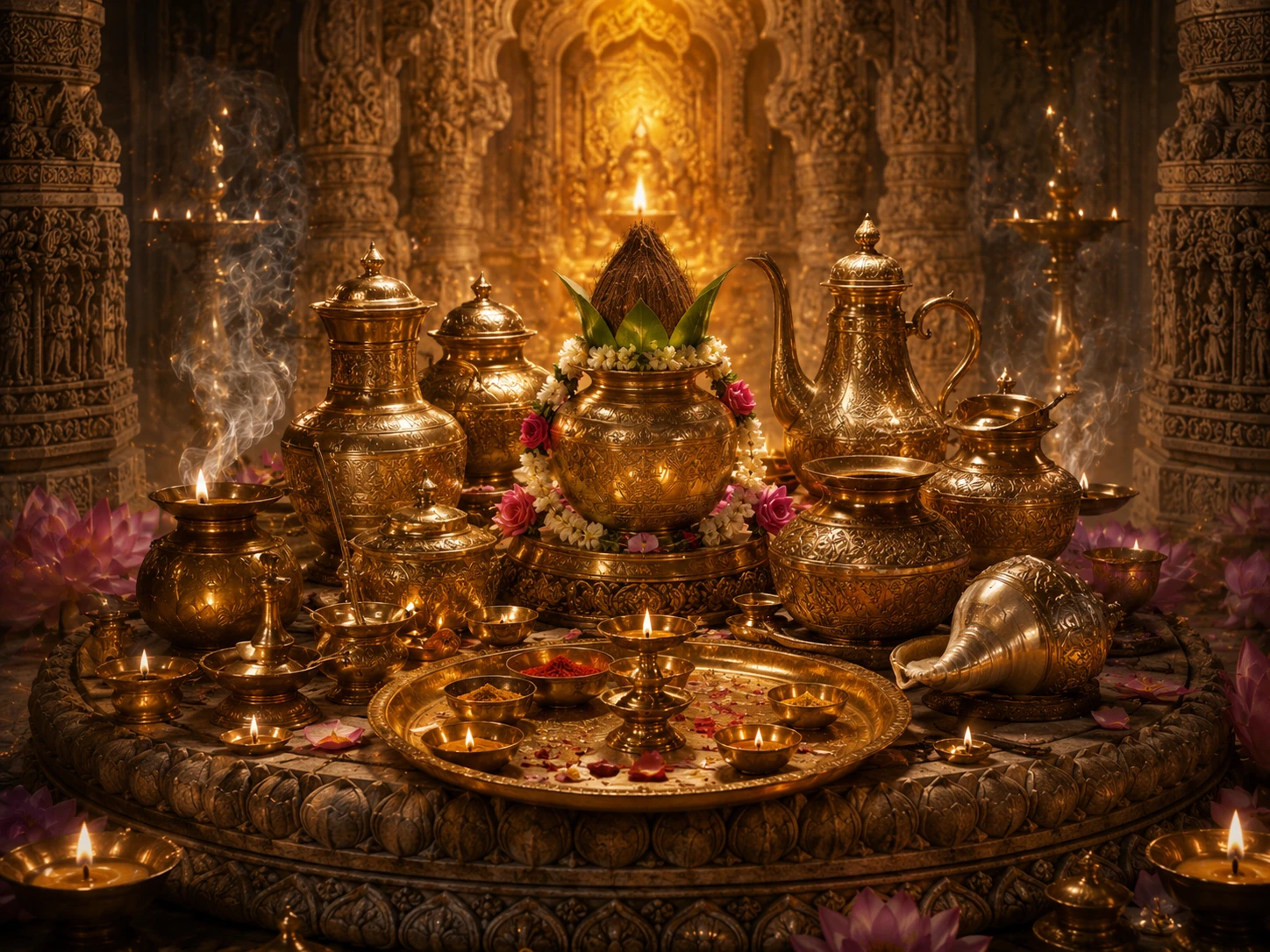
Sacred Vessels -- Akshaya Patra, Kamandalu, and Amrit Kalash
पवित्र पात्र -- अक्षय पात्र, कमण्डलु और अमृत कलश
Look at any image of Vishnu, Shiva, Brahma, or any of the major rishis in Hindu iconography. Somewhere in the composition, a vessel is placed. Vishnu's left hand often cups the shankha (conch), but behind Him, near the feet, rests a small pot. Shiva, when seated as the ascetic on Mount Kailasha, keeps a kamandalu at his side. Brahma, shown seated on a lotus with four faces, holds in one hand a kamandalu and in another a book of the Vedas. The sage Durvasa arriving at Pandava's doorstep, the sage Agastya walking through the Vindhyas, the sage Narada crossing between worlds, each carries the same vessel. The water-pot is one of the silent signatures of sacred status.
And then there are the festival vessels. The kalasha placed under the wedding mandap in a Lucknow Kayastha home. The copper kumbha carried on the head of a Malayali woman at Onam. The brass amrit kalash lowered into the Sangam at Prayagraj during Kumbh Mela. Every one of these is a continuation of the same idea, though the names differ. A vessel is not a container. It is a cosmos in miniature. What it holds defines what it is.
This article takes three of the most iconic vessels in Hindu tradition, each from a different register. The Akshaya Patra, from the Mahabharata's epic narrative, the food-vessel that fed the Pandavas through their twelve years in the forest. The kamandalu, the ascetic's water-pot, present across every tradition from Adi Shankara to the naga sadhu at Haridwar today. And the amrit kalash, the pot of immortality that rose from the churned ocean, still symbolically enacted at every Kumbh Mela. Three vessels. Three teachings about what a container can be.
The Akshaya Patra story opens in the Vana Parva of the Mahabharata, chapter three. The Pandavas have just lost everything in the dice game, are headed for twelve years in the forest, and find themselves with a problem any Indian hostess of any century can recognise. Too many guests, too little food. The brahmanas accompanying them into exile need to be fed. Draupadi has one cooking vessel. The rations will last days, not years.
Sage Dhaumya, the Pandavas' family priest, advises Yudhishthira to propitiate Surya, the sun god, the source of all food. Yudhishthira stands in the waters of the Ganga, fasts, and recites the 108 names of Surya. On the twelfth day Surya appears. He gives Yudhishthira a copper vessel and sets one rule: the vessel will remain inexhaustible for twelve years, from the moment food is placed in it until Draupadi herself eats. Once Draupadi finishes her meal, the vessel is empty until the next day.
This is not just a magical food-pot story. The rule itself is what matters. Indian hospitality places the woman of the house last at the table. A guest cannot be turned away. The family eats before her. She eats what remains. Surya's vessel codifies that practice into cosmology. The inexhaustibility extends to every possible guest; it ends at her plate. When the sage Durvasa arrives late one afternoon with ten thousand disciples, after Draupadi has eaten, the vessel is empty. Krishna, answering her prayer, eats one remaining grain of rice clinging to the pot and declares Himself satisfied. Because He is the universe, every belly in creation is now full. Durvasa and his disciples find themselves unable to eat another bite. They quietly depart.
पूर्णमदः पूर्णमिदं पूर्णात्पूर्णमुदच्यते । पूर्णस्य पूर्णमादाय पूर्णमेवावशिष्यते ॥
pūrṇam adaḥ pūrṇam idam pūrṇāt pūrṇam udacyate | pūrṇasya pūrṇam ādāya pūrṇam evāvaśiṣyate ||
That is full, this is full. From the full, the full rises. Take the full from the full, and the full alone remains.
— Brihadaranyaka Upanishad 5.1.1 and Isha Upanishad Shanti Mantra
This is the famous Purnamadah Purnamidam, the shanti mantra that opens the Isha Upanishad and also appears at the start of the fifth chapter of the Brihadaranyaka. Every Sanskrit class in every gurukul recites it before any study begins. But the verse is not merely a prayer for peace. It is the philosophical backing for exactly what the Akshaya Patra enacts. Wholeness does not diminish by giving. The full remains full even when the full is taken from it. What the epic narrative dramatises through a copper vessel, the Upanishad formulates as a metaphysical principle. Abundance is a property of consciousness, not of things. The vessel Surya gives Yudhishthira is not magical because it creates food from nothing. It is sacred because it operates on Upanishadic logic.
A similar logic underpins the second vessel, the kamandalu. Where the Akshaya Patra is for the householder feeding guests, the kamandalu is for the ascetic who has renounced the householder's life. A kamandalu is a water-pot, usually made of a dried coconut-shell, a gourd, wood, brass, or copper, with a narrow spout and a handle for carrying. Every ascetic from the earliest Vedic forest-dwellers to the naga sadhu stepping into the Triveni at Prayagraj in 2025 has carried one. The Grihya Sutras specify it. The Dharma Shastras specify it. Every iconographic tradition gives Brahma a kamandalu in one of his four hands. Agastya, Vyasa, Durvasa, and Narada all travel with theirs. Shiva in his Bhikshatana form, begging alms as a mendicant, carries one.
The kamandalu has a specific rule of use. The water inside is for drinking, for washing before sandhyavandana, and for ritual purification, not for daily bathing or recreation. A sannyasi who wastes the water in his kamandalu is breaking a discipline, not just being careless. This is because the pot is a condensed statement of what the sannyasi has kept from the world of the householder. Everything else the householder owns, he has given up: house, wealth, family bonds, even his name. The kamandalu and the staff (danda) are what remain. The water is the least possible commitment to staying alive. The pot holds exactly what is needed and not more.
The third vessel belongs to an altogether different register. The amrit kalash is not held by a human or even an ordinary deity. It belongs to the cosmological narrative of the Samudra Manthan, the churning of the cosmic ocean described in the Bhagavata Purana, the Vishnu Purana, and the Mahabharata's Adi Parva. The devas and asuras, weakened by the curse of Durvasa, have lost their immortality. They agree, under Vishnu's guidance, to churn the cosmic ocean together, using Mount Mandara as the churning rod and Vasuki the serpent as the rope. For a thousand years they pull, one team on each side.
Fourteen treasures rise in sequence. The poison halahala first, which Shiva drinks to save creation, turning his throat blue. Then Lakshmi, Airavata, Kamadhenu, Parijata, Uchchaihshravas, and the others. The final treasure is Dhanvantari, the divine physician, rising from the waters with a pot in his hands. That pot is the amrit kalash. It contains amrita, the nectar of immortality. Whoever drinks it cannot die.
The asuras seize it. Vishnu, taking the form of Mohini, the only feminine avatara in the standard Dashavatara lists, charms the asuras into letting her distribute the nectar. She serves only the devas. Rahu, disguised as a deva, slips into the line and drinks a sip before Vishnu's chakra separates his head from his body. Both pieces survive, because the nectar had already reached his throat. His head becomes Rahu, his body becomes Ketu, both now immortal. Today they are the two shadow-planets of Vedic jyotisha. Every birth-chart in India still includes them. They are both, in a literal sense, the continuing footprints of what the amrit kalash made possible.
The Three Vessels -- Function, Holder, and Source
| Vessel | Contents | Holder | Function | Source Text |
|---|---|---|---|---|
| Akshaya Patra | Cooked food, inexhaustible until Draupadi eats | Pandavas during their twelve-year vanavas | Feeds all guests; ends when the hostess eats; enforces the dharma of hospitality | Mahabharata Vana Parva, chapters 3 and 260-261 |
| Kamandalu | Water for drinking and ritual use | Brahma, all sages, all sannyasis; Shiva in ascetic form | Marks ascetic status; condenses the renunciate's possessions to bare necessity | Grihya Sutras; Dharma Shastras; Agama iconography |
| Amrit Kalash | Amrita, nectar of immortality | Dhanvantari, then Mohini, then the devas | Reverses the curse of Durvasa; establishes the Kumbh pilgrimage sites | Bhagavata Purana 8.8; Vishnu Purana 1.9; Mahabharata Adi Parva 18 |
| Purna Kalash | Water, mango leaves, coconut, kumkum, turmeric | Every Hindu household at weddings, griha pravesh, major pujas | Invokes the deities of waters and grains; represents the cosmic vessel in daily ritual | Rig Veda hymns; Puranas; Agama texts on puja vidhi |
| Kumbha (Pot) | Water from sacred river at Kumbh Mela | Every pilgrim at Haridwar, Prayagraj, Ujjain, Nashik | Re-enacts the amrit kalash narrative; twelve-year cycle matches the mythic falling of drops | Skanda Purana; traditional Kumbh Mela documentation |
| Soma Patra | Soma juice, pressed from the soma plant | Vedic ritualists at the soma-yajna | Holds the fermented ritual drink central to the Rig Veda's oldest hymns | Rig Veda Book 9 (Soma Mandala); Shrauta Sutras |
Every temple ritual, every wedding, every major life-event puja places a vessel at the centre of the action. The vessel is called differently in different contexts, but the grammar is consistent. Water-filled, topped with mango leaves, sealed with a coconut, marked with kumkum and turmeric. The shape of the ritual vessel has not changed since the Shatapatha Brahmana described it almost three millennia ago.
During the fight in the sky after the nectar was churned up, four drops fell to earth. The Skanda Purana identifies the four spots where they fell: Haridwar, Prayagraj (Allahabad), Ujjain, and Nashik. These are the four Kumbh Mela sites. Every twelve years, the sun and Jupiter return to the same planetary configuration that existed during the churning. At that astrological moment, the gathering called Kumbh Mela happens at one of the four sites. The 2025 Mahakumbh at Prayagraj saw over sixty-six crore pilgrims, the largest human gathering in recorded history, according to the Uttar Pradesh tourism department. Every one of those pilgrims was, at the ritual level, stepping into the amrit kalash narrative. Bathing at the Sangam at the auspicious time replicates the moment the drop fell. The pilgrim's body becomes, for a few seconds, the vessel the nectar entered.
The amrit kalash is the only one of the three vessels that you cannot see or touch. It is pure narrative. But the ritual enactment of the narrative is so total, so literal, that for the pilgrim at Prayagraj in January, the logical status of the vessel has shifted. The Akshaya Patra was a physical object in a specific forest. The kamandalu is a physical object you can buy at any Haridwar shop today. The amrit kalash was an object that dissolved into the sky after being distributed. What survives is the ritual re-creation. Every Hindu bathing at a Kumbh site is holding an amrit kalash between his or her palms as the water is cupped and poured over the head.
The fourth vessel, the Purna Kalasha, appears at almost every Indian wedding and housewarming. It is a small brass or copper pot, filled with water, five mango leaves arranged at the mouth, sealed with a coconut, tied with red thread, and marked with turmeric and vermilion. The structure is identical to the one described in the Shatapatha Brahmana written around the eighth century BCE, almost three thousand years ago. When a Punjabi aunt in Chandigarh sets up the kalash for her niece's wedding in 2026, she is repeating a ritual action with a continuity longer than Roman civilisation. Most brides at their own mandap do not know this. The pot does not need them to know. It keeps doing what it was designed to do.
In the world of Indian philanthropy, the Akshaya Patra story has a modern afterlife that is worth naming. The Akshaya Patra Foundation, started in Bengaluru in 2000 by ISKCON's Indian wing with seed funding from Infosys co-founders, now runs the largest NGO-led school-lunch programme in the world. It serves mid-day meals to over two and a half million children in government schools across twelve Indian states, from Mathura to Assam. Industrial kitchens, stainless-steel vessels, and logistics software have replaced the Pandavas' forest cookware, but the operating principle is the one Surya gave Yudhishthira. Food is inexhaustible when its purpose is to feed others. A child in a Rajasthan village school, eating sambar and rice from a vessel the foundation has delivered that morning, is eating from a twenty-first-century Akshaya Patra. The story has become an institution.
The kamandalu is also still a working object, not a museum piece. Walk into any ashram from Rishikesh to Kanchipuram today and the senior sannyasis there will have one. The Mahanirvani, Niranjani, and Juna Akharas of the dashanami order, tracing their lineage to Adi Shankara, maintain specific rules on what material a kamandalu must be made from, how it is ritually blessed at the time of diksha, and when it may be replaced. A sannyasi whose kamandalu is accidentally broken must perform specific expiatory rites before a replacement is accepted. At the Prayagraj Kumbh of 2025, the procession of the akharas was led, as always, by the elders holding their kamandalus upright. The object is still carrying meaning, not just memory.
The amrit kalash, being mythic, has had the strangest modern afterlife of all three. Indian Ayurvedic brands have trademarked the name. Dabur Chyawanprash is marketed with the tagline hinting at its origins in the amrit legend. Patanjali sells an Amrit Kalash branded product that is essentially a premium chyawanprash-style formulation. Whether these claims hold up against pharmacological scrutiny is a separate discussion, but the marketing reveals something: in Indian consumer culture, the amrit kalash is still a recognisable promise. It promises not literal immortality, but longevity, vitality, resilience. The churning of the ocean has become an advertising framework, and the fact that it still works in 2026 is a sign the original narrative still has commercial and cultural weight.
The philosophical point connecting all three vessels is actually simple, and it appears most clearly when you look at them together. A vessel is not a tool. A vessel is a teacher. The Akshaya Patra teaches that abundance is a relationship, not a property. The kamandalu teaches that ownership is freedom, not accumulation. The amrit kalash teaches that immortality is not the point; what matters is that immortality, once introduced into the cosmos, keeps reshaping what the cosmos can do. Rahu and Ketu are the permanent souvenirs. Every birth-chart still carries them. Every Kumbh pilgrim still re-enacts the distribution.
Indian families live inside this grammar even when they do not consciously articulate it. The grandmother in a Bhopal joint family who refuses to sit for dinner until every guest has been served is enacting the Akshaya Patra rule. The retired school-teacher in Chennai who owns almost nothing but keeps a small brass lota for his daily sandhyavandana is enacting the kamandalu discipline. The bride in Kolkata circling the fire with the priest's kalash to her right, and the software engineer in Bengaluru setting up a brass purna kalasha for his griha pravesh, are both linking their private moment to the amrit kalash narrative. No one is thinking about Upanishadic metaphysics in that moment. But the ritual forms carry it, whether or not the ritualist can articulate it.
The vessels outlive their holders. The Pandavas' Akshaya Patra eventually disappears from the narrative after the forest years end. The Mahabharata does not say what happened to it. Some traditions hold that the Jagannath temple at Puri retains a vessel considered its successor; every day, the food cooked for the deity comes out of pots that never fully empty, no matter how many pilgrims arrive. Whether that is the original vessel or a ritual continuation, the principle remains intact. The vessels teach. The teachers are still working.
One more vessel deserves mention because it clarifies what the first three are not. The soma patra, the vessel that held soma juice in the oldest layer of Vedic ritual, has left far fewer traces in modern Hindu life than the other three. The Rig Veda dedicates its entire ninth book, known as the Soma Mandala, to hymns addressed to Soma Pavamana, the purifying soma-drink. The Shrauta Sutras describe elaborate procedures for pressing soma stalks, filtering the juice through sheep's wool, and offering it in specific ritual vessels at the yajna. This was the central sacrament of Vedic religion for at least a thousand years. And yet today, no Indian household keeps a soma patra on its shelf. No temple priest hands a devotee a sip of soma. The vessel exists only in textual memory, reconstructed in academic papers, occasionally attempted in specialist Vaidika yajnas at places like the Tirupati Veda Patha Shala or the Kumbakonam mathas.
The contrast tells you something about what makes a vessel survive. The Akshaya Patra survived because every Indian household has the problem it solves: how to feed unexpected guests with limited means. The kamandalu survived because the ascetic tradition it represents is still functioning, still producing new sannyasis every generation. The amrit kalash survived because it anchored a pilgrimage that happens every twelve years, pulling crores of people through the same ritual form. The soma patra did not survive because the soma plant itself, whatever it was (scholars still debate whether it was ephedra, amanita muscaria, or another plant now lost), became unavailable or unidentifiable. When the substance is gone, the vessel for it becomes unnecessary.
This is why Hindu tradition is pragmatic in a way outsiders often miss. What persists is what is used. What is used is what meets a real need. The sacred is not a museum. The sacred is what a grandmother in 2026 still pulls down from a high shelf for a Tuesday puja, the same way her grandmother in 1926 did. A vessel lives or dies by whether it still catches somebody's hand at the right moment. The Akshaya Patra, the kamandalu, and the amrit kalash all still catch hands. That is why this article is even possible to write. The objects did not wait for someone to remember them. They stayed in the kitchen, in the ashram, in the ghat, and the writing caught up to them.
For the curious young Indian in 2026, these three vessels are not museum curiosities or Pinterest aesthetics. They are daily life, if you know where to look. The Akshaya Patra shows up every time a Mumbai BPO manager orders extra parathas for his team during a late-night shift because no junior colleague should leave hungry. The kamandalu shows up every time a UPSC aspirant in Old Rajinder Nagar keeps a single water-bottle at his study table for twelve hours, because he has learned that wanting less lets him study more. The amrit kalash shows up every time an IIT-Delhi student, home for a short break, watches her mother fill the brass kalash for a puja and asks, for the first time as an adult, what the leaves and coconut actually mean.
The vessels live where the questions are asked. They live less in the temples and texts than in the hands and habits of Indian families who have carried them forward, one generation at a time, without needing instructions. A Kota coaching student packing her tiffin for her parents' twenty-fifth anniversary function already knows, from watching her mother, where the kalash will be placed and what it will be filled with. She does not need a book. The book has already been written into the movement of her hands.
Read the Samudra Manthan in the Bhagavata Purana
The churning of the ocean is told in the Bhagavata Purana's eighth canto, chapters 5 to 12. Chapter 8 tells of the treasures that rise -- Kamadhenu, Airavata, the Kaustubha gem, Lakshmi herself -- ending with Dhanvantari bearing the pot of amrita. It is on Eternal Raga with Sanskrit and translation.
Tags
Eternal Raga · शाश्वत राग
Institutional voice — scholarly articles on Sanatan Dharma
Deepen Your Understanding
अपनी समझ और गहरी करें
sacred artefacts
Samudra Manthan Treasures -- The 14 Things That Came Out When Gods and Demons Churned the Ocean Together
Poison came first. Immortality came last. In between: a goddess, a gem, a cow, a horse, a tree, a physician, a bow, a moon, and an elephant. The Samudra Manthan is not just a myth -- it is a startup pitch deck for the universe. Two rival teams. One impossible project. Fourteen deliverables. And a hostile takeover at the end.
sacred artefacts
Kamandalu -- The Water Pot That Carries an Ocean of Renunciation
A small gourd or metal pot, carried by Brahma in one hand and by every wandering sannyasi on the road. The Kamandalu holds just enough water to sustain life -- and that is the point. It is the material reduction of existence to its absolute minimum. Everything you need. Nothing you want. The original minimalist design object.
sacred artefacts
Divine Gems -- Syamantaka, Kaustubha, and Chintamani
Hindu mythology's most precious stones are not mere ornaments -- they are plot devices, moral tests, and cosmic forces. The Syamantaka Mani turned Krishna into a detective. The Kaustubha emerged from the Ocean of Milk to sit forever on Vishnu's chest. The Chintamani fulfils every wish -- and teaches why that might be the worst thing that could happen to you.
sacred artefacts
Panchamrita -- The Five-Nectar Offering That Is Simultaneously Puja and Pharmacy
Milk, yogurt, ghee, honey, sugar. Five ingredients. Mixed in a specific order, offered to the deity, poured over the murti, and then distributed as prasadam. Every Hindu has tasted Panchamrita. Almost none know that each ingredient represents a cosmic element and that the mixture is also a clinically documented Ayurvedic formulation for immunity and digestion.
sacred artefacts
The Kalasha Across Temple and Household Ritual
A brass pot filled with water, topped with five mango leaves and a coconut, tied with red thread and marked with turmeric. Every Hindu wedding sets one up. Every griha pravesh, every puja, every temple consecration. The same object appears at the top of every Hindu temple spire as the crowning kalasha. From the Rig Veda to a Bengaluru flat-warming in 2026, one pot carries the tradition.
sacred artefacts
Celestial Trees -- Kalpavriksha and Parijata
A wish-fulfilling tree in Indra's paradise. A night-blooming flower that triggered a domestic argument, a diplomatic crisis, and a full-scale war between Krishna and the king of heaven. Hindu mythology's celestial trees are not just botanical wonders -- they are stories about desire, entitlement, ecology, and the fine art of keeping your wife happy.
The fourth vessel, the Purna Kalasha, appears at almost every Indian wedding and housewarming. It is a small brass or copper pot, filled with water, five mango leaves arranged at the mouth, sealed with a coconut, tied wi…
More in Sacred Artefacts
Ashtadhatu -- The Sacred Eight-Metal Alloy of Indian Temples
12 min read
Banalinga -- The Stone God Made Himself in a River Over Millions of Years
13 min read
Celestial Trees -- Kalpavriksha and Parijata
12 min readThe same translation error that turned '33 Koti' into '33 crore' in Hinduism also happened in Buddhism. The Chinese translation of Buddhist texts rendered 'Sapta Koti Buddha' (7 Supreme Buddhas) as '7 Crore Buddhas.' The…
Deities AvatarsCommunity Reflections
🕉️
Be the first to share your reflection.