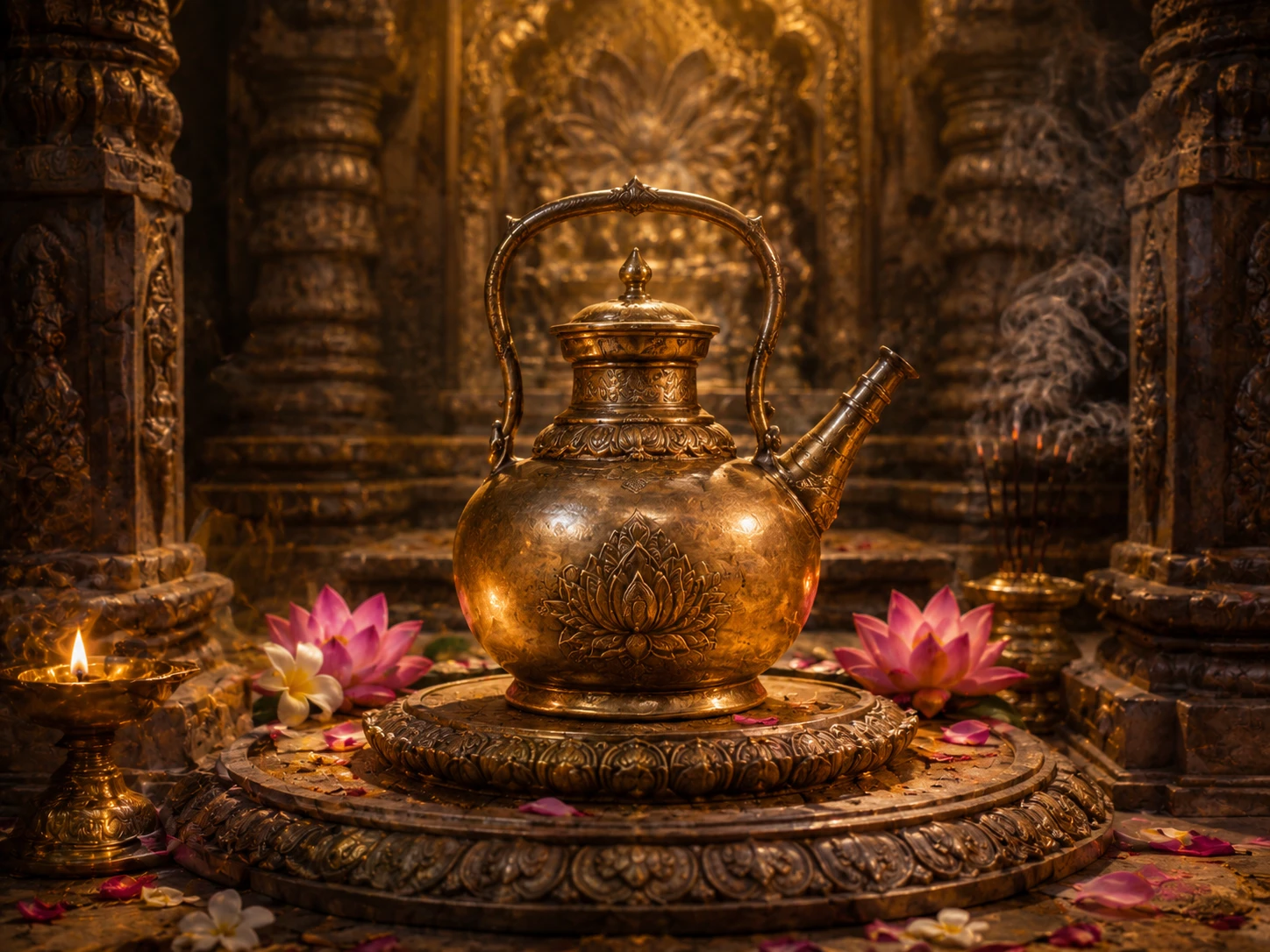
Kamandalu -- The Water Pot That Carries an Ocean of Renunciation
कमण्डलु -- वो जल-पात्र जिसमें त्याग का सागर समाया
Of all the objects associated with Hindu deities, the Kamandalu is the most deceptively simple. It is a small water vessel -- traditionally made from a dried gourd (tumbi/lauki) or coconut shell, later also from wood, clay, copper, or brass -- with a narrow neck and a spout. Brahma carries one. Shiva in his Dakshinamurti (teacher) form carries one. Every sadhu, sannyasi, and parivrajaka (wandering monk) in the Hindu, Buddhist, and Jain traditions carries one.
It holds water. That is all it does. And that is its entire teaching.
The Kamandalu is the material philosophy of renunciation (sannyasa) compressed into an object. A sannyasi who takes formal vows of renunciation is permitted to carry only a few objects: a staff (danda), a water pot (kamandalu), a begging bowl, and a cloth. The kamandalu provides the one substance the body cannot survive without -- water. It does not provide comfort. It does not provide luxury. It does not provide variety. It provides survival. The kamandalu says: this is what a human actually needs. Everything else is desire.
In deity iconography, the Kamandalu carries additional layers. When Brahma holds it, the water inside represents the cosmic creative potential -- the primordial waters from which all life emerges. The Kamandalu in Brahma's hand is the entire ocean of creation compressed into a pot. When Shiva holds it in his Dakshinamurti form (the south-facing teacher, the guru of all gurus), the Kamandalu represents controlled knowledge -- wisdom contained, measured, and dispensed only to those ready to receive it.
The Skanda Purana narrates a striking origin story. The sage Agastya once drank the entire ocean to help the Devas defeat the demons who were hiding in the waters. He held the ocean in his kamandalu. When the battle was won, he released the waters, refilling the seas. This is the Kamandalu as cosmic container -- a small pot that holds infinity.
The Ganga legend connects the Kamandalu to Brahma directly. When Vishnu, in his Vamana (dwarf) avatar, took three steps to measure the universe, his foot pierced the shell of the cosmic egg (Brahmanda) at the highest point. Water from the celestial Ganga flowed through the crack, and Brahma collected it in his Kamandalu. He later released it to flow through Shiva's matted locks and down to earth as the river Ganga. The Kamandalu is therefore the vessel that held the Ganga before the Ganga became a river -- the container of India's holiest water.
For a modern minimalist -- the startup founder who reads about capsule wardrobes and Marie Kondo's decluttering philosophy -- the Kamandalu is the original proof of concept. Three thousand years before Silicon Valley discovered that 'less is more', Indian sannyasis were walking across the subcontinent with everything they needed in a gourd and a cloth. The Kamandalu is not a design trend. It is a civilisational argument that has been tested over millennia: you need less than you think, and what you need is already available.
The Kamandalu also appears in the initiation ceremony for sannyasa. When a Hindu formally renounces worldly life, the guru hands him a kamandalu and a danda (staff). The kamandalu replaces the kitchen -- the sannyasi will no longer cook, no longer store food, no longer accumulate. He will carry water and receive whatever food is offered. The pot that held the ocean now holds a day's drink. The reduction is the teaching.
कमण्डलुधरो देवो ब्रह्मा लोकपितामहः। सृजत्यखिलभूतानि तोयपूर्णकरः सदा॥
kamaṇḍaludharo devo brahmā lokapitāmahaḥ | sṛjatyakhilabhūtāni toyapūrṇakaraḥ sadā ||
The god Brahma, grandfather of the worlds, holding the water-filled Kamandalu in his hand, eternally creates all beings.
— Brahma Stuti tradition (Puranic invocation)
Kamandalu Across Deity Iconography
| Deity / देवता | Context / सन्दर्भ | Kamandalu Represents / कमण्डलु प्रतिनिधित्व | Material / सामग्री |
|---|---|---|---|
| Brahma / ब्रह्मा | Four-handed creator / चतुर्भुज सृष्टिकर्ता | Primordial creative waters / आदिम सृजन-जल | Gold or divine / स्वर्ण या दिव्य |
| Shiva (Dakshinamurti) / शिव (दक्षिणामूर्ति) | South-facing guru / दक्षिणमुखी गुरु | Contained, measured wisdom / नियन्त्रित, मापित प्रज्ञा | Gourd or clay / तुम्बी या मिट्टी |
| Varuna / वरुण | Lord of waters / जलाधिपति | Oceanic authority / सागरीय अधिकार | Gold |
| Sannyasi / संन्यासी | Wandering renunciant / भटकता त्यागी | Minimum necessity; freedom from accumulation / न्यूनतम आवश्यकता | Gourd, coconut shell / तुम्बी, नारियल खोल |
| Agastya (Sage) / अगस्त्य | Ocean-drinker / सागर-पायी | Cosmic containment; unlimited in small form / ब्रह्माण्डीय धारण | Clay or copper / मिट्टी या ताम्र |
| Buddha (early art) / बुद्ध | Mendicant / भिक्षुक | Simplicity, non-attachment / सरलता, अनासक्ति | Gourd |
The Kamandalu also appears in Buddhist and Jain monastic traditions, carried by monks as their sole water vessel. The cross-tradition presence underscores its origin in the shared shramana (renunciant) culture of ancient India.
The Kamandalu appears in the logo of the Ramakrishna Mission -- one of India's most respected educational and humanitarian organisations, founded by Swami Vivekananda in 1897. The logo shows a swan on a lotus in a lake, with a serpent encircling the scene and the sun rising behind -- and Vivekananda himself was often depicted carrying a Kamandalu as a wandering monk during his travels across India and later to the Parliament of Religions in Chicago (1893). When Vivekananda stood before the Western world and began with 'Sisters and Brothers of America', the Kamandalu he had carried across India was the physical emblem of the tradition he represented: the sannyasi who needs nothing, carries almost nothing, and offers everything.
Carry Only What You Need -- A Meditation on Vairagya
The kamandalu teaches radical simplicity. Choose one object you use every day but do not need, and give it away this week. Then sit and watch what the mind does when it reaches for it. The Final Letting Go dharana on Eternal Raga is a meditation on release.
Tags
Eternal Raga · शाश्वत राग
Institutional voice — scholarly articles on Sanatan Dharma
Deepen Your Understanding
अपनी समझ और गहरी करें
sacred artefacts
Banalinga -- The Stone God Made Himself in a River Over Millions of Years
No sculptor shaped it. No temple priest consecrated it. The Banalinga is a smooth, egg-shaped stone that emerges from the bed of the Narmada River in central India -- formed by millions of years of water erosion into a shape that Hindus recognise as Shiva's aniconic emblem. It is called Svayambhu: self-born. It needs no prana pratishtha because divinity is already inside. In a tradition that fills temples with carved murtis and elaborate rituals, the Banalinga is a radical statement: God does not need human hands to manifest.
sacred artefacts
Panchamrita -- The Five-Nectar Offering That Is Simultaneously Puja and Pharmacy
Milk, yogurt, ghee, honey, sugar. Five ingredients. Mixed in a specific order, offered to the deity, poured over the murti, and then distributed as prasadam. Every Hindu has tasted Panchamrita. Almost none know that each ingredient represents a cosmic element and that the mixture is also a clinically documented Ayurvedic formulation for immunity and digestion.
sacred artefacts
Kusha Grass -- The Blade That Doubles as a Spiritual Conductor
It looks like ordinary grass. It is not. Kusha -- also called Darbha or Pavitram -- is a sharp-edged, razor-bladed grass that appears in virtually every Hindu ritual from birth to death. The Bhagavad Gita prescribes it as the ideal meditation seat. The Garuda Purana says it grew from Vishnu's hair. The Rig Veda mentions it alongside soma. It is worn as a ring by priests, laid under the dead, spread around sacrificial fires, and placed on food during eclipses. No other grass on Earth has this resume.
sacred symbols
Trishul -- The Three-Pronged Weapon That Encodes the Entire Operating System of the Universe
Three prongs. At least seven simultaneous meanings. Forged from the sun's own fire by Vishwakarma. The Trishul is not just Shiva's weapon -- it is a philosophical diagram you can hold in your hand. Creation-preservation-destruction. Past-present-future. Ida-Pingala-Sushumna. Every triad in Hinduism converges on those three points.
sacred artefacts
Damaru -- The Drum That Created the Sanskrit Language in Fourteen Beats
When Shiva's cosmic dance ended, he did not bow. He picked up a small hourglass-shaped drum and struck it fourteen times. From those fourteen beats emerged the fourteen Maheshwara Sutras -- the phonemic code of the Sanskrit language. Panini, the greatest grammarian in human history, used these fourteen sound-groups to build the Ashtadhyayi, a system of nearly four thousand grammatical rules so precise that modern computer scientists call it the world's first formal language specification. A drum made a language. That language made a civilisation.
sacred symbols
Lotus (Padma) -- The Flower That Grows in Mud and Became God's Throne
It grows from the bottom of a swamp. It rises through murky water. It blooms in sunlight without a single stain. This is not a motivational poster -- it is the central metaphor of Hindu civilisation. Every god sits on it. Every scripture references it. The Bhagavad Gita used it to explain the entire philosophy of detached action in one line.
The Kamandalu appears in the logo of the Ramakrishna Mission -- one of India's most respected educational and humanitarian organisations, founded by Swami Vivekananda in 1897. The logo shows a swan on a lotus in a lake, …
More in Sacred Artefacts
Ashtadhatu -- The Sacred Eight-Metal Alloy of Indian Temples
12 min read
Banalinga -- The Stone God Made Himself in a River Over Millions of Years
13 min read
Celestial Trees -- Kalpavriksha and Parijata
12 min readThe same translation error that turned '33 Koti' into '33 crore' in Hinduism also happened in Buddhism. The Chinese translation of Buddhist texts rendered 'Sapta Koti Buddha' (7 Supreme Buddhas) as '7 Crore Buddhas.' The…
Deities AvatarsCommunity Reflections
🕉️
Be the first to share your reflection.