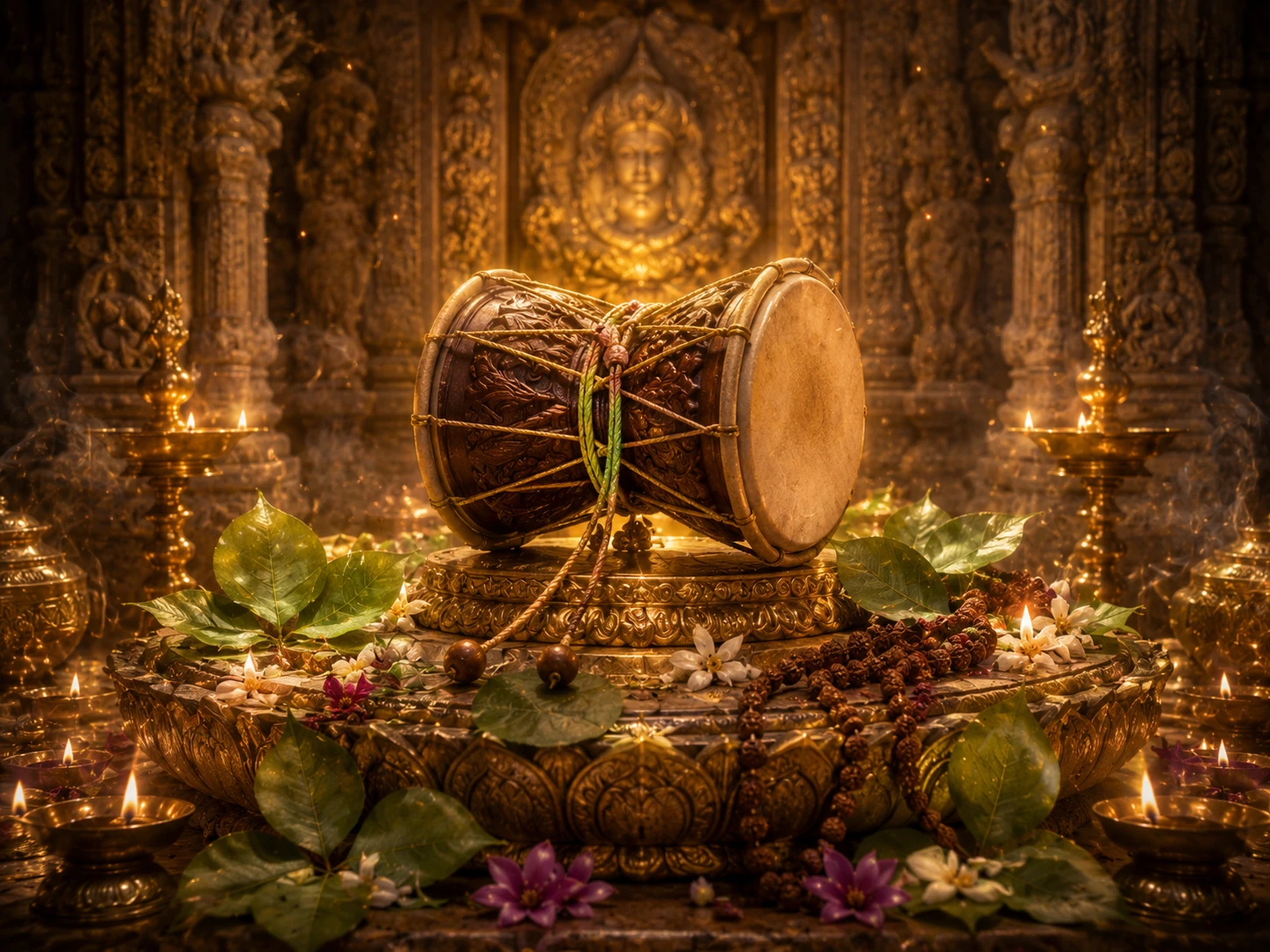
Damaru -- The Drum That Created the Sanskrit Language in Fourteen Beats
डमरू -- वो ढोल जिसने चौदह थापों में संस्कृत भाषा रची
In the Nataraja icon -- arguably the most recognised image in all of Hindu art -- Shiva dances inside a ring of fire. His upper left hand holds Agni (fire, symbolising destruction). His lower left hand points down in Gajahasta mudra (the elephant-trunk gesture, symbolising grace). His lower right hand is raised in Abhaya mudra (the gesture of fearlessness). And his upper right hand holds a small, hourglass-shaped drum. That drum is the Damaru.
Of the four objects in Nataraja's hands, the Damaru is the one that creates. Fire destroys. The gestures communicate. But the Damaru generates -- it produces Nada (primordial sound), the vibration from which the universe itself arises. In the Shaiva philosophical framework, the universe is not built from matter. It is built from sound. The first act of creation is not an explosion but a beat. And the instrument of that beat is a drum small enough to fit in one hand.
The Damaru is a pellet drum -- two small drumheads connected by a narrow waist, with knotted cords hanging from the sides. When shaken or rotated, the knots strike the drumheads alternately, producing a rapid, rhythmic rattling sound. The shape is an hourglass, and that shape is not accidental. The two heads represent the duality of creation (Shiva and Shakti, consciousness and energy, male and female), and the narrow waist is the bindu -- the point where duality collapses into unity. The entire cosmology of Shaivism is encoded in the drum's geometry before a single beat is played.
But the Damaru's most extraordinary claim is not cosmological. It is linguistic. According to tradition, Shiva's Damaru produced the sounds that became the phonemic foundation of the Sanskrit language -- and from that foundation, Panini constructed the most sophisticated grammar system the ancient world ever produced.
नृत्तावसाने नटराजराजो ननाद ढक्कां नवपञ्चवारम्। उद्धर्त्तुकामो सनकादिसिद्धानेतद्विमर्शे शिवसूत्रजालम्॥
nṛttāvasāne naṭarājarājo nanāda ḍhakkāṃ navapañcavāram | uddhartukāmo sanakādisiddhānetadvimarśe śivasūtrajālam ||
At the end of His cosmic dance, the Lord of Dance (Nataraja) sounded His Damaru fourteen times (nava-pancha: nine plus five). Desiring to uplift the sages Sanaka and others, He revealed this web of Shiva Sutras for their contemplation.
— Nandikesha Kashika (commentary tradition associated with Panini's Ashtadhyayi; widely cited as the invocatory verse of the Maheshwara Sutras)
THE FOURTEEN MAHESHWARA SUTRAS -- A DRUM BEAT THAT ENCODED A LANGUAGE
The tradition states that at the conclusion of his Tandava (cosmic dance), Shiva sounded his Damaru fourteen times. Each beat produced a distinct group of phonemes -- the basic sound units of the Sanskrit language. These fourteen groups, taken together, contain every vowel and every consonant in the Sanskrit alphabet. They are called the Maheshwara Sutras (Sutras of the Great Lord) or Shiva Sutras.
Here they are, in Devanagari, exactly as tradition preserves them:
1. अ इ उ ण् 2. ऋ ऌ क् 3. ए ओ ङ् 4. ऐ औ च् 5. ह य व र ट् 6. ल ण् 7. ञ म ङ ण न म् 8. झ भ ञ् 9. घ ढ ध ष् 10. ज ब ग ड द श् 11. ख फ छ ठ थ च ट त व् 12. क प य् 13. श ष स र् 14. ह ल्
The last consonant in each sutra is called an 'anubandha' or 'it' -- a marker that Panini uses as a shorthand device. By combining the first letter of one sutra with the anubandha of another, Panini creates what he calls 'Pratyaharas' -- compact abbreviations that refer to entire groups of phonemes. For example, 'aC' (a + C from sutra 4) refers to all vowels. 'haL' (ha + L from sutra 14) refers to all consonants. This is the world's oldest known compression algorithm -- a system for representing complex phonemic sets through minimal notation.
Panini used these Pratyaharas to construct the Ashtadhyayi -- approximately 3,959 rules of Sanskrit grammar encoded in eight chapters. The Ashtadhyayi is so precise, so internally consistent, and so complete that Noam Chomsky, the founder of modern generative linguistics, acknowledged Panini as a predecessor. Computer scientists at Stanford, MIT, and IIT Bombay have studied the Ashtadhyayi's formal structure and found it comparable to -- and in some cases more elegant than -- modern programming language specifications.
All of this traces back to fourteen beats of a drum.
NADA BRAHMAN -- THE THEOLOGY OF SOUND AS CREATOR
The Damaru is the physical instrument of a much larger philosophical concept: Nada Brahman -- the idea that ultimate reality (Brahman) is identical with primordial sound (Nada). This is not metaphor. In Shaiva Siddhanta, in Kashmir Shaivism, and in the Nada Yoga tradition, sound is literally the substance of creation. The universe does not merely contain sound. The universe is sound.
The Mandukya Upanishad teaches that the syllable Om (AUM) encompasses all states of consciousness -- waking (A), dreaming (U), and deep sleep (M) -- and that the silence after Om represents Turiya, the fourth state beyond the three. The Damaru's role in this framework is the role of the generator: it produces the primal vibration from which Om itself emerges. If Om is the seed of the universe, the Damaru is the hand that plants it.
This theology has practical consequences. In Shaiva ritual, the Damaru is not merely a musical instrument. It is a yantra of creation. When a Tantric practitioner plays a damaru during sadhana, they are not 'making music.' They are participating in the cosmogonic act -- re-enacting the moment when Shiva's drum brought the universe into being. The rhythm of the Damaru is understood as a micro-repetition of the original creative impulse.
For the philosophy student preparing for NET or UPSC, Nada Brahman connects Shaivism to the Mandukya Upanishad, to Bhartrhari's Sphota theory of language (where meaning bursts forth from sound like a seed sprouting), and to the entire Indian musical tradition that treats Raga not as entertainment but as spiritual practice. The Damaru sits at the fountainhead of all these streams.
THE DAMARU IN NATARAJA ICONOGRAPHY -- CHIDAMBARAM TO CERN
The Nataraja bronze of the Chola dynasty (10th-12th century CE, Tamil Nadu) is one of the supreme achievements of Indian sculpture. In it, Shiva dances the Ananda Tandava -- the dance of bliss through which he simultaneously creates, preserves, and destroys the universe. The Damaru in his upper right hand represents Shristi (creation). The fire in his upper left represents Samhara (destruction). His dancing foot crushes Apasmara, the dwarf of ignorance. The whole icon is a complete philosophical system rendered in bronze.
In 2004, the European Organization for Nuclear Research (CERN) installed a 2-metre statue of Nataraja at its headquarters in Geneva, Switzerland -- home of the Large Hadron Collider, the most powerful particle accelerator ever built. The plaque reads: 'Hundreds of years ago, Indian artists created visual images of dancing Shivas in a beautiful series of bronzes. In our time, physicists have used the most advanced technology to portray the patterns of the cosmic dance.' The connection is not decorative. Fritjof Capra's 1975 book 'The Tao of Physics' drew explicit parallels between the Nataraja's dance of creation-destruction and the continuous creation and annihilation of subatomic particles observed in quantum field theory.
The Damaru specifically corresponds to the Big Bang in this reading -- the initial vibration that set the universe in motion. Whether this parallel is literal, metaphorical, or coincidental is debated. But the fact remains that a small hand-drum from Hindu iconography stands at the entrance of the world's most advanced physics laboratory, and the scientists who put it there did so deliberately.
For the physics student at IIT or NEET, this is not about claiming that ancient Indians knew quantum mechanics. It is about recognising that the intuition that the universe begins with vibration -- that reality is fundamentally oscillatory, wave-like, rhythmic -- is an insight that both Shaiva philosophy and modern physics arrived at independently, separated by millennia and methodology but united in conclusion.
The Damaru Across Traditions -- Hindu, Buddhist, and Modern
| Tradition | Name / Type | Primary Association | Symbolic Function | प्रतीकात्मक कार्य (हिन्दी) |
|---|---|---|---|---|
| Shaiva Hinduism | Damaru / Dhakka | Nataraja Shiva | Creation through primordial sound (Nada) | आदिम ध्वनि (नाद) द्वारा सृष्टि |
| Tantric Hinduism | Damaru | Shakti-Shiva sadhana | Invoking the cosmogonic vibration during ritual | अनुष्ठान में सृष्टि-कम्पन आवाहन |
| Tibetan Vajrayana | Chod Damaru (skull drum) | Chod practice / Machig Labdron | Cutting ego-attachment through terrifying sound | भयंकर ध्वनि से अहं-आसक्ति काटना |
| Tibetan Vajrayana | Skull Damaru | Wrathful deities | Summoning protective energies | रक्षात्मक ऊर्जाओं का आह्वान |
| Classical Sanskrit | Maheshwara Sutras source | Panini's Ashtadhyayi | Phonemic foundation of Sanskrit grammar | संस्कृत व्याकरण की ध्वन्यात्मक नींव |
| Modern Physics (CERN) | Nataraja icon with Damaru | Particle physics metaphor | Vibration as origin of universe parallels quantum theory | कम्पन सृष्टि-मूल -- क्वाण्टम सिद्धान्त समानान्तर |
| Indian Classical Music | Nada Brahman concept | Raga tradition | Music as spiritual practice rooted in primal sound | आदिम ध्वनि में निहित आध्यात्मिक साधना |
The Damaru's cross-cultural presence spans approximately 2,500 years of documented history. The Tibetan Chod tradition (11th century CE, Machig Labdron) and the Hindu Tantric tradition share a common Indo-Tibetan heritage.
THE DAMARU IN TANTRIC AND TIBETAN PRACTICE
In the Hindu Tantric tradition, the Damaru is a ritual instrument used during Shakti-Shiva sadhana. The practitioner holds the drum and rotates it to produce a continuous rattling rhythm that is understood to replicate the primal vibration. The sound is neither melodic nor percussive in the conventional sense -- it is a continuous, shimmering hum that fills the ritual space and is believed to activate the Kundalini energy at the base of the spine.
The Tibetan Buddhist adoption of the Damaru is one of the most fascinating examples of Indo-Tibetan cultural transmission. Between the 8th and 12th centuries CE, Tantric Buddhist masters carried the Damaru from India to Tibet, where it became central to the Chod (cutting) practice developed by the female master Machig Labdron in the 11th century. In Chod, the practitioner sits in a charnel ground (cremation site) and plays the Damaru while chanting. The purpose is radical: to use the terrifying sound and setting to cut through ego-attachment, the practitioner's deepest fears, and the illusion of a separate self.
Tibetan Damarus come in two varieties: the Chod Damaru, made from wood and often elaborately decorated, and the Skull Damaru, made from two human skull caps joined at the crown. The Skull Damaru is the more esoteric instrument, used in advanced Tantric practices. Its material -- human bone -- is a deliberate confrontation with mortality. The practitioner who plays a drum made of skulls is forced to hold death in their hands every time they pick up the instrument.
This cross-cultural journey -- from Shiva's hand to Panini's grammar to Tibetan charnel grounds -- makes the Damaru one of the most widely travelled sacred objects in Asian religious history. It carries creation, destruction, language, philosophy, and the confrontation with death in one small, hourglass-shaped package.
THE DAMARU AND PANINI -- HOW A DRUM BEAT BECAME COMPUTER SCIENCE
Panini lived in Gandhara (modern-day Pakistan-Afghanistan border region) around the 4th century BCE. His Ashtadhyayi contains approximately 3,959 rules that describe the morphology, syntax, and semantics of Sanskrit with a precision that remained unmatched until the development of formal language theory in the 20th century.
The connection to the Damaru is through the Maheshwara Sutras that open the Ashtadhyayi. Whether Panini composed them himself or received them from an older tradition is debated by scholars. What is not debated is their function: they provide the phonemic raw material from which Panini's entire system is constructed. Without the fourteen sound-groups, the Pratyahara system does not work. Without the Pratyahara system, the Ashtadhyayi cannot express its rules concisely. The fourteen beats of the Damaru are, functionally, the boot sequence of the Sanskrit operating system.
In 1985, the NASA researcher Rick Briggs published a paper titled 'Knowledge Representation in Sanskrit and Artificial Intelligence,' arguing that Sanskrit's rule-based structure made it an ideal language for AI processing. This claim has been both celebrated and contested, but the underlying observation is valid: Panini's grammar is a generative system. It takes a finite set of rules and applies them recursively to produce an infinite set of grammatically correct sentences. This is exactly what a programming language does.
IIT Bombay's Sanskrit Computational Linguistics Lab has been working for years on building computational tools based on Panini's framework. Their Ashtadhyayi simulator can parse and generate Sanskrit sentences using Panini's original rules -- a system designed in the 4th century BCE running on 21st century hardware. When a JEE student in Kota writes code in Python, they are using a formal grammar system whose philosophical ancestor is the sound of a small drum in the hand of a dancing god.
For the startup world, there is a lesson here about the power of compression. Panini's 3,959 rules, derived from fourteen sound-groups, describe one of the world's most complex natural languages completely. That is the ultimate minimum viable product -- a grammar so efficient it has not needed an update in 2,400 years.
अ इ उ ण्। ऋ ऌ क्। ए ओ ङ्। ऐ औ च्। ह य व र ट्। ल ण्। ञ म ङ ण न म्। झ भ ञ्। घ ढ ध ष्। ज ब ग ड द श्। ख फ छ ठ थ च ट त व्। क प य्। श ष स र्। ह ल्।
a i u ṇ | ṛ ḷ k | e o ṅ | ai au c | ha ya va ra ṭ | la ṇ | ña ma ṅa ṇa na m | jha bha ñ | gha ḍha dha ṣ | ja ba ga ḍa da ś | kha pha cha ṭha tha ca ṭa ta v | ka pa y | śa ṣa sa r | ha l |
The fourteen Maheshwara Sutras -- the complete phonemic inventory of the Sanskrit language, organized in fourteen groups. The final consonant of each group is a marker (anubandha) used by Panini to create shorthand references (Pratyaharas) for his grammar rules.
— Maheshwara Sutras (Shiva Sutrani), as preserved in the Ashtadhyayi tradition of Panini (c. 4th century BCE)
THE PHYSICAL INSTRUMENT -- CONSTRUCTION, MATERIALS, AND ACOUSTICS
A traditional Damaru is deceptively simple. Two small drumheads -- typically made of stretched animal hide or, in some traditions, snakeskin -- are connected by a narrow wooden or metal waist. Two knotted cords (or beads on strings) hang from the waist. When the player rotates the drum back and forth with a wrist motion, the knots alternately strike the two heads, producing the characteristic rapid tattoo.
The size varies by tradition and purpose. Hindu devotional Damarus are typically 10-15 centimetres in length. Tibetan Chod Damarus can be larger. The miniature Damaru depicted in Nataraja icons is symbolic rather than functional -- no drum that small could produce audible sound in a cosmic dance, but the icon is theology, not engineering.
The acoustics of the Damaru are distinctive. Because the two heads are of slightly different tension and sometimes different sizes, the strikes produce two slightly different pitches -- a high-low alternation that creates a shimmering, warbling effect rather than a steady beat. This acoustic quality is deliberate. The Damaru is not meant to keep time like a tabla or mridangam. It is meant to produce unstable, oscillating sound -- a sonic representation of the constant vibration (spanda) that Shaiva philosophy identifies as the fundamental nature of reality.
Kashmir Shaivism formalises this in the concept of Spanda -- the 'divine throb' or 'sacred tremor' that pervades all existence. The Spanda Karikas, a foundational text of Kashmir Shaivism attributed to Vasugupta (9th century CE), describe reality as continuous vibration -- neither static nor chaotic, but pulsating. The Damaru's sound is the audible analogue of Spanda: not a note, not silence, but the throb between them.
For the music production enthusiast or the JEE student studying wave mechanics, the Damaru is worth examining. Its two-headed design creates interference patterns between the two sound sources. The slight pitch difference between the heads produces a natural 'beat frequency' -- the same phenomenon used in electronic music synthesis. Ancient sacred instrument, modern physics principle.
THE DAMARU IN POPULAR CULTURE AND EVERYDAY INDIA
Beyond temples and philosophy departments, the Damaru has an unmistakable presence in Indian daily life. The wandering Shaiva ascetic -- the Naga sadhu with ash-smeared body and matted hair -- often carries a small Damaru and a trident (trishul), the two most iconic accessories of Shiva worship. At Kumbh Mela, the world's largest religious gathering, thousands of sadhus can be seen playing Damarus as they process through the streets.
In Indian folk tradition, the Damaru is associated with street performers, medicine sellers, and wandering storytellers. The 'damaru-wala' -- a figure familiar to anyone who grew up in small-town India before the cable TV era -- would attract a crowd by rattling a Damaru, then sell herbal remedies or narrate mythological stories. This association between the drum and the transmission of knowledge is itself a folk echo of the Maheshwara Sutra tradition: the Damaru's sound gathers people, and into the gathered silence, language is born.
Bollywood has used the Damaru as a sonic and visual motif in countless Shiva-themed songs and sequences. The rhythmic 'dum-dum-dum' of the Damaru is one of the most recognisable sounds in Hindi film music's devotional genre. From 'Bam Bam Bhole' in movies to Kanwar Yatra processions on the streets of North India in the month of Shravan, the Damaru's sound marks the intersection of popular devotion and ancient symbolism.
For children growing up in Indian households, the Damaru is often one of the first religious symbols they encounter -- depicted in colouring books, Amar Chitra Katha comics, and nursery rhyme animations as the toy in 'Shiva's hand.' That a child's first image of God includes a musical instrument -- rather than a weapon, a crown, or a throne -- says something about the Shaiva worldview that prioritises creation (sound, language, vibration) over power. The first thing Shiva reaches for after his cosmic dance is not a sceptre. It is a drum.
The CERN Nataraja statue -- installed in 2004 at the European Organization for Nuclear Research in Geneva -- was a gift from the Indian government. The statue stands near the entrance of the facility that houses the Large Hadron Collider, where physicists study the fundamental particles of the universe. Meanwhile, IIT Bombay's Sanskrit Computational Linguistics Lab has built a working simulator of Panini's Ashtadhyayi that can parse Sanskrit text using rules derived from the Damaru's fourteen sound-groups. NASA researcher Rick Briggs's 1985 paper arguing that Sanskrit is ideal for AI knowledge representation has been cited over 500 times. The word 'Damaru' itself comes from the Sanskrit root 'dam' meaning 'to tame' or 'to subdue' -- the same root as the English word 'tame' and the Latin 'domare.' So when Shiva plays the Damaru, the etymological implication is that he is taming chaos into language, turning primal noise into structured sound. From subatomic particles to artificial intelligence to etymology, the Damaru keeps showing up.
Explore Shiva's Hymns on Eternal Raga
The damaru is the source of nada, and nada is the foundation of all music. Shiva's hymns, including the Sri Rudram and the Shiva Tandava Stotram, are on Eternal Raga with their meaning. Begin with Om Namah Shivaya, the Panchakshari mantra that echoes the damaru's primal beat.
Tags
Eternal Raga · शाश्वत राग
Institutional voice — scholarly articles on Sanatan Dharma
Deepen Your Understanding
अपनी समझ और गहरी करें
sacred artefacts
Divine Musical Instruments -- Veena, Damaru, Murali
Saraswati's Veena created knowledge. Shiva's Damaru created language. Krishna's Murali created longing. Three instruments, three cosmic functions -- and the foundation of one of the world's oldest musical traditions. From the 14 Maheshwara Sutras that birthed Sanskrit grammar to the raga system that maps human emotion, Hindu mythology placed music at the centre of creation itself.
deities avatars
Nataraja -- The Cosmic Dancer
One foot crushes a dwarf. The other is raised in liberation. A ring of fire frames the dance. A drum beats creation into existence. An open palm says 'do not fear.' This is Nataraja -- Shiva as the Lord of Dance -- and it is the single most replicated Indian bronze in the history of art. The physicists at CERN chose it to stand outside the world's largest particle accelerator. The Chola bronzesmiths of Tamil Nadu perfected it a thousand years ago. And every time a subatomic particle appears and disappears, the cosmic dance continues.
tantra mantra yantra
Tantra, Mantra and Yantra -- The Three Pillars of Spiritual Practice
Tantra is the loom, Mantra is the thread, Yantra is the pattern. Together they form the complete technology of spiritual transformation that India gifted to the world -- and they are far more profound than popular culture imagines.
sacred artefacts
Banalinga -- The Stone God Made Himself in a River Over Millions of Years
No sculptor shaped it. No temple priest consecrated it. The Banalinga is a smooth, egg-shaped stone that emerges from the bed of the Narmada River in central India -- formed by millions of years of water erosion into a shape that Hindus recognise as Shiva's aniconic emblem. It is called Svayambhu: self-born. It needs no prana pratishtha because divinity is already inside. In a tradition that fills temples with carved murtis and elaborate rituals, the Banalinga is a radical statement: God does not need human hands to manifest.
tantra mantra yantra
Nada Yoga -- The Yoga of Sacred Sound
The Hatha Yoga Pradipika declares that of all paths to samadhi, meditation on Nada -- the inner sound -- is supreme. In a world drowning in noise-cancelling earbuds and Spotify playlists, the oldest yoga of sound asks you to listen to the one frequency that needs no device.
vedic sciences
Panini and Ashtadhyayi -- The Science of Sanskrit Grammar
In the 5th century BCE, a man in Gandhara wrote approximately 4,000 rules that could generate every valid sentence in Sanskrit. No exceptions. No ambiguity. His system anticipated formal grammar, programming languages, and natural language processing by two and a half millennia. His name was Panini, and his Ashtadhyayi is not a grammar book -- it is an algorithm.
scriptural exegesis
Ravana Lifts Kailash -- How the Demon King Became Shiva's Greatest Devotee
A ten-headed king tries to uproot God's mountain. God presses it back with his little toe. The king, crushed and trapped, sings for a thousand years -- and the hymn he composes becomes one of the most powerful devotional poems in Sanskrit. The Ravananugraha episode is where arrogance meets devotion, and the result is the Shiva Tandav Stotram.
The CERN Nataraja statue -- installed in 2004 at the European Organization for Nuclear Research in Geneva -- was a gift from the Indian government. The statue stands near the entrance of the facility that houses the Larg…
More in Sacred Artefacts
Ashtadhatu -- The Sacred Eight-Metal Alloy of Indian Temples
12 min read
Banalinga -- The Stone God Made Himself in a River Over Millions of Years
13 min read
Celestial Trees -- Kalpavriksha and Parijata
12 min readThe same translation error that turned '33 Koti' into '33 crore' in Hinduism also happened in Buddhism. The Chinese translation of Buddhist texts rendered 'Sapta Koti Buddha' (7 Supreme Buddhas) as '7 Crore Buddhas.' The…
Deities AvatarsCommunity Reflections
🕉️
Be the first to share your reflection.