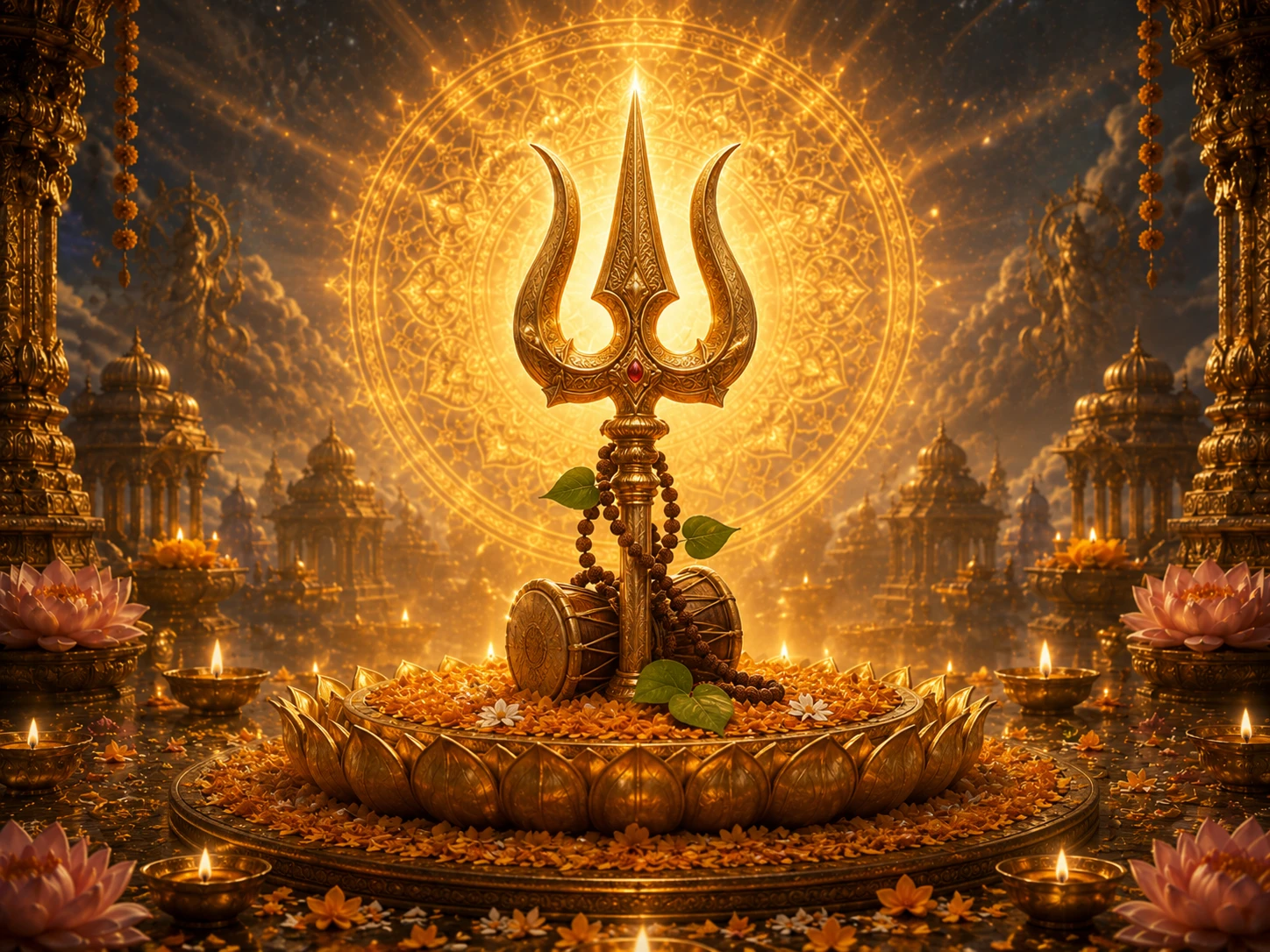
Trishul -- The Three-Pronged Weapon That Encodes the Entire Operating System of the Universe
त्रिशूल -- वो तीन-शूल अस्त्र जिसमें ब्रह्माण्ड का पूरा operating system कूटबद्ध
If you were asked to design one object that simultaneously encodes the structure of the cosmos, the architecture of the human nervous system, the mechanics of time, the hierarchy of the three worlds, and the balance of human psychology -- you would end up with a trident. The ancient Indians did exactly that.
The Trishul (Sanskrit: tri = three, shula = sharp stake or spear) is Shiva's primary weapon and one of the most instantly recognisable symbols in all of Hinduism. It appears in virtually every depiction of Shiva -- in temple sculpture, in calendar art, in the ash-smeared hands of Naga sadhus at the Kumbh Mela, and as a tilak-like mark on Shaiva foreheads. It stands planted beside Shiva temples across India, from the Himalayan shrines of Kedarnath to the coastal sanctums of Rameswaram.
But calling the Trishul a 'weapon' is like calling the Bhagavad Gita a 'conversation'. Technically accurate. Fundamentally misleading. The Trishul is a three-dimensional philosophical thesis. Each prong carries at least seven layers of meaning, and the three prongs together form a compressed encyclopedia of Hindu cosmology.
According to the Vishnu Purana, the Trishul was forged by the divine architect Vishwakarma. The origin story is characteristically elegant: Vishwakarma's daughter Sanjna was married to Surya (the Sun God) but could not bear his blazing heat. Vishwakarma asked Surya to diminish his radiance, and from the excess solar matter that was shaved off, Vishwakarma crafted three divine objects: the Pushpaka Vimana (the aerial chariot), Shiva's Trishul, and Vishnu's Sudarshana Chakra. The Trishul is therefore literally made of concentrated sunlight -- a weapon forged from the fundamental energy source of the solar system.
An alternative Shaiva tradition holds that the Trishul has no origin because Shiva has no origin. It exists as an eternal attribute of Mahadeva, preceding creation itself. This is the Adi Yogi perspective: the weapon was not made; it simply is, because the cosmic principles it represents simply are.
For the engineering student at IIT Bombay who sees a trishul on the dashboard of his cab on the way to Powai and dismisses it as superstition -- the object he is dismissing is a multi-variable symbolic system that encodes more information per square centimetre than most infographics he will encounter in his data science coursework.
त्र्यम्बकं यजामहे सुगन्धिं पुष्टिवर्धनम्। उर्वारुकमिव बन्धनान्मृत्योर्मुक्षीय माऽमृतात्॥
tryambakaṃ yajāmahe sugandhiṃ puṣṭivardhanam | urvārukamiva bandhanānmṛtyormukṣīya mā'mṛtāt ||
We worship the three-eyed One (Shiva) who is fragrant and nourishes all beings. As a cucumber is released from its bondage to the vine, may we be liberated from death, not from immortality.
— Mahamrityunjaya Mantra, Rig Veda 7.59.12 (Tryambaka = Three-eyed, the same 'three' principle as the Tri-shul)
The three prongs of the Trishul carry at least seven simultaneous triadic encodings. This is not a list of alternative meanings -- it is a stack of simultaneous meanings, all active at once:
**1. Trimurti (The Cosmic Triad):** Brahma (creation) -- Vishnu (preservation) -- Shiva (destruction/transformation). Shiva holds all three functions in one hand.
**2. Trigunas (The Three Qualities of Nature):** Sattva (purity, harmony, clarity) -- Rajas (passion, activity, desire) -- Tamas (inertia, ignorance, darkness). Every being and every moment is a mixture of these three. Shiva, as the wielder, stands above all three -- the Gunatita (beyond the gunas).
**3. Trikala (The Three Times):** Past -- Present -- Future. The Trishul encodes Shiva's mastery over time itself. He is Mahakala -- the Great Time, the force that governs all temporal existence.
**4. Triloka (The Three Worlds):** Svarga (heaven) -- Bhu (earth) -- Patala (netherworld). The three prongs pierce all three planes of existence simultaneously.
**5. Tri-Avastha (Three States of Consciousness):** Jagrat (waking) -- Svapna (dreaming) -- Sushupti (deep sleep). The Trishul represents mastery over all states, pointing towards Turiya -- the fourth state, pure awareness, which transcends the three.
**6. Tri-Nadi (Three Energy Channels):** Ida (left, lunar, feminine) -- Pingala (right, solar, masculine) -- Sushumna (central, the channel of Kundalini awakening). The central prong is Sushumna -- the channel through which spiritual energy ascends to the Sahasrara chakra. The Trishul, planted in the ground, is a yogic diagram of the human subtle body.
**7. Tri-Dosha (Three Inner Enemies):** Ahamkara (ego) -- Maya (illusion) -- Karma (bondage of action-reaction). The Trishul destroys all three, clearing the path to moksha.
Notice that these seven triads are not disconnected. They map onto each other. The three gunas correspond to the three states of consciousness. The three nadis correspond to the three worlds. The three times correspond to the three functions of the Trimurti. The Trishul is a node where all these systems intersect -- a physical object that serves as a cross-reference table for the entire Hindu philosophical database.
The Trishul is not Shiva's alone. Durga receives a Trishul from Shiva as one of the weapons the gods bestow upon her before her battle with Mahishasura. In Durga iconography, the Trishul in her hand represents her assumption of Shiva's destructive power -- the feminine divine wielding the masculine weapon of dissolution. The Devi Mahatmyam describes how each god gave Durga a copy of his own weapon, and Shiva's gift of the Trishul is the most symbolically charged -- he gives her the power to end what he himself ends.
Today, the Trishul appears on DRDO missile installations, on the logos of Shaiva mathas, on the gates of cremation grounds (where Shiva as Mahakala presides over the final dissolution), and tattooed on the forearms of Shiva devotees from Varanasi to Melbourne. The Indian Navy's Operation Trident (1971) was named evoking this weapon. The Trishul missile system was a surface-to-air defence weapon in the Indian military arsenal. The three-pronged symbol that your grandmother recognises from the temple is the same symbol that Indian defence scientists name their weapons after. The continuity is unbroken.
The Seven Triads Encoded in the Trishul
| Triad / त्रय | Left Prong / वाम शूल | Central Prong / मध्य शूल | Right Prong / दक्षिण शूल |
|---|---|---|---|
| Trimurti / त्रिमूर्ति | Brahma (Creation) / ब्रह्मा (सृष्टि) | Vishnu (Preservation) / विष्णु (स्थिति) | Shiva (Destruction) / शिव (संहार) |
| Trigunas / त्रिगुण | Rajas (Activity) / रजस् | Sattva (Purity) / सत्त्व | Tamas (Inertia) / तमस् |
| Trikala / त्रिकाल | Past / भूत | Present / वर्तमान | Future / भविष्य |
| Triloka / त्रिलोक | Patala (Netherworld) / पाताल | Bhu (Earth) / भू | Svarga (Heaven) / स्वर्ग |
| Tri-Avastha / त्र्यवस्था | Sushupti (Deep sleep) / सुषुप्ति | Svapna (Dream) / स्वप्न | Jagrat (Waking) / जाग्रत |
| Tri-Nadi / त्रिनाड़ी | Ida (Lunar) / इड़ा (चन्द्र) | Sushumna (Central) / सुषुम्ना (केन्द्रीय) | Pingala (Solar) / पिंगला (सूर्य) |
| Tri-Dosha / त्रिदोष | Maya (Illusion) / माया | Ahamkara (Ego) / अहंकार | Karma (Bondage) / कर्म |
The seven triads are not alternative interpretations but simultaneous layers. A single Trishul encodes all seven at once -- making it perhaps the most information-dense religious symbol ever designed.
India's DRDO named its short-range surface-to-air missile 'Trishul' -- a weapon designed to protect naval vessels and ground installations from aerial threats. The missile system's three-pronged guidance approach (radar, infrared, and command guidance) mirrors the three-pronged symbolism of Shiva's weapon. The Indian Navy's Operation Trident during the 1971 Indo-Pakistani War -- a decisive missile boat attack on Karachi harbour -- was named after the same symbol. In both cases, the naming is deliberate: the Trishul represents the protective and destructive aspects of sovereign power, exactly as it does in Shiva's hand. Ancient mythological weapons continue to name modern Indian defence systems -- Agni (missile), Prithvi (missile), Akash (missile), Nag (missile), Brahmos (cruise missile) -- making Puranic weapon lore a living vocabulary of Indian strategic culture.
Chant the Mahamrityunjaya Mantra
The Mahamrityunjaya mantra invokes Tryambaka, the three-eyed Shiva who wields the trishul. Chant it 108 times on a mala. Its page on Eternal Raga gives the meaning and how to chant it.
Tags
Eternal Raga · शाश्वत राग
Institutional voice — scholarly articles on Sanatan Dharma
Deepen Your Understanding
अपनी समझ और गहरी करें
sacred artefacts
Damaru -- The Drum That Created the Sanskrit Language in Fourteen Beats
When Shiva's cosmic dance ended, he did not bow. He picked up a small hourglass-shaped drum and struck it fourteen times. From those fourteen beats emerged the fourteen Maheshwara Sutras -- the phonemic code of the Sanskrit language. Panini, the greatest grammarian in human history, used these fourteen sound-groups to build the Ashtadhyayi, a system of nearly four thousand grammatical rules so precise that modern computer scientists call it the world's first formal language specification. A drum made a language. That language made a civilisation.
sacred symbols
Tripundra -- The Three Ash Lines That Declare You Are Already Free
Three horizontal lines of sacred ash. The mark of Shiva. Worn by Naga sadhus, Smarta Brahmins, Lingayats, and Adi Shankaracharya himself. Each line simultaneously represents a sacred fire, a syllable of Om, a guna, a world, a Veda, and an aspect of Shiva. The Kalagni Rudra Upanishad devotes its entire text to explaining why.
sacred symbols
Dharma Chakra -- The Wheel on Your Flag That Spins Since Before the Buddha
The 24-spoke blue wheel at the centre of the Indian flag is not just a Buddhist symbol adopted by Ashoka. It is a Vedic concept of cosmic order, a weapon on Vishnu's finger, a sun-symbol older than recorded history, and a political statement about the sovereignty of dharma over kings. It is the most seen Hindu symbol in the world -- and the least understood.
divine arsenal
Sudarshana Chakra -- The Disc of Divine Will
Vishnu's spinning disc is not merely a weapon -- it is cosmic justice made manifest. With 108 serrated edges, it never misses, never falters, and returns to the hand that released it. From Shishupala's hundredth sin to the Sudarshana Homa still performed in South Indian temples, this is the story of divine precision.
divine arsenal
The Divine Shields and Armour -- Karna's Kavach-Kundal, Agastya's Gift, and the Spiritual Meaning of Protection
Karna was born wearing armour that made him invincible -- and gave it away to the one man who wanted him dead. Rama received divine armour from a sage moments before facing Ravana. In Hindu tradition, the greatest protection is not what you wear on your body but what you carry in your soul.
sacred artefacts
Samudra Manthan Treasures -- The 14 Things That Came Out When Gods and Demons Churned the Ocean Together
Poison came first. Immortality came last. In between: a goddess, a gem, a cow, a horse, a tree, a physician, a bow, a moon, and an elephant. The Samudra Manthan is not just a myth -- it is a startup pitch deck for the universe. Two rival teams. One impossible project. Fourteen deliverables. And a hostile takeover at the end.
India's DRDO named its short-range surface-to-air missile 'Trishul' -- a weapon designed to protect naval vessels and ground installations from aerial threats. The missile system's three-pronged guidance approach (radar,…
More in Sacred Symbols
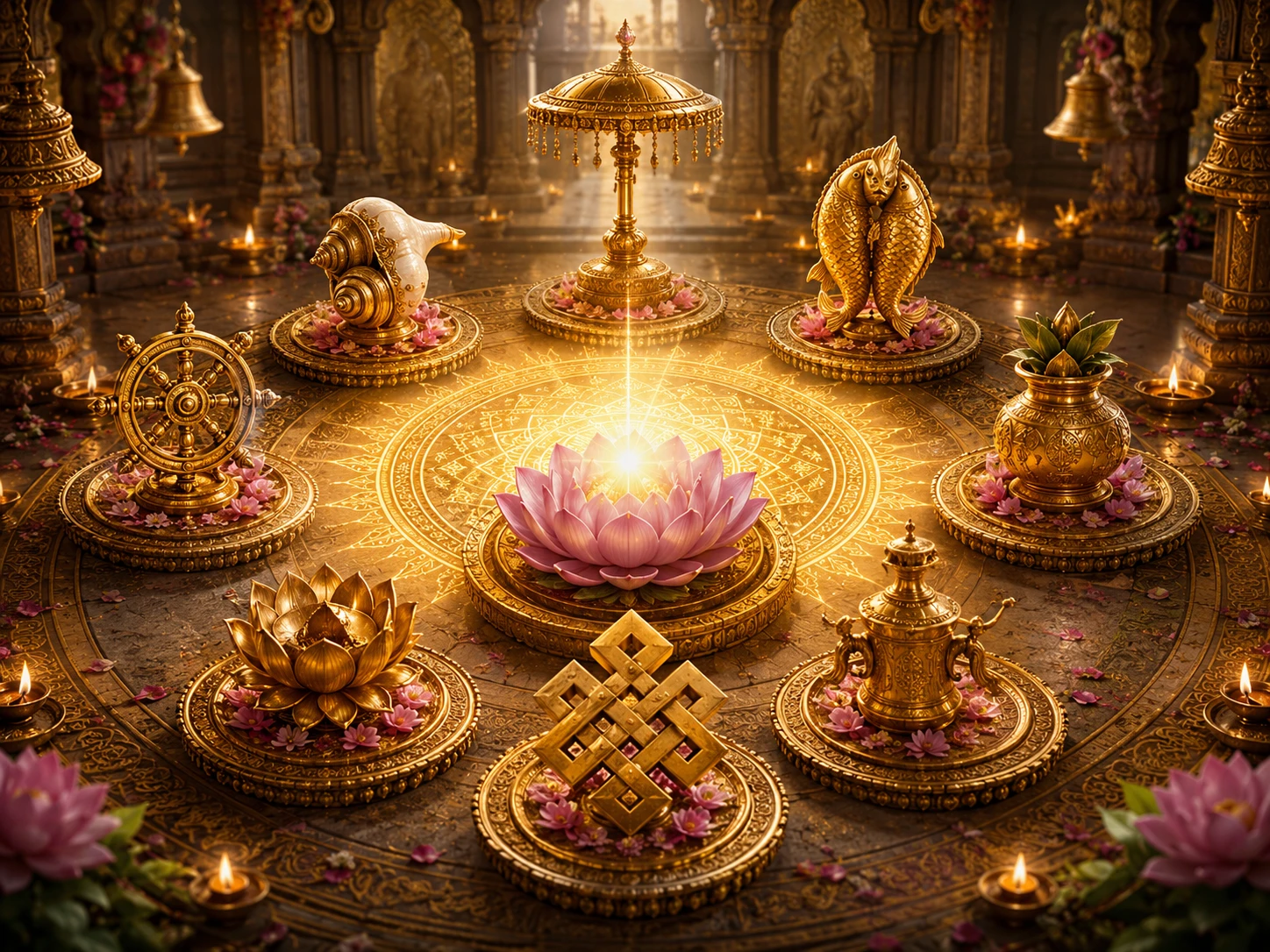
Ashtamangala -- The Eight Auspicious Symbols of Hindu Tradition
13 min read
Bindu -- The Point from which Creation Emerges
12 min read
Gau -- Why the Cow Holds the Place She Does in Hindu Life
14 min readThe same translation error that turned '33 Koti' into '33 crore' in Hinduism also happened in Buddhism. The Chinese translation of Buddhist texts rendered 'Sapta Koti Buddha' (7 Supreme Buddhas) as '7 Crore Buddhas.' The…
Deities AvatarsWatch: The Meaning of the Trishul
Community Reflections
🕉️
Be the first to share your reflection.