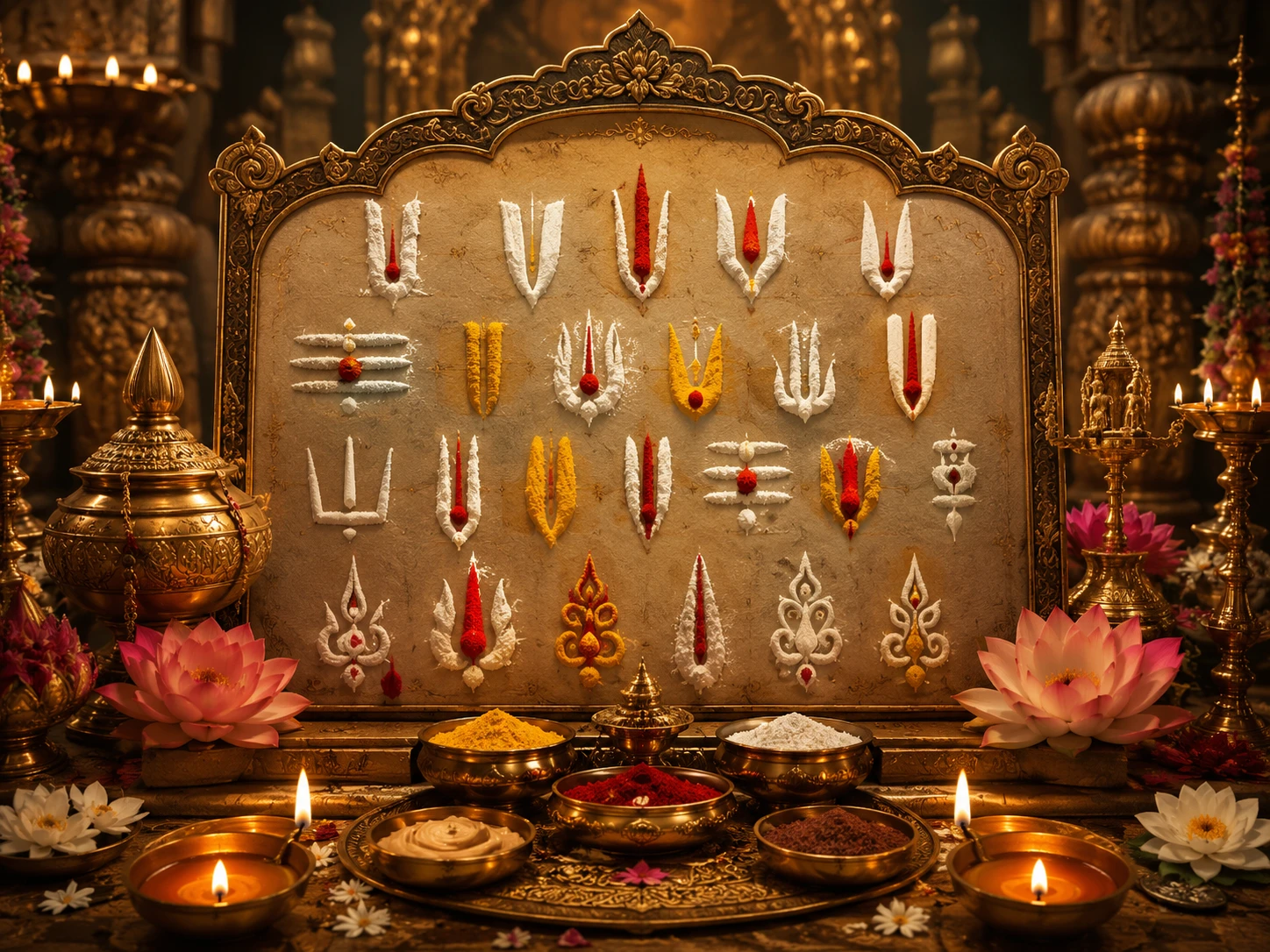
Tripundra -- The Three Ash Lines That Declare You Are Already Free
त्रिपुण्ड्र -- भस्म की तीन रेखाएँ जो घोषित करती हैं कि तुम पहले से मुक्त हो
The Tripundra is the most ancient continuously worn sectarian mark in Hinduism -- three horizontal lines of vibhuti (sacred ash) drawn across the forehead, sometimes with a red or sandalwood bindu at the centre. It is the mark of Shiva, worn by every Shaiva sect from the Dashnami sannyasis to the Naga sadhus to the Lingayats of Karnataka, and by Smarta Brahmins who follow Adi Shankaracharya's tradition.
The Kalagni Rudra Upanishad, a minor Upanishad of the Krishna Yajurveda, is devoted entirely to the Tripundra -- its material, preparation, application, mantras, and symbolic meaning. In a dialogue between the sage Sanatkumara and Lord Kalagni Rudra (a fierce form of Shiva), the text establishes the Tripundra as the 'Shambhu Vrata' -- the vow of Shiva, taught in all the Vedas.
The material is vibhuti -- ash from the sacred fire (yagna), collected while reciting the Pancha Brahma mantras (Sadyojata, Vamadeva, Aghora, Tatpurusha, Ishana) and consecrated with the Mahamrityunjaya Mantra. The Atharvashiras Upanishad declares that all five elements are ash: fire is ash, air is ash, water is ash, earth is ash, space is ash. Vibhuti is not death's residue. It is reality's substrate -- what remains when all transient forms have been surrendered.
The three lines extend from the centre of one eyebrow to the centre of the other, covering the ajna chakra zone. Each line carries six simultaneous symbolic layers (as detailed in our tilak-types article): three sacred fires (Garhapatya, Dakshinagni, Ahavaniya), three syllables of Om (A, U, M), three gunas (Rajas, Sattva, Tamas), three worlds (Bhu, Bhuvar, Svar), three Vedas (Rig, Yajur, Sama), and three aspects of Shiva (Maheshvara, Sadashiva, Mahadeva).
The Upanishad declares: whoever wears the Tripundra -- whether brahmachari, grihastha, vanaprastha, or sannyasi -- is purified of all sins, major and minor. He becomes equal to one who has bathed in all holy places and one who constantly recites the Rudra hymn. After enjoying all worldly pleasures, he enters union with Shiva and does not return.
This is not a casual mark. It is a complete soteriology compressed into three streaks of ash. For the Shaiva, the Tripundra is not decoration. It is a daily declaration: this body is already ash. This self is already Shiva. Liberation is not a destination -- it is the current state, temporarily obscured by identification with form.
Today, the Tripundra remains the most visible marker at the Kumbh Mela, at Shaiva temples across India, on the foreheads of classical Bharatanatyam dancers who invoke Shiva before performing, and on the cricket bat of certain devout players who mark their equipment before a match. The three lines that the Vedic rishis prescribed are the same three lines that appear on foreheads in Varanasi, Madurai, Pashupatinath, and the Shaiva diaspora worldwide.
अग्निरिति भस्म वायुरिति भस्म जलमिति भस्म स्थलमिति भस्म व्योमेति भस्म।
agniriti bhasma vāyuriti bhasma jalamiti bhasma sthalamiti bhasma vyometi bhasma.
Fire is ash. Air is ash. Water is ash. Earth is ash. Space is ash. (All five elements are, in their ultimate nature, ash -- the imperishable residue.)
— Atharvashiras Upanishad (Bhasma Mantra, recited during Tripundra application)
Tripundra -- The Six Symbolic Layers of Each Line
| Layer / स्तर | First Line / प्रथम रेखा | Second Line / द्वितीय रेखा | Third Line / तृतीय रेखा |
|---|---|---|---|
| Sacred Fire / पवित्र अग्नि | Garhapatya / गार्हपत्य | Dakshinagni / दक्षिणाग्नि | Ahavaniya / आहवनीय |
| Om Syllable / ॐ अक्षर | A / अ | U / उ | M / म |
| Guna / गुण | Rajas (Activity) / रजस् | Sattva (Purity) / सत्त्व | Tamas (Inertia) / तमस् |
| World / लोक | Bhu (Earth) / भू | Bhuvar (Atmosphere) / भुवः | Svar (Heaven) / स्वः |
| Veda / वेद | Rigveda / ऋग्वेद | Yajurveda / यजुर्वेद | Samaveda / सामवेद |
| Shiva Aspect / शिव पक्ष | Maheshvara / महेश्वर | Sadashiva / सदाशिव | Mahadeva / महादेव |
All six layers are active simultaneously in each line. The Tripundra is therefore an 18-cell matrix (3 lines x 6 layers) compressed into three streaks of ash -- perhaps the highest information density per unit area of any religious mark.
The Tripundra is the forehead mark visible on the face of the Pashupatinath idol in Nepal -- one of the oldest Shiva temples in the world, dating to at least the 5th century CE. The same three-line pattern appears on Indus Valley Civilisation seals (c. 2500-1900 BCE) depicting a seated figure in a yogic posture, which some scholars (following John Marshall) identify as a proto-Shiva figure. If this identification holds, the Tripundra may be over 4,000 years old -- making it the single longest-lived religious body-marking practice in documented human history.
Apply Vibhuti with the Mahamrityunjaya Mantra
The tripundra is applied while chanting the Tryambakam mantra. Each morning, take a pinch of vibhuti, draw the three horizontal lines across the forehead with three fingers, and recite the Mahamrityunjaya mantra as you do. Its page on Eternal Raga gives the meaning and how to chant it.
Tags
Eternal Raga · शाश्वत राग
Institutional voice — scholarly articles on Sanatan Dharma
Deepen Your Understanding
अपनी समझ और गहरी करें
sacred symbols
Tilak Types -- The Hindu Forehead Mark That Tells Your Entire Spiritual Address
Before LinkedIn profiles and Instagram bios, Hindus had a one-glance identity system -- the tilak. A single mark on the forehead could tell you someone's deity, lineage, philosophy, and guru. Tripundra or Urdhva Pundra? Vibhuti or chandana? Each line is a declaration of cosmic allegiance.
sacred symbols
Urdhva Pundra -- The Vertical Lines That Turn Your Body into Twelve Vishnu Temples
Two or three vertical lines on the forehead -- white clay, sandalwood, or gopichandana -- with a central mark of red, yellow, or black. The Urdhva Pundra is the Vaishnava counterpart to the Shaiva Tripundra. But it does not stop at the forehead. Orthodox Vaishnavas mark twelve points on the body, each reciting a name of Vishnu. The body becomes a walking shrine.
sacred symbols
Trishul -- The Three-Pronged Weapon That Encodes the Entire Operating System of the Universe
Three prongs. At least seven simultaneous meanings. Forged from the sun's own fire by Vishwakarma. The Trishul is not just Shiva's weapon -- it is a philosophical diagram you can hold in your hand. Creation-preservation-destruction. Past-present-future. Ida-Pingala-Sushumna. Every triad in Hinduism converges on those three points.
sacred artefacts
Damaru -- The Drum That Created the Sanskrit Language in Fourteen Beats
When Shiva's cosmic dance ended, he did not bow. He picked up a small hourglass-shaped drum and struck it fourteen times. From those fourteen beats emerged the fourteen Maheshwara Sutras -- the phonemic code of the Sanskrit language. Panini, the greatest grammarian in human history, used these fourteen sound-groups to build the Ashtadhyayi, a system of nearly four thousand grammatical rules so precise that modern computer scientists call it the world's first formal language specification. A drum made a language. That language made a civilisation.
sacred artefacts
Banalinga -- The Stone God Made Himself in a River Over Millions of Years
No sculptor shaped it. No temple priest consecrated it. The Banalinga is a smooth, egg-shaped stone that emerges from the bed of the Narmada River in central India -- formed by millions of years of water erosion into a shape that Hindus recognise as Shiva's aniconic emblem. It is called Svayambhu: self-born. It needs no prana pratishtha because divinity is already inside. In a tradition that fills temples with carved murtis and elaborate rituals, the Banalinga is a radical statement: God does not need human hands to manifest.
sacred symbols
Temple Architecture Symbolism -- Why Every Hindu Temple Is a Human Body, a Mountain, and the Universe
The dark womb-room at the centre. The tower rising above it like a spine. The gateway that frames the divine like an eye. A Hindu temple is not a building where you go to see God. It IS the body of God -- designed on a mandala grid, proportioned by sacred mathematics, and oriented to catch the first ray of the rising sun.
The Tripundra is the forehead mark visible on the face of the Pashupatinath idol in Nepal -- one of the oldest Shiva temples in the world, dating to at least the 5th century CE. The same three-line pattern appears on Ind…
More in Sacred Symbols
Ashtamangala -- The Eight Auspicious Symbols of Hindu Tradition
13 min read
Bindu -- The Point from which Creation Emerges
12 min read
Gau -- Why the Cow Holds the Place She Does in Hindu Life
14 min readThe same translation error that turned '33 Koti' into '33 crore' in Hinduism also happened in Buddhism. The Chinese translation of Buddhist texts rendered 'Sapta Koti Buddha' (7 Supreme Buddhas) as '7 Crore Buddhas.' The…
Deities AvatarsCommunity Reflections
🕉️
Be the first to share your reflection.