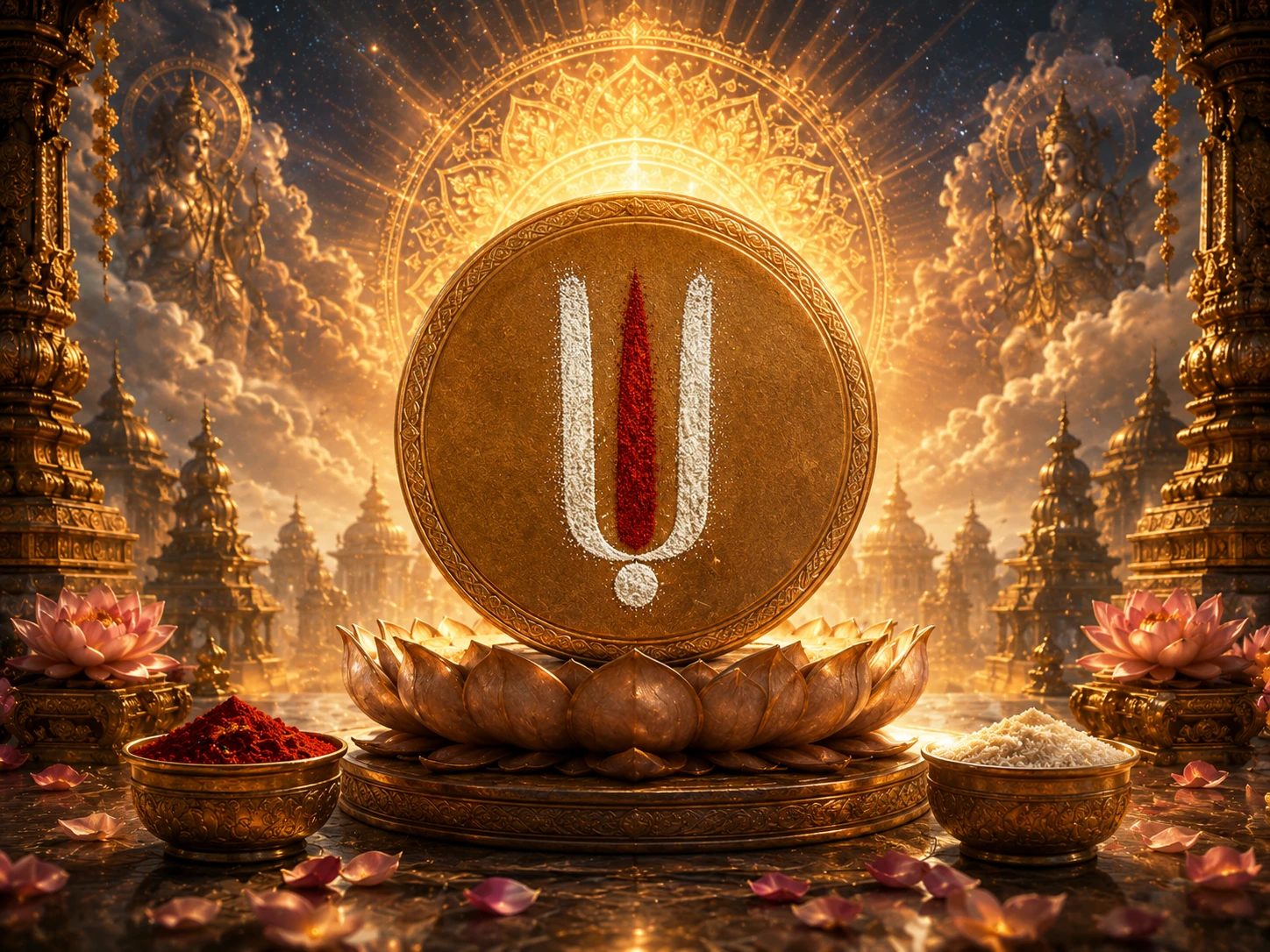
Tilak Types -- The Hindu Forehead Mark That Tells Your Entire Spiritual Address
तिलक प्रकार -- माथे का वो चिह्न जो तुम्हारा पूरा आध्यात्मिक पता बताता है
Walk into any temple town in India -- Varanasi, Vrindavan, Udupi, Madurai, Tirupati -- and you can read the crowd like an open book without saying a word. The three horizontal lines of ash on that old sadhu at Dashashwamedh Ghat? He is Shaiva -- a devotee of Shiva, walking the path of detachment, reminding himself with every streak that this body will one day be ash. The white U-shaped mark with a red centre on the priest at ISKCON Vrindavan? Gaudiya Vaishnava -- he carries the lotus feet of Vishnu on his forehead, literally. The red kumkum dot on the woman doing aarti at the Kamakhya temple? Shakta -- the energy of the Goddess burns between her brows.
The tilak is the oldest identity system in continuous use anywhere in human civilisation. Before passports, before heraldry, before family crests, before corporate logos -- there was a smear of ash, clay, or paste on the forehead that told the world who you worshipped, which philosophical school you belonged to, and which guru's lineage you walked in. It was -- and still is -- an entire spiritual CV compressed into a single visual mark.
And yet, for millions of young Indians today, the tilak is that thing your grandmother puts on your forehead before an exam. You tolerate it. You might even wipe it off in the auto on the way to the JEE centre. You know it is supposed to be auspicious. But you probably don't know that it is one of the most sophisticated semiotic systems ever created -- a single mark that encodes theology, philosophy, lineage, and practice.
This article is a field guide to reading the forehead of Hindu India.
The word tilaka comes from the Sanskrit root 'til' (sesame seed), suggesting something small that carries immense potency -- much like a sesame seed, which despite its size is packed with oil. The Rig Veda mentions the practice of marking the forehead, and by the time of the Upanishads, the tilak had evolved into a formalised system with specific texts devoted entirely to the rules of application, materials, mantras, body locations, and spiritual benefits.
The placement is not random. The tilak sits at the ajna chakra -- the sixth energy centre, located between the eyebrows, associated in yogic anatomy with the pineal gland, intuition, and higher perception. In Ayurvedic tradition, this point is a marma (vital energy junction). Applying pressure or stimulation here -- whether through chandana paste, kumkum, or ash -- is believed to calm the mind and activate inner awareness. Modern neuroscience has noted that the area between the eyebrows corresponds to the prefrontal cortex, the brain region associated with decision-making, concentration, and self-regulation.
The materials used are never arbitrary. Chandana (sandalwood paste) is cooling and calming -- it literally reduces surface temperature of the skin. Kumkum (turmeric-based vermillion) is warming and energising. Vibhuti (sacred ash) is symbolically the ultimate material -- it is what remains when everything combustible has been destroyed, a physical reminder that the body is temporary but the atman is eternal. Gopichandana (white clay from Dwarka) is specific to Vaishnava traditions, believed to be from the land where Krishna walked. Each material carries not just symbolic but also tangible physiological properties.
The point is this: the tilak is not superstition. It is applied science wrapped in sacred symbolism.
The four major tilak families correspond to the four primary devotional streams of Hinduism. Understanding them is understanding the map of Hindu theological diversity.
**1. Tripundra (त्रिपुण्ड्र) -- The Shaiva Mark**
Three horizontal lines of vibhuti (sacred ash) drawn across the forehead, sometimes with a red or sandalwood bindu at the centre. This is the mark of Shiva and is worn by all Shaiva sects -- from the Dashnami sannyasis of Adi Shankaracharya's order to the Naga sadhus at the Kumbh Mela, from the Lingayat community of Karnataka to Tamil Shaiva Siddhanta practitioners.
The three lines are among the most symbolically dense marks in all of Hinduism. The Kalagni Rudra Upanishad, a minor Upanishad of the Krishna Yajurveda, devotes its entire text to the Tripundra -- its material, application method, mantras, and multi-layered symbolism. According to this text, the three lines simultaneously represent: the three sacred fires (Garhapatya, Dakshinagni, Ahavaniya), the three syllables of Om (A, U, M), the three gunas (Rajas, Sattva, Tamas), the three worlds (Bhur, Bhuvar, Svar), the three types of atman (external, inner, supreme), the three Vedas (Rig, Yajur, Sama), the three Soma pressings (morning, midday, evening), and three aspects of Shiva (Maheshvara, Sadashiva, Mahadeva).
The material -- vibhuti -- is itself a theological statement. It is ash from the yagna fire, collected while reciting the Panchbrahma mantras (Sadyojata, Vamadeva, Aghora, Tatpurusha, Ishana). The Atharvashiras Upanishad equates all five elements with ash: fire is ash, air is ash, water is ash, earth is ash, space is ash. This is not nihilism. It is the Shaiva recognition that destruction is not the end but the ground state -- what remains when all form has been surrendered is the imperishable truth.
Applied with the Mahamrityunjaya Mantra (Tryambakam yajamahe), the Tripundra extends from the centre of one eyebrow to the centre of the other, covering the breadth of the ajna chakra. The Smarta tradition, which follows Adi Shankaracharya's Advaita Vedanta, also wears the Tripundra -- because Shankaracharya, despite being a philosopher of non-dual Brahman, maintained Shaiva ritual forms.
Today, if you see three horizontal ash lines on a forehead in India, you are looking at the oldest continuously worn sectarian mark on the planet.
यस्य प्रथमा रेखा सा गार्हपत्यश्चाकारो रजो भूर्लोकः स्वात्मा क्रियाशक्तिः ऋग्वेदः प्रातःसवनं महेश्वरो देवतेति।
yasya prathamā rekhā sā gārhapatyaścākāro rajo bhūrlokaḥ svātmā kriyāśaktiḥ ṛgvedaḥ prātaḥsavanaṃ maheśvaro devateti.
Its first line is the Garhapatya fire, the A-sound of Om, the quality of Rajas, the earthly realm, the external Self, the power of Action, the Rigveda, the morning Soma pressing, and Maheshvara is its deity.
— Kalagni Rudra Upanishad, Chapter 2 (Krishna Yajurveda)
**2. Urdhva Pundra (ऊर्ध्वपुण्ड्र) -- The Vaishnava Mark**
Two or three vertical lines, usually in a U-shape or V-shape, extending from the bridge of the nose to the hairline, applied with white clay (gopichandana), sandalwood paste, or turmeric. A central mark -- red, yellow, or sometimes black -- sits between the lines. This is the mark of Vishnu and is worn by all Vaishnava sects.
The Vasudeva Upanishad explains the three vertical lines as representing: the three Vedas (Rig, Yajur, Sama), the three worlds (Bhu, Bhuvar, Svar), the three syllables of Om, the three states of consciousness (waking, dream, deep sleep), the three realities (Maya, Brahman, Atman), and the three bodies (gross, subtle, causal). The Padma Purana prescribes that a Vaishnava should apply twelve such marks on the body -- forehead, chest, neck, belly, both sides, both elbows, both arms, back, and back of the neck -- while reciting the twelve names of Vishnu beginning with Keshava and ending with Vasudeva.
The diversity within Vaishnava tilak alone is staggering, and this is where the system becomes a precise denominational identifier:
The **Sri Vaishnava** tilak (Iyengar community, Tamil Nadu) has two white outer lines representing the feet of Narayana, with a central red line representing Lakshmi. A curvature at the nose bridge indicates the Tenkalai (southern school) denomination; a straight bridge indicates Vadakalai (northern school). This distinction -- a tiny curl versus a straight line -- represents a centuries-old philosophical debate about whether grace requires self-effort or is entirely unconditional.
The **Gaudiya Vaishnava** tilak (ISKCON, Chaitanya tradition) uses gopichandana clay from Dwarka in a U-shape with a tulasi leaf mark in the centre. This specific clay is believed to come from the land where the gopis loved Krishna.
The **Madhva** tilak (Udupi tradition, Karnataka) is distinctive: two vertical lines that do not meet at the bottom, with a straight black line of gopichandana in the middle -- the line said to represent Vayu, the breath of God.
The **Swaminarayan** tilak-chandlo has a U-shaped sandalwood tilak with a round kumkum dot (chandlo) in the centre -- representing the feet of Krishna with Lakshmi residing within.
The **Nimbarka** tilak is two black vertical lines with a central black dot, said to represent Radha-Krishna together -- the mark reportedly first given to Nimbarka by the sage Narada himself at initiation.
The **Ramanandi** tilak (the largest Vaishnava monastic order in North India) applies a broad red line down the forehead's centre.
Think of it this way: a JEE aspirant in Kota preparing for the exam might see two different Vaishnava sadhus at the nearby temple and assume their tilaks are the same. They are not. One is Madhva. One is Gaudiya. They disagree on the nature of God, the role of the soul, and the mechanics of liberation. And you can see the disagreement on their foreheads.
ऊर्ध्वपुण्ड्रं हरेः क्षेत्रं ललाटे यस्य विद्यते। तं दृष्ट्वा सर्वपापेभ्यो मुच्यते नात्र संशयः॥
ūrdhvapuṇḍraṃ hareḥ kṣetraṃ lalāṭe yasya vidyate | taṃ dṛṣṭvā sarvapāpebhyo mucyate nātra saṃśayaḥ ||
The urdhva pundra on one's forehead is the temple of Lord Hari. By seeing it, one is freed from all sins -- there is no doubt about this.
— Padma Purana, Uttara Khanda
**3. Shakta Tilak -- The Goddess Mark**
A single dot or vertical line of kumkum (red turmeric powder) or sindoor (vermillion) at the ajna chakra. This is the mark of Shakti -- the divine feminine energy worshipped as Durga, Kali, Lakshmi, Saraswati, and the many regional forms of the Goddess.
The Shakta tilak is perhaps the most widely recognised Hindu mark globally, largely because of the bindi -- its simplified, everyday form. Every married Hindu woman who applies a red dot on her forehead is participating, consciously or not, in a Shakta tradition thousands of years old. The kumkum represents the creative and energetic force of the divine feminine. At the ajna chakra, it signifies awakened Shakti -- the Kundalini energy that, in tantric physiology, rises from the base of the spine to the third eye.
The Ganapatya tradition (devotees of Ganesha) uses red sandalwood paste (rakta chandana) in a similar single-mark format.
**4. Smarta Tilak -- The Philosopher's Mark**
Smarta Brahmins who follow the Shanmata system (worship of six deities as equal manifestations of one Brahman) may wear any of the above tilaks or a simpler mark -- often just a small chandana dot or a single horizontal line. The Smarta position is essentially: the external mark matters less than the internal realisation. Adi Shankaracharya himself wore the Tripundra but his philosophical framework -- Advaita Vedanta, where all distinctions are ultimately illusory -- makes any particular tilak a concession to vyavaharika (conventional reality) rather than a claim of paramarthika (ultimate truth).
**5. Raj Tilak and Vir Tilak -- The Ceremonial Marks**
Beyond daily devotional use, India has two honorary tilak traditions that are purely ceremonial. The Raj Tilak -- a single vertical red line -- is applied during coronations and when receiving distinguished guests. The Vir Tilak is applied to warriors or victors after battle or competition. When Virat Kohli walks out to bat and his mother has put a tikka on his forehead before the match, she is performing a Vir Tilak -- whether she uses that term or not.
The tilak, then, is not one thing. It is a family of marks, each carrying centuries of theological debate, philosophical precision, and lived devotional practice. And India may be the only civilisation where you can determine someone's metaphysics by looking at their forehead.
Major Tilak Types -- Quick Reference
| Tilak / तिलक | Shape / आकार | Material / सामग्री | Deity / देवता | Key Scripture / प्रमुख ग्रन्थ | Worn By / कौन धारण करता है |
|---|---|---|---|---|---|
| Tripundra / त्रिपुण्ड्र | Three horizontal lines / तीन क्षैतिज रेखाएँ | Vibhuti (sacred ash) / विभूति (पवित्र भस्म) | Shiva / शिव | Kalagni Rudra Upanishad | Shaivas, Smartas, Naga sadhus, Lingayats |
| Urdhva Pundra (Sri Vaishnava) / ऊर्ध्वपुण्ड्र (श्री वैष्णव) | Two white lines + red centre / दो श्वेत रेखाएँ + लाल केन्द्र | White clay + kumkum / श्वेत मिट्टी + कुमकुम | Narayana-Lakshmi / नारायण-लक्ष्मी | Vasudeva Upanishad, Pancharatra Agamas | Sri Vaishnavas (Iyengars, Tamil Nadu) |
| Urdhva Pundra (Gaudiya) / ऊर्ध्वपुण्ड्र (गौडीय) | U-shape + tulasi leaf mark / U-आकार + तुलसी पत्ती चिह्न | Gopichandana (Dwarka clay) / गोपीचन्दन (द्वारका मिट्टी) | Krishna-Radha / कृष्ण-राधा | Chaitanya Charitamrita | ISKCON, Gaudiya Vaishnavas |
| Urdhva Pundra (Madhva) / ऊर्ध्वपुण्ड्र (माध्व) | Two lines not joined + black centre / दो रेखाएँ (नीचे अलग) + काला केन्द्र | Gopichandana / गोपीचन्दन | Vishnu-Vayu / विष्णु-वायु | Madhva's commentaries | Dvaita Vaishnavas (Udupi, Karnataka) |
| Shakta Bindi / शाक्त बिन्दी | Single dot or vertical line / एकल बिन्दु या ऊर्ध्व रेखा | Kumkum or sindoor / कुमकुम या सिन्दूर | Devi / देवी | Devi Bhagavata Purana | Shaktas, married women |
| Swaminarayan Tilak-Chandlo | U-shape + round red dot / U-आकार + गोल लाल बिन्दु | Chandana + kumkum / चन्दन + कुमकुम | Krishna-Lakshmi / कृष्ण-लक्ष्मी | Shikshapatri | BAPS, Swaminarayan mandirs |
| Ganapatya | Single red mark / एकल लाल चिह्न | Rakta chandana (red sandalwood) / रक्त चन्दन | Ganesha / गणेश | Ganapati Atharvashirsha | Ganapatya tradition |
| Raj Tilak / राज तिलक | Single vertical red line / एकल ऊर्ध्व लाल रेखा | Kumkum / कुमकुम | Ceremonial / औपचारिक | Rajasuya texts | Coronations, VIP welcomes |
Many sub-sects within these traditions have further micro-variations. The Ramanandis, Pushtimargis (Vallabhacharya), and Nimbarkas each have distinctive marks not detailed in this summary table.
Beyond the four major families, the tilak tradition reveals India's remarkable talent for encoding complex information in simple visual forms.
Consider the twelve-body tilak system of staunch Vaishnavas. The Padma Purana and Skanda Purana prescribe marking twelve locations on the body -- forehead, stomach, chest, throat, right side, right upper arm, right forearm, left side, left upper arm, left forearm, upper back, and lower back -- each while reciting one of the Dvadasha Nama (twelve names of Vishnu): Keshava, Narayana, Madhava, Govinda, Vishnu, Madhusudana, Trivikrama, Vamana, Sridhara, Hrishikesha, Padmanabha, and Damodara. This is not merely decoration. Each name corresponds to a different aspect of Vishnu's cosmic function, and each body location is believed to be a seat of divine energy. The practice transforms the entire body into a temple.
Or consider the Naga sadhus at the Kumbh Mela, who smear their entire bodies with ash -- not just three lines but full-body bhasma. This is the Tripundra principle taken to its logical extreme: if the body is impermanent and ash is the truth, then let the entire body declare its own future. These sadhus, who renounce clothing, shelter, and social identity, use ash as their only covering -- philosophical nudity dressed in philosophical truth.
The tilak also enters political and cultural life in ways that most modern Indians do not consciously register. When you see a news anchor on Republic Day wearing a tilak, when a BJP politician applies chandan before a rally, when a cricketer touches his forehead before walking to the crease -- these are all echoes of a system that once declared your complete spiritual identity in a single mark.
The startup culture parallel is irresistible: the tilak is the original personal brand. Your brand identity, your mission statement, your founding philosophy -- all on your forehead, updated every morning, and available for verification by anyone who knows how to read the code.
If you are a young Indian reading this and you have never thought about what the mark on your grandmother's forehead actually says -- now you know. It says everything.
The Tenkalai vs. Vadakalai split in the Sri Vaishnava tradition -- one of the most significant theological debates in Hinduism about whether divine grace requires self-effort (the monkey model, where the baby clings to the mother) or is entirely unconditional (the cat model, where the mother carries the kitten) -- can be identified by a single tiny difference in the tilak: whether the urdhva pundra curves at the nose bridge or remains straight. This means that one of Hindu philosophy's deepest metaphysical disagreements is literally visible to the naked eye, encoded in a millimetre of forehead paste. No other civilisation has achieved this density of philosophical signalling in a body mark.
Begin Your Morning Sandhya with a Mantra
The tilak is traditionally applied during morning sandhya. Start your day with the Gayatri or the Mahamrityunjaya mantra, 108 times on a mala, before you apply it. The Gayatri's page on Eternal Raga gives its meaning and how to chant it.
Tags
Eternal Raga · शाश्वत राग
Institutional voice — scholarly articles on Sanatan Dharma
Deepen Your Understanding
अपनी समझ और गहरी करें
sacred symbols
Tripundra -- The Three Ash Lines That Declare You Are Already Free
Three horizontal lines of sacred ash. The mark of Shiva. Worn by Naga sadhus, Smarta Brahmins, Lingayats, and Adi Shankaracharya himself. Each line simultaneously represents a sacred fire, a syllable of Om, a guna, a world, a Veda, and an aspect of Shiva. The Kalagni Rudra Upanishad devotes its entire text to explaining why.
sacred symbols
Urdhva Pundra -- The Vertical Lines That Turn Your Body into Twelve Vishnu Temples
Two or three vertical lines on the forehead -- white clay, sandalwood, or gopichandana -- with a central mark of red, yellow, or black. The Urdhva Pundra is the Vaishnava counterpart to the Shaiva Tripundra. But it does not stop at the forehead. Orthodox Vaishnavas mark twelve points on the body, each reciting a name of Vishnu. The body becomes a walking shrine.
sacred symbols
Temple Architecture Symbolism -- Why Every Hindu Temple Is a Human Body, a Mountain, and the Universe
The dark womb-room at the centre. The tower rising above it like a spine. The gateway that frames the divine like an eye. A Hindu temple is not a building where you go to see God. It IS the body of God -- designed on a mandala grid, proportioned by sacred mathematics, and oriented to catch the first ray of the rising sun.
sacred symbols
Yajnopavita -- The Sacred Thread That Made You Born Twice
Three cotton strands, nine deities, a knot that encodes your entire lineage. The Janeu is not a string -- it is a contract. A contract with your guru, your ancestors, and the Vedas. The Upanayana ceremony that gives it to you is called a second birth. And the thread you wear for the rest of your life is the receipt.
sacred artefacts
Samudra Manthan Treasures -- The 14 Things That Came Out When Gods and Demons Churned the Ocean Together
Poison came first. Immortality came last. In between: a goddess, a gem, a cow, a horse, a tree, a physician, a bow, a moon, and an elephant. The Samudra Manthan is not just a myth -- it is a startup pitch deck for the universe. Two rival teams. One impossible project. Fourteen deliverables. And a hostile takeover at the end.
tantra mantra yantra
Tantra, Mantra and Yantra -- The Three Pillars of Spiritual Practice
Tantra is the loom, Mantra is the thread, Yantra is the pattern. Together they form the complete technology of spiritual transformation that India gifted to the world -- and they are far more profound than popular culture imagines.
The Tenkalai vs. Vadakalai split in the Sri Vaishnava tradition -- one of the most significant theological debates in Hinduism about whether divine grace requires self-effort (the monkey model, where the baby clings to t…
More in Sacred Symbols
Ashtamangala -- The Eight Auspicious Symbols of Hindu Tradition
13 min read
Bindu -- The Point from which Creation Emerges
12 min read
Gau -- Why the Cow Holds the Place She Does in Hindu Life
14 min readThe same translation error that turned '33 Koti' into '33 crore' in Hinduism also happened in Buddhism. The Chinese translation of Buddhist texts rendered 'Sapta Koti Buddha' (7 Supreme Buddhas) as '7 Crore Buddhas.' The…
Deities AvatarsCommunity Reflections
🕉️
Be the first to share your reflection.