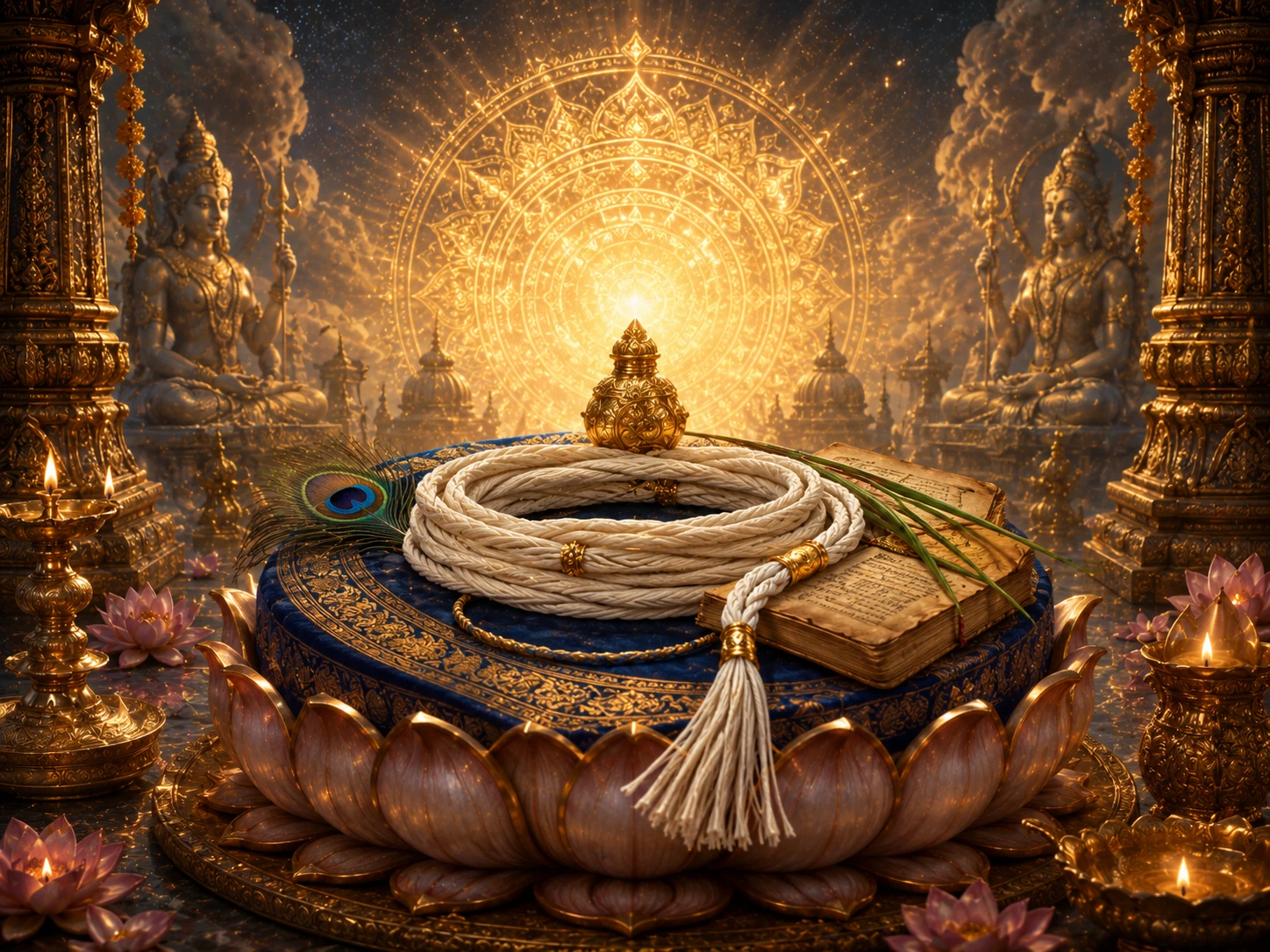
Yajnopavita -- The Sacred Thread That Made You Born Twice
यज्ञोपवीत -- वो पवित्र सूत्र जिसने तुम्हें दोबारा जन्म दिया
There is a piece of string that has been the most consequential credential in Hindu civilisation for over three thousand years. It has no digital signature. It cannot be laminated. It will not survive a Google search. And yet, for millennia, wearing it was the single act that determined whether you could study the Vedas, perform fire rituals, recite the Gayatri Mantra, and claim the status of 'twice-born' -- Dvija.
The Yajnopavita -- known colloquially as the Janeu, Poonal, Janivaara, or Zunnar depending on which part of India your family comes from -- is a loop of three cotton threads, twisted together, worn diagonally from the left shoulder to the right hip. It is given during the Upanayana Samskara, one of the sixteen rites of passage (Shodasha Samskaras) prescribed in Hindu tradition, and once invested, it is worn continuously for the rest of the wearer's life, replaced periodically but never permanently removed.
For a 21-year-old in Bangalore who got his thread ceremony done at age 12 in a Jayanagar hall while simultaneously checking his ICSE board results on his phone, the janeu might seem like an artifact of an older generation's obligations -- something his grandfather insists on but that has no obvious connection to his life as a software intern at a startup in Koramangala.
He would be wrong. The janeu is one of the most information-dense objects in all of Hindu material culture. Every strand, every knot, every rule about how to wear it, when to change it, and how to position it during different rituals encodes a specific piece of theological, social, and cosmological data. It is, in a real sense, the original wearable technology.
The word Yajnopavita comes from two Sanskrit roots: yajna (sacred ritual, sacrifice) and upavita (to put on, to invest). The literal meaning is 'that which is worn for the sake of sacrifice.' Before you can approach the sacred fire, before you can chant the Vedic hymns, before you can perform any srauta or smarta ritual -- you must be wearing the thread. It is your access credential to the entire Vedic operating system.
यज्ञोपवीतं परमं पवित्रं प्रजापतेर्यत्सहजं पुरस्तात्। आयुष्यमग्र्यं प्रतिमुञ्च शुभ्रं यज्ञोपवीतं बलमस्तु तेजः॥
yajñopavītaṃ paramaṃ pavitraṃ prajāpateryatsahajaṃ purastāt | āyuṣyamagryaṃ pratimunca śubhraṃ yajñopavītaṃ balamastu tejaḥ ||
The Yajnopavita is supremely sacred, born with Prajapati (the Creator) from the very beginning. Wear this radiant thread that grants long life, distinction, strength, and spiritual lustre.
— Yajnopavita Dharana Mantra (recited during Upanayana; referenced in Paraskara Grihya Sutra)
The Upanayana ceremony -- the ritual investiture of the sacred thread -- is one of the most ancient and best-documented rites of passage in any civilisation. The word Upanayana means 'leading near' (upa = near, nayana = leading), referring to the act of leading the child near the guru for the beginning of formal Vedic education. In its original form, the Upanayana marked the day the child left his parents' home and moved to the gurukula -- the teacher's residential school -- where he would live for twelve years, studying the Vedas, practising austerity, and serving his teacher.
This was not a symbolic event. It was a literal departure. The child shaved his head, bathed, put on new clothes, received the thread, heard the Gayatri Mantra whispered into his ear by the guru, and then walked away from his mother and father to begin his education. The mother fed him his last meal at home before the ceremony -- an act called Matri-bhojanam that is still performed today even when the child will return home the same evening.
The Atharvaveda (11.5.3) describes the moment with striking intimacy:
'The Acharya, while performing the Upanayana of the Brahmachari, keeps him, so to speak, in his own womb.'
This is the concept of the second birth -- Dvitiya Janma. The first birth is biological, from the mother. The second birth is intellectual and spiritual, from the guru. After Upanayana, the child is Dvija -- twice-born. The thread is the visible mark of this second birth, worn on the body as a permanent reminder that the spiritual life has begun.
The ceremony is prescribed at different ages for different varnas in the Dharmashastra texts: age 8 for Brahmanas (the teaching/priestly class), age 11 for Kshatriyas (the warrior/ruling class), and age 12 for Vaishyas (the merchant/agricultural class). The Manusmriti prescribes specific materials for the thread based on varna: cotton for Brahmanas, hemp for Kshatriyas, and wool for Vaishyas. In modern practice, cotton is nearly universal.
The Grihya Sutras -- the domestic ritual manuals of different Vedic schools -- provide detailed instructions for the ceremony: the homa (fire ritual), the specific mantras for each step, the positioning of the guru and student, the offering of samidha (sacred fuel sticks) into the fire, and the first recitation of the Gayatri Mantra. The Gayatri, taught during Upanayana, becomes the mantric core of the Dvija's daily practice for the rest of his life.
The thread itself is an exercise in compressed information. Nothing about it is decorative or random.
**The Three Strands (Tri-Sutra)**
The yajnopavita consists of three threads twisted together, and the three strands carry at least four simultaneous layers of meaning:
1. The Trimurti: Brahma (creation), Vishnu (sustenance), Shiva (transformation). You carry the cosmic cycle on your shoulder.
2. The Three Debts (Tri-Rina): Every human is born with three debts that must be repaid across a lifetime -- Deva-rina (debt to the gods, repaid through worship and ritual), Rishi-rina (debt to the sages, repaid through study and knowledge), and Pitri-rina (debt to the ancestors, repaid through progeny and shraddha ceremonies). The three threads are a constant tactile reminder of these obligations.
3. The Three Gunas: Sattva (purity/clarity), Rajas (activity/passion), Tamas (inertia/darkness). The thread reminds the wearer that all three qualities are always present and must be managed, not eliminated.
4. The Three States: Jagrat (waking), Svapna (dream), Sushupti (deep sleep). The thread accompanies the wearer through all three states of consciousness -- it is never removed, even during sleep.
**The Nine Strands (Nava-Tantu)**
Each of the three threads is itself made of three finer strands, totalling nine. According to the Prekshaa tradition's documentation of the Grihya Sutra commentaries, the nine strands are associated with nine deities: Omkara, Agni, Naga, Soma, Pitris, Prajapati, Vayu, Surya, and Vishvedevas. This means the seemingly simple thread is a nine-deity portable shrine worn against the skin.
**The Brahma-Granthi (Knot)**
The sacred knot tied in the yajnopavita is called the Brahma-Granthi -- the knot of Brahma. The number of knots corresponds to the number of pravaras (eminent ancestors) in the wearer's gotra (clan lineage). A Brahmana whose gotra has three pravaras will have three knots; one with five pravaras will have five. The knot is therefore a genealogical record encoded in cotton -- your family tree compressed into a twist of thread.
**Positional Rules**
The yajnopavita is worn in three different positions depending on the ritual context:
- Upavita (normal position): Over the left shoulder, hanging under the right arm. This is the default position for all worship of the Devas (gods) and for daily activities.
- Nivita (neutral position): Around the neck like a garland. This is for Rishi-related activities -- teaching, studying, reciting scripture.
- Prachinavita (reversed position): Over the right shoulder, hanging under the left arm. This position is exclusively for Pitri-karma -- ancestral rites, shraddha ceremonies, tarpana (water offerings to ancestors). The reversal signifies that you are now addressing the departed, not the living.
Think about what this means practically. An orthodox Hindu performing a shraddha ceremony physically shifts his thread from the left shoulder to the right at the moment he begins offering to his ancestors. The thread's position tells any observer exactly what kind of ritual is being performed, who is being addressed, and which cosmological plane the worshipper is oriented towards. The yajnopavita is a navigational instrument for moving between the worlds of the living and the dead.
Yajnopavita -- Thread Positions and Their Ritual Context
| Position / स्थिति | Sanskrit Name | Shoulder / कन्धा | Used For / किसके लिए | Addresses / किसे सम्बोधित |
|---|---|---|---|---|
| Normal / सामान्य | Upavita / उपवीत | Left shoulder, under right arm / बायाँ कन्धा, दायीं भुजा के नीचे | Deva Puja, daily life / देव पूजा, दैनिक जीवन | Gods (Devas) / देवगण |
| Neutral / तटस्थ | Nivita / नीवीत | Around neck like garland / गले में माला-सम | Study, teaching, recitation / अध्ययन, शिक्षण, पाठ | Sages (Rishis) / ऋषिगण |
| Reversed / उलटी | Prachinavita / प्राचीनावीत | Right shoulder, under left arm / दायाँ कन्धा, बायीं भुजा के नीचे | Shraddha, tarpana, pitri-karma / श्राद्ध, तर्पण, पितृकर्म | Ancestors (Pitris) / पितृगण |
A brahmachari (student) wears one set of three threads. A grihastha (householder) receives a second set at marriage, totalling six threads. Some traditions add a third set for those who have completed the Vedic study, totalling nine.
The Upanayana and yajnopavita tradition has been the subject of significant social and reform debate in modern India, and intellectual honesty requires addressing this directly.
Historically, the Upanayana was restricted to the 'twice-born' varnas -- Brahmana, Kshatriya, and Vaishya -- excluding Shudras and, by extension, communities classified under that category. This restriction became one of the most visible markers of caste-based social stratification. The denial of Upanayana meant denial of Vedic education, which in turn meant exclusion from the ritual and intellectual life of Hindu civilisation. The consequences were enormous and lasting.
However, this exclusion was not unchallenged even in pre-modern times. The Parasara Grihya Sutra contains the passage 'Shudranam dushta-karmanam upanayanam' -- suggesting that even those born in the Shudra classification, if of good character, are sanctioned for Upanayana. The reformer Swami Dayananda Saraswati (1824-1883), founder of the Arya Samaj, argued forcefully that Vedic study and the sacred thread should be available to all regardless of birth, based on his reading of the Vedas themselves. The Arya Samaj conducts Upanayana for all communities.
The question of women and Upanayana is equally significant. The Gobhila Grihya Sutra (2.1.19) and several Dharmasutras describe a step during wedding rituals where the bride completed a symbolic Upanayana before her marriage -- after which she wore her upper garment (later the sari) over the left shoulder, mirroring the thread position. Ancient texts distinguish between Brahmavadinī -- women who chose formal Vedic study, underwent full Upanayana, and wore the thread -- and Sadyovadhu -- women who married directly and received only the wedding-day symbolic form. The existence of Brahmavadinī women in Vedic literature (including the celebrated Gargi and Maitreyi) establishes clearly that the gender restriction was a later accretion, not an original Vedic principle.
Today, several Hindu reform movements and progressive sampradayas conduct Upanayana for women and for members of all communities. The thread remains contested -- as does virtually every symbol of caste distinction in modern India. But the thread's original meaning -- a commitment to learning, discipline, and the pursuit of knowledge -- transcends the social hierarchies that later co-opted it.
For a young UPSC aspirant in Old Rajinder Nagar studying the caste system for the sociology optional, the yajnopavita is a layered case study: simultaneously a symbol of Vedic knowledge philosophy and a tool of historical exclusion, now being reclaimed and democratised. Like much of Hindu tradition, it is not one thing. It is a conversation that continues.
The thread, ultimately, asks a simple question: do you accept the three debts? Do you commit to repay what you owe to your teachers, your ancestors, and the divine order? If you do, the thread is your declaration. If you don't, no thread can make you. The Upanayana is not magic. It is a vow. The thread is its witness.
The yajnopavita has an exact parallel in ancient Iran. The Zoroastrian Navjote ceremony invests both boys and girls with a sacred thread called the Kusti, worn around the waist, at around age seven. Scholars regard both the Upanayana and Navjote as descendants of a common Proto-Indo-Iranian initiation rite that predates the separation of the Vedic and Avestan peoples -- placing the sacred thread tradition's origins at potentially 4,000 years or more. The Kusti, like the yajnopavita, is woven with specific prayers and must be worn at all times. The fact that two civilisations separated by thousands of years independently preserved the same threadwearing rite is one of the strongest pieces of evidence for a shared ancestral religious culture.
Chant the Gayatri Mantra Daily
The Gayatri mantra, taught at Upanayana, is the daily practice of every wearer of the sacred thread. Begin your sandhyavandana with it, 108 times on a mala if you can. The Gayatri's page on Eternal Raga gives its meaning and how to chant it.
Tags
Eternal Raga · शाश्वत राग
Institutional voice — scholarly articles on Sanatan Dharma
Deepen Your Understanding
अपनी समझ और गहरी करें
sacred symbols
Tilak Types -- The Hindu Forehead Mark That Tells Your Entire Spiritual Address
Before LinkedIn profiles and Instagram bios, Hindus had a one-glance identity system -- the tilak. A single mark on the forehead could tell you someone's deity, lineage, philosophy, and guru. Tripundra or Urdhva Pundra? Vibhuti or chandana? Each line is a declaration of cosmic allegiance.
sacred symbols
Kalash -- The Sacred Pot That Contains Every Hindu Ritual Inside It
A brass pot, some water, mango leaves, a coconut on top. Looks simple. But the Purna Kumbha is a complete cosmological diagram -- the pot is Earth, the water is the life-force, the leaves are creation, the coconut is divine consciousness. No Hindu ritual begins without it. From Navratri to weddings to your griha pravesh -- the kalash was there first.
sacred symbols
Ghanta -- The Temple Bell That Resets Your Brain Before You Meet God
You ring it without thinking. Every single time you enter a temple. But that brass bell hanging at the entrance is a neurological instrument designed to produce a specific frequency that empties your mind of distraction. The ancients called it 'devata-ahvana' -- the invocation of the divine. Neuroscience calls it an attentional reset. The bell is the same technology.
sacred artefacts
Kusha Grass -- The Blade That Doubles as a Spiritual Conductor
It looks like ordinary grass. It is not. Kusha -- also called Darbha or Pavitram -- is a sharp-edged, razor-bladed grass that appears in virtually every Hindu ritual from birth to death. The Bhagavad Gita prescribes it as the ideal meditation seat. The Garuda Purana says it grew from Vishnu's hair. The Rig Veda mentions it alongside soma. It is worn as a ring by priests, laid under the dead, spread around sacrificial fires, and placed on food during eclipses. No other grass on Earth has this resume.
sacred symbols
Temple Architecture Symbolism -- Why Every Hindu Temple Is a Human Body, a Mountain, and the Universe
The dark womb-room at the centre. The tower rising above it like a spine. The gateway that frames the divine like an eye. A Hindu temple is not a building where you go to see God. It IS the body of God -- designed on a mandala grid, proportioned by sacred mathematics, and oriented to catch the first ray of the rising sun.
philosophy darshana
The Four Mahavakyas -- Upanishadic Sentences That Changed Civilisation
Four sentences. Twelve words of Sanskrit. Three thousand years of commentary. The Mahavakyas are the most compressed, most powerful, and most debated statements in all of Indian philosophy. Each one claims that the individual self and the ultimate reality of the universe are not two different things. And each one has been interpreted to mean something completely different by every major school of Vedanta.
The yajnopavita has an exact parallel in ancient Iran. The Zoroastrian Navjote ceremony invests both boys and girls with a sacred thread called the Kusti, worn around the waist, at around age seven. Scholars regard both …
More in Sacred Symbols
Ashtamangala -- The Eight Auspicious Symbols of Hindu Tradition
13 min read
Bindu -- The Point from which Creation Emerges
12 min read
Gau -- Why the Cow Holds the Place She Does in Hindu Life
14 min readThe same translation error that turned '33 Koti' into '33 crore' in Hinduism also happened in Buddhism. The Chinese translation of Buddhist texts rendered 'Sapta Koti Buddha' (7 Supreme Buddhas) as '7 Crore Buddhas.' The…
Deities AvatarsCommunity Reflections
🕉️
Be the first to share your reflection.