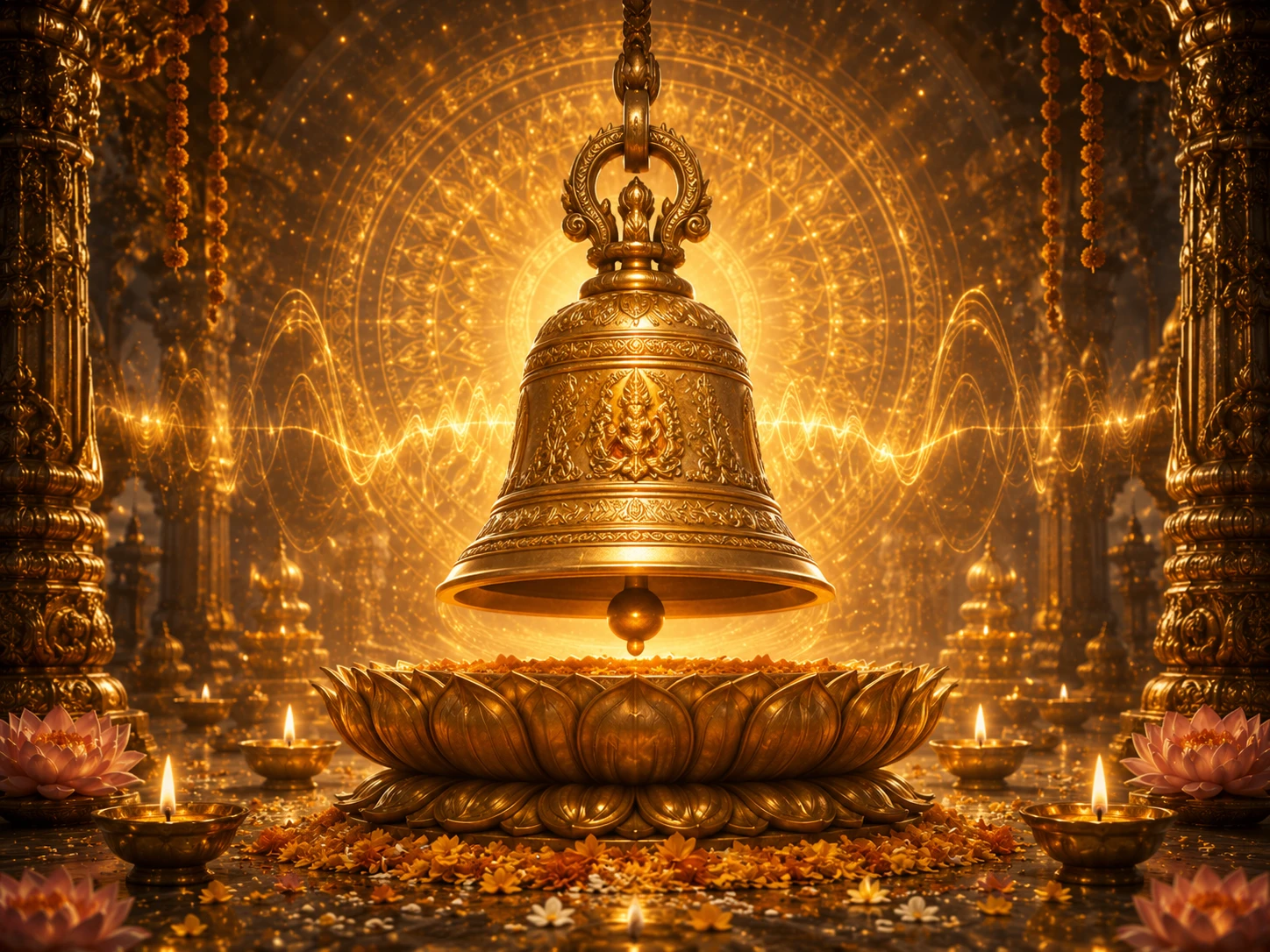
Ghanta -- The Temple Bell That Resets Your Brain Before You Meet God
घण्टा -- वो मन्दिर की घण्टी जो भगवान से मिलने से पहले तुम्हारा दिमाग़ reset करती है
There is a moment, if you pay attention, that happens every time you ring a temple bell. The clang cuts through whatever you were thinking about -- the auto fare, the office deadline, the WhatsApp argument, the NEET score you are waiting for -- and for precisely as long as the sound reverberates, your mind goes blank. Not thoughtless. Blank. Open. Receptive.
That moment is not an accident. It is an engineering outcome.
The temple bell -- Ghanta in Sanskrit -- is one of the most ancient acoustic instruments in continuous use. It predates the European church bell by millennia. It is mentioned in Vedic-era texts, described in the Agama Shastras (the temple ritual manuals), regulated by the Shilpa Shastras (the architectural and craft treatises), and present in every Hindu temple on the planet -- from the massive bell at Tarakeshwar Mandir in Bengal to the small ghanti on your grandmother's home altar in a 2BHK in Thane.
And yet, most Indians ring the bell as a formality. They grab the clapper, give it a pull, hear the sound, and walk in. The ritual has become muscle memory. The meaning has faded.
Here is what the bell is actually doing.
The sound of a well-crafted temple bell produces a frequency that resonates for a minimum of seven seconds. During those seconds, the reverberation activates both hemispheres of the brain. The sustained tone, according to acoustic research on bell frequencies, stimulates the auditory cortex in a way that temporarily suppresses the default mode network -- the brain network responsible for mind-wandering, self-referential thought, and the constant narration that constitutes your inner monologue. In simpler terms: the bell shuts up the voice in your head.
This is exactly what you want before darshan. You want an empty, attentive mind -- not one replaying the argument you had on the metro or calculating EMIs. The bell achieves in one second what ten minutes of trying to meditate often fails to do.
The ancients did not have fMRI machines. But they had something better: three thousand years of iterative observation. They knew the bell worked. The Agama Shastras codified exactly how it should work. And the Shilpa Shastras specified exactly how to build one that did.
आगमार्थं तु देवानां गमनार्थं तु रक्षसाम्। घण्टारवं करोम्यादौ देवताह्वानलाञ्छनम्॥
āgamārthaṃ tu devānāṃ gamanārthaṃ tu rakṣasām | ghaṇṭāravaṃ karomyādau devatāhvānalāñchanam ||
I ring this bell to invoke the arrival of the gods and to drive away the demons. This ringing is the mark of divine invocation.
— Agama Shastra (Vedic ritual tradition)
The verse from the Agama Shastra is chanted by priests across India every single day as they begin puja. It is remarkably precise in its claim: the bell invites the divine ('agamartham tu devanam') and expels the demonic ('gamanartham tu rakshasam'). Read metaphorically, the 'devas' are positive mental states -- focus, devotion, clarity -- and the 'rakshasas' are the distractions, anxieties, and mental noise that the bell's sound momentarily silences.
But the bell is not merely a sound machine. It is a symbolic microcosm, and every part of its anatomy carries meaning.
**The Body (Ghanta-sharira)**
The hollow, open-mouthed body of the bell represents Ananta -- infinity, the limitless expanse of time and space. The wide opening at the bottom symbolises the universe's vastness, while the narrowing towards the top represents the convergence of all reality towards the singular divine point. The shape mirrors the temple shikhara itself -- broad at the base, tapering to a point.
**The Tongue (Jihva)**
The clapper inside the bell is called the jihva (tongue) and represents Goddess Saraswati -- the deity of knowledge, speech, and music. When the tongue strikes the body, it is knowledge striking the vessel of infinity, producing the sacred sound. Without the tongue, the bell is silent. Without Saraswati, creation is mute. The metaphor is exact.
**The Handle (Danda)**
The handle atop the bell represents Prana Shakti -- the vital life force. In different temple traditions, the handle takes the form of different divine figures: Hanuman (strength and devotion), Garuda (transcendence), Nandi (patient service), or the Sudarshana Chakra (divine protection). The Agama-Kosha (a ritual encyclopedia) specifically notes that a bell without a handle in one of these divine forms is forbidden in ritual use, as it would be inauspicious. This is not arbitrary superstition -- the handle is what connects the human hand to the sacred sound. Without it, there is no agency, no intentional invocation.
**The Material (Panchadhatu)**
The Shilpa Shastra prescribes that a proper temple bell must be made of Panchadhatu -- an alloy of five metals. These correspond to the Pancha Bhutas (five elements) and, in Vedic astrology, to the five major planetary influences:
Gold (Surya/Sun), Silver (Chandra/Moon), Copper (Shukra/Venus), Zinc (Guru/Jupiter), Iron (Shani/Saturn).
Some traditions expand this to Saptadhatu -- seven metals -- adding Tin (also Jupiter) and Lead (also Saturn) or Mercury. The specific proportions of these metals determine the bell's tone, duration, and harmonic qualities. This is not guesswork. The sthapatis (temple artisans) of South India, particularly in the Swamimalai bronze-casting tradition of Tamil Nadu, have maintained bell-making knowledge for over a thousand years. The process involves lost-wax casting (madhuchcchishta vidhana), and the alloy proportions are treated as guild secrets.
A well-made temple bell produces a sound whose fundamental frequency lies in the range that yogic traditions associate with the Anahata Nada -- the 'unstruck sound', the cosmic vibration that underlies all creation. In Nada Yoga, this sound is considered identical to Om -- the primordial syllable. The bell does not just symbolise Om; a properly forged bell literally produces an acoustic approximation of the Om frequency during its decay phase.
The bell appears in multiple roles across Hindu ritual life, and each context reveals a different facet of its function.
**Temple Entrance Bell (Dvara Ghanta)**
The large bell or cluster of bells hanging at the temple entrance is the most familiar. Devotees ring it upon entering -- and in many traditions, also upon leaving. The entrance ring is the invocation: 'I am here, I am attentive, please accept my presence.' The exit ring is the offering: 'The darshan is complete, I carry your blessing.' Some temples have a single massive bell; others have rows of dozens, creating a curtain of sound through which devotees physically pass.
The Dakshineswar Kali Temple in Kolkata, the Meenakshi Amman Temple in Madurai, and the Mahakaleshwar Temple in Ujjain all have entrance bells that have been rung millions of times, their surfaces polished smooth by countless hands. Touching the bell is itself a form of darshan -- contact with an object that has channelled millennia of devotion.
**Aarti Bell (Naivedya Ghanta)**
During aarti, the priest rings a smaller handheld bell (ghanti) continuously with the left hand while waving the lamp with the right. The sound creates a sacred acoustic enclosure around the ritual. Combined with the conch (shankha), drum (damaru or nagara), and cymbals (jhanjh or tala), the bell contributes to a multi-instrument soundscape that drowns out external noise and concentrates awareness on the flame and the deity.
If you have ever attended the Ganga Aarti at Dashashwamedh Ghat in Varanasi, you have experienced this in its most overwhelming form: dozens of priests, each with a bell, a lamp, and a conch, creating a wall of sacred sound against the backdrop of the river. The acoustic effect is designed to produce total immersion -- a state where the boundary between the devotee and the ritual dissolves.
**Puja Bell (Archana Ghanta)**
In home worship, a small bell is rung before and during puja. It marks the transition from the profane to the sacred -- the sonic equivalent of crossing a threshold. Many Indian mothers ring the bell at the beginning of their morning puja at 5 AM while their engineering-student children sleep through it. The children will tell you the bell woke them up. The mothers will tell you that is the point.
**Festival Bells**
During Durga Puja in Bengal, Ganesh Chaturthi in Maharashtra, and temple car festivals (ther/ratha yatra) across South India, oversized bells are rung at specific ritual moments -- the immersion, the visarjan, the final aarti. The bell's sound here is communal: it gathers the crowd's attention to a single point, transforming a festival of thousands into a moment of collective focus.
**The Tibetan Connection**
In Vajrayana Buddhism -- which absorbed significant elements from Hindu tantra -- the ghanta is paired with the vajra (dorje) as the primary ritual instrument. The vajra represents compassion (upaya), the bell represents wisdom (prajna). Together, they symbolise the union of method and insight. The Dalai Lama carries a bell and vajra during empowerment ceremonies. This is a direct inheritance from the Hindu tantric tradition, transmitted through Buddhist teachers who studied at Nalanda and Vikramashila universities in Bihar before the 12th century.
The next time you stand at a temple entrance, your hand on the rope, about to ring the bell as a formality before hurrying to the sanctum -- pause. Let the full sound ring out. Let it reverberate for its full seven seconds. Count them. Feel the silence that follows. In that silence, you are in exactly the mental state the bell was designed, over three thousand years of acoustic engineering, to create.
Types of Ghanta in Hindu Worship
| Type / प्रकार | Size / आकार | Location / स्थान | Rung When / कब बजाया | Handle / दण्ड |
|---|---|---|---|---|
| Dvara Ghanta (Entrance Bell) / द्वार घण्टा | Large, hanging / बड़ा, लटकता | Temple entrance / मन्दिर प्रवेशद्वार | Entry and exit of devotees / भक्तों के प्रवेश-प्रस्थान पर | Chain or rope / शृंखला या रस्सी |
| Archana Ghanti (Puja Handbell) / अर्चना घण्टी | Small, handheld / छोटी, हस्तगत | Home altar, priest's hand / गृह-वेदी, पुजारी का हाथ | Throughout puja and aarti / सम्पूर्ण पूजा और आरती में | Nandi, Garuda, Hanuman, or Chakra / नन्दी, गरुड, हनुमान या चक्र |
| Kansya Ghanta (Bronze Temple Bell) / कांस्य घण्टा | Very large, fixed / अत्यन्त बड़ा, स्थिर | Temple mandapa / मन्दिर मण्डप | Major festivals, abhisheka / प्रमुख उत्सव, अभिषेक | Often ornate with deity forms / प्रायः देवता-रूपों से अलंकृत |
| Ghantika (Miniature Bell) / घण्टिका | Tiny, decorative / अति लघु, सजावटी | Strung on temple doors, chariots / मन्दिर द्वारों, रथों पर गुँथी | Movement-activated / गति से सक्रिय | None (strung directly) / नहीं (सीधे गुँथी) |
| Vajra-Ghanta (Tantric Bell) / वज्र-घण्टा | Medium, ritual / मध्यम, अनुष्ठानिक | Tantric puja, Buddhist ceremonies / तान्त्रिक पूजा, बौद्ध समारोह | Paired with vajra during empowerment / वज्र के साथ अभिषेक में | Half-vajra form / अर्ध-वज्र रूप |
The Swamimalai bronze-casting tradition in Tamil Nadu, recognised by UNESCO, still produces temple bells using the lost-wax (madhuchcchishta vidhana) method -- a technique at least 4,000 years old, traceable to the Indus Valley civilisation's 'Dancing Girl' bronze.
The bell ringing tradition at Hindu temples influenced church bell culture through an unexpected route. When Portuguese missionaries arrived in Goa in the 16th century, they encountered a sophisticated bell-ringing tradition in Hindu temples that was far more ritually integrated than anything in European churches at the time. The large bells of Goan temples -- some weighing several hundred kilograms -- impressed the missionaries enough that they incorporated more elaborate bell-ringing patterns into Goan Catholic churches. Today, Goa has one of the richest church-bell cultures in Asia, with Portuguese-era churches housing bells that were often cast by the same Hindu artisan families who made temple bells. The ghanta's influence crossed religious boundaries without anyone noticing.
Experience the Sound of Om
The temple bell is made to ring out a long, fading tone that draws attention inward. Strike a bell, or chant Om once on a full breath, and follow the sound until it disappears. The Fading of a Sound dharana on Eternal Raga is this practice.
Tags
Eternal Raga · शाश्वत राग
Institutional voice — scholarly articles on Sanatan Dharma
Deepen Your Understanding
अपनी समझ और गहरी करें
sacred symbols
Kalash -- The Sacred Pot That Contains Every Hindu Ritual Inside It
A brass pot, some water, mango leaves, a coconut on top. Looks simple. But the Purna Kumbha is a complete cosmological diagram -- the pot is Earth, the water is the life-force, the leaves are creation, the coconut is divine consciousness. No Hindu ritual begins without it. From Navratri to weddings to your griha pravesh -- the kalash was there first.
sacred artefacts
Damaru -- The Drum That Created the Sanskrit Language in Fourteen Beats
When Shiva's cosmic dance ended, he did not bow. He picked up a small hourglass-shaped drum and struck it fourteen times. From those fourteen beats emerged the fourteen Maheshwara Sutras -- the phonemic code of the Sanskrit language. Panini, the greatest grammarian in human history, used these fourteen sound-groups to build the Ashtadhyayi, a system of nearly four thousand grammatical rules so precise that modern computer scientists call it the world's first formal language specification. A drum made a language. That language made a civilisation.
sacred symbols
Temple Architecture Symbolism -- Why Every Hindu Temple Is a Human Body, a Mountain, and the Universe
The dark womb-room at the centre. The tower rising above it like a spine. The gateway that frames the divine like an eye. A Hindu temple is not a building where you go to see God. It IS the body of God -- designed on a mandala grid, proportioned by sacred mathematics, and oriented to catch the first ray of the rising sun.
tantra mantra yantra
Tantra, Mantra and Yantra -- The Three Pillars of Spiritual Practice
Tantra is the loom, Mantra is the thread, Yantra is the pattern. Together they form the complete technology of spiritual transformation that India gifted to the world -- and they are far more profound than popular culture imagines.
sacred artefacts
Samudra Manthan Treasures -- The 14 Things That Came Out When Gods and Demons Churned the Ocean Together
Poison came first. Immortality came last. In between: a goddess, a gem, a cow, a horse, a tree, a physician, a bow, a moon, and an elephant. The Samudra Manthan is not just a myth -- it is a startup pitch deck for the universe. Two rival teams. One impossible project. Fourteen deliverables. And a hostile takeover at the end.
sacred symbols
Dharma Chakra -- The Wheel on Your Flag That Spins Since Before the Buddha
The 24-spoke blue wheel at the centre of the Indian flag is not just a Buddhist symbol adopted by Ashoka. It is a Vedic concept of cosmic order, a weapon on Vishnu's finger, a sun-symbol older than recorded history, and a political statement about the sovereignty of dharma over kings. It is the most seen Hindu symbol in the world -- and the least understood.
The bell ringing tradition at Hindu temples influenced church bell culture through an unexpected route. When Portuguese missionaries arrived in Goa in the 16th century, they encountered a sophisticated bell-ringing tradi…
More in Sacred Symbols
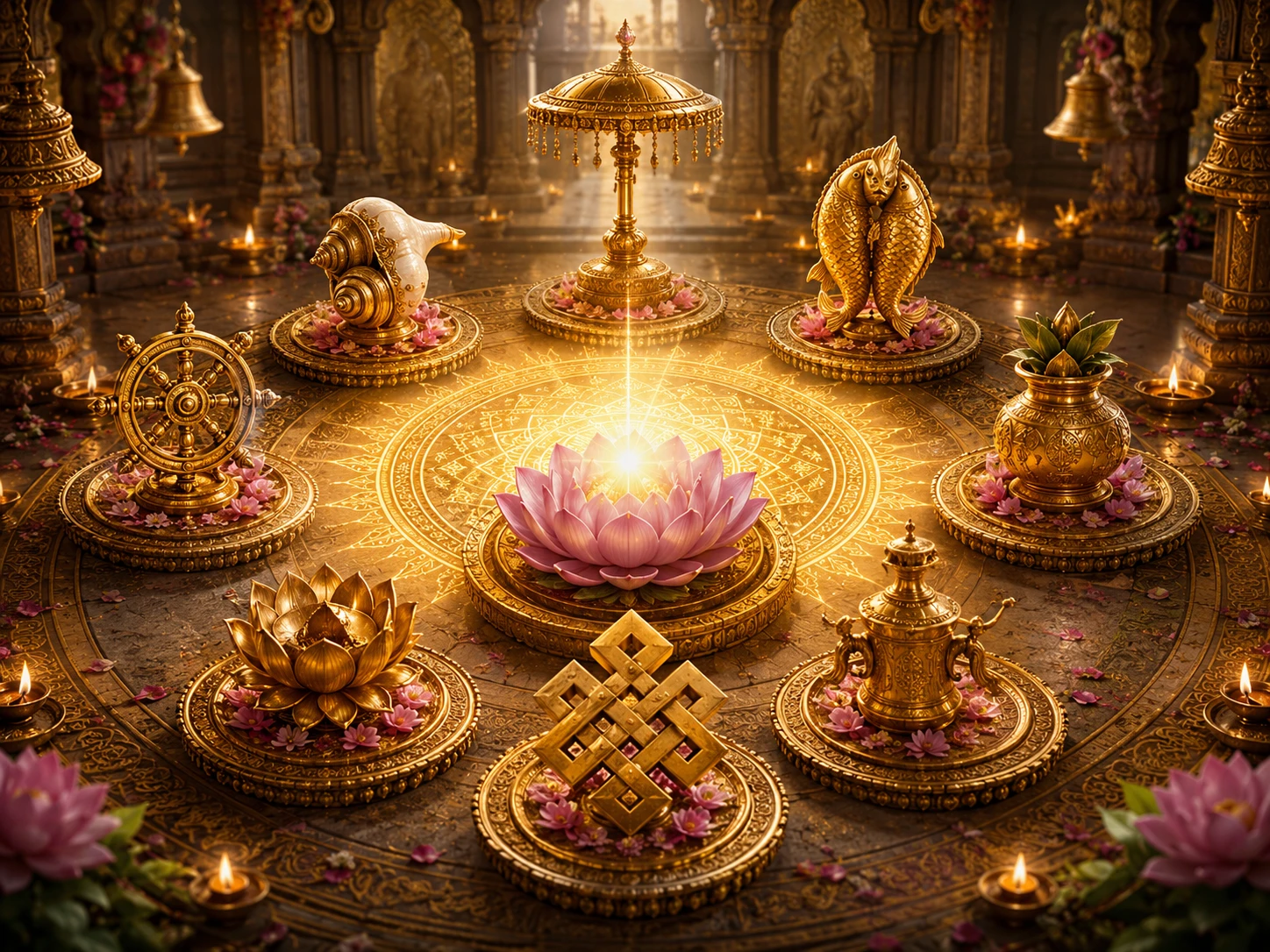
Ashtamangala -- The Eight Auspicious Symbols of Hindu Tradition
13 min read
Bindu -- The Point from which Creation Emerges
12 min read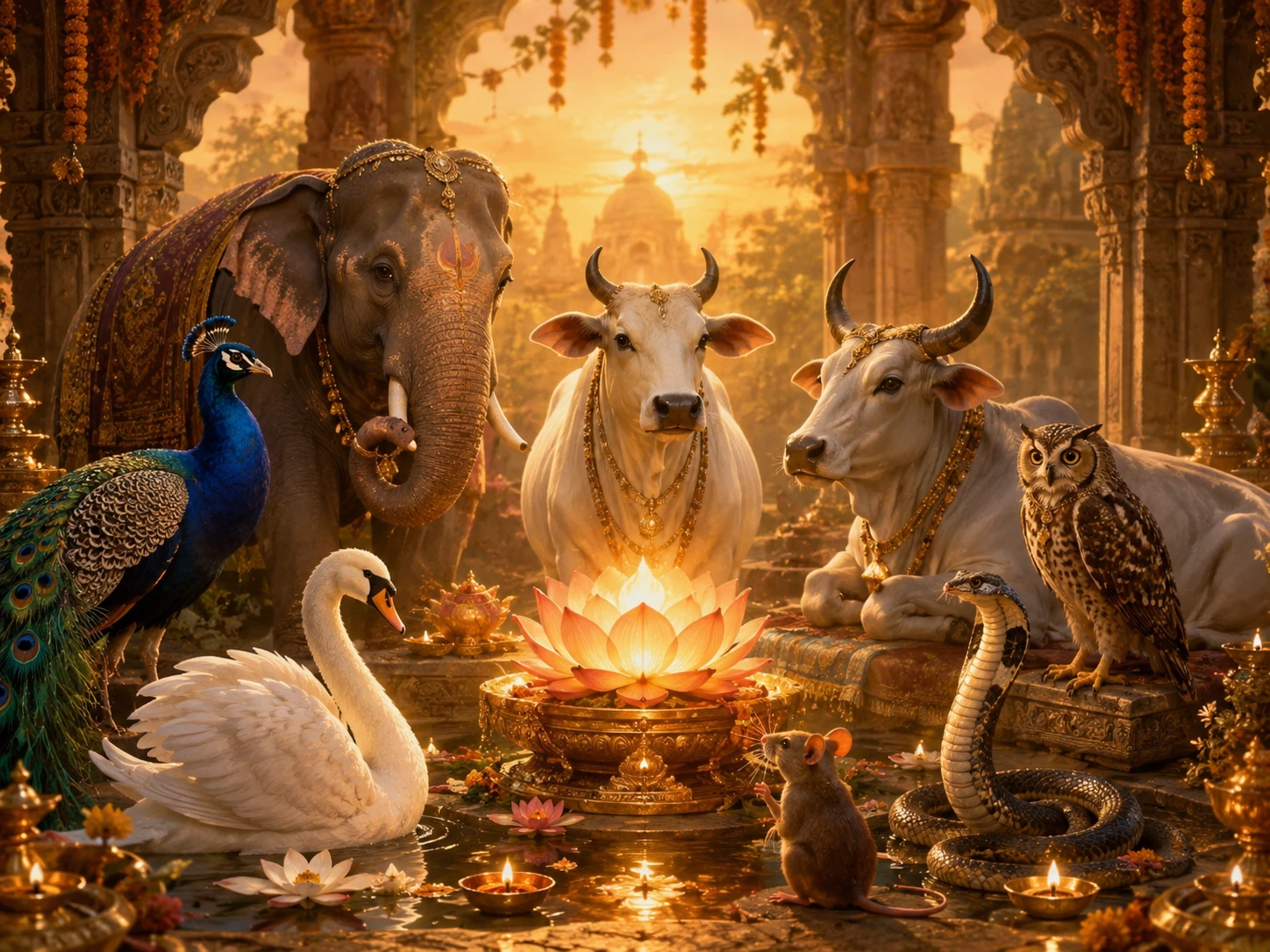
Gau -- Why the Cow Holds the Place She Does in Hindu Life
14 min readThe same translation error that turned '33 Koti' into '33 crore' in Hinduism also happened in Buddhism. The Chinese translation of Buddhist texts rendered 'Sapta Koti Buddha' (7 Supreme Buddhas) as '7 Crore Buddhas.' The…
Deities AvatarsCommunity Reflections
🕉️
Be the first to share your reflection.