Kalash -- The Sacred Pot That Contains Every Hindu Ritual Inside It
कलश -- वो पवित्र पात्र जिसके भीतर हर हिन्दू विधि समाहित है
There is an object that has been present at every important moment of Hindu life for at least three thousand years, and most people could not explain what it means. It was there when your parents married. It was there when your family moved into a new house. It was there at the beginning of every Navratri your grandmother ever observed. It sits at the entrance of temples. It crowns the spires of sanctums. It gives its name to the largest religious gathering in human history.
It is a pot.
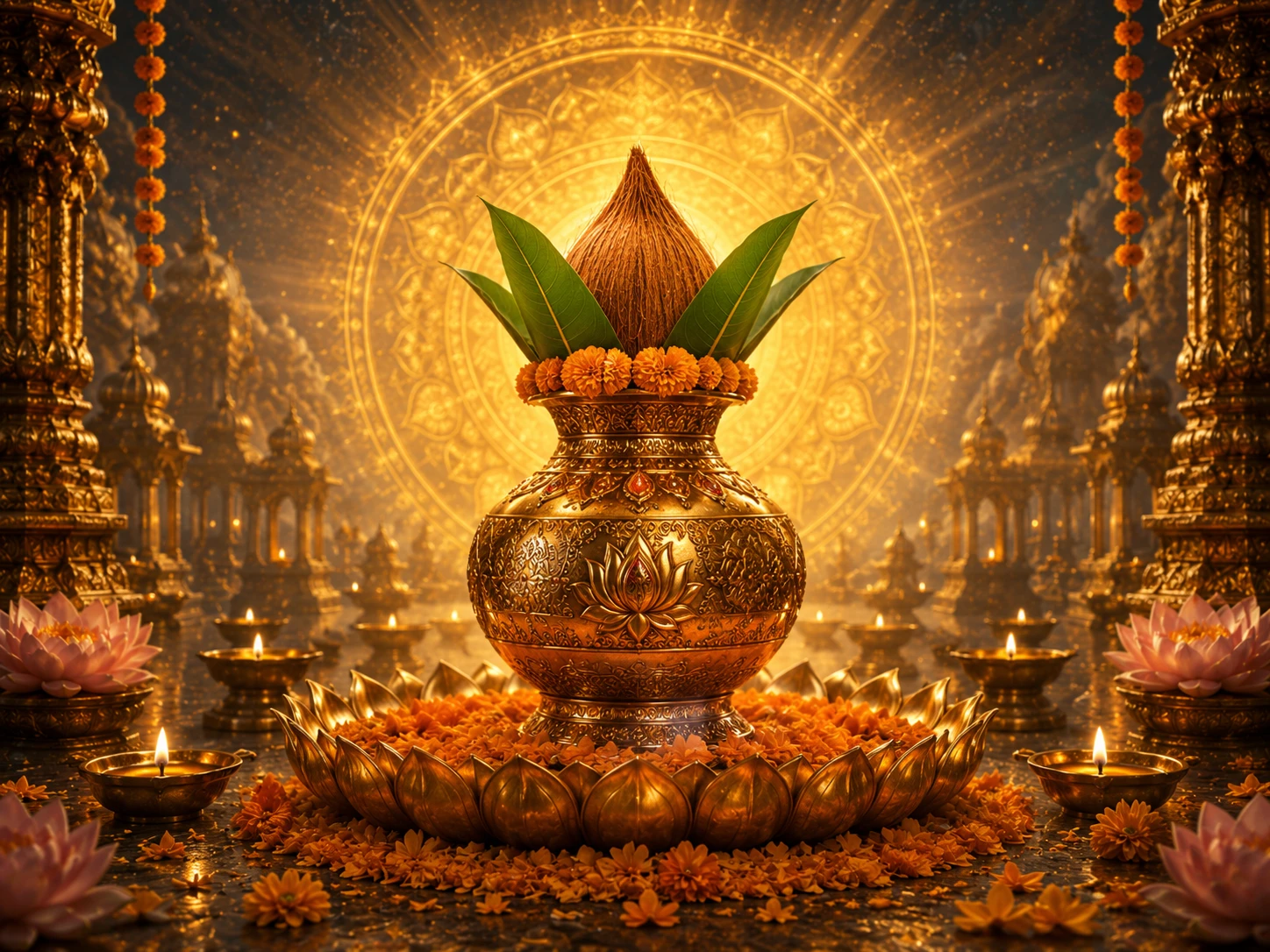
A brass, copper, or clay pot filled with water, topped with mango leaves and a coconut, tied with a red or white thread, and sometimes decorated with a swastika or geometric pattern. This arrangement -- deceptively simple, almost humble -- is the Purna Kalash, and it is arguably the single most universal ritual object in all of Hinduism. No puja begins without it. No sanctum is consecrated without it. No auspicious event in Hindu life proceeds without someone, somewhere, filling a pot with water and placing a coconut on top.
The Rig Veda calls it the 'purno-asya kalasha' -- the overflowing full vessel. It is not a container. It is a cosmogram. Every element of the Purna Kalash maps onto a dimension of reality: the pot is the body (or the earth), the water is the life-force (prana, or the primordial ocean), the mango leaves are the vitality of creation, the coconut is the head -- the seat of consciousness, the divine self. The red thread is the binding force that holds the universe together. The coin inside is the sacrifice of the material for the spiritual.
The next time you see one at a wedding shamiana or a Navratri pandal, don't walk past it. Stop. Look at it. You are looking at a three-thousand-year-old diagram of the cosmos that fits in the palm of your hand.
कलशस्य मुखे विष्णुः कण्ठे रुद्रः समाश्रितः। मूले तत्र स्थितो ब्रह्मा मध्ये मातृगणाः स्मृताः॥ कुक्षौ तु सागराः सर्वे सप्तद्वीपा वसुन्धरा। ऋग्वेदोऽथ यजुर्वेदः सामवेदो ह्यथर्वणः॥ अङ्गैश्च सहितास्सर्वे कलशाम्बु समाश्रिताः।
kalaśasya mukhe viṣṇuḥ kaṇṭhe rudraḥ samāśritaḥ | mūle tatra sthito brahmā madhye mātṛgaṇāḥ smṛtāḥ || kukṣau tu sāgarāḥ sarve saptadvīpā vasundharā | ṛgvedo'tha yajurvedaḥ sāmavedo hyatharvaṇaḥ || aṅgaiśca sahitāssarve kalaśāmbu samāśritāḥ |
At the mouth of the Kalash resides Vishnu, at the throat Rudra (Shiva), and at the base is established Brahma. In the middle dwell the Mother Goddesses. In the belly reside all the oceans and the seven-continented earth. The Rigveda, Yajurveda, Samaveda, and Atharvaveda -- all with their subsidiary texts -- reside in the water of the Kalash.
— Kalash Gayatri / Kalash Sthapana Mantra (Puja Vidhi tradition)
The anatomy of the Purna Kalash is not arbitrary. Each component serves both a symbolic and a functional purpose, layered with meaning that deepens the more you examine it.
**The Pot (Kalash/Kumbha/Ghata)**
The vessel itself -- typically brass or copper, occasionally silver, gold, or clay -- represents the earth and the human body. Copper is the preferred material because of its antimicrobial properties (this was known empirically in Indian tradition long before modern science confirmed it). A copper vessel naturally purifies water stored in it. The wide base and narrow mouth represent stability grounded in containment -- a physical metaphor for the concentrated mind.
In Vedic cosmology, the pot also represents the womb -- the container of fertility, creation, and potential life. This is why the Purna Kalash is central to wedding ceremonies and childbirth rituals. It is simultaneously the earth that holds the seed and the body that holds the soul.
As per scriptural tradition, different parts of the kalash correspond to the Trimurti: the mouth represents Vishnu (the sustainer, the opening through which nourishment flows), the throat represents Rudra/Shiva (the passage, the point of transformation), and the base represents Brahma (the foundation, the creator from whom all things originate).
**The Water**
The water inside represents the primordial ocean -- the cosmic waters from which all creation emerged. In the Nasadiya Sukta (Rigveda 10.129), the hymn of creation, the universe begins with water: 'In the beginning, there was neither existence nor non-existence. There was no air, no sky beyond. What covered all? Where was it? In whose protection? Was there water, unfathomably deep?'
The water is also practical: it is the medium into which all deities are invoked (avahana) during the puja. The waters from all sacred rivers -- Ganga, Yamuna, Godavari, Saraswati, Narmada, Sindhu, Kaveri -- are symbolically invoked into the kalash water through specific mantras. This is why, after the puja, the kalash water is used for abhisheka (ritual bathing of the deity) and for sprinkling (prokshanam) to purify the space. A small portion is distributed as tirtha (sacred water) to devotees.
**The Mango Leaves**
Five or seven leaves of the mango tree are placed at the mouth of the kalash, partially submerged. Mango is considered the king of trees in Indian tradition -- its association with Kama, the god of love, makes it a symbol of fertility and desire fulfilled. The leaves, which remain fresh for days in water, symbolise the vitality and regenerative power of nature. In Ayurvedic practice, mango leaves release compounds that naturally purify water and air -- another case where ritual form and functional benefit coincide.
Some regional traditions substitute betel leaves (pan patta) or ashoka leaves, each with its own symbolic register -- betel for offering and hospitality, ashoka (literally 'without sorrow') for auspiciousness.
**The Coconut (Sriphala)**
The coconut atop the kalash is called Sriphala in Sanskrit -- 'the fruit of Sri (Lakshmi)' or 'the fruit of auspiciousness'. It represents the divine head, consciousness, and the ajna chakra. The three eyes of the coconut are sometimes interpreted as the three eyes of Shiva (two physical eyes and the third eye of wisdom) or as the Trimurti.
The coconut is the most universal offering in Hindu worship -- it can substitute for almost any other offering and is accepted at every temple, every deity, every occasion. Breaking a coconut before a deity symbolises the breaking of the ego: the hard outer shell of pride cracks open to reveal the pure white flesh of the soul and the sweet water of devotion within. This is why coconuts are broken at the launch of ships, the inauguration of buildings, before starting new businesses, and at the beginning of academic years in schools across India. If you have ever seen a coconut smashed on the ground outside a Maruti showroom in Pune before a new car's first drive, you have witnessed an unbroken Vedic tradition adapted to the automotive age.
**The Thread (Mauli/Kalava)**
The red or white thread tied around the neck of the kalash represents the binding force of dharma -- the moral and cosmic order that holds the universe together. In some traditions, the thread is specifically a mauli (sacred red thread also tied on the wrist during puja), representing the protection of the divine. The thread is sometimes wound in a diamond or cross pattern, creating a geometric design that mirrors yantra patterns.
The kalash appears in almost every significant Hindu ritual context. Understanding where and how it shows up reveals the extraordinary range of this single object.
**Ghatasthapana (Navratri)**
The most visible annual appearance of the kalash is Ghatasthapana -- literally 'establishment of the pot' -- on the first day of Navratri. A Purna Kalash is set up as the seat of Goddess Durga and maintained for nine consecutive days. In Gujarat, entire communities gather around the kalash for Garba. In Bengal, it is the Ghata that anchors the Durga Puja pandal. In Maharashtra, families set up the kalash at home with barley seeds sown around it; the growth of the sprouts over nine days symbolises the fertility and abundance invoked by the Goddess. If the barley grows tall and green, it is considered highly auspicious.
For a Gen-Z student living in a Pune PG, the Ghatasthapana might seem like 'just a pot my mom puts in the corner'. It is not. It is a nine-day agricultural-spiritual experiment that ties Vedic cosmology to seasonal farming cycles -- Navratri coincides with both the autumn harvest and the spring planting season.
**Kumbh Abhisheka (Temple Consecration)**
The most elaborate use of the kalash is in Kumbh Abhisheka -- the consecration or re-consecration of a temple. Water sanctified through elaborate Vedic rituals over several days is poured from multiple kalashas onto the temple's shikhara (spire). This ritual re-energises the temple -- think of it as a reboot of the sacred space. The Tirumala Tirupati Devasthanam conducts this for the Balaji temple, the Padmanabhaswamy temple in Kerala underwent a major Kumbh Abhisheka, and thousands of temples across India perform this periodically. The kalash here functions as the delivery mechanism for divine energy -- it channels the invoked deities from the water to the stone.
**Hindu Weddings**
At every Hindu wedding, a Purna Kalash is placed at the entrance of the venue as a sign of welcome and auspiciousness. In South Indian weddings, the bride and groom circle the kalash. In North Indian traditions, the kalash is present during the havan (fire ceremony). The Mangal Kalash -- decorated with flowers and turmeric -- is the wedding's visual anchor, more central to the ritual structure than the stage decorations or the DJ.
**Griha Pravesh (Housewarming)**
When a family enters a new home, a Purna Kalash is carried across the threshold by the woman of the house -- typically the bride or the senior-most woman. This is not just symbolic welcome. In traditional understanding, the kalash literally transfers the invoked divine presence from the old space to the new, sanctifying the home from its first moment of occupation. In today's India, this happens in Hiranandani towers in Mumbai, DLF apartments in Gurgaon, and NRI homes in New Jersey with equal sincerity.
**Samudra Manthan -- The Mythological Origin**
The Puranas trace the kalash's sacred status to the Samudra Manthan -- the churning of the cosmic ocean. When the Devas and Asuras churned the ocean of milk, Dhanvantari -- the divine physician -- emerged holding a kalash filled with amrita, the nectar of immortality. This image -- a figure holding a pot of nectar -- is the foundational icon of the kalash in Hindu consciousness. The kalash is not just a ritual tool; it is the container that held the most precious substance in the universe.
This origin story also explains why the Kumbh Mela -- the largest periodic human gathering on earth, attended by over 100 million people at the 2019 Prayagraj event -- is named after the Kumbh (pot). Legend holds that during the battle over the amrita between Devas and Asuras, drops fell at four locations: Prayagraj, Haridwar, Nashik, and Ujjain. The Kumbh Mela rotates among these four cities. The entire festival -- which is visible from space -- is named after a pot.
Types of Kalash and Their Ritual Context
| Kalash Type / कलश प्रकार | Assembly / संयोजन | Occasion / अवसर | Significance / महत्त्व |
|---|---|---|---|
| Purna Kumbha / पूर्णकुम्भ | Water + mango leaves + coconut + thread / जल + आम पत्ते + नारियल + धागा | All pujas, daily worship / सभी पूजा, दैनिक पूजन | Universal symbol of abundance and divinity / समृद्धि और दिव्यता का सार्वभौमिक प्रतीक |
| Ghata Kalash / घट कलश | Invocation of specific deity into water / जल में विशिष्ट देवता का आवाहन | Navratri, Durga Puja, Griha Pravesh / नवरात्रि, दुर्गा पूजा, गृहप्रवेश | Seat of the deity for ritual duration / विधि-अवधि के लिए देवता का आसन |
| Mangal Kalash / मंगल कलश | Decorated with flowers + turmeric / फूल + हल्दी से सजा | Weddings, engagement / विवाह, सगाई | Fertility, prosperity, auspicious union / उर्वरता, समृद्धि, शुभ मिलन |
| Abhisheka Kalash / अभिषेक कलश | Sanctified water from multi-day rituals / बहुदिवसीय विधि से पवित्र जल | Temple consecration (Kumbh Abhisheka) / मन्दिर प्रतिष्ठा (कुम्भाभिषेक) | Re-energises the temple's sacred space / मन्दिर के पवित्र स्थान को पुनर्ऊर्जित |
| Ashta-Mangala Kalash / अष्टमंगल कलश | Eight kalashas arranged in specific pattern / विशिष्ट प्रतिरूप में आठ कलश | Major temple ceremonies / प्रमुख मन्दिर समारोह | Eight forms of prosperity / समृद्धि के आठ रूप |
| Amrit Kalash / अमृत कलश | Symbolic of Dhanvantari's pot / धन्वन्तरि के पात्र का प्रतीकात्मक | Dhanteras, Ayurveda context / धनतेरस, आयुर्वेद सन्दर्भ | Immortality, health, divine healing / अमरता, स्वास्थ्य, दिव्य चिकित्सा |
Regional variations include rice-filled kalashas (South India), grain-sprouting kalashas (Maharashtra/Gujarat during Navratri), and gold or silver kalashas for major temple events.
The kalash is not just inside the temple. It IS the temple.
Look at any Hindu temple shikhara -- the tower above the sanctum sanctorum. At its very apex, you will see a kalash. This is not decoration. The architectural kalash is the structural culmination of the temple's design philosophy. The temple is conceived as a cosmic body: the garbhagriha (sanctum) is the heart, the mandapa (hall) is the body, and the shikhara is the spine reaching upward. The kalash at the top is the sahasrara chakra -- the crown energy centre through which the temple connects to the cosmos.
In South Indian Dravidian temples (gopura style), the kalash appears as a series of gold-plated copper finials atop each tier of the tower. In North Indian Nagara temples (curved shikhara style), a single amalaka (ribbed disc) sits below the kalash. The kalash is often made of gold, copper, or gilt metal -- and replacing or re-gilding the temple kalash is one of the most meritorious acts a devotee can perform.
The Padmanabhaswamy temple vault controversy of 2011 -- when vaults containing treasures worth an estimated $22 billion were discovered -- included among its holdings gold replicas of the Purna Kalash weighing several kilograms. The kalash is valuable not just symbolically but, in the case of India's wealthiest temples, quite literally.
The architectural kalash also appears on the finials of homes, businesses, and institutions across India. That small brass pot shape on top of your apartment building's mandir? That is a kalash. The shape crowning the gateway of a traditional haveli in Rajasthan? Kalash. The motif repeated in Kolkata's Kalighat paintings, in Madhubani art from Bihar, in Warli art from Maharashtra? Kalash.
It is everywhere. And once you learn to see it, you cannot unsee it.
For a UPSC aspirant preparing for the Art and Culture section, the kalash is a one-stop case study in how a single ritual object encodes Vedic cosmology, Puranic mythology, Ayurvedic science, architectural design, and living cultural practice. For an NRI family in Houston setting up a Navratri kalash in their apartment, it is a three-thousand-year-old anchor to home. For a grandmother in a Tamil village placing a Purna Kumbha at the entrance during Pongal, it is simply what you do -- because the pot holds everything that matters.
The Kumbh Mela -- attended by 120 million people at Prayagraj in 2019 -- is named after the Kumbh (kalash/pot). It is the largest periodic gathering of humans on planet Earth, and its entire identity derives from a pot of nectar that Dhanvantari held during the Samudra Manthan. The 2019 Kumbh Mela was so large that it was visible from space via satellite imagery. Essentially, a pot gave its name to an event that can be seen from orbit.
Set Up Your Own Kalash Puja
Fill a copper or brass kalash with water, add mango leaves and a coconut, tie a red thread around its neck, and invoke the sacred rivers into it with 'Gange cha Yamune chaiva...'. It serves for Navratri Ghatasthapana or daily worship. Eternal Raga's Navratri article explains Ghatasthapana in its place among the nine nights.
Tags
Eternal Raga · शाश्वत राग
Institutional voice — scholarly articles on Sanatan Dharma
Deepen Your Understanding
अपनी समझ और गहरी करें
sacred artefacts
Samudra Manthan Treasures -- The 14 Things That Came Out When Gods and Demons Churned the Ocean Together
Poison came first. Immortality came last. In between: a goddess, a gem, a cow, a horse, a tree, a physician, a bow, a moon, and an elephant. The Samudra Manthan is not just a myth -- it is a startup pitch deck for the universe. Two rival teams. One impossible project. Fourteen deliverables. And a hostile takeover at the end.
sacred artefacts
Panchamrita -- The Five-Nectar Offering That Is Simultaneously Puja and Pharmacy
Milk, yogurt, ghee, honey, sugar. Five ingredients. Mixed in a specific order, offered to the deity, poured over the murti, and then distributed as prasadam. Every Hindu has tasted Panchamrita. Almost none know that each ingredient represents a cosmic element and that the mixture is also a clinically documented Ayurvedic formulation for immunity and digestion.
sacred symbols
Temple Architecture Symbolism -- Why Every Hindu Temple Is a Human Body, a Mountain, and the Universe
The dark womb-room at the centre. The tower rising above it like a spine. The gateway that frames the divine like an eye. A Hindu temple is not a building where you go to see God. It IS the body of God -- designed on a mandala grid, proportioned by sacred mathematics, and oriented to catch the first ray of the rising sun.
sacred symbols
Ghanta -- The Temple Bell That Resets Your Brain Before You Meet God
You ring it without thinking. Every single time you enter a temple. But that brass bell hanging at the entrance is a neurological instrument designed to produce a specific frequency that empties your mind of distraction. The ancients called it 'devata-ahvana' -- the invocation of the divine. Neuroscience calls it an attentional reset. The bell is the same technology.
sacred symbols
Tulasi -- The Only Plant in Hinduism That Gets Married to God
She has eight names. She gets a wedding ceremony. Vishnu refuses prasadam without her leaf. And she sits in the courtyard of 100 million Indian homes -- not as decoration but as a living deity. Tulasi is not a plant you worship. She is a goddess who chose to become a plant.
sacred symbols
Lotus (Padma) -- The Flower That Grows in Mud and Became God's Throne
It grows from the bottom of a swamp. It rises through murky water. It blooms in sunlight without a single stain. This is not a motivational poster -- it is the central metaphor of Hindu civilisation. Every god sits on it. Every scripture references it. The Bhagavad Gita used it to explain the entire philosophy of detached action in one line.
sacred artefacts
The Kalasha Across Temple and Household Ritual
A brass pot filled with water, topped with five mango leaves and a coconut, tied with red thread and marked with turmeric. Every Hindu wedding sets one up. Every griha pravesh, every puja, every temple consecration. The same object appears at the top of every Hindu temple spire as the crowning kalasha. From the Rig Veda to a Bengaluru flat-warming in 2026, one pot carries the tradition.
The Kumbh Mela -- attended by 120 million people at Prayagraj in 2019 -- is named after the Kumbh (kalash/pot). It is the largest periodic gathering of humans on planet Earth, and its entire identity derives from a pot o…
More in Sacred Symbols
Ashtamangala -- The Eight Auspicious Symbols of Hindu Tradition
13 min read
Bindu -- The Point from which Creation Emerges
12 min read
Gau -- Why the Cow Holds the Place She Does in Hindu Life
14 min readThe same translation error that turned '33 Koti' into '33 crore' in Hinduism also happened in Buddhism. The Chinese translation of Buddhist texts rendered 'Sapta Koti Buddha' (7 Supreme Buddhas) as '7 Crore Buddhas.' The…
Deities AvatarsCommunity Reflections
🕉️
Be the first to share your reflection.