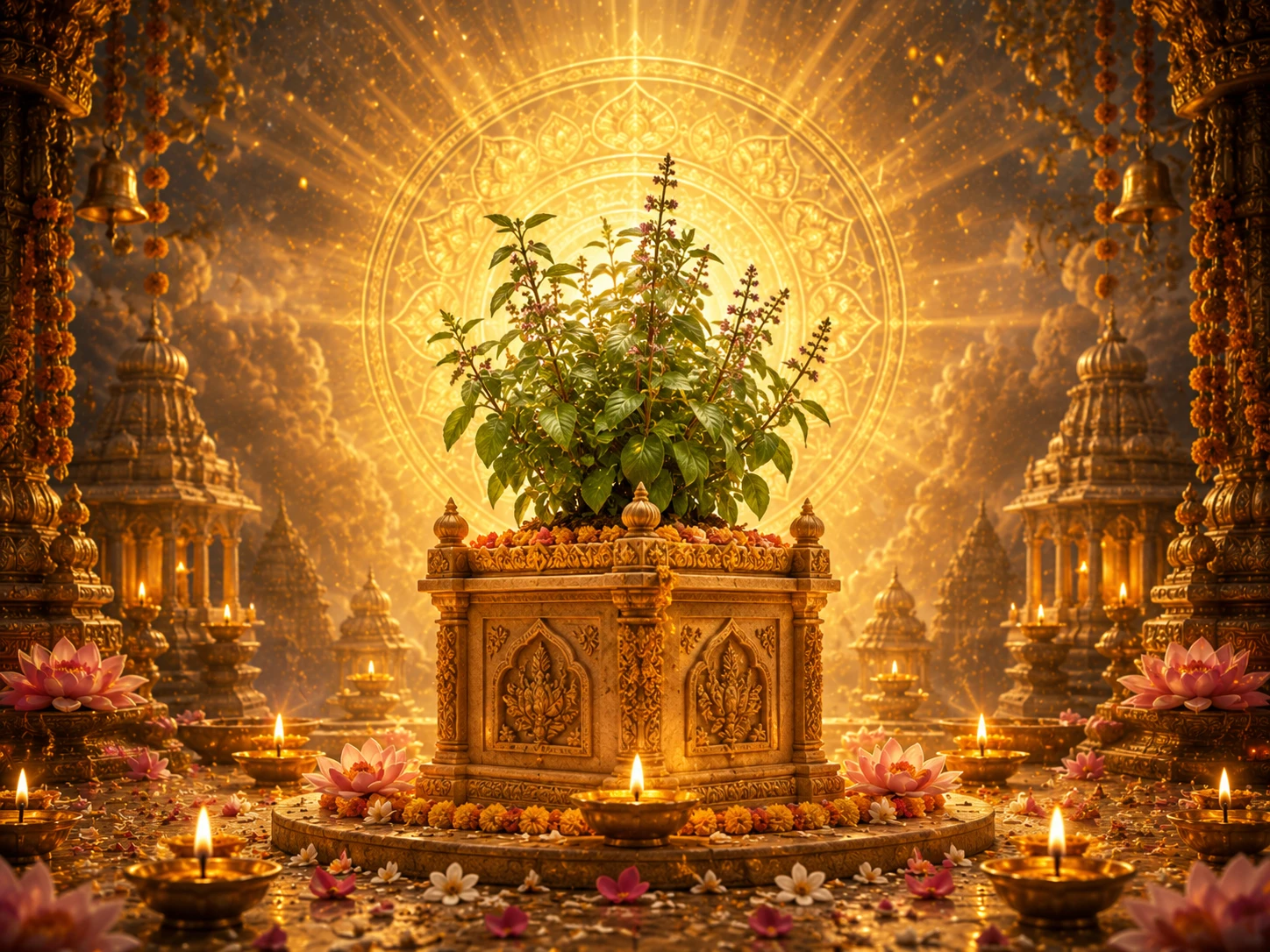
Tulasi -- The Only Plant in Hinduism That Gets Married to God
तुलसी -- हिन्दू धर्म का वो एकमात्र पौधा जिसका भगवान से विवाह होता है
In the courtyard of virtually every traditional Hindu home in India, there is a small raised brick or stone structure -- sometimes painted, sometimes plain, sometimes elaborately tiled -- on which sits a single plant. This structure is called the Tulasi Vrindavan, and the plant is Tulasi (Ocimum tenuiflorum, holy basil). Every evening, someone in the household -- usually a woman -- lights a small oil lamp beside it. Some mornings, she circumambulates it with folded hands. On festivals, the plant is decorated with sari fabric, flowers, and kumkum. On one specific day in the month of Kartik (October-November), the plant is formally married to God.
No other plant in any religion anywhere on earth receives this treatment. Trees are worshipped in many traditions. Sacred groves are protected in animist cultures. But a full Hindu wedding ceremony -- with mantras, pheras, mangalashtak, kanyadaan -- conducted between a basil plant and a deity? That is unique to Hinduism, and it tells you everything about how the tradition views the relationship between nature, divinity, and the domestic life of ordinary women.
Tulasi is not simply sacred. She is a goddess. The Padma Purana devotes thirty chapters to her glorification. The Skanda Purana, Shiva Purana, Brahmavaivarta Purana, and Devi Bhagavata Purana all narrate her story. In Vaishnava tradition, no offering to Vishnu or Krishna is complete without a Tulasi leaf placed on the prasadam. Vishnu is said to not accept food offered without Tulasi. The entire Vaishnava devotional apparatus -- from the tulasi-mala (neck beads) worn by ISKCON devotees to the tilak made with Vrindavan clay -- revolves around this one plant.
And she is not just ritually important. She is medicinally extraordinary. The Charaka Samhita, the foundational Ayurvedic text, documents her therapeutic properties. Modern pharmacological research has confirmed that Ocimum sanctum contains eugenol, rosmarinic acid, apigenin, myretenal, and other bioactive compounds with anti-inflammatory, antibacterial, antiviral, adaptogenic, and immunomodulatory properties. The WHO recognises holy basil as a medicinal herb. The plant your grandmother waters every morning is, in addition to being a deity, a pharmacy.
This dual identity -- divine and botanical, sacred and scientific -- makes Tulasi uniquely positioned in the Hindu ecosystem. She is the plant that proves the tradition's insistence on the sacredness of nature is not merely symbolic.
तुलसी श्रीसखी शुभे पापहारिणी पुण्यदे। नमस्ते नारदनुते नारायणमनःप्रिये॥
tulasī śrīsakhi śubhe pāpahāriṇī puṇyade | namaste nāradanute nārāyaṇamanaḥpriye ||
O Tulasi, companion of Lakshmi, auspicious one, destroyer of sins, bestower of merit -- I bow to you, praised by Narada, beloved of Narayana's heart.
— Tulasi Stava, Padma Purana (Srishti Khanda)
The mythology of Tulasi is one of the most narratively complex and emotionally charged in all of Puranic literature. It involves deception, sacrifice, divine cruelty, marital fidelity, curses, and ultimately -- transformation into sacred permanence.
The core narrative, found across the Padma Purana, Skanda Purana, and Shiva Purana with variations, centres on Vrinda -- a pious and virtuous woman, devoted to Vishnu, who is married to the asura king Jalandhara.
Jalandhara was born from Shiva's rage -- when Shiva's third-eye fire struck the ocean, Jalandhara emerged. He grew powerful, conquered the devas, seized Svarga (heaven), and ruled as a formidable but not unjust king. His power, however, had a peculiar source: the chastity (pativrata dharma) of his wife Vrinda. As long as Vrinda remained faithful and her virtue unbroken, Jalandhara was literally invincible. Not even Shiva could defeat him in battle.
The situation became critical when Jalandhara, inflamed by Narada's description of Parvati's beauty, demanded that Shiva hand over Parvati. War followed. Shiva fought but could not kill Jalandhara. The devas appealed to Vishnu for help. Vishnu devised a plan: he would break Vrinda's chastity by appearing before her in the guise of Jalandhara.
Vishnu approached Vrinda in her husband's form. Vrinda, believing her husband had returned, embraced him. Her chastity was broken. At that instant, Jalandhara's invincibility vanished, and Shiva destroyed him.
When Vrinda discovered the deception, she was devastated. She cursed Vishnu: 'You too shall be separated from your wife, and you shall become a stone.' This curse manifests in two ways -- in the Ramayana, when Sita is separated from Rama, and in the form of the Shaligrama stone (a black stone found in the Gandaki river), which is considered a natural aniconic form of Vishnu.
Vrinda then immolated herself on her husband's funeral pyre. From her ashes, or in some versions from seeds planted by the devas at Vishnu's instruction, grew the Tulasi plant. Vishnu, grief-stricken, blessed Vrinda: she would be reborn as the Tulasi plant, and he would never accept worship without her. In her next birth, she would be married to him -- hence the Tulsi Vivah ceremony.
This story is not simple hagiography. It is a deeply uncomfortable narrative about divine deception, the violation of a devoted woman's trust, and the moral cost of cosmic necessity. The tradition does not sanitise it. Vrinda's curse sticks -- it becomes part of the Ramayana's plot. Her anger is justified. Her transformation into Tulasi is not a punishment but a consecration -- the tradition elevates her pain into permanent divinity.
For Indian women who have inherited this tradition -- who light the lamp before the Tulasi every evening, who celebrate Tulsi Vivah with full wedding rituals -- the story carries layers of meaning about female agency, the costs of virtue, and the eventual recognition that even gods must answer for deception.
The Tulsi Vivah -- the ceremonial wedding of the Tulasi plant to Vishnu (usually in his Shaligrama stone form or as a Krishna murti) -- takes place on Prabodhini Ekadashi or Kartik Shukla Dvadashi, typically falling in late October or November. This day also marks the end of Chaturmas -- the four-month rainy-season period during which Hindu tradition prohibits weddings. Tulsi Vivah is therefore the first wedding of the season, and it inaugurates the marriage season across India.
The ceremony is remarkable for its completeness. The Tulasi plant is dressed in a miniature sari, adorned with ornaments, and treated as a bride. The Shaligrama or Krishna idol is clothed in a dhoti. A mandap is constructed around the Tulasi Vrindavan in the courtyard. The priest performs the full wedding ritual -- mangalashtak (auspicious verses), kanyadaan (giving away of the bride), pheras (circumambulation of the sacred fire or around the Tulasi), and sindoor-daan. In Maharashtra, elaborate rangoli surrounds the Vrindavan. In Bengal and Odisha, the ceremony is accompanied by folk songs. In parts of Bihar, devotees offer thekua -- a traditional wheat sweet -- as prasadam.
Women play the central role. A woman or family performs the kanyadaan, acting as Tulasi's parents. This is significant: in a tradition where giving away one's daughter in marriage is considered the highest form of dana (charity), performing kanyadaan for Tulasi is believed to grant the same merit -- making it accessible to families who may not have daughters.
The practice extends across India with regional variation: in Tamil Nadu and Andhra Pradesh, it is called Tulasi Kalyanam, performed with grandeur in Vishnu temples. In Gujarat, it coincides with the post-Navratri festive period. In ISKCON temples worldwide, it is celebrated with kirtan, abhisheka of the Tulasi plant, and distribution of Tulasi leaves as prasadam.
The eight names of Tulasi, from the Padma Purana's Ashta-Nama-Stava, each encode a theological dimension: Vrindavani (she who first manifested in Vrindavan), Vrinda (goddess of all plants), Vishvapujita (worshipped by the entire universe), Pushpasara (the best of all flowers), Nandini (she whose sight brings bliss), Krishna-jivani (the life-force of Krishna), Vishva-pavani (she who purifies the world), and Tulasi (the incomparable one).
Today, the Tulasi plant sits in the courtyard of over 100 million Indian homes. It is watered every morning, lit every evening, and treated with the same reverence as a temple deity. In Pune's Sadashiv Peth, in Chennai's Mylapore, in Varanasi's narrow galis, in NRI homes in Edison, New Jersey and Fremont, California -- the Tulasi Vrindavan is the smallest temple in Hinduism. And it is tended, in the vast majority of cases, by women. The tradition that elevated a wronged woman into a goddess is maintained, daily, by women. There is something quietly powerful about that.
Tulasi Varieties and Their Sacred-Medicinal Properties
| Variety / किस्म | Botanical / वानस्पतिक | Leaf Colour / पत्ती रंग | Sacred Use / पवित्र उपयोग | Medicinal Use / औषधीय उपयोग |
|---|---|---|---|---|
| Rama Tulasi / राम तुलसी | Ocimum sanctum | Green / हरा | Most common in household worship, Vishnu puja / गृह-पूजा में सर्वाधिक, विष्णु पूजा | Cough, cold, fever, stress relief / खाँसी, सर्दी, बुखार, तनाव-राहत |
| Krishna Tulasi / कृष्ण तुलसी | Ocimum sanctum (dark) | Purple-dark / बैंगनी-गहरा | Considered more sacred, preferred for Krishna worship / अधिक पवित्र मानी, कृष्ण पूजा में प्राथमिक | Higher eugenol content, stronger antimicrobial / अधिक eugenol, प्रबल रोगाणुरोधी |
| Vana Tulasi / वन तुलसी | Ocimum gratissimum | Light green / हल्का हरा | Forest-growing variety, associated with wild devotion / वन-उगने वाली, जंगली भक्ति से सम्बद्ध | Respiratory ailments, insect repellent / श्वसन रोग, कीट-विरोधी |
| Kapoor Tulasi / कपूर तुलसी | Ocimum kilimandscharicum | Grey-green / धूसर-हरा | Aromatic variety used in some temple traditions / कुछ मन्दिर परम्पराओं में सुगन्धित किस्म | Camphor-like compounds, analgesic / कपूर-सम यौगिक, पीड़ानाशक |
Modern research has identified over 200 bioactive compounds in Tulasi varieties, including adaptogens that help the body resist physical, chemical, and biological stress -- validating its traditional classification as a Rasayana (rejuvenative) herb in Ayurveda.
The Tulabharam ritual at the Guruvayur Krishna Temple in Kerala involves weighing a devotee against an offering on a large balance scale. The most famous Tulabharam in mythology is the Tulabharam of Satyabhama -- one of Krishna's queens who placed all her gold jewellery on one side of the scale to outweigh Krishna, but failed. Rukmini, another queen, placed a single Tulasi leaf with devotion on the scale, and it outweighed all of Satyabhama's gold. The story is a foundational Vaishnava teaching: a single Tulasi leaf offered with genuine bhakti outweighs all material wealth. The word 'Tulasi' itself derives from the Sanskrit root 'tula' (comparison, balance) -- she is the one who tips every scale.
Offer Tulasi to Vishnu
No Vishnu puja is complete without Tulasi. Offer a leaf from your courtyard plant with each section of the Vishnu Sahasranama, or with a Krishna aarti. The Sahasranama is on Eternal Raga with the meaning of each name.
Eternal Raga · शाश्वत राग
Institutional voice — scholarly articles on Sanatan Dharma
Deepen Your Understanding
अपनी समझ और गहरी करें
sacred symbols
Lotus (Padma) -- The Flower That Grows in Mud and Became God's Throne
It grows from the bottom of a swamp. It rises through murky water. It blooms in sunlight without a single stain. This is not a motivational poster -- it is the central metaphor of Hindu civilisation. Every god sits on it. Every scripture references it. The Bhagavad Gita used it to explain the entire philosophy of detached action in one line.
sacred artefacts
Tulasi Mala -- The Neckbeads That Mark You as Vishnu's Own
Two or three strands of small wooden beads, worn around the neck at all times -- in the shower, during sleep, at work, at death. The Tulasi Mala is not jewellery. It is a permanent declaration of spiritual identity. The Padma Purana says that Yama's messengers will not approach a body wearing Tulasi beads. ISKCON devotees worldwide wear it as their most visible marker of Krishna consciousness.
sacred artefacts
Samudra Manthan Treasures -- The 14 Things That Came Out When Gods and Demons Churned the Ocean Together
Poison came first. Immortality came last. In between: a goddess, a gem, a cow, a horse, a tree, a physician, a bow, a moon, and an elephant. The Samudra Manthan is not just a myth -- it is a startup pitch deck for the universe. Two rival teams. One impossible project. Fourteen deliverables. And a hostile takeover at the end.
sacred symbols
Kalash -- The Sacred Pot That Contains Every Hindu Ritual Inside It
A brass pot, some water, mango leaves, a coconut on top. Looks simple. But the Purna Kumbha is a complete cosmological diagram -- the pot is Earth, the water is the life-force, the leaves are creation, the coconut is divine consciousness. No Hindu ritual begins without it. From Navratri to weddings to your griha pravesh -- the kalash was there first.
sacred artefacts
Banalinga -- The Stone God Made Himself in a River Over Millions of Years
No sculptor shaped it. No temple priest consecrated it. The Banalinga is a smooth, egg-shaped stone that emerges from the bed of the Narmada River in central India -- formed by millions of years of water erosion into a shape that Hindus recognise as Shiva's aniconic emblem. It is called Svayambhu: self-born. It needs no prana pratishtha because divinity is already inside. In a tradition that fills temples with carved murtis and elaborate rituals, the Banalinga is a radical statement: God does not need human hands to manifest.
sacred artefacts
Panchamrita -- The Five-Nectar Offering That Is Simultaneously Puja and Pharmacy
Milk, yogurt, ghee, honey, sugar. Five ingredients. Mixed in a specific order, offered to the deity, poured over the murti, and then distributed as prasadam. Every Hindu has tasted Panchamrita. Almost none know that each ingredient represents a cosmic element and that the mixture is also a clinically documented Ayurvedic formulation for immunity and digestion.
scriptural exegesis
Krishna's 16,108 Queens -- The Story Behind the Number
The number sounds absurd until you understand what it means. Krishna did not 'collect' 16,108 wives. He rescued 16,100 women from a demon's prison, and when no one in society would accept them back -- because they were 'tainted' -- he married every single one to restore their honour. Add 8 named queens (the Ashtabharya) married through love, valour, or diplomacy, and you get the most misunderstood number in Hindu mythology. This is not a harem story. It is the largest social rehabilitation programme in ancient literature.
The Tulabharam ritual at the Guruvayur Krishna Temple in Kerala involves weighing a devotee against an offering on a large balance scale. The most famous Tulabharam in mythology is the Tulabharam of Satyabhama -- one of …
More in Sacred Symbols
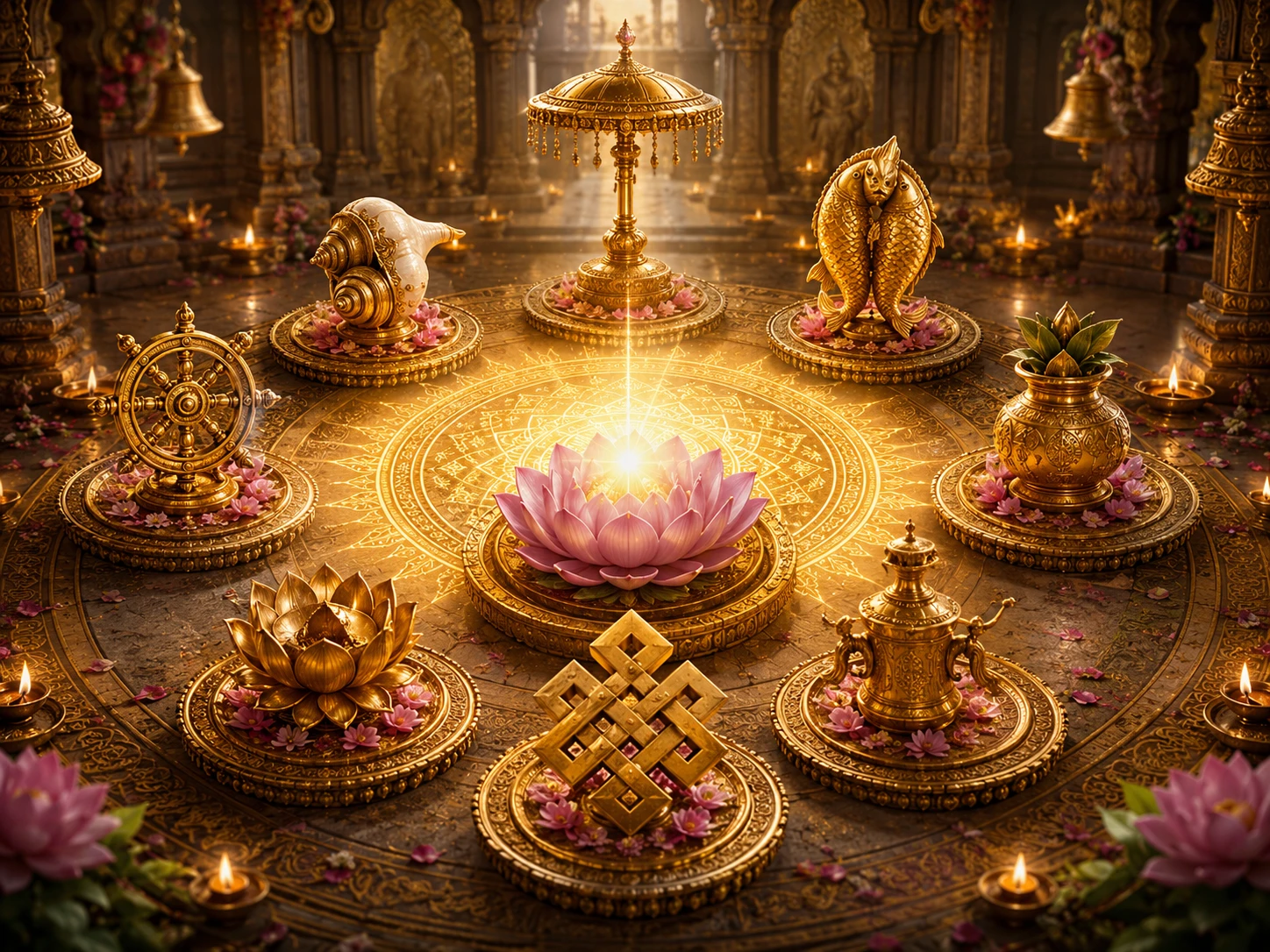
Ashtamangala -- The Eight Auspicious Symbols of Hindu Tradition
13 min read
Bindu -- The Point from which Creation Emerges
12 min read
Gau -- Why the Cow Holds the Place She Does in Hindu Life
14 min readThe same translation error that turned '33 Koti' into '33 crore' in Hinduism also happened in Buddhism. The Chinese translation of Buddhist texts rendered 'Sapta Koti Buddha' (7 Supreme Buddhas) as '7 Crore Buddhas.' The…
Deities AvatarsCommunity Reflections
🕉️
Be the first to share your reflection.