Tulasi Mala -- The Neckbeads That Mark You as Vishnu's Own
तुलसी माला -- वो गले के मनके जो तुम्हें विष्णु का अपना चिह्नित करते हैं
If you have ever seen an ISKCON devotee -- in Vrindavan, in Mayapur, on the streets of Manhattan or Melbourne, in the airport at Frankfurt or Bangkok -- you noticed the beads before you noticed anything else. Two or three strands of small, light-brown wooden beads encircling the neck, sitting flat against the skin, worn over the kurta or under the shirt collar but always visible. These are Tulasi neck beads -- kanthi mala -- and they are the single most visible external identifier of a Vaishnava devotee in the modern world.
But the Tulasi mala is not an ISKCON invention. It is an ancient Vaishnava tradition documented in the Padma Purana, Garuda Purana, Vishnu Dharmottara Purana, and Hari Bhakti Vilasa (the authoritative Gaudiya Vaishnava ritual manual compiled by Sanatana Goswami in the 16th century). The tradition holds that wearing Tulasi on the body creates a permanent protective field of Vishnu's grace -- a spiritual armour that no negative force can penetrate.
The Padma Purana states with characteristic directness: those who are cremated with Tulasi twigs on the funeral pyre, or who wear Tulasi beads at the time of death, are freed from the cycle of rebirth. Yama's messengers (Yamadutas) will not approach such a person. Vishnu's messengers (Vishnudutas) will come instead. The theological claim is extraordinary: a string of wooden beads, made from a plant, worn around the neck, alters the trajectory of the soul after death.
For a software engineer in Whitefield, Bangalore, who wears a Tulasi kanthi under his office shirt every day and nobody at work knows, the beads are a private compass -- a constant tactile reminder that the material world, with its sprint reviews and OKRs, is not the final reality. For his grandmother in Srirangam who has worn them for sixty years, they are simply part of her body. She would feel more naked without them than without her sari.
There are two primary forms of the Tulasi mala: the kanthi mala (neckbeads, worn permanently) and the japa mala (prayer beads, used for counting mantras).
तुलसीकाष्ठसम्भूतां मालां यः कण्ठे धारयेत्। स गच्छेद्विष्णुसदनं यत्र गत्वा न शोचति॥
tulasīkāṣṭhasambhūtāṃ mālāṃ yaḥ kaṇṭhe dhārayet | sa gacchedviṣṇusadanaṃ yatra gatvā na śocati ||
One who wears around the neck a mala made from Tulasi wood goes to the abode of Vishnu, having reached which one never grieves.
— Padma Purana (Tulasi Mahatmya section)
The two forms serve different functions but share the same sacred material.
**Kanthi Mala (Neck Beads)**
The kanthi is worn permanently, day and night, and is never voluntarily removed. It typically consists of two or three strands of small, smooth Tulasi wood beads strung on a strong thread. The beads are made from the dried wood of a Tulasi plant that has died naturally -- the plant must never be killed to harvest wood. The kanthi sits close to the throat, at the Vishuddha chakra (throat energy centre), which in yogic anatomy governs purification and truth.
Receiving the kanthi mala is part of Vaishnava diksha (initiation). In the Gaudiya Vaishnava tradition (ISKCON and related sampradayas), the guru places the kanthi around the disciple's neck during the initiation ceremony, along with teaching the disciple the Hare Krishna Mahamantra and giving a spiritual name. From that moment, the kanthi is the disciple's permanent identity marker -- it declares to the world (and to the self) that this person has accepted the path of bhakti.
The Hari Bhakti Vilasa specifies that the kanthi protects the wearer from premature death, nightmares, snakebite, disease, and the influence of malefic planets. Whether understood literally or symbolically, the tradition's claim is consistent: the Tulasi kanthi is a spiritual shield.
**Japa Mala (108-Bead Prayer Beads)**
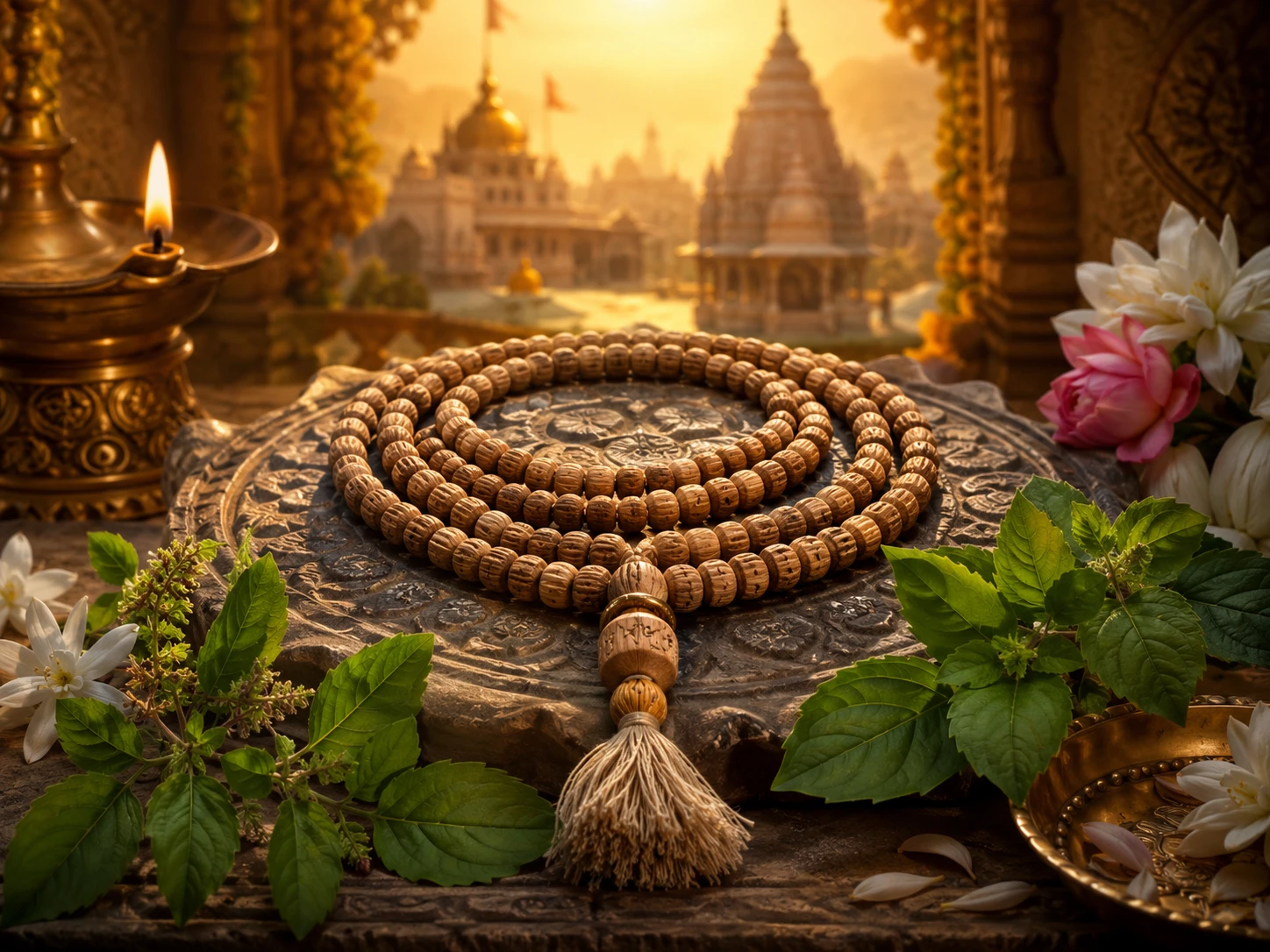
The Tulasi japa mala consists of 108 beads plus one larger 'sumeru' or 'guru' bead, strung in a single loop. The 108 beads correspond to the 108 Upanishads, 108 names of major deities, and the sacred number 108 that permeates Hindu sacred mathematics. The devotee holds the mala in the right hand, inside a cloth bag (gomukhi) to keep it clean and uncontaminated. Each bead corresponds to one complete recitation of the chosen mantra -- typically the Hare Krishna Mahamantra (Hare Krishna Hare Krishna, Krishna Krishna Hare Hare / Hare Rama Hare Rama, Rama Rama Hare Hare) or the deity's name.
One complete round of the mala = 108 repetitions. Serious practitioners chant 16 rounds daily (the ISKCON standard set by Srila Prabhupada), which equals 1,728 mantras per day. The tactile movement of bead to bead provides a physical anchor for the wandering mind -- each bead click is a micro-return to attention. The mala is, in this sense, a manual mindfulness device: a pre-digital technology for sustained concentration that has been in continuous use for at least two thousand years.
The japa mala never touches the floor, is never placed in impure locations, and is replaced when worn through. Old malas are not discarded but reverently placed at the base of a Tulasi plant or immersed in a sacred river.
Today, Tulasi malas are worn by millions of Vaishnavas worldwide -- from traditional Iyengar families in Tamil Nadu to ISKCON congregations in Moscow, from Pushtimarg devotees in Gujarat to Hare Krishna communities in Nairobi. The beads that were once visible only in Vrindavan and Tirupati now appear in WeWork offices, on Zoom calls, and at tech conferences in San Francisco. The Tulasi mala is quietly becoming one of the most globally distributed Hindu sacred objects of the 21st century.
Kanthi Mala vs. Japa Mala -- Key Differences
| Aspect / पक्ष | Kanthi Mala / कण्ठी माला | Japa Mala / जप माला |
|---|---|---|
| Purpose / उद्देश्य | Identity + protection; worn permanently / पहचान + संरक्षण; स्थायी | Mantra counting during japa / जप में मन्त्र गणना |
| Bead count / मनके | Varies (usually 2-3 strands, small beads) / भिन्न (2-3 लड़ियाँ) | 108 + 1 sumeru bead / 108 + 1 सुमेरु |
| Worn / पहना | Around neck, always / गले में, सदा | Held in right hand inside gomukhi bag / दायें हाथ में गोमुखी थैली में |
| When used / कब | 24/7 -- never removed except to replace / 24/7 | During designated japa time / निर्धारित जप-काल में |
| Given by / किसके द्वारा | Guru at diksha (initiation) / गुरु दीक्षा पर | May be self-obtained or guru-given / स्वयं प्राप्त या गुरु-दत्त |
| Replacement / प्रतिस्थापन | When thread breaks or beads wear / धागा टूटे या मनके घिसें | When beads wear smooth / मनके चिकने घिसें |
| Disposal / विसर्जन | Placed at Tulasi base or river / तुलसी मूल या नदी में | Same -- never discarded casually / समान -- कभी लापरवाही से नहीं |
Some traditions also use Tulasi japa malas with 27 beads (quarter-mala) or 54 beads (half-mala) for shorter practice sessions. Sandalwood and Rudraksha malas serve similar japa functions for Shaiva and other traditions.
Srila A.C. Bhaktivedanta Swami Prabhupada, the founder of ISKCON, set the standard of chanting 16 rounds of the Hare Krishna Mahamantra on a 108-bead Tulasi japa mala daily -- that is 1,728 individual mantra recitations. When Prabhupada arrived in New York in 1965 at the age of 69, with 40 rupees and a trunk of books, the first thing he gave his earliest American followers was not a book or a lecture. It was a Tulasi japa mala and the instruction to chant. The beads preceded the philosophy. Today, ISKCON has over 800 temples, restaurants, and centres in more than 100 countries, and virtually every initiated member wears Tulasi kanthi beads and chants on a Tulasi japa mala -- making Tulasi wood from Vrindavan quite possibly the most globally distributed sacred plant material in the Hindu tradition.
Start Your Japa Practice Today
Begin with one round of 108 on a Tulasi mala, with the Hare Krishna maha-mantra or Om Namo Bhagavate Vasudevaya. Add a round only when one feels steady. The maha-mantra's page on Eternal Raga gives its meaning and how to chant it.
Tags
Eternal Raga · शाश्वत राग
Institutional voice — scholarly articles on Sanatan Dharma
Deepen Your Understanding
अपनी समझ और गहरी करें
sacred symbols
Tulasi -- The Only Plant in Hinduism That Gets Married to God
She has eight names. She gets a wedding ceremony. Vishnu refuses prasadam without her leaf. And she sits in the courtyard of 100 million Indian homes -- not as decoration but as a living deity. Tulasi is not a plant you worship. She is a goddess who chose to become a plant.
sacred symbols
Kalash -- The Sacred Pot That Contains Every Hindu Ritual Inside It
A brass pot, some water, mango leaves, a coconut on top. Looks simple. But the Purna Kumbha is a complete cosmological diagram -- the pot is Earth, the water is the life-force, the leaves are creation, the coconut is divine consciousness. No Hindu ritual begins without it. From Navratri to weddings to your griha pravesh -- the kalash was there first.
sacred symbols
Tilak Types -- The Hindu Forehead Mark That Tells Your Entire Spiritual Address
Before LinkedIn profiles and Instagram bios, Hindus had a one-glance identity system -- the tilak. A single mark on the forehead could tell you someone's deity, lineage, philosophy, and guru. Tripundra or Urdhva Pundra? Vibhuti or chandana? Each line is a declaration of cosmic allegiance.
sacred symbols
Yajnopavita -- The Sacred Thread That Made You Born Twice
Three cotton strands, nine deities, a knot that encodes your entire lineage. The Janeu is not a string -- it is a contract. A contract with your guru, your ancestors, and the Vedas. The Upanayana ceremony that gives it to you is called a second birth. And the thread you wear for the rest of your life is the receipt.
sacred artefacts
Samudra Manthan Treasures -- The 14 Things That Came Out When Gods and Demons Churned the Ocean Together
Poison came first. Immortality came last. In between: a goddess, a gem, a cow, a horse, a tree, a physician, a bow, a moon, and an elephant. The Samudra Manthan is not just a myth -- it is a startup pitch deck for the universe. Two rival teams. One impossible project. Fourteen deliverables. And a hostile takeover at the end.
sacred artefacts
Divine Gems -- Syamantaka, Kaustubha, and Chintamani
Hindu mythology's most precious stones are not mere ornaments -- they are plot devices, moral tests, and cosmic forces. The Syamantaka Mani turned Krishna into a detective. The Kaustubha emerged from the Ocean of Milk to sit forever on Vishnu's chest. The Chintamani fulfils every wish -- and teaches why that might be the worst thing that could happen to you.
Srila A.C. Bhaktivedanta Swami Prabhupada, the founder of ISKCON, set the standard of chanting 16 rounds of the Hare Krishna Mahamantra on a 108-bead Tulasi japa mala daily -- that is 1,728 individual mantra recitations.…
More in Sacred Artefacts
Ashtadhatu -- The Sacred Eight-Metal Alloy of Indian Temples
12 min read
Banalinga -- The Stone God Made Himself in a River Over Millions of Years
13 min read
Celestial Trees -- Kalpavriksha and Parijata
12 min readThe same translation error that turned '33 Koti' into '33 crore' in Hinduism also happened in Buddhism. The Chinese translation of Buddhist texts rendered 'Sapta Koti Buddha' (7 Supreme Buddhas) as '7 Crore Buddhas.' The…
Deities AvatarsCommunity Reflections
🕉️
Be the first to share your reflection.