Panchamrita -- The Five-Nectar Offering That Is Simultaneously Puja and Pharmacy
पञ्चामृत -- वो पाँच-अमृत अर्पण जो एक साथ पूजा भी है और औषधालय भी
You have tasted it. In a temple, after abhisheka, the priest handed you a small spoonful of a milky, sweet, slightly tangy liquid from a silver or brass vessel. You cupped your right palm, received it, sipped it, and touched the remainder to your forehead. You did this as a child without understanding it. You may have done it last week without thinking about it. That liquid is Panchamrita -- literally 'five nectars' -- and it is one of the most ubiquitous sacred substances in Hindu worship.
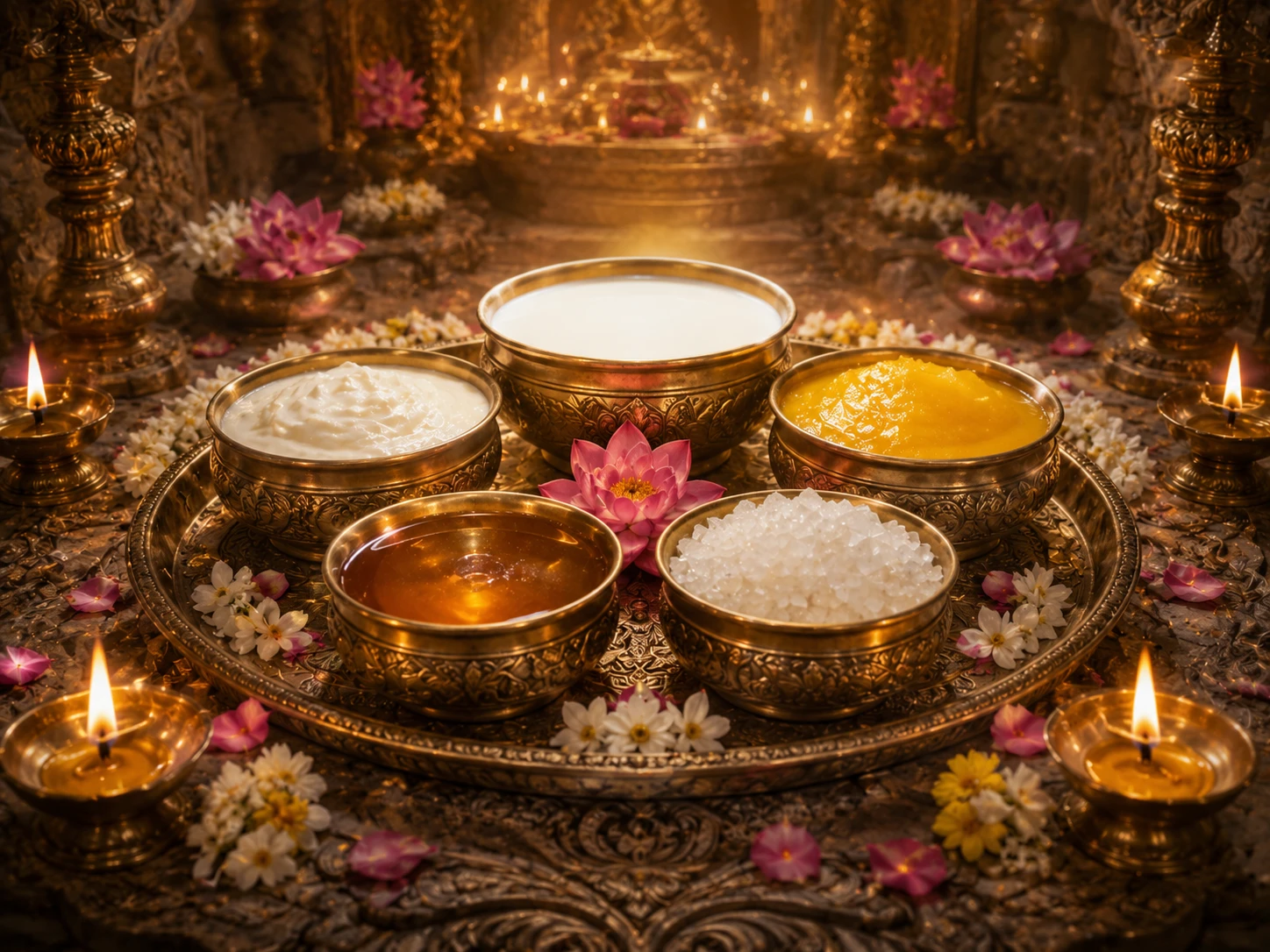
Panchamrita is a mixture of five specific ingredients: milk (dugdha/kshira), yogurt (dadhi), ghee (ghrita), honey (madhu), and sugar (sharkara). In some traditions, the sugar is replaced by jaggery (guda) or the mixture includes a sixth element like Tulasi leaves or crushed banana. But the canonical five are fixed in the Agama Shastras and Puja Vidhi texts.
The mixture serves two simultaneous functions that the Hindu ritual system never separates: it is a sacred offering to the deity AND a health-promoting substance for the devotee. It is poured over the murti during abhisheka (ritual bathing of the deity image), collected after it has 'touched God's feet', and distributed as Charnamrita (literally 'nectar from the feet') to devotees. Every sip of Panchamrita prasadam is simultaneously an act of devotion and a dose of traditional medicine.
This dual function is not coincidental. It is designed. The Ayurvedic tradition classifies each ingredient as having specific doshic (constitutional) properties, and the combination is explicitly noted in the Charaka Samhita and Sushruta Samhita as beneficial for digestion, immunity, skin health, and mental clarity. Modern nutritional science has confirmed that each of the five ingredients contains bioactive compounds: milk provides casein and calcium, yogurt offers probiotics, ghee supplies butyric acid and fat-soluble vitamins, honey contains antimicrobial enzymes, and sugar provides quick-release glucose.
The person who designed this mixture was simultaneously a priest and a nutritionist. The tradition that distributes it is simultaneously a church and a clinic.
क्षीरं दधि घृतं चैव मधु शर्करया सह। पञ्चामृतमिदं प्रोक्तं स्नानार्थं तव शङ्कर॥
kṣīraṃ dadhi ghṛtaṃ caiva madhu śarkarayā saha | pañcāmṛtamidaṃ proktaṃ snānārthaṃ tava śaṅkara ||
Milk, yogurt, ghee, honey, and sugar together -- this is declared as Panchamrita, for the sacred bathing of You, O Shankara (Shiva).
— Abhisheka Vidhi (Puja ritual tradition)
The Five Ingredients of Panchamrita -- Sacred and Scientific
| Ingredient / सामग्री | Sanskrit / संस्कृत | Cosmic Symbolism / ब्रह्माण्डीय प्रतीक | Ayurvedic Property / आयुर्वेदिक गुण | Modern Science / आधुनिक विज्ञान |
|---|---|---|---|---|
| Milk / दूध | Kshira / क्षीर | Purity, motherhood, Kamadhenu / शुद्धता, मातृत्व, कामधेनु | Cooling, Vata-Pitta balancing / शीतल, वात-पित्त सन्तुलन | Calcium, casein protein, B vitamins |
| Yogurt / दही | Dadhi / दधि | Prosperity, transformation / समृद्धि, रूपान्तरण | Digestive, Agni-kindling / पाचक, अग्नि-प्रदीपक | Probiotics, L. acidophilus, gut health |
| Ghee / घी | Ghrita / घृत | Agni (sacred fire), tejas (inner radiance) / अग्नि, तेजस | Rasayana (rejuvenative), intelligence-enhancing / रसायन, बुद्धिवर्धक | Butyric acid, fat-soluble vitamins A/D/E/K, CLA |
| Honey / मधु | Madhu / मधु | Sweetness of speech, Vaani (divine word) / वाणी-माधुर्य | Antimicrobial, wound-healing, Kapha-reducing / रोगाणुरोधी, कफ-शामक | Hydrogen peroxide, antioxidants, methylglyoxal |
| Sugar / शर्करा | Sharkara / शर्करा | Ananda (bliss), sweetness of life / आनन्द, जीवन-माधुर्य | Quick energy, Vata-calming / त्वरित ऊर्जा, वात-शान्तिकर | Glucose, sucrose -- rapid energy source |
The order of mixing is traditionally prescribed: milk first, then yogurt, then ghee, then honey, then sugar. This sequence moves from liquid to semi-solid to fat to viscous to crystalline -- a progression that also corresponds to increasingly refined states of matter. Tulasi leaves are added last in many traditions, consecrating the mixture.
A 2019 study published in the Journal of Ayurveda and Integrative Medicine found that Panchamrita -- in its traditional five-ingredient formulation -- demonstrated significant antioxidant activity, antimicrobial properties against common pathogens, and immunomodulatory effects in laboratory conditions. The researchers noted that the combination of ingredients produced synergistic effects greater than any single ingredient alone -- meaning the traditional mixture is more effective than its parts. The ancient formulators appear to have intuitively optimised a nutraceutical combination that modern food science is only now beginning to characterise. Every spoonful of Charnamrita you receive at the temple is, according to peer-reviewed research, a clinically relevant functional food.
Prepare Panchamrita at Home
Mix the five nectars in the traditional order -- milk, curd, ghee, honey and sugar -- and offer abhisheka to your home deity while chanting Om Namah Shivaya or your ishta devata's mantra. Eternal Raga's article on abhisheka explains the full ritual.
Tags
Eternal Raga · शाश्वत राग
Institutional voice — scholarly articles on Sanatan Dharma
Deepen Your Understanding
अपनी समझ और गहरी करें
sacred artefacts
Banalinga -- The Stone God Made Himself in a River Over Millions of Years
No sculptor shaped it. No temple priest consecrated it. The Banalinga is a smooth, egg-shaped stone that emerges from the bed of the Narmada River in central India -- formed by millions of years of water erosion into a shape that Hindus recognise as Shiva's aniconic emblem. It is called Svayambhu: self-born. It needs no prana pratishtha because divinity is already inside. In a tradition that fills temples with carved murtis and elaborate rituals, the Banalinga is a radical statement: God does not need human hands to manifest.
sacred symbols
Kalash -- The Sacred Pot That Contains Every Hindu Ritual Inside It
A brass pot, some water, mango leaves, a coconut on top. Looks simple. But the Purna Kumbha is a complete cosmological diagram -- the pot is Earth, the water is the life-force, the leaves are creation, the coconut is divine consciousness. No Hindu ritual begins without it. From Navratri to weddings to your griha pravesh -- the kalash was there first.
sacred symbols
Tulasi -- The Only Plant in Hinduism That Gets Married to God
She has eight names. She gets a wedding ceremony. Vishnu refuses prasadam without her leaf. And she sits in the courtyard of 100 million Indian homes -- not as decoration but as a living deity. Tulasi is not a plant you worship. She is a goddess who chose to become a plant.
sacred artefacts
Samudra Manthan Treasures -- The 14 Things That Came Out When Gods and Demons Churned the Ocean Together
Poison came first. Immortality came last. In between: a goddess, a gem, a cow, a horse, a tree, a physician, a bow, a moon, and an elephant. The Samudra Manthan is not just a myth -- it is a startup pitch deck for the universe. Two rival teams. One impossible project. Fourteen deliverables. And a hostile takeover at the end.
sacred artefacts
Kusha Grass -- The Blade That Doubles as a Spiritual Conductor
It looks like ordinary grass. It is not. Kusha -- also called Darbha or Pavitram -- is a sharp-edged, razor-bladed grass that appears in virtually every Hindu ritual from birth to death. The Bhagavad Gita prescribes it as the ideal meditation seat. The Garuda Purana says it grew from Vishnu's hair. The Rig Veda mentions it alongside soma. It is worn as a ring by priests, laid under the dead, spread around sacrificial fires, and placed on food during eclipses. No other grass on Earth has this resume.
sacred artefacts
Kamandalu -- The Water Pot That Carries an Ocean of Renunciation
A small gourd or metal pot, carried by Brahma in one hand and by every wandering sannyasi on the road. The Kamandalu holds just enough water to sustain life -- and that is the point. It is the material reduction of existence to its absolute minimum. Everything you need. Nothing you want. The original minimalist design object.
A 2019 study published in the Journal of Ayurveda and Integrative Medicine found that Panchamrita -- in its traditional five-ingredient formulation -- demonstrated significant antioxidant activity, antimicrobial properti…
More in Sacred Artefacts
Ashtadhatu -- The Sacred Eight-Metal Alloy of Indian Temples
12 min read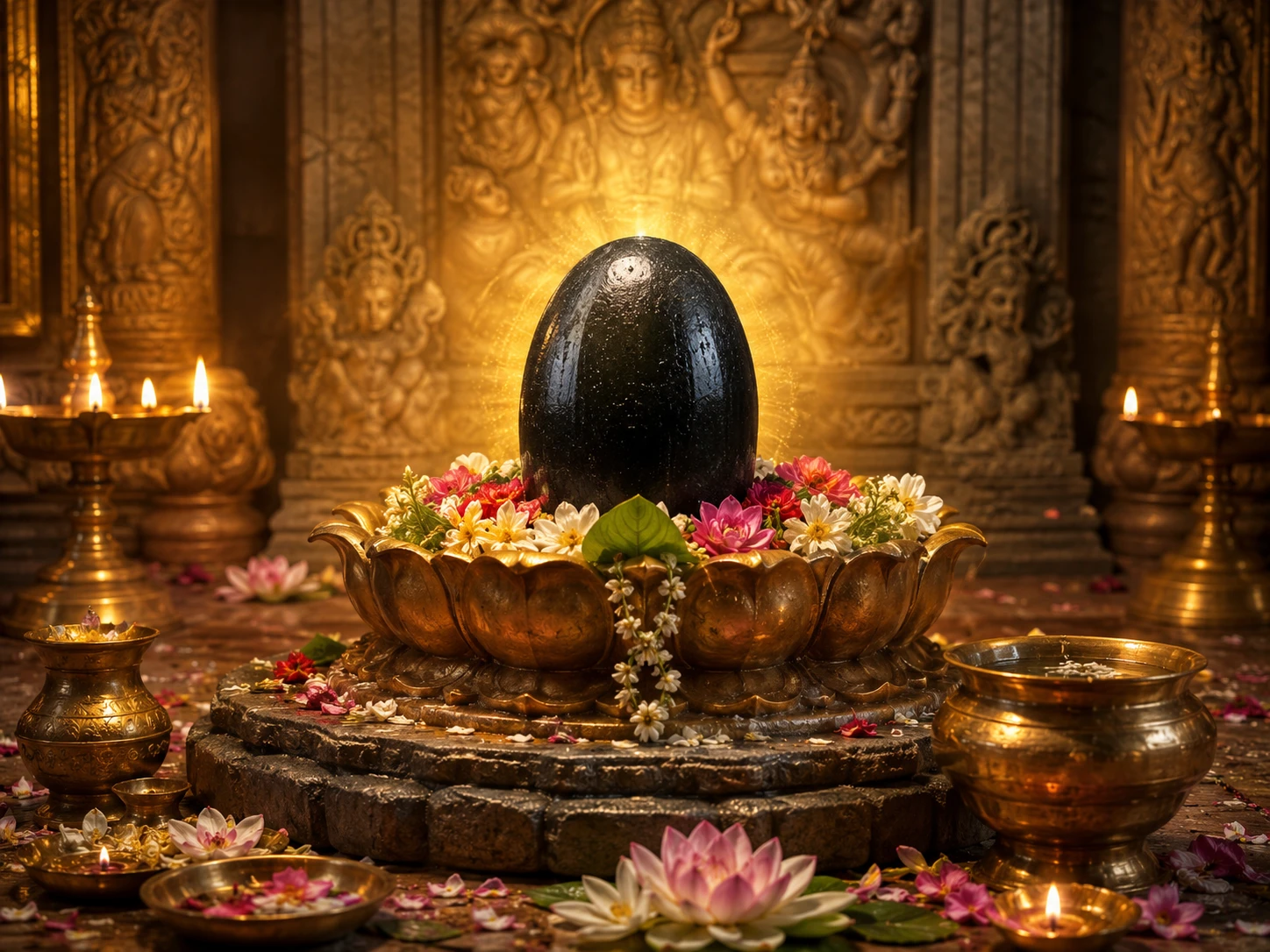
Banalinga -- The Stone God Made Himself in a River Over Millions of Years
13 min read
Celestial Trees -- Kalpavriksha and Parijata
12 min readThe same translation error that turned '33 Koti' into '33 crore' in Hinduism also happened in Buddhism. The Chinese translation of Buddhist texts rendered 'Sapta Koti Buddha' (7 Supreme Buddhas) as '7 Crore Buddhas.' The…
Deities AvatarsCommunity Reflections
🕉️
Be the first to share your reflection.