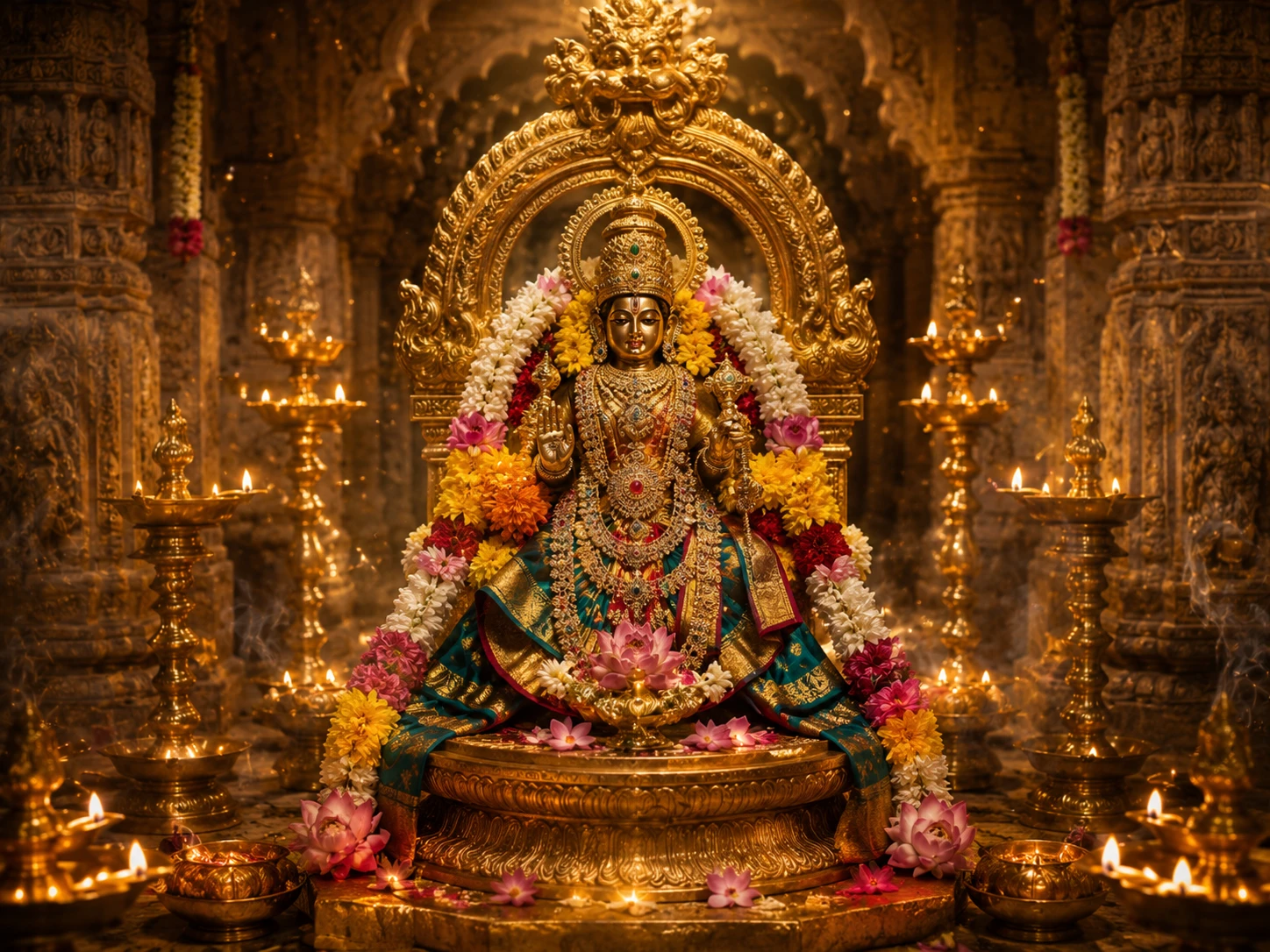
Utsava Murti -- The Processional Deity
उत्सव मूर्ति -- शोभायात्रा की प्रतिमा
If you have ever stood at the Tirumala Brahmotsavam in Tirupati during the nine-day festival, you have seen something most visitors to the main temple never see. Every evening, a smaller, golden, three-foot-tall Venkateshwara is brought out of the temple, placed on a vahana (mount) of the day (Hamsa, Garuda, Simha, Hanuman, each on a different day), and taken in procession around the four mada streets of the town. Tens of thousands of devotees who cannot enter the sanctum for darshan see this smaller deity clearly, receive His garland as prasad, and follow the procession for hours. Inside the temple, meanwhile, the stone Venkateshwara of the sanctum remains exactly where He has stood for over a thousand years. He does not move. He cannot move.
These are two different images of the same god. The Tamil agamic tradition calls the immovable stone deity the mulavar or dhruva bera, meaning 'the fixed root'. The movable metal one, usually bronze, gold-plated in some traditions, is the utsava murti, also called utsava bera or yatra murti. The name breaks down clearly. Utsava comes from ut (removing) and sava (sorrow), so utsava means that which removes sorrow, a festival. Murti is the embodied form of the divine. The utsava murti is the festival image, the deity that comes out into the world during festival days.
Every major Hindu temple in South India, and many in the North, operates this way. Srirangam, Madurai, Chidambaram, Kanchipuram, Guruvayur, Tirumala, Pandharpur, Puri, Nathadwara, Udupi, each keeps a fixed sanctum deity and a separate processional deity. The Chola bronzes in the Government Museum at Chennai, at the Metropolitan Museum in New York, at the Victoria and Albert in London, are not aesthetic objects made for contemplation. They are utsava murtis, removed from temples (sometimes during worship, sometimes during the colonial thefts of the nineteenth century) and now displayed as art. Put a living agama-ordained priest in front of any one of them and he can tell you within seconds which temple it came from, which festival it was made for, and which mantra should be chanted before it is touched.
The theology behind this double image is subtle, and it is what the Bhagavad Gita is partly answering when Krishna tells Arjuna that form-worship is not a lower form of spirituality. It is a more accessible one. The Vaikhanasa Agama, the older of the two major Vaishnava ritual systems, codifies this into what it calls the panchabera, the five-fold deity system. Five distinct images, each with a separate function, together make up the full ritual presence of the god in a major Vishnu temple.
The first is the dhruva bera, the fixed stone image in the sanctum. It never moves and it never receives direct offerings of food; it holds the divine presence in its purest, most concentrated form. The second is the kautuka bera, a smaller bronze placed just outside the innermost sanctum, which receives daily offerings of food, water, flowers, and fragrance. The third is the utsava bera, the processional image carried out on vahanas during festivals. The fourth is the snapana bera, used for abhishekam (ritual bathing), because the dhruva bera cannot be bathed in water and milk. The fifth is the bali bera, used for bali offerings outside the sanctum, to the attendants of the main deity.
This five-fold system solves a theological problem. If the stone deity is the supreme god Himself, how can He be moved, bathed, fed, carried on a palanquin? The Vaikhanasa answer is that He cannot and He need not. The divine presence that is concentrated in the dhruva bera extends outward through these other images, each of which performs a specific function. You can pour milk over the snapana bera at Tirumala without anyone thinking the main deity has been touched. You can carry the utsava bera around four streets without anyone thinking Vishnu has left the sanctum. The mulavar remains fixed. The utsavar does the work that requires motion. Both are real. Both are the same god, refracted through different ritual functions.
क्लेशोऽधिकतरस्तेषामव्यक्तासक्तचेतसाम् । अव्यक्ता हि गतिर्दुःखं देहवद्भिरवाप्यते ॥
kleśo 'dhikataras teṣām avyaktāsaktacetasām | avyaktā hi gatir duḥkhaṃ dehavadbhir avāpyate ||
Greater is the trouble of those whose minds are set on the unmanifest. The path of the unmanifest is hard for the embodied to reach.
— Bhagavad Gita 12.5
This is Krishna's defence of form-worship in the twelfth chapter of the Gita, the Bhakti Yoga. Arjuna has just asked whether it is better to worship the formless absolute or the god with form. Krishna does not dismiss the formless path. He says it is available, it leads to the same goal, but it is harder for beings who have bodies. The embodied mind reaches more easily for what it can see, touch, carry in procession, garland, bathe, and follow through four city streets at sunset. The utsava murti is the answer Krishna's verse gives, turned into a metal object that forty generations of temple-goers have followed.
The Pancharatra Agama, the other major Vaishnava system, adopts a slightly different framework but arrives at a similar conclusion. The Pancharatra organises worship around the five vyuhas or cosmic emanations of Vishnu, Vasudeva, Sankarshana, Pradyumna, Aniruddha, with the worshipper's own soul as the fifth. Temple ritual in this system emphasises the dynamic, devotional aspect of the god, and the utsava murti becomes the instrument through which that dynamism takes visible form. Where Vaikhanasa priests are hereditary and trace their lineage to the forest ascetic Vikhanas, Pancharatra priests receive diksha (initiation) and can come from any background. A worshipper at a Pancharatra temple may participate more actively; she may help carry the palanquin; she may receive the deity's bronze feet on her head as a blessing. The utsava murti becomes the point where strict agama rules meet popular bhakti.
The craft of making an utsava murti is itself a living tradition. The town of Swamimalai near Kumbakonam in Tamil Nadu is still, in 2026, home to the Sthapati community of bronze-workers whose ancestors cast the great Chola bronzes between the ninth and thirteenth centuries. The technique is called madhuchchhishtavidhana, lost-wax casting. A wax model of the deity is sculpted to exact shilpa-shastra proportions. Clay is packed around it and baked. The wax runs out through a small channel. Molten panchaloha (five-metal alloy of copper, silver, gold, brass, and tin) is poured in. When the clay is broken away, the bronze emerges. Each bronze is unique, because the mould is destroyed in the process.
The Brihat-Samhita of Varahamihira, from the sixth century, specifies the proportions. The face-height unit is called tala, roughly the length of the deity's palm. A standing Vishnu murti for processional use must be nine talas tall, with specific ratios for every limb. A seated Krishna must be eight talas. A Nataraja must have its raised leg at a specific angle, with the drummer-palm lined up to a specific point on the torso. These are not aesthetic preferences. They are agamic requirements. A bronze that violates them cannot be installed for puja; it can only be kept as a reference object. The great tenth-century Chola bronze of Nataraja at the Brihadisvara temple in Thanjavur, and the one now at the Sarabhai Collection in Ahmedabad, and the one at the Cleveland Museum of Art, all follow the same proportions because all three come from the same shilpa-shastra lineage.
The Five Beras of Vaikhanasa Agama
| Bera | Material | Location | Function | Example at Tirumala |
|---|---|---|---|---|
| Dhruva bera (Mulavar) | Stone, usually granite | Innermost sanctum, fixed permanently | Holds the pure concentrated divine presence; receives no food; never moves | The seven-foot stone Venkateshwara in the garbhagriha |
| Kautuka bera | Small bronze or silver | Just outside the sanctum; moved only on a small peetham | Receives daily food, water, and flower offerings on behalf of the dhruva bera | Bhoga Srinivasa, donated in the tenth century by Pallava queen Samavai |
| Utsava bera (Yatra murti) | Bronze, often gold-plated | Temple mandapa; comes out for processions | Carried on palanquins and vahanas during festivals to let the deity meet devotees | Malayappa Swami, discovered in 1339 CE, three feet tall |
| Snapana bera | Bronze, smaller | Used in a separate mandapa for abhishekam | Receives ritual bath of milk, curd, honey, sugar, and ghee (pancha amrita) | Koluvu Srinivasa or specific snapana murti at Tirumala |
| Bali bera | Bronze, smallest | Carried outside the sanctum for bali offerings | Represents the deity at the offering of food-portions to the dik-palakas and attendants | Separate bali murti used during daily pradakshina |
| Ugra bera (Pancharatra system) | Stone or metal | A cosmic aspect form kept in a separate shrine | Represents the dynamic, sometimes fearsome aspect of the god; not all temples have one | Narasimha in some Pancharatra temples; Mahishasuramardini for Devi temples |
The Vaikhanasa panchabera system is codified in texts such as the Kashyapa Jnanakanda and the Marichi Samhita, probably between the eighth and tenth centuries. Not every temple maintains all five beras; smaller temples combine functions into two or three. The system is most fully visible at Tirumala, Srirangam, and Kanchipuram Varadaraja.
The Malayappa Swami of Tirumala is the most famous utsava murti in India. The story of His discovery is recorded in temple chronicles. In 1339 CE, during a period when the main temple needed a processional image because the existing utsavar had become too damaged to use, a priest followed a dream to a nearby hill called Malaikuniya. Buried there he found a three-foot bronze image of a standing Venkateshwara with Shankha and Chakra in the upper hands and varada and katyavalambita in the lower. The consecration followed. The bronze was installed as the new utsava murti. He has been called Malayappa, 'the lord of the hill', ever since. For almost seven centuries, every procession at Tirumala has been led by Him.
The Chola period, roughly 850 to 1250 CE, was the golden age of Indian utsava bronze. The queen mother Sembiyan Mahadevi in the tenth century commissioned hundreds of bronze images for temples across her son's and grandson's domains. Her name appears on inscriptions at over thirty Shiva temples in Tamil Nadu. The Nataraja as cosmic dancer, now the world's most recognisable Hindu image, became the definitive Chola utsava form during her patronage. What we now call a Chola bronze was, in her lifetime, a new utsava murti being dedicated to a specific temple for a specific festival, with the queen's name and the date inscribed on the base. Many of these bronzes were later lost, stolen, buried for protection during invasions, or sold to foreign buyers. The ones in museums today are fragments of what was once a living network of processions across the Tamil country.
The Indian government's Idol Wing CID, set up by the Tamil Nadu Police in 1983, has been recovering stolen Chola utsava murtis from international auction houses and museum collections for over forty years. By 2025, the Wing had repatriated more than five hundred bronze images, including the celebrated Sripuranthan Nataraja (recovered from the National Gallery of Australia in 2014) and the Pathur Nataraja (recovered from a British buyer after a twenty-year legal battle ending in 1991). Each recovered bronze is a utsava murti returning to active service. Some are now re-installed in the original temples; some are kept at the Icon Centre in Tiruvarur. The Wing works directly with Interpol, the FBI Art Crime Team, and the British Museum's provenance researchers.
The utsava murti is not exclusive to South India, though the agamic vocabulary belongs there. In Puri, the Rath Yatra of Jagannath is perhaps the most spectacular example anywhere in the world. The three enormous wooden chariots (ratha) of Jagannath, Balabhadra, and Subhadra are rebuilt every year from scratch; the old wood is not reused. The deities Themselves are unique: they are wooden, repainted periodically, and they are the only major Hindu deities whose processional forms are also the main sanctum forms. There is no mulavar-utsavar distinction at Puri. The wooden Jagannath is both at once. Once every twelve or nineteen years, the ritual of Navakalevara replaces the wood itself, with the internal Brahma-padartha (a sacred substance) transferred from the old form to the new. The Rath Yatra then carries the refreshed deity to the Gundicha temple and back over nine days. Ten to twelve lakh pilgrims attend each year.
In Maharashtra, the Varkari sampradaya has its own procession grammar. Twice a year, thousands of Varkari pilgrims walk hundreds of kilometres to Pandharpur, carrying the palkhi (palanquin) containing the padukas (sandals) of Sant Dnyaneshwar from Alandi and of Sant Tukaram from Dehu. The padukas themselves are the utsava murti of the saints; they are not statues. A slipper, a stone, or a footprint can function as an utsava murti if it holds the required concentration of presence. This is important because it shows the theology is flexible. The utsava murti is not defined by medium or form; it is defined by ritual role.
In Gujarat, the Ratha Yatra of Lord Jagannath at Ahmedabad, started in 1876, now draws lakhs of devotees and includes a procession of Bhanjan Sagar, Lord Balarama, and Subhadra, with specific halts at fourteen sub-temples along the route. Rajasthan's Shrinathji at Nathadwara does not have a traditional utsava murti (the main deity is a svarupa, a self-manifested image, and the Pushtimarg tradition does not separate fixed from processional), but the daily darshan cycle itself takes on a processional character, with the deity seen in eight different shringaras (adornments) through the day, each representing a different movement in Krishna's life. The agamic logic extends even where the agamic vocabulary does not apply.
For a twenty-first-century Indian, the utsava murti answers a question most people never consciously ask but live within every day. If I cannot go to the god in the sanctum, how does the god come to me? The Tirumala Vaikuntha Ekadashi crowd is so dense that many pilgrims who travel from Chennai or Hyderabad never actually see the main Venkateshwara; they shuffle through the sanctum in seconds under the gaze of crowd-control priests. But every one of them sees Malayappa Swami on the streets during the nine-day Brahmotsavam. The utsava murti makes the darshan accessible. The stone is fixed. The bronze is generous.
A software engineer in Chennai working sixty-hour weeks for a US client may only get one free evening in Tirupati during his annual family trip. He will not clear the sanctum queue. But he will catch Malayappa coming down East Mada Street on the Garuda vahana at six in the evening. He will lift his daughter onto his shoulders so she can see. His daughter will one day tell her own daughter about Grandfather's Brahmotsavam evening. The utsava murti has worked exactly as the agama intended. It has crossed the sanctum barrier. It has met the devotee in the street. It has created a memory that passes to the next generation without a single word of shastra being taught directly.
And this is why, when a Chola bronze stands behind glass at the Metropolitan Museum in New York, labelled 'Nataraja, Tanjavur, 11th century', something in the label is wrong. It is not a sculpture. It is a utsava murti temporarily out of service. If it were returned to Tamil Nadu, re-consecrated at a temple, and placed on a vahana, it would again do what it was made to do. A devotee would again place marigolds at its feet. A priest would again chant the ghanta-mantra before carrying it out. It would not need to be restored to its original temple for this to happen. Any properly consecrated temple could host it. The bronze knows its job. It is waiting.
There is one more ritual detail worth naming, because it explains something viewers often miss. When a utsava murti is taken out of the temple, the dhruva bera inside the sanctum is ritually invited to 'enter' the utsava murti for the duration of the procession. The technique is called avahana, or invocation. A specific mantra is chanted. A small flame, a touch of water, and a bilva or tulasi leaf transfer the deity's presence. When the procession returns, a reverse mantra, visarjana, releases the presence back into the sanctum. The utsava murti is, for those hours, the living deity. Once visarjana is done, it is only a ritually potent bronze again, awaiting the next festival.
This detail matters because it tells us what the utsava murti actually is, theologically. It is not a copy. It is not an idol in the crude sense of a stand-in. It is a vessel. The same logic that makes a kalash hold divine presence during a puja makes a utsava murti hold divine presence during a procession. The presence is invited, received, borne through the streets, and returned. The bronze does not permanently contain the god. It hosts Him for the duration of the ritual. This is why a Chola bronze in a museum can be re-consecrated at any temple: the vessel is waiting. What it held before has been released. What it will hold next depends on which priest performs the next avahana.
Once you understand this, the entire landscape of Hindu temple ritual becomes coherent. The stone deity in the sanctum is permanently occupied. The metal deity is ritually occupied on specific occasions. The home altar's small brass murti is occupied during the daily puja and becomes a quiet metal object between rituals. The kalash at a wedding is occupied for the duration of the ceremony. The bhumi puja stone at a Bengaluru apartment's foundation-laying is occupied for a few minutes while the priest performs the rite, and then it becomes part of the building. Hindu worship is not about permanent icons. It is about temporary vessels that host the god as long as the ritual requires. The utsava murti simply extends this logic across nine festival days.
The continuity of this tradition into the present is often missed because it hides in plain sight. The Sthapatis of Swamimalai in 2026 still accept commissions from new temples being built by diaspora communities in the United States, the United Kingdom, Singapore, and Australia. When the Hindu Temple of Greater Chicago commissioned a new Venkateshwara utsava murti in the 2010s, the bronze was cast in Swamimalai using the same lost-wax process, blessed by a Vaikhanasa priest flown in for the consecration, and shipped to Illinois for installation. At the inaugural Brahmotsavam, American-born Indian children watched their grandparents' Tirumala ritual repeated in a Chicago suburb. The bronze was new; the procedure was a thousand years old.
The utsava murti has quietly become one of the most successful diaspora exports of Indian religion. Every major Indian-origin temple abroad, from Pittsburgh to Johannesburg, from Dubai to Sydney, commissions a separate processional deity. The logic is the same as it was in Chola Tamil Nadu: the god must come out to meet the community, not sit waiting for the community to enter. A Gujarati family in New Jersey that cannot fly to Dakor every year can, instead, attend the annual procession at the local Ranchhodrai temple, where the utsava murti is carried on a palanquin through the parking lot. Three generations stand and watch, the youngest generation learning, without being formally taught, that the god walks.
Join a Temple Procession
The utsava murti leaves the sanctum so that everyone can have darshan. Plan to join one: Tirumala's Brahmotsavam, Puri's Rath Yatra, or the festivals of Srirangam and Guruvayur. Note the vahana the deity rides each day. Eternal Raga's temple guides cover many of these temples.
Tags
Eternal Raga · शाश्वत राग
Institutional voice — scholarly articles on Sanatan Dharma
Deepen Your Understanding
अपनी समझ और गहरी करें
sacred artefacts
Divine Ornaments -- Vaijayanti, Kundala, and Kirit
Hindu deities are never shown bare. Every garland, earring, and crown carries a name, a cosmology, and a story. The Vaijayanti on Vishnu's chest holds the five elements. Karna was born with his kundalas fused to his ears. Arjuna earned the title Kiriti from Indra's crown. This is the grammar of divine adornment.
sacred artefacts
Sacred Thrones and Asanas of the Deities
No Hindu deity stands or sits on bare ground. Every god is placed on a specific seat, and every seat carries a name, a cosmology, and a rule. Vishnu reclines on Shesha. Shiva sits on a tiger. Durga commands the simhasana. Lakshmi rests on a lotus in full bloom. The throne is not where the deity happens to be. The throne is what tells the viewer which deity this is.
sacred artefacts
Divine Crowns and Mukutas
Look at a Hindu deity's head before you look anywhere else. The crown tells you which deity this is. Vishnu wears the tall conical kirita, sovereign of all. Shiva wears the jata-mukuta, matted locks crowned with the moon and the Ganga. The Devi wears the basket-shaped karanda. Each crown has a measurement, a theology, and a rule about who may wear it.
sacred artefacts
Temple Bells -- Sound as Purification
You never enter a Hindu temple in silence. Your first act at the threshold is to reach up and strike the bell. There is a verse for why. There is an alloy-ratio for the metal. There is an agamic rule for when to ring it, and who may. The temple bell is not decoration. It is the audible signal that ordinary space has just become sacred.
sacred artefacts
Temple Lamps -- Vilakku, Nilavilakku, and Deepa
A Hindu temple without light is unthinkable. The brass lamps that flank every sanctum, the tall standing nilavilakku in Kerala temple courtyards, the thousand-wick deepasthamba that rises at Karthigai Deepam at Tiruvannamalai, and the small clay diya at a Varanasi ghat during Dev Deepawali all do the same work. They make the invisible visible, and they say it in lamp-light.
sacred artefacts
The Kalasha Across Temple and Household Ritual
A brass pot filled with water, topped with five mango leaves and a coconut, tied with red thread and marked with turmeric. Every Hindu wedding sets one up. Every griha pravesh, every puja, every temple consecration. The same object appears at the top of every Hindu temple spire as the crowning kalasha. From the Rig Veda to a Bengaluru flat-warming in 2026, one pot carries the tradition.
The Indian government's Idol Wing CID, set up by the Tamil Nadu Police in 1983, has been recovering stolen Chola utsava murtis from international auction houses and museum collections for over forty years. By 2025, the W…
More in Sacred Artefacts
Ashtadhatu -- The Sacred Eight-Metal Alloy of Indian Temples
12 min read
Banalinga -- The Stone God Made Himself in a River Over Millions of Years
13 min read
Celestial Trees -- Kalpavriksha and Parijata
12 min readThe same translation error that turned '33 Koti' into '33 crore' in Hinduism also happened in Buddhism. The Chinese translation of Buddhist texts rendered 'Sapta Koti Buddha' (7 Supreme Buddhas) as '7 Crore Buddhas.' The…
Deities AvatarsCommunity Reflections
🕉️
Be the first to share your reflection.