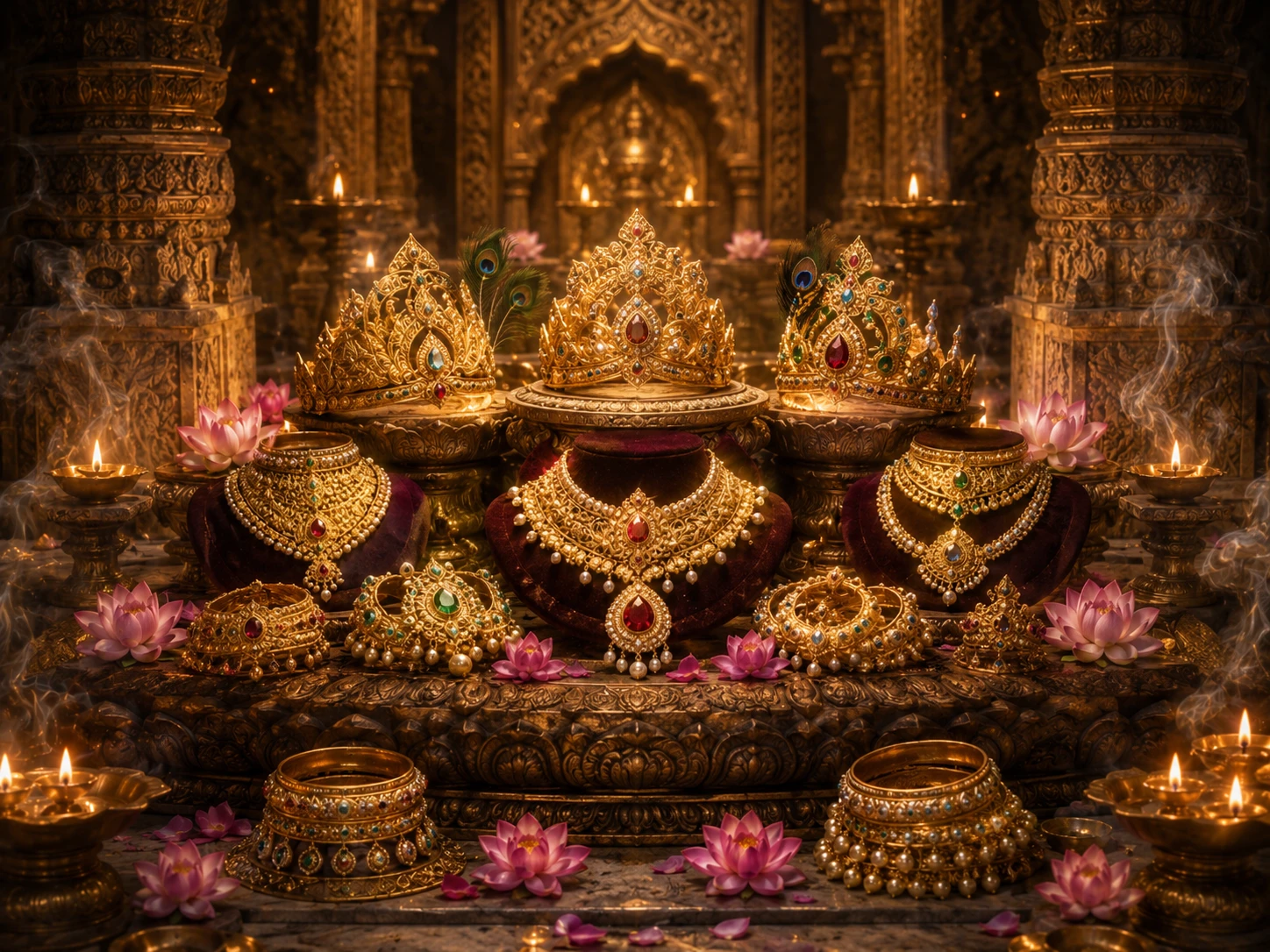
Divine Ornaments -- Vaijayanti, Kundala, and Kirit
दिव्य आभूषण -- वैजयन्ती, कुण्डल और किरीट
Walk into any Hindu temple in India and look at the presiding deity. Vishnu in Tirupati, Krishna in Udupi, Jagannath in Puri, Ranganatha in Srirangam. Notice what never changes: the god is never naked of ornament. A garland falls from shoulder to knee. Earrings curve past the jawline. A crown rises above the head in layered tiers. These are not decorations added by the priest in the morning. They are part of the god's own form.
Hindu iconography treats ornaments the way other traditions treat scripture. Each piece carries a name, a Sanskrit etymology, a story of where it came from, and a rule about who may wear it. When a Bharatanatyam dancer in Chennai puts on the kanchi kamarbandh before a performance, she is not accessorising. She is stepping into a grammar of divine presence that goes back to the Vedas. When a Kota coaching student lights a lamp before her NEET exam and prays to a murti of Krishna wearing Vaijayanti, Kundala, and Kirit, she is speaking to a specific form with a specific iconography.
This article takes three of the most distinctive ornaments in Hindu tradition. The Vaijayanti, Vishnu's chest garland. The Kundala, the earring that turns a warrior into a god or a god into a warrior. The Kirita Mukuta, the tiered crown that marks cosmic sovereignty. Each one sits at the intersection of cosmology, iconography, and biography. Each one tells a different story about what it means to be divine in a body.
Begin with Vishnu. Every depiction of Vishnu, from the twelfth-century Cholas in Thanjavur to the mass-produced calendar prints in Maharashtrian homes, shows the same four iconographic signs: shankha (conch), chakra (discus), gada (mace), and padma (lotus). Just below them, resting on the chest, is a fifth sign most people notice without naming. A long garland reaching below the knees, made of flowers or gems, with a prominent central stone. That is the Vaijayanti, the garland of victory.
The word itself breaks down clearly. Vaijayanti comes from the Sanskrit root ji, to conquer, with the prefix vi, thorough or complete. It names that which is totally victorious. The garland is sometimes also called Vanamala, which gives Vishnu one of His thousand names, Vanamali. The Vishnu Sahasranama, in verse 23, lists sragvī, 'the one wearing the sragma' or garland, as a name of Vishnu. The commentary by Shankara and the standard medieval commentators identifies that sragvī specifically with the Vaijayanti.
But the garland is not ordinary. The Vishnu Purana gives it a specific composition. Five stones are set into it in a fixed order: mukta (pearl), padmaraga (ruby), marakata (emerald), vajra (diamond), and indranila (sapphire). These five stones are not decorative. They correspond to the five mahabhutas, the classical elements that make up the physical world. Pearl for water. Ruby for fire. Emerald for earth. Diamond for ether. Sapphire for air. When Vishnu wears the Vaijayanti, He is not showing off wealth. He is carrying the five elements on His chest, because He is the one in whom they were first composed and into whom they will eventually dissolve.
किरीटिनं गदिनं चक्रिणं च तेजोराशिं सर्वतो दीप्तिमन्तम् । पश्यामि त्वां दुर्निरीक्ष्यं समन्ताद्दीप्तानलार्कद्युतिमप्रमेयम् ॥
kirīṭinaṃ gadinaṃ cakriṇaṃ ca tejorāśiṃ sarvato dīptimantam | paśyāmi tvāṃ durnirīkṣyaṃ samantād dīptānalārkadyutim aprameyam ||
I see You wearing the crown, holding the mace and the discus, a mass of splendour blazing light in every direction. Your form is hard to look upon, lit like flaming fire and the sun, measureless.
— Bhagavad Gita 11.17
Arjuna speaks this verse at the centre of the Gita's eleventh chapter, when Krishna has revealed the vishvarupa, the cosmic form. Notice the first word Arjuna reaches for. Not 'divine,' not 'infinite,' not 'luminous.' Kiritinam. 'The one wearing the kirita.' Before he names the weapons, before he tries to describe the light, Arjuna names the crown. The crown is the first thing his eyes catch because in Hindu cosmology the kirita is not an ornament placed on the deity. The deity wears the kirita the way a mountain wears its peak.
The kirita mukuta is specifically the tall, conical, multi-tiered crown with a pointed or rounded top, usually seen on Vishnu, Rama, Krishna, and on royal avataras. It is distinct from the mauli (simpler crown), the jata-mukuta (matted-hair crown of ascetics and Shiva), the karanda mukuta (basket-shaped crown of goddesses and lesser deities), and the kuntala (pearl-crown of younger forms). Each type has its own rule. A Shiva image never wears a kirita; Shiva wears jata. A Devi image rarely wears a kirita; she wears karanda or ratna-mukuta. When you see a kirita, you are looking at kingship made cosmic.
Arjuna carried this name into the Mahabharata. After he defeated the Nivatakavachas in Indra's battle, Indra placed his own crown on Arjuna's head. From that day Arjuna was called Kiriti, 'the crowned one.' The Mahabharata uses this name hundreds of times. When Sanjaya narrates the Kurukshetra war to Dhritarashtra, he often calls Arjuna 'Kiriti' rather than Arjuna, because the crown is what marks him as distinct from other warriors. This is why the prayer Kiriti-mala, still chanted today in Tamil Nadu and Kerala, invokes Arjuna by that one name alone.
The third ornament, the kundala, sits at a different register entirely. Where the Vaijayanti carries cosmology and the kirita carries sovereignty, the kundala carries biography. Every major deity wears kundalas. But the single most famous kundala story in Hindu tradition belongs not to a deity but to a warrior. Karna.
The Adi Parva of the Mahabharata records that Kunti, before her marriage to Pandu, invoked the mantra given to her by the sage Durvasa. She called upon Surya, the sun god. Surya came to her, and from that union Karna was born. What the text emphasises is the birth itself. The infant came out of Kunti's body already wearing kavacha (armour) fused to his skin and kundalas fused to his ears. These were not given later. They were part of his body. As long as he carried them, no weapon could kill him.
Indra, knowing this, came to Karna in the form of a Brahmin during the thirteenth year of the Pandavas' exile. He asked for the kavacha and the kundalas as alms. Karna knew exactly who the Brahmin was. His father Surya had warned him the night before. But Karna's rule of life was simple: no one who approaches me as a supplicant leaves empty-handed. He took out his knife and cut the armour off his own body. He cut the kundalas off his ears. Blood poured. He handed them to Indra, smiling. Indra, stunned, gave him in return the Vasavi Shakti, a one-use celestial weapon that Karna would later use to kill Ghatotkacha instead of Arjuna. The trade cost Karna his life on the eighteenth day of the war.
The Three Ornaments -- Form, Function, and Textual Source
| Ornament | Wearer | Form | Meaning | Primary Source |
|---|---|---|---|---|
| Vaijayanti Mala | Vishnu, Krishna, Rama, Balarama | Long garland from shoulder to knee, five central gems in fixed order | Holds the five mahabhutas (earth, water, fire, air, ether) on the divine chest | Vishnu Purana 1.9; Mahabharata Vishnu Sahasranama 23 |
| Makara Kundala | Vishnu, Shiva (one ear), Devi, most major deities | Heavy earring carved in the shape of a makara (crocodile), hanging to the shoulder | Symbol of mastery over desire; makara is the vehicle of Kamadeva, turning lust to discipline | Agni Purana 50; Shilpa Shastra traditions |
| Kirita Mukuta | Vishnu, Rama, Krishna, Arjuna (as Kiriti), royal avatars | Tall, tiered, conical crown with pointed or rounded top | Mark of cosmic or earthly sovereignty; distinguishes royal form from ascetic or warrior form | Bhagavad Gita 11.17; Mahabharata Vana Parva; Agama texts on iconography |
| Kavacha-Kundala | Karna (born with these fused to body) | Gold armour fused to skin and earrings fused to ear-lobes, given by Surya at birth | Birth-protection that made Karna unkillable; surrendered in dana, defining his moral character | Mahabharata Adi Parva; Vana Parva 284-293 |
| Karnaphul (Karnika) | Women in worship, Devi images | Small flower-shaped ear-stud worn close to the lobe | Domestic counterpart to makara-kundala; still worn today in Bengal, Kerala, Tamil Nadu | Grihya Sutras; regional temple traditions |
| Hara, Kanthi, Chandrahara | All major deities; temple utsava murtis | Multiple layered neck-ornaments of different lengths | Each length has a name; the collective establishes the figure as fully royal or divine | Bhavishya Purana; Shilpa Shastra |
Ornament names in Sanskrit are not interchangeable. A priest performing alankara (decoration) in a Tirumala-style temple places each ornament in a fixed order: kundalas first, then the kanthi, then the haras by length, then the Vaijayanti last over the chest, and finally the kirita. The order itself is part of the ritual.
The kundala story of Karna is not just a tale of a warrior. It is the canonical illustration of one of Hinduism's oldest ethical ideas. An ornament that is part of your body is still not yours to keep if someone asks. The kundala in Karna's ear was not jewellery. It was life insurance. And still, when a petitioner came, he gave it up. The medieval Sanskrit poet Magha, in his Shishupala Vadha, takes Karna as the paradigmatic giver: whatever is his is already the asker's before the asker arrives.
The other great kundala story is Shiva's. Shiva wears asymmetric ornaments. One ear carries a makara kundala; the other carries a tatanka or a simpler ring. The asymmetry is not accidental. In the Ardhanarishvara form, where Shiva and Parvati share one body, the right ear (Shiva's side) carries a simpler kundala, and the left ear (Parvati's side) carries a more ornate one. When a temple sculptor in Thanjavur carves this form, he chooses the earrings before he carves the face. The earrings are how the viewer will know which side is which.
The makara specifically is a composite sea-creature, part crocodile, part fish, sometimes part elephant. It is the vahana of Kamadeva, the god of desire. Wearing a makara on your ear is a visual declaration: I have mastered what this creature represents. I have made the vahana of desire into my ornament. This is why ascetic Shiva, who burned Kamadeva to ash, still wears the makara. It is a trophy of discipline, not a surrender to it.
When Indian jewellery houses like Tanishq, Kalyan Jewellers, and Amrapali launched their temple-jewellery revival lines in the 2010s, they did not copy museum pieces at random. Their masters sat with agama texts and temple priests in Srirangam, Tirupati, and Padmanabhaswamy to match the Vaijayanti, kundala, and kirita specifications exactly. The five-gem order on the Vaijayanti they sell today, pearl-ruby-emerald-diamond-sapphire, is the same order Vishnu Purana 1.9 describes. A Bharatanatyam dancer ordering a Pazhani-style kirita for her arangetram in 2026 receives an ornament made by the same shilpa-shastra rules a tenth-century Chola sculptor would have recognised.
The temple ornament is also an economic artefact. When the Kerala High Court in 2011 allowed an inventory of the vaults of the Padmanabhaswamy temple in Thiruvananthapuram, the officials opened chambers that had not been opened in centuries. Gold Vaijayanti garlands weighing kilograms each. Kundalas set with diamonds the size of a grape. A kirita so heavy it required two priests to lift. The estimated value crossed two lakh crore rupees, making the temple treasury larger than most central-bank reserves of small nations. Reports spoke of gold coins, gemstone bundles, and antique ornaments, but the inventory lists themselves, when examined by the royal family's scholars, read like a commentary on Agama iconography. Every item had a ritual function. Nothing was stored as bullion. Every piece was meant to return to the deity's body on some future festival day.
This is the older economics of Indian temples. The ornament is not a deposit; it is a permanent loan. A merchant in the thirteenth century who donated a gold kundala was not banking it. He was putting his wealth into the service of the deity forever. When he died, the ornament did not come back. When his descendants visited three hundred years later, the kundala was still on the god's ear, now perhaps supplemented by new donations from new families. The chain of donation is how temple ornaments grew into legendary collections. This is why, when you read of the Golconda Diamonds originally adorning a Tirumala deity, or of the Nizam's gifts to the Srisailam temple, or of the Mysore royal family's emeralds gracing Chamundi, you are not reading about lost treasure. You are reading about living iconography that happened to contain the wealth of kings.
Regional iconographies add their own grammar on top of the pan-Indian one. In Odia temple tradition, the Jagannath, Balabhadra, and Subhadra of Puri are famously armless and legless, yet even these abstracted wooden forms receive full alankara: painted Vaijayanti patterns, attached gold kundalas, and a distinctive tahiya crown during the Rath Yatra. The tahiya is taller and flatter than a classical kirita, specific to Puri, but the logic is the same. The deity without the crown is incomplete. In Tamil agamic tradition, the kirita on Venkateshwara at Tirumala is of a style called kulavi, with a specific curvature that distinguishes it from the Chola-period kirita seen on Brihadisvara Nataraja images. A devotee who has seen both notices the difference. The priests certainly do.
In Kashmir, before the exodus of the 1990s, the Pandits kept a tradition of small domestic bronzes where Vishnu wore a much simpler crown, closer to a patta than a full kirita, reflecting the region's own Shilpa Shastra traditions that went back to the Karkota period. Bengali iconography gives Krishna a lighter, almost dance-like set of ornaments, with kundalas that flare outward rather than hang straight, matching the lyrical Vaishnavism of Chaitanya and the Gaudiya school. Maharashtrian Vitthal in Pandharpur wears ornaments that feel austere by comparison, in keeping with the Varkari sampradaya's preference for simplicity over opulence. The same grammar bends to regional temperament without breaking.
The precision behind this grammar comes from a body of texts most Indians have never opened but whose rules they see applied every day. The Shilpa Shastra and Agama literature, going back to the Manasara, the Mayamata, and the Kashyapa Shilpa, fix exact iconometric ratios. The kirita on a Vishnu murti of a given height must be a specific fraction of that height. The Vaijayanti must hang to a specific knee-level, calculated in talamana (hand-span) units. The kundala must be of a specific shape depending on which of the chaturvimshati (twenty-four) Vishnu forms is being sculpted: Keshava wears one type, Narayana another, Madhava another. A Sthapati, the traditional temple-architect caste still practising in places like Swamimalai and Mamallapuram, still works with these measurements. He will not carve a Rama whose kirita is off by half a centimetre from what the agamas allow.
This is not pedantry. It is the reason Hindu deities are recognisable across twelve hundred years of separated regional tradition. A Pallava Vishnu from seventh-century Mahabalipuram, a Pala Vishnu from tenth-century Bengal, a Hoysala Vishnu from twelfth-century Karnataka, and a modern Tanishq Vishnu bought online in 2026 all follow the same rule-set. The robes and the proportions vary by period. The ornament names and their positions do not. This is what allows a five-year-old at a Bengaluru apartment shrine to recognise the same god her Telugu grandmother worshipped in a Hyderabad village temple, and her ancestor three centuries back saw at a Vijayanagara court. The Vaijayanti is a bridge across time. So is the kundala. So is the kirita. The ornament does something a book cannot: it survives because it is worn, and every time it is worn it passes the grammar to the next pair of eyes that watches it glint in the morning light of the arati.
There is a practical reason Hindu ritual cares so much about these three ornaments specifically. They mark the three zones a deity occupies: the head (kirita), the ears (kundala), the chest (Vaijayanti). Head for sovereignty, ears for hearing the petitioner, chest for the place where the devotee's offering lands. A temple doing panchopachara or shodashopachara puja moves through these zones in order. The priest first anoints the crown, then the earrings, then the garland. Each touch is a mantra. Each mantra names the ornament by its Sanskrit name.
This is also why, in many South Indian temples, the utsava murti (processional image) has a separate set of ornaments that are taken off and locked back in the temple treasury each night. The Tirumala Venkateshwara temple famously has a treasury older than most European states. Thousands of ornaments are catalogued, each with a name, a weight, and a ritual role. When the deity goes out on Brahmotsavam, the priest selects that day's kirita, that day's Vaijayanti, that day's set of kundalas. There are different ones for different festivals. The iconography shifts by calendar.
For the devotee, the ornament is not separate from the god. When you see a Nataraja with cascading rudraksha malas and asymmetric kundalas, you do not see a god plus jewellery. You see a grammar of presence. The ornaments are adjectives. They modify the noun. Without them, the noun is incomplete. This is why a stone Shiva linga is complete as is (it is the absolute, without form), but a stone Vishnu image missing its Vaijayanti is considered khanda, broken. The god is not the body alone. The god is the body and the ornament together.
The everyday Indian still lives inside this grammar, often without naming it. A Mumbai bride walking seven steps around the fire wears a nath in her nose, jhumkas in her ears, a rani haar on her chest, and a maang tikka on her forehead. The shapes are simpler than temple jewellery, but the zones are the same. Forehead, ears, neck, chest. When she steps out of the marriage pandal as a wife, the ornaments are not decoration. They are a statement that she has assumed a new role, and the body has been re-marked to carry that role.
A Kathakali performer in Thrissur before a Krishna-Arjuna scene puts on the kirita for Arjuna, not a generic crown. A Yakshagana artist in Udupi painting his face green for a Krishna role checks that the Vaijayanti hangs correctly over the torso before he steps out of the tent. These are not museum people. They are working artists whose livelihoods depend on the iconography being right. If the kirita sits wrong, the rasika in the third row will notice. The grammar is living.
And a schoolboy in Varanasi, a software engineer in Whitefield, and an NRI grandmother in New Jersey all know, when they look at a Krishna image on the puja shelf, which ornament is which. They might not know the Sanskrit names. They might not know which verse of the Vishnu Purana describes which gem. But they know the shape of Krishna. They know the Vaijayanti, the kundala, the kirita. The grammar has sunk into the skin of the culture. It does not need a class to stay alive. It stays alive because every temple, every wedding, every classical performance, every festival procession, and every home altar keeps repeating it.
Notice the Ornaments at Your Next Darshan
At your next darshan of Vishnu, Krishna or Rama, look for the Vaijayanti garland, the makara-kundalas and the kirita, and name each to yourself as you see it. Eternal Raga's temple guides describe the deities of India's great Vaishnava temples.
Tags
Eternal Raga · शाश्वत राग
Institutional voice — scholarly articles on Sanatan Dharma
Deepen Your Understanding
अपनी समझ और गहरी करें
sacred artefacts
Divine Gems -- Syamantaka, Kaustubha, and Chintamani
Hindu mythology's most precious stones are not mere ornaments -- they are plot devices, moral tests, and cosmic forces. The Syamantaka Mani turned Krishna into a detective. The Kaustubha emerged from the Ocean of Milk to sit forever on Vishnu's chest. The Chintamani fulfils every wish -- and teaches why that might be the worst thing that could happen to you.
sacred artefacts
Navaratna -- Nine Gems That Map the Cosmos to Your Finger
Nine planets. Nine gems. Nine frequencies of cosmic light captured in crystalline matter and worn on the human body. The Navaratna system is not superstition -- it is the oldest surviving framework of planetary gemology, codified in the Garuda Purana, the Brihat Samhita, and still followed by jewellers from Jaipur to Jakarta.
sacred artefacts
Divine Crowns and Mukutas
Look at a Hindu deity's head before you look anywhere else. The crown tells you which deity this is. Vishnu wears the tall conical kirita, sovereign of all. Shiva wears the jata-mukuta, matted locks crowned with the moon and the Ganga. The Devi wears the basket-shaped karanda. Each crown has a measurement, a theology, and a rule about who may wear it.
sacred artefacts
Sacred Thrones and Asanas of the Deities
No Hindu deity stands or sits on bare ground. Every god is placed on a specific seat, and every seat carries a name, a cosmology, and a rule. Vishnu reclines on Shesha. Shiva sits on a tiger. Durga commands the simhasana. Lakshmi rests on a lotus in full bloom. The throne is not where the deity happens to be. The throne is what tells the viewer which deity this is.
sacred artefacts
Rudraksha Mala -- Shiva's Tears That Became Seeds of Power
Legend says Shiva meditated for a thousand years, and when his eyes opened, tears of compassion fell to earth and became the Rudraksha tree. Science says the seeds of Elaeocarpus ganitrus contain electromagnetic properties measurable in a laboratory. Between the legend and the lab lies the most worn sacred object in India.
sacred artefacts
Tulasi Mala -- The Neckbeads That Mark You as Vishnu's Own
Two or three strands of small wooden beads, worn around the neck at all times -- in the shower, during sleep, at work, at death. The Tulasi Mala is not jewellery. It is a permanent declaration of spiritual identity. The Padma Purana says that Yama's messengers will not approach a body wearing Tulasi beads. ISKCON devotees worldwide wear it as their most visible marker of Krishna consciousness.
When Indian jewellery houses like Tanishq, Kalyan Jewellers, and Amrapali launched their temple-jewellery revival lines in the 2010s, they did not copy museum pieces at random. Their masters sat with agama texts and temp…
More in Sacred Artefacts
Ashtadhatu -- The Sacred Eight-Metal Alloy of Indian Temples
12 min read
Banalinga -- The Stone God Made Himself in a River Over Millions of Years
13 min read
Celestial Trees -- Kalpavriksha and Parijata
12 min readThe same translation error that turned '33 Koti' into '33 crore' in Hinduism also happened in Buddhism. The Chinese translation of Buddhist texts rendered 'Sapta Koti Buddha' (7 Supreme Buddhas) as '7 Crore Buddhas.' The…
Deities AvatarsCommunity Reflections
🕉️
Be the first to share your reflection.