Divine Crowns and Mukutas
दिव्य मुकुट
A small test. Show a Hindu devotee a line drawing of a deity's head, with no face, no arms, no weapons. Just the head and whatever crowns it. Eight times out of ten, the devotee can tell you which deity it is. Tall conical crown with a pointed knob at top: Vishnu, or one of his avatars. Matted locks piled up, with a crescent moon tucked in: Shiva. A basket-shaped crown with three or five tiered rings, each slightly smaller than the one below: a goddess, probably Lakshmi or Saraswati. A single spire with a peacock-feather pluck: Krishna-Murari, who complicates the kirita convention. The face is not what identifies the deity. The crown is.
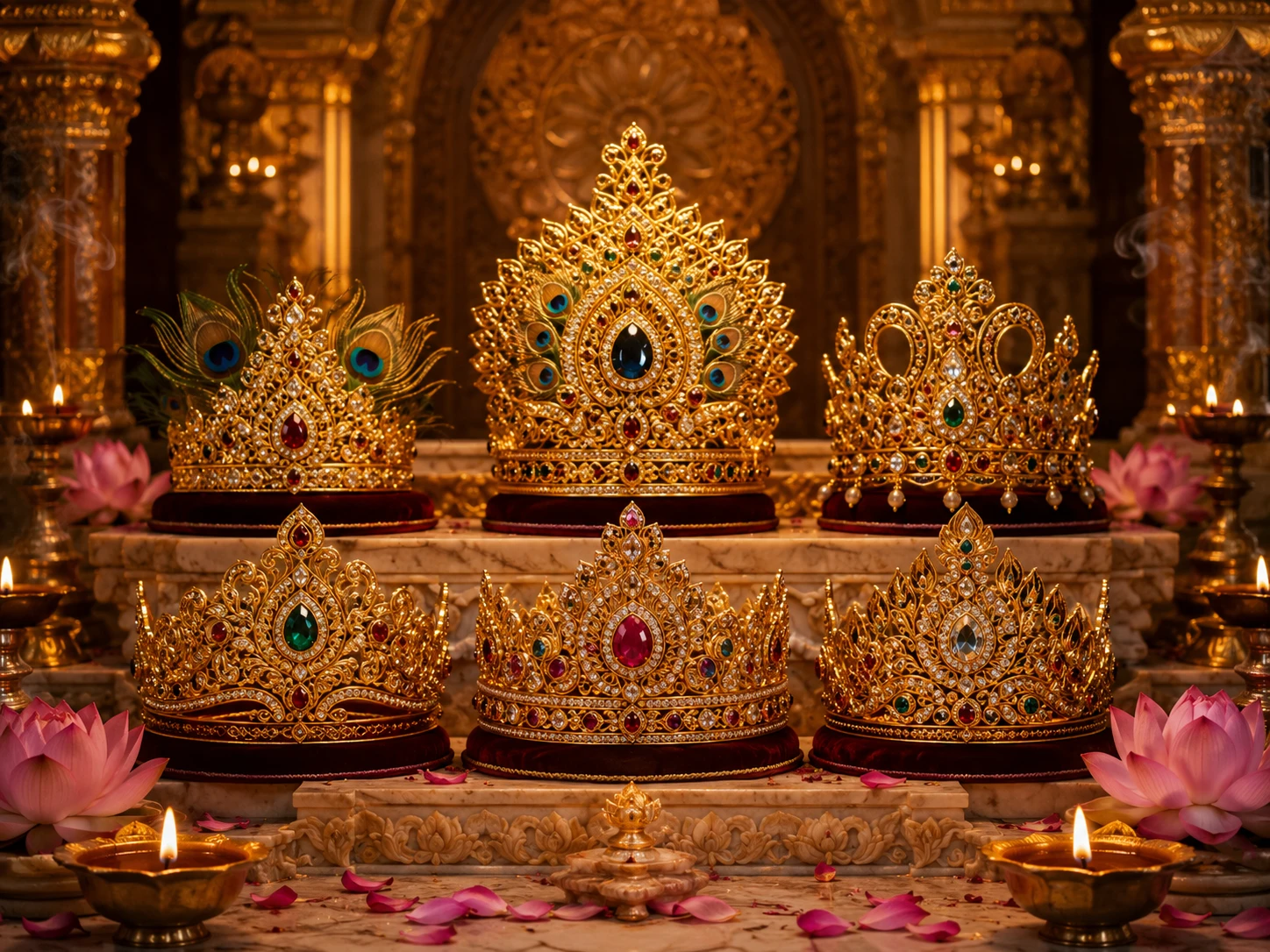
The Sanskrit word for crown is mukuta (sometimes spelled mukuṭa in IAST). The medieval shilpa-shastra texts, especially the Manasara compiled around the fifth to seventh centuries CE, identify three major classes: kirita-mukuta (conical, royal), jata-mukuta (matted-hair, ascetic), and karanda-mukuta (basket-shaped, maternal or subordinate). Minor sub-categories include the kuntala (pearl-and-hair arrangement for young or dance-form deities), the shirastraka (turban-wrap for naga and yaksha figures), and various hair-dressings called dhammila, alaka, and keshabandha, but these are exceptions. The three major mukutas dominate every temple, every sculpture, every calendar print, and every dance headgear across India.
This article takes each major mukuta in turn, looks at who wears it and why, and what the crown carries beyond royal display. For Hindu iconography, crowns are not about monarchy. They are about identity. A deity's crown answers the question: who is this, and how should I approach them? The answer is as old as the Gupta period bronzes of the fifth century, and as current as the plastic Krishna murti on a 2026 Bengaluru apartment's puja shelf. The crown above the face is what forty generations of devotees have used to locate themselves in relation to their god.
The kirita mukuta is the most majestic of the three. It is a tall, conical cap, usually sixteen to twenty-four angulas (finger-widths) in height, ending in a pointed knob or finial. The knob itself is called a chudamani or culamani, the crest-jewel. The body of the kirita is decorated with jewelled discs, sometimes in front only, sometimes on all sides. A band of patterned gold or gems runs around the base. The top is sometimes crowned by a small lotus bud or a stylised flame. Varahamihira in the sixth-century Brihatsamhita specifies the kirita as the crown of Vishnu, of his avatars, and of emperors. He adds that Surya, the sun god, and Kubera, the god of wealth, may also wear kiritas, though Kubera's kirita is tilted to the left (vama-kirita) as a sign of his secondary status in the Vedic pantheon.
The classical rule is absolute in one direction and flexible in the other. A deity below the Vishnu-class should not wear a kirita. A Ganesha image in kirita is ritually incorrect. A Shiva image in kirita is simply wrong; Shiva's head is crowned by jata, not kirita, and a sculptor who violates this rule will have his work rejected at the pratishtha ceremony. In the other direction, a Vishnu or Rama image may occasionally wear something simpler than a kirita (a plain turban or mauli), particularly in bala-swarupa or young-form depictions, but the default for a mature Vishnu image in a royal-form puja is the kirita. Walk into Padmanabhaswamy, Tirumala, Srirangam, or Guruvayur, and every principal Vishnu murti you will see is kirita-mukuta-dhara, kirita-crown-wearing.
The etymology of kirita is instructive. It comes from the Sanskrit root kṝ, to scatter or pour out, and the suffix -ita, meaning 'that which is made of' or 'having that quality'. The kirita is literally that which pours outward from the head, or radiates. The conical shape is not geometry. It is a visual metaphor for divine radiance extending upward and outward from the deity's head. When Arjuna, in the Bhagavad Gita's eleventh chapter, sees the vishvarupa and names Krishna as kirītinam, 'the kirita-bearing one', the Sanskrit is punning on this radiance-meaning. Arjuna is not saying Krishna wears a hat. He is saying Krishna's head is pouring out light.
जटाटवीगलज्जलप्रवाहपावितस्थले गलेऽवलम्ब्य लम्बितां भुजङ्गतुङ्गमालिकाम् । डमड्डमड्डमड्डमन्निनादवड्डमर्वयं चकार चण्डताण्डवं तनोतु नः शिवः शिवम् ॥
jaṭāṭavī-galaj-jala-pravāha-pāvita-sthale gale'valambya lambitāṃ bhujaṅga-tuṅga-mālikām | ḍamaḍ-ḍamaḍ-ḍamaḍ-ḍamaṅ-ninādavaḍ-ḍamarvayaṃ cakāra caṇḍa-tāṇḍavaṃ tanotu naḥ śivaḥ śivam ||
On the ground sanctified by the stream of water flowing down from the jungle of matted locks, with a lofty garland of serpents hanging from His neck, and the damaru sounding damad-damad-damad-daman, Shiva performed His fierce tandava dance. May that Shiva extend His auspiciousness to us.
— Shiva Tandava Stotra, verse 1, composed by Ravana; preserved across Shaiva devotional tradition and recited at every major Shiva temple
The first word of Ravana's Shiva Tandava Stotra is jata-atavi, jungle of matted locks. It is not incidental. Before the serpents, before the damaru, before the cosmic dance, Ravana names the jata-mukuta. This is the recognised signature of Shiva. The jata-mukuta is not a crown in the architectural sense. It is Shiva's own matted hair (jata), tied up into a piled knot at the top of his head, held in place by a thin band (patta), and populated with specific iconographic features that no other deity is allowed to wear. Specifically: the crescent moon on the left side, Ganga emerging as a stream from the right or centre, a snake (naga) coiled near the base, and occasionally a skull marking the presence of Kali or Bhairava forms.
Each of these features has a story. The moon, chandra, is Soma, the lunar deity, who sought refuge from a curse and was placed on Shiva's head as a favour; this is why Shiva is called Chandrashekhara. The Ganga's presence on Shiva's jata comes from the Bhagirathi narrative: when King Bhagiratha brought Ganga down from heaven to liberate his ancestors' souls, the river's force would have destroyed the earth; Shiva agreed to receive her first in his matted locks to break the fall, and from his jata she flowed out as the river we know today. The snake is Vasuki or Sheshika, the ancient serpent companion. The skull, when present, marks the kapalika form of Shiva or Bhairava.
The jata-mukuta, therefore, is not just a hairstyle. It is a reservoir of mythic events. Every element represents a story in which Shiva accepted, absorbed, or carried something the rest of creation could not handle. The poison halahala he drank during the Samudra Manthan stayed in his throat (making it neelakantha, blue-throated). The Ganga he caught to save the earth settled in his locks. The moon he hid when cursed. The snake around his neck, once a weapon against him, became an ornament. Shiva's jata is the physical evidence of his role as the receiver-of-what-others-cannot-receive. This is why ascetics growing jata today, from the Naga sadhus of Haridwar to the Aghoris at Varanasi, are not just being unshaven. They are enacting, in their own hair, Shiva's willingness to carry what the world cannot.
The karanda mukuta is the third major class. Karanda in Sanskrit means a basket, specifically a small round basket woven from bamboo strips. The karanda-mukuta is a crown shaped like such a basket: tiered in three, five, or seven rings of descending size, each tier slightly narrower than the one below, topped by a shikhamani (crest jewel) or a small finial. The lowest tier is usually the most ornate, set with jewels and finished with a gold band. The overall height is less than a kirita. In proportion to the deity's head, the karanda sits gently rather than rising sharply.
The karanda is the crown of the major goddesses: Lakshmi, Saraswati, Parvati in her benign forms, Kali in her peaceful aspect, Durga in non-combat depictions, Sita as Rama's consort, Radha alongside Krishna, Bhudevi and Sridevi alongside Vishnu. The karanda also appears on minor gods like Indra, Agni, and Vayu in their consort-attendant forms, on Yakshas, and on human kings in the non-sovereign roles. Varahamihira's Brihatsamhita states that this is the headgear of deities who occupy a subordinate-to-supreme position, reflecting the idea that the karanda does not claim the full radiance of the kirita but still marks divine or noble status.
This raises an interesting theological question. Why do the major goddesses, who are in no way subordinate in Shakta theology, wear the karanda rather than the kirita? The answer is iconographic and historical rather than theological. The karanda is the older feminine crown, attested already in early Indian sculpture, including Buddhist and Jain Yakshi figures from the Mauryan and Shunga periods. The kirita, by contrast, is associated with solar-royal masculine iconography from the Kushana and Gupta periods. The iconographic convention stuck even as Shakta theology developed, and now the karanda reads as feminine-divine while the kirita reads as masculine-divine. In the Sri Vidya tantra tradition, the supreme Devi does sometimes wear a kirita-like crown, but in the broader temple iconography the karanda remains her signature.
The Three Major Mukuta Types
| Mukuta Type | Shape and Height | Worn By | Distinctive Features | Textual Source |
|---|---|---|---|---|
| Kirita Mukuta | Tall conical, 16-24 angulas high, pointed knob at top | Vishnu, Vishnu's avatars (Rama, Krishna in royal forms), Narasimha, Surya, emperors | Conical shape, culamani crest-jewel, jewelled discs and bands | Manasara; Brihatsamhita (Varahamihira); Vaishnava Agamas |
| Jata Mukuta | Piled matted hair tied with patta band, medium height | Shiva, Brahma, Rudra-class deities, Shiva's attendants, major rishis, some forms of Devi | Crescent moon on left, Ganga-stream, naga, skull (for Bhairava/Kali) | Shiva Tandava Stotra; Lingapurana; Shaiva Agamas; Agni Purana |
| Karanda Mukuta | Basket-shaped, 3-7 tiered rings, shorter than kirita | Lakshmi, Saraswati, Sita, Parvati (saumya), Radha, minor gods, Yakshas, human kings in secondary roles | Tapering basket profile, jewels on lowest tier, shikhamani on top | Manasara; Brihatsamhita; Kashyapa Shilpa |
| Mauli / Mauli-mukuta | Lower, rounded, wound-cloth or gathered-hair style | Young-form deities, bala-swarupa (Bala Krishna, Bala Ganesha), sometimes Hanuman | Simpler than full mukuta, often cloth-based | Early sculptural tradition; early Gupta bronzes |
| Shirastraka | Turban-like wrap, cloth or banded | Nagas, Yakshas, guardians (dwarapalakas) | Indicates semi-divine guardian status; not classed with primary mukutas | Manasara; regional Shilpa texts |
| Kuntala | Hair arrangement with pearls and flowers, no solid crown | Dance-form Krishna, some young deities, Bala Devi | Peacock feather (for Krishna); flowing curls | Vishnudharmottara Purana; Bharata's Natyashastra |
The Manasara recognises eight mauli types in total: jatamukuta, kiritamukuta, karandamukuta, shirastraka, kuntala, keshabandha, dhammila, and alaka-chudaka. The first three are crowns proper. The last five are hairstyles or cloth-wraps that function iconographically like crowns but are classified separately. Every classical temple sculptor studies all eight; a modern Swamimalai Sthapati can still identify a Hoysala twelfth-century bronze by its mauli type within seconds.
The measurements matter far more than a casual observer realises. The Manasara and allied shilpa-shastra texts specify the kirita's proportions in angulas relative to the deity's own height. For a standing nine-tala deity (nine face-heights tall), the kirita should be approximately 1.5 talas, or one-sixth of the total standing height. For a seated eight-tala deity, the kirita is approximately 1.25 talas. The karanda, being shorter, is usually between one-eighth and one-tenth of the total deity height. The jata-mukuta is variable, since matted hair has no fixed shape, but it should not rise more than 1.25 talas above the head, and the moon, Ganga, and other features have their own placement rules. A Shiva sculpture with the moon on the right side instead of the left is ritually invalid. A Vishnu kirita whose knob is below 16 angulas is considered incomplete and cannot be consecrated.
These rules explain why diaspora temple commissions take so long and cost so much. When a new Guruvayur-style Krishna murti is ordered for a temple in Toronto in 2026, the Sthapati in Cherpulassery calculates the kirita measurements to the angula, factoring in the specific dimensions of the murti, the ritual tradition of the temple (Vaikhanasa or Pancharatra), and the daily puja programme that will be conducted. The kirita is cast separately from the body in some cases and joined during final finishing. An error of even half an angula in the kirita's height can disqualify the murti from temple consecration, and the Sthapati will have to redo the piece at his own cost. This is not perfectionism. This is the continuous application of rules written eighteen centuries ago.
Regional variations exist within the broader framework. The Kerala iconographic tradition gives Vishnu a slightly taller, more vertically emphatic kirita than the Tamil tradition, because Kerala's agamic tradition (Tantrasamuchchaya of Chennas Narayanan Nambudiripad) differs on certain proportions. The Bengali Durga Puja tradition gives Durga a karanda-like crown that is significantly more ornate and floral than the southern tradition, because the Bengali pandal culture has added layers of aesthetic elaboration on the shilpa-shastra baseline. The Kashmir Valley's pre-1990 Shaiva bronzes gave Shiva a specific jata-mukuta with a particularly prominent moon, reflecting the local Pratyabhijna and Krama tantric traditions. The underlying grammar is pan-Indian. The dialect is regional.
The Tirumala Venkateshwara's golden kirita, the diamond-studded one placed on Him during major festivals and for select darshans, was commissioned in multiple phases across centuries. The earliest layers date to the Vijayanagara period (fifteenth-sixteenth centuries), with additions by the Mysore Wodeyars, the Nizams of Hyderabad, the Marathas, and British-era industrialists. The full diamond-studded kirita, weighing around 40 kilograms and worth several crores of rupees at current gold prices, is never shown to the general queue. It is reserved for specific days on the Brahmotsavam calendar and for VIP darshans. An ordinary pilgrim sees Venkateshwara wearing His everyday golden kirita, already one of the heaviest crowns worn by any functioning deity in the world. Both crowns follow the same agamic proportions. Only the jewellery differs.
A working mukuta is a living object with a maintenance cycle. At Tirumala, a specialist team of goldsmiths reviews every element of the presiding deity's golden kirita every six months, cleaning, polishing, and occasionally reworking loosened settings. A damaged mukuta is never discarded. If a pearl in the front row comes loose during one of the daily abhishekams, the pearl is retrieved, examined, re-drilled if necessary, and reset before the next sandhya arati. This is why the Tirumala treasury records list individual pearls, emeralds, and rubies with inventory numbers; each one is tracked across centuries. When the goldsmith's team finishes an overhaul, the senior priest performs a short re-consecration ritual (punah-prana-pratishtha) to restore the ritual presence to the refurbished mukuta.
At Srirangam, the Ranganatha's mukuta has a different maintenance tradition. The outer gold plating is renewed every twelve years during the Brahmotsavam cycle, with the original gold plate melted down, purified with specific herb-infused water, and re-applied. Devotees can donate gold towards this process as a form of seva. In 2008, when the last major renewal cycle took place, thousands of small devotees contributed anywhere from one gram to one kilogram of gold each, and the total donation crossed two hundred kilograms. The mukuta that now sits on the Ranganatha therefore contains a layered history of devotees going back to previous renewals, each layer invisible but ritually recorded in temple ledgers.
Smaller temples and household murtis follow scaled-down versions of these practices. A Bengaluru family that inherited a brass Lakshmi murti with a small karanda-mukuta from a grandmother in 1975 may take it to a specialist in the city's Chickpet market every five to seven years for cleaning, gold-plating touch-up, and minor re-setting. The family does not treat this as restoration. They treat it as care of a living being, the way one would take a pet or an elder for periodic health check-up. The murti has, across their three generations of ownership, accumulated its own quiet biography. The mukuta holds that biography visibly. A scratch from the 1980s monsoon. A re-welded tier from the 2000s. A fresh gold polish from last year. The object is not static. It ages alongside the family.
The Jagannath of Puri, like so many things about that temple, breaks and simultaneously honours the rules. Jagannath, Balabhadra, and Subhadra do not wear kirita, jata, or karanda in the classical sense. Their heads, carved from neem wood, are nearly abstracted, with large round eyes and no visible hair. On top of their heads during festivals, the temple priests place a distinctive crown called the tahia, a tall golden-painted cone made of shola pith, flowers, and gold leaf, reaching almost two feet above the deity's head. The tahia is constructed fresh for each festival and is not a permanent fixture. At the Rath Yatra in particular, the three deities ride their chariots wearing the tahia, and this crown is what devotees crane to see as the rathas pass.
The tahia is not a kirita. It is higher, broader, and more floral. It belongs to a local Odia iconographic tradition that parallels rather than mirrors the pan-Indian agamic system. The Madala Panji, the temple's chronicle, dates the tahia form to the twelfth century, and there is evidence from Chinese traveller Fa Xian's fifth-century account of another local crown at the Purushottama-kshetra that suggests the tradition is older still. Local Odia sculptors still know how to build a proper tahia; the skill is hereditary and is passed down in specific families of the temple's servitor castes. A tahia for the Rath Yatra takes about fifteen days to build, involves about forty people, and uses materials sourced from specific village suppliers who have held those contracts for centuries.
The Krishna of Udupi represents yet another crown tradition. The Madhva lineage that controls the Udupi matha uses a specific form of the mukuta called the Mukhalingadhara, where Krishna's head is crowned with a golden mukuta that integrates a peacock feather at the centre front, flaring outward. The peacock feather is not worn by any other major deity in this position; it is specific to Krishna. The Udupi Krishna iconography further combines this with a long plaited braid visible behind the crown, suggesting a dance-form rather than a royal-form Krishna. Visitors to Udupi, approaching the famous Navagraha Kindi window, see Krishna's mukuta and peacock feather before they see anything else; the single small opening frames the crowned head at eye level, and the viewer's attention is drawn upward, not at the face but at the feathered crown that marks Him as the cowherd-god.
Outside the temple, the mukuta grammar has extended into Indian public life in ways that often go unnoticed. A Bharatanatyam dancer performing her arangetram in Chennai wears a karanda-style headpiece, never a kirita, because the dance form adopts the feminine iconographic convention. A Kathakali actor playing Krishna builds up a towering kireeta (the Malayalam version of kirita) as part of his aharya abhinaya; the headgear for a single Kathakali role weighs up to seven kilograms and takes hours to assemble. A Kerala Theyyam performer embodying a particular deity dons a specific mukuta whose shape and colour identify the deity to the audience before a single word is sung.
Indian weddings extend the grammar further. The Tamil Brahmin wedding groom wears a small thalappu (forehead ornament resembling a shortened karanda) tied over his forehead during the ceremony. The Bengali wedding bride wears the famous conical topor made of shola pith, essentially a floral tahia-like crown, as she circles the fire with her groom. In Rajasthan, the bride and groom both wear elaborate safa turbans crowned with kalgis (feathered or jewelled plumes); these function as human mukutas, honouring the couple as divine in the marriage ritual. None of these crowns are arbitrary. Each draws from a specific element of temple iconography and applies it to the human wearing the role of the deity for that moment.
Even political and corporate symbolism has absorbed the mukuta imagery. When Indian political rallies garland a leader with a large floral crown before speeches, the gesture invokes the tahia-like honouring of someone who has been elevated to a god-like role for the occasion. When Bollywood film posters from the 1950s onwards depict actors in iconographic mukuta positions (Prithviraj Kapoor as Porus wearing a kirita, Bharat Bhushan as Tulsidas wearing a jata-like turban, Hema Malini as Devi wearing the karanda), the iconography is instantly readable because the audience has grown up with it. Indian visual culture is, at its deepest layer, structured by mukuta grammar. The crown does not have to be explained. It is already in the eye that sees it.
Notice the Mukuta at Your Next Darshan
At your next darshan, notice the crown before anything else: the tall kirita-mukuta of Vishnu's forms, the jata-mukuta of matted locks on Shiva's images, the karanda-mukuta on many goddesses. Each form tells you who the deity is. Eternal Raga's temple guides describe the presiding deity of each temple.
Tags
Eternal Raga · शाश्वत राग
Institutional voice — scholarly articles on Sanatan Dharma
Deepen Your Understanding
अपनी समझ और गहरी करें
sacred artefacts
Divine Ornaments -- Vaijayanti, Kundala, and Kirit
Hindu deities are never shown bare. Every garland, earring, and crown carries a name, a cosmology, and a story. The Vaijayanti on Vishnu's chest holds the five elements. Karna was born with his kundalas fused to his ears. Arjuna earned the title Kiriti from Indra's crown. This is the grammar of divine adornment.
sacred artefacts
Sacred Thrones and Asanas of the Deities
No Hindu deity stands or sits on bare ground. Every god is placed on a specific seat, and every seat carries a name, a cosmology, and a rule. Vishnu reclines on Shesha. Shiva sits on a tiger. Durga commands the simhasana. Lakshmi rests on a lotus in full bloom. The throne is not where the deity happens to be. The throne is what tells the viewer which deity this is.
sacred artefacts
Utsava Murti -- The Processional Deity
The stone god in the sanctum never leaves. The metal god on the palanquin walks every street. This is the utsava murti, the deity that comes out to meet you. Every Chola bronze in a museum was once carried in procession. Every Brahmotsavam at Tirumala, every Rath Yatra at Puri, every temple car at Madurai, runs on the same principle: the god moves so the devotee need not travel to the sanctum to be seen.
sacred artefacts
Temple Bells -- Sound as Purification
You never enter a Hindu temple in silence. Your first act at the threshold is to reach up and strike the bell. There is a verse for why. There is an alloy-ratio for the metal. There is an agamic rule for when to ring it, and who may. The temple bell is not decoration. It is the audible signal that ordinary space has just become sacred.
sacred artefacts
Divine Gems -- Syamantaka, Kaustubha, and Chintamani
Hindu mythology's most precious stones are not mere ornaments -- they are plot devices, moral tests, and cosmic forces. The Syamantaka Mani turned Krishna into a detective. The Kaustubha emerged from the Ocean of Milk to sit forever on Vishnu's chest. The Chintamani fulfils every wish -- and teaches why that might be the worst thing that could happen to you.
sacred artefacts
Navaratna -- Nine Gems That Map the Cosmos to Your Finger
Nine planets. Nine gems. Nine frequencies of cosmic light captured in crystalline matter and worn on the human body. The Navaratna system is not superstition -- it is the oldest surviving framework of planetary gemology, codified in the Garuda Purana, the Brihat Samhita, and still followed by jewellers from Jaipur to Jakarta.
The Tirumala Venkateshwara's golden kirita, the diamond-studded one placed on Him during major festivals and for select darshans, was commissioned in multiple phases across centuries. The earliest layers date to the Vija…
More in Sacred Artefacts
Ashtadhatu -- The Sacred Eight-Metal Alloy of Indian Temples
12 min read
Banalinga -- The Stone God Made Himself in a River Over Millions of Years
13 min read
Celestial Trees -- Kalpavriksha and Parijata
12 min readThe same translation error that turned '33 Koti' into '33 crore' in Hinduism also happened in Buddhism. The Chinese translation of Buddhist texts rendered 'Sapta Koti Buddha' (7 Supreme Buddhas) as '7 Crore Buddhas.' The…
Deities AvatarsCommunity Reflections
🕉️
Be the first to share your reflection.