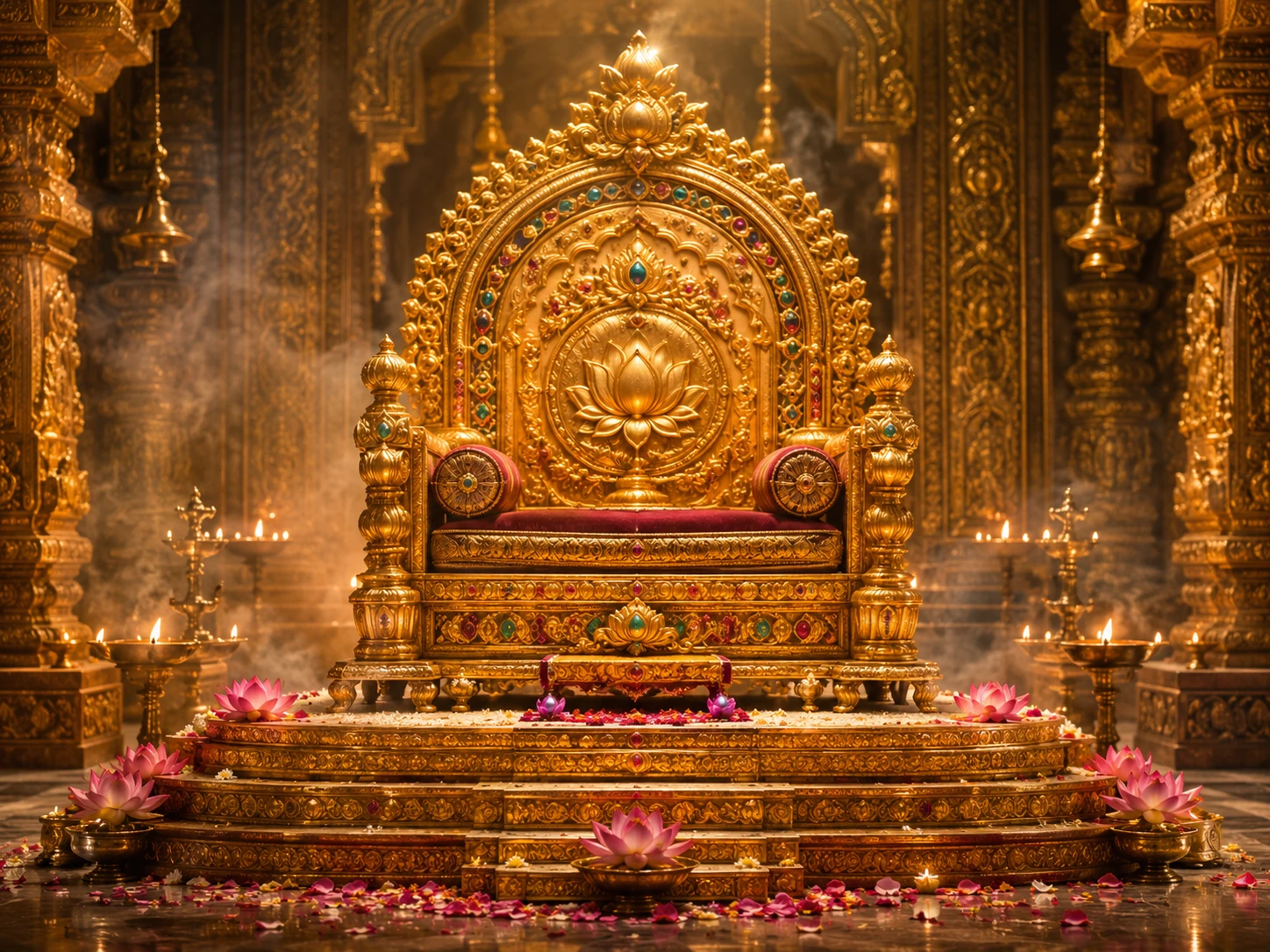
Sacred Thrones and Asanas of the Deities
देवताओं के दिव्य आसन और सिंहासन
Stand in front of a Hindu temple sanctum and look at the deity. Before you notice the crown, before you notice the weapons, before you notice the number of arms, look at what the deity is resting on. That surface, that creature, that formation, is the asana. And the asana is never generic. It is always specific, identified by name in the agamas, and inseparable from the deity's identity. A Vishnu without His serpent is not the same Vishnu. A Durga without Her lion is not the same Durga. The asana is not furniture. The asana is a half of the identification.
The word asana in Sanskrit has a wider range than we tend to remember. In everyday modern usage, asana means a yoga posture. In Patanjali's Yoga Sutra, verse 2.46, asana is defined simply as sthira-sukham-asanam, 'that which is steady and comfortable'. In the eight-limbed yoga system, asana is the third anga. But in temple iconography, asana means the seat of the deity, and this meaning is actually older than the yogic one. The Rig Veda already uses asandi and pitha to refer to ritual seats. The Shatapatha Brahmana discusses the preparation of the king's asana before the Rajasuya sacrifice. By the time the Gupta-period iconographic texts like the Brihatsamhita are compiled, asana has become a full category of classification. A seated deity is classified not only by His mudra and His ayudhas (weapons) but by the specific type of asana he occupies.
This article takes the major deity-thrones and reads their grammar. Shesha for Vishnu, Nandi and the tiger-skin for Shiva, the lion for Durga, the lotus for Lakshmi and Saraswati, the swan for Brahma, the mouse for Ganesha, the peacock for Kartikeya. The list could go longer. Each pairing is deliberate. Each pairing has a story. Each pairing is still enforced in 2026 by every icon-maker, every temple sculptor, every home-shrine manufacturer, every Bharatanatyam dance choreographer. The grammar has not weakened over a thousand years of use. If anything, it has tightened.
Begin with Vishnu. The dominant Vishnu posture in Indian iconography is anantashayana, reclining on the coils of the cosmic serpent Ananta Shesha. The image is immediately recognisable. Vishnu lies on His left side, one arm propping His head, Lakshmi seated at His feet massaging His legs, Brahma emerging from a lotus that rises from Vishnu's navel. The serpent on which He reclines is seven-hooded (sometimes five, sometimes twelve), its coils arranged to form a bed, its hooded heads spreading above Vishnu's crown like a canopy. The entire tableau floats on the kshira-sagara, the ocean of milk. Padmanabhaswamy temple at Thiruvananthapuram holds the largest and most iconic sculpted anantashayana image in the world, eighteen feet long, visible through three separate sanctum doors that each reveal a third of the figure.
The cosmological logic is explicit. Shesha is time, or more precisely, that which remains (the Sanskrit root shish means to remain). At the end of each kalpa (cosmic cycle), when all creation dissolves into its primal waters, what remains is Shesha. Vishnu, lying on Shesha, represents the divine that persists through pralaya (dissolution) and from which the next creation will emerge. The lotus rising from His navel, on which Brahma sits, is the moment of re-creation. So the anantashayana image is not a restful portrait. It is a cosmogony in visual form: the end of one universe, the sustaining divine consciousness, and the seed of the next, all in a single tableau.
Shesha also has a parallel form as Vishnu's throne in standing and seated images. Temples like Srirangam and Badrinath show Vishnu seated on Shesha coiled into a throne. The Tirumala Venkateshwara, the most visited temple in India, stands on a small platform identified in Vaikhanasa Agama as Ananta-garbha, the womb of Ananta. Even when Shesha is not visible in the sculpture, the priest who performs the daily puja addresses Him in the sankalpa. Shesha is named. Shesha is present. Shesha is the base on which Vishnu becomes visible.
शान्ताकारं भुजगशयनं पद्मनाभं सुरेशं विश्वाधारं गगनसदृशं मेघवर्णं शुभाङ्गम् । लक्ष्मीकान्तं कमलनयनं योगिभिर्ध्यानगम्यं वन्दे विष्णुं भवभयहरं सर्वलोकैकनाथम् ॥
śāntākāraṃ bhujaga-śayanaṃ padmanābhaṃ sureśaṃ viśvādhāraṃ gagana-sadṛśaṃ megha-varṇaṃ śubhāṅgam | lakṣmī-kāntaṃ kamala-nayanaṃ yogibhir-dhyāna-gamyaṃ vande viṣṇuṃ bhava-bhaya-haraṃ sarva-lokaika-nātham ||
Of peaceful form, reclining on the serpent, having a lotus at His navel, lord of the gods; support of the universe, wide as the sky, cloud-coloured, auspicious-limbed; beloved of Lakshmi, lotus-eyed, reachable to yogis through meditation; I salute Vishnu, remover of the fear of existence, sole lord of all worlds.
— Vishnu Dhyana Shloka, traditional prelude recited before the Vishnu Sahasranama; widely attributed to the Padma Purana tradition and preserved across Vaishnava puja manuals
This is the verse that opens every recitation of the Vishnu Sahasranama at Tirumala, at Guruvayur, at Srirangam, and at the majority of Vaishnava households in India. Notice what it names first. Before the lotus-navel, before the divine colour, before the Lakshmi-beloved, it says bhujaga-shayanam, 'reclining on the serpent'. The asana comes before almost every other descriptor. To know Vishnu, the verse teaches, is to see Him on Shesha first. The sequence of the Sanskrit compounds is not accidental. Indian devotional grammar puts the throne before the face.
Shiva's asanas tell a different story. Shiva does not recline. He sits, in meditation, on a tiger-skin (vyaghra-charma) spread over a rock on Mount Kailasha. When He moves, He rides Nandi, the white bull. The tiger-skin asana marks Shiva as the yogi-god, the mahayogi who has transcended fear (the tiger he sits on was a lunar demon who once attacked him in the Deodar forest; the Puranas recount how Shiva killed it and wrapped the skin around Himself as a seat and garment). Nandi is a different statement. Nandi is present not only in the sanctum with Shiva, but also separately, massive and seated, facing the sanctum from the entrance of every Shiva temple in India. At Brihadisvara in Thanjavur, the Nandi is fourteen feet tall, the second-largest in India after the Lepakshi Nandi in Andhra Pradesh. The Nandi is Shiva's bhakta and Shiva's vehicle simultaneously. When Shiva rides out, it is on Nandi. When Shiva sits in the sanctum, Nandi waits.
The asymmetry is pointed. Shiva's asana (the tiger-skin) is about Himself as the absolute ascetic. Shiva's vahana (Nandi) is about His relationship with His devotees. The tiger-skin is what Shiva is. Nandi is how Shiva moves through the world. This distinction between asana and vahana runs through Hindu iconography consistently. Asana is identity. Vahana is connection.
Durga's throne and Lakshmi's throne give us two different feminine theologies. Durga rides a lion (simha), sometimes named Dawon in regional traditions. In the major iconographic treatment, known as Mahishasuramardini, Durga stands with one foot on her lion and another on the defeated buffalo-demon Mahishasura, wielding weapons in her eight or ten arms. The lion is not decorative. The lion is the active partner in her victory. Bengali pandal art every Durga Puja makes this vivid: the lion's face is as fierce as Durga's own, its paws often larger than Mahisha's torso, its tail swishing in paint even when still. Without the lion, the victory scene loses half its force.
Lakshmi, by contrast, is almost always seated on or emerging from a fully opened lotus (padma). She is Padmasana, 'the lotus-seated one'. Her throne is not a creature. It is a flower. And not any flower: the padma in full bloom, held up by its stem from the waters of an unspecified pond or ocean. This is philosophically important. The lotus grows from mud but is not stained by it. It blooms in water but is not wet. Lakshmi's being on the lotus marks her as the goddess of purity-in-abundance, wealth that remains untouched by corruption. Every Hindu merchant family that installs a Lakshmi murti on Diwali places her on a lotus pedestal. Every Mahalakshmi temple in Kolhapur, in Mumbai's Bhuleshwar, and in the Vaibhava Lakshmi Vrat observed in millions of homes on Fridays reinforces the same iconography.
Saraswati also sits on a lotus, but hers is a different lotus from Lakshmi's. Saraswati's lotus is white (shweta-padma), unopened at the petals, suggesting modesty and inner illumination rather than outward abundance. Lakshmi's lotus is red or pink, fully opened, suggesting the world's visible wealth. The same flower, two different uses, two different goddesses. Indian iconography uses colour and degree-of-bloom as additional grammatical markers. To the trained eye (which in India includes any grandmother who has set up Saraswati Puja at home), the lotus-asana reveals the goddess even before the face is seen.
Major Hindu Deities and Their Asanas
| Deity | Asana / Throne | Vahana | Meaning of the Seat | Key Temple Example |
|---|---|---|---|---|
| Vishnu | Shesha (seven-hooded serpent), coiled as bed or throne | Garuda (eagle) | Shesha means 'that which remains'; the divine persists through pralaya | Padmanabhaswamy, Thiruvananthapuram; Ranganatha, Srirangam |
| Shiva | Vyaghra-charma (tiger-skin) over rock; or standing pose | Nandi (bull) | Tiger-skin marks him as the ascetic who conquered fear; Nandi is his bhakta-vehicle | Brihadisvara, Thanjavur; Kedarnath |
| Durga / Shakti | Simhasana (lion-throne); she stands or rides the lion | Lion (simha) or tiger | Lion is the active partner in her victory; identity is inseparable from the mount | Vaishno Devi, Katra; Kamakhya, Guwahati |
| Lakshmi | Padmasana (fully-opened red/pink lotus) | Elephant (Gaja Lakshmi) or owl | Lotus grows from mud untouched; wealth-in-purity, abundance without corruption | Mahalakshmi, Kolhapur; Ashtalakshmi, Chennai |
| Saraswati | Padmasana (white lotus, partially opened) | Swan (hamsa) or peacock | White lotus is purity of learning; swan separates milk from water, truth from falsehood | Sharadamba, Sringeri; Vargal Saraswati, Telangana |
| Brahma | Red or pink lotus rising from Vishnu's navel | Hamsa (swan / goose) | Brahma emerges from the lotus at the moment of re-creation; secondary to Vishnu's asana | Pushkar, Rajasthan (rare Brahma temple) |
| Ganesha | Simhasana, padmasana, or seated on any divine seat | Mushaka (mouse) | No fixed asana; he adjusts to the host shrine's tradition; mouse vahana is always present | Siddhivinayak, Mumbai; Ashtavinayak circuit, Maharashtra |
| Kartikeya / Murugan | Peetham (pedestal) with peacock standing beside | Peacock (mayura) | Peacock represents the destruction of pride (he killed the demon Surapadma as a peacock) | Palani, Tamil Nadu; Tiruttani; Pazhani |
| Hanuman | Pedestal, usually standing; sometimes seated on a rock | None (he is a vahana form in some senses) | As a bhakta, he does not require a royal throne; stone and rock signify service | Hanumangarhi, Ayodhya; Jakhu, Shimla |
The distinction between asana (seat) and vahana (mount) is strict in agamic iconography. Shesha is Vishnu's asana; Garuda is His vahana. A devotee never confuses them. Garuda is shown as a separate figure, often with folded hands, beside or before Vishnu; Shesha is under Vishnu. The lion of Durga is unique in that it functions as both asana and vahana, which is part of why Durga's iconography feels more dynamic than most other deities.
Beyond the deity-specific thrones, Hindu iconography recognises a smaller category of generic peethas (pedestals) that any deity may occupy depending on context. The simhasana is one; it is the lion-pedestal, with four or eight lion figures supporting the platform, used for royal deities. The yoga-peetha is another, a low plain pedestal used for meditating forms of the deity. The shakti-peetha is the seat of the devi at one of fifty-one specific sites where her body fell after Sati's self-immolation and Shiva's dance; each shakti-peetha has its own body-part mythology (Kamakhya at the yoni, Kangra Jwalamukhi at the tongue, Hinglaj at the brahmarandhra). The dharma-chakra peetha is the circular pedestal used for teaching forms, from Buddha seated in the deer park to the Vishnu Nrisimha emerging from the pillar.
The agamic texts also specify strict measurement rules for the peetha. A standing deity's peetha height should be between one-quarter and one-third of the deity's total height. A seated deity's peetha should be larger. A lotus-peetha should show eight petals if for a standard deity, sixteen petals if for a Lakshmi or Saraswati image, and a thousand petals (represented by a double-layered carving) for specific forms of Shakti in tantric temples. The Mayamata, the Manasara, and the Kashyapa Shilpa all specify these measurements down to the level of the individual petal.
The social significance of these rules is often missed. A temple that violates the peetha measurements is considered ritually invalid. A newly installed deity must be placed on a peetha made according to the agamic specifications or the pratishtha ceremony will not have the desired effect. This is why, when a diaspora temple in Houston or Johannesburg commissions a new deity, the shilpa-shastra measurements for the peetha are calculated as carefully as for the murti itself. The peetha travels separately from the murti, is installed first, and then the murti is placed on it with its own mantras. Only after both are in place does the pratishtha begin.
The Jagannath of Puri sits on a specific wooden platform called the Ratna Simhasana (jewel-lion-throne), a raised four-foot structure inside the sanctum that is rebuilt every twelve or nineteen years during the Navakalevara ritual alongside the deities themselves. The throne is made of specifically consecrated neem wood (daru), not teak or sandalwood. The wood for the throne is selected by the temple's Daita community through an elaborate search that can take weeks, following signs described in the Madala Panji, the temple chronicles. In 2015, the last Navakalevara year, the selection process alone took over forty days, and the tree finally chosen was in a village near Kakatpur, Odisha. Every detail was documented, photographed, and archived. The throne on which Jagannath now sits is thus the same throne that has held Him ritually for forty cycles of renewal, stretching continuously back to the twelfth century.
One category of asana that deserves its own paragraph is the yoni-peetha, the seat specific to certain forms of the goddess in tantric Shakta temples. Unlike the lotus or lion, the yoni-peetha is anatomical in its symbolism, representing the creative womb of the goddess and the source of all manifestation. The Kamakhya temple in Guwahati is built around a natural rock cleft that is revered as the original yoni-peetha; the sanctum has no murti, only a spring-fed stone shape that is sometimes described as swayambhu. Once a year, during the Ambubachi Mela in June, the goddess is said to menstruate; the temple closes for three days and the waters of the spring turn red. This is the only major temple in India where the asana itself, not a carved deity, is the focus of worship. The agamic texts of the Kaula tantric tradition discuss yoni-peetha iconography in careful detail, though this literature has always been restricted to initiated practitioners and rarely reaches general devotees.
The Shakti-peethas across the subcontinent, fifty-one by the Devi Bhagavata Purana's count, are considered to be sites where the different body parts of Sati fell after Shiva carried her corpse in grief across the earth. Each peetha corresponds to a specific body-part: Kamakhya for the yoni, Jwalamukhi in Kangra for the tongue, Vindhyavasini for the face, Hinglaj in Balochistan for the brahmarandhra (crown of the head), Kanyakumari for the back. The body-part mythology makes the entire subcontinent into a geography of the goddess's dismembered form. The pilgrim who travels to multiple Shakti-peethas is not merely visiting temples; she is reassembling the divine body through her own journey. The peetha in its highest sense is not a platform on which the goddess sits; it is a fragment of the goddess herself.
The tantric understanding of peetha is therefore philosophically richer than the Vaishnava or Shaiva understanding. In Shakta philosophy, the asana and the devata are the same; the seat is the goddess in one of her modes of being. This idea has fed back into contemporary Hindu iconography more than most people realise. When a modern Devi-temple in a diaspora city commissions a new murti, the pratishtha ceremony includes the recitation of the Shakti-peetha list (ashtapeetha-stotra or the longer 51-peetha-stotra), binding the local shrine to the pan-Indian geography of the goddess. The peetha is local. The goddess is continental. The recitation is the hinge.
The dance traditions of India have preserved and extended the asana grammar in a distinct way. Bharatanatyam codifies forty specific karana positions in its grammar, each derived from temple sculptures at Chidambaram, Tanjavur, and Kumbakonam. Several of these karanas are deity-asana positions: the Natesha karana reproduces Shiva's cosmic dance pose, the Alapadma karana evokes Lakshmi on the lotus, the Padmasana karana seats the dancer as Vishnu-Lakshmi or as a meditating yogi. A Bharatanatyam dancer presenting a varnam or padam at her arangetram does not merely dance; she becomes the deity, briefly, by occupying the exact asana the iconography prescribes. The audience that is trained to recognise these karanas (which includes most rasikas at major sabhas) reads the dance through the asana vocabulary.
Kathakali in Kerala treats this with even more precision. A Kathakali actor playing Krishna does not sit down during the interludes; he stands in specific mudras that signal Krishna's identity. When Rama is played, the actor sits briefly on a low wooden stool during a specific shanta moment; the stool functions as the simhasana. Costume alone does not identify the character. The seated or standing asana is part of the identification. When two Kathakali actors play Krishna and Arjuna in a chariot scene, one stands holding imaginary reins (Krishna on the chariot-asana) and the other stands in bow-drawing pose (Arjuna on his own asana). The asanas determine who is who even before the audience can see the makeup clearly.
Odissi, derived originally from the dancing-girl traditions of the Jagannath temple, uses the tribhangi (three-bend) posture as its signature karana. Tribhangi is essentially Krishna's asana, the way He stands with flute to His lips, one knee bent, hip jutting, head tilted. A female Odissi dancer presenting Krishna's hours with Radha occupies tribhangi throughout her performance, reproducing in her own body the exact pose the iconographic tradition shows in Krishna sculpture. The dance form and the sculpture form are the same grammar, performed through different media.
The everyday Indian still lives inside the asana grammar in a hundred small ways. A Mumbai family setting up their home altar on the first day of Diwali places the Ganesha murti first, because Ganesha occupies any peetha and blesses the installation. The Lakshmi on her lotus goes next, with a specific red cloth laid under the murti (the red cloth representing the lotus as a matter of ritual substitution when a carved lotus is unavailable). Saraswati, if present, goes on her white cloth. The seating order, the colour of the cloth, the material of the peetha, all follow the agamic grammar even in a private home. No one explicitly teaches this. The grammar is absorbed through watching mothers and grandmothers.
A Tamil wedding in Chennai places the bride and groom on a single large peetha during the muhurtam ceremony, with the bride seated slightly to the groom's left. This is the asana of the divine couple, Shiva-Parvati or Vishnu-Lakshmi, replicated for the human marriage. The cloth on which they sit is called vedi, and it is treated with the same care as a temple peetha: it is spread, consecrated, occupied, and at the end of the ceremony removed and often kept as a family heirloom. When the bride and groom sit on that cloth, they are temporarily on a divine seat.
And at a Kerala Onam sadya, the traditional banana-leaf meal is served to guests seated on a specific low platform called the aasanam or pala, woven from coconut-palm fronds or made of plain teak. The aasanam is not neutral. It is the host's assertion that the guest is, for the duration of the meal, occupying a position of honour. The ritual grammar of the deity's asana extends outward to the guest, to the bride, to the elder receiving respect. You do not sit on a random surface in traditional Indian contexts. Every sitting is positioned, and every position is read. The deity's throne is the origin of this reading. Everything else is a variation on it.
Notice the Asana at Your Next Darshan
Every deity sits on a seat that means something: Vishnu on Shesha, Durga on the lion, Lakshmi on the lotus, Shiva on the tiger skin. At your next darshan, look at the seat before the form, and ask what it says. Eternal Raga's temple guides describe the deities of India's great temples.
Tags
Eternal Raga · शाश्वत राग
Institutional voice — scholarly articles on Sanatan Dharma
Deepen Your Understanding
अपनी समझ और गहरी करें
sacred artefacts
Divine Crowns and Mukutas
Look at a Hindu deity's head before you look anywhere else. The crown tells you which deity this is. Vishnu wears the tall conical kirita, sovereign of all. Shiva wears the jata-mukuta, matted locks crowned with the moon and the Ganga. The Devi wears the basket-shaped karanda. Each crown has a measurement, a theology, and a rule about who may wear it.
sacred artefacts
Divine Ornaments -- Vaijayanti, Kundala, and Kirit
Hindu deities are never shown bare. Every garland, earring, and crown carries a name, a cosmology, and a story. The Vaijayanti on Vishnu's chest holds the five elements. Karna was born with his kundalas fused to his ears. Arjuna earned the title Kiriti from Indra's crown. This is the grammar of divine adornment.
sacred artefacts
Utsava Murti -- The Processional Deity
The stone god in the sanctum never leaves. The metal god on the palanquin walks every street. This is the utsava murti, the deity that comes out to meet you. Every Chola bronze in a museum was once carried in procession. Every Brahmotsavam at Tirumala, every Rath Yatra at Puri, every temple car at Madurai, runs on the same principle: the god moves so the devotee need not travel to the sanctum to be seen.
sacred artefacts
Temple Lamps -- Vilakku, Nilavilakku, and Deepa
A Hindu temple without light is unthinkable. The brass lamps that flank every sanctum, the tall standing nilavilakku in Kerala temple courtyards, the thousand-wick deepasthamba that rises at Karthigai Deepam at Tiruvannamalai, and the small clay diya at a Varanasi ghat during Dev Deepawali all do the same work. They make the invisible visible, and they say it in lamp-light.
sacred artefacts
The Kalasha Across Temple and Household Ritual
A brass pot filled with water, topped with five mango leaves and a coconut, tied with red thread and marked with turmeric. Every Hindu wedding sets one up. Every griha pravesh, every puja, every temple consecration. The same object appears at the top of every Hindu temple spire as the crowning kalasha. From the Rig Veda to a Bengaluru flat-warming in 2026, one pot carries the tradition.
sacred artefacts
Yajna Kunda -- The Sacred Fire Pit
At the centre of the oldest Indian ritual sits a brick-lined pit. Agni is lit. Ghee is poured in. Mantras rise with the smoke. Every yajna kunda is built to a specific shape, calculated to a specific geometry, oriented to specific cardinal directions. The Shulba Sutras, three thousand years old, give the instructions. Indian geometry did not begin in the classroom. It began at the fire-altar.
The Jagannath of Puri sits on a specific wooden platform called the Ratna Simhasana (jewel-lion-throne), a raised four-foot structure inside the sanctum that is rebuilt every twelve or nineteen years during the Navakalev…
More in Sacred Artefacts
Ashtadhatu -- The Sacred Eight-Metal Alloy of Indian Temples
12 min read
Banalinga -- The Stone God Made Himself in a River Over Millions of Years
13 min read
Celestial Trees -- Kalpavriksha and Parijata
12 min readThe same translation error that turned '33 Koti' into '33 crore' in Hinduism also happened in Buddhism. The Chinese translation of Buddhist texts rendered 'Sapta Koti Buddha' (7 Supreme Buddhas) as '7 Crore Buddhas.' The…
Deities AvatarsCommunity Reflections
🕉️
Be the first to share your reflection.