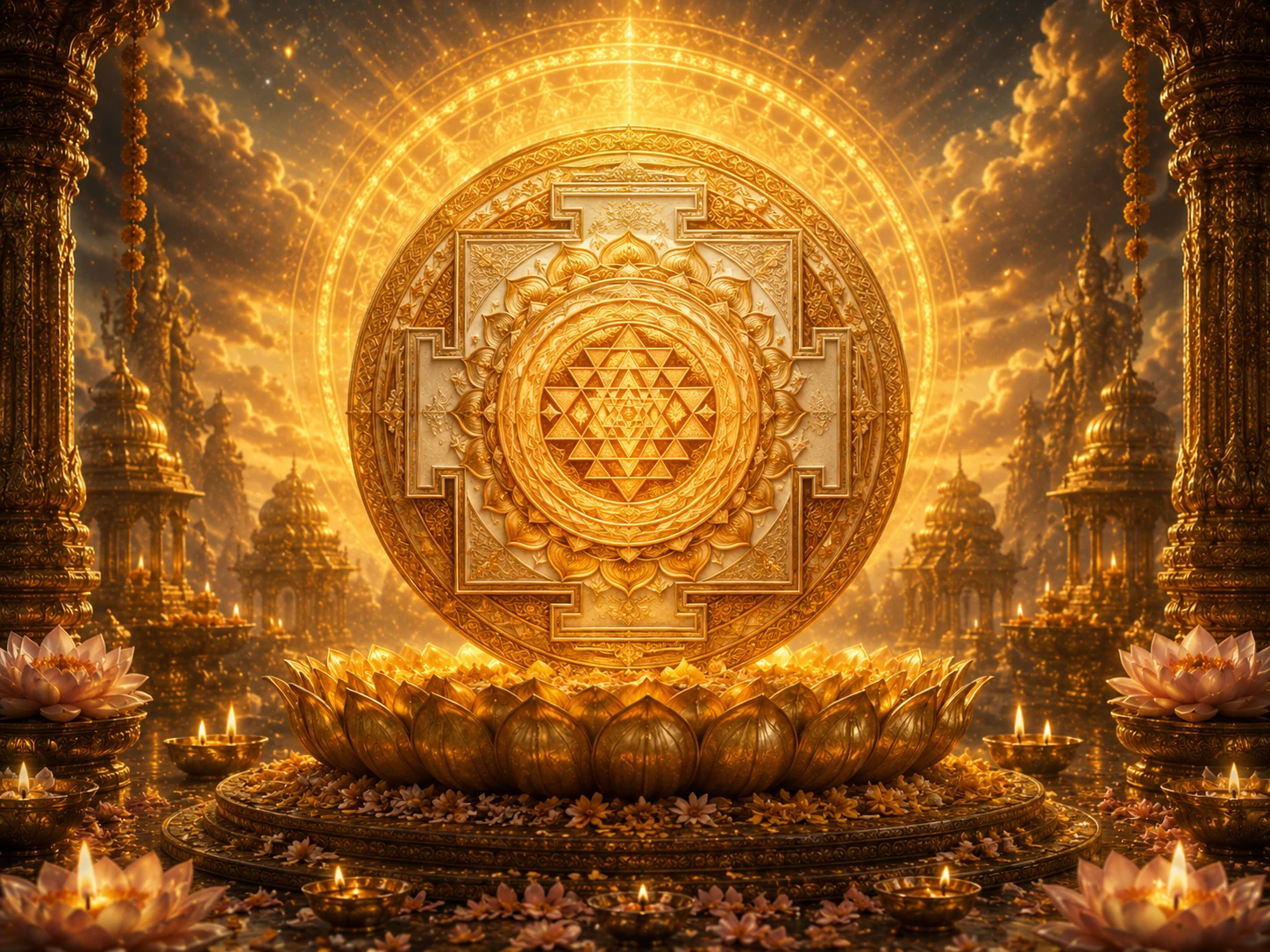
Mandala -- The Cosmic Blueprint That Hinduism Drew Before the Universe Existed
मण्डल -- वो ब्रह्माण्डीय नक़्शा जो हिन्दू धर्म ने ब्रह्माण्ड से पहले बनाया
The word mandala appears in the Rig Veda -- not as a drawing but as a structural principle. The Rig Veda is divided into ten mandalas (books), each a 'circle' of hymns attributed to a specific rishi lineage. The word comes from Sanskrit: manda (essence) + la (container). A mandala is a container of essence. This etymological meaning -- an enclosed space that holds the fundamental nature of something -- is the key to understanding why the mandala became the master template for everything from temple architecture to tantric meditation.
In its simplest Hindu form, a mandala is a square with four T-shaped gates, containing a circle, containing a central point (bindu). The square represents the earth, stability, the four cardinal directions, the material world ordered and bounded. The circle represents the sky, infinity, the cycle of time, the spiritual domain without beginning or end. The bindu is Brahman -- the ultimate reality, the dimensionless point from which all creation expands and to which all creation returns.
This is not abstract philosophy. It is a building code.
Every Hindu temple in India -- from the 7th-century shore temples at Mahabalipuram to the 11th-century Kandariya Mahadeva at Khajuraho to the 16th-century Meenakshi Amman in Madurai to every neighbourhood Shiva temple in your colony -- is designed on a mandala. The specific mandala used for temple ground plans is the Vastu Purusha Mandala, prescribed in the Vastu Shastras and Shilpa Shastras, and it is one of the most sophisticated spatial planning systems ever devised.
For a civil engineering student at NIT Trichy studying structural design, or an architect at an IIT preparing a thesis on Indian vernacular architecture, or a UPSC aspirant answering a question on Indian art and culture -- the mandala is not a decorative curiosity. It is a design framework that has governed the built environment of an entire civilisation for over two thousand years.
ॐ वास्तोष्पते प्रतिजानीह्यस्मान् त्स्वावेशो अनमीवो भवा नः। यत्त्वेमहे प्रति तन्नो जुषस्व शं नो भव द्विपदे शं चतुष्पदे॥
oṃ vāstoṣpate pratijānīhyasmān tsvāveśo anamīvo bhavā naḥ | yattvemahe prati tanno juṣasva śaṃ no bhava dvipade śaṃ catuṣpade ||
O Lord of the dwelling, accept us. May your entry bring freedom from disease. May you approve of what we ask. Be auspicious to our two-footed (human) and four-footed (animal) beings.
— Rig Veda, Mandala 7, Sukta 54, Verse 1 (Vastu Sukta)
The Vastu Purusha Mandala is the foundational diagram for Hindu temple architecture. The name encodes three concepts: Vastu (the dwelling place, the physical environment), Purusha (the cosmic being, the universal energy), and Mandala (the diagram, the container of essence). Together, the Vastu Purusha Mandala is a diagram that maps cosmic energy onto physical space.
The legend behind it is vivid. In the beginning, an unnamed formless being -- the Vastu Purusha -- blocked the sky and the earth. The gods seized him and pinned him face-down onto the earth, each deity holding a different part of his body. Brahma occupies the centre (the navel/Brahmasthana). The 45 deities of the Hindu pantheon are arranged around the grid, each occupying specific squares. The Vastu Purusha lies beneath every building, and the mandala maps his body onto the floor plan so that the building sits in harmony with the cosmic forces he represents.
The most common temple mandala is the 8x8 Manduka (64 squares), also called Bhekapada or Ajira. The 9x9 Paramasaayika (81 squares) is used for the most important temples. The central Brahmasthana -- the zone directly above Brahma -- becomes the garbhagriha (sanctum sanctorum) in the temple. The surrounding squares become the pradakshina path, the mandapa, the entrance, and the outer walls, each aligned with the deity governing that square.
The practical implications are extraordinary. The garbhagriha is always at the geometric centre. The entrance always faces east (towards the rising sun) unless site conditions force otherwise. The proportions of height to width to length follow fixed ratios derived from the mandala grid. The temple shikhara (tower) rises directly above the Brahmasthana, forming a vertical axis that connects earth to sky -- the architectural equivalent of the bindu.
Charles Correa, one of India's greatest modern architects, studied the Vastu Purusha Mandala extensively and incorporated its spatial principles into secular buildings like the Jawahar Kala Kendra in Jaipur -- a cultural centre whose plan is literally a 9x9 mandala grid with one square displaced, creating both a modern art space and an ancient cosmological statement.
The relationship between mandala and yantra is important to understand. A mandala is the broader concept -- any sacred enclosed space. A yantra is a specific type of mandala used in tantric practice, characterised by precise geometric elements: the bindu (centre point), trikona (triangles -- upward for Shiva/masculine, downward for Shakti/feminine), vrittas (circles representing cycles), padma (lotus petals representing creation), and bhupura (the outer square with four gates representing the earth). The most celebrated yantra is the Sri Yantra (also called Sri Chakra) -- nine interlocking triangles radiating from a central bindu, forming 43 smaller triangles, surrounded by lotus petals and a square gate structure. The Sri Yantra is considered the geometric form of the Goddess Lalita Tripura Sundari, and its meditation is central to the Sri Vidya tradition.
The Tirupati Balaji temple in Andhra Pradesh is said to be built in the shape of a Sri Yantra when viewed from above. Whether architecturally precise or not, the claim reflects the deep Hindu conviction that sacred geometry is not decoration but structure -- that the shape of a space determines the energy it contains.
Mandala vs. Yantra -- Key Differences
| Aspect / पक्ष | Mandala / मण्डल | Yantra / यन्त्र |
|---|---|---|
| Meaning / अर्थ | Circle, container of essence / वृत्त, सार का पात्र | Instrument, engine / उपकरण, यन्त्र |
| Form / रूप | Can be figurative (deities, landscapes) / आकृतिमूलक हो सकता | Strictly geometric (lines, triangles, circles) / कठोरतः ज्यामितीय |
| Colour / रंग | Multi-coloured, elaborate / बहुरंगी, विस्तृत | Usually limited palette (red, gold, black on copper) / प्रायः सीमित रंग |
| Size / आकार | Can be very large (sand mandalas, temple floors) / बहुत बड़ा हो सकता | Usually small and portable / प्रायः छोटा और वहनीय |
| Primary Use / प्राथमिक उपयोग | Temple architecture, meditation visualization / मन्दिर वास्तु, ध्यान दृश्यावलोकन | Tantric sadhana, deity invocation, Vastu correction / तान्त्रिक साधना, देवता आवाहन, वास्तु सुधार |
| Key Example / प्रमुख उदाहरण | Vastu Purusha Mandala (64/81 grid) / वास्तु पुरुष मण्डल | Sri Yantra (9 interlocking triangles) / श्री यन्त्र (9 परस्पर गुँथे त्रिकोण) |
| Tradition / परम्परा | Pan-Hindu + Buddhist + Jain / सर्व-हिन्दू + बौद्ध + जैन | Primarily Tantric Hindu + Buddhist / मुख्यतः तान्त्रिक हिन्दू + बौद्ध |
In practice, the terms mandala and yantra are often used interchangeably, especially in popular usage. Technically, every yantra is a mandala, but not every mandala is a yantra.
Carl Jung, the Swiss psychiatrist and founder of analytical psychology, independently discovered the mandala as a therapeutic tool in 1916 without initially knowing about its Hindu or Buddhist origins. He began drawing circular patterns during a personal psychological crisis and found that they helped integrate unconscious material into conscious awareness. He later studied Hindu and Tibetan mandalas extensively and concluded that the mandala is a universal archetype -- a 'symbol of the Self' that appears spontaneously in the dreams and art of people across all cultures. Jung's use of mandalas in psychotherapy -- now called mandala therapy or mandala colouring -- has become a global wellness practice, with millions of mandala colouring books sold annually. The therapeutic technique that mindfulness apps sell as 'modern self-care' is a 3,000-year-old Hindu meditation technology.
Meditate with the Sri Yantra
The Sri Yantra is the most revered mandala-yantra in Hindu tradition. Sit before an image of it and let the gaze travel inward through its nine interlocking triangles to the bindu at the centre, where individual consciousness meets the infinite. The Lalita Sahasranama calls the goddess Bindu-mandala-vasini, she who dwells in that bindu; it is on Eternal Raga with each name's meaning.
Tags
Eternal Raga · शाश्वत राग
Institutional voice — scholarly articles on Sanatan Dharma
Deepen Your Understanding
अपनी समझ और गहरी करें
sacred symbols
Rangoli -- The Sacred Floor Art That Turns Every Doorstep into a Temple
Every morning before dawn, millions of Indian women bend at their doorsteps and draw geometric patterns in rice flour. They are not decorating. They are performing a ritual older than any standing temple -- inviting Lakshmi in, keeping Moodevi out, feeding the ants, and encoding sacred geometry into the threshold between the profane street and the sacred home.
sacred symbols
Temple Architecture Symbolism -- Why Every Hindu Temple Is a Human Body, a Mountain, and the Universe
The dark womb-room at the centre. The tower rising above it like a spine. The gateway that frames the divine like an eye. A Hindu temple is not a building where you go to see God. It IS the body of God -- designed on a mandala grid, proportioned by sacred mathematics, and oriented to catch the first ray of the rising sun.
tantra mantra yantra
Tantra, Mantra and Yantra -- The Three Pillars of Spiritual Practice
Tantra is the loom, Mantra is the thread, Yantra is the pattern. Together they form the complete technology of spiritual transformation that India gifted to the world -- and they are far more profound than popular culture imagines.
sacred symbols
Dharma Chakra -- The Wheel on Your Flag That Spins Since Before the Buddha
The 24-spoke blue wheel at the centre of the Indian flag is not just a Buddhist symbol adopted by Ashoka. It is a Vedic concept of cosmic order, a weapon on Vishnu's finger, a sun-symbol older than recorded history, and a political statement about the sovereignty of dharma over kings. It is the most seen Hindu symbol in the world -- and the least understood.
sacred symbols
Lotus (Padma) -- The Flower That Grows in Mud and Became God's Throne
It grows from the bottom of a swamp. It rises through murky water. It blooms in sunlight without a single stain. This is not a motivational poster -- it is the central metaphor of Hindu civilisation. Every god sits on it. Every scripture references it. The Bhagavad Gita used it to explain the entire philosophy of detached action in one line.
sacred symbols
Trishul -- The Three-Pronged Weapon That Encodes the Entire Operating System of the Universe
Three prongs. At least seven simultaneous meanings. Forged from the sun's own fire by Vishwakarma. The Trishul is not just Shiva's weapon -- it is a philosophical diagram you can hold in your hand. Creation-preservation-destruction. Past-present-future. Ida-Pingala-Sushumna. Every triad in Hinduism converges on those three points.
Carl Jung, the Swiss psychiatrist and founder of analytical psychology, independently discovered the mandala as a therapeutic tool in 1916 without initially knowing about its Hindu or Buddhist origins. He began drawing c…
More in Sacred Symbols
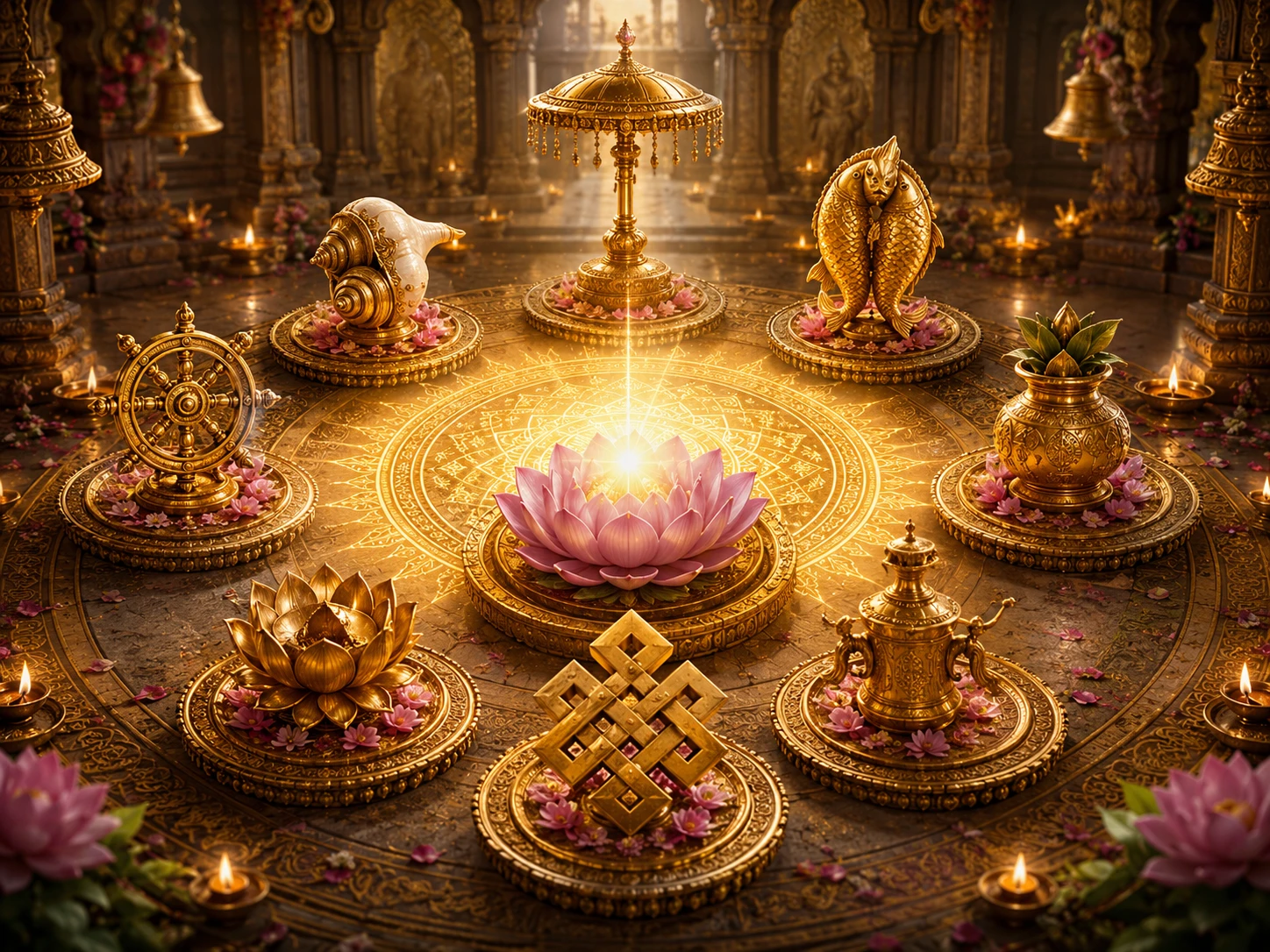
Ashtamangala -- The Eight Auspicious Symbols of Hindu Tradition
13 min read
Bindu -- The Point from which Creation Emerges
12 min read
Gau -- Why the Cow Holds the Place She Does in Hindu Life
14 min readThe same translation error that turned '33 Koti' into '33 crore' in Hinduism also happened in Buddhism. The Chinese translation of Buddhist texts rendered 'Sapta Koti Buddha' (7 Supreme Buddhas) as '7 Crore Buddhas.' The…
Deities AvatarsCommunity Reflections
🕉️
Be the first to share your reflection.