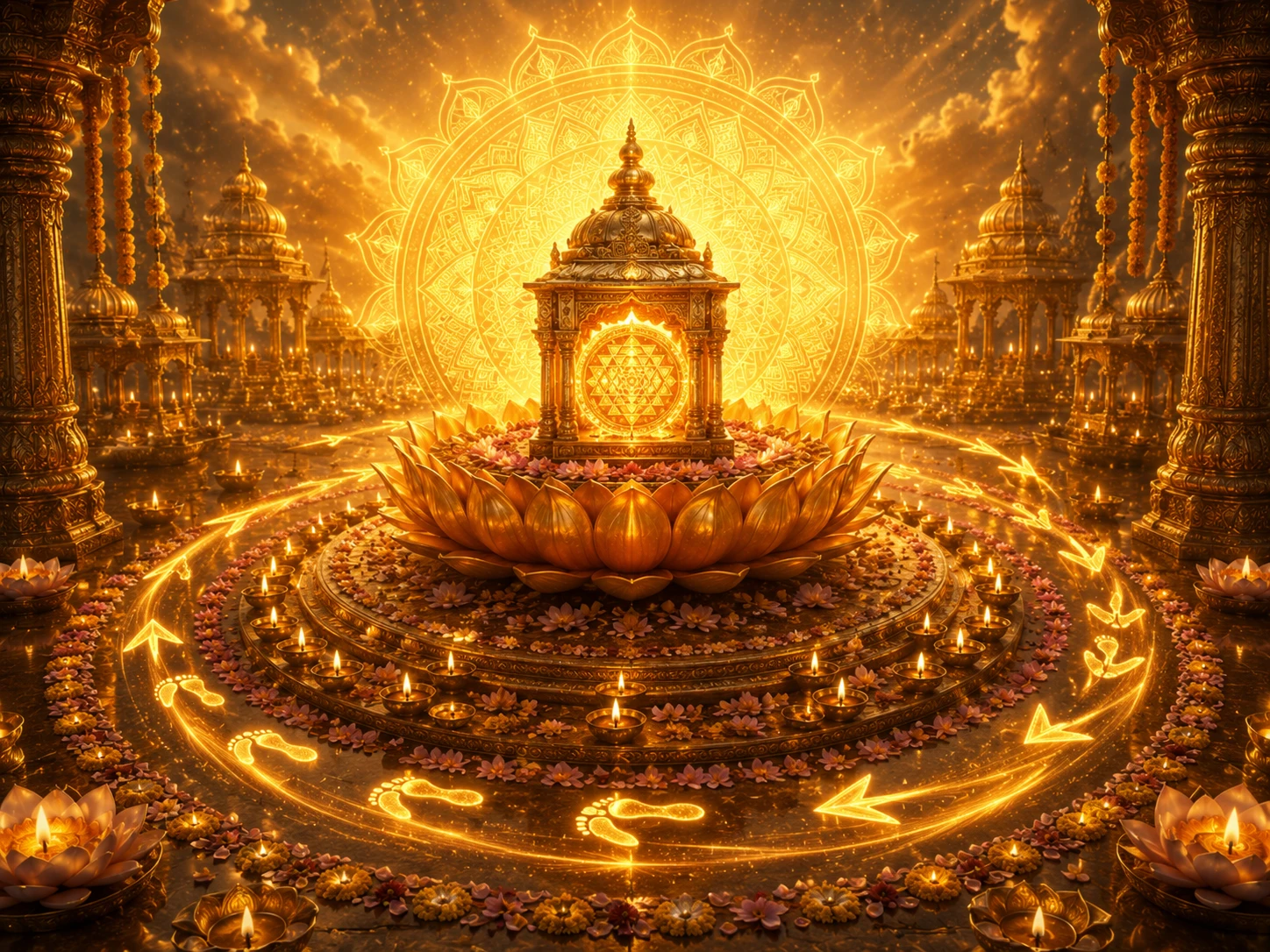
Why the Right Hand and Clockwise -- The Logic of Dakshina
दाहिना हाथ और दक्षिणावर्त -- दक्षिणाचार का तर्क
The Pattern You Have Already Noticed
If you grew up in any Hindu household in India, you have absorbed a series of unstated rules about which hand and which direction. Receive prasadam with the right hand. Offer flowers with the right hand. Eat with the right hand. Give dakshina to the priest with the right hand. Walk around the temple in a clockwise direction. Receive a sacred thread, a wedding ring, a turmeric-tipped envelope at a wedding -- always with the right hand. The rules were never explained, only enforced through subtle disapproval if violated. A child reaching for a sweet with the left hand at Sai Baba's mandir in Shirdi will be quietly redirected by the temple volunteer. A young professional handing a business card with the left hand to a senior at a Diwali corporate event will sense the air shift, even if no one says anything.
This is not arbitrary etiquette. The pattern is the surface of a deep philosophical principle that runs through Hindu thought, ritual, geography, and even weapon iconography. The principle is contained in a single Sanskrit word: dakshina. The word means right, south, skilful, generous, and capable, all at once. It is one of those Sanskrit terms that compresses several English words into one because the underlying culture sees them as facets of the same idea. To understand why the right hand and clockwise direction matter, you have to understand what dakshina actually means and why its opposite, vama or savya, sits at a precise philosophical distance from it.
What follows is not a defence of the convention or a polemic for or against it. The right-hand convention is a tool with a logic. Some readers will find the logic compelling and want to honour it more carefully. Others will conclude that the original logic has aged into something that needs rethinking. Both responses are legitimate. What is not legitimate is treating the convention as random superstition. It is not.
यानि कानि च पापानि जन्मान्तरकृतानि च। तानि सर्वाणि नश्यन्ति प्रदक्षिणपदे पदे॥
yani kani ca papani janma-antara-krtani ca tani sarvani nasyanti pradakshina-pade pade
Whatever sins have been committed across many births -- all of them are destroyed at every step of the pradakshina.
— Pradakshina Mantra (traditional, recited during temple circumambulation; widely cited in Smarta and Vaishnava ritual manuals)
The Word Dakshina and Its Triple Meaning
The Sanskrit root daksh means to grow, increase, become able, become skilful. From this root come three related but distinct words. Daksha is the name of one of the prajapati progenitors in Vedic literature, signifying capable creative power. Dakshatva means skill or competence. Dakshina, the form most relevant here, carries three layered meanings that converge in ritual.
The first meaning is right, as opposed to left. Dakshina hasta means the right hand. The second meaning is south, the cardinal direction. Dakshina disha means the southern direction. The third meaning is offering or gift, particularly the honorarium given to a priest after a ritual. Why these three meanings cluster in a single word is the philosophical heart of the matter. The connection is geographical and orientational. Stand facing east, the direction of the rising sun where every Vedic ritual is supposed to begin. The east is in front of you. The south is on your right. The west is behind you. The north is on your left. In this orientation, right and south are the same direction. This is not a coincidence of vocabulary. It is a built-in solar grid encoded into the language.
The third meaning, dakshina as offering, descends from the same logic. The priest stands on the southern side of the sacrificial fire, on the right hand of the patron facing east. When the patron makes the closing gift, it is given with the right hand toward the south. The word for the gift becomes the word for the direction becomes the word for the hand. All three are facets of one ritual geometry. Modern Hindi has retained this. When a Bangalore startup founder gives a Diwali bonus to her cleaning staff, she still calls it dakshina. The word remembers a fire altar she has never seen and an orientation she has never consciously inhabited. Language is the slowest archaeology of culture.
Right Hand and Left Hand -- Where Each Belongs
| Activity | Right Hand (Dakshina) | Left Hand (Vama) | Reason |
|---|---|---|---|
| Receiving prasadam | Yes -- both hands cupped, right slightly above | No | Sacred substances enter through the auspicious channel |
| Offering flowers / arghya to deity | Yes | No | Outgoing devotion flows through the right |
| Eating | Yes | Used only for assistance | Food enters the body through the right channel; left handles cleansing |
| Giving / receiving gifts in ceremony | Yes | No | Same logic as offering: auspicious giving uses dakshina |
| Wearing the sacred thread (yagnopavita) | Across right shoulder for shubha karya | Across left for ashubha (death rites) | Direction of the thread tracks ritual auspiciousness |
| Pradakshina (circumambulation) | Right shoulder always toward the deity | N/A | Keeps the auspicious side facing the divine |
| Personal hygiene / toilet | Avoided | Used | Practical separation of clean and unclean tasks |
The pattern is a clean separation of channels. Right is for sacred and auspicious flows. Left is for cleansing and the everyday. Both are needed; both are honoured for different roles.
Why Pradakshina Is Always Clockwise
Walk into any major Hindu temple -- the Tirupati Balaji shrine, the Kashi Vishwanath at Varanasi, the Meenakshi Amman temple at Madurai, the Jagannath at Puri, the Akshardham complex at Delhi -- and observe the direction of the moving devotees. Without exception, they walk around the central deity in a clockwise direction, keeping their right shoulder turned toward the sanctum. This is pradakshina, literally moving toward the right. The word itself contains the principle. Pra means forward or toward. Dakshina means right. Pradakshina is the forward-toward-the-right movement. To walk counter-clockwise around a Hindu deity is not just unusual but ritually wrong. In some traditions it is considered actively inauspicious, performed only at funerals or during certain Tantric left-hand practices.
The geometric logic is solar. The sun, viewed from the northern hemisphere where most of India sits, appears to move from east to south to west to north and back to east. Stand at the centre of any temple courtyard. Trace the sun's apparent path through the day. You will trace a clockwise arc as seen from above, with the southern peak being the noon position. To circumambulate clockwise around the deity is to move in solar synchrony, rotating around the sacred centre as the sun rotates around the earth as observed in the northern hemisphere. The body of the worshipper imitates, at room scale, the cosmic geometry the sun draws at planetary scale. This is one of the cleanest examples in Hindu ritual of macrocosm and microcosm rendered in the same gesture.
The second reason is anatomical. The right side of the body in classical Hindu physiology is the pingala channel -- solar, masculine, active, outward-flowing. The left is ida -- lunar, feminine, receptive, inward-flowing. By keeping the right side toward the sanctum during pradakshina, the worshipper directs the active solar channel toward the deity. The deity receives the offering through the worshipper's pingala. The worshipper receives blessing through ida, returning to the body's left. The flow is not arbitrary. It is the same map of nadis that governs pranayama, kundalini sadhana, and the placement of sandhya rituals. A college student in Pune who learns alternate-nostril pranayama at the Iyengar Yoga Institute is, without realising it, training the same nadi distinction that her grandmother is enacting at the Pataleshwar cave temple two kilometres away. Different scales, same principle.
The principle scales upward from temple courtyards to entire pilgrimage geographies. The Mount Kailash parikrama in Tibet, undertaken by tens of thousands of Hindu, Jain, and Bon pilgrims each year, is a fifty-two-kilometre clockwise walk around the mountain at altitudes above 5,000 metres. Pilgrims who walk it counter-clockwise are typically Bon practitioners following their own pre-Buddhist convention. The Govardhan parikrama at Mathura, twenty-three kilometres around a sacred hill associated with Krishna, draws lakhs of pilgrims every year, all moving clockwise. The Narmada parikrama, which traces the entire Narmada river basin in Madhya Pradesh and Gujarat over several months, is the longest sustained pradakshina in the Hindu world -- and it too is performed clockwise, with the river always on the right shoulder. The same rule that governs the three steps a worshipper takes around a household tulsi plant governs the three thousand kilometres a Narmada parikrama takes around an entire watershed. The geometry is fractal. The principle is one.
The conch shell, used in Hindu ritual since the Rig Veda, almost always spirals counter-clockwise when viewed from its open end. This is the standard vamavarti shankha, abundant and used in temples across India. But roughly one in tens of thousands of conches spirals clockwise -- the dakshinavarti shankha. This rare shell is considered extraordinarily auspicious, associated with Lakshmi, and historically valued at lakhs of rupees. The Tirupati temple, Puri Jagannath, and several Lakshmi temples possess specially mounted dakshinavarti shankhas as ritual treasures. Marine biologists confirm that the right-spiral shell is a genuine genetic anomaly in the species Turbinella pyrum. The Hindu valuation of the rare anomaly is a thousand years older than the marine biology that explains its rarity.
The Hygiene Reading and Why It Is Downstream
A common modern Indian explanation for the right-hand convention is hygiene. The left hand is used for personal cleansing in traditional toilet use. Therefore the left hand is reserved for impure tasks, and the right hand is used for eating and ritual. This explanation is not wrong, but it is downstream of the deeper logic, not the source of it. If hygiene were the original reason, every culture in the world that practiced traditional cleansing would have arrived at the same convention. Many did, but others did not. The Sanskrit-language tradition has the convention layered into its grammar, its directional vocabulary, its solar geometry, and its yogic physiology long before any explicit hygienic justification appears in the texts.
What actually seems to have happened is the reverse. The dakshina-vama distinction is older and more fundamental. It came from the solar east-facing orientation of Vedic ritual. The hygienic separation of left and right hands developed within that pre-existing distinction, using it as the natural template for organising clean and unclean activities. This is how mature ritual cultures often work. A symbolic distinction is established for one reason, then it gets used to organise other distinctions that need a clean separation. The auspicious-inauspicious axis was first; the clean-unclean axis got mapped onto it later because the slot was already there.
For a contemporary Indian who finds the hygiene reading sufficient, that is fine. The convention works whether or not you believe the cosmological story behind it. But it is worth knowing that the reasoning is older and richer than the simplest practical explanation suggests. A medical student at AIIMS Delhi can wash both hands meticulously and still observe the convention out of cultural continuity rather than germ theory. A Brahmin priest at Pashupatinath in Kathmandu may not be able to articulate the solar logic, but his body is performing it every time he turns to receive an offering with the right hand from the south side of the fire.
Clockwise vs Counter-Clockwise -- Where Each Belongs
| Ritual Context | Clockwise (Dakshinavarti) | Counter-Clockwise (Vamavarti) | Tradition |
|---|---|---|---|
| Temple pradakshina (mainstream) | Yes, always | No | Pan-Hindu, Smarta, Vaishnava |
| Aarti waving lamp before deity | Clockwise from deity's left | No | Standard puja in all sampradayas |
| Funeral pradakshina (apasavya) | No | Yes, deliberately reversed | Pitru karma, antyeshti rituals |
| Tantric vama-marga sadhana | No (some practices) | Yes, deliberately | Kaula and Vama tantric lineages |
| Sacred thread for shubha karya | Right shoulder, savya | No | Yajurvedic, Smarta tradition |
| Sacred thread for ashubha karya | No | Left shoulder, apasavya | Death rites only |
| Sun salutation (Surya Namaskar) | Sun's apparent path, dakshinavarti | No | Yogic and surya upasana |
The pattern is consistent: dakshinavarti for life, growth, and shubha; vamavarti for the inversion -- death rites, dissolution, and the Tantric paths that deliberately reverse the everyday flow.
Vama-Marga -- When the Left Becomes Sacred
Hindu thought is not symmetrical. Dakshinacara, the right-hand way, is the mainstream path of orthodox temple worship, smriti-bound ritual, and household dharma. But there is also Vamacara, the left-hand way, a parallel current that runs through Tantric Shakta and Kaula traditions. Vamacara does not mean immoral or transgressive in the popular sense it has acquired in modern English. It refers to a deliberately inverted ritual style in which practices forbidden in mainstream worship -- offerings made with the left hand, ingestion of substances normally avoided, antinomian rituals at cremation grounds -- are used as accelerated paths to liberation under strict guru supervision.
The philosophical premise of vamacara is that the same energies the right-hand path channels gradually upward through purity and orthodoxy can be channelled by the left-hand path through controlled engagement with the impure, the taboo, and the inverted. Both paths aim at the same goal. The vamacara practitioner argues that the right-hand path is slow because it never confronts the shadow material directly. The dakshinacara practitioner argues that the left-hand path is dangerous because the shadow material can devour the unprepared. Both critiques have merit. Indian tradition has accommodated both for two thousand years without resolving the tension, because the tension itself is generative.
For a contemporary reader, the relevant point is that even within Hindu thought, the right-clockwise convention is not absolute. It is the default. There exist legitimate paths in which it is deliberately reversed. The fact that vamacara exists as a recognised tradition is itself proof that the dakshinacara convention is not arbitrary -- because if it were, there would be nothing meaningful to invert. You cannot inversion a custom unless the custom carries weight. The asymmetry between the everyday right-hand world and the rare left-hand sadhana is what makes both meaningful. A Tantric sadhaka at the Tarapith shrine in Bengal who deliberately walks counter-clockwise around the deity at midnight is making a meaningful gesture only because the rest of Hindu India walks clockwise during daylight.
The geography of vama-marga in India is concentrated in specific shakti-pithas where the goddess is worshipped in her fierce, transformative aspect. Kamakhya in Assam, Tarapith and Kalighat in Bengal, Hinglaj on the Pakistan-Iran border, and certain Bhairava shrines in Varanasi are the major centres. At Kamakhya during the annual Ambubachi Mela, when the goddess is said to menstruate, the temple itself closes for three days -- the only major Hindu temple that observes this -- and tantric practices that would be considered transgressive elsewhere are performed by recognised lineages. The point is that even the most extreme inversions are bounded -- specific places, specific times, specific lineages, specific guru sanctions. Vama-marg is not anarchy. It is a regulated counter-current within a larger dakshinacara framework, and the framework holds the inversion in safe containment exactly the way the bhupura of a yantra holds its volatile interior geometry.
A popular online claim says clockwise pradakshina aligns with the Coriolis force in the Northern Hemisphere, which causes free-falling water to spiral clockwise. This is partly true and mostly misleading. Coriolis is real but operates at very large scales -- weather systems, ocean currents, hurricanes. At the scale of a temple courtyard, its effect is negligible compared to local turbulence. The viral claim that bathroom drains spiral differently in the Northern and Southern hemispheres is largely a myth. So while clockwise pradakshina does happen to match the apparent solar path in the Northern Hemisphere, the Coriolis-force version of the argument is overclaim. The original logic in Sanskrit texts is solar-orientation, not geophysical. Honest tradition does not need overstated science to defend itself.
Living Dakshinacara in Modern Indian Life
The right-hand convention has survived urbanisation, English-medium education, the rise of nuclear families, and the digital age, mainly because it is woven into too many daily moments to extract cleanly. It survives in tiny, almost invisible, gestures. A daughter visiting her mother's house in Lucknow extends her right hand to receive blessings before leaving. A best man at a Bengaluru wedding hands the ring with the right hand. A junior employee accepting a Diwali bonus envelope in a Delhi office instinctively uses both hands but with the right slightly forward. A delivery executive handing a Zomato package at a Mumbai apartment door, even when in a hurry, reaches with the right hand if the customer is older. None of these people are practicing tantra. They are practicing dakshina at low resolution.
For someone who wants to honour the convention more deliberately, the entry points are simple and require no esoteric knowledge. Receive prasadam with both hands cupped, right slightly above. Give and receive any ceremonial item -- garland, gift, money envelope, ring, sacred thread -- with the right hand or both hands with right forward. When entering a temple, walk the pradakshina clockwise even if signage does not specify it. When greeting an elder with namaskara, place the right palm slightly higher than the left during the joining of palms. When eating a traditional meal at a relative's house, eat with the right hand, even if you have grown up using a fork. None of these gestures requires belief. They are participation in a working grammar.
The deeper invitation, for a contemporary Indian who finds the convention thin, is to read it not as superstition but as an embodied practice of attention. Every time you reach for an object with deliberate awareness of which hand you are using, you slow down. You make the gesture conscious. The right hand convention, at this level, is a daily mindfulness practice disguised as etiquette. Each time you receive prasadam at the Siddhivinayak temple in Mumbai with the correct hand, you are not just following tradition. You are training yourself to act consciously rather than absent-mindedly. The geometry of the gesture and the mindfulness of the gesture are the same thing seen from two angles. The convention turns out, on closer reading, to be a quiet meditation practice that millions of Hindus perform without ever calling it meditation.
This is also why the convention has irritated reformers across centuries. Periyar in twentieth-century Tamil Nadu, Phule in nineteenth-century Maharashtra, and modern liberal commentators have all argued that distinctions of right and left, clean and unclean, dakshina and vama, encode social hierarchies that should be dismantled. The argument is serious and deserves engagement. Some aspects of how the right-hand convention has been deployed historically -- to mark out certain communities as ritually impure, for instance -- do not survive contemporary ethical scrutiny and should be abandoned without nostalgia. But the underlying solar-grammatical logic is older and more philosophically interesting than its worst social applications. A thoughtful contemporary practice keeps the geometry and discards the hierarchy. That is harder than either uncritical retention or wholesale rejection. It is also, arguably, what intelligent tradition has always done.
Pradakshina with Mantra Recitation
Walk three rounds of pradakshina with the traditional mantra: 'Yani kani cha papani janmantara-kritani cha, tani tani vinashyanti pradakshina pade pade.' Let each step carry a syllable, and turn an unconscious convention into conscious sadhana. The Walking With Awareness dharana on Eternal Raga builds the same attention.
Tags
Eternal Raga · शाश्वत राग
Institutional voice — scholarly articles on Sanatan Dharma
Deepen Your Understanding
अपनी समझ और गहरी करें
sacred symbols
Sacred Directions and Dikpalas -- The Eight Guardians of Space
Why does your grandmother insist the kitchen face southeast and the master bedroom southwest? Behind every Vastu rule stands a Dikpala -- a deity assigned to guard one of eight directions of cosmic space. Meet the eight watchmen who turn empty space into sacred geography.
sacred symbols
Yantra Geometry -- The Sacred Mathematics of Form
Triangles, hexagrams, lotus petals, the central dot, the framing square -- every classical Hindu yantra is built from a small grammar of geometric elements. This is the visual language behind Sri Yantra, Shri Chakra, and every temple wall.
tantra mantra yantra
Tantra, Mantra and Yantra -- The Three Pillars of Spiritual Practice
Tantra is the loom, Mantra is the thread, Yantra is the pattern. Together they form the complete technology of spiritual transformation that India gifted to the world -- and they are far more profound than popular culture imagines.
rituals traditions
Pradakshina and Namaskara -- Why Hindus Walk Clockwise and Touch the Ground
You have seen it a thousand times: devotees walking clockwise around a temple, a deity, a sacred tree, or even a person. You have seen people fall flat on the ground -- forehead, chest, knees, palms all touching the earth -- before a deity or an elder. Pradakshina (circumambulation) and Namaskara (prostration) are the two most physically embodied acts of Hindu worship. They are not empty gestures. The clockwise walk mirrors planetary orbits and channels energy through the body's right side. The prostration dissolves ego by making the body a straight line of surrender. Both are technologies of the body that the mind alone cannot replicate.
tantra mantra yantra
Nadis and the Subtle Body
Your body has 72,000 nadis. You will not find them in a surgical dissection. They are channels of prana, the subtle life energy, running through the subtle body that underlies the physical. Three are principal -- Ida running down the left, Pingala down the right, and Sushumna running through the centre of the spine. Every pranayama, every mudra, every mantra practice is shaping the flow of these invisible highways.
vedic sciences
Vastu Shastra -- The Ancient Science of Architecture That India Still Builds By
Before Frank Lloyd Wright talked about buildings harmonising with nature, before Le Corbusier designed Chandigarh, and before LEED green-building certifications existed, Indian architects were writing Sanskrit manuals on how to align a house with sunlight, wind, water, and the earth's magnetic field. Vastu Shastra -- literally 'the science of dwelling' -- is not superstition wrapped in incense. At its core, it is an empirical framework for orienting buildings so that natural light, ventilation, and thermal comfort work in the occupants' favour. The problem is that centuries of misapplication have buried the science under astrology, pseudoscience, and real-estate marketing. This article separates the architecture from the astrology.
The conch shell, used in Hindu ritual since the Rig Veda, almost always spirals counter-clockwise when viewed from its open end. This is the standard vamavarti shankha, abundant and used in temples across India. But roug…
More in Sacred Symbols
Ashtamangala -- The Eight Auspicious Symbols of Hindu Tradition
13 min read
Bindu -- The Point from which Creation Emerges
12 min read
Gau -- Why the Cow Holds the Place She Does in Hindu Life
14 min readThe same translation error that turned '33 Koti' into '33 crore' in Hinduism also happened in Buddhism. The Chinese translation of Buddhist texts rendered 'Sapta Koti Buddha' (7 Supreme Buddhas) as '7 Crore Buddhas.' The…
Deities AvatarsCommunity Reflections
🕉️
Be the first to share your reflection.